
Few beauty instructions have travelled as far as this one. It needs no product, no budget and no explanation, it arrives from a grandmother or a fifteen-second video with equal authority, and it has comfortably outlived every piece of evidence against it.
So rather than argue with it, let us audit it. Below are the five things people actually say about lemon and skin, each checked against what has been published.
Where the advice comes from
Three separate ideas got welded together somewhere along the way.
The first is that lemon is a source of vitamin C, and vitamin C is a real, well-studied skincare ingredient. The second is that lemon is acidic, and acids exfoliate; also true. The third is the oldest: that citrus bleaches things, which anyone who has spilled lemon on a tablecloth believes instinctively.
Each of those is a true statement about lemons. None survives contact with the arithmetic once you ask how much, in what form, and at what cost.
Claim one — “it’s natural, so it’s gentle”
The word people reach for here is allergy: I am not allergic to lemons, so this cannot hurt me. It is the wrong word, and picking the right one changes the whole risk calculation.
What lemon does to skin is phototoxicity. Medscape’s summary of the condition notes that it “can affect anyone, and prior sensitisation or a particular immune status is not required.” Nothing has to recognise anything. The compounds responsible are furanocoumarins, concentrated in the peel and peel oil, and they are inert until UVA light reaches them; at that point they damage skin cells directly. DermNet’s page on the resulting burn, phytophotodermatitis, calls it a direct toxic effect that does not involve the immune system at all.

Two consequences follow that most people get wrong. Window glass does not stop UVA, so an afternoon at a desk beside a window is exposure; “I stayed indoors” is not a defence. And rubbing the cut fruit is considerably worse than using strained juice, because dragging a halved lemon across a cheek delivers peel and peel oil along with the juice.
The timing is the third thing, and it is the reason this remedy survives generation after generation. Redness, if it appears at all, takes 24 to 48 hours and peaks at two to three days. The brown mark that follows the inflammation surfaces over the next one to two weeks. By then the lemon is long forgotten, and what gets blamed is the sun, or age, or hormones.
Claim two — “lemon is loaded with vitamin C”
Loaded for a drink. Not for skin, and the gap can be worked out on the back of an envelope.
USDA figures put one cup (244 g) of fresh lemon juice at 94.4 mg of vitamin C, which is roughly 0.04% by weight. A review in the Journal of Clinical and Aesthetic Dermatology (Al-Niaimi and Chiang, 2017) states that in most cases a product needs a concentration above 8% to be biologically meaningful on skin. That is a shortfall of roughly two hundred times, before anything degrades.
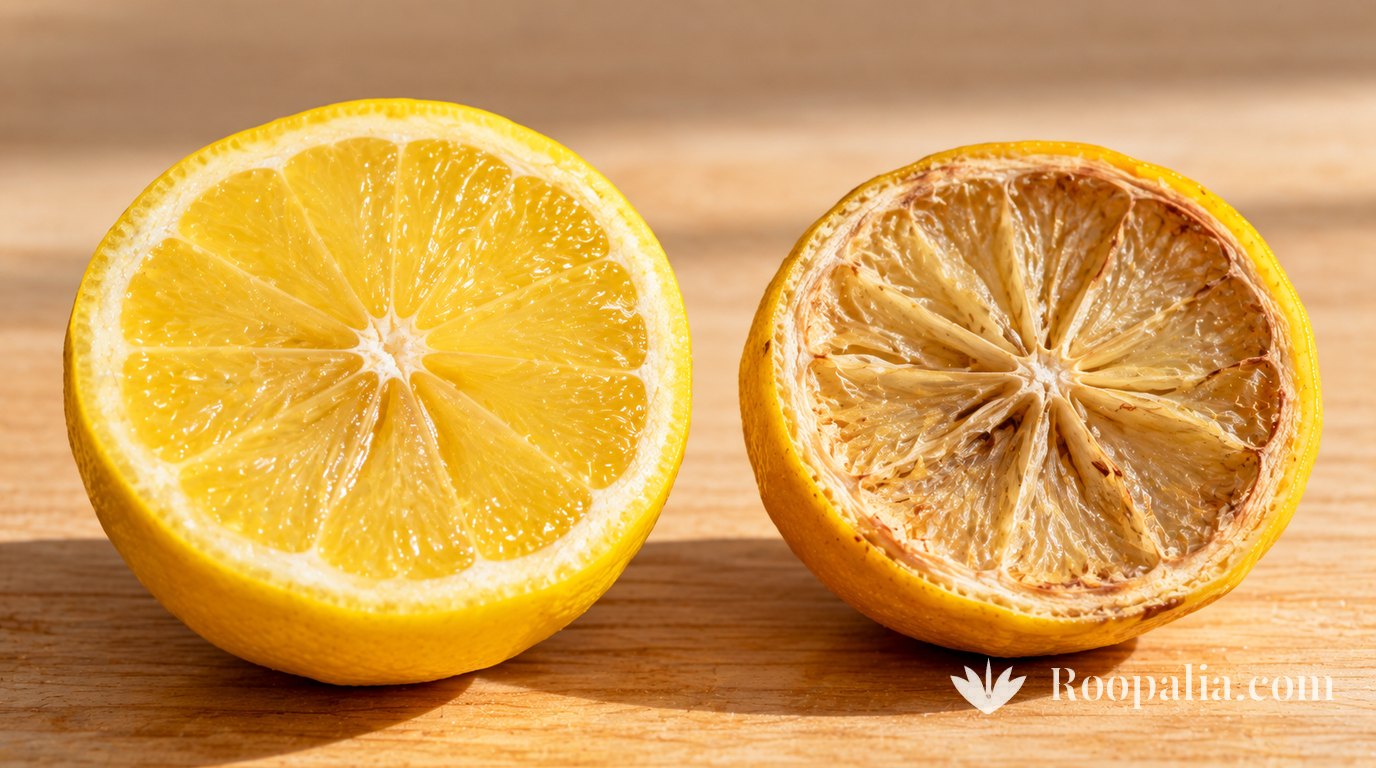
And it does degrade. Ascorbic acid is one of the least stable ingredients in cosmetic chemistry, which is why serums that contain it are sold in opaque bottles, packed with stabilisers, and given an expiry date. A lemon halved on a kitchen counter has none of those advantages.
A footnote for anyone who has read that lemon “has the wrong pH for vitamin C.” That particular criticism is misdirected: serums are formulated acidic on purpose, because ascorbic acid needs a low pH to cross the barrier at all. Lemon happens to land in that range. It is one of the few things about this remedy that is chemically sensible, and it does not rescue anything, because the molecule it is helping across is barely present. The acidity causes trouble elsewhere, for reasons that have nothing to do with vitamin C — claim five.
Claim three — “it lightens dark spots”
Pigmentation is a crowded research field. A long queue of mild agents has been put through trials over the past three decades, and the ones that earned a place keep reappearing in the same guidance — the American Academy of Dermatology’s own advice on fading dark spots in darker skin tones names azelaic acid, glycolic acid, kojic acid, a retinoid and vitamin C, and reviews of the area add niacinamide, arbutin and tranexamic acid to that group.
Lemon is not in that queue. I looked for a study showing that lemon juice or citric acid lightens skin and did not find one, and citric acid turns up in the literature as an exfoliant rather than as a lightening agent.
So the honest summary is not “lemon has been tested and failed.” It is that in a field where a great many mild agents have been trialled, this one has not earned a line in the guidance, despite being the most popular remedy on earth. That is its own kind of answer.
Meanwhile the mechanism running in the other direction is well described: a phototoxic injury in pigment-rich skin leaves post-inflammatory hyperpigmentation, which is darker and more persistent than whatever prompted the remedy. If your concern is dark spots, pigmentation and melasma, lemon belongs on the causes side of that page.
Claim four — “I’ve used it for years and nothing happened”
This is the hardest one to argue with, and the answer is that both halves of the sentence are less solid than they sound.
“Lemon” is not one thing. The 1985 study that identified bergapten and oxypeucedanin as responsible for essentially all of lemon oil’s phototoxic activity (Naganuma et al., Archives of Dermatological Research) measured oils from several growing regions and found those two compounds varying by more than twenty-fold. A fruit from one supplier can be an order of magnitude stronger than a fruit from another, which makes anyone’s personal track record a poor guide to anyone else’s.
“Nothing happened” is doing work too, because the sentence assumes the damage would have announced itself. The same study found oxypeucedanin producing pigmentation with no preceding visible redness at all. That was pigmented animal skin rather than human skin, so it is suggestive rather than settled. But it describes a failure mode worth knowing about: a reaction with no alarm attached to it, which is the only kind a person can repeat for years without ever revising their opinion of it.
Claim five — “it’s just a natural version of a chemical peel”
Half right, and the half that is right is the problem.
The FDA classes citric acid as an alpha hydroxy acid, the same family as glycolic and lactic acid. Lemon is not a gentle natural alternative to a chemical exfoliant; it is one, applied at a strength nobody has measured.
What separates a formulated AHA from a lemon is that somebody controlled two numbers. The FDA’s guidance for leave-on cosmetics is 10% or less at pH 3.5 or above, with sun protection. Lemon juice sits at pH 2.00 to 2.60 on the agency’s own food pH data — well under that floor, and well under skin’s own surface pH of 4.1 to 5.8 (a 2025 review in the Journal of Investigative Dermatology). Because pH is logarithmic, each whole point is a tenfold difference, which is what “too acidic” actually amounts to here.
| Product | pH | Concentration |
|---|---|---|
| Formulated AHA, within FDA guidance | 3.5 or above | 10% or less, stated on the label |
| Lemon juice | 2.00–2.60 | Unknown, varies by fruit |
There is a second cost, described on that same FDA page. Agency-sponsored studies found that four weeks of AHA use left volunteers with an 18% increase in sensitivity to UV-induced redness and roughly double the UV-related cell damage. Lemon therefore does something no sensible routine does: it raises your sensitivity to light while simultaneously depositing compounds that are only dangerous in light.
The part that stops being cosmetic

Most of the above concerns a mark appearing. This is about whether it leaves, and it is the reason I would not file this under harmless.
The optimistic case is genuinely fine. Pigment that stays in the epidermis fades without treatment, and the American Academy of Dermatology puts a spot a few shades darker than your skin at six to twelve months to clear on its own. Slow, but it goes.
The other case does not. If the injury reaches the dermis, pigment is deposited below the layer that turns over, and DermNet describes that outcome as “usually permanent” — adding, pointedly, that lasers and peels “won’t benefit dermal hyperpigmentation.” The usual mental fallback of “I’ll get it treated later” is not available.
Nothing in the moment tells you which of the two you are producing. That is an unusual risk to accept from a home remedy, most of which fail by simply doing nothing. Depth of skin tone shifts the odds rather than the mechanism: DermNet notes this pigmentation “may be more intense in skin of colour,” which means the calculation in most English-language skincare writing is not the one that applies to you.
Does Ayurveda recommend lemon for the face?

This question is usually answered badly in both directions. One camp produces a verse forbidding lemon, which does not exist. The other treats “Ayurvedic” as a synonym for anything from a kitchen, which is how besan, curd and lemon ended up filed under classical tradition together.
The texts are more specific than either camp. Charaka Samhita does discuss lemon — at Sutrasthana 27/167, in the harita varga, the group covering relishes and condiments. It is grouped with what you eat alongside a meal, and every property listed for it concerns digestion or the mouth.
For the face, the relevant instruction is about how a paste should be made at all. Ashtanga Hridaya, Sutrasthana 22/14:
उष्णो वातकफे शस्तः शेषेष्वत्यर्थशीतलः Ashtanga Hridaya · Sutrasthana 22/14
Warm for vata and kapha; for everything else, intensely cooling. Set that beside the properties the same tradition assigns to lemon — sour in taste, heating in potency, and tikshna, sharp — and a lemon face pack is not a borderline case. It is the specification inverted on every axis. Joining those two up is a reading rather than a citation; the verse and the properties are both the texts’ own.
The strongest signal, though, is simply the shopping list. The six seasonal face pastes at Ashtanga Hridaya 22/19–21 are built from sandalwood, vetiver, liquorice, padmaka, lotus and barley: powders, roots, barks and flowers, with no fruit acid anywhere. And 22/17, a few lines earlier, tells you what not to do while wearing one, ending with atapa — direct sunlight. If you want that chain set out verse by verse, along with the rule about removing a paste before it dries, the Hindi companion piece does it properly — नींबू चेहरे पर लगाने के नुकसान. The classical oil-based preparations, such as kumkumadi tailam, are night applications, deliberately so.
If you have already used it
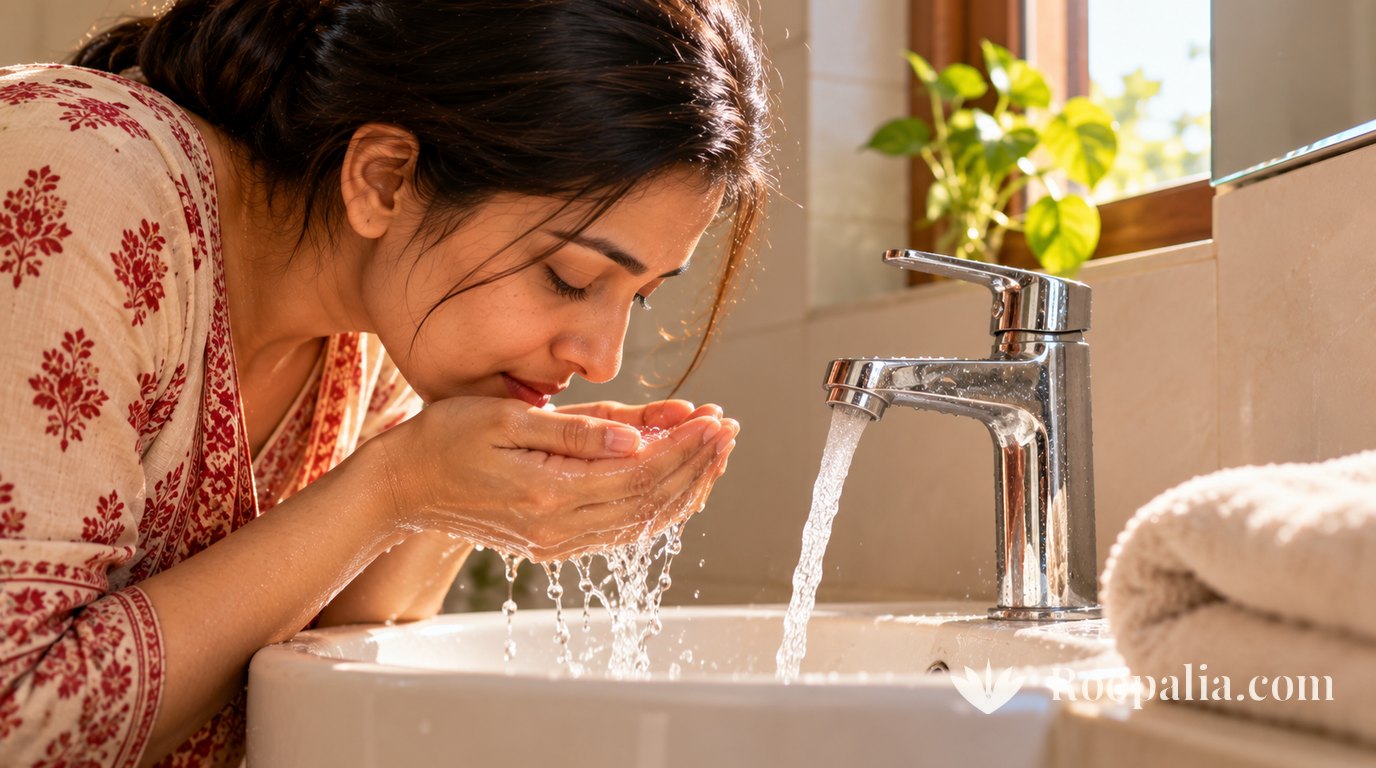
Assume nothing has gone wrong, because usually nothing has. Then:
- Rinse it off, sooner rather than later — Poison Control’s guidance is that washing with water within the first hour or two reduces absorption.
- Keep out of daylight for two to three days, windows included. This is the step people skip and it is the one that decides the outcome.
- If it stings, a cool compress. Adding a second remedy on top of the first is how a mild reaction becomes a memorable one.
- If it has blistered, treat it as a chemical burn and follow the NHS burns guidance — cool running water for 20 minutes, blisters left alone, and nothing applied to the burn.

Same-day assessment is warranted for blistering, for anything that got into an eye, and for fever, chills, dizziness or confusion. The NHS threshold for urgent attention is lower here than people assume — a burn on the face clears it on its own, and so does a burn caused by a chemical.
Infection is the later worry, and the signs are heat, swelling and pain. There is an NHS note here worth carrying well beyond this article: the affected area “is usually red, but this may be less obvious on brown or black skin.” Much first-aid advice was written as though redness were universally visible, and it is not. Pigmentation still sitting there after several months belongs with a dermatologist rather than with another remedy.
What the evidence supports instead
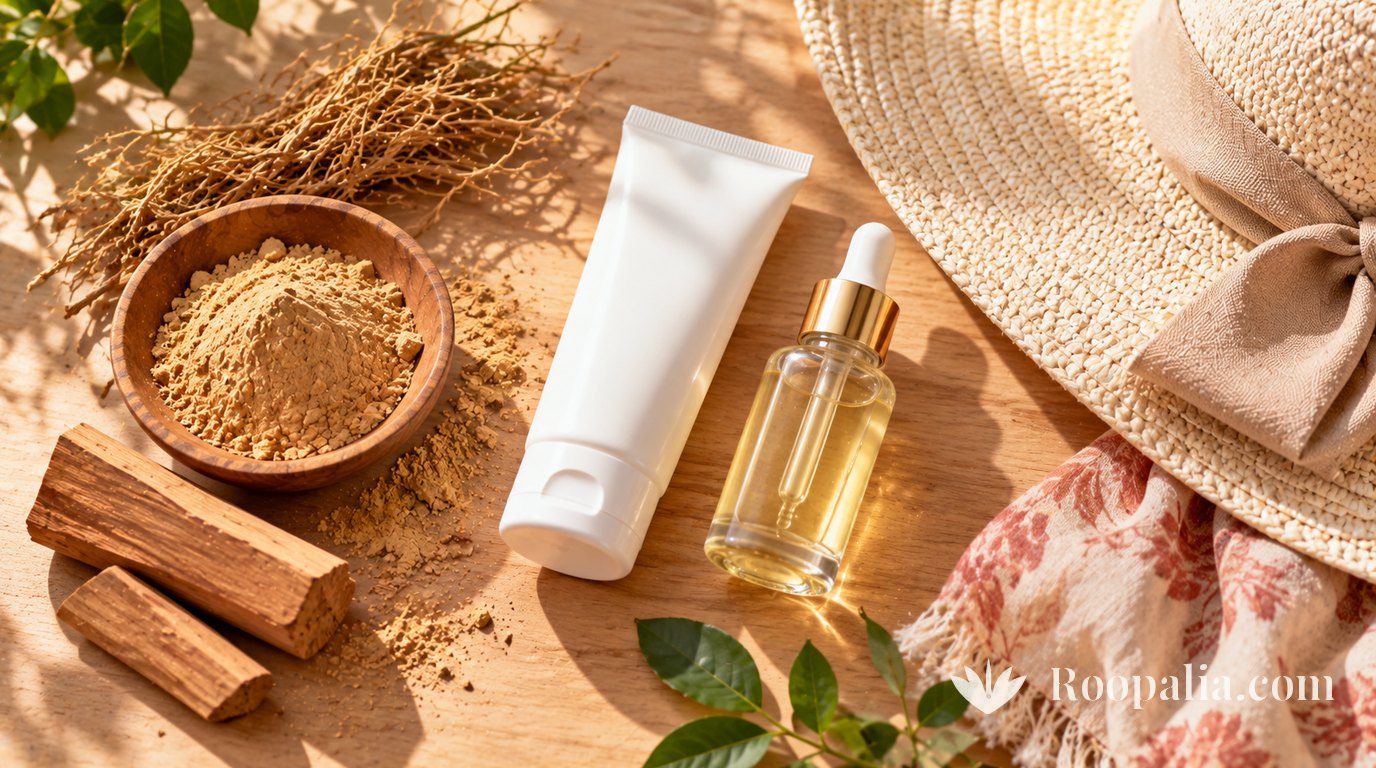
Ordered by how much is actually known about each, rather than by how active it feels.
Niacinamide has the cleanest single result behind it. In the British Journal of Dermatology (Hakozaki, 2002), 5% niacinamide reduced pigmentation and improved skin appearance within four weeks. It is also unusually well tolerated, which matters if the skin in question has recently been burned.
Then the rest of the AAD’s own list for fading dark spots: azelaic acid, kojic acid, a retinoid, and formulated vitamin C at 10–20% — the concentration lemon misses by a factor of two hundred. If exfoliation was the goal, a formulated glycolic or lactic acid at 10% or less and pH 3.5 or above stays inside the envelope claim five described.
None of it works without the boring part. Treating pigmentation while leaving the light source in place is emptying a bath with the tap running. Broad-spectrum SPF 30+, and for deeper skin tones a tinted sunscreen containing iron oxides, because those also screen visible light — which drives pigmentation in melanin-rich skin and which most sunscreen advice never mentions.
And a note on the obvious substitutions, since “not lemon” is usually taken to mean “a different thing from the fridge.” Lime, bergamot and bitter orange contain the same class of furanocoumarins and several carry more. Vinegar is acetic acid with no measured concentration. The failure here is not the specific fruit; it is applying an acid of unknown strength and then going outside.
If you remember one line from all of this, make it the AAD’s: “If a product burns or stings when you apply it, stop using it.” It is a rule that needs no chemistry to apply, and it rules out lemon on the first use.
This article has been prepared for educational purposes. The information in it has been drawn from a range of sources — classical Ayurvedic texts, published medical research, regulators and health institutions — which were studied and compiled into this account. Every source is listed at the end. Where a claim has no evidence behind it, that is said plainly. This is not medical advice.
Frequently asked questions
How bad is it really, if I have already been doing this for years?
Does lemon juice lighten skin or fade dark spots?
Isn't lemon just a natural version of a glycolic acid peel?
Is diluted lemon juice safe — in a mask, or used only at night?
Is the stinging a sign that it's working?
If I stop, how long until the mark goes?
Does Ayurveda recommend lemon for the face?
Sources
- DermNet — Phytophotodermatitis
- DermNet — Post-inflammatory hyperpigmentation
- Medscape — Phytophotodermatitis
- Naganuma M, Hirose S, Nakayama Y, et al. A study of the phototoxicity of lemon oil. Arch Dermatol Res. 1985 — PubMed 4096528
- Poison Control — Lime juice and sun can cause skin rashes
- FDA — Alpha Hydroxy Acids
- FDA/CFSAN, Approximate pH of Foods and Food Products, 2007
- Brooks SG, et al. The Skin Acid Mantle: An Update on Skin pH. J Invest Dermatol. 2025;145(3):509–521 — ScienceDirect
- USDA — Vitamin C content per measure
- Al-Niaimi F, Chiang NYZ. Topical Vitamin C and the Skin. J Clin Aesthet Dermatol. 2017;10(7):14–17 — JCAD
- Hakozaki T, et al. The effect of niacinamide on reducing cutaneous pigmentation. Br J Dermatol. 2002;147(1):20–31 — Oxford Academic
- AAD — How to fade dark spots in darker skin tones
- NHS — Burns and scalds
- NHS — Cellulitis
- Charaka Samhita, Sutrasthana 27/167 — jambira, in the harita varga
- Ashtanga Hridaya, Sutrasthana 22/14 — how a mukhalepa is to be prepared
- Ashtanga Hridaya, Sutrasthana 22/17 — what to avoid while wearing a face paste, including atapa
- Ashtanga Hridaya, Sutrasthana 22/19–21 — the six seasonal face pastes
This article is for information only and is not medical advice. For your own skin, any medication, or an existing condition, consult a dermatologist. No brand or product is recommended anywhere in this article, and it contains no affiliate links.