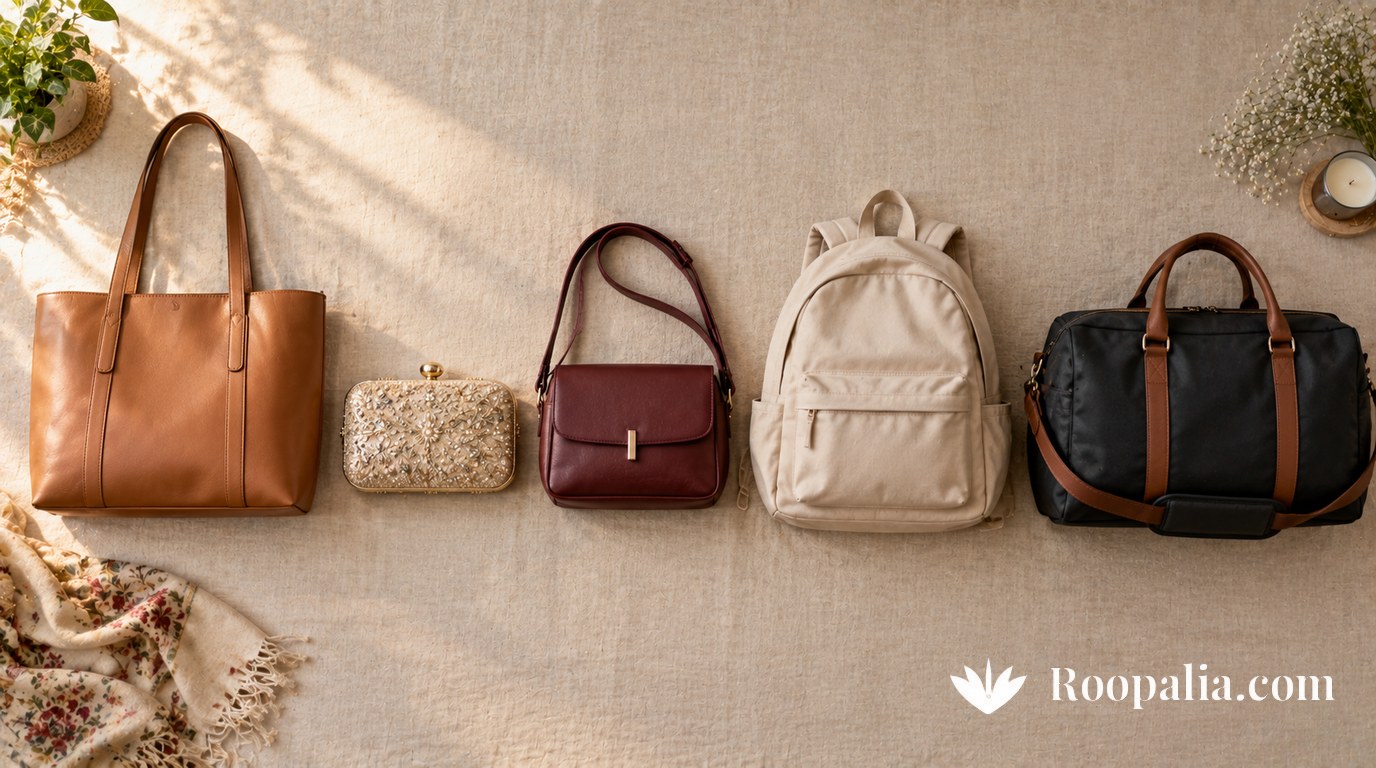
Start with a question. How many bags are in your wardrobe right now, and how many of them did you actually use last month?
In most homes the answer is the same: six or seven owned, two in rotation. The other five are not bad bags. They were simply never built for the job you do every day — and a bag doing the wrong job always feels slightly wrong, without you being able to say why.
So the useful question is not "which handbag should I buy". It is which bag does which job — and that has a much clearer answer.
The short answer
If you read nothing else, read this:
| Occasion | Bag | Why |
|---|---|---|
| Office | Structured tote | Holds a laptop and files, and keeps its shape when loaded |
| Wedding, party | Clutch or potli | The outfit is already doing the work; the bag should be small |
| College | Backpack + small sling | Book weight lands on two shoulders instead of one |
| Everyday errands | Crossbody | Both hands stay free |
| Travel | Duffel + a small zipped crossbody | Luggage in one place, essentials on your body |
That table does half the work. The other half is knowing what each bag was designed to do — which is where we start.
The 7 types of bags, and what each one is for
Shops use these names loosely and often interchangeably, which is why the same bag can be sold to you as three different things. Here are the seven shapes that actually matter, and the job each was built for.
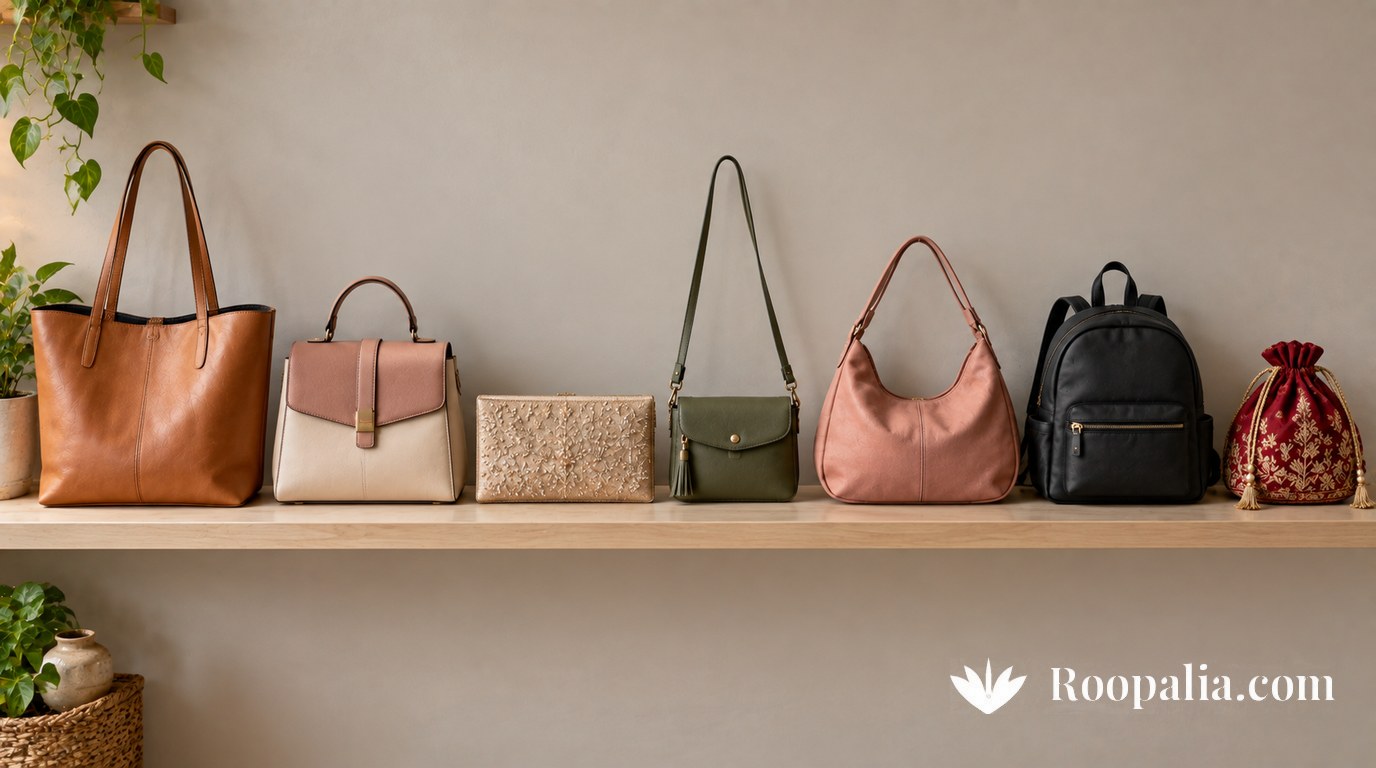
- Tote — open at the top, two long handles, roughly rectangular. Carries the most. Built for the daily haul.
- Satchel — a flap over the top and a buckle at the front, structured enough to stand on its own. Built for order: you can find things in it.
- Clutch — small, flat, no handle or a very fine chain. Held in the hand, which is where the name comes from. Built for an evening, not a day.
- Sling / crossbody — a long strap worn across the body. The only difference between the two is how you wear them: a sling can hang off one shoulder, a crossbody always goes corner to corner. Built to keep your hands free.
- Hobo — soft, crescent-shaped, slouching in the middle. Built for comfort; it moulds to the body and carries a surprising amount.
- Backpack — two straps, two shoulders. The only shape that splits weight evenly. Built for load.
- Potli / batua — a fabric pouch gathered at the top with a drawstring. India's oldest bag, and the one with an actual verse behind it — more on that below.
Bucket bags, baguettes, duffels and wristlets all exist too, but each is a variation on one of these seven rather than a separate idea.
🎯 How many of the seven do you need?
Three. One structured bag for work, one small crossbody for everyday, one clutch or potli for occasions. Buy a fourth only when a job turns up that those three genuinely cannot do. There is a whole section on this further down, because it is the part most guides quietly avoid.
For the office

One feature matters more than colour, brand or price, and almost nobody checks it in the shop: whether the base is flat.
A flat-based bag stands upright on a desk, stays put while you dig through it, and keeps a laptop vertical instead of letting it slide into a corner. A soft-based bag collapses the moment it is loaded, and after three months the laptop has worn a permanent bulge into one side.
After that, three things:
- Size. For a 13-inch laptop you want at least 14 inches of internal width. It will fit at 13.5 — it just won't come out easily, every single day.
- Strap drop. Long enough to clear your shoulder and sit at the elbow. A short strap digs in once the bag is full, and an office bag is always full.
- Colour. Tan, dark brown or black. All three go with everything and all three hide wear.
We have reviewed five office bags in detail in a separate piece, so this section stays short — see the best office bags for women if you want the specifics.
Now to the occasion where every one of these rules is reversed.
For weddings, parties and festivals
At the office the bag does the work. At a wedding the bag only has to sit well in your hand and not fall. Here the most common mistake is carrying something too big — a full-size handbag against a heavy lehenga or a silk saree flattens the whole outfit.
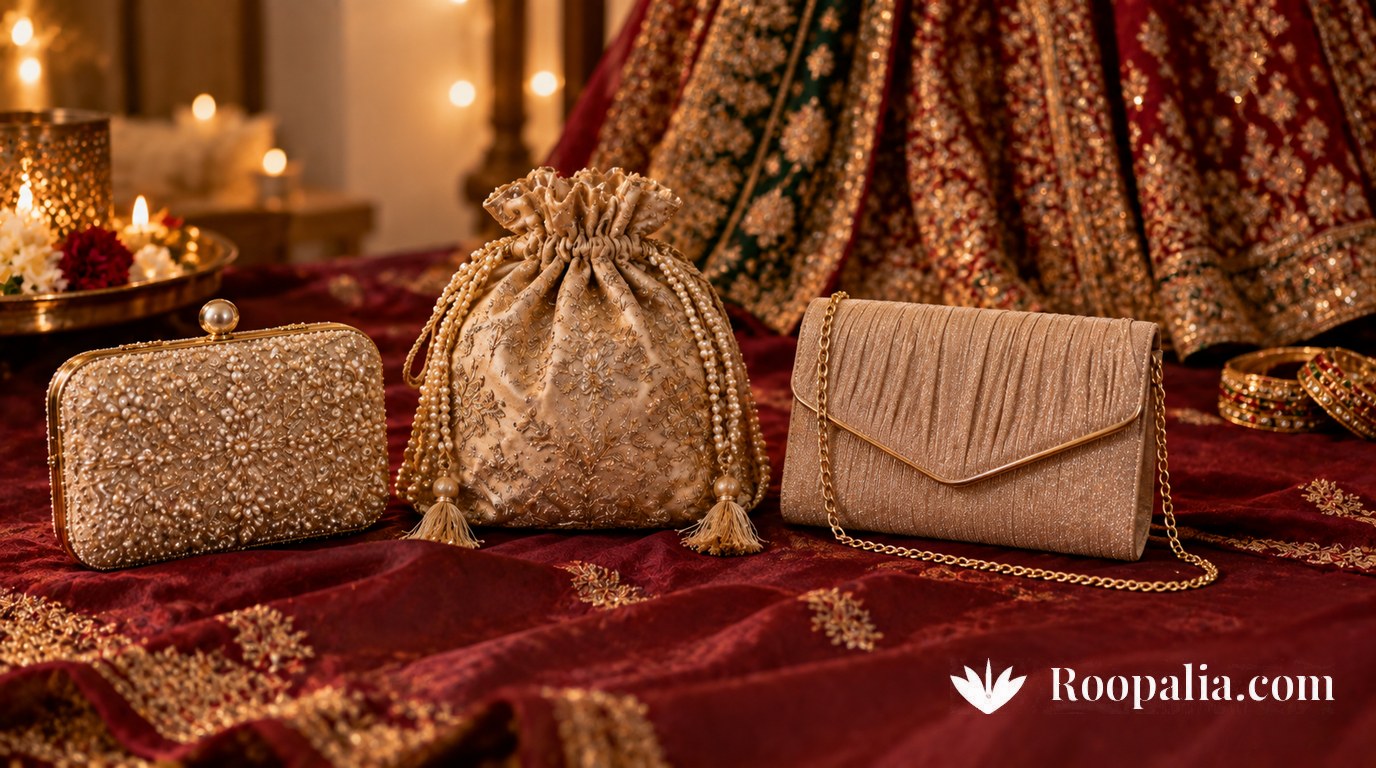
- Box clutch — rigid, clasp on top, the most formal of the three. Nothing inside gets crushed; equally, nothing much fits beyond a phone.
- Potli — soft fabric gathered with a drawstring. Sits most naturally against heavy zari work and Banarasi silk, because it comes out of the same tradition.
- Chain-strap envelope bag — flat, with a fine chain. The most practical of the three, because the chain goes over a shoulder and gives you both hands back.
For a full day of functions — mehndi, haldi, the ceremony itself — the third one wins every time. The other two have to be put down somewhere, and at an Indian wedding, anything put down is gone for the next two hours.
🪔 The potli is the oldest bag in the book — and there is a verse for it.
yācitvā caturo muṣṭīn viprān pṛthuka-taṇḍulān |
caila-khaṇḍena tān baddhvā bhartre prādād upāyanam ||
Translation — Having begged four fistfuls of flattened rice from the neighbouring brahmins, she tied them in a torn piece of cloth and gave it to her husband as a gift for Krishna. — Bhagavata Purana, Canto 10, Chapter 80, Verse 14
This is the Sudama story. Caila-khaṇḍena tān baddhvā — tied in a scrap of cloth. That is the potli in its simplest form, and it is still exactly that today: fabric, contents, a knot at the top.
Two honest footnotes: the verse does not use the word potli — it says caila-khaṇḍa, a piece of cloth — and this chapter never actually names the brahmin Sudama. That name comes from later tradition.
While we are here, one claim that circulates widely is worth correcting: that Arjuna hid his weapons in a potli. In the Virata Parva of the Mahabharata the weapons are bound high in a shami tree and wrapped to look like a corpse so that nobody would go near them. Good story — no potli in it.
For college and everyday
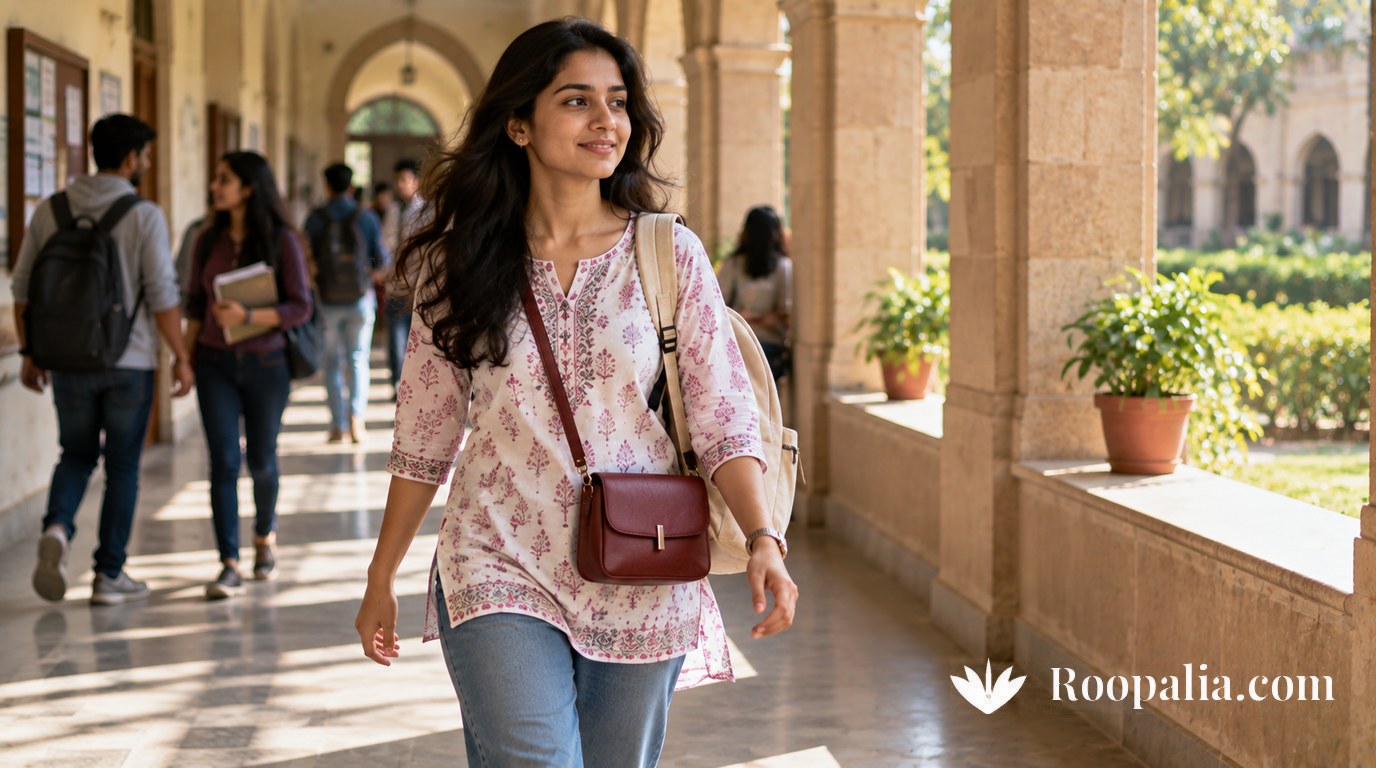
The standard college mistake is putting three or four textbooks into a single-shoulder tote. That is comfortably over two kilos hanging off one side of the body for six hours. A backpack is better for that one reason — not because it looks a certain way.
Pair it with a small crossbody holding phone, cards and keys, so that a trip to the canteen doesn't mean carrying the entire backpack around.
For everyday errands — groceries, the bank, a school pickup, the chemist — the answer is a crossbody, and again the reason is physical rather than stylistic. On a scooter, in a crowd, or already carrying something, you need both hands. A bag worn corner to corner can also be swung round to the front, which is the simplest security habit there is.
💡 One test before you buy an everyday bag
Put your phone inside, then take it out again using one hand only. Any bag that fails this is not an everyday bag, however good it looks on the shelf — you are going to do that exact movement twenty times a day.
For travel
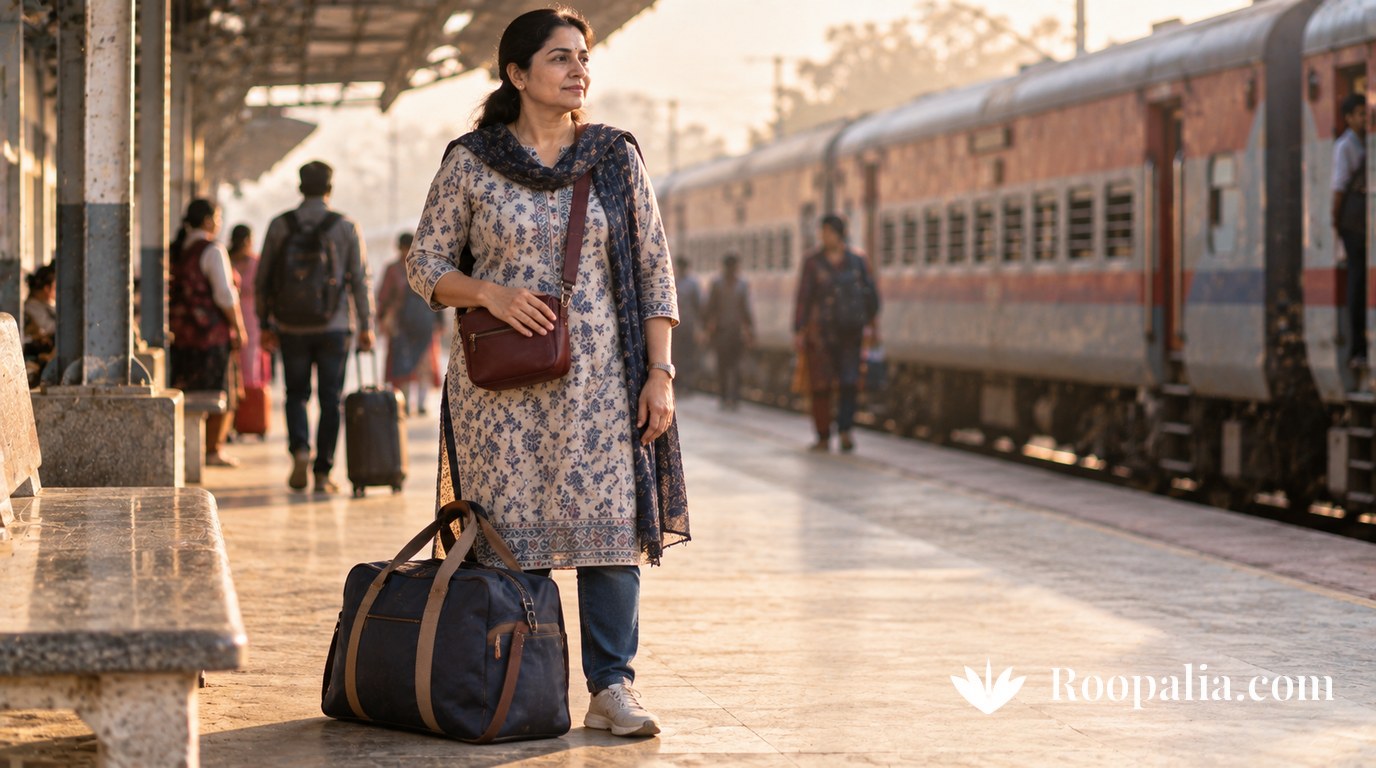
There is one rule for travel and it covers almost everything: luggage in one bag, essentials on your body.
The big bag — duffel or trolley — takes the clothes. A small zipped crossbody takes tickets, money, phone, medication and ID. That small bag never goes on the floor, never goes into the overhead rack, and stays on your body even while dozing on a train.
- Choose a wide strap for the small bag. A thin one cuts into the shoulder after a few hours, and travel is measured in hours.
- In a crowd, swing it to the front. A bag hanging behind your shoulder is the easiest target there is.
- Pack a folded cotton tote at the bottom of the duffel — for wet clothes, shoes, or anything bought on the way. It costs nothing and weighs nothing.
So much for occasions. Now the part that actually causes the most hesitation in front of a mirror.
Matching the bag to the outfit — and choosing a colour
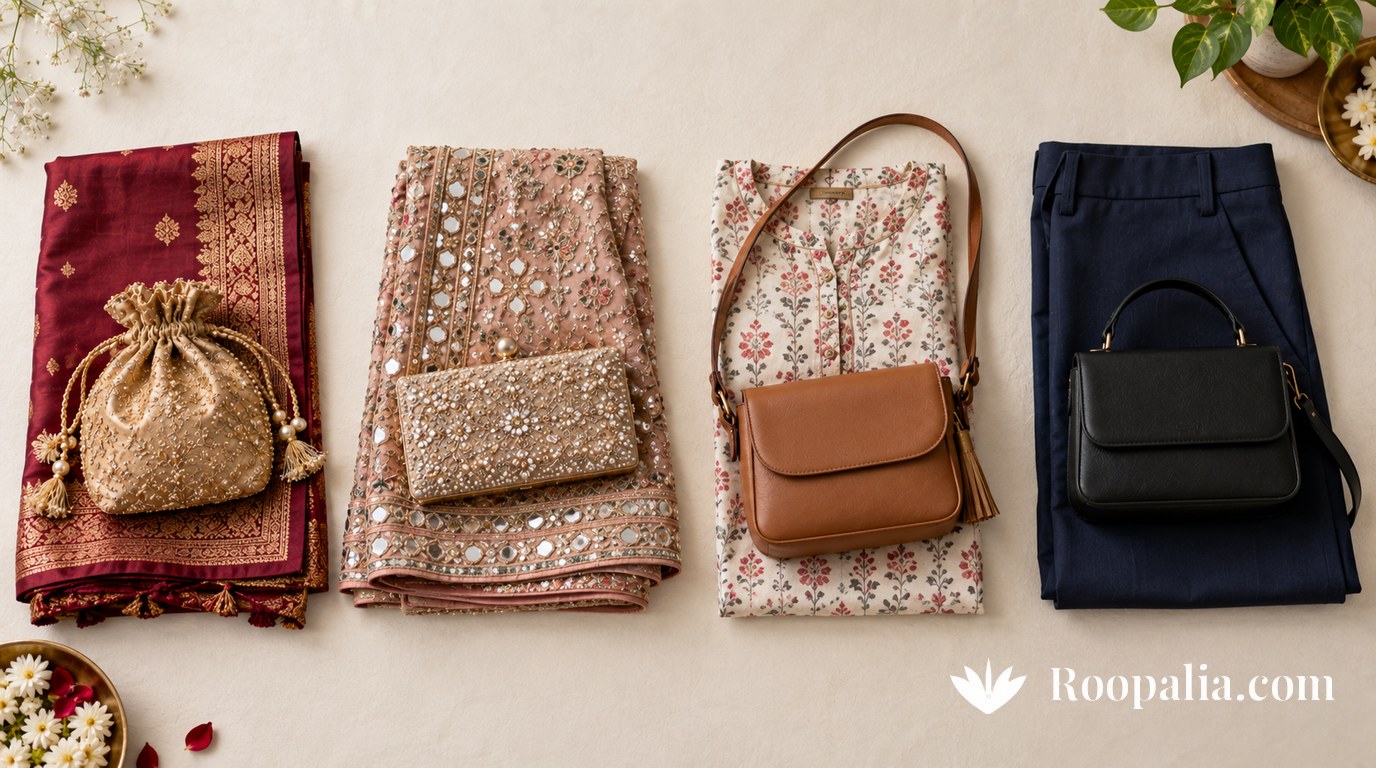
There is a piece of old advice worth dropping: "match the bag to the saree." Matching the main colour exactly makes an outfit look flat, and it forces you to own a different bag for every saree.
Match the bag to the border or the motif instead, not the body of the fabric. A maroon saree with a gold border takes a gold potli. A green saree with red buti takes a maroon clutch. The colours then speak to each other rather than repeat.
- Saree — potli or a small clutch. A long strap catches on the pallu and you will spend the evening rearranging it.
- Lehenga — clutch, and a small one. There is already a great deal happening.
- Salwar suit — a medium satchel or a light tote. Watch where the strap sits under the dupatta.
- Kurti and jeans — crossbody. This is the pairing that gets worn most often, so it is worth buying well.
- Western — a small structured bag or a plain tote, in a single colour.
On colour: if one bag has to work with most of your wardrobe, buy tan. It sits well with both Indian and western clothing, lifts dark colours and holds its own against light ones. Black is the second choice — always safe in formal settings, but heavy against light summer fabrics.
One more thing worth knowing. The classical list of solah shringar, the sixteen adornments, contains no bag at all. In this tradition the bag was never an ornament; it arrived as a necessity. Which is oddly freeing — choose it like a tool rather than like jewellery, and it tends to look better anyway.
Bag size for your height
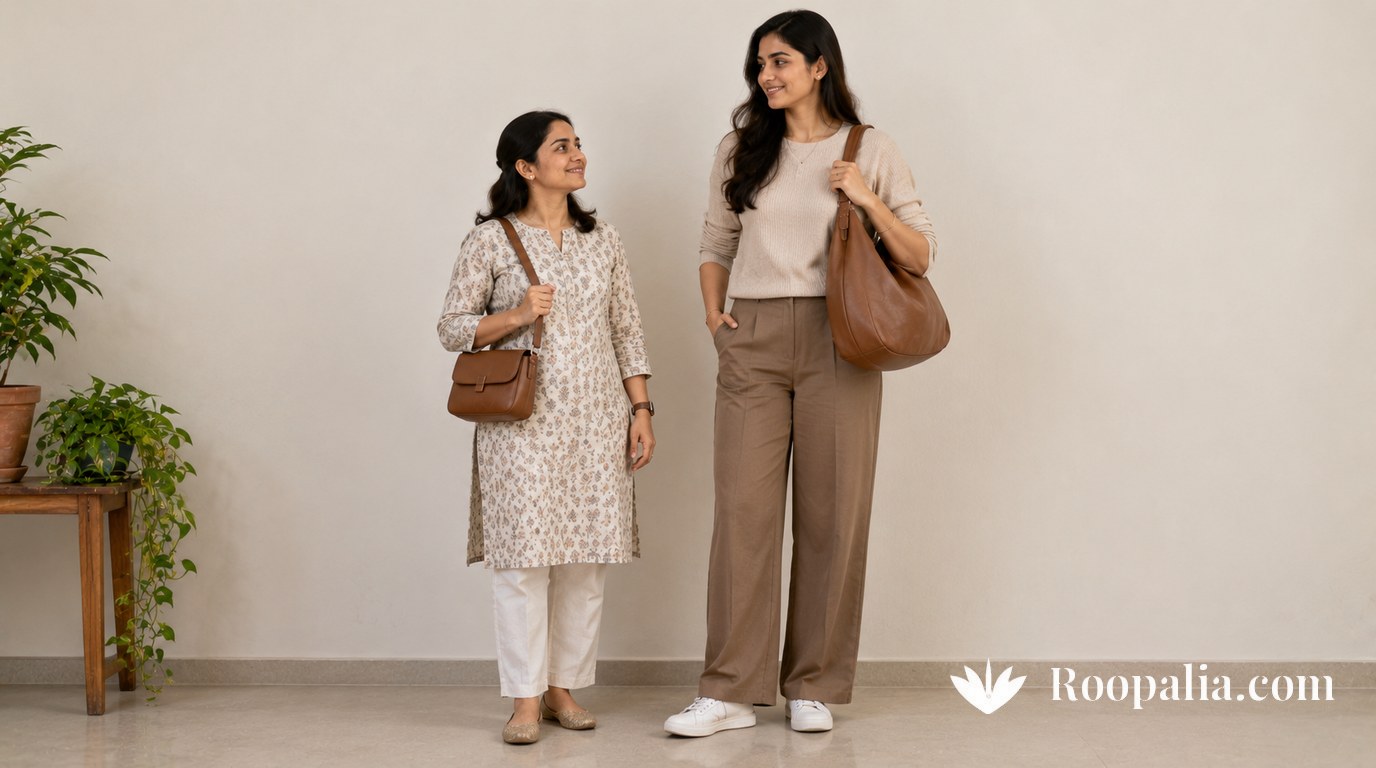
This is the part no shop assistant mentions, and it explains why an expensive bag can still look wrong. A bag is read in proportion to the body carrying it, never on its own. The bag that looked elegant on the display stand may simply be out of scale on your shoulder — nothing wrong with the bag.
| Height | What works | What fights you |
|---|---|---|
| Under 5'2" | Small to medium, structured; strap set so the bag sits at the waist | A large slouchy hobo that hangs toward the knee |
| 5'2" to 5'6" | Almost any size works | A very small clutch as an everyday bag |
| Over 5'6" | Medium to large; hobos and big totes look best here | A tiny bag that reads as palm-sized |
The shop test is easier than the table. Put the bag on and look in the mirror from a distance, not up close. If the bottom edge falls well below your waist, shorten the strap or try the next size down.
And treat all of this as proportion, not law. If a bag feels right when you wear it, it is right.
How many handbags do you actually need?
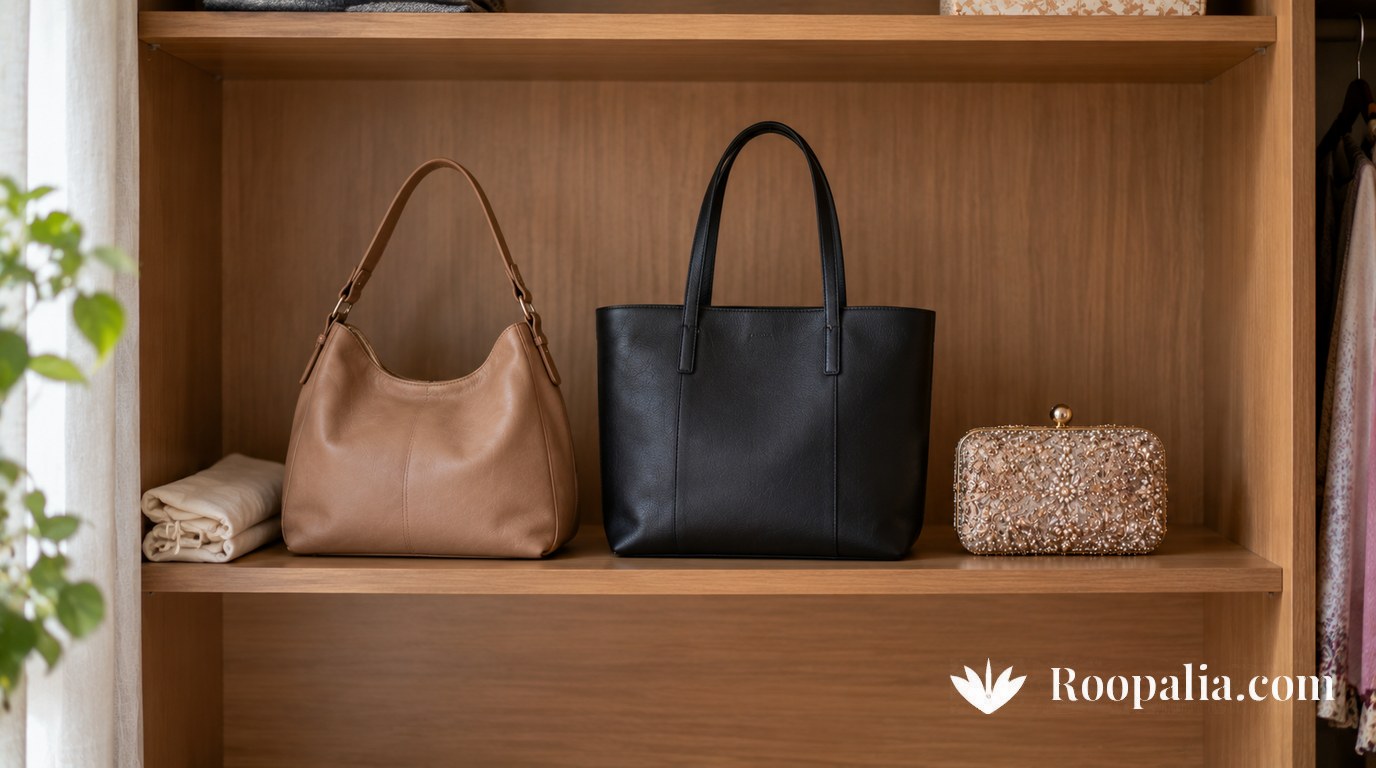
Shops have no reason to answer this one, so here it is plainly.
Three. For most women, three bags cover an entire year:
- One structured larger bag — work, appointments, full days out
- One small crossbody — errands, markets, hands-free days
- One clutch or potli — weddings, festivals, invitations
Add a fourth only when a genuine gap appears: you start travelling monthly, or college begins, or a job changes what you carry.
There is a practical argument here, not just a tidy one. Three bags means you can spend a little more on each and actually maintain them. Seven cheap bags usually means five sitting in a cupboard growing mould through a monsoon and then being thrown out. That is not the cheaper option.
🧹 A one-question wardrobe audit
Pick up each bag and ask: how many times did I use this in the last twelve months? If the answer is none and it carries no sentimental weight, pass it on to someone who will use it. Your remaining bags will keep better for the space.
Care — monsoon, mould and keeping the shape
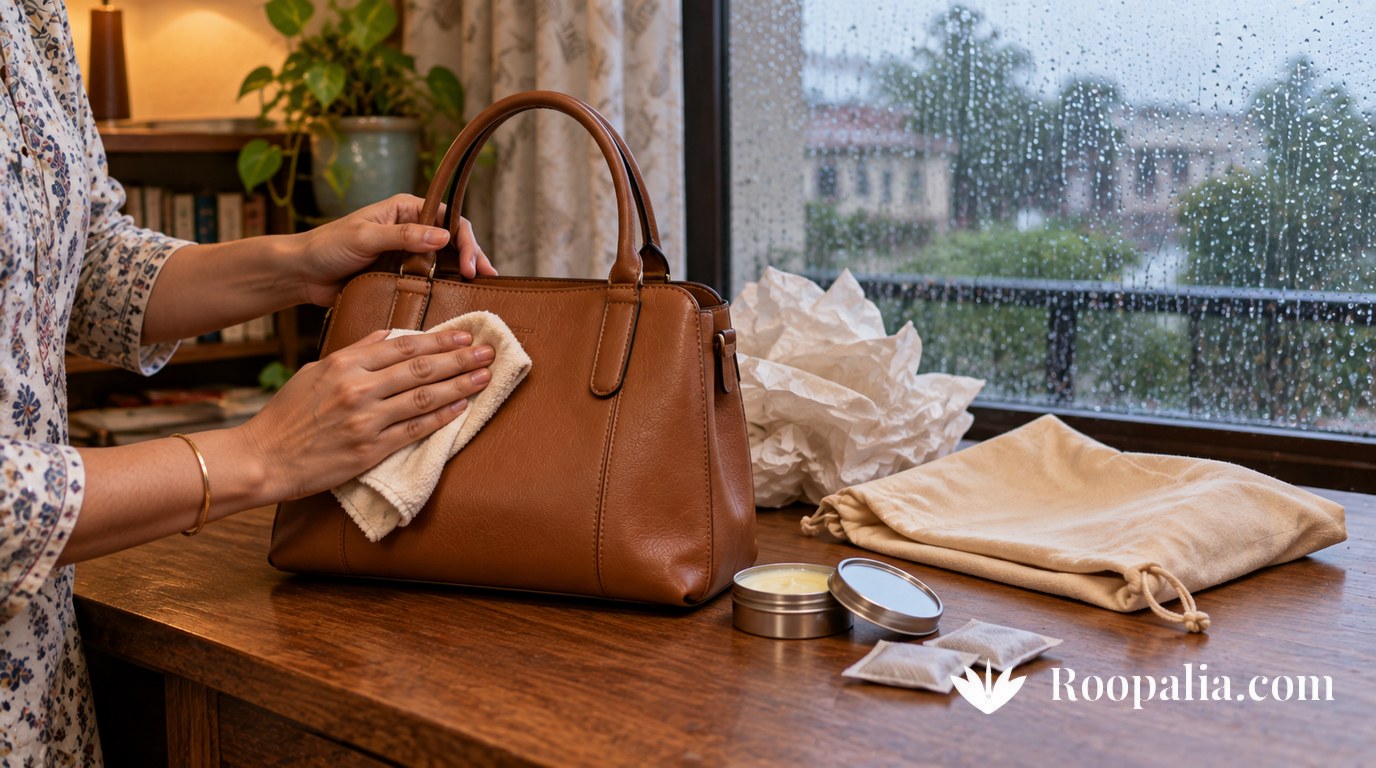
In an Indian climate bags fail for three reasons — damp, direct sun, and bad storage. All three are easy to avoid.
- If it gets soaked — blot with a dry cloth first, then dry in the shade. A fan is fine. Direct sun and a hair dryer are not: heat shrinks leather and it cracks along the fold lines.
- Against mould — never store a bag in a plastic bag; it seals the moisture in. Use a cotton dust bag and drop in a couple of silica gel sachets, the kind that come in shoe boxes and medicine packs.
- To hold the shape — stuff the bag with crumpled paper or an old dupatta. An empty bag collapses at the middle within a few months and never quite recovers.
- Storage — upright, not stacked on top of each other. Through the monsoon, open the wardrobe once a week and let the air move.
- Leather — a little conditioner every two or three months, applied with a soft cloth. Test on a hidden patch first.
- Zari and mirror-work potlis — never washed. Brush dust off dry, and store them separately so the threadwork does not snag on anything.
Real vs fake leather — four quick tests
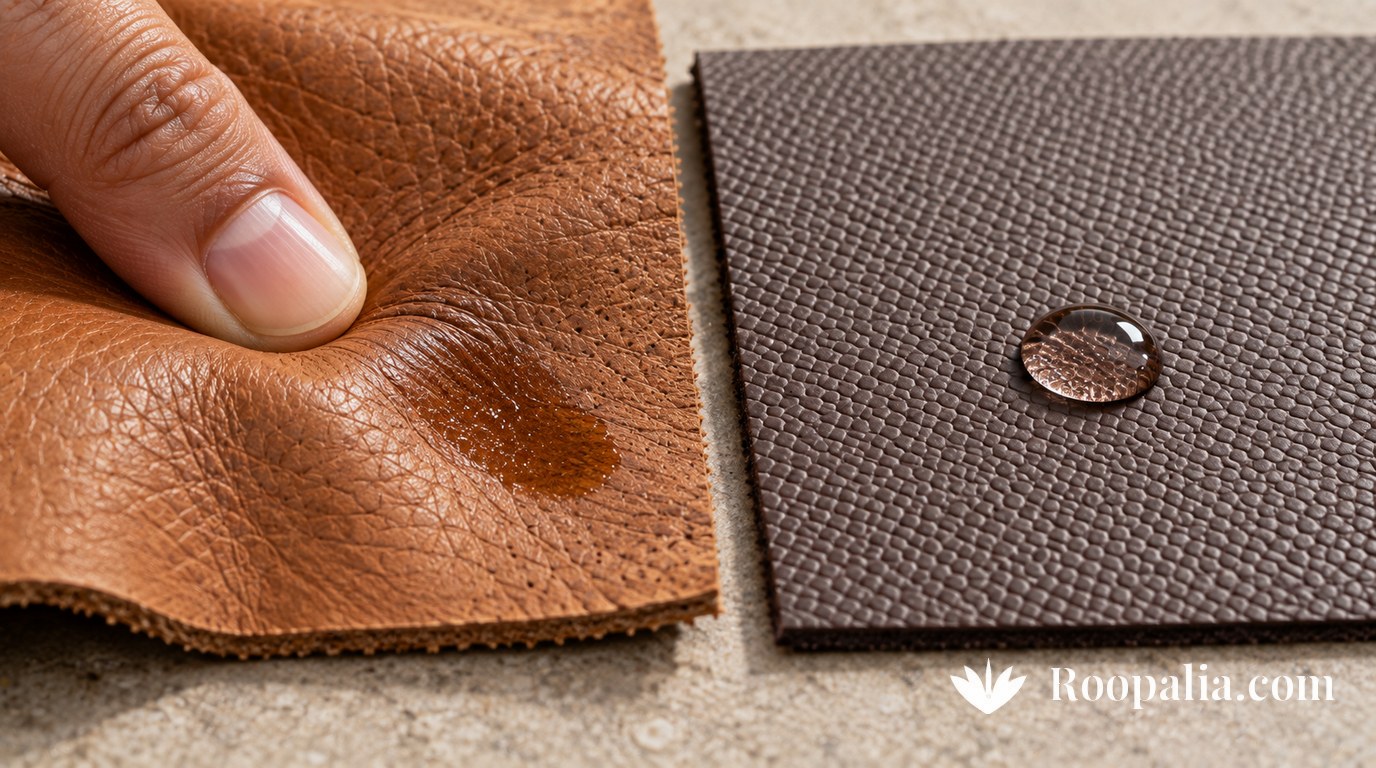
The label "genuine leather" reads like a guarantee of quality. It is not. It is the third grade down. The ladder runs:
- Full grain — the top layer of the hide, unsanded. The most durable and the most expensive.
- Top grain — lightly sanded to even out the surface. Most good bags are this.
- Genuine leather — the lower layers left after the top is split away. Leather, but well down the list.
- Bonded leather — leather dust glued together. Looks like leather, does not last like it.
- PU / faux leather — not leather at all. Nothing wrong with it, and it costs far less. Just don't pay leather prices for it.
Four tests you can run at the counter in under a minute:
- A drop of water. Real leather absorbs it slowly and darkens at that spot. On synthetic the droplet beads and sits on the surface.
- Press with your thumb. Real leather creases around the pressure and springs back when you let go. Synthetic dents without creasing.
- Look closely at the grain. Real hide is irregular — coarse in one place, fine in another. A printed surface repeats the same pattern exactly.
- Check a cut edge. Real leather is fibrous and slightly rough at the edge. PU is smooth, and you can usually see the fabric mesh backing underneath.
If you live outside India
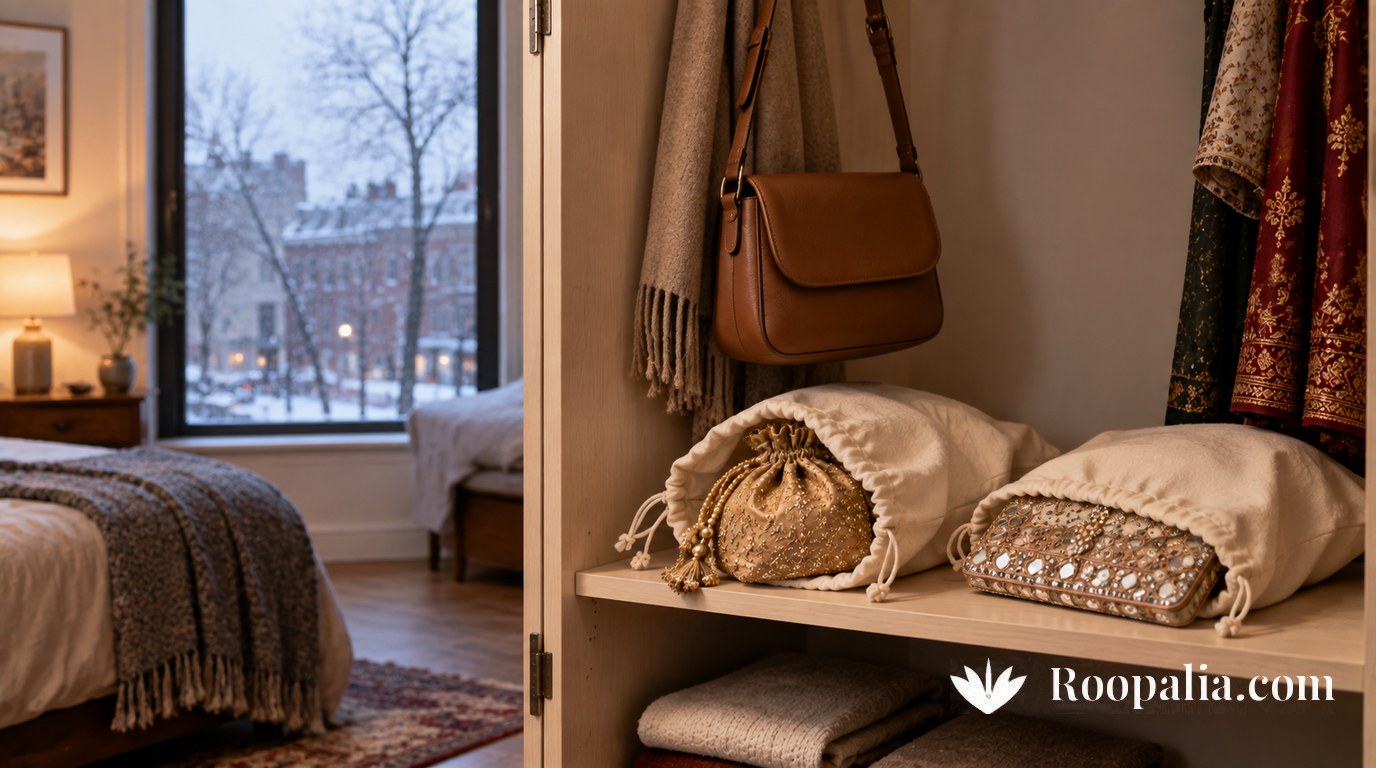
Three things change. Everything else above still applies.
The climate works in reverse. In heated homes through a northern winter, leather loses moisture and cracks at the edges — the opposite of the monsoon problem. Condition more often than you would in India, and keep bags away from radiators and heating vents.
Occasion bags brought from India need storing properly. Zari, mirror work and beading come out two or three times a year and sit in a cupboard the rest of the time. Cotton dust bags, never plastic. If a thread pulls, don't cut it — ease it back through from the inside.
Buy in the right place. Potlis, batuas and zari clutches are available abroad at several times the price. Carry those back from India instead: they are light, they take almost no suitcase space, and they last for years. Buy the everyday crossbody and the work tote locally, since those wear out and get replaced.
In the end
A bag is a tool, not an ornament
You do not need a different bag for every outfit. Three — one structured, one crossbody, one clutch or potli — will carry you through a year, and owning only three means you can afford to buy each one properly and actually look after it. Pick the occasion first and the bag second. Match to the border of the fabric, not its main colour. Scale the size to your own frame rather than to a shop display. The best bag you own is not the one that looked best in the shop — it is the one you reach for without thinking.
Frequently Asked Questions
Which bag should I carry for which occasion?
What are the 7 types of bags?
Which type of bag is best for the office?
How do I choose a handbag for everyday use?
Which bag goes best with a saree?
What bag size suits a shorter height?
How many handbags do I actually need?
How can I tell real leather from fake?
Does "genuine leather" mean the best quality?
How do I stop my bag getting mould in the monsoon?
What should I do if my handbag gets wet?
What is a potli bag?
Why do people say Gen Z has turned against crossbody bags?
What is the difference between a sling bag and a crossbody?
📷 AI-generated images. For illustration only.
🙏 This article carries no affiliate or sponsored links. The potli verse is from the Bhagavata Purana, Canto 10, Chapter 80, Verse 14; the Arjuna reference is from the Virata Parva of the Mahabharata. Leather grades and the identification tests follow the classifications commonly used in the leather trade. Height and proportion suggestions are general guidance, not rules.