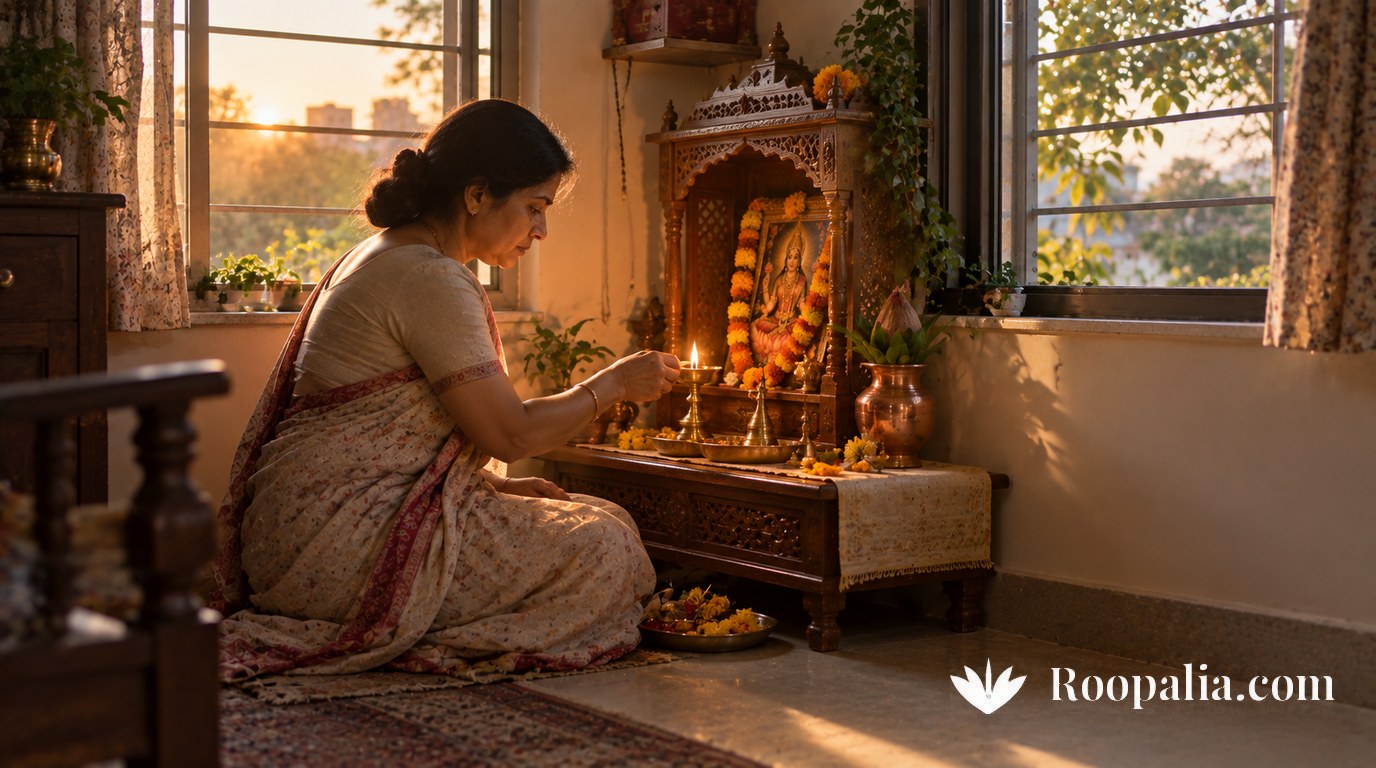
Deciding where the pooja space goes is one of those household questions that feels heavier than it should. Every other decision about a home gets made on convenience. This one feels like it has a right answer and a wrong one, and getting it wrong feels expensive in a way nobody can quite name.
Part of that anxiety is manufactured. The advice available online contradicts itself, often within the same paragraph, and a reader who notices the contradiction is left more uncertain than before.
So: the answer first, then where it actually comes from, then the questions people really have — flats without a north-east corner, mandirs in bedrooms, how many idols is too many, and whether a Shivling belongs at home.
The short answer
The pooja room should be in the north-east corner of the home — the ishana corner. If that corner is unavailable, the second choice is the east and the third is the north.
Before going further, separate two words that get used as if they meant the same thing. Placement is which corner of the house the shrine sits in. Orientation is which way it looks. The north-east rule is about placement only. It says nothing about orientation, and most of the confusion online comes from treating one answer as though it settled both.
🧭 Find your corner in one minute: open the compass app on your phone, hold it flat on your palm, and stand facing your main door. The reading is your home's facing direction. Now find where north and east meet — that intersection is your ishana corner. Don't take the reading standing next to a steel almirah or a fridge; the needle drifts.
Where this rule actually comes from
This is not folk advice. The oldest clear statement of it sits in the Brihat Samhita, written by Varahamihira around the sixth century CE. One verse lays out the entire floor plan of a house:
aiśānyāṃ devagṛhaṃ mahānasaṃ yadi cāpi kāryam āgneyyām |
nairṛtyāṃ bhāṇḍopaskaro'rthadhānyāni mārutyām ||
Translation — Let the shrine (devagriha) be in the north-east, the kitchen in the south-east, the vessels and household implements in the south-west, and the wealth and grain in the north-west.
The whole house in a single line — and the shrine is the first thing it places.
📖 If you go looking for the verse number
This is chapter 53, verse 118 in N. Chidambaram Iyer's English translation, and the same verse appears as chapter 52, verse 116 in Pandit Achyutananda Jha's Sanskrit edition. The chapter numbering differs between editions; the text does not. If one numbering fails you, try the other before concluding the verse doesn't exist.

The same chapter sets out the framework everything else in Vastu rests on: the Vastu Purusha Mandala. A plot is divided into a nine-by-nine grid of 81 squares, with 32 deities occupying the outer squares and 13 the inner ones (53.42). The Vastu Purusha lies face down across this grid with his head in the north-east (53.51). The Garuda Purana repeats the same arrangement in chapter 46, and the origin story of the Vastu Purusha comes from chapter 252 of the Matsya Purana.
The name is not incidental either. Ishana is a form of Shiva, and the corner named after him is treated as the quarter of the devatas. The devatas' room goes in the devatas' corner. The logic is internally consistent, and it is old.
North-East
🪔 Pooja room
Second choice
North-West
Wealth, grain
Second choice
Centre
Keep it open
South-East
🔥 Kitchen
South-West
Vessels, stores
The same verse, drawn out. Read the grid with north at the top.
Worth being honest about the source. The north-east rule is Vastu tradition, drawn from the internal logic of the Vastu Purusha Mandala. No Purana prescribes which way a household image should face. The texts that do legislate the orientation of an image — the Mayamatam and the Manasara — are manuals of temple architecture, not of domestic corners. Knowing this does not weaken the rule. It tells you how much weight to give each part of it.
Which direction should the idol face? Here is the contradiction
Look at the highest-ranking pages on this question and you will find them saying opposite things. Some advise that the person praying should face west. Others advise that the idols should face east or north — and then add, in the same breath, that this ensures you face those directions while praying.
That second claim cannot be true. You and the idol are facing each other. If the idol faces east, you are facing west. There is no arrangement in which both of you face east, short of you sitting behind the murti.
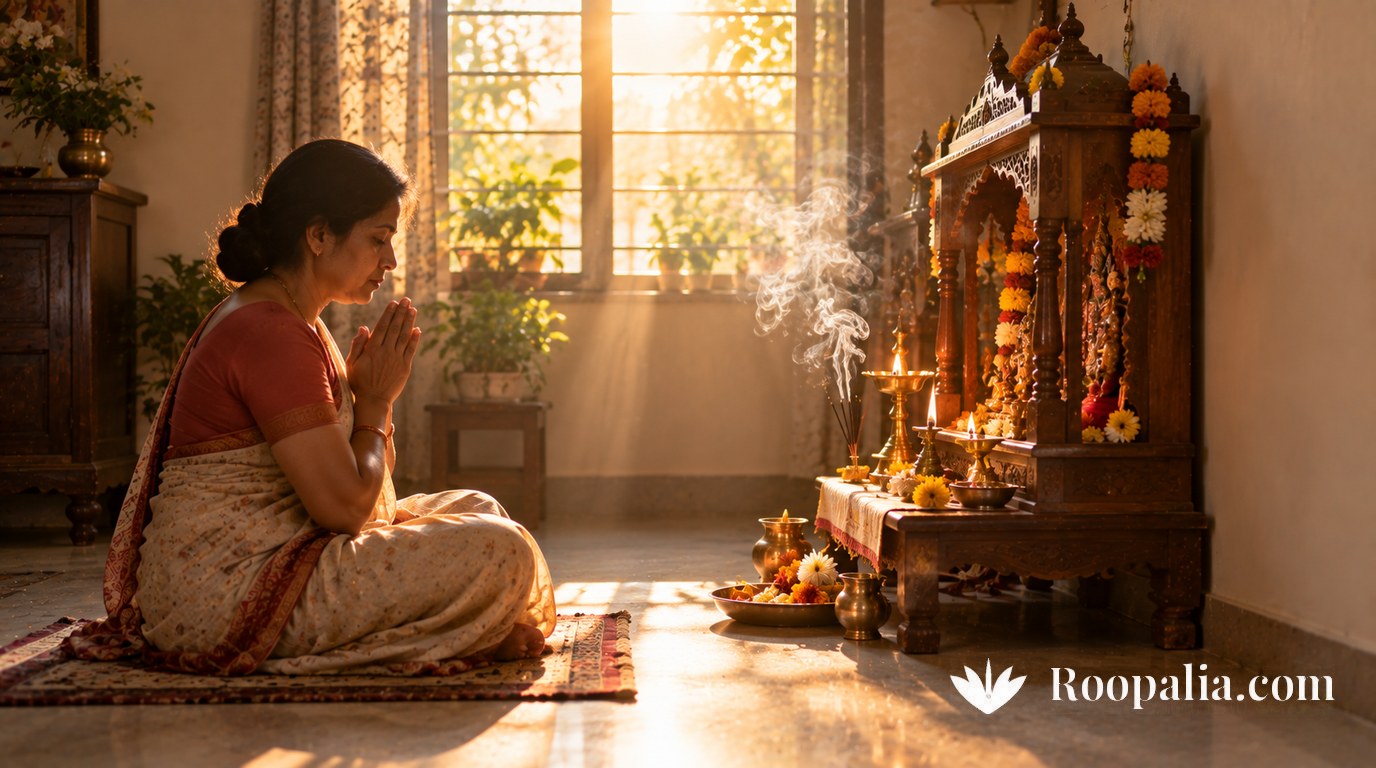
What the tradition actually contains is two different configurations, both valid. The confusion comes from fusing them into one sentence.
The temple convention. The garbhagriha sits toward the west and the deity faces east, so the first light of sunrise falls on the image. The devotee enters from the east and faces west for darshan. This is why the main entrances of Konark, Kashi Vishwanath and the Brihadeshwara at Thanjavur all open eastward.
The domestic Vastu convention. Here the person praying is the reference point, not the image. The rule is that the worshipper should face east or north — which leaves the idol facing west or south.
The good news for a household is that you never have to choose between them, because the north-east corner resolves it by itself.
🎯 The simplest arrangement that satisfies everything
Place the shrine against the east wall of the north-east corner. The idol then faces west, and you sit facing east — toward the rising sun. That is exactly what domestic Vastu asks for. If the east wall is occupied, use the north wall of the same corner; you will then be facing north, which is the second preference.
The rule of thumb is shorter still: you face whichever wall the shrine is mounted on. Shrine on the east wall, you face east. Shrine on the north wall, you face north. Shrine on the south wall, you face south — and that is the one arrangement the tradition steers you away from.
It is worth knowing why the south is avoided, because it usually gets passed on as a fear rather than a reason. South is associated with Yama and with the ancestors, and the rites of shraddha and tarpana are performed facing south. Daily deity worship is therefore kept separate from it. This is a rule about categories, not about misfortune. No text says that praying while facing south brings harm.
Pooja room direction for east, west, north and south facing houses
This question gets asked constantly and the answer is simpler than it looks. The facing of your house does not change where the ishana corner is. North-east is north-east regardless of which way your main door opens. What changes is how much of that corner you actually get.
- North-facing and east-facing houses are the easiest. The north-east corner usually falls near the front of the plan, is well lit, and is rarely swallowed by service areas.
- West-facing houses put the north-east at the rear. That is often better, not worse — a shrine set away from the entrance is quieter.
- South-facing houses are the tightest case, because the north-east ends up diagonally opposite the door and is frequently taken by a bedroom or a bathroom. Here you fall back to the order below.
In every one of these plans the fallback order stays the same: ishana corner first, then any clean stretch of the east wall, then the north wall. The facing of the building changes which of these is convenient, not which is correct.
Where a pooja room should not be
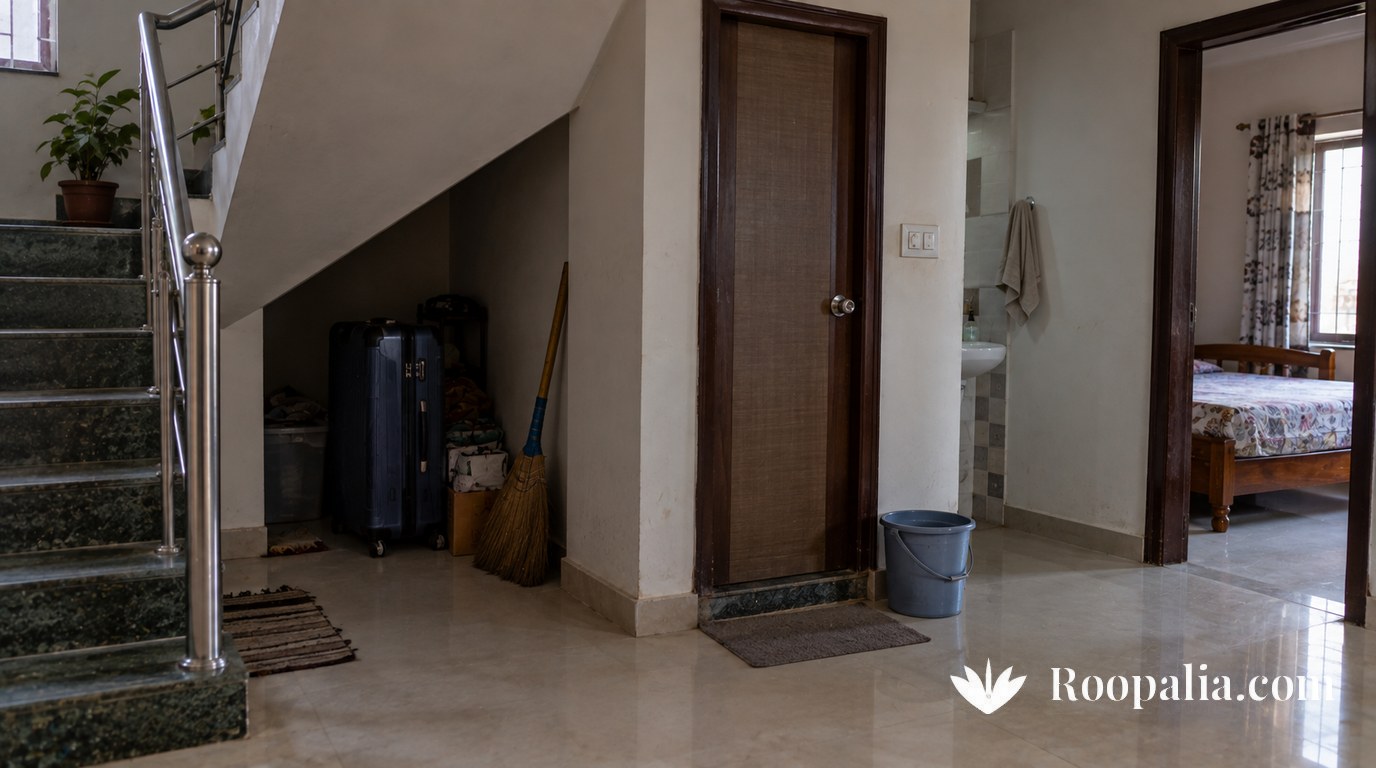
- Under a staircase. The reason is plain rather than mystical — people walk over it all day. It is the most tempting recess in a small house and the least appropriate.
- Sharing a wall with a bathroom, or directly above or below one. In a two-storey home this is easy to miss, so check the floor plan of the level above as well.
- Directly facing the main door. Brihat Samhita 53.78 treats an image of a deity placed opposite the gate as inauspicious. Set the energy argument aside and there is still a plain objection: every visitor's first glance lands on the murti.
- The exact centre of the house (Brahmasthan). Brihat Samhita 53.66 asks that this portion be kept pure and undisturbed. Filling it with a heavy structure works against that.
- Beneath a beam. Weight bearing down from above is avoided in the tradition and looks oppressive in practice.
- A basement or a windowless corner. A shrine needs air and light, or the damp from flowers, incense and lamp smoke simply collects there.
- Inside the kitchen. The same verse assigns the kitchen to the south-east. If there is genuinely no alternative, see the next section.
Pooja room in an apartment, a 1BHK or a rented flat
Everything above assumes a house being planned from scratch. Most people live in a flat somebody else designed, where the north-east corner is occupied by a kitchen, a bathroom, or a balcony that was added later.
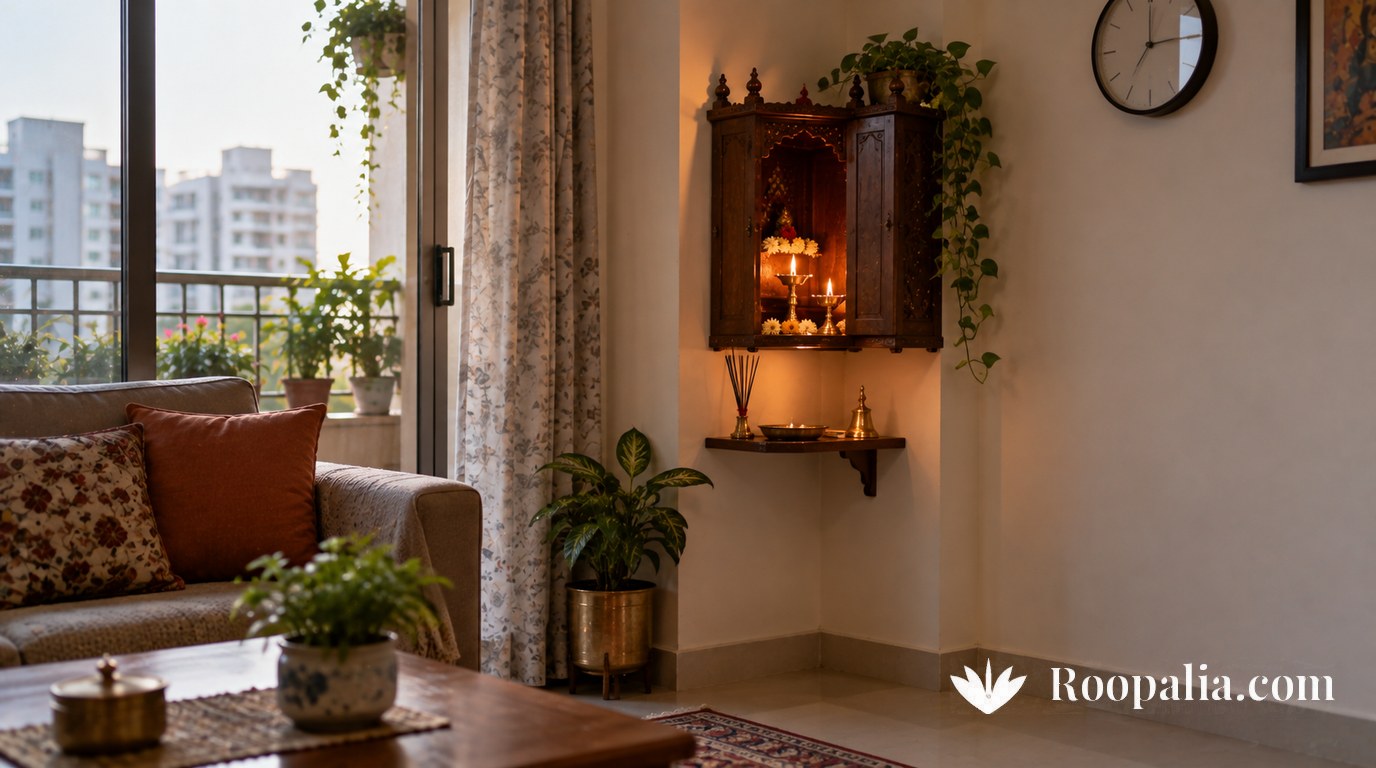
The tradition has an answer for this built into its own grammar. Note the words yadi cāpi in the verse — "and if it be done thus". That is the language of preference, not of command. Vastu has always ranked options rather than issuing absolutes.
Work down the list:
- The north-east corner, if you have it.
- Otherwise, any clean stretch of the east wall — the living room counts.
- Failing that, the north wall.
- If both walls are taken, pick the corner of the room that is quietest, cleanest and out of the traffic path. A calm wrong corner beats a busy right one.
Rented flats have their own constraints — no drilling, and a move every couple of years. The best answer there is also the oldest one: a low wooden chowki with a clean cloth over it. No nails, no contractor, and it travels.
📏 How much space do you actually need? Enough to sit in front of it on a mat without your knees hitting the wall. Roughly two and a half to three feet of width, and the same again as floor space to sit. Less than that works too, but you will end up standing, and a shrine you never sit down at slowly becomes a shelf.
Can a mandir be kept in a bedroom?
Yes, with conditions — and the conditions are about height and privacy, not about the room itself.
The basis is again in the Brihat Samhita. Verse 124 of the same chapter advises that a person seeking prosperity should not sleep at a level higher than grain, cattle, the preceptor, fire, or the deities. Read that carefully. It does not say never sleep in the same room as the deities. It says do not sleep above them.
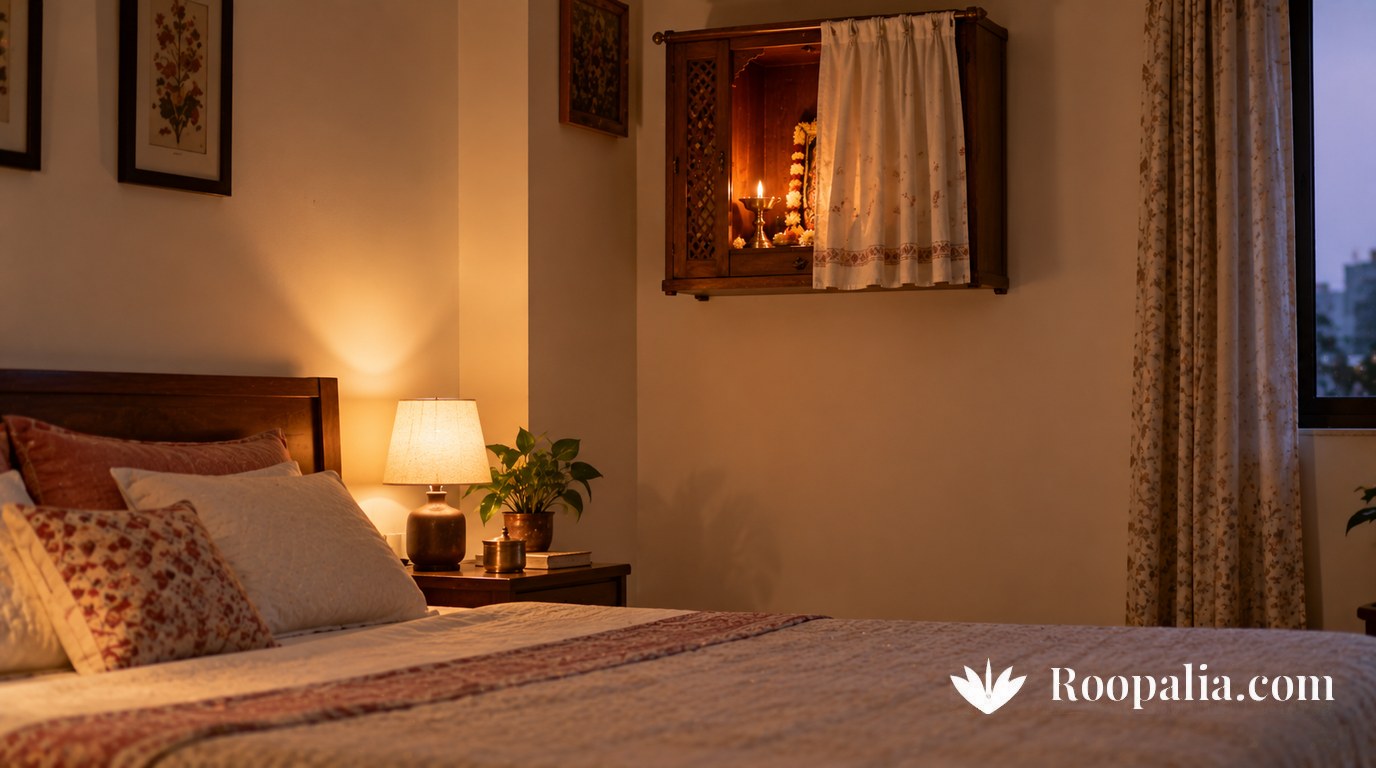
- Mount the shrine clearly higher than the mattress. A wall cabinet is the cleanest solution.
- Give it a curtain or a pair of doors that close at night. Covering the shrine is not disrespect — large temples close the sanctum doors after the night aarti for the same reason.
- Do not sleep with your feet pointing toward it.
- In a couple's bedroom the tradition hesitates, and the reason is privacy rather than impurity. In a child's room or a single person's room the question does not really arise.
In a one-room home there is no alternative anyway, and no guilt is called for. These rules were written for houses people actually lived in, and they have always made room for shortage of space.
How many idols, how large, how high
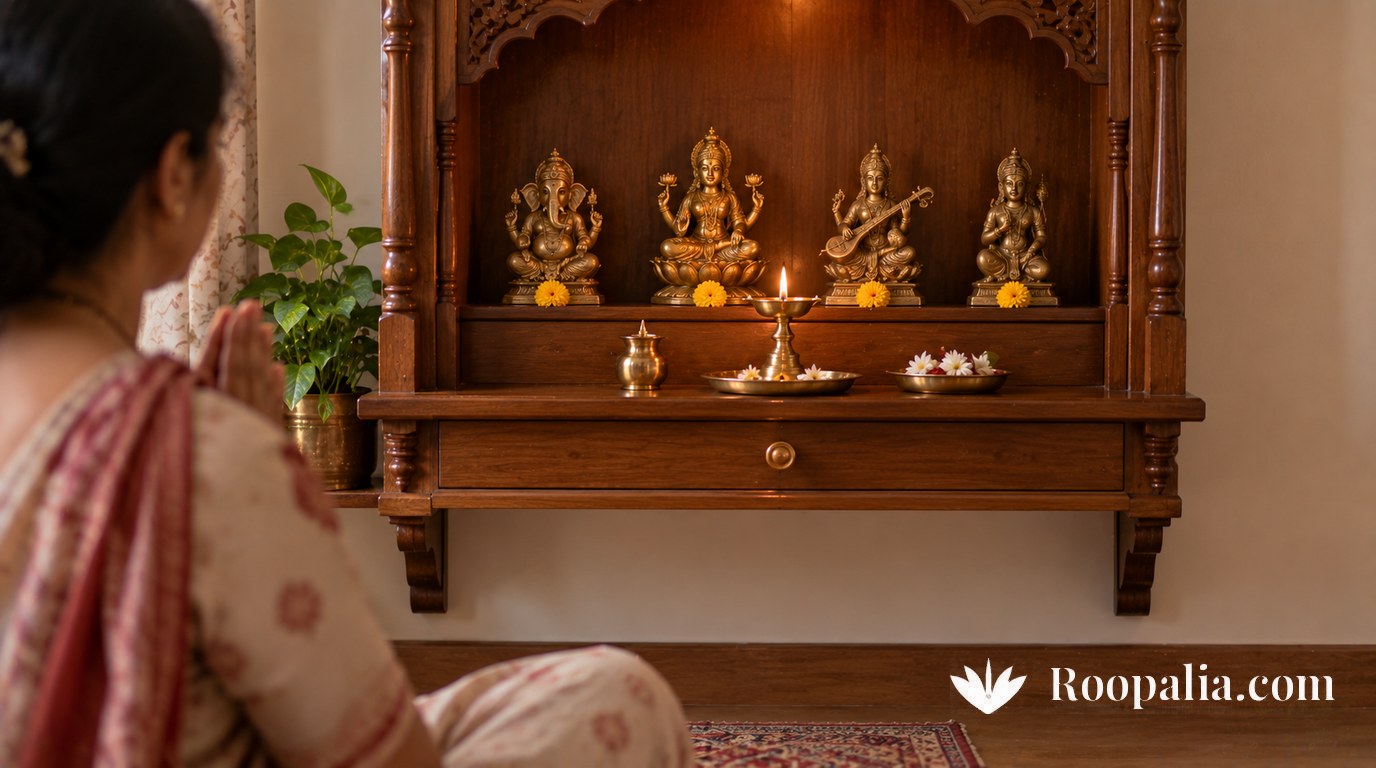
There is a well-known verse on this, and it is more specific than most advice you will read:
gṛhe liṅgadvayaṃ nārcyaṃ gaṇeśatritayaṃ tathā |
śaṅkhadvayaṃ tathā sūryo nārcyau śaktitrayaṃ tathā ||
Translation — In a house one should not worship two Shivlings, three Ganeshas, two conches, two images of Surya, three of Shakti, two Dwarka chakras or two Shaligrams; doing so brings restlessness (udvega) to the householder.
One clarification matters here. This verse is not from a Purana. It comes from Acharaprakasha and Acharendu, digest works of Dharmashastra that collected rules from scattered sources. It is quoted constantly online without attribution. Knowing where it sits tells you it is considered tradition rather than revealed text — which is a reasonable thing to follow, and a reasonable thing to be relaxed about.
- Height — set the images so they fall level with the chest or heart of a seated person. Not on the floor, not above head height.
- Clearance — leave about a finger's gap between the image and the back wall. It makes cleaning easier and keeps damp off the base.
- Facing — do not place two images looking directly at each other.
- Size — large images are not prescribed for homes. The logic is practical: the bigger the murti, the more elaborate the daily service expected of you, and few households can sustain that every single day.
- Damaged images — a chipped or cracked murti is retired from worship. It is not thrown away but immersed in flowing water or laid at the root of a tree.
What to keep in a pooja room, and what to remove

✓ Belongs there
- A brass or clay diya
- A small copper kalash
- A bell and one conch
- Incense with a holder
- Roli, akshat, sandalwood
- Fresh flowers
- A clean mat to sit on
- Your prayer or katha book
✗ Should be moved out
- Chipped or cracked idols
- Wilted flowers, old garlands
- Photographs of ancestors
- Medicines, spectacles, keys
- Cash or a jewellery box
- Used plates, leftover prasad
- Accumulated incense ash
- Torn cloth or a broken lamp
The ancestors' photographs rule upsets people, so here is the reasoning. Deva karma and pitru karma are two separate procedures in the tradition — deity worship faces east or north, ancestral rites face south; the sacred thread is worn one way for one and the reverse way for the other. Keeping both in one place blurs a distinction the tradition takes seriously. It is not a judgement on your elders. Give their photographs a dignified place on another wall, conventionally a southern one.
A peacock feather is fine to keep. It is associated with Krishna and no text prohibits it. Just retire it once it is dusty and shedding.
A Shivling can absolutely be kept at home, and millions of households do. The three rules commonly cited — usually attributed to the Shiva Purana — are that there should be only one, that it should be no larger than the top joint of your thumb, and that it should receive a daily water offering. A Banalinga or Narmadeshwar from the Narmada is treated as self-manifest, so formal consecration is not considered necessary for it. All three rules point the same way: keep at home only what you can genuinely serve every day.
Tulsi should not be shut inside a cabinet; it needs sun and air, so a balcony, courtyard or windowsill is its place. And one old rule worth remembering — tulsi is not offered to Ganesha, for reasons given in a story in the Brahmavaivarta Purana.
Wood, marble, or just a chowki
This is a question about your building, not your beliefs. No text specifies what a home shrine should be made of.
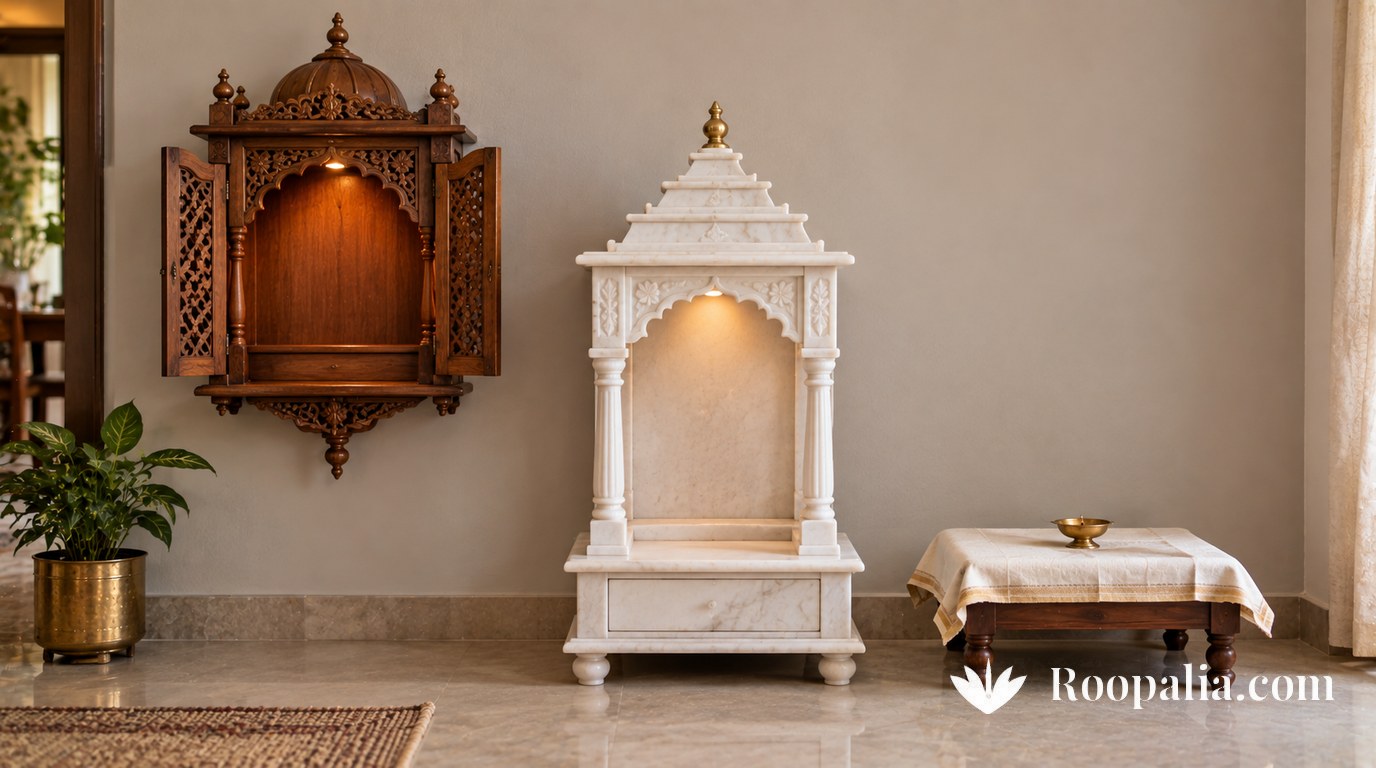
- Wood is the most common. Light, wall-mountable, well suited to flats. Teak and sheesham last; cheap MDF swells in humidity. In high-rainfall regions get it treated against termites.
- Marble is handsome and permanent, easy to wipe, and does not absorb lamp soot. But it is heavy, so it sits on the floor rather than on a wall. On an upper floor, think about the load.
- A chowki is the oldest and cheapest form — a low wooden platform with a clean cloth. For rented homes, small rooms and newly married couples, it is the most practical of the three.
One thing buyers routinely forget: doors. If the shrine will live in a bedroom, or if there are small children or pets in the house, a unit that closes is worth far more than one with extra carving.
Colour, lighting, cloth and daily cleaning
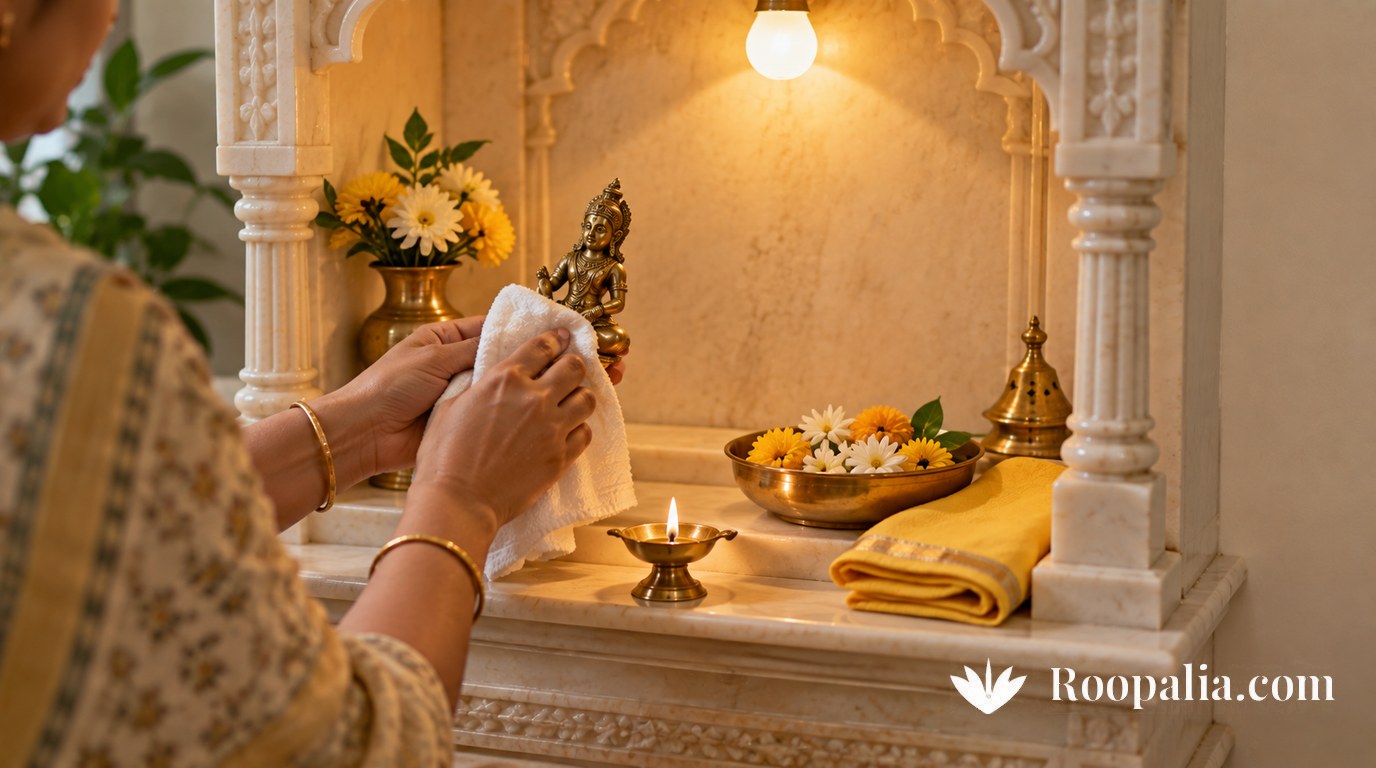
Colour. Keep it pale — white, cream, light yellow, soft saffron or a light rose. Deep black, navy and heavy browns are not chosen for this corner. There is a practical benefit too: soot from lamps and incense shows up immediately on a pale surface, so the cleaning does not get postponed.
Cloth. Yellow, red or white are the usual choices — yellow associated with Brihaspati and Vishnu, red with the Devi, white with Shiva and Saraswati. It need not be changed daily, but lay a washed cloth once a week, and retire anything stained or torn straight away.
Lighting. A small warm-white bulb suits this corner best. Bright cool LEDs make it look like an office. Natural light during the day is ideal, and at night one small lamp is enough. Coloured string lights are for festivals, not for every day.
When to clean. Every morning, after your bath and before the puja. Yesterday's flowers and garland go out then, not next week. Wipe the images with a soft dry cloth, and clear the incense ash daily because it cakes on. Deep-clean the brass once a month, and wash the whole corner before a major festival.
💡 One habit that makes all of this easier
Keep a small box near the shrine holding matches, cotton wicks, camphor, incense and a dry cloth. The mornings when puja gets skipped are almost always the mornings when something had to be hunted for. Everything within arm's reach turns a five-minute ritual back into a five-minute ritual.
If you live outside India
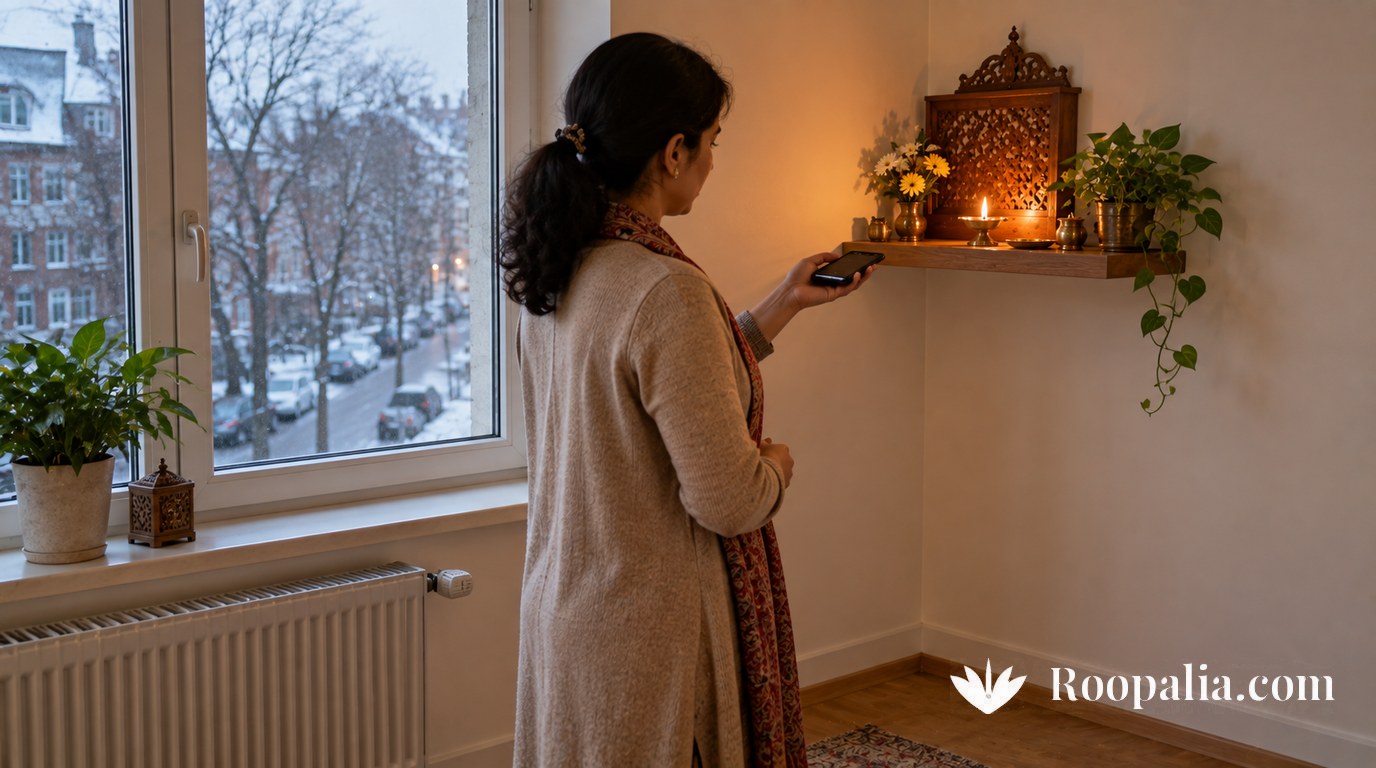
First, the reassuring part: direction does not change. North-east is north-east in Toronto and in Sydney. Open the compass app, find the corner, and no separate calculation is needed.
Second, if you rent and cannot drill, a floating shelf or a small chowki does the entire job. That is the same approach we suggested in the piece on raising children with Indian values abroad.
Third, and most practically — watch the open flame and the smoke. Most apartments in North America, Britain and Europe have ceiling smoke detectors, and many leases restrict open flames outright. Incense smoke can set off an alarm. The workable answer is a short ghee lamp with a window cracked open, or an LED diya for daily use with a real lamp saved for festivals. The lamp stands for light, and that meaning survives the substitution.
Fourth, supplies. Roli, akshat, camphor and incense are stocked in Indian grocery stores in most large cities now — Edison, Southall, Brampton, Harris Park. Where they are not, fresh flowers, clean water and a single lamp are sufficient. The tradition has never ranked the shopping list above the intention.
Explaining the corner to your children
When a child asks why the shrine is in that particular corner, resist "that's just how it's done." A question deflected at that age tends not to get asked again.
The real answer is more interesting anyway. Tell them the corner was chosen because it is where the first morning light enters the house, and that a book written about fifteen hundred years ago said the shrine should go exactly there. For a ten-year-old that lands better than any warning ever could.
Then give them a job — trimming the wick, changing the flowers, ringing the bell. What the hands do is what gets remembered, and it is how a corner in your house eventually becomes a corner in theirs.
In the end
Direction is a decision. Regularity is a practice.
Fifteen hundred years ago Varahamihira said one thing about this: put the shrine in the north-east. He did not list the objects, fix the orientation of the image, or specify the bulb. Everything else was added later by tradition, and a good deal of it is useful. But the original instruction is that single line. Pick the north-east corner, set the shrine against the east wall, and keep it clean. A corner where a lamp is lit every morning is right even if the compass disagrees; a corner that gathers dust for months is wrong no matter how perfectly it is aligned.
Frequently Asked Questions
Which direction should a pooja room face as per Vastu?
Which direction should God face in a pooja room?
Where should a pooja room not be placed?
What is the pooja room direction for an east-facing or north-facing house?
Can a mandir be kept in a bedroom?
How do I set up a pooja room in a small apartment?
How many idols should be kept in a home temple?
How high should idols be placed in a home temple?
What should not be kept in a pooja room?
Can we keep a Shivling at home?
What should the pooja room door direction be?
What colour and lighting suit a pooja room?
When should the pooja room be cleaned?
📷 AI-generated images. For illustration only.
🙏 This article is general cultural and Vastu information. Textual references are drawn from the Brihat Samhita of Varahamihira (chapter 53; chapter 52 in some editions), Garuda Purana chapter 46, Matsya Purana chapter 252, and the commonly printed editions of Acharaprakasha and Acharendu. The texts that legislate image orientation, the Mayamatam and the Manasara, are temple-architecture manuals. Vastu practice varies by region and family, and this article is not a substitute for professional Vastu or astrological consultation.