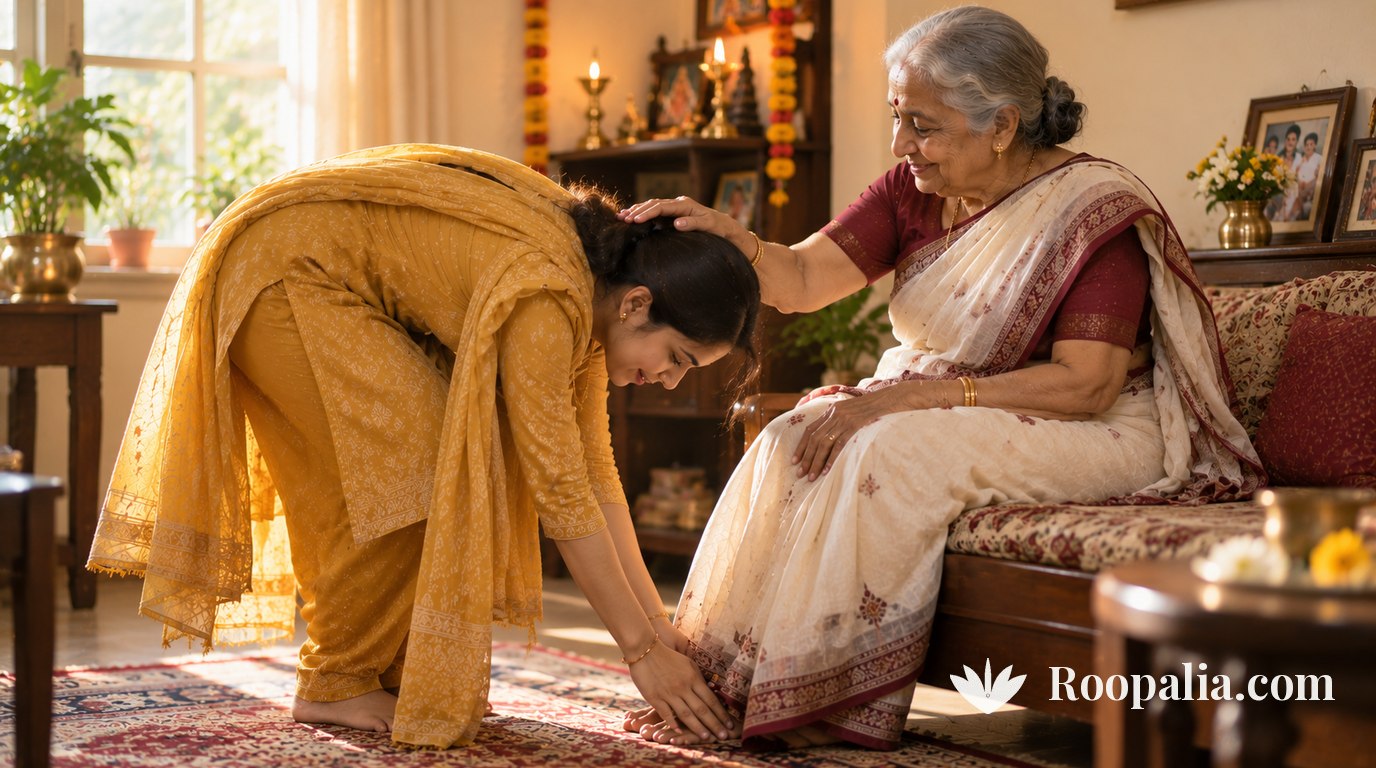
It is a two-way gesture, not a one-way bow
This is the single thing most explanations miss, and it changes how the whole gesture reads.
Charan sparsh is not submission. It is an exchange. The younger person offers respect; the older person returns a blessing by touching their head. In traditional understanding, if the blessing does not come, the greeting is incomplete. That is why an elder who is asleep is not supposed to have their feet touched — they cannot complete their half of it.
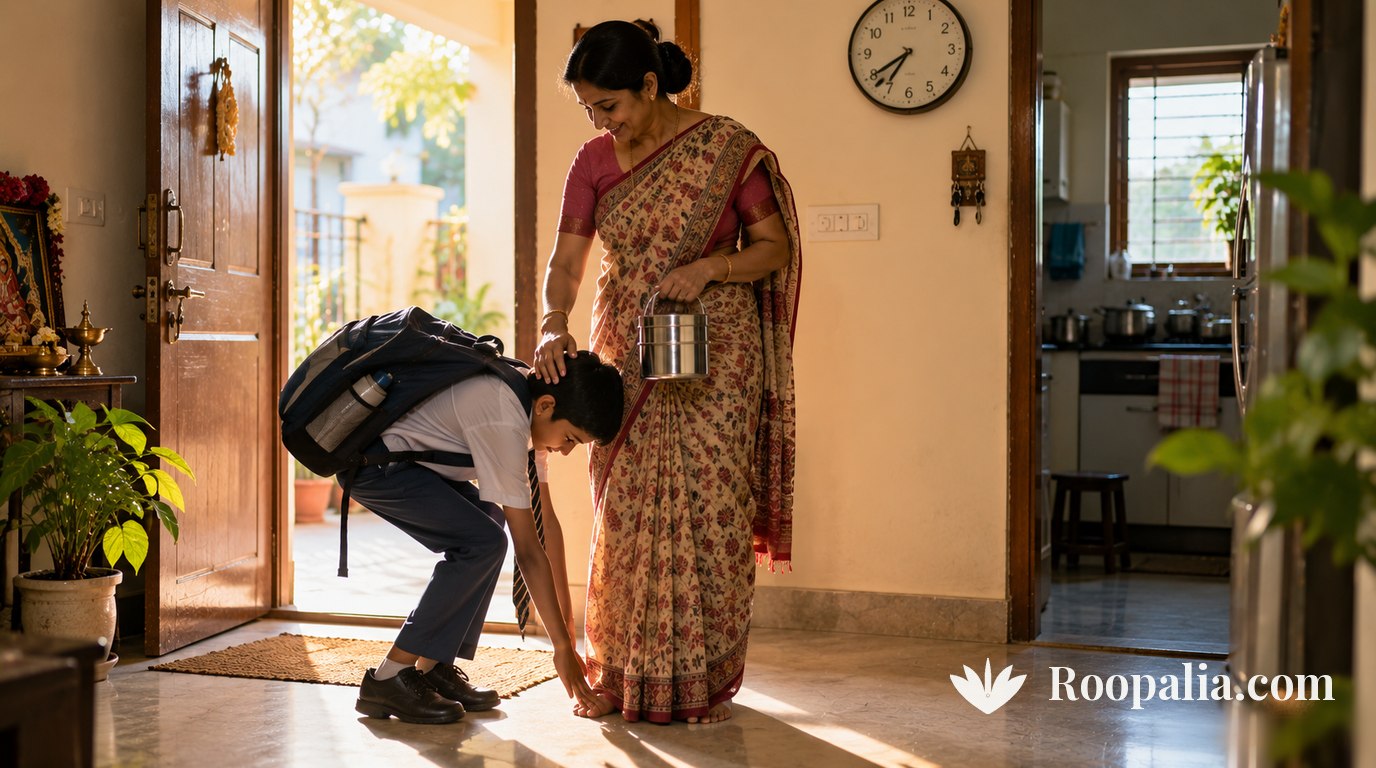
Sanskrit actually has three different words for what English lumps together as "bowing":
- Pranam — to bow. Folded hands and a lowered head count. No touching required.
- Charan sparsh / pada-grahana — literally clasping the feet. Reserved for family elders and teachers.
- Abhivadana — the full, formal greeting in which you present yourself respectfully to an elder.
Every charan sparsh is a pranam, but not every pranam is a charan sparsh. Knowing the difference is useful — it tells you when folding your hands is enough.
What the scriptures actually say
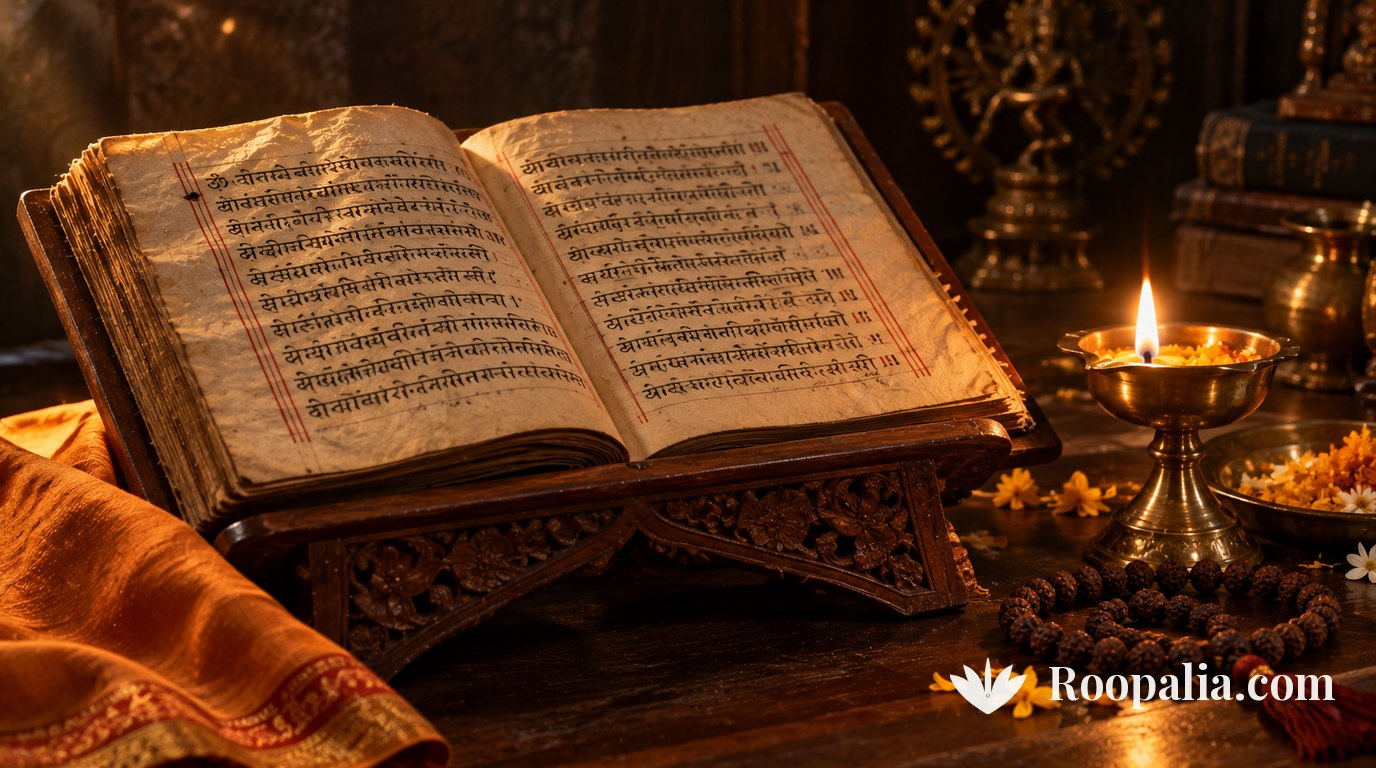
The verse quoted most often comes from the second chapter of the Manusmriti:
Abhivādanaśīlasya nityaṁ vṛddhopasevinaḥ,
catvāri tasya vardhante āyur-dharmo yaśo balam.
— Manusmriti 2.121
Meaning: For one whose nature it is to greet elders respectfully and to serve them, four things increase — lifespan, dharma, reputation and strength.
A correction worth knowing
A very large number of websites quote this verse as "āyur-vidyā yaśo balam" — long life, knowledge, fame and strength. Standard Sanskrit editions of the Manusmriti read āyur-dharmo — dharma, not knowledge. Both readings have circulated for centuries and neither changes the spirit of the verse, but if you want to quote it correctly, the received text says dharma. We would rather tell you this than repeat a popular error.
More interesting is the verse that describes the method. Manusmriti 2.72 instructs that a student should clasp the teacher's feet vyatyasta-pāṇinā — with crossed hands — the left foot touched by the left hand and the right foot by the right hand. Because you are facing the elder, their right foot sits to your left, so your arms genuinely have to cross. The rule exists to slow you down: it makes an absent-minded bob impossible.
The same instruction turns up in the Gautama Dharmasutra, the Apastamba Dharmasutra and the Vishnu Smriti, all in the context of a student greeting a teacher at the start and end of a lesson. That origin matters: this began as an educational courtesy, not a religious ritual.
How to do charan sparsh correctly
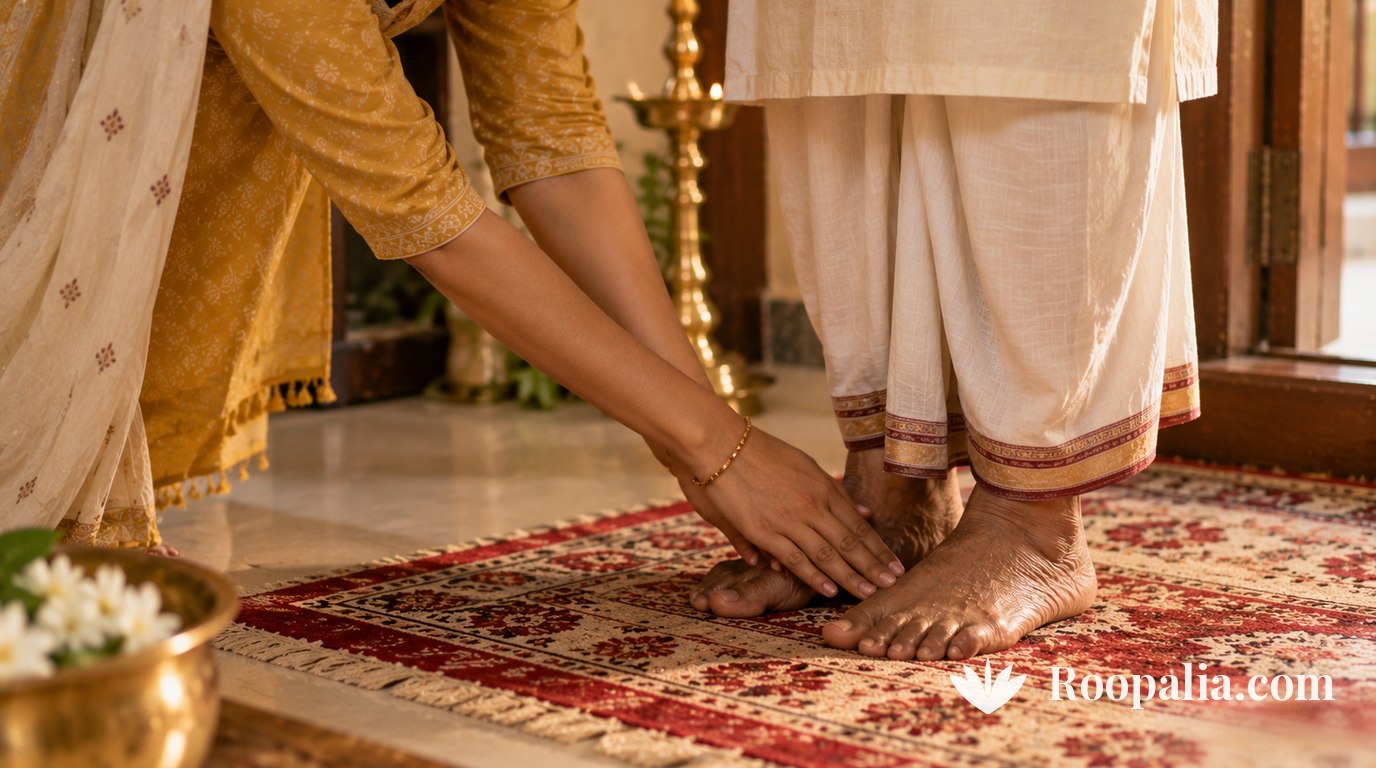
1. Stop first. Bending while still walking past someone is not a greeting. Pause and turn towards them.
2. Bend from the waist, back straight. Kneel only if the elder is seated low, on the floor or on a bed.
3. Cross your arms — right hand to their right foot, left hand to their left. This is the method the texts prescribe.
4. Touch lightly. A brush of the fingers. Not a grip, and not theatrical.
5. Stand up and fold your hands. Many people then touch their own hand to their forehead.
6. Wait a beat for the blessing. Give the elder the moment they need to place a hand on your head. This is the part most people rush past, and it is the part that matters.
If the elder is frail, seated in a wheelchair, or physically unable to be approached at the feet, touching their knees is entirely acceptable and very widely practised. And if you are far away, saying the words "charan sparsh" on a phone or video call is a real, long-standing substitute — Indians have been doing it since telephones arrived.
Whose feet — and whose not
Customarily touched: parents, grandparents, parents-in-law, older siblings, aunts and uncles, teachers and gurus, and monks or spiritual figures.
Customarily not touched:
- Anyone younger than you, however senior they may be at work.
- Peers of the same age, unless they are your teacher.
- Anyone who is visibly uncomfortable with it. This is not a modern softening; consent has always been part of the courtesy.
- Someone who is asleep — they cannot bless you back.
Where the custom goes wrong
The gesture is about humility, not hierarchy. When a child is scolded into bowing in front of guests, what is produced is embarrassment, not respect. And when someone demands it on the strength of their position, money or influence, that is not tradition — that is the misuse of it. The texts speak about honouring age and experience. They say nothing about honouring status.
Is there any science behind touching feet?
You will find a lot of pages claiming that touching feet completes an "energy circuit", that nerve endings in the fingers connect with nerve endings in the toes, that a bioelectric current passes between two bodies.
None of that is supported by evidence. No study demonstrates any transfer of energy between an elder's feet and a younger person's hands. Articles that present these claims as established science are overstating them.
What is real is more modest, and more interesting:
- Physical. Bending from the waist is a mild stretch of the back and hamstrings. Done twice a day, it is a small piece of movement — no more than that, but no less either.
- Psychological. Body posture genuinely influences how we feel. Deliberately lowering yourself interrupts self-importance for a moment, and people report feeling it.
- Social. This is the largest and most underrated effect. A household that repeats a small physical acknowledgement between generations every day is a household in which the relationship keeps getting renewed.
A tradition does not need a laboratory to justify it. Dressing it up in invented science tends to weaken it rather than strengthen it.
The many forms of bowing

Charan sparsh sits in the middle of a scale:
- Namaste / namaskar — palms joined, head inclined. Appropriate everywhere.
- Charan sparsh — bending to touch the feet. For family elders and teachers.
- Panchanga pranam — five points touching the ground: both knees, both hands and the forehead.
- Sashtang / ashtanga dandvat — the full prostration, body straight as a staff. Offered mainly to deities and to a revered guru.
The classical verse describing the eight-limbed prostration lists chest, head, gaze, mind, speech, feet, hands and knees. Traditionally, women were advised to offer panchanga rather than the full prostration; this is a customary position rather than a universal scriptural rule, and many families and temples today do not observe it.
Teachers, and why it can be complicated at school
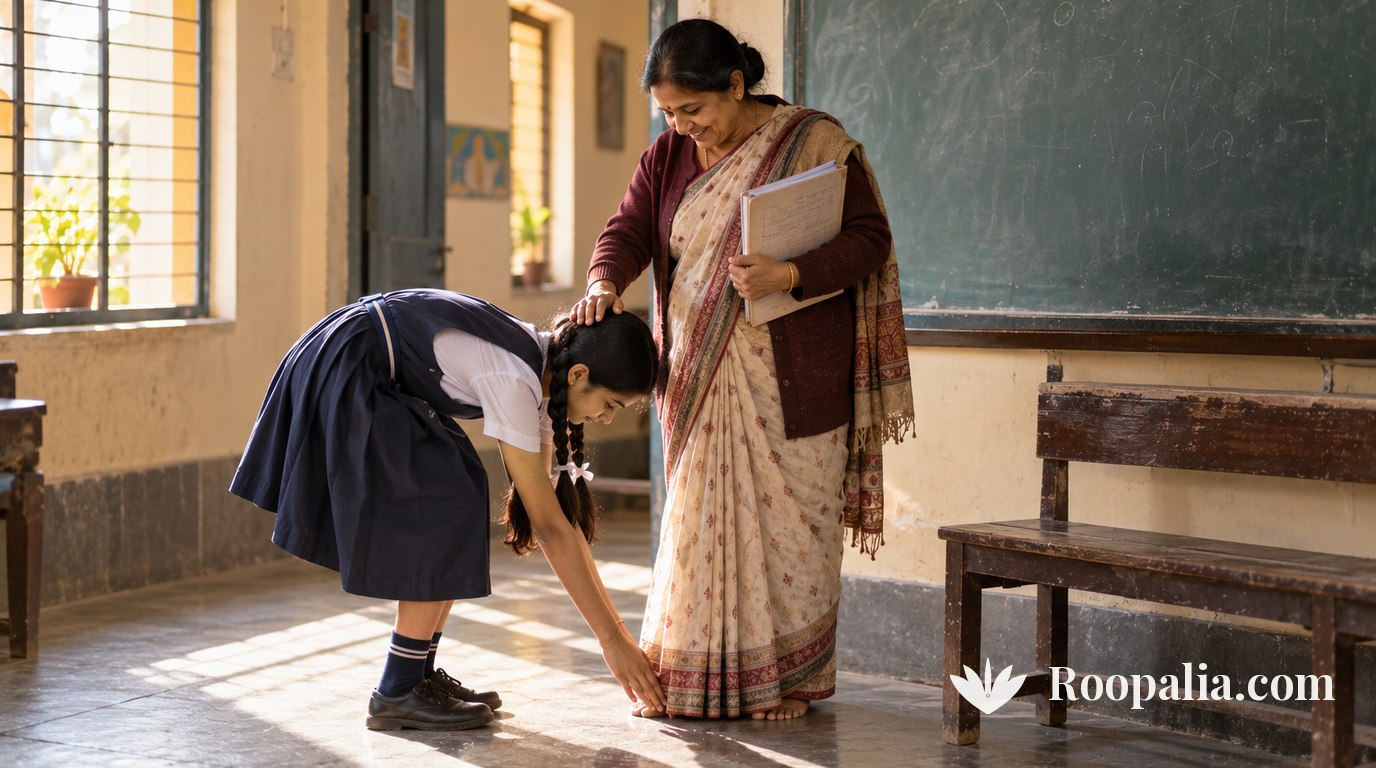
It is worth repeating that the scriptural material on charan sparsh is mostly about teachers, not parents. In the old residential system of learning, clasping the guru's feet at the beginning and end of a lesson was a formal signal: I am here to learn, and I have left my ego outside. That is why it still happens on Guru Purnima, before exams, and when a student returns years later with good news.
If your children are at school outside India, this is one place to be practical. Many schools have explicit rules about physical contact between staff and students, and a child bending to a teacher's feet can create genuine awkwardness for the teacher. Teach the child that a folded-hands "namaste" is the right greeting at school, and keep charan sparsh for family elders, visiting teachers, and trips to India.
If your family lives outside India: passing this on to children
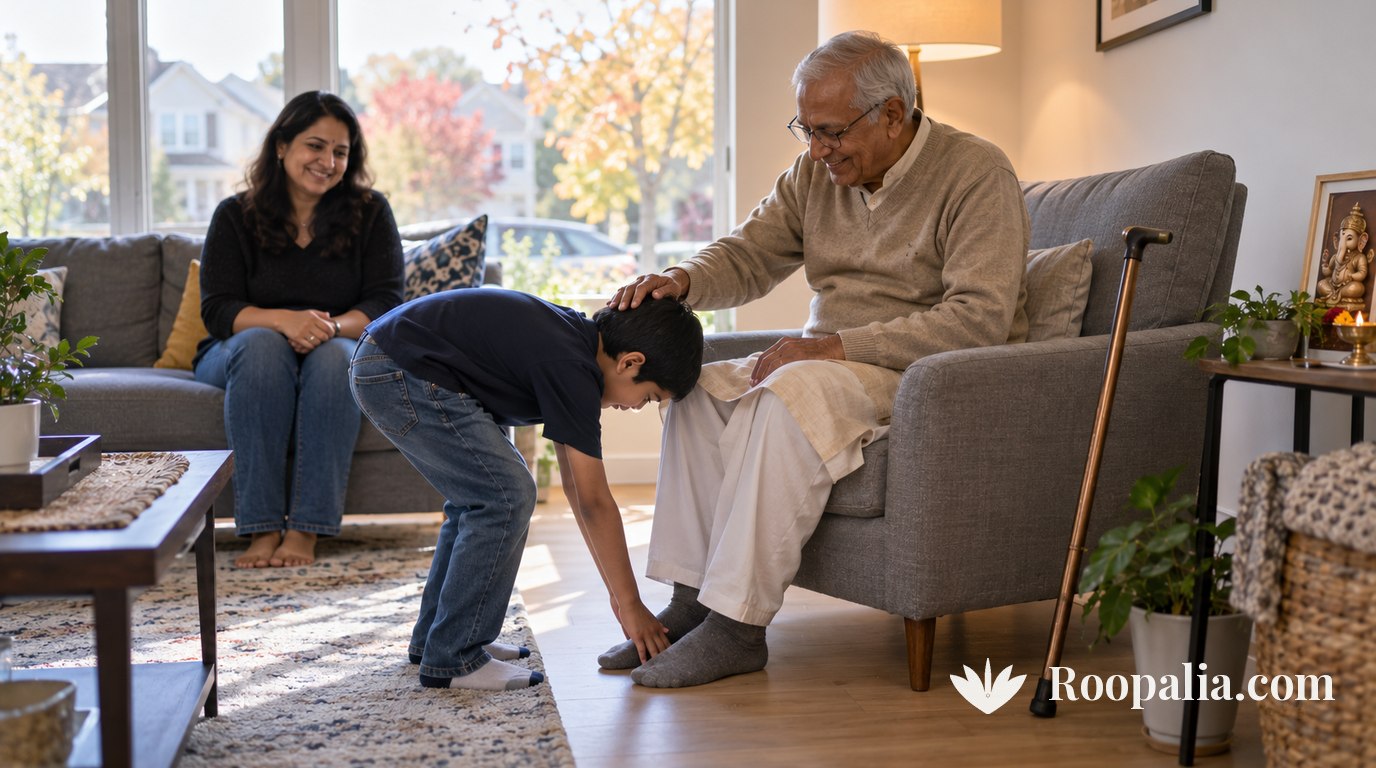
For families settled in the US, Canada, the UK, Australia, Singapore or the Gulf, the difficulty is not willingness. It is that the child does not live inside the setting where this gesture explains itself. Five things that work:
1. Give the reason, not the instruction. "It's our tradition" persuades nobody. Try: "When we bend, we're saying — you've lived more than me, and I want to learn from you." A seven-year-old understands that.
2. Never force it in front of guests. Public pressure produces resentment, not respect. Praise it when it happens; discuss it privately when it doesn't.
3. Let video calls count. Have the child fold their hands to the screen and say "charan sparsh, Dadaji." This is completely legitimate, and for grandparents in India it means a great deal.
4. Separate school from home. Make the rule explicit so the child is never confused about which greeting belongs where.
5. Give them a sentence for their friends. They will be asked. Something like: "It's how we greet elders — a very respectful bow." A child with an answer ready never feels embarrassed.
Before a trip to India, walk your child through who they will meet. Large family gatherings are overwhelming, and preparation halves the anxiety. We have written more about raising children with these habits in this guide for Indian parents abroad.
And the part no guide can teach: a child copies what they watch. If they see you touch your own mother's feet, one day they will bend without being told. Values are absorbed far more than they are instructed.
If someone touches your feet and you are not Indian
This happens more often than people expect — at weddings, at a colleague's home, when meeting a partner's family.
You do not need to know Sanskrit. Place your hand gently on or just above their head, or on their shoulder, and say something warm — "bless you", "be well", "all the very best". That is exactly what the gesture is asking for. Do not step backwards or wave them off; declining looks like rejection even when it is meant as modesty.
And you are not expected to touch anyone's feet in return. A namaste is always correct and always sufficient.
What is it called in English?
There is no single equivalent. The usual renderings are "touching the feet of elders" or "seeking blessings by touching feet". Obeisance comes close but carries connotations of servility that the Indian gesture does not have. Increasingly, English writing simply keeps the original — charan sparsh — the way it kept namaste and yoga.
Within India the names change by region: paeri pauna in Punjab, pronam in Bengal, namaskar in Maharashtra, namaskaram in the south. The gesture is the same everywhere.
The bottom line
Bend, but understand why
Charan sparsh is the least elaborate ritual in Indian family life. No materials, no auspicious hour, no priest — two people and two seconds. Its power is not that it produces some effect; its power is that it makes two generations stop and face each other, every single day. In households where everyone shares a roof and stares at separate screens, that pause is worth more than it looks.
Frequently Asked Questions
Why do Indians touch the feet of elders?
What is the correct way to touch someone's feet?
Is there scientific evidence behind touching feet?
Whose feet should you not touch?
What should I say when someone touches my feet?
Should daughters touch their parents' feet?
Is saying "charan sparsh" on a phone call acceptable?
What is charan sparsh called in different parts of India?
I'm not Indian — should I touch my Indian in-laws' feet?
📷 AI-generated images. For illustration only.
🙏 This article is general cultural information. Scriptural references are drawn from widely available editions of the Manusmriti, Gautama Dharmasutra and Apastamba Dharmasutra. Customs vary by region and by family.