
First, the word itself: "sanskar" means two different things

Almost nobody untangles this, and it causes real confusion.
In everyday speech, calling a child sanskari refers to their character — humility, honesty, respect for elders.
In the texts, samskara has a second, far more concrete meaning: the sixteen life-stage rites set out in the Grihya Sutras, known collectively as the shodasha samskara.
The Sanskrit root means refining — polishing, preparing. Gold is heated to purify it; a life is passed through a rite at each turning point. So the two meanings are not separate at all. The rite is the frame; the character is the result.
The sixteen samskaras
1. Garbhadhana · 2. Pumsavana · 3. Simantonnayana · 4. Jatakarma (at birth) · 5. Namakarana (naming) · 6. Nishkramana (first outing) · 7. Annaprashana (first solid food) · 8. Chudakarma (first haircut) · 9. Vidyarambha (start of learning) · 10. Karnavedha (ear piercing) · 11. Upanayana (sacred thread) · 12. Vedarambha · 13. Keshanta · 14. Samavartana (end of study) · 15. Vivaha (marriage) · 16. Antyeshti (last rites)
Worth stating honestly
This list of sixteen is not fixed across the tradition. Different Grihya Sutras and Smritis give different numbers and different orders — some fewer, some considerably more. The count of sixteen settled later and became the popular form. Pages that present it as an unchanging Vedic list are overstating the case. That does not diminish the tradition; it is simply what the record shows.
Here is the part that matters if you live outside India. Of the sixteen, only naming, first feeding, first haircut, the sacred thread, marriage and last rites remain in common practice — and the first three can be done anywhere, in any country, with almost nothing. Annaprashana needs a bowl of kheer, a spoon and the family. No priest is strictly required, no temple.
Why does that matter? Because many families skip these markers thinking "it can't be done here." It can. And these are exactly the photographs a child looks at for the rest of their life.
The scriptures do say how to pass values on — and the key line is startling
There is one place in the tradition that is literally about what one generation should hand the next: the Taittiriya Upanishad, Shiksha Valli, eleventh anuvaka.
The scene: education is complete, the student is leaving the gurukul for household life, and the teacher gives a parting instruction. It is arguably the oldest convocation address in the world.
Satyaṁ vada. Dharmaṁ chara. Svādhyāyān mā pramadaḥ.
Mātṛdevo bhava. Pitṛdevo bhava. Āchāryadevo bhava. Atithidevo bhava.
— Taittiriya Upanishad, Shiksha Valli 1.11
Meaning: Speak the truth. Walk in dharma. Do not neglect your study. Let your mother be as a deity to you; your father, your teacher, your guest likewise.
That much is widely quoted. What follows in the same passage is almost never quoted — and it is the backbone of this article.
Yāny asmākaṁ sucharitāni, tāni tvayopāsyāni, no itarāṇi.
Meaning: Of our conduct, follow only what is good — not the rest.
Consider who is saying this. The teacher himself is telling the student not to copy everything. Take what is good; leave the rest.
This is the most generous moment in the tradition, and the most thoroughly forgotten. We tell children "do as we say" while the text is granting them the right to sort. In a tradition where the guru says this, demanding blind imitation is going against the tradition, not upholding it.
It also happens to be good practice. A child given the right to choose rarely rebels. Rebellion grows where there is no option.
The first rule: what you do is what you teach
If only one line from this article survives, let it be this one.
Children learn by watching, not by listening. You can tell a child daily to respect elders — but if they watch you speak sharply to your own mother-in-law, they will learn what they saw, not what they heard.
Turned around, this is enormously freeing: there is no separate "values class" to run. What you already do is the syllabus. Calling your mother every morning, helping a neighbour, not swearing when you are angry, not mocking someone's name — that is the curriculum, and it is already in session.
Where it usually goes wrong
In many homes, teaching values collapses into correcting. "Don't sit like that." "Don't talk like that." "Look at how that boy behaves." A child corrected twenty times a day does not become well-mannered — they become quiet, and we mistake the quiet for character. The real distinction: a child with values does the right thing because it makes sense to them; a frightened child does it because someone is watching. The second one changes the moment nobody is.
Pillar 1 — Language: the first door

For families outside India this is usually the biggest worry, and it is a reasonable one, because the pattern is documented.
The sociolinguist Joshua Fishman described what is now called the three-generation model of language shift among immigrant families: the first generation is fluent; the second understands but answers in the dominant language; by the third the heritage language is largely gone, surviving as a few phrases kept for grandparents.
Later research has criticised the model as too deterministic — it does not play out identically in every community, and it breaks when the language stays in active use at home. Breaking it is your job.
Four things that actually work
1. When they answer in English, keep speaking your language anyway. This is the hardest rule and the most important one. Comprehension comes first, production later. A child who only understood for ten years often starts speaking within three weeks in India — the reservoir was full, the tap simply hadn't opened.
2. Don't correct. Wrong gender, wrong verb ending — let it pass. A child whose every mistake is caught stops speaking. Fluency first, accuracy later.
3. Attach the language to tasks, not to lessons. "Time for Hindi class" makes a child flee. "Go ask Dadi when the cardamom goes into the kheer" makes them speak it without noticing.
4. Bind one language to one person. If it becomes household law that Papa is always spoken to in Hindi, the child's brain files it as natural. Children respond to consistency, not to rules.
And the fear many parents carry — will two languages hold my child back? No. Decades of research on bilingual children do not show that two languages reduce ability. Vocabulary can look split across the two early on, and some children start speaking a little later, but the gap closes. Dropping the home language does not improve the school language; it only removes the home language.
Pillar 2 — Stories, not sermons

Values never travelled through lectures in Indian homes. They travelled through stories.
"You should tell the truth" has never changed a single child. But a child who hears the story of Raja Harishchandra understands what truth costs. "Obey your elders" does nothing; Shravan Kumar leaves a mark. The clever-rabbit tale from the Panchatantra teaches wit — without announcing that wit is being taught.
A story has one thing no app has: a teller. The voice, the pause to ask "and then what do you think happened?", the hand on the child's back. Children come back for the person as much as the plot.
We saw the clearest example of this in a real family — a retired lecturer from Sadulpur, Rajasthan, who spent a month with his son in Charlotte, North Carolina. His American-born grandchildren demanded village stories every single night, and at the airport on the day he left they cried and asked not "don't go" but "Dadaji, who will tell us stories now?" The full account, and what he did afterwards, is told in this article.
The lesson of that evening is worth sitting with. Every screen in the world was available to those children, and they were choosing an old man's voice. The problem was never the screen. The problem is what we put up against it.
Pillar 3 — Festivals: give them a job, not a seat
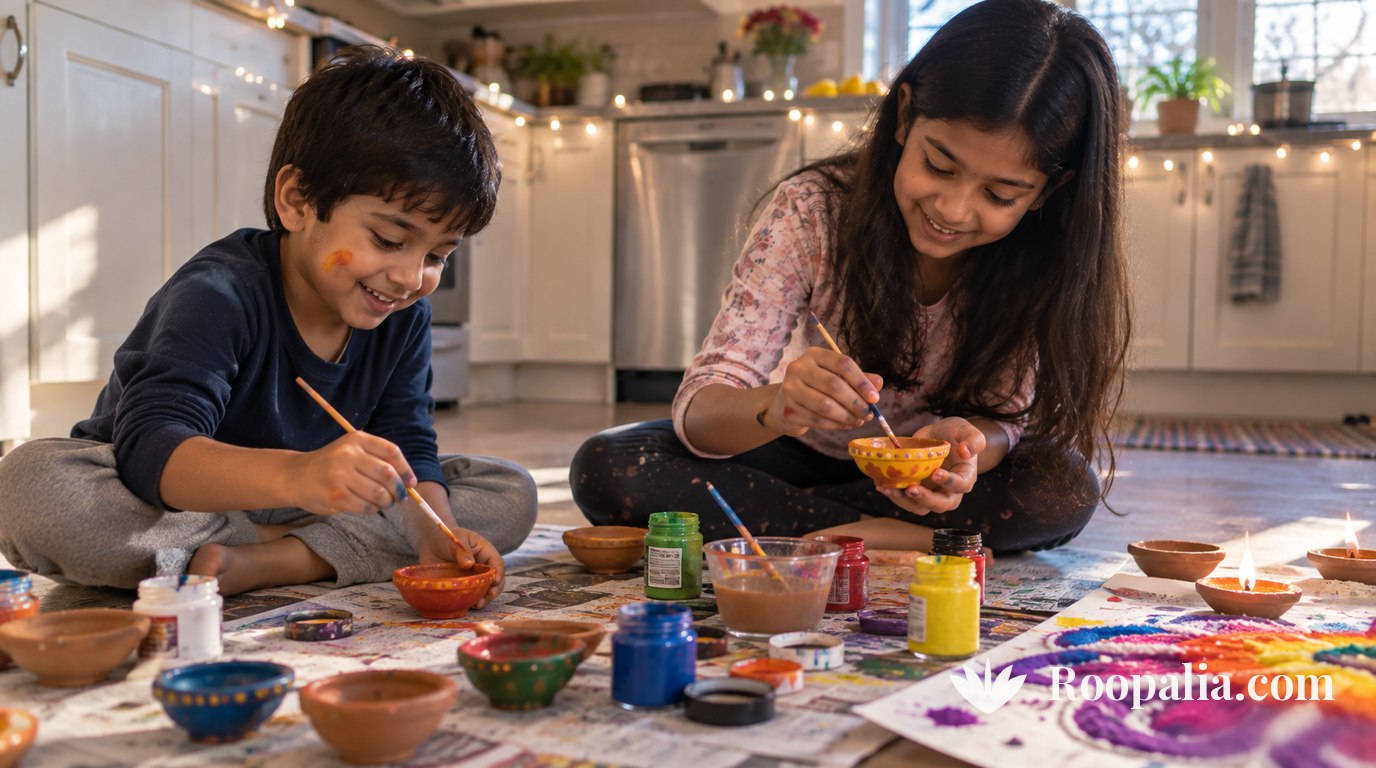
This is where the most effort goes and the least sticks.
The house gets decorated, the puja happens, the photographs get taken — and the child stands at the edge of it the whole time. Then we conclude they aren't interested in festivals. Interest follows the hands.
So the rule is simple: every festival, give the child one real responsibility. Small, but real. Arranging the diyas, laying the thali, kneading the dough, one corner of the rangoli, shaping clay for the idol. What is made by hand is what gets remembered.
Outside India there is an extra advantage that most families miss. Nothing happens automatically — no drums in the street, no markets turning festive. Which means whatever happens will happen in your home, by your hands, and the child will see it with unusual clarity. In India a festival becomes background noise; abroad it becomes a distinct family event. That is an advantage, not a deficit.
Follow your own city's clock, not India's
The commonest mistake is timing a puja by Indian time. Most vrats and festivals run on your sunrise, sunset and moonrise. We calculate these separately for cities worldwide:
Navratri ghatasthapana window ·
Karwa Chauth moonrise ·
Chhath arghya timings ·
Ganesh sthapana muhurat ·
Hartalika Teej date
And don't agonise over materials. No bel patra — use tulsi. No mango leaves — betel leaves. No clay — air-dry modelling clay from the craft shop. The child is not registering which leaf it was. They are registering that you tried.
Pillar 4 — Elders: respect is felt before it is taught
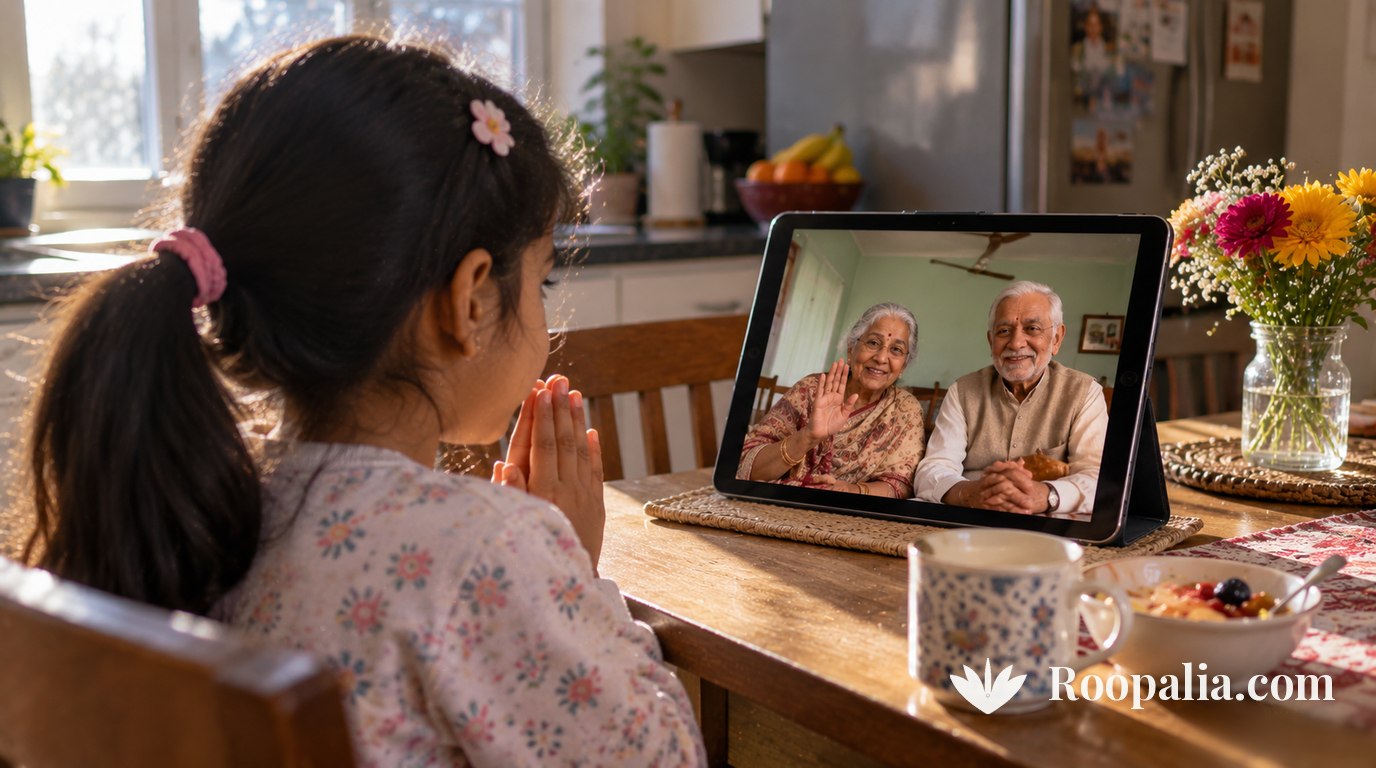
"Respect your elders" may be the most-repeated and least-effective sentence in parenting.
A child respects someone they know. Grandparents encountered for fifteen formal minutes once a year are strangers — and bowing to a stranger feels like theatre, not respect.
How to make video calls work
Fifteen minutes daily beats an hour weekly. The child starts waiting for it. Fix a slot — breakfast, or just before bed.
Ask the grandparents not to interrogate. "How was school, what marks did you get" drives a child away. "When I was your age…" pulls them in. Say this to them plainly; they won't take offence.
Give the call a task. Asking Dadi for a recipe, showing Dadaji a drawing, counting out loud. Shared activity works better than conversation.
Let the greeting count. Folding hands at the screen and saying "charan sparsh, Dadaji" is entirely valid in the tradition — and for people of that generation its value is hard to overstate.
If you want the scriptural basis for touching elders' feet, the correct method, whose feet not to touch, and how to explain it to a child, we've written a separate detailed article on it. The Manusmriti says of this same practice that four things grow in the person who habitually greets elders — lifespan, dharma, reputation and strength.
Pillar 5 — The kitchen: culture's most durable carrier
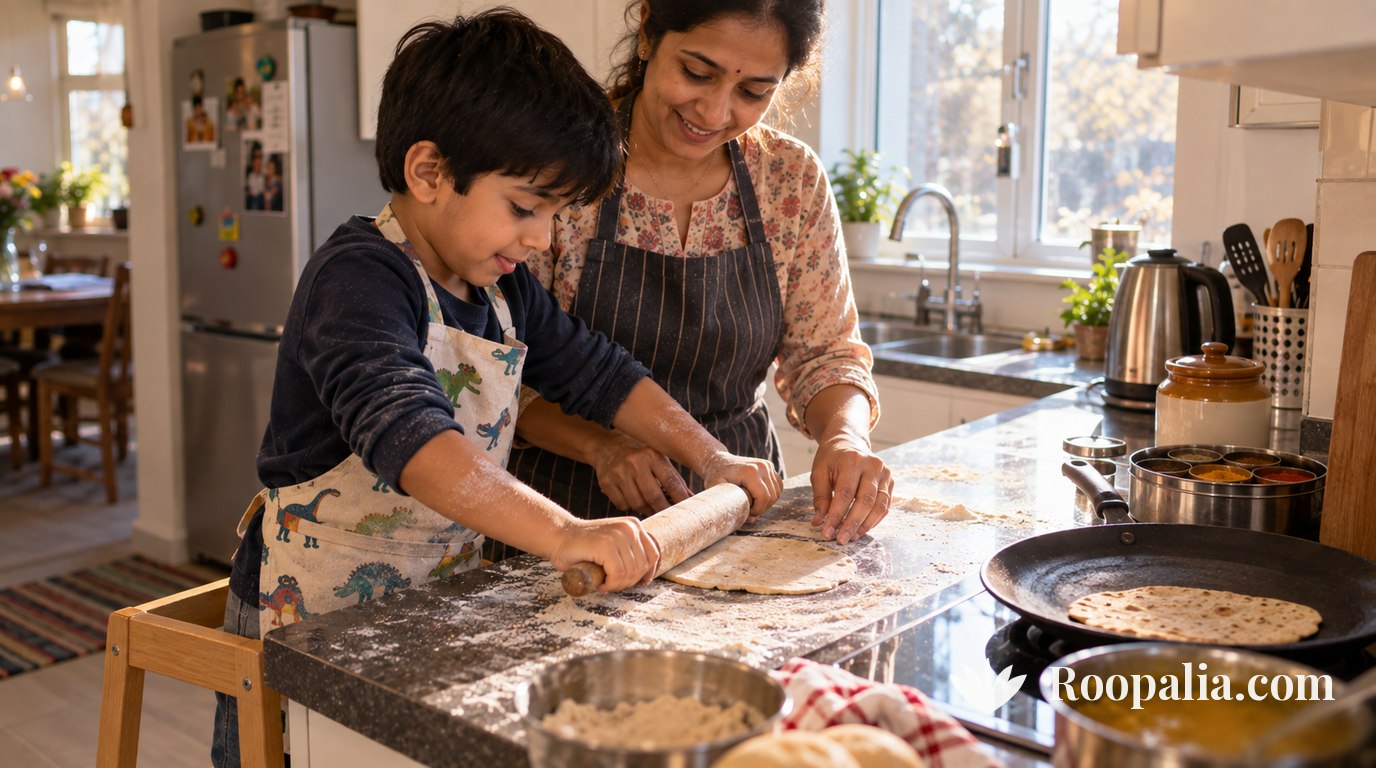
The most underrated pillar, and possibly the strongest.
What a child tastes is not undone by any argument. A child who grew up rolling lopsided rotis will, at forty, make a roti in a strange city and feel briefly at home.
- Say the spice names in your language. Jeera, haldi, hing, ajwain. That vocabulary exists nowhere else in their life, and it lasts.
- Tell them where the dish comes from. "This is from your great-grandfather's village" is enough. Food attached to a story becomes identity.
- Let them make the festival sweet. Modak, thekua, gujiya — however misshapen. Misshapen is what gets remembered.
One caution. Never force food. A child scolded nightly over dal-chawal grows up disliking dal-chawal, and everything attached to it. Identity is served, not force-fed.
What to do at which age
0–5 — the foundation years
Children learn most and resist least here. Give three things only: language (spoken constantly at home), routine and touch (a story before sleep, a greeting in the morning), and the sight of the lamp being lit. No explaining is needed — at this age the atmosphere is the lesson.
6–10 — the "why" years
Now they ask for reasons, and this is the golden window. Give the story behind every custom. Give them real jobs at festivals. A child who learns the reasons here rarely abandons the practice as a teenager.
11–15 — the argument years
They will reason, compare, and sometimes mock. Don't panic — this is examination, not rejection. The biggest mistake available here is force. Argue with them; don't try to win. And remember that Upanishadic line: the right to sort was granted by the tradition itself.
16+ — the return
Most children turn back towards their roots after this point, and they do the searching themselves. Your only job is to leave the door open — and to have packed enough into their childhood that there is something to come back to.
When your child feels embarrassed — the most delicate turn
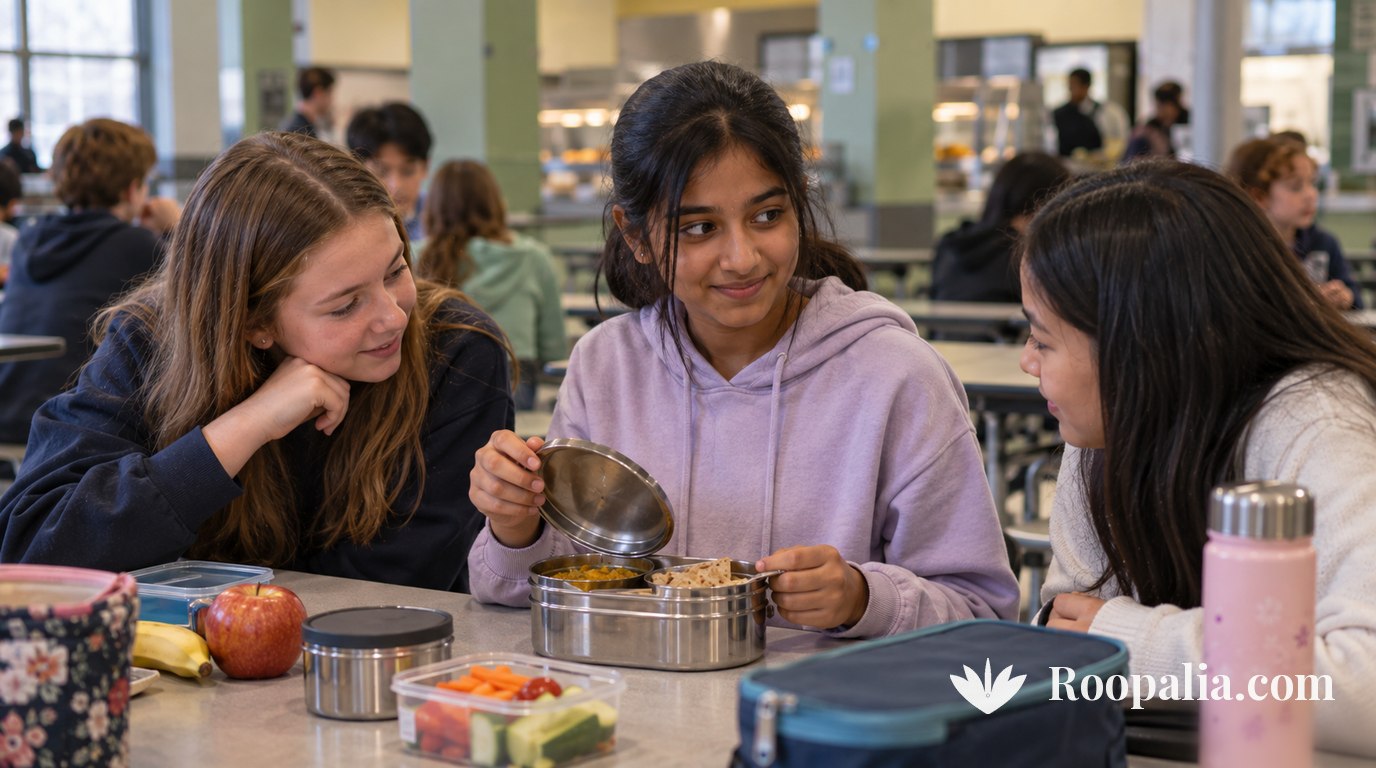
This day arrives in almost every diaspora family, and almost nobody writes about it.
One day the child doesn't want Indian food in their lunchbox. Or doesn't want you speaking Hindi in front of their friends. Or starts using a shortened, easier version of their name.
First: this is not your failure. It is a developmental stage. Between roughly ten and fifteen, a child's dominant need is to look like everyone else. Whatever marks them as different feels like a burden at that age — glasses, a name, a tiffin.
Second: do not get angry about it. "Are you ashamed of your culture?" does not bring a child back; it pushes them further away. Worse, it teaches them not to tell you next time.
So what does work?
1. Concede, without argument. Send sandwiches for a few weeks. That is strategy, not surrender.
2. Give them a sentence. Embarrassment comes from having no answer ready. "It's called dal — kind of a lentil soup, want to try?" A child armed with one confident line rarely gets teased twice.
3. Don't leave them alone in it. An Indian family in the city, a cultural event, a dance or tabla class — anywhere there are other children like them. Isolation feeds the embarrassment; company dissolves it.
4. Wait. This phase almost always passes. By sixteen or seventeen the same child is often the first to ask, "Mum, how do you make that dal?"
And one finding that should reassure you. Research on bicultural identity consistently points the same way: people who feel connected to both cultures tend to do better than those under pressure to pick one. So the goal is not to make your child "more Indian." The goal is that they never have to choose.
Trips to India — three weeks worth three years
This is your most powerful tool, and usually the worst used.
The typical trip: twenty relatives, sweets in every house, an overwhelmed child, heat, an upset stomach, and a flight home carrying the impression that India is exhausting. That produces the opposite of what you wanted.
How to make the trip do its work
Prepare them beforehand. Who they'll meet, who is related how — show photos before you fly. Preparation halves the anxiety.
Stay longer in fewer places. Ten days in one house beats two days each in five cities. Relationships form in boredom, not in touring — in the hour when there's nothing to do and the child drifts over to sit near their grandmother.
Cousins are the single strongest weapon. What you couldn't manage in ten years, a cousin their own age manages in ten days. The language usually opens there too.
Give them one responsibility. Fetching something from the shop, talking to the auto driver, paying at the counter. A child who does something in India comes home saying "I went to the shop by myself there" — and that sentence is where belonging begins.
Five mistakes nearly every household makes
- Comparison. "Look at the Sharmas' son." This sentence has never improved a child. It only teaches that affection is conditional.
- Performing for guests. "Beta, say namaste to uncle… go on, do it!" Respect extracted under pressure permanently links tradition with embarrassment in a child's mind.
- Discipline by fear. "God will be angry." "It's a sin." The child follows the rule without understanding it — and the day the fear lifts, so does the rule.
- Treating it as the mother's job. The whole burden usually lands on the woman of the house. The child is watching both parents, and the father's conduct is exactly as much of a lesson.
- Calling every preference "tradition." The subtlest mistake. Not every family habit is scripture. Dressing up your own convenience as shastra means that when the child eventually works it out — and they will — they lose trust in the genuine parts too.
In closing
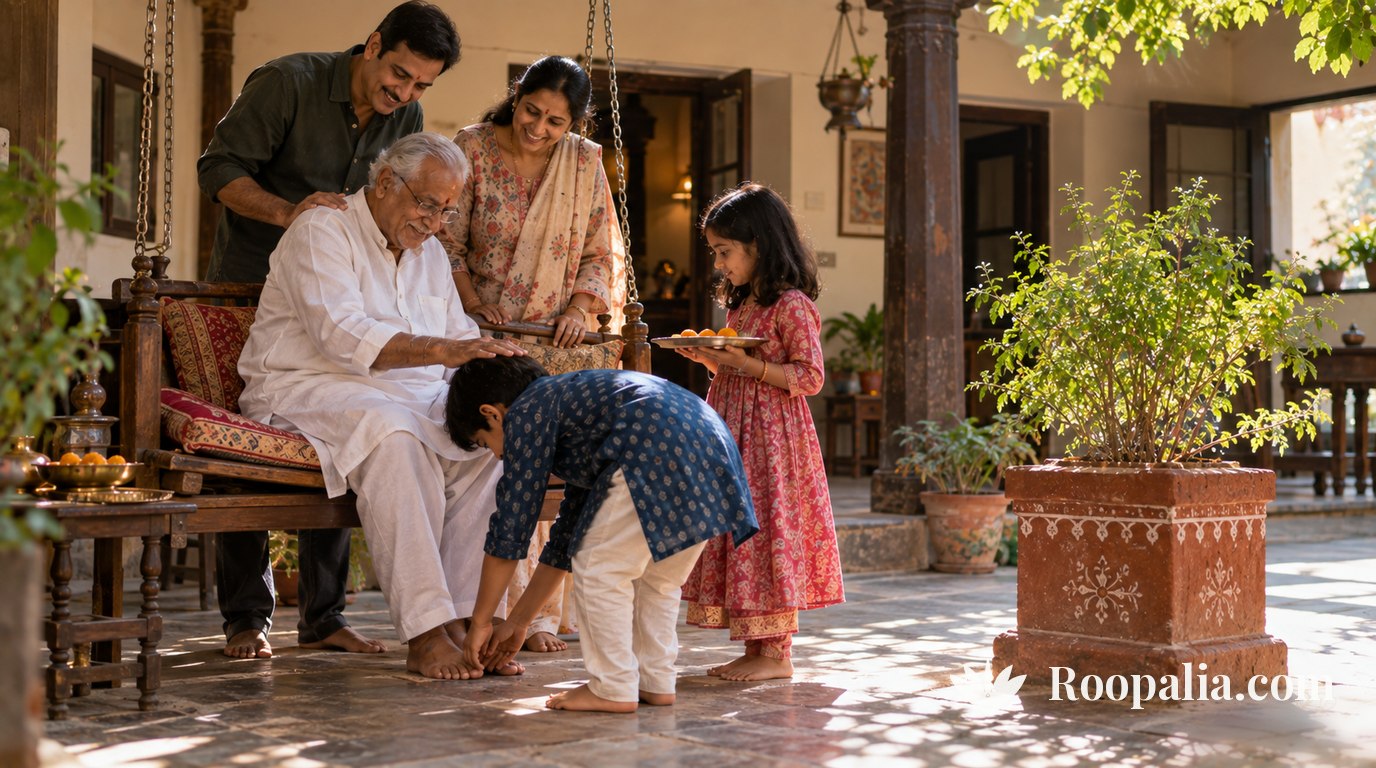
You are not shaping them — you are packing their luggage
Passing on values does not mean producing a copy of yourself. The teacher in the Taittiriya Upanishad said as much: take what is good. Your job is not to decide what your child will keep; your job is to make sure there is something there to keep. Language, stories, tastes, the smell of a festival, a grandmother's voice — you pack all of it into their childhood. At some point in their life they will open that case. What matters, on that day, is whether anything was in it.
Frequently Asked Questions
How do I teach my child Indian values?
What does "sanskar" actually mean?
What are the 16 samskaras?
At what age should I start teaching values?
How do I raise my children with Indian culture while living abroad?
My child understands Hindi but won't speak it. What should I do?
Will teaching two languages confuse or delay my child?
My teenager seems embarrassed about being Indian. What do I do?
Can strictness or fear be used to instil values?
What do Hindu scriptures say about passing values to children?
📷 AI-generated images. For illustration only.
🙏 This article is general cultural and family guidance. Scriptural references are drawn from widely available editions of the Taittiriya Upanishad, the Manusmriti and the Grihya Sutras; customs vary by region and by family. For serious concerns about a child's behaviour or development, consult a qualified doctor or child psychologist.