
Chhath 2026 dates — the four days
Chhath falls on the sixth day of the bright fortnight of Kartika — exactly six days after Diwali. In other words, once Navratri and Diwali have come and gone, eastern India's biggest observance begins. The name comes straight from that: shashthi, the sixth, becomes Chhath.
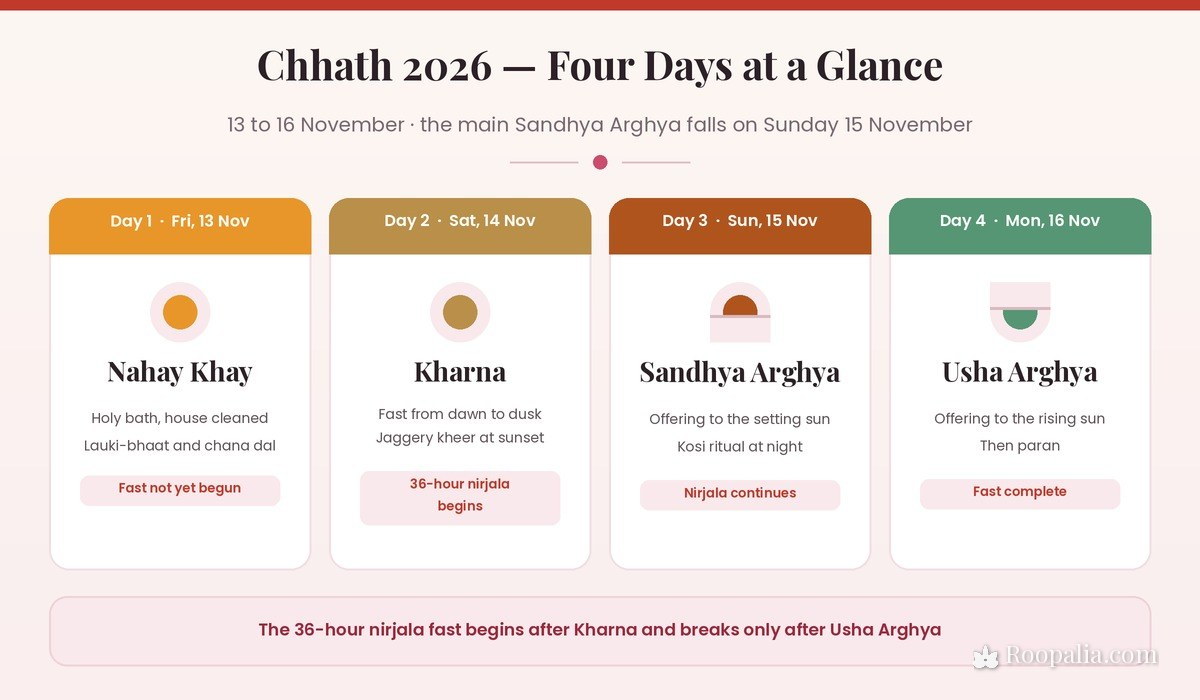
One thing to understand before anything else: Chhath has no muhurat in the way most Hindu observances do. No almanac fixes a lucky hour. The sun itself sets the clock. Whenever the sun goes down in your city, that is your Sandhya Arghya. Whenever it comes up, that is your Usha Arghya. Which is exactly why the city-by-city tables further down matter more here than they would for any other festival.
Who is Chhathi Maiya? The answer explains everything
Most write-ups mention her name and move on. Understanding who she actually is changes how the whole fast reads.
Chhathi Maiya is not a stray folk deity. In scripture she is Shashthi Devi — described as a mind-born daughter of Brahma and a sister of Surya, and identified with Usha, the Vedic goddess of dawn whose hymns appear in the Rigveda.
Now the connection that ties it together. In North Indian homes, the ritual held on the sixth day after a baby is born — literally called the chhathi — is a worship of this same goddess. She is the protector of newborns, the one who grants children and lengthens their lives.
So the goddess this four-day fast is kept for is the same one who is believed to have stood at your child's cradle on the sixth day of their life. What the vrat asks for is not wealth or success. It asks for the years of a child. Which is why the woman keeping it does not count the hours.
Folk memory also threads Chhath into the Mahabharata. Karna, a son of Surya, is said to have stood waist-deep in water offering prayers to his father — the exact posture every vrati takes today. Another telling places Draupadi and Kunti in sun worship. Treat these the way you would a story an elder repeats every year: not as history, but as the way a community explains itself to itself.
Day 1 — Nahay Khay (Friday, 13 November)
Chhath begins not with prayer but with cleaning — and a level of cleaning that happens at no other point in the year.
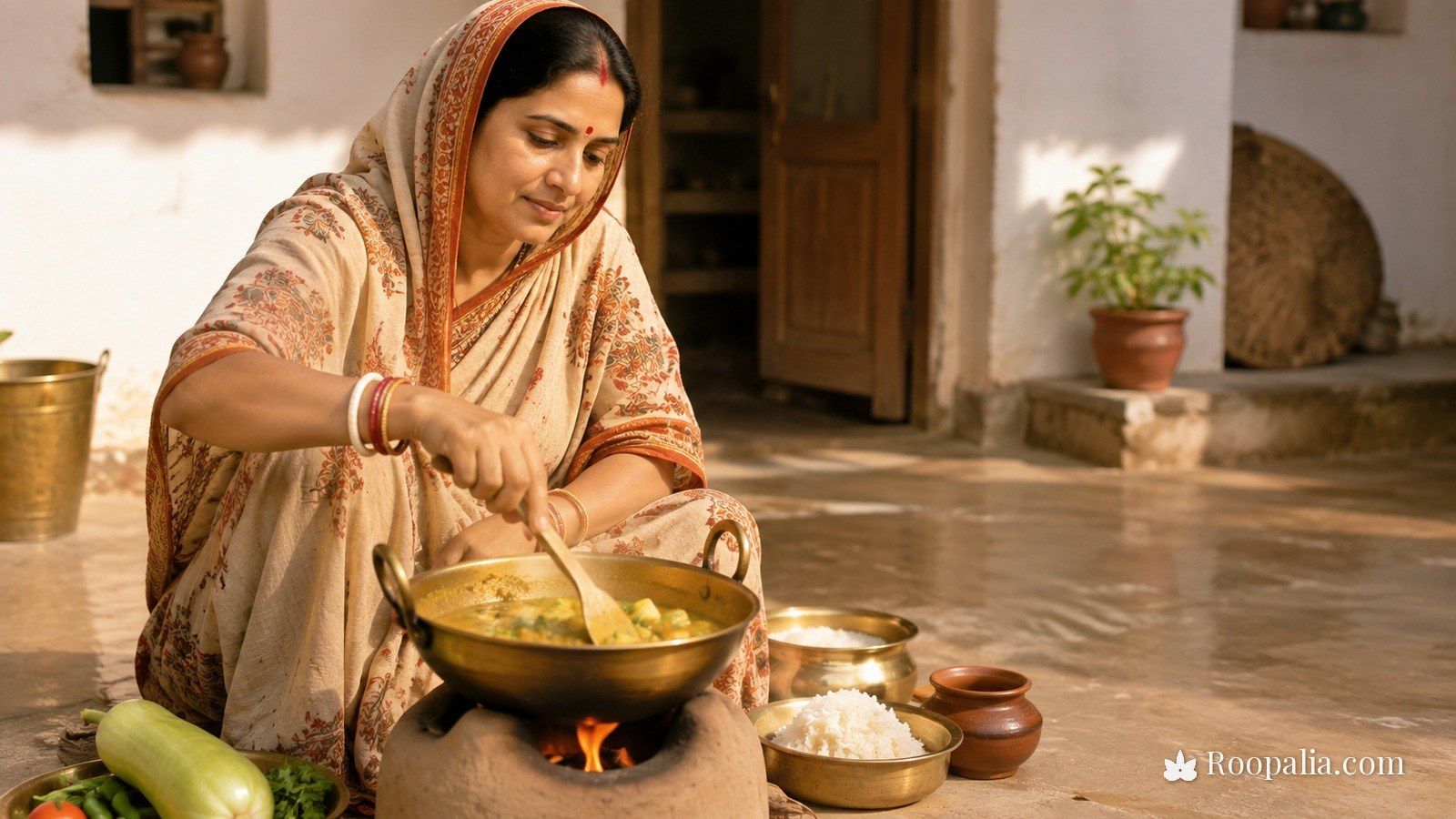
The vrati bathes in a river, pond or at home. Then the entire house is washed down — kitchen, courtyard, even the path to the ghat. After that comes the meal that gives the day its name: lauki (bottle gourd) curry, chana dal and arwa rice, cooked on a clay stove over mango wood, in vessels kept aside for the purpose. No onion, no garlic, nothing left over from before.
The food is offered to Chhathi Maiya first, then eaten by the vrati, then by the family. This is the vrati's last full meal. Everything from here is discipline.
💡 A word most guides skip: the person keeping the fast is called the vrati or parvaitin. And Chhath is not exclusively a women's fast — men keep it too, in many families for generations. Tradition also holds that once a household begins this vrat, it is meant to be kept for life and then handed to the next generation, not dropped at will.
Day 2 — Kharna (Saturday, 14 November)
This is the hinge the whole observance turns on, and the day outsiders understand least.
On Kharna the vrati fasts from sunrise to sunset — no food and no water at all. After the sun goes down, kheer made with jaggery is cooked on the clay stove: jaggery, arwa rice and milk, with roti and fruit alongside.
A comparison worth holding on to: the Hartalika Teej nirjala fast runs 24 hours, Chhath's runs 36. And where Teej is kept at home, Chhath sends the vrati into cold water twice.
After the offering, the vrati eats. Households traditionally keep complete silence while she does — no talking, no noise. And the moment she finishes, the 36-hour nirjala fast begins.
Thirty-six hours. Not a bite, not a sip. In that window she will pass an evening, a full night, a full day and another night — and twice in the middle of it she will stand waist-deep in cold November water. Families who keep Chhath will tell you that nobody in the house really sleeps on those two nights.
Kharna kheer is shared around the neighbourhood. In homes across Bihar and eastern Uttar Pradesh this evening is a small festival of its own — and for a great many people who grew up there, it is the single sharpest food memory of childhood.
Thekua — the prasad Chhath cannot do without
If Chhath has one taste, it is thekua.
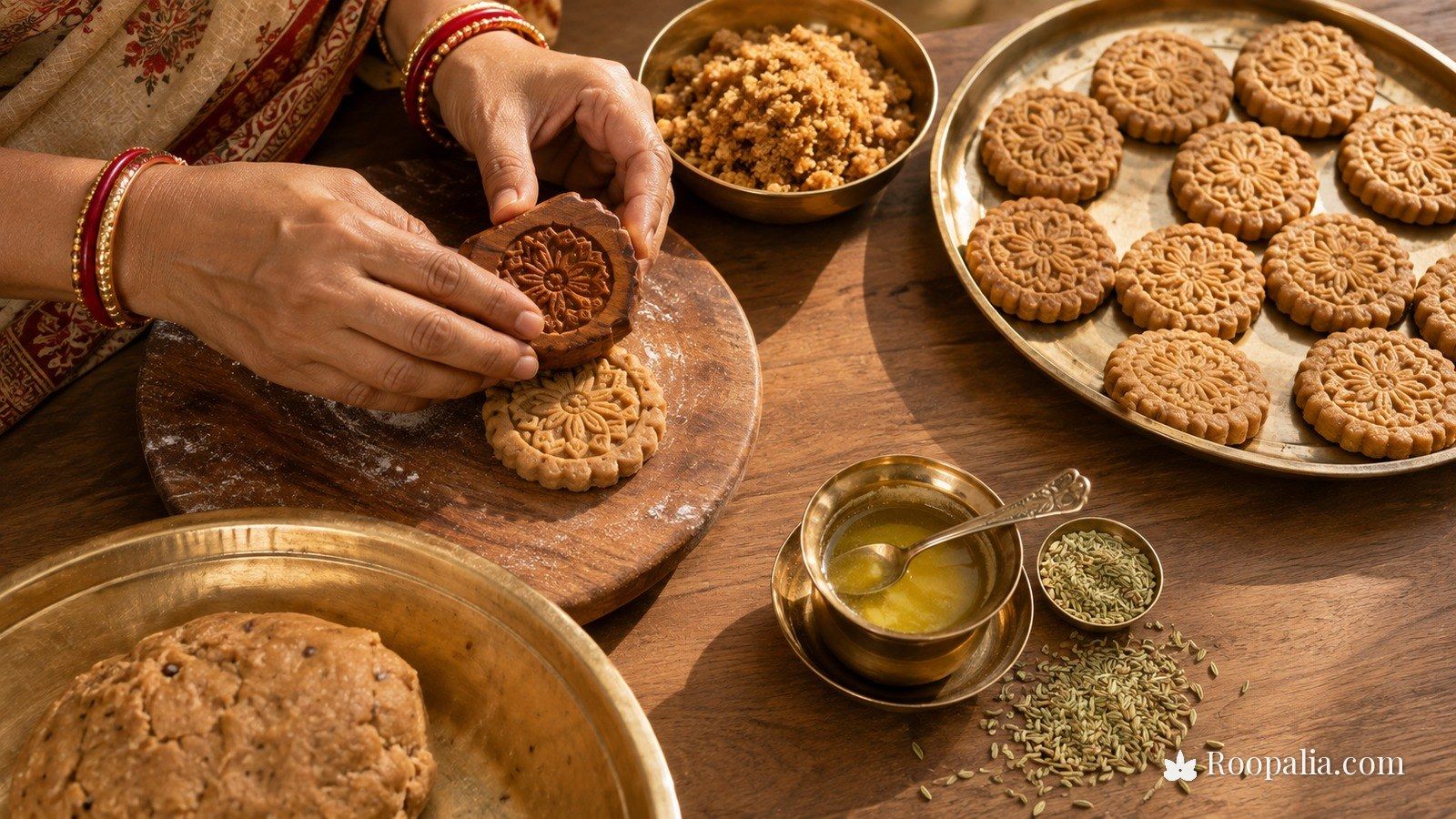
The ingredients are humble: wheat flour, jaggery, ghee. The making is not. On thekua day the kitchen is treated like a shrine — bathed, in clean clothes, nothing tasted while cooking. Some households keep a separate grinding stone for the flour.
The method, briefly: dissolve jaggery in water and strain it, add a little fennel and a spoon of ghee as shortening, and knead the wheat flour stiff — nothing like soft roti dough. Press small balls into the carved mould, then fry in ghee on a low flame until deep gold. The low flame is the entire secret; rush it and you get colour outside and raw dough inside.
🌿 Why thekua and not something richer? Because it contains nothing perishable — no milk, no khoya. It keeps for weeks. In an era of distant ghats and no refrigeration, that made it the only sensible prasad. Tradition and practicality tend to travel together more often than we credit.
The samagri — everything you will need
Look at a Chhath shopping list and one thing is immediately obvious: nothing on it is manufactured, and nothing comes in plastic. Bamboo, clay, brass, leaves and whatever the fields have just produced.
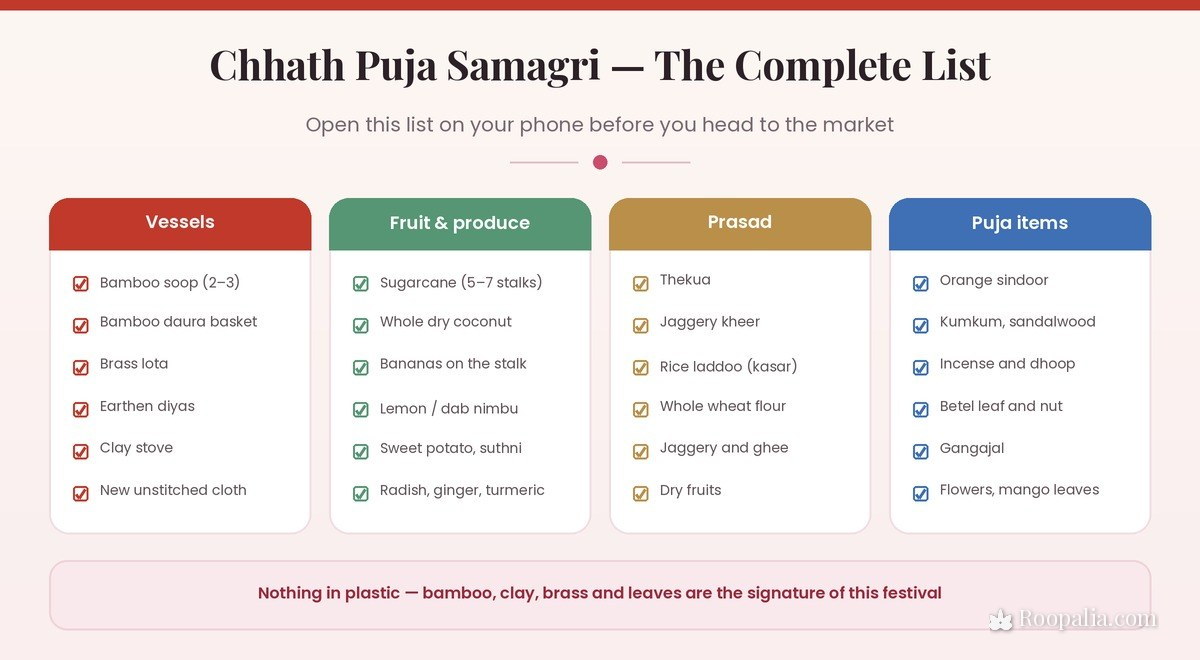
One detail worth noticing: the sindoor used at Chhath is orange rather than red, and the vrati applies it in a long line from the bridge of the nose to the parting. It is a signature of this festival alone.
Several items carry their own meaning. The soop (a flat bamboo winnowing tray) and daura (a round bamboo basket) are made of bamboo because bamboo signifies the growth of a family line — fitting for a fast kept for children. Sugarcane is the Kartika harvest, so what is offered is what the earth has just given. Dry coconut keeps almost indefinitely and stands for a resolve that does not spoil.
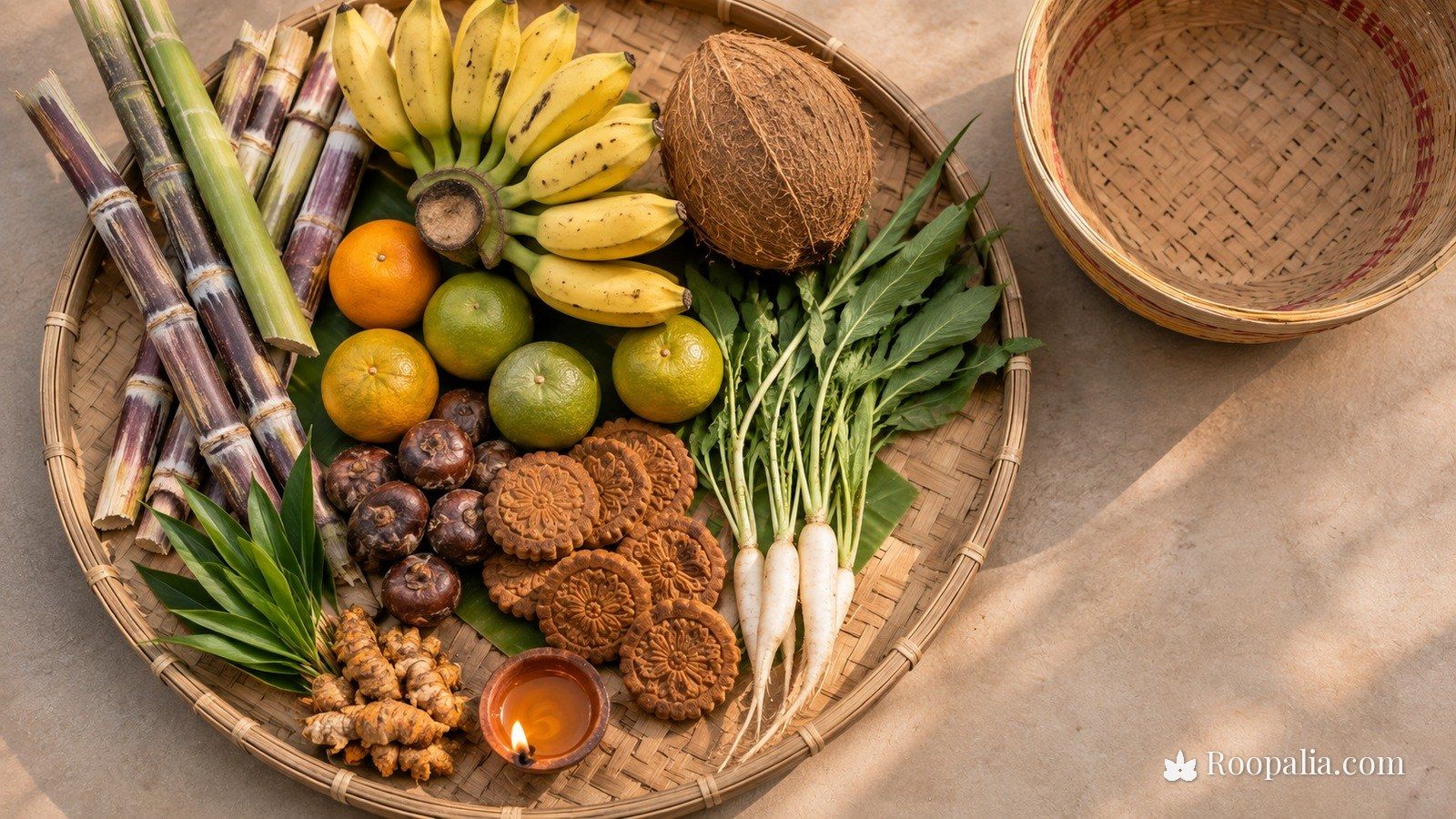
And here is something that reads very differently in 2026 than it once did: because Chhath uses no idol, there is no immersion. No plaster, no paint, nothing dissolving into a river afterwards. Environmentalists routinely call it India's cleanest large festival — and nobody retrofitted that virtue onto it. It was built this way.
Day 3 — Sandhya Arghya (Sunday, 15 November)
This is the heart of it, and arguably the most photographed hour in the Indian religious calendar.
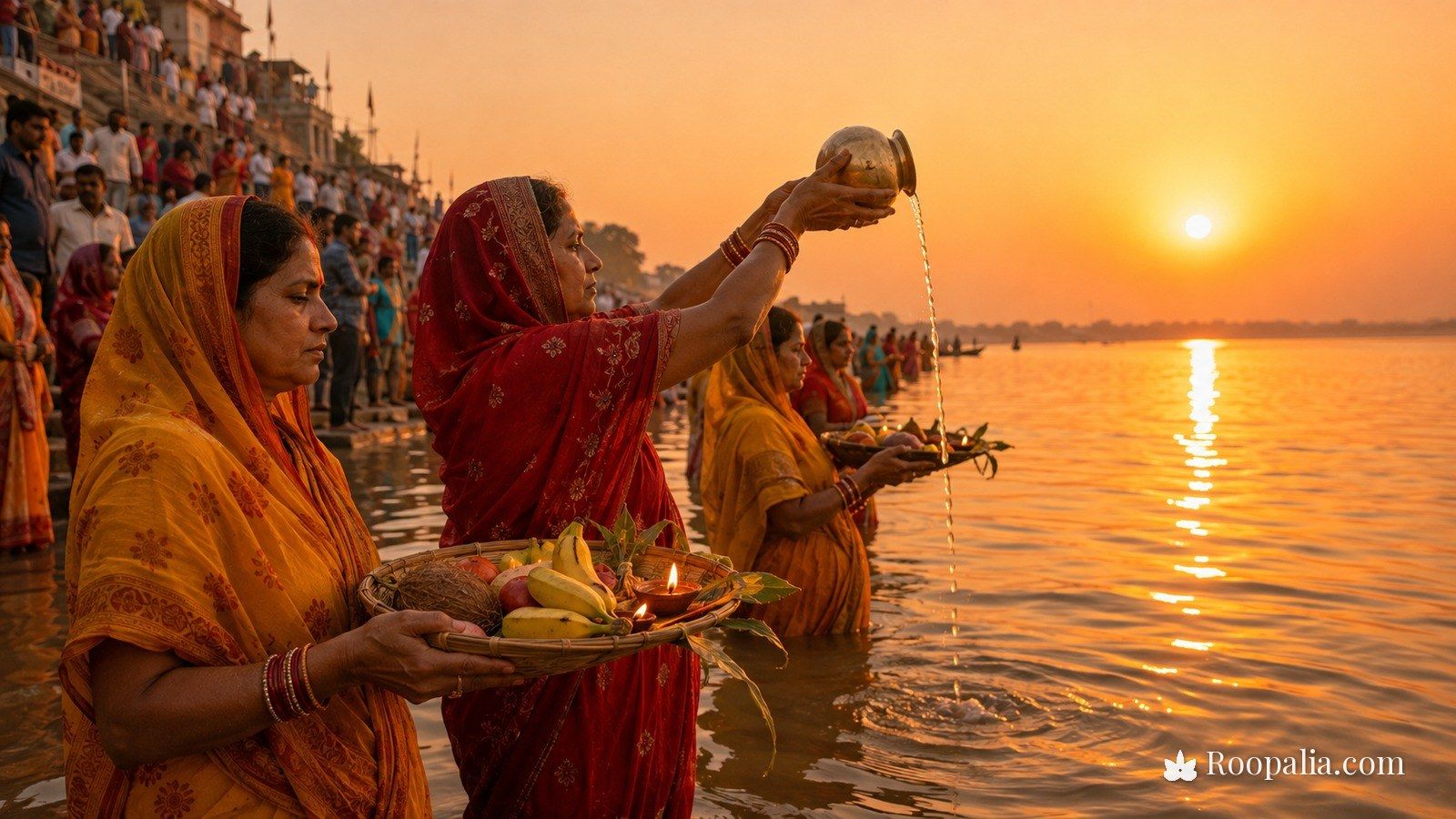
From midday the soops are loaded at home. As the light drops, the family walks to the ghat with the daura carried on someone's head — usually a man of the house, barefoot. Folk songs carry the whole way.
At the water the vrati wades in to her waist and faces west. In her hands, a brass vessel of water and milk. And as the sun touches the horizon, she pours — to the sun that is going.
Sit with that idea for a moment. Every one of us knows how to salute what is rising — the thing gaining, succeeding, growing brighter. Chhath insists on thanking what is declining first. What is spent. What has finished its work. The festival's argument is that gratitude is owed to the departing precisely because it carried you all day.
After the offering she stays in the water and prays. Some devotees arrive at the ghat performing dandavat — full-body prostrations along the road, rising and lying flat again the whole distance. That is done when a wish has been granted.
What happens at the ghat happens nowhere else
Here is the detail that most sets Chhath apart, and it is worth stating plainly.
There is no priest, no idol and no temple. The vrati stands in the water and offers directly to the sun, with nobody in between. No mantra has to be sourced from a specialist, no fee changes hands, no permission is required from anyone. Britannica describes the worship in exactly these terms.
The consequence is visible on the bank. The woman from the biggest house in the village stands in the same water as the labourer's wife two steps away. Same sun, same soop, no separate queue. For one evening a year, caste and standing dissolve into the river — and that is not a modern reform grafted on, it is simply how the festival has always worked.
Kosi — the most beautiful hour of the night
After the sunset offering, households where a wish has been fulfilled — a child born, a marriage settled, an illness survived — perform the Kosi ritual at night.
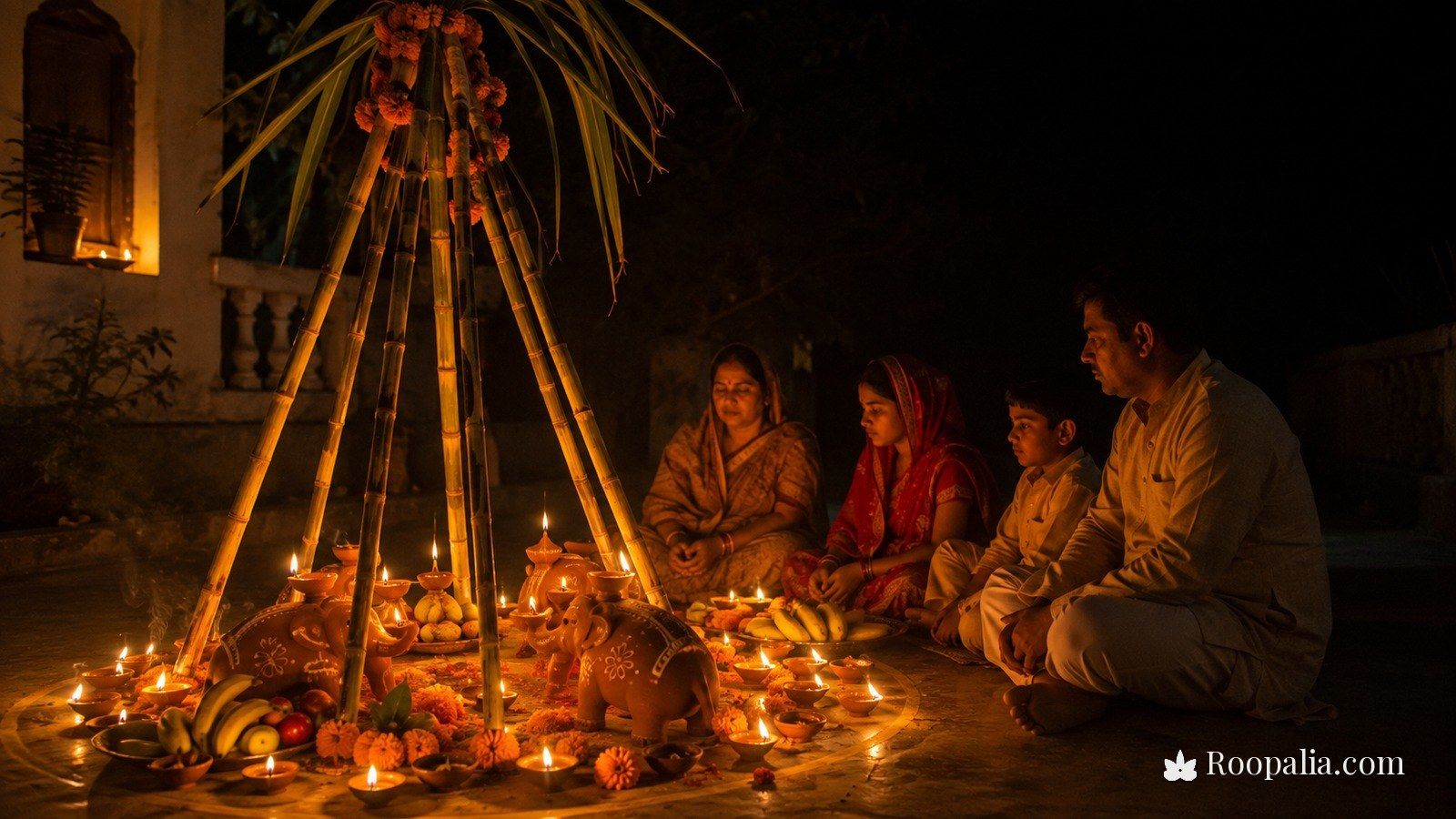
Five sugarcane stalks are stood up in the courtyard and tied together at the top to form a small canopy. Beneath it go earthen lamps, clay vessels shaped like elephants, and offerings of fruit. The family sits around it singing.
The same Kosi is carried to the ghat and lit again the next morning. People seeing it for the first time usually say the same thing — that they had never encountered anything quite like a dark courtyard lit only by oil lamps, with low singing over it.
Day 4 — Usha Arghya and paran (Monday, 16 November)
It is still dark. Perhaps four in the morning. It is November-cold. And the ghat is full again.
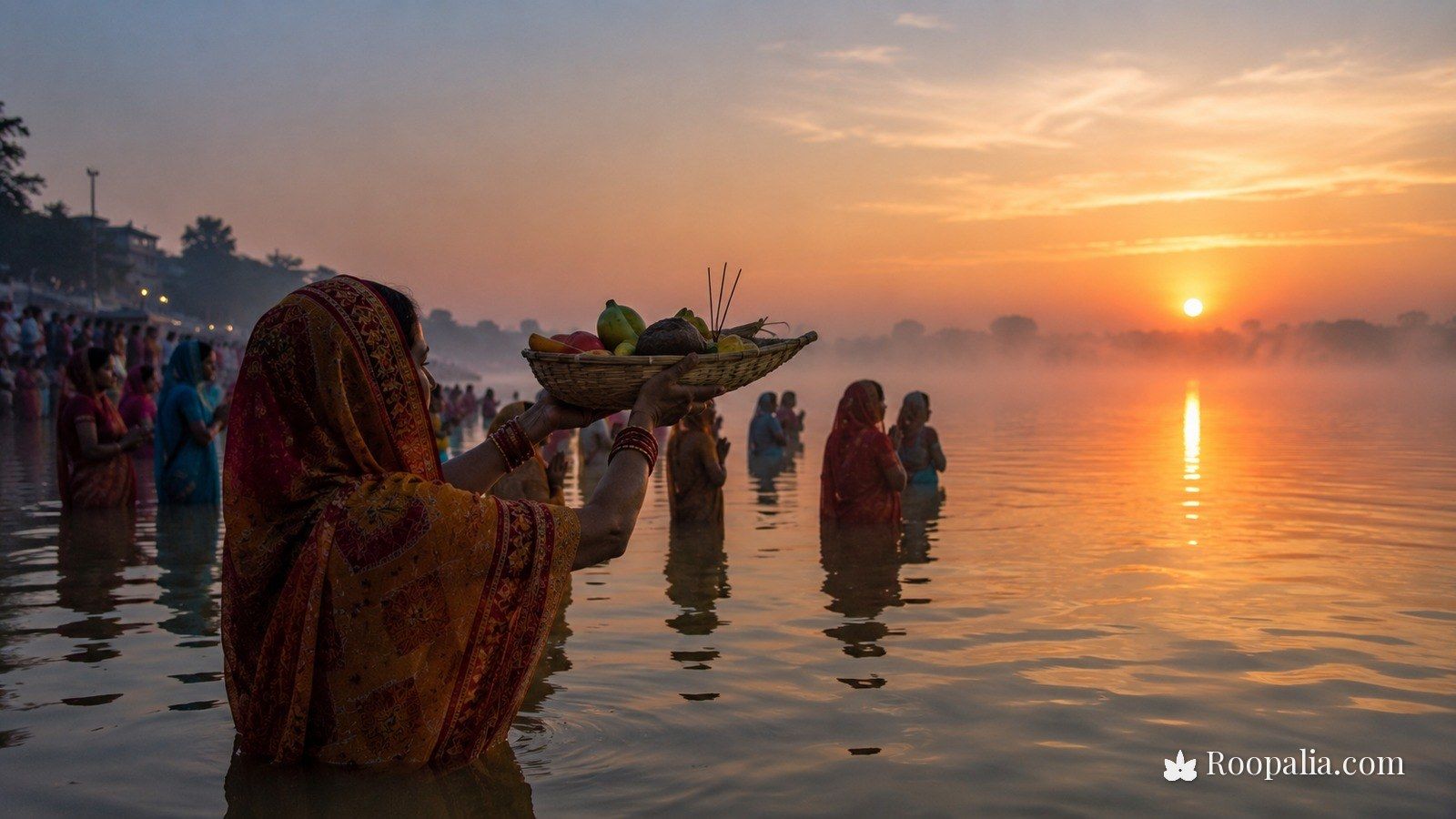
The vrati enters the water again, facing east this time. As the horizon reddens, the same soop goes up. An offering to the rising sun — thirty-six hours after the last drop of water.
Then paran, the breaking of the fast. Tradition breaks it with ginger and jaggery, then a little water, then prasad. And then the whole household sits down together with thekua and sends plates around the neighbourhood.
🍵 The sense behind the sequence: after thirty-six hours the first thing eaten should not be heavy. Water first, then ginger and jaggery or lemon water, then something light — and only later a proper meal. Vratis who go straight to a full plate frequently end up nauseous or dizzy. This is not about piety; it is about how a fasting body restarts.
Arghya timings for your city
Because Chhath is timed by the sun rather than an almanac, the numbers below are all you need. These are the sunset on 15 November and the sunrise on 16 November — your Sandhya and Usha Arghya. The 14 November sunset is included too, since that is when the Kharna fast is broken.
| City | Kharna — 14 Nov sunset | Sandhya Arghya — 15 Nov sunset | Usha Arghya — 16 Nov sunrise |
|---|---|---|---|
| Patna | 5:03 pm | 5:03 pm | 6:09 am |
| Muzaffarpur | 5:01 pm | 5:01 pm | 6:09 am |
| Gaya | 5:05 pm | 5:04 pm | 6:08 am |
| Ranchi | 5:06 pm | 5:05 pm | 6:04 am |
| Varanasi | 5:12 pm | 5:12 pm | 6:17 am |
| Lucknow | 5:18 pm | 5:17 pm | 6:28 am |
| New Delhi | 5:30 pm | 5:29 pm | 6:45 am |
| Kolkata | 4:55 pm | 4:54 pm | 5:51 am |
| Mumbai | 6:02 pm | 6:02 pm | 6:48 am |
| Ahmedabad | 5:57 pm | 5:57 pm | 6:55 am |
| Hyderabad | 5:42 pm | 5:42 pm | 6:23 am |
| Bengaluru | 5:52 pm | 5:51 pm | 6:20 am |
| Kathmandu, Nepal | 5:14 pm | 5:13 pm | 6:26 am |
Computed astronomically from each city's latitude and longitude. Within a large city there may be a minute or two of variation. Reach the ghat 30–40 minutes early — finding a spot and arranging the soop takes about that long.
Thirty-six hours without water — look after the body too
This is the part devotional write-ups tend to leave out, and the silence does no favours. The Chhath fast is genuinely demanding, and the person keeping it deserves as much care as the ritual does.
Practical precautions
- Hydrate heavily before Kharna — drink plenty through Nahay Khay and into Kharna morning. Whatever is in your system has to last thirty-six hours.
- Cold water and long standing — November river water is genuinely cold. If your knees or back protest, do not stay in for long; the arghya can be offered from the water's edge.
- Dizziness, blurred vision, real weakness — sit down at once and tell your family. This is not a test to be passed.
- Do not break the fast with a heavy meal — water first, then ginger and jaggery, then something light.
🩺 Who should think carefully before keeping this fast: anyone pregnant or breastfeeding, anyone on diabetes or blood-pressure medication, people with kidney conditions, and the elderly. Tradition itself allows for this — another family member can keep the vrat, or the vrati can observe a lighter fruit-and-water fast and still make the offering. What is being asked of Chhathi Maiya is the wellbeing of the family; risking your own health does not strengthen that request. If you take regular medication, speak to your doctor before deciding.
How Chhath crossed the oceans
Chhath's journey abroad did not begin with software engineers. It began in the 1830s, with indentured labourers.
When workers were shipped out of Bihar and eastern Uttar Pradesh to sugar colonies — Mauritius, Fiji, Trinidad, Guyana, Suriname — they carried almost nothing. What travelled with them were songs, food and festivals, because those need no luggage. Chhath survived in those places for generations, adapted to unfamiliar rivers and different coastlines, long before anyone used the word diaspora.
The second wave is the one happening now. Chhath is observed today in the United States, Canada, the United Kingdom, Australia, Singapore, Malaysia, Japan, Mauritius and across the Gulf. In New Jersey, hundreds gather at Donaldson Park in Highland Park; there are organised ghats in Raleigh, Chicago and California. In London and Toronto, ordinary park lakes become ghats for one evening.
And where there is no open water at all — Doha, Abu Dhabi, a high-rise in Singapore — people fill a large steel tub on a terrace, stand in front of it at their own local sunset, and play Sharda Sinha through a phone speaker. The ghat has moved. The song has not.
Observing Chhath abroad — the practical guide
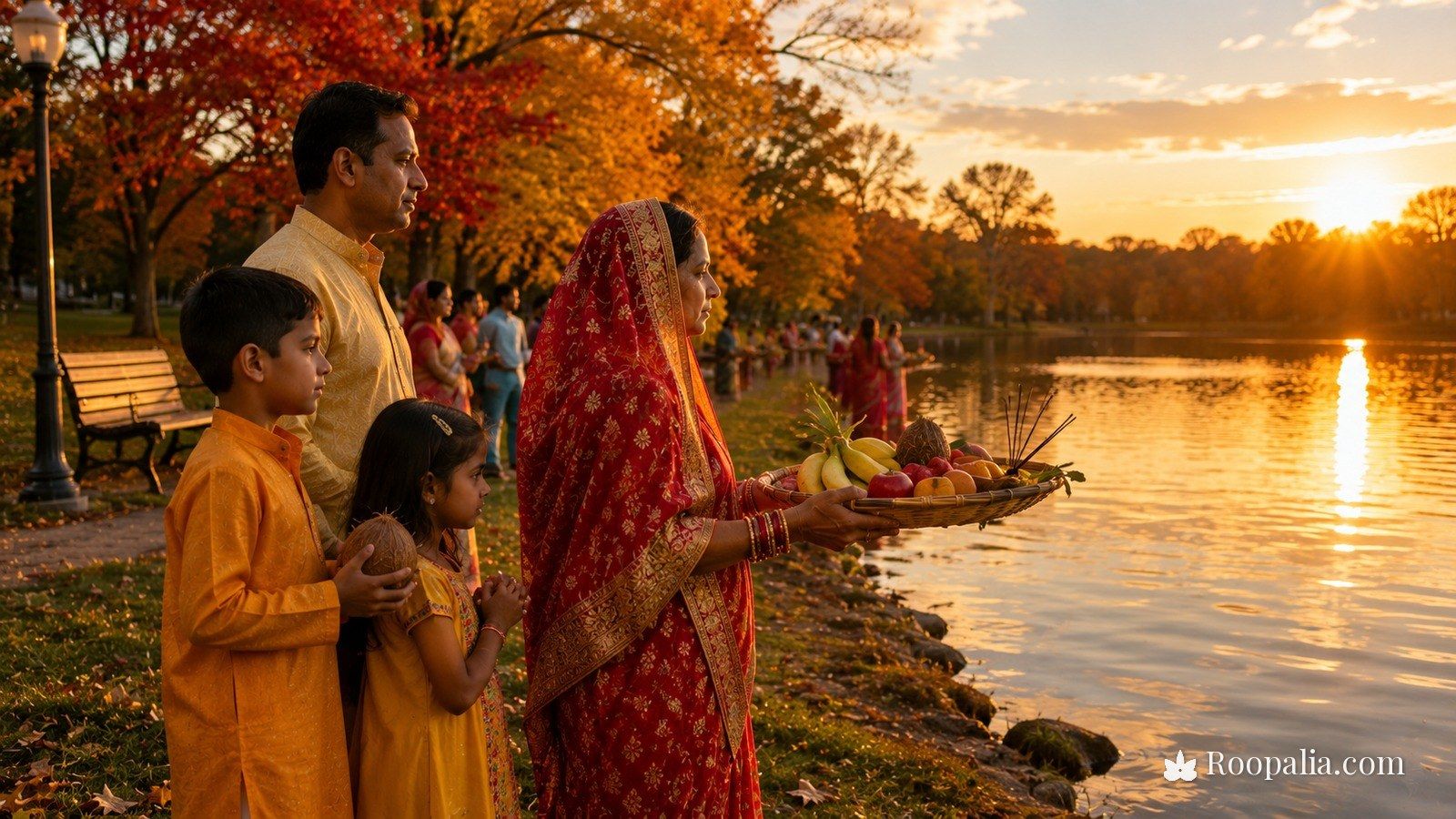
First, the question that causes most confusion. The arghya is always offered at your own city's sunset and sunrise, never at Indian times. The festival is bound to the sun, not to a clock. When your sun goes down, that is your Sandhya Arghya.
| City | Sandhya Arghya — 15 Nov sunset | Usha Arghya — 16 Nov sunrise |
|---|---|---|
| New Jersey / New York | 4:40 pm | 6:46 am |
| Chicago, USA | 4:31 pm | 6:43 am |
| San Francisco, USA | 5:00 pm | 6:52 am |
| Toronto, Canada | 4:54 pm | 7:14 am |
| London, UK | 4:13 pm | 7:21 am |
| Dubai, UAE | 5:33 pm | 6:38 am |
| Doha, Qatar | 4:47 pm | 5:53 am |
| Singapore | 6:52 pm | 6:49 am |
| Sydney, Australia | 7:37 pm | 5:45 am |
| Melbourne, Australia | 8:10 pm | 6:01 am |
| Tokyo, Japan | 4:37 pm | 6:19 am |
| Port Louis, Mauritius | 6:28 pm | 5:24 am |
Computed astronomically. Cross-check the same dates in your local weather app. If your family follows a particular panchang, follow that.
Where to find water
Easier than it sounds. In North America, park lakes are the standard answer, and several have become established Chhath sites with hundreds of families. In the UK and Canada, local park lakes serve the same purpose for an evening.
Where there is no open water — much of the Gulf, or an apartment in a dense city — people use a large tub of clean water on a terrace, balcony or courtyard, and sometimes a swimming pool. Tradition accommodates this, because the substance of the arghya is not the volume of water but the act of standing before the sun and offering.
📍 Three things to sort out before you go: First, many countries regulate entering public lakes — check with the local parks authority; in several places Chhath permissions are granted routinely and organisers arrange them. Second, November water in the northern hemisphere is very cold, so keep children and elderly relatives out of it. Third, take your prasad, fruit and flowers home with you rather than leaving them in the water — that is our own tradition's rule as much as any council's.
Sourcing the samagri
Bamboo soops and dauras now turn up in Indian grocery stores across the US, UK, Canada and the Gulf, and online. For whatever you cannot find:
- No bamboo soop? A round cane or wicker basket works, as long as it is natural fibre and not plastic.
- No sugarcane? Latin American grocers usually stock it. Failing that, many families simply increase the seasonal fruit.
- Make thekua at home — wheat flour, jaggery and ghee are available everywhere. Without a mould, press a pattern with a fork; the taste is unchanged.
- No earthen lamps? Brass or steel diyas are fine. Avoid candles.
Explaining Chhath to children born abroad
This may be the most valuable thing you do all four days.
A child growing up in Chicago or Sydney will not absorb this the way you did — from the crowd at the ghat, from a whole street preparing at once, from grandmothers singing in the courtyard. If it reaches them, it reaches them through you.
So skip the rules. Lead with the idea: there is one festival in the world that thanks the setting sun before the rising one. Children of any age understand that instantly — say thank you to the thing that is leaving.
If they already know Karwa Chauth, use the contrast — that one waits for the moon, this one waits for the sun; that one is kept for a husband, this one for a child.
Then tell them there is no priest, no statue and no temple, and that on the riverbank the richest and poorest families stand in the same water. A child who hears the language of equality every day at school will find it genuinely interesting that their own tradition has been practising it for centuries without announcing it.
Above all, give them a job. Let them press the thekua mould. Let them place the bananas in the soop. Let some flour hit the floor. They will not remember the date or the timing. They will remember that one November morning, in the dark, their mother took them to the edge of a lake — and that when the sun came up, everybody went quiet at the same moment.
And if you are doing this alone this year, with no community anywhere near you, remember that this festival has never needed a crowd. No temple, no priest, no permission. Clean water, one soop, and a sun that is the same in every country. The one setting over your balcony is the one setting over the ghats of Patna.
The songs
Chhath's other signature is its music. Sung in Bhojpuri, Maithili and Magahi, these songs appear in no scripture — they have passed from mother to daughter and mother-in-law to daughter-in-law entirely by ear.
What is striking about them is the tone. Chhathi Maiya is not addressed at a distance. She is argued with, coaxed, updated on household news. The sun is less a deity than a member of the family.
For families abroad the songs have become something more again. A woman standing before a tub on a terrace in Doha plays the same recording her grandmother sang in a courtyard. The ghat has changed, the water has changed, the country has changed. The voice has not.
Chaiti Chhath — the other one
Few outside the region know that Chhath happens twice a year. The Kartika version is the large, famous one — but Chaiti Chhath falls in Chaitra, around March or April, following exactly the same four-day structure.
It draws far smaller crowds and is mostly kept by families with a particular vow. Because it lands at the start of the hot season, it is considered physically harder than the November observance.
In closing
Thank what is leaving, first
Strip away the four days, the samagri and the discipline, and a single idea sits underneath all of it. We will bow to what is declining, because it carried us through the day. And we will trust it to return. That trust is what makes thirty-six hours possible — and it is what pulls a mother out of bed in the dark, seven thousand miles from the Ganga, to stand at the edge of a cold suburban lake and wait for the same sun. 🌅
Frequently asked questions
When is Chhath Puja in 2026?
Why is the setting sun worshipped before the rising sun?
Is it true that Chhath has no priest and no idol?
How long is the Chhath fast?
What goes into the Chhath samagri?
What is thekua and how is it made?
Can men keep the Chhath fast?
Can someone who is not from Bihar observe Chhath?
How do you observe Chhath abroad without a river?
Should pregnant women or people on medication keep this fast?
Why is Chhath called an eco-friendly festival?
What is the difference between Chaiti Chhath and Kartika Chhath?
📖 A note on variation: Chhath customs differ by region, village and family — where the Kosi is set up, how many soops are carried, which songs are sung. What is described here is the most widely followed practice. Whatever your family has always done is right for your family. For dates and timings, do cross-check against your local panchang.