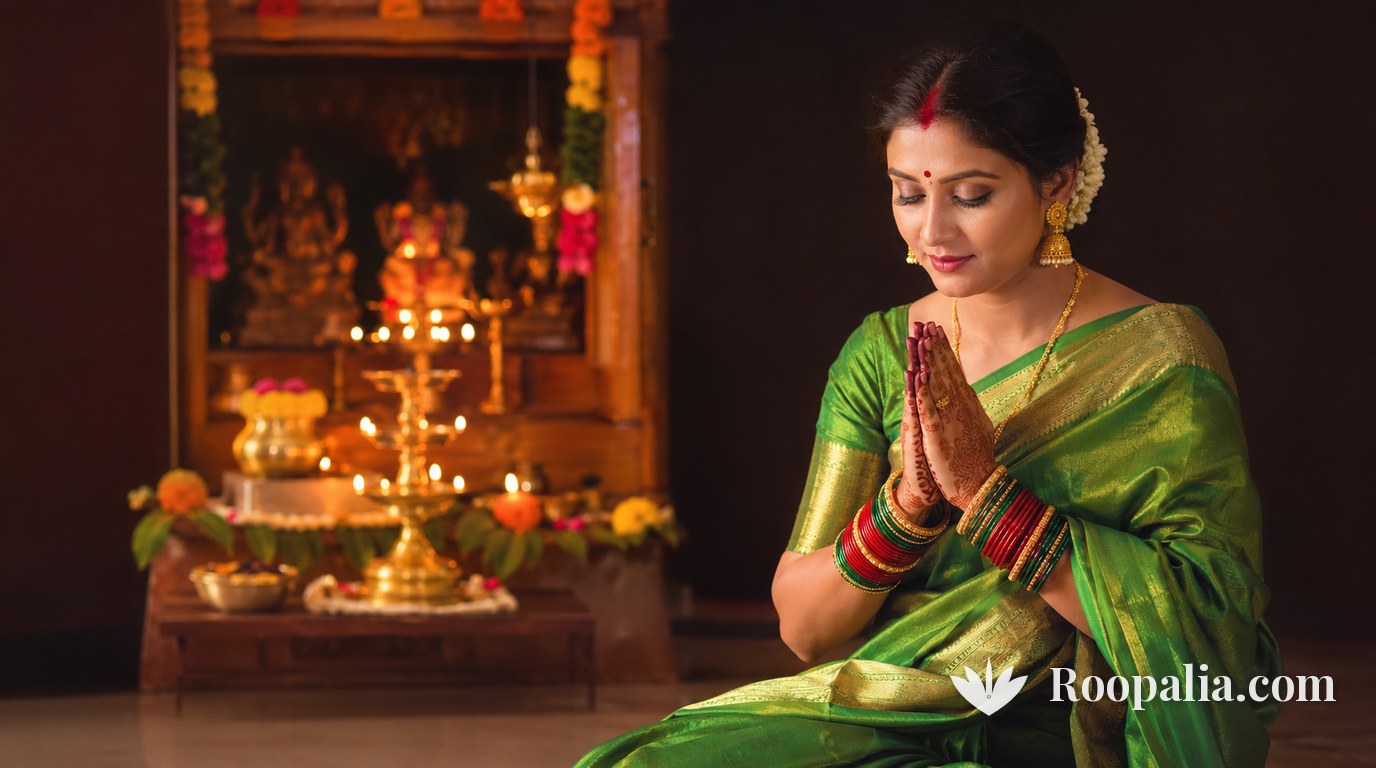
13 or 14 September — why the confusion?
You have probably heard both dates, and this causes more confusion than anything else about the festival. The reason is straightforward.
The Tritiya tithi starts on the morning of 13 September. But in Hindu tradition a fast is counted by udaya tithi — whichever tithi is running at sunrise decides the day. At sunrise on 14 September the Tritiya is still running (it ends at 7:06 AM), so the fast belongs to 14 September.
Even so, some families in Uttar Pradesh and Bihar traditionally keep it on 13 September. If your household has followed one day for generations, do not change it. In a vrat, continuity matters more than the calendar. If you are starting fresh, take 14 September.
The whole story is hidden in the name
This is perhaps the loveliest thing about this vrat, and most people never learn it.
"Hartalika" is built from two words — "harat", meaning abduction, and "alika", meaning female friend. Literally: abducted by her friends.
Now stop and ask — why would a fast be named after an abduction? The answer lies in the katha, and that katha is as old as it is oddly current.
The Hartalika Teej vrat katha
The story is found in the Bhavishyottara Purana — the Uttaraparva of the Bhavishya Purana, the section devoted entirely to vratas, festivals, charity and pilgrimage. A handwritten copy titled "Haritalika Vrat Katha — Bhavishyottara Purana" survives to this day in the Dharmarth Trust collection at the Raghunath Temple in Jammu.
The katha runs as follows.
Lord Shiva once narrated this story to Parvati to remind her of an earlier stretch of her own life. Parvati was the daughter of Himalaya, and from childhood she had resolved to have Shiva as her husband. To that end she performed years of severe penance — at times living only on fallen leaves, and eventually giving up even those.
Her father Himalaya was distressed at his daughter's condition. On Narada's suggestion he settled her marriage with Lord Vishnu — without asking Parvati.
When Parvati learned of it, she was devastated. It was then that her friends took her away from home into a dense forest and hid her there, so the marriage could not take place. That is the "abduction", and that is where the name comes from.
In a cave in that forest, on Bhadrapada Shukla Tritiya, Parvati shaped a Shiva linga out of sand and worshipped through the night without food or water. Pleased by her penance, Shiva appeared and gave his word to accept her as his wife.
What is worth noticing in the katha
This vrat is not simply about a husband's long life. At its root is a woman's own decision — Parvati held to what she had chosen even when her father had decided otherwise. And the ones who stood by that decision were not men but her friends. That is why, to this day, women keep this fast together rather than alone.
A mistake repeated in many places — some articles state that Parvati was "the daughter of Daksha Prajapati" in a previous birth. That confuses this with the story of Sati, which is a separate episode. In the Hartalika katha, Parvati is the daughter of Himalaya, and the marriage was arranged with Vishnu.
Hartalika Teej puja vidhi, step by step
The puja is performed twice — in the morning and during pradosh kaal, the window where day meets night. The pradosh kaal puja is considered the main one.
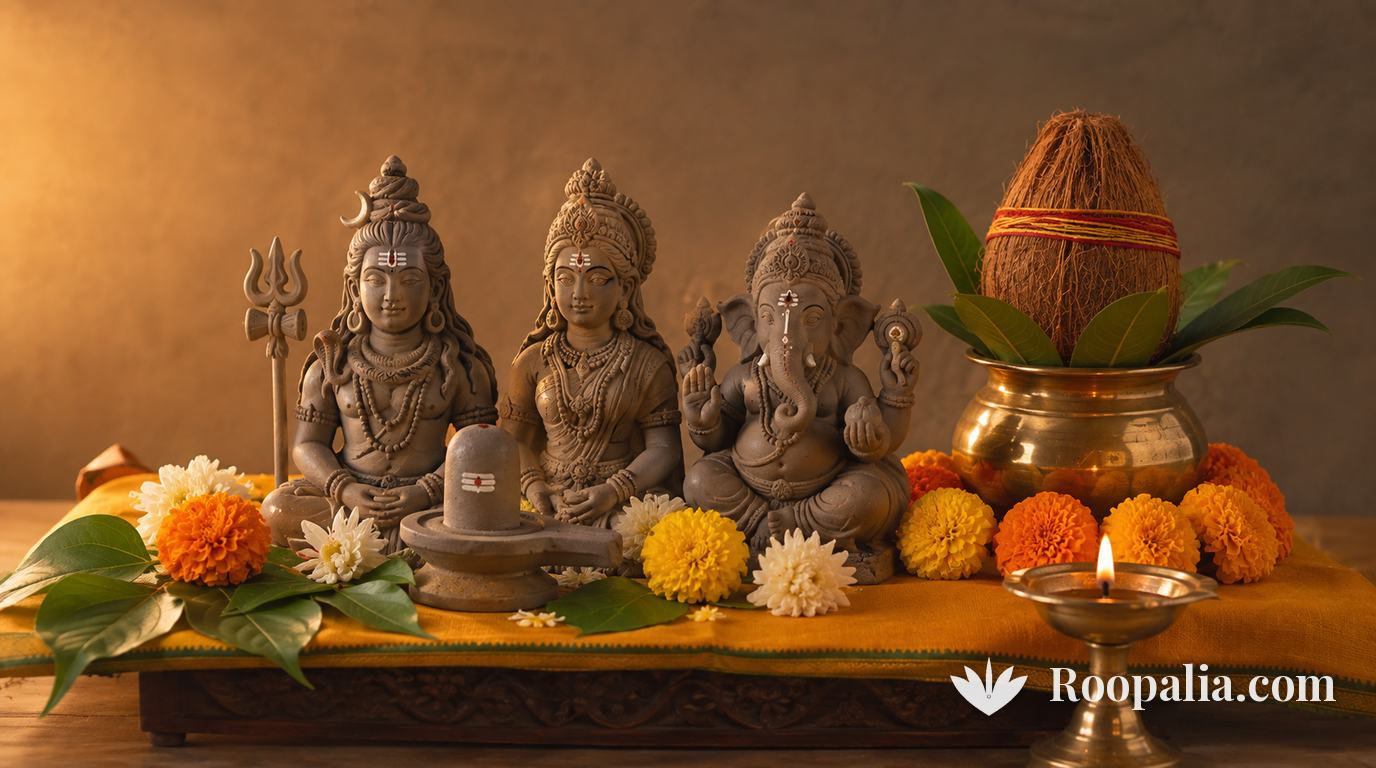
1. Shape the idols — With wet black clay or river sand, shape idols of Shiva, Parvati and Ganesha with your own hands, along with a small Shiva linga. Decorate them with flowers and let them dry. Those who cannot make them can bring ready clay idols from the market.
2. Set the chowki — Spread a yellow cloth over a low wooden platform and place all three idols on it.
3. Kalash sthapana — To the right of the chowki, form an ashtakamal with rice and place a water-filled kalash on it. Draw a swastika on the kalash and put a betel nut, a coin and turmeric inside.
4. Abhishek and puja — Bathe the idols in panchamrit, then offer roli, akshat, sandalwood, bel leaves, shami leaves and durva grass.
5. Offer the suhag samagri — Arrange the complete suhag samagri in a pitari and offer it to Parvati. Offer a dhoti and angocha to Shiva.
6. Katha and aarti — Read or listen to the vrat katha, then perform the aarti and offer bhog.
7. Night vigil — Stay awake through the night with bhajans and kirtan. This is the hardest and the most beautiful part of the vrat.
8. Next morning — Apply the sindoor offered to Parvati in your own parting, then break the fast.
What items are needed for the Hartalika Teej puja?
This is where most of the last-minute scrambling happens — so make the list a day ahead and gather everything.
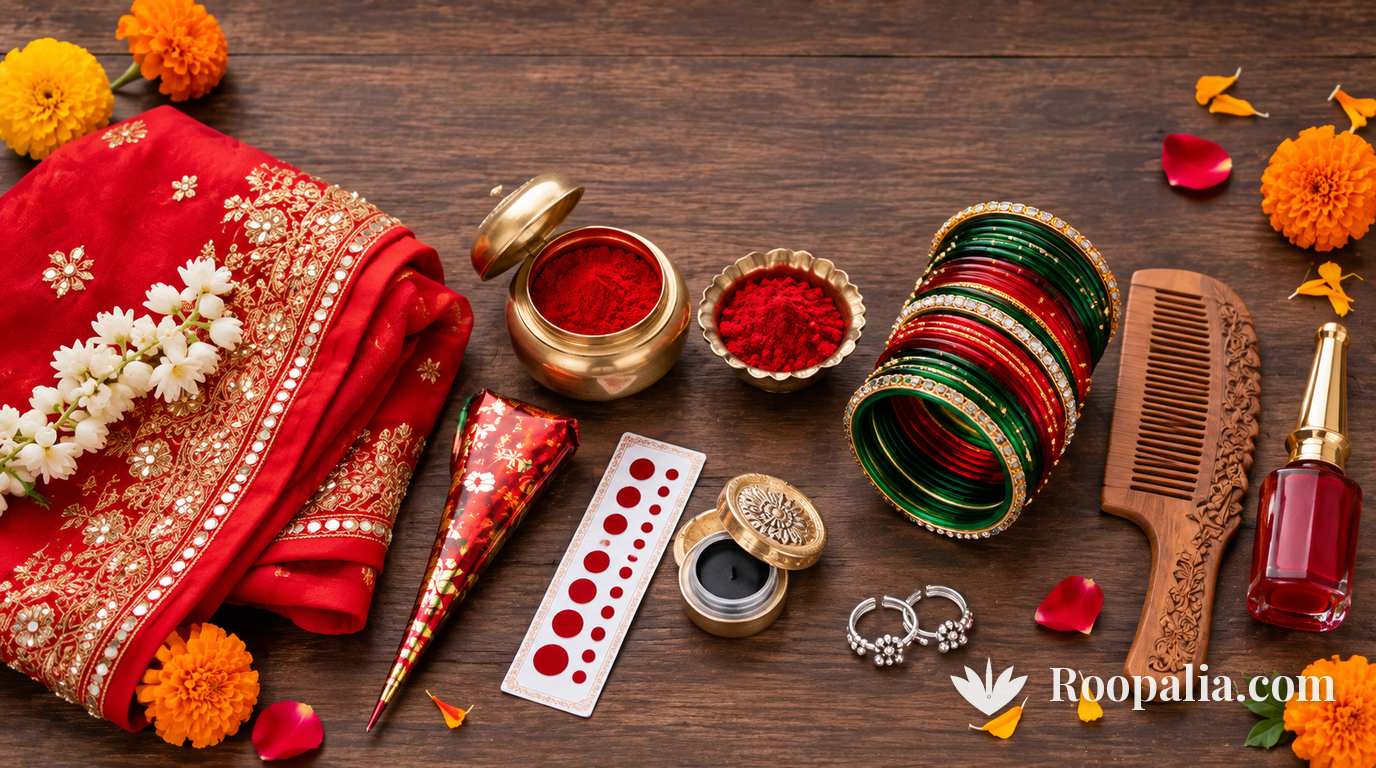
For the idols — wet black clay or river sand, and flowers to decorate.
Suhag samagri (for Parvati) — red chunri, sindoor, kumkum, mehndi, bindi, bangles, toe rings, anklets, kajal, comb, alta, abir, sandalwood, mahawar and other shringar items.
For Shiva — a dhoti and an angocha.
Puja items — roli, akshat, turmeric, sandalwood, a ghee lamp, cotton wicks, incense, camphor, matches and mauli.
Kalash and abhishek — a kalash, a coconut to sit on it, mango leaves, durva grass, bel leaves, shami leaves, tulsi, water and Gangajal.
For panchamrit — milk, curd, ghee, honey and sugar.
Prasad — seasonal fruit, sweets, kheer, halwa, soaked chana, banana and apple.
What happens to the suhag samagri afterwards?
The day after the puja, the offered suhag samagri is given in charity to a married brahmin woman, and the dhoti and angocha to a brahmin. It is not the custom to keep and use it yourself. In many households a mother-in-law gives her daughter-in-law a sindhara — a pitari of suhag items — on this very day.
Can you drink water during the Hartalika Teej fast?
This is the most-asked question, and the answer is less simple than most people make it sound.
The traditional rule: this is a nirjala fast — no food and no water from sunrise until the fast is broken the next morning. That is exactly why it is considered harder than Karwa Chauth.
In practice: in many households and regions, women take water once the evening puja is complete. This latitude has been passed down for generations and is not treated as breaking the fast.
On your health — please do not take this lightly
A nirjala fast is not for everyone. Pregnant women, breastfeeding mothers, anyone with diabetes or blood-pressure conditions, and those who are ill or weak should not keep the fast without water. Tradition itself allows this — the fast can be kept on fruit or with water.
If during the fast you feel dizzy, your vision darkens, you feel severe weakness or your heartbeat races — take water or lemon water immediately, and see a doctor if needed. No fast is worth more than your health, and no scripture asks you to worship by harming your body.
Which colour saree should you wear for Hartalika Teej?
Green is considered the most auspicious — and there is a reason for it. Green is the colour of nature, renewal and abundance, and Teej itself celebrates the earth turning green after the rains. A green saree, green bangles and mehndi together complete the Teej look.
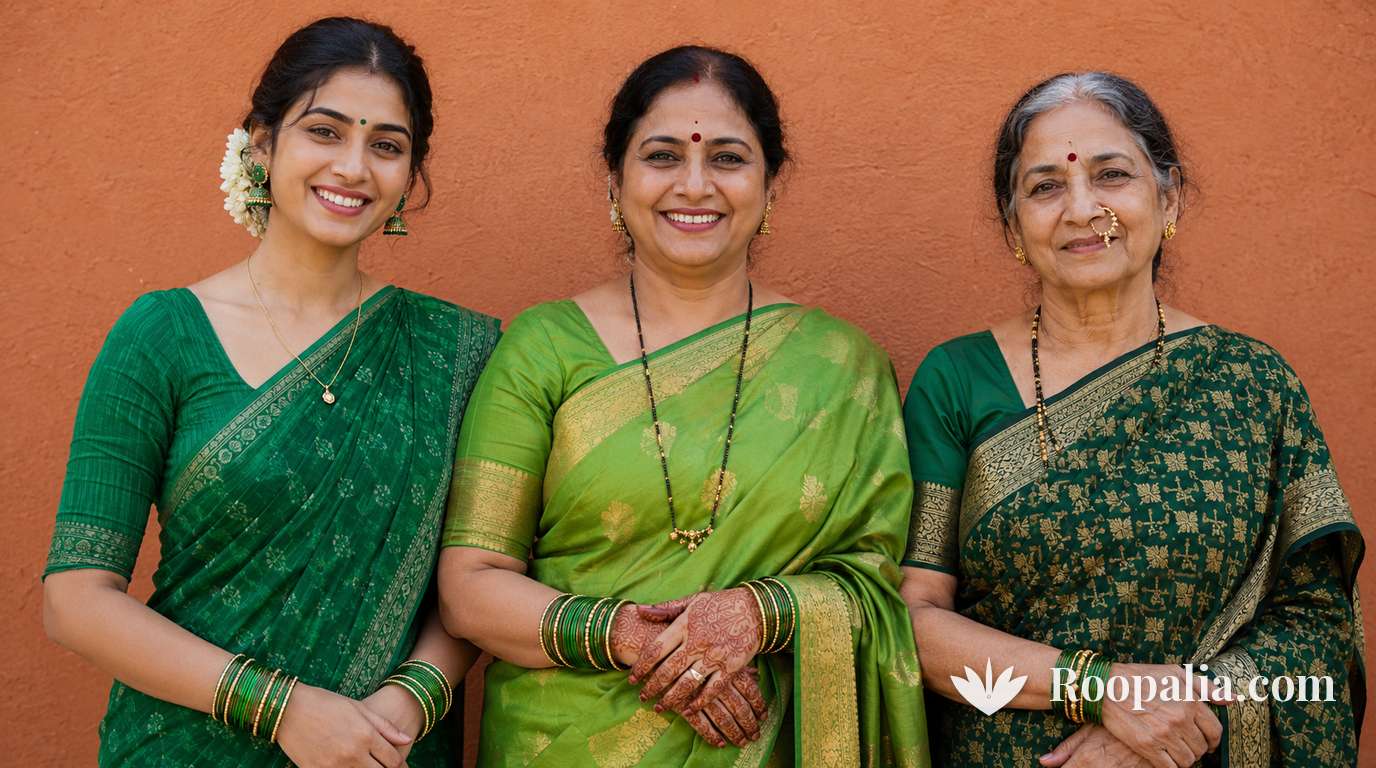
Red is auspicious too, particularly for married women, as it is associated with saubhagya. Green paired with red is the most traditional Teej combination of all.
Yellow works as well — it is tied to Shiva worship, which is why a yellow cloth is spread on the chowki.
Black and white are usually avoided on this day. This is social custom rather than scriptural instruction.
For the complete list of adornments and what each one means, see our solah shringar guide, and why the bindi is worn between the eyebrows — part of the same tradition.
There are three Teejs — and most people mix them up
If you have ever thought "but Teej was last month too", you were not wrong. Three Teejs fall each year.
1. Hariyali Teej — Shravan Shukla Tritiya. 15 August in 2026. A celebration of rain and greenery, and of the reunion of Shiva and Parvati. The day is marked by swings, mehndi and folk songs, and the fast is comparatively gentle.
2. Kajari Teej — Bhadrapada Krishna Tritiya, also called Badi Teej. 31 August in 2026. It comes roughly fifteen days after Hariyali Teej and is observed especially in Uttar Pradesh and Madhya Pradesh.
3. Hartalika Teej — Bhadrapada Shukla Tritiya. 14 September in 2026, exactly one lunar month after Hariyali Teej. This is the hardest of the three, because this is the nirjala one.
The clearest difference: Hariyali Teej is a celebration — swings, songs, sweets. Hartalika Teej is penance — a waterless fast and a night-long vigil. Both worship Shiva and Parvati, but the mood is entirely different.
Why do unmarried girls keep this fast?
Because the katha is itself the story of an unmarried girl.
When Parvati kept this vrat she was not married — she was performing penance for the husband she had chosen. So tradition holds that an unmarried girl who keeps this fast obtains the husband she wishes for, and a married woman lasting saubhagya.
Widowed women may keep this fast as well; several traditions record it. Treating it as reserved for married women alone is a social assumption, not a scriptural rule.
Should you wash your hair on Teej?
Here I will be plain, because there is a great deal of confusion about it.
No scripture or Purana contains a rule against washing your hair on Teej. It is a regional folk belief, held in some areas and entirely absent in others.
What tradition does say is that you should bathe and wear clean, bright clothes before the puja. The insistence is on purity, not on unwashed hair.
The practical advice is this — wash your hair early in the morning so it is dry by the pradosh kaal puja. Sitting for long stretches with wet hair during a waterless fast can add to weakness. And if your household does observe the custom, wash it the day before. That settles it.
How to break the fast
The fast is broken the next morning, on 15 September.
Complete the morning puja first, apply the sindoor offered to Parvati in your own parting, and immerse the clay idols in water.
Then break the fast — but not with a heavy meal. Water first, then something sweet or a fruit, and only after that a light meal. After a night without water, the stomach needs to be brought back slowly, or you may face nausea, headache or stomach trouble.
Hartalika Teej Abroad — Your City's Date and Timings
If you are reading this from Sydney, New Jersey or London, there is something you need to know before anything else, and almost nobody tells you.
⚠️ Outside India, Hartalika Teej does not always fall on 14 September.
The Tritiya tithi runs from 7:08 AM on 13 September to 7:06 AM on 14 September, Indian time. Converted to your clock, that same window lands on a different date. In New York it begins at 9:38 PM on 12 September and ends at 9:36 PM on 13 September — which means the sunrise it covers is the one on 13 September, not the 14th.
By the rule of udaya tithi — the day is decided by whichever tithi is running at sunrise — much of the Western world observes Teej one day earlier than India.
The table below works this out for the cities where most of the Indian diaspora lives. Every timing is calculated for that city's own coordinates.
| City | Teej falls on | Sunrise | Sunset (pradosh begins) |
|---|---|---|---|
| Sydney, Australia | Mon, 14 Sept | 5:56 AM | 5:45 PM |
| Melbourne, Australia | Mon, 14 Sept | 6:22 AM | 6:09 PM |
| Auckland, New Zealand | Mon, 14 Sept | 6:23 AM | 6:10 PM |
| Singapore | Mon, 14 Sept | 6:57 AM | 7:03 PM |
| Dubai, UAE | Sun, 13 Sept | 6:04 AM | 6:25 PM |
| Doha, Qatar | Sun, 13 Sept | 5:19 AM | 5:40 PM |
| London, UK | Sun, 13 Sept | 6:32 AM | 7:19 PM |
| Toronto, Canada | Sun, 13 Sept | 6:54 AM | 7:31 PM |
| New York / New Jersey, USA | Sun, 13 Sept | 6:35 AM | 7:08 PM |
| Chicago, USA | Sun, 13 Sept | 6:28 AM | 7:03 PM |
| Houston / Dallas, USA | Sun, 13 Sept | 7:05 AM | 7:28 PM |
| San Francisco Bay Area, USA | Sun, 13 Sept | 6:48 AM | 7:17 PM |
| India (New Delhi) | Mon, 14 Sept | 6:05 AM | 6:27 PM |
Sunrise and sunset are astronomically calculated for each city's coordinates on the date shown. The date itself follows the udaya tithi rule applied to the Indian Tritiya window (13 Sept 7:08 AM – 14 Sept 7:06 AM IST). Times shift by a few minutes across a metropolitan area — take these as your guide, and if your family follows a particular panchang, follow that.
🕐 How to read this table
Your fast begins at your city's sunrise on the date shown, and is kept through that day.
Pradosh kaal — the main puja window — begins at your city's sunset and runs for roughly the next hour and a half.
The night vigil follows, and the fast is broken the next morning.
You are not "late" or "early" compared to India. Your sunrise is your sunrise. The tradition was always calculated from the sky above you, not from a clock in another country.
Where to find puja samagri outside India
This is the part that causes real anxiety — the feeling that without the right things, the vrat somehow won't count. It will. But here is how to get as close as you can.
Clay for the idols. Clean garden soil works, and it is what most families abroad use. No garden? Air-dry modelling clay from any craft or toy shop is perfectly acceptable — several families use it and shape lovely little idols with their children. Wheat dough works too. What you are making is not a statue; it is a gesture.
Bel patra and shami leaves. Genuinely hard to find abroad. Indian grocery stores in areas with large communities — Edison in New Jersey, Southall in London, Harris Park in Sydney, Gerrard Street in Toronto — sometimes stock them fresh before festivals. If you cannot find them, tulsi or any clean, unblemished green leaf offered with intention is accepted in every tradition we know of.
Suhag samagri. Sindoor, bangles, a red chunri, kajal, a small comb — Indian grocery stores keep these year-round, and most cities now have online Indian stores that deliver within a few days. Order at least a week ahead of the date in your city.
The karwa, kalash and diya. Any small brass or copper vessel serves. Many families abroad use a steel puja thali they already own. A tealight is fine if you cannot get a ghee diya.
A grandmother in Melbourne once said something worth repeating: "I have kept this vrat for forty years — thirty in Rajasthan and ten here. The clay was different. The sky was different. Nothing else was."
Keeping the fast on a working day
In India, Teej falls into a rhythm the whole neighbourhood shares. Abroad, it lands on an ordinary Sunday or Monday, with meetings and school runs and nobody around you who knows what day it is. That is the real difficulty — not the hunger.
The fast is roughly twelve to thirteen hours of daylight in these cities — 11 hours 48 minutes in Sydney, 12 hours 32 minutes in New York, 12 hours 47 minutes in London. Plan around that.
Do the morning puja before the household wakes. Twenty quiet minutes, before the day begins, is enough — and for many women it becomes the best part of the day.
Tell one person at work. Not for permission, just so somebody knows. It makes a heavy meeting easier to sit through.
The main puja is after sunset, which in most of these cities falls conveniently after working hours — 7:08 PM in New York, 7:19 PM in London, 5:45 PM in Sydney. You have time.
If the night vigil is impossible, do not carry guilt about it. Stay awake as long as you can, sing what you remember, and sleep. Tradition has always permitted observance according to capacity — that clause exists precisely for lives like yours.
And a health note that matters more abroad — you may not have family around to notice if you feel unwell. Pregnant women, breastfeeding mothers, anyone with diabetes or blood-pressure conditions, or anyone unwell should not keep a waterless fast. Keep it on fruit or with water instead; that is entirely valid. If you feel dizzy or weak, take water at once. No vrat is worth more than your health.
Teaching your children what this day is
This may be the most valuable thing you do on Teej abroad.
A child growing up in Sydney or Chicago will not absorb this the way you did — from grandmothers, neighbours, the smell of a whole street preparing at once. If it is going to reach her, it has to come from you, and it has to come as a story, not an instruction.
So tell her the actual story. Parvati wanted to marry Shiva. Her father arranged a different marriage without asking her. And her friends — not a god, not a rescue party, her friends — took her into a forest and hid her so she could hold on to her own choice. That is why the festival is called Hartalika: harat, taken away, and alika, a friend.
Let her shape a small clay idol with her own hands. Let her spill some. Let her ask why the earth has to be wet. She will not remember the tithi timings. She will remember that her mother made something out of mud on a Sunday and told her a story about a girl who did not give in.
And if you are alone this year, with nobody around you marking Teej — remember that at the root of this vrat too was a single girl, sitting far from home, doing her puja in a cave. She had no temple and no priest. She had earth, a resolve, and her friends. You have the same three. The friends are just on a video call now.
In closing
This fast is not only about sacrifice — it is about choice
Hartalika Teej is often reduced to "the fast for a husband's long life". The katha says something else. Its heroine is a girl who refused the match her father had arranged and held to her own choice, and whose friends carried her into a forest to protect it. This vrat is a celebration of resolve — and of the sisterhood that has always been a woman's greatest strength. When you sit without water on 14 September, remember what it is you are marking.
Frequently Asked Questions
When is Hartalika Teej in 2026?
Can you drink water during the Hartalika Teej fast?
Which colour saree should you wear for Hartalika Teej?
What items are needed for the Hartalika Teej puja?
What is the difference between Hariyali Teej and Hartalika Teej?
Why do unmarried girls keep Teej?
Should you wash your hair on the day of Teej?
Why is it called "Hartalika" Teej?
How and when should the fast be broken?
How do I work out the muhurat while living abroad?
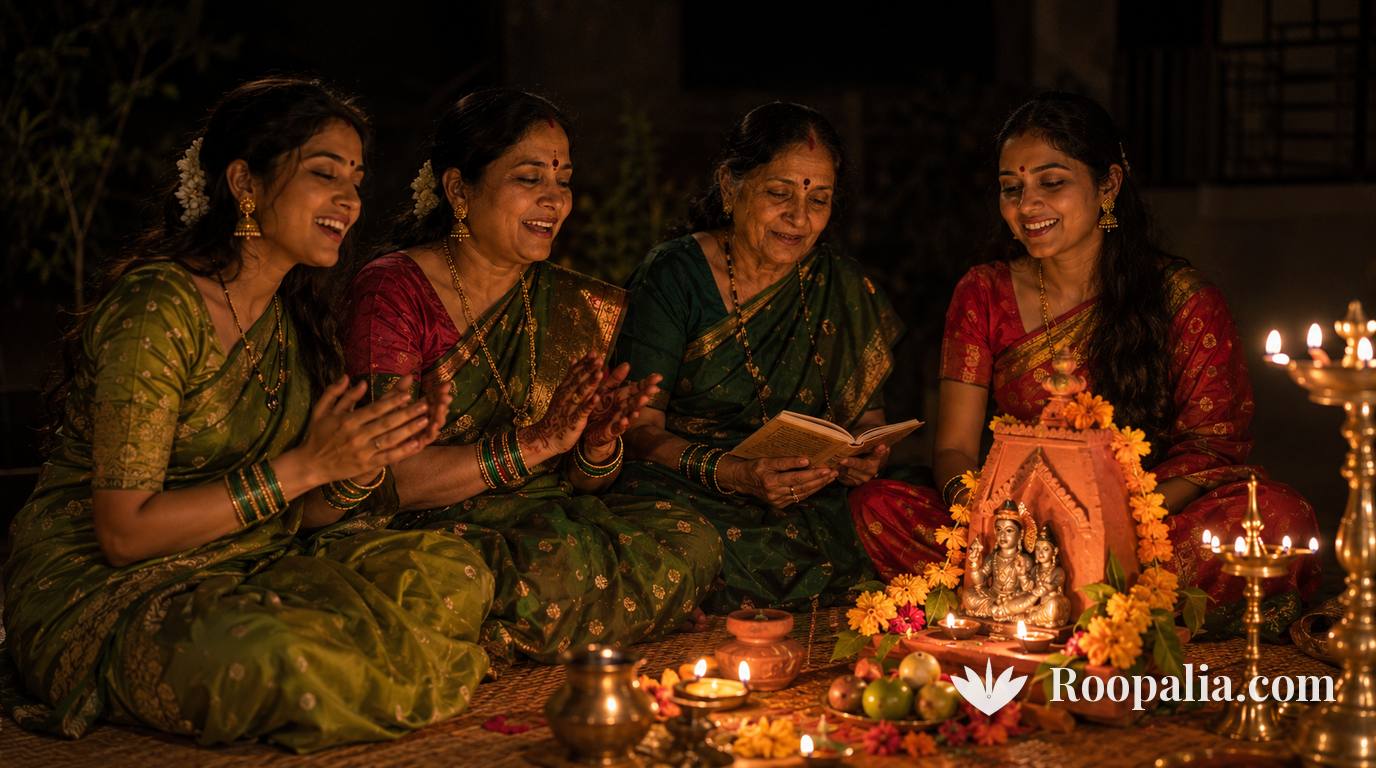
📷 AI-generated images. For illustration only.
🙏 Dates and muhurat are based on the panchang and may vary slightly by region. For any health concern relating to fasting, please consult your doctor.