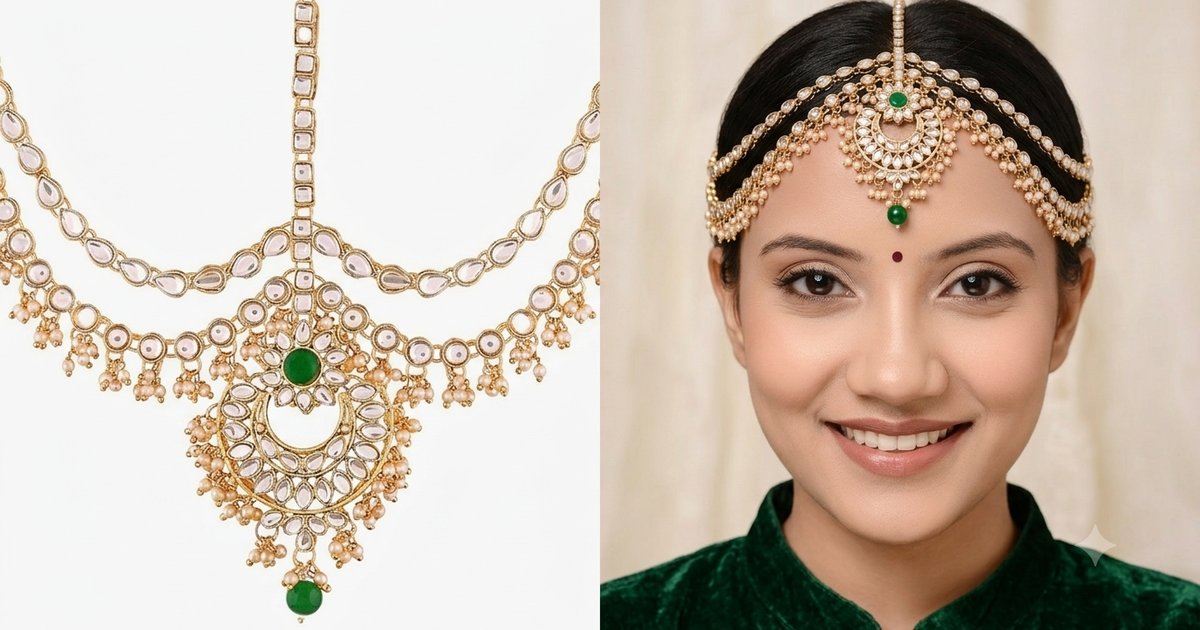
What is the cultural significance of the Maang Tikka in Indian tradition?
In Indian culture the maang tikka is not merely an ornament but a symbol of auspiciousness, good fortune and respect for a married woman and a new bride. It is worn at the centre of the hair parting — at the spot tradition identifies as the Ajna chakra.
One thing should be said plainly here — the term "maang tikka" in its present form is not directly mentioned in every ancient text. But the significance of the parting, the forehead and a woman's adornment is described across many classical texts, and today's maang tikka is regarded as an evolved form of those very ideas.
The marriage hymns of the Rigveda describe the bride entering her husband's home adorned and auspicious in appearance — making clear that a bride's adornment was an important part of Vedic tradition. The Natyashastra describes at length women's garments, ornaments, hairstyling and the decoration of the forehead; the text indicates that ornaments worn on the head and forehead were considered important adornments that heightened a woman's grace and dignity.
Vatsyayana's Kamasutra, among the sixty-four arts, counts hairstyling, floral arrangement, fragrance, eye kohl and various ornaments as integral to a woman's beauty — showing that the adornment of the head and face held particular importance in ancient Indian life. Likewise, the Puranas describe the significance of the auspicious marks of a married woman, where sindoor, the adornment of the forehead and marital ornaments are held as symbols of conjugal good fortune.
Even today, at weddings, Karwa Chauth, Teej, Gangaur and other auspicious occasions, the maang tikka is counted among the principal ornaments of Solah Shringar. It does more than enhance beauty — it stands for the cultural identity, tradition and auspiciousness of the Indian woman.
The Three Maang Tikkas in Detail
For each piece below we set out four things — the key details, who it suits, why it stands out, and who should skip it. We include that last part because it is better to know now than after it arrives. Colours and construction are described as the photographs show them.
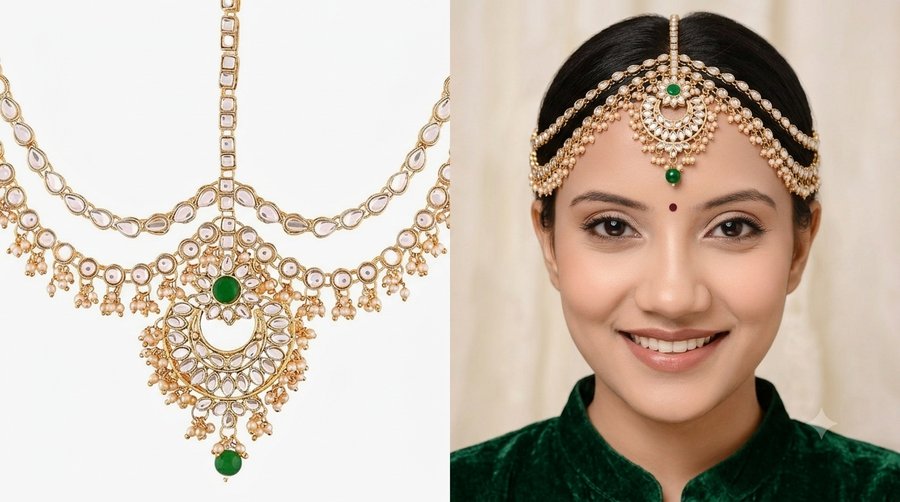
I Jewels Gold Plated Traditional Kundan & Pearl Matha Patti / Maang Tikka (T2014)
- Metal & finishGold-plated alloy
- StonesWhite kundan + pearls + green stone
- StyleMatha patti (centre pendant + two side strands)
- WeightLightweight — comfortable all day
- Best forWeddings, engagement, reception, festivals
Who it suits: For the bride who wants her forehead fully adorned on her big day. Wedding ceremonies, engagement, reception — wherever every eye is meant to rest on her.
This is not a single maang tikka but a full matha patti — a crescent-shaped kundan pendant at the centre set with a green stone, and two pearl-fringed strands sweeping across the forehead on either side. It carries the highest score on this list, and the reason is clear: the reviews describe real occasions — several women wore it on their wedding day and said seeing themselves in the mirror was genuinely moving. Gold plating with white kundan and a green stone gives it that classic bridal presence, and being lightweight, it stays comfortable through a long day.
⚠️ Who should skip it: One point comes up repeatedly in the reviews — the packaging is weak; a piece this delicate deserved a better box. Another: this is a full design, so some women had their makeup artist remove one strand to suit their face and hairstyle. If you want a simple, single maang tikka, this is not the one.
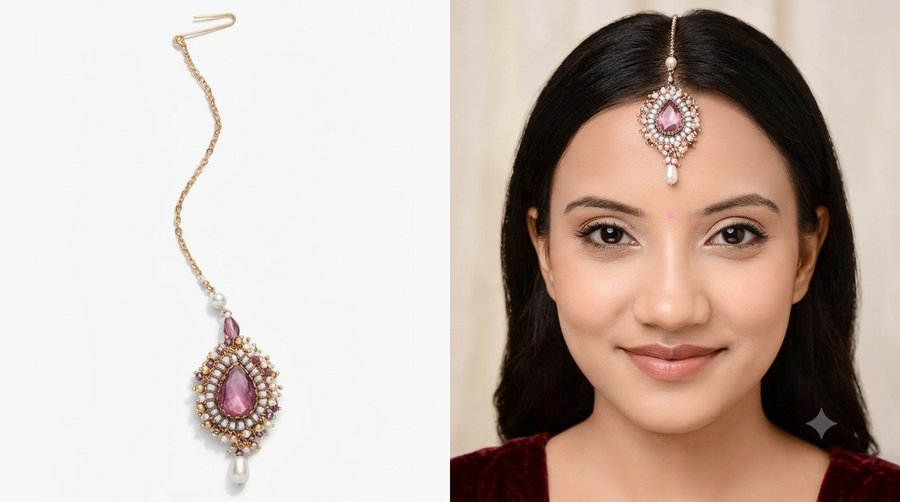
SANJOYA by EVERSTYLISH Embroidered Maang Tikka — Violet Stone, Beads & Pearls
- Metal & finishGold-tone finish with chain
- StonesRound violet stone + pearls + fine beads
- Special detailEmbroidered fabric elements
- WeightJust 9 grams — the lightest here
- Best forWeddings, parties, festivals, sangeet
Who it suits: For the woman who wants a different colour — not red, not green. Violet reads as regal and is very much in fashion. It also suits anyone who dislikes any weight on the head.
Its greatest strength is the weight — just 9 grams. A forehead ornament that is heavy starts to ache within the hour; here that complaint simply does not arise. A round violet stone sits at the centre, ringed with pearls and fine beads, with embroidered fabric elements alongside — a combination that sets it apart from plainer tikkas. Violet pairs beautifully with white, cream, gold and deep blue outfits, so one piece works across several occasions.
⚠️ Who should skip it: Violet is a matter of taste — some love it, some not at all. Think it through before gifting. Second, this is a single maang tikka with no side strands; if you are after a full bridal look, it will feel small. And embroidered elements are delicate, so keep them away from water and perfume.
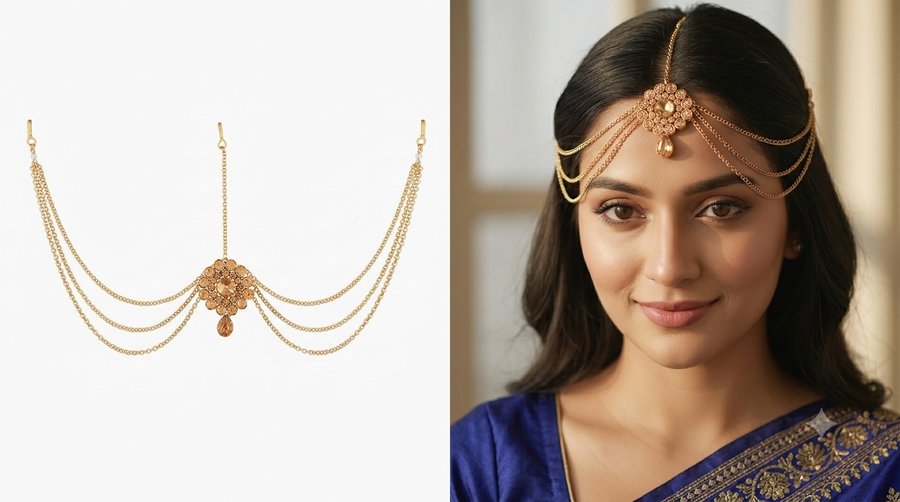
I Jewels Gold Plated Traditional Bridal Matha Patti (T1108FL)
- Metal & finishGold-plated alloy
- StonesKundan and pearl work
- StyleThree-strand matha patti + flower pendant and drop
- SizeLarge — reads as full
- Best forSangeet, mehndi, haldi, festivals
Who it suits: For the woman on a tighter budget who still wants a bright gold look. Ideal for sangeet, mehndi or haldi — where the look should feel large but the spend stays small.
The least expensive here, yet the largest-looking. Three gold chains drape across the forehead, with a flower-like pendant at the centre and a drop hanging below. Reviewers praised its gold shine and its size — the sort of comment that runs "very pretty, go for it without hesitation". If your wardrobe leans towards gold and cream, it is hard to find better presence for around ₹400.
⚠️ Who should skip it: Honesty matters here — its Amazon rating is the lowest of the three (3.8/5), and one reviewer states plainly that of two ordered, one arrived broken. So build consistency is a real concern; you may need a replacement. It is also heavy and large, so a long function can leave the forehead feeling weighed down. Not for anyone who prefers delicate, understated jewellery.
Which of these is right for you?
The choice rests on three things — the occasion, the width of your forehead, and how much weight you can carry. Kundan matha patti for a bride, the violet tikka for lighter occasions, and the gold three-strand if you want maximum presence on a small budget.
Main wedding ceremonies or a reception — take the kundan matha patti (#1); it gives that full bridal presence. Sangeet, mehndi or haldi — the gold three-strand (#3) works, large-looking and inexpensive. Party, festival or Karwa Chauth — the violet tikka (#2), light enough to last all day.
A broad forehead suits a matha patti with side strands (#1 or #3), since it balances the width. A small or narrow forehead is better with a single delicate tikka (#2) — a large pendant tends to overwhelm the face.
If the function runs 6-8 hours, or it is a fast like Karwa Chauth, then weight matters most — the SANJOYA at 9 grams (#2) wins clearly here. For a two or three hour ceremony, a heavier piece is perfectly manageable.
⚠️ About the prices: Every price above is approximate. Amazon prices change daily and often fall around festivals. Do open the link and check today's price before buying.
How do you wear a maang tikka in modern life?
The maang tikka is no longer only a bride's ornament. With a plain kurta, an indo-western outfit or a saree, one light and simple tikka transforms the whole look — provided the rest of the jewellery stays understated.
One easy rule worth remembering: if you are wearing a maang tikka, skip the heavy jhumkas. Both sit around the forehead and face, and when both are heavy the face gets lost. The photograph above does exactly this — the tikka is the main ornament, everything else simple.
A second suggestion — try a light gold tikka at festivals, at garba during Navratri or at Diwali puja. Many young women now wear one with a braid or with open hair, which makes a lovely bridge between tradition and today's fashion. The tradition stays the same; only the way of wearing it changes.
Final verdict — who should buy which?
The most dependable of the three — I Jewels kundan matha patti
Of the three, the I Jewels kundan matha patti (8.1/10) is the most dependable — its reviews describe real occasions, several women wore it on their wedding day, and the green stone with the pearl fringe makes it look more expensive than it is; the only real complaint is the packaging. The SANJOYA violet tikka (7.8/10) is for anyone who cannot bear weight on the head — at 9 grams it stands alone in its class, though the colour will not suit every taste. The I Jewels three-strand (7.2/10) is the cheapest and the largest-looking, but it carries the lowest rating and one reviewer reported a piece arriving broken — so inspect it the moment the parcel opens. And whichever you choose, remember: a maang tikka does not merely set gold on the forehead — it carries forward a tradition thousands of years old, one your grandmother and hers kept before you. 🌸
Frequently Asked Questions
What is the significance of Maang Tikka in Solah Shringar?
Which bridal Maang Tikka is best for Indian brides?
How do I choose the right Maang Tikka for my face shape?
Gold vs Kundan vs American Diamond Maang Tikka: which is better?
How do you wear a Maang Tikka correctly?
Which Maang Tikka is considered most auspicious for Karwa Chauth?
Which Maang Tikka design is trending in India right now?
Where and how should you buy the best bridal Maang Tikka online?
🛒 Check today's price and availability
Our top pick — I Jewels Kundan & Pearl Matha Patti (T2014) · Roopalia Score 8.1/10