How old is the mehndi tradition?
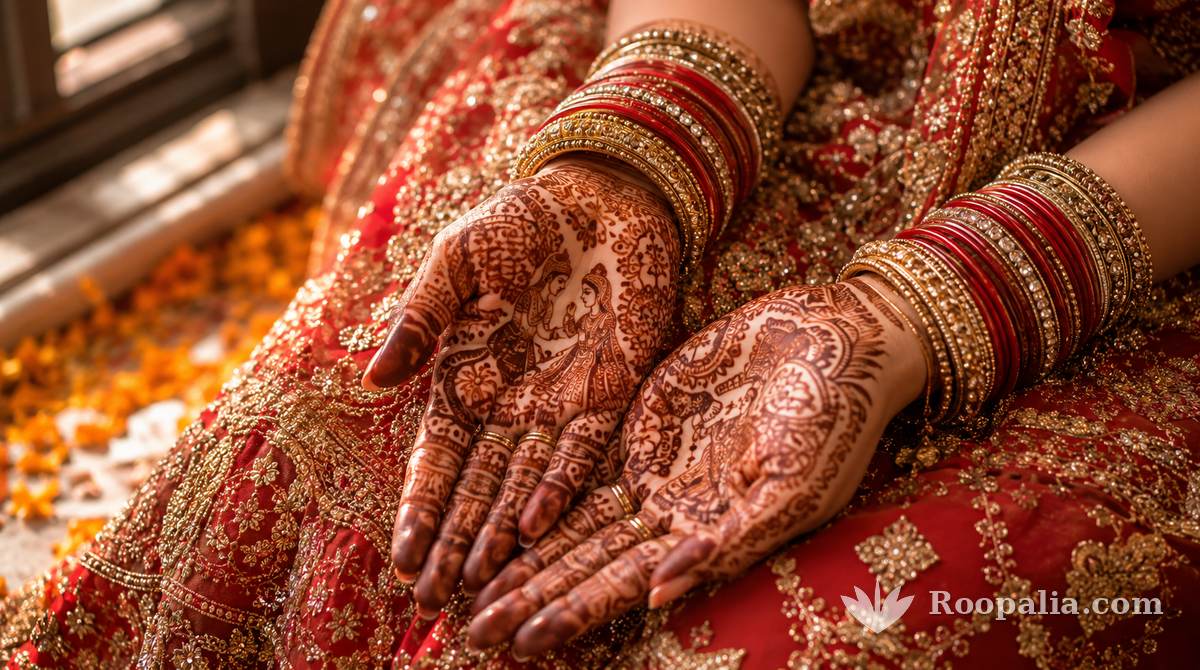
Mehndi is regarded as one of the oldest forms of body art in the world. Historians trace its use back thousands of years — in ancient Egypt as well as across the Indian subcontinent. In those days it was not merely decorative; in hot desert regions people applied henna to their palms and soles precisely because it cooled the body.
Exactly when the practice took root in India, nobody can say with certainty. But mehndi appears so deeply in the folk songs of Rajasthan, Gujarat and north India that the custom is understood to be several centuries old. What is telling is that mehndi songs exist in almost every Indian language — meaning this was never the custom of one region, but a shared ritual of the whole subcontinent.
What does Ayurveda say about henna?
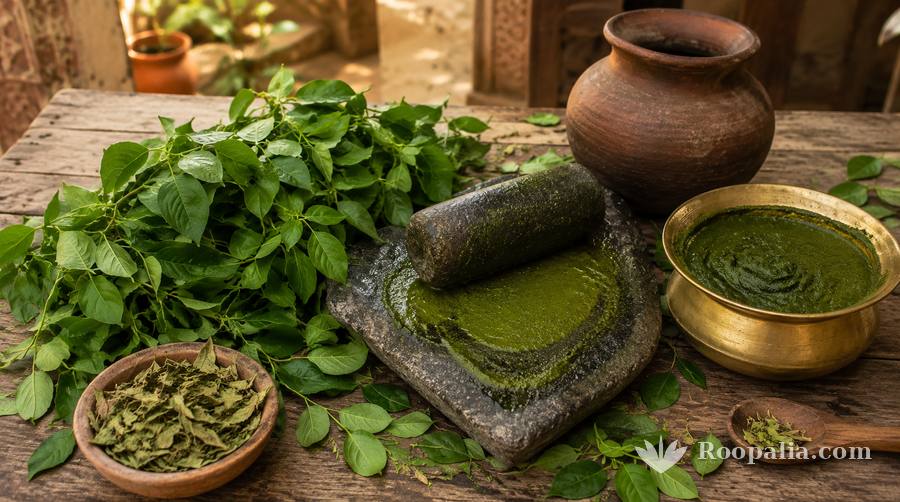
In Ayurveda, henna is described as cooling in nature. This is considered the most practical reason behind the whole tradition. The days before a wedding are heavy for any young woman — preparations, guests, too little sleep, and the quiet anxiety of leaving home.
By traditional understanding, applying henna to the palms and the soles of the feet cools the body and settles the mind. The palms and soles carry many of the body’s sensitive points, and that is precisely where the coolness of henna is said to work.
One thing fewer people know: henna was long regarded as kind to the skin in its own right. In times when medicines were not easily available, a paste of henna was often applied to minor burns or skin irritations.
⚠️ An important clarification: This article describes tradition and folk belief. Please do not treat henna as a remedy for any medical condition. Some people are allergic to it, so do a patch test before a first application and consult a dermatologist if you notice any reaction.
What place does mehndi hold in the solah shringar?
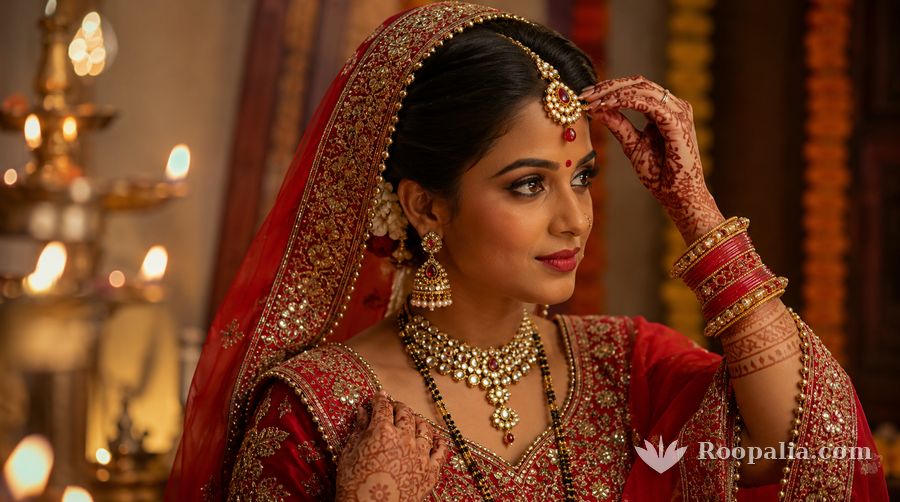
In Indian tradition, a bride’s adornment is described as the solah shringar — the sixteen adornments — and mehndi is counted among them. Bindi, sindoor, kajal, bangles, maang tikka, payal — mehndi belongs on that same list.
The idea behind the solah shringar is that a bride is adorned completely, from head to foot, and that each element carries its own meaning. In folk understanding, mehndi is associated with auspiciousness and new beginnings. These are the very hands with which a new household will begin — so they are the first to be adorned.
If you would like the full list of the solah shringar and what each element means, our guide on the solah shringar list and its meaning explains it in detail.
Does a darker mehndi stain really mean anything?
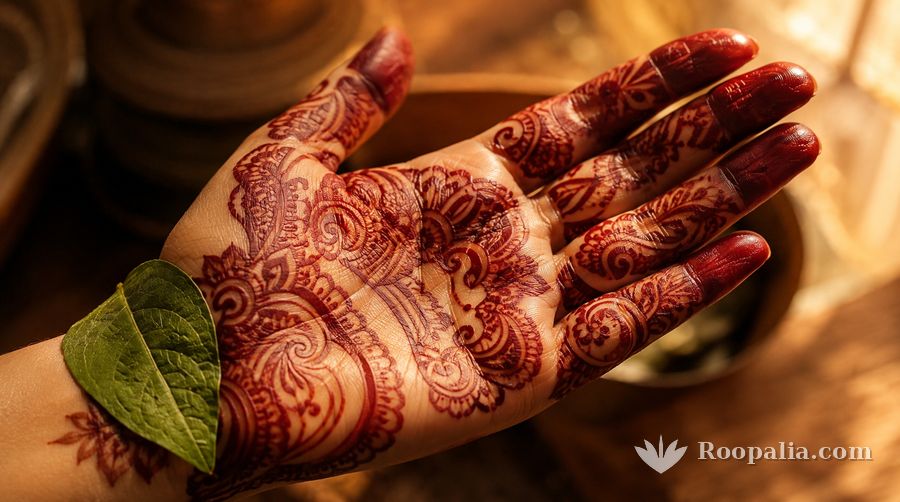
This is probably the best-known belief attached to mehndi — that the darker the bride’s stain, the more love she will receive in her husband’s home. In some regions it is also said that a deep colour reflects the depth of love between husband and wife.
Here it is only fair to say plainly — this is folk belief, not fact. How dark the stain turns depends entirely on how much lawsone (the dye molecule) the leaves contain, how long the paste was soaked, and how long it stayed on the hands. It has nothing to do with anyone’s love or fortune.
Even so, the belief is charming enough to have survived generations, and it remains the biggest source of teasing on the mehndi evening. Take it as part of the fun of the tradition, not as a test of anything.
1. Soak the paste for at least 8 to 12 hours — only then does the dye release fully.
2. Mix it with black tea or coffee water rather than plain water.
3. Keep the hands warm after applying — steaming them over warmed cloves is the old method.
4. Do not wash it off with water. Scrape the dried paste away and then rub in mustard oil.
5. Keep the hands away from water for the first 12 hours — this is the single most important rule.
When and how is the mehndi ceremony held?
In most homes the ceremony takes place one or two days before the wedding, usually after the haldi. The timing is deliberate: it leaves a full day for the colour to develop, since the true stain only emerges roughly 24 hours after the paste is removed.
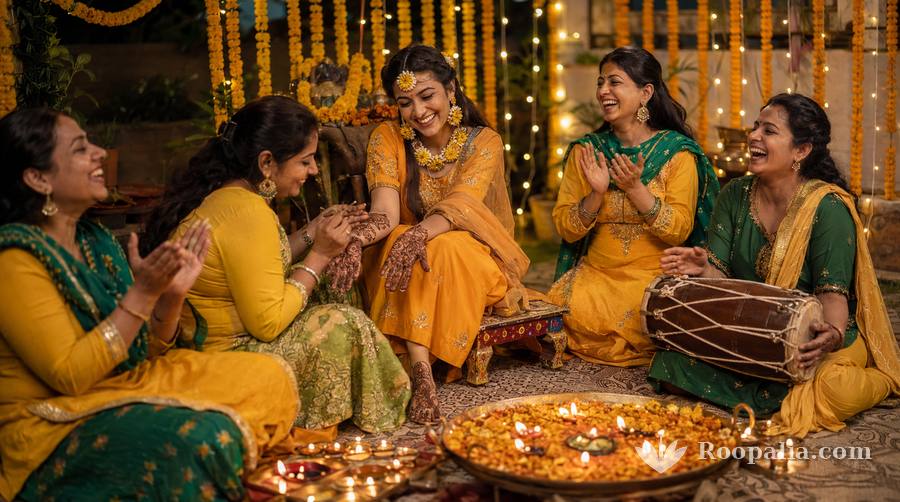
The bride is seated in the middle while the women of the family gather around her and sing. In many families the groom’s name is hidden somewhere within the bride’s design — and on the wedding night he has to find it. This custom is the source of most of the evening’s teasing.
In some regions a little mehndi is applied to the groom as well — symbolically, on the palm, not as a full design. This is not uniform everywhere; it is more common in north India.
Is applying mehndi religiously required?
Many people ask this, and the answer is straightforward — no. No scripture states that mehndi must be applied before a wedding. Mehndi is counted within the solah shringar, and the solah shringar is itself a cultural tradition rather than a religious injunction.
The custom grew out of Indian folk culture, Ayurveda and an idea of beauty. That is precisely why it appears, in one form or another, at Hindu, Muslim and Sikh weddings alike. Its beauty lies in the fact that it belongs to culture rather than to doctrine.
Practice also varies by region. Rajasthani designs are famously intricate, south Indian ones comparatively simple, and in some traditions only a single round tikki is placed at the centre of the palm. No one version is the “correct” one — each family has its own custom.
Mehndi in weddings today
The mehndi ceremony has grown larger than it once was. In many places it is now a separate function of its own — with décor, photography, professional henna artists and mehndi arranged for the guests as well. The designs have changed too; alongside traditional paisley and floral work, Arabic and minimal styles are now commonly chosen.
One thing, though, has not changed — it is still the evening when the women of the house sit together. Everything else has moved on; that has not. Perhaps that is exactly why the tradition has lasted so many centuries.
If you are choosing henna for a wedding or a festival, it is worth checking whether it contains chemicals such as PPD. We looked at exactly that in our comparison of 5 organic henna powders.
In closing
The colour fades, but that evening stays
The mehndi tradition never grew from a single reason. There is the coolness of Ayurveda in it, the beauty of the solah shringar, and the sweetness of folk belief. But perhaps its real reason is the one written in no book — this is the evening when all the women of the house sit together, sing, laugh, and spend a few hours with a girl before she leaves. The colour on her hands fades in two or three weeks. That evening lasts a lifetime.