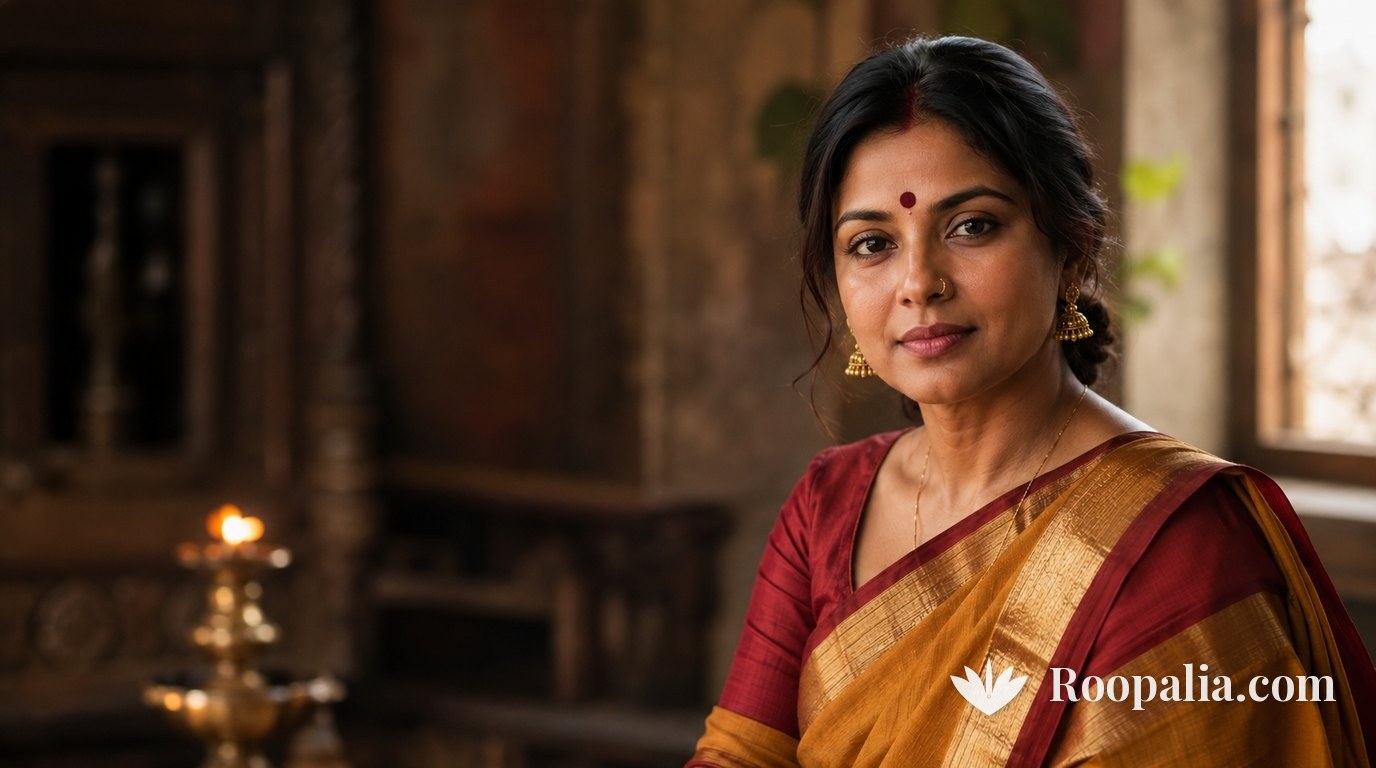
Where does the word "bindi" come from?
It comes from the Sanskrit bindu, meaning a drop, a particle, or a centre. What is worth noticing is that bindu also carries the sense of zero — the point everything begins from and returns to. This idea surfaces again and again in Indian philosophy.
That is why the bindi is round and no other shape. It is a point — a mark on the body that gestures towards one particular place. And which place that is happens to be the real question.
Why is the spot between the eyebrows so significant?
The point between the eyebrows is called bhrumadhya in Sanskrit, literally "the middle of the brows". Three separate streams of Indian knowledge converge on this single spot, and that convergence is the most interesting part of the story.
Three traditions, one point
1. Yoga — calls it the Ajna chakra, the sixth chakra of the body.
2. The Bhagavad Gita — describes fixing the gaze and the breath here during meditation.
3. Ayurveda — identifies it as Sthapani marma, one of the body's sensitive points.
What do the scriptures say about bhrumadhya?
The clearest reference appears in the Bhagavad Gita. In the twenty-seventh verse of the fifth chapter, describing the method of meditation, it says "chakshush chaiva antare bhruvoh" — shutting out external contacts and holding the gaze between the eyebrows. The same verse speaks of balancing prana and apana.
The idea returns in the tenth verse of the eighth chapter — "bhruvor madhye pranam aveshya" — the yogi establishing the life-breath at the point between the brows. Two different chapters pointing to the same spot tells you it was never treated as an ordinary place on the body.
In yogic practice, holding the gaze at this point is a technique called Shambhavi mudra, described in detail in the hatha yoga texts. The Ajna chakra is often translated as the "centre of command" — the seat associated with discernment and judgement.
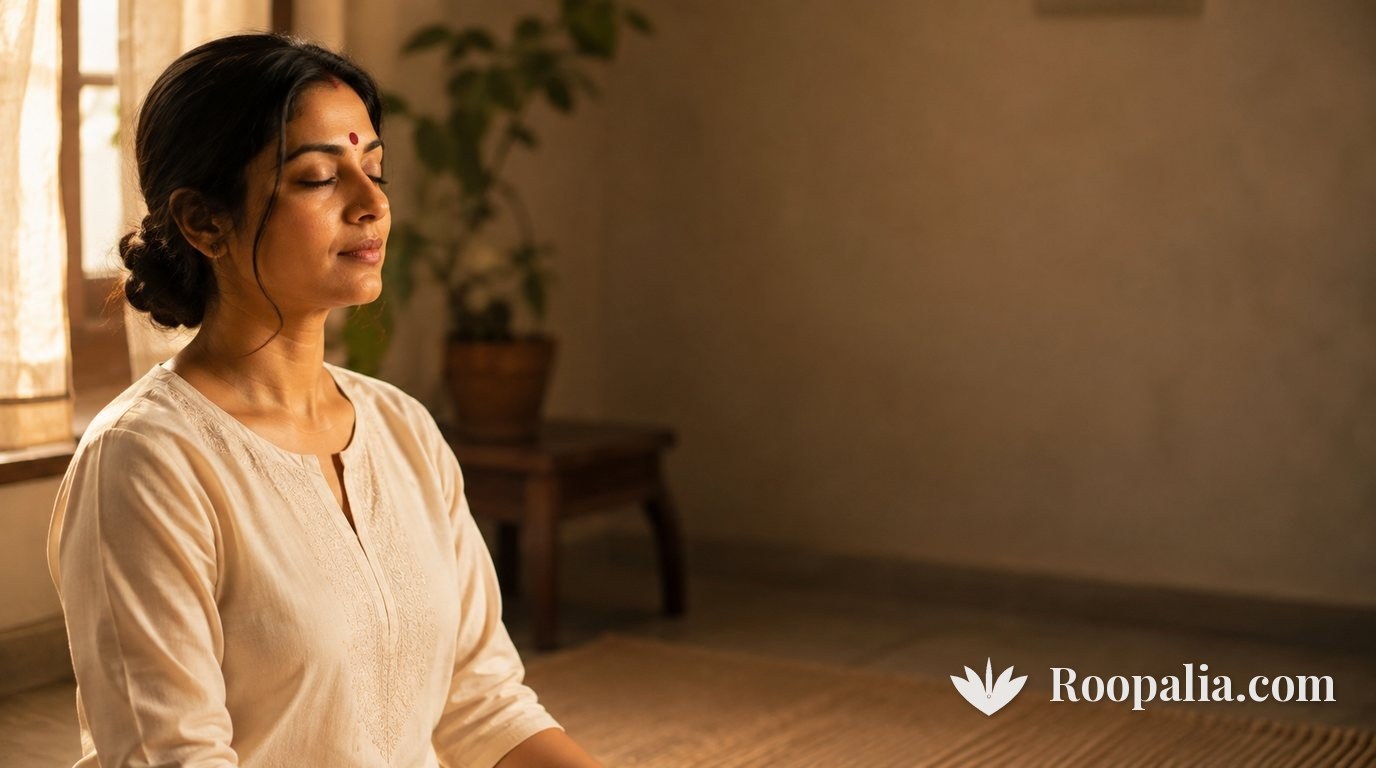
An honest note — no scripture states that "women must wear a bindi". What the Gita describes is meditation, not adornment. The bindi tradition grew out of this body of knowledge; it was never commanded by it. Anyone citing scripture to make the bindi compulsory is stretching the point.
What does Ayurveda say about this point?
In Ayurveda, marma refers to places where flesh, vessels, ligaments, bone and joints meet — the body's most sensitive junctions. The Sushruta Samhita enumerates 107 marma points. The one between the eyebrows is called Sthapani.
Traditional belief holds that gentle pressure or touch at this point settles the mind and helps concentration. That is the reason usually given for why kumkum or sandalwood is pressed on with a fingertip rather than merely dabbed. The old practice of applying a sandalwood paste to the forehead for a headache comes from the same line of thinking.
Please note: this is traditional belief, not a medical claim. Wearing a bindi does not treat any condition. For any health concern, consult a qualified doctor.
Where does the bindi sit in the solah shringar?
Indian tradition describes sixteen elements of a woman's adornment, known as the solah shringar. The bindi is one of them — and notably, it appears near the top of the list. Adornment begins at the head, and the forehead comes first.
We have covered the full list, the meaning of each element and its significance on Karwa Chauth in our detailed solah shringar guide.
Are the bindi and the tilak the same thing?
No — and this distinction is one many people miss.
A bindi is applied by the wearer herself. It belongs to adornment and identity, it is round, and it is worn chiefly by women.
A tilak is usually applied by someone else — a priest, a mother, a sister, an elder. It marks a blessing, a welcome or a ritual. It may be a vertical line (urdhvapundra), three horizontal lines (tripundra) or another form, and men wear it too. A warrior leaving for battle, a child heading into an exam, a son departing for another country — the tilak always arrives carrying somebody's good wishes.
Put simply — the bindi is for yourself; the tilak comes from someone else.
How does the bindi differ across India?
This may be the loveliest part of the tradition — one bindi, and a distinct form in every region.
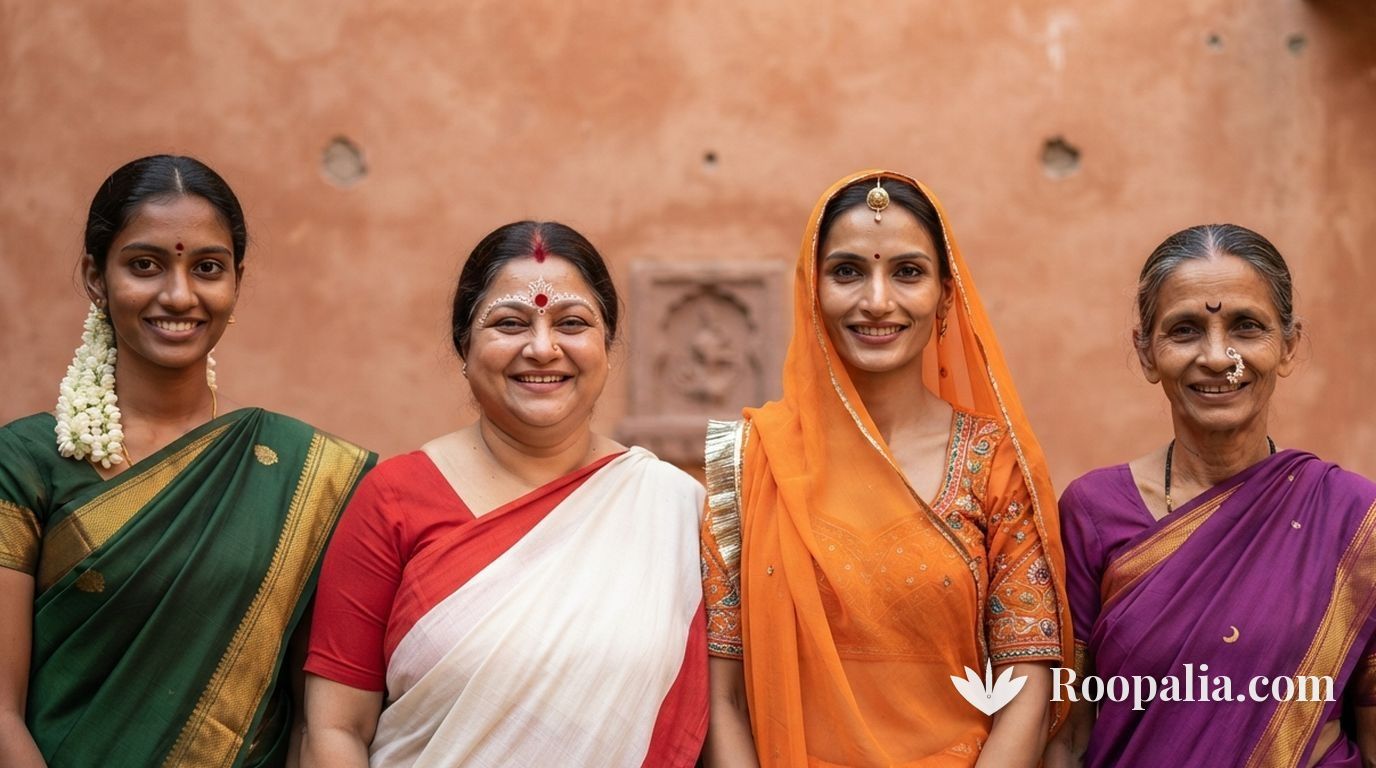
South India — a clean round kumkum bindi, often large. In Tamil Nadu, Andhra Pradesh and Karnataka, applying kumkum after a temple visit is entirely routine.
Bengal — here the bindi never travels alone. A fine design is drawn across the forehead in white sandalwood paste with a red dot at its centre. Durga Puja is when you see it at its most beautiful.
Maharashtra — the chandrakor, a crescent-shaped bindi. It is such a strong marker of Maharashtrian identity that the region is recognisable at a glance.
Rajasthan and Gujarat — a small teardrop-shaped bindi, often paired with a maang tikka or borla. Glimpsed from beneath an odhni, this bindi even finds its way into folk songs.
For all these variations, the location never changes — bhrumadhya. The shape changed, the colour changed, the point did not.
What do bindi colours mean?
Some care is needed here, because beliefs about colour vary as much from region to region as they are widespread. A rule that holds in one household simply does not in another.
Red — the most common. The colour of kumkum, associated with auspiciousness, energy and celebration. Several communities linked it to married women, though this is far from a universal rule.
Black — in many households, young girls and unmarried women wear a black bindi, with the belief that it wards off the evil eye. Today it is the most widely worn everyday bindi of all.
White sandalwood — associated with calm and purity, used in worship and contemplative practice.
Every other colour — green, blue, gold, matching shades — carries no traditional meaning at all. These came entirely from fashion and are chosen to go with a saree or a suit.
One thing worth saying plainly — treating the bindi as a test of marital status has been a social custom, not a scriptural rule. Which bindi to wear, or whether to wear one at all, is entirely each woman's own decision. Nobody owes anyone an explanation for it.
What types of bindi are there?
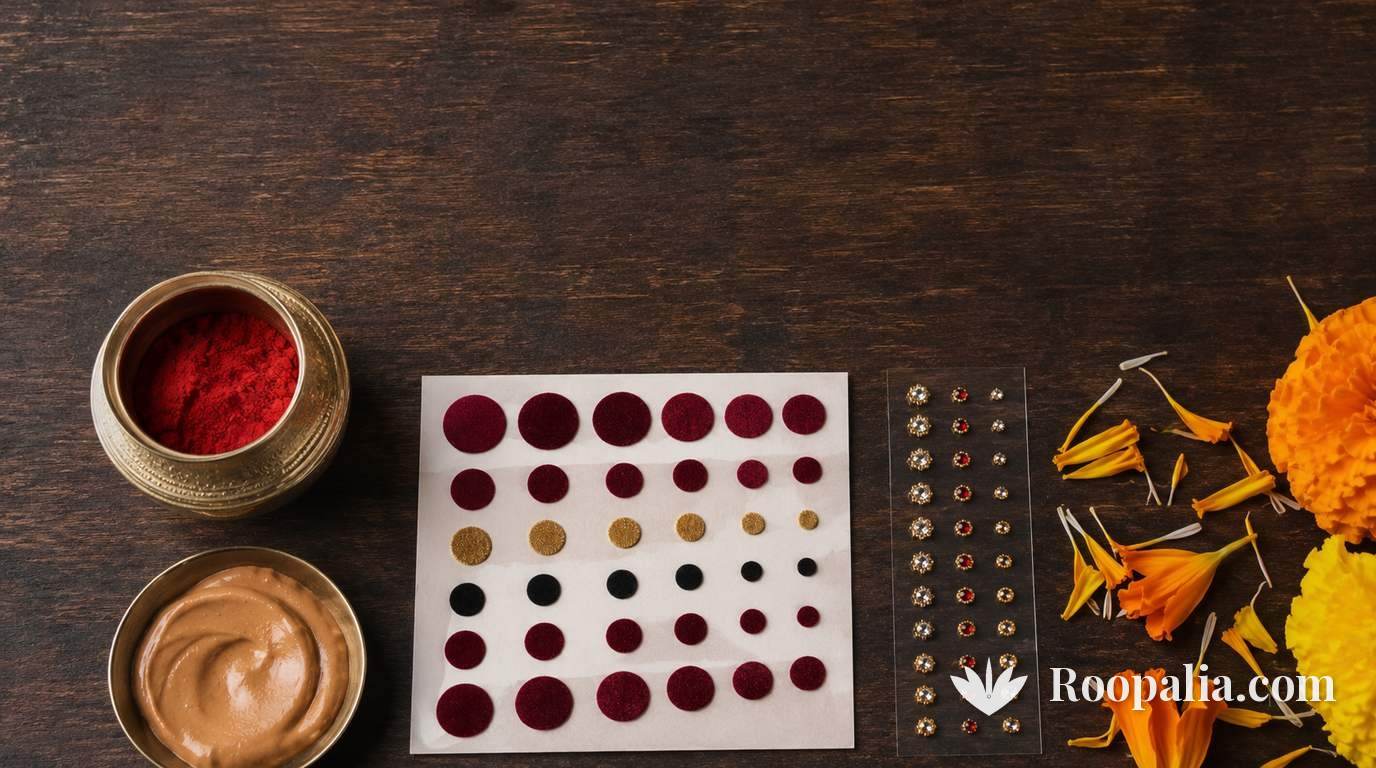
Kumkum — traditionally a deep red powder produced by the reaction of turmeric with slaked lime. This is the oldest form and remains the one used in worship.
Sandalwood — a paste of ground sandalwood. Considered cooling, which is why it has long been favoured in summer and in contemplative practice.
Sindoor — this is not a bindi. Sindoor is applied along the parting of the hair and carries a different meaning altogether. The two are often confused.
Sticker or velvet bindi — this reached households from the 1980s onward and changed the bindi's world completely. Easy to apply, easy to remove, available in every colour and shape.
Designer bindi — set with kundan, pearls or crystals, meant for weddings and festivals. It is most often seen paired with a bride's maang tikka.
Sticker bindis and your skin — practical advice
Reusing the same bindi repeatedly leaves adhesive behind, and some people develop a faint dark or pale patch on the forehead. Three simple habits help: do not reuse a single bindi more than two or three times, remove it before sleeping, and apply a little coconut or almond oil to the spot afterwards. If irritation or itching persists, stop using that brand and see a dermatologist.
For Indian women living abroad
This is the question we are asked most often — "Should I wear a bindi to the office? What will people think?"

The first thing worth knowing — the bindi is not a religious obligation. It is a cultural tradition. Which means there is no pressure on you to wear one, and no shame in not wearing one. Both choices are equally correct.
If you do want to wear one, a few things help in practice:
For the office — a small bindi in deep maroon or a shade close to your skin tone sits most naturally. It does not look out of place with Western clothing either.
For festivals and occasions — wear it fully. At Diwali, Karwa Chauth, Durga Puja or a wedding, a large decorated bindi is exactly where it belongs.
If someone asks — there is no need to feel awkward. Most people ask out of curiosity, not mockery. One sentence is enough: "It marks the point between the eyebrows, which our tradition regards as the centre of focus." More often than not, the conversation turns to respect.
And if your daughter is growing up abroad, do not tell her "you have to wear it, it is our tradition". Tell her instead why this spot was chosen, what the Gita says about it, why her grandmother wore a chandrakor. A child who understands the reason keeps the tradition. A child handed only an instruction lets it go.
Is wearing a bindi necessary?
The straight answer — no. No text makes it compulsory. The bindi is part of the solah shringar, and the solah shringar is itself a cultural tradition rather than a religious command.
But it is equally worth knowing that this tradition did not appear for no reason. The spot it marks has been thought about in texts thousands of years old. Wearing it knowing that, and wearing it without knowing, are not the same thing.
In closing
The smallest ornament, the deepest meaning
The bindi is probably the cheapest and smallest element of Indian adornment. No gold, no silver, not a single stone. Just a dot. Yet behind it stand the Ajna chakra of yoga, two verses of the Gita, the Sthapani marma of Ayurveda, and four distinct regional styles from four different states. There can be few ornaments anywhere in the world that cost so little and mean so much. Whether you wear one is your decision — but now you know what it is you are wearing.