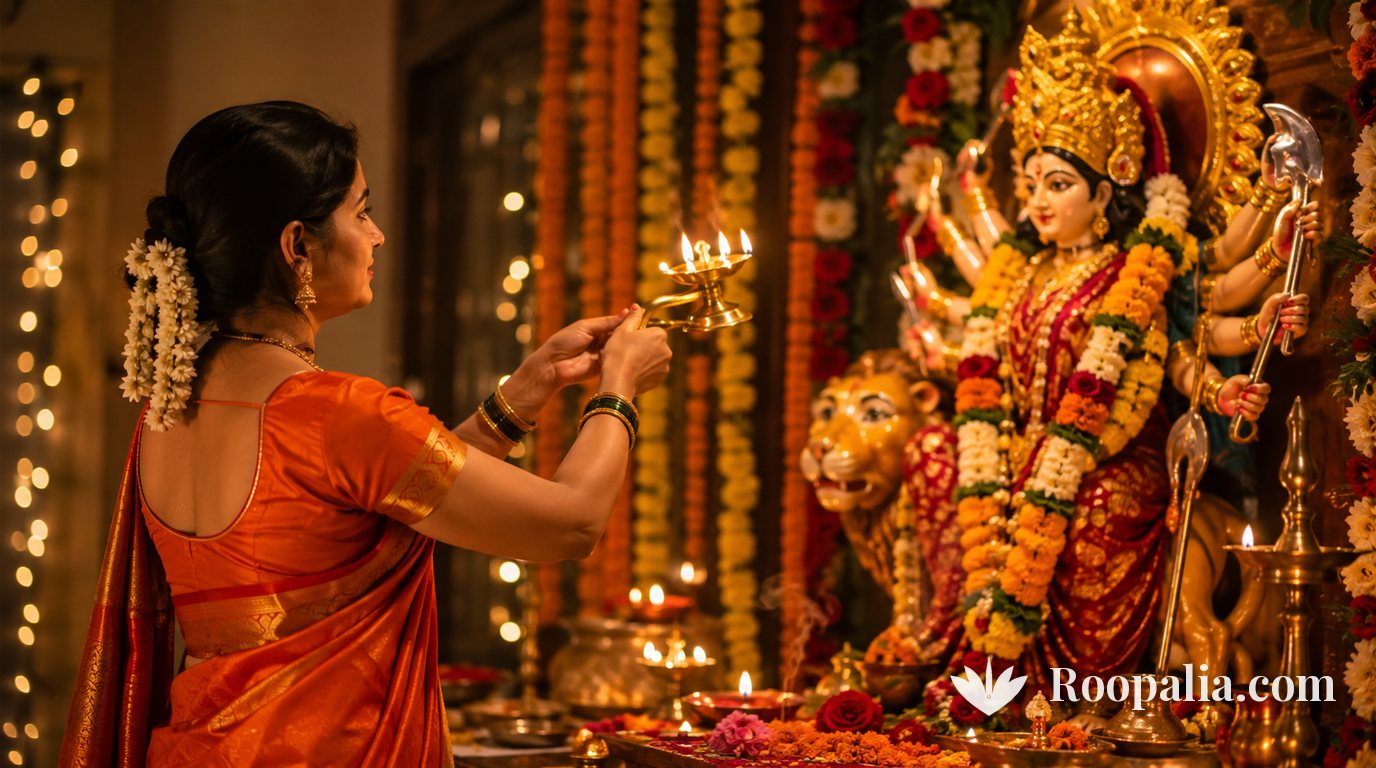
Is Navratri on 11 or 12 October? Here's where the confusion comes from
You will have seen both dates. Some panchangs print 12 October. The correct date is 11 October — and once you understand why, this confusion never troubles you again.
The Pratipada tithi begins at 9:19 PM on 10 October and ends at 9:30 PM on 11 October.
Now, the rule in Hindu tradition is that fasts and festivals are counted by udaya tithi — whichever tithi is running at sunrise decides the day. At sunrise on 11 October, Pratipada is running. So Ghatasthapana falls on 11 October.
Pratipada does technically begin on the night of 10 October — but Ghatasthapana is forbidden at night in the scriptures, which is why that day is not counted.
⚠️ There's a complication with this year's Ghatasthapana — read this
This is the part most guides leave out, and it is the part that matters most.
According to Drik Panchang's calculation, this year's Ghatasthapana muhurat falls during the prohibited Chitra Nakshatra, and also during the prohibited Vaidhriti Yoga.
The scriptures advise avoiding both Chitra Nakshatra and Vaidhriti Yoga for Ghatasthapana. This year they coincide.
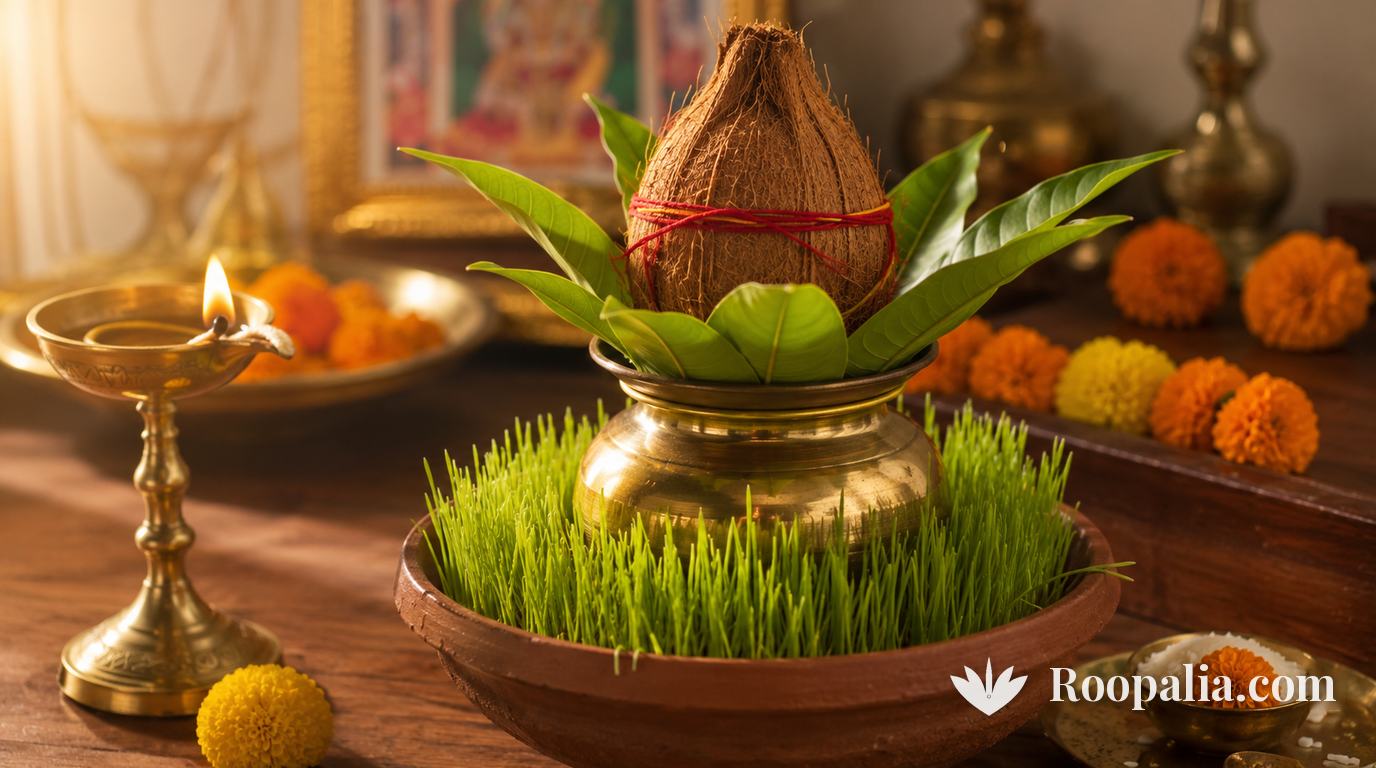
So when should you perform it?
There is no need to panic — the scriptures provide the answer. When the morning window is unsuitable, Ghatasthapana may be performed during the Abhijit muhurat.
Abhijit muhurat — 11:44 AM to 12:31 PM (New Delhi)
Note that Chitra Nakshatra and Vaidhriti Yoga are advised against rather than absolutely forbidden. What is genuinely non-negotiable is that Ghatasthapana must be done before Hindu midday and while Pratipada is still running. It is entirely prohibited during Amavasya and at night.
What is the Ghatasthapana muhurat in your city?
This is the most overlooked point of all — the muhurat is different in every city.
The reason is simple: the muhurat is calculated from sunrise, and sunrise happens at one time in Jaipur and another in Kolkata. India stretches roughly 2,900 kilometres from east to west, which means sunrise in Kolkata and Ahmedabad can differ by close to an hour.
That is exactly why two reliable panchangs quote slightly different windows — Drik Panchang gives 6:19 to 10:12 for New Delhi, while Astroyogi lists 6:22 to 10:16. The gap isn't an error; it's the city.
How to find the correct muhurat for your location
No article can give you an exact time for your city, so use this method instead:
1. Look up the sunrise time for your city on 11 October 2026.
2. The most auspicious window for Ghatasthapana is the first one-third of the day, while Pratipada is running.
3. If that isn't available, take the Abhijit muhurat — roughly 48 minutes around your local midday, wherever you are.
4. The most reliable route is to open a panchang like Drik Panchang and select your own city. They calculate separately for over 100,000 cities.
In eastern India (Kolkata, Patna) the window falls about half an hour earlier; in western India (Ahmedabad, Mumbai) about half an hour later.
Navratri 2026 — the nine days, goddesses and colours
This table follows Drik Panchang's calculation.

Day 1 — 11 October, Sunday · Pratipada · Maa Shailputri · Ghatasthapana · Orange
Day 2 — 12 October, Monday · Dwitiya · Maa Brahmacharini · Chandra Darshan · White
Day 3 — 13 October, Tuesday · Tritiya · Maa Chandraghanta · Sindoor Tritiya · Red
Day 4 — 14 October, Wednesday · Chaturthi · Maa Kushmanda · Upang Lalita Vrat · Royal Blue
Day 5 — 15 October, Thursday · Panchami · Maa Skandamata · Yellow
Day 6 — 16 October, Friday · Shashthi · Maa Katyayani · Saraswati Avahan · Green
Day 7 — 17 October, Saturday · Saptami · Maa Kalaratri · Saraswati Puja · Grey
Day 8 — 18 October, Sunday · Maa Mahagauri · Purple (the Ashtami tithi begins at 8:27 AM on this day)
Day 9 — 19 October, Monday · Maa Siddhidatri · Peacock Green (Durga Ashtami, Sandhi Puja and Maha Navami all fall on this day)
Day 10 — 20 October, Tuesday · Vijayadashami, Navratri Parana, Durga Visarjan
⚠️ Read this carefully — this year Ashtami and Navami fall on the same day
The nine days of Navratri are numbered in sequence. But tithis do not change at sunrise; they change partway through the day. That is why "Day 8" and "Ashtami" do not always land on the same date.
In 2026 this goes a step further:
Ashtami tithi — 8:27 AM on 18 October to 10:51 AM on 19 October
Navami tithi — 10:51 AM on 19 October to 12:50 PM on 20 October
So at sunrise on 18 October, Saptami is still running; and at sunrise on 19 October it is Ashtami — which then ends at 10:51 AM that same morning and turns into Navami.
This is why Durga Ashtami and Maha Navami both fall on Monday, 19 October this year, with Sandhi Puja at their junction between 10:27 and 11:15 AM. It is unusual, but it happens every few years, and virtually every major panchang follows this sequence.
Vijayadashami is on 20 October. Note that at sunrise on 20 October, Navami is still running (it ends at 12:50 PM) — but Vijayadashami is not decided by udaya tithi. It is decided by aparahna kaal, the afternoon window, by which time Dashami has begun. That is why Dussehra is observed on 20 October.
Something about the nine colours that few people know
The order of the colours changes every year — it is not fixed. The first colour is set by the weekday on which Navratri begins, and the remaining eight then follow a fixed cycle. Navratri 2026 starts on a Sunday, which is why the first colour is orange.
This means last year's list will not work this year. Sites that print the colours as though they were permanent are spreading confusion.
Wearing a different colour each day is most popular in Gujarat and Maharashtra. If you're planning outfits and jewellery for the nine days, these will help — traditional jhumka earrings and a kundan necklace set are the two pieces that carry across the most outfits.
Which day is Kanya Pujan — 19 October?
This is the biggest question every year, and the answer isn't as simple as it looks — because it depends on your region and your family.
First, get the tithis straight, because this is where most of the confusion starts:
Ashtami tithi — 18 October 8:27 AM to 19 October 10:51 AM.
Navami tithi — 19 October 10:51 AM to 20 October 12:50 PM.
The tithis fall in such a way this year that Durga Ashtami and Maha Navami both land on Monday, 19 October. Ashtami ends at 10:51 AM that morning and turns straight into Navami, and Sandhi Puja is performed at that junction — between 10:27 and 11:15 AM. Virtually every major panchang follows this sequence.
Which means there is less to be confused about this year — both traditions converge on the same date. Articles that print "Ashtami, 18 October" are mistaking the moment a tithi begins for the day it is observed.
Who observes it on Ashtami — in Haryana, Punjab and Rajasthan, Kanya Pujan is commonly performed on Ashtami and the fast broken the same day. This year that falls on Monday, 19 October.
Who observes it on Navami — in Uttar Pradesh and Bihar, Navami carries special weight for Kanya Pujan; it is treated as the "complete" observance. This year that is also 19 October, since Navami begins at 10:51 AM the same morning. Families who prefer Navami can simply do it after 10:51 AM.
So what should you do? The soundest answer is this — follow whatever your family has followed for generations. Both days are scripturally sound. If you're starting fresh with no family custom to follow, take 19 October (Ashtami) — on the 20th the house will already be busy with Dussehra.
Preparing for Kanya Pujan — the practical side
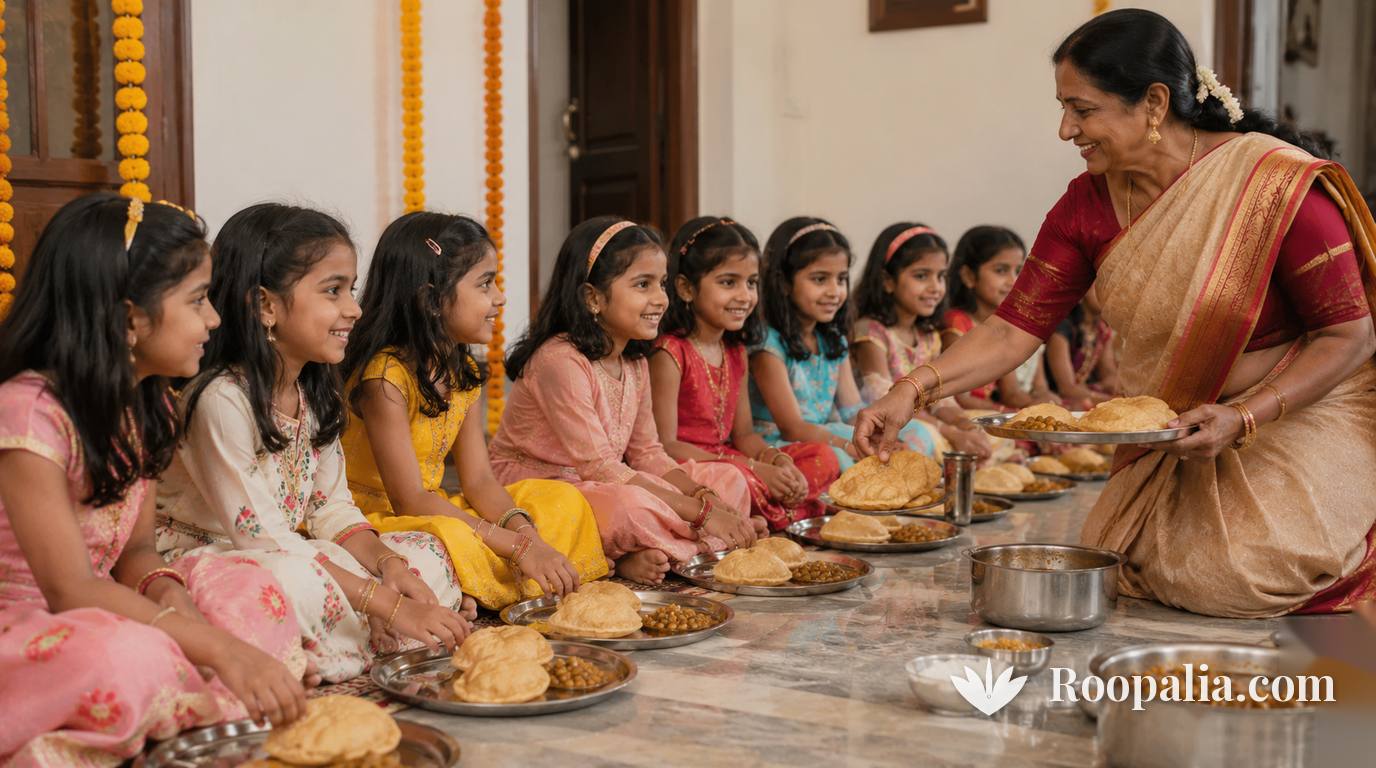
How many girls — tradition calls for nine girls and one boy (langur). If you can't gather nine, the puja is still performed with however many come.
Age — usually between two and ten years.
What to do — wash their feet, apply tilak, serve them a meal, and offer dakshina and gifts according to your means.
The food — halwa, puri and black chana are traditional.
One important thing — never pressure a child to eat, and do ask about preferences. A child may well have an allergy.
What can you eat during the Navratri fast?
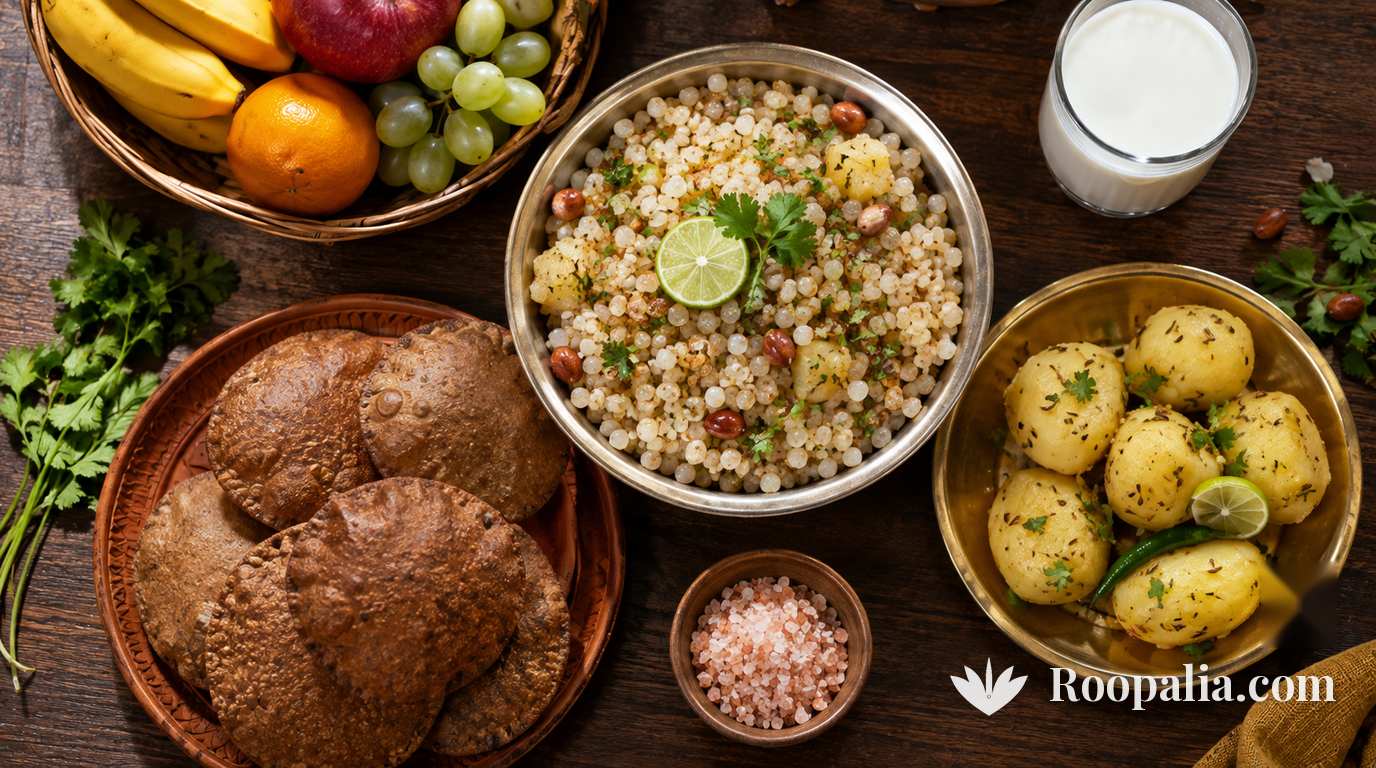
Not permitted — grains (wheat, rice, lentils), onion, garlic, ordinary table salt, meat and alcohol.
Permitted — buckwheat and water chestnut flour, sabudana, samak rice, potatoes, sweet potatoes, bottle gourd, pumpkin, all fruit, milk, curd, paneer, makhana, peanuts, dry fruits and rock salt (sendha namak).
Drink plenty of water through the fast. Even in October the body needs just as much, and the most common complaint over nine days — weakness and headaches — usually traces back to dehydration.
On your health — don't skip this
Pregnant and breastfeeding women, anyone with diabetes or blood-pressure conditions, and those who are ill or weak should not attempt a strict nine-day fast. Tradition has always allowed observance according to one's capacity — the fast can be kept on fruit, or by eating one meal a day.
Those with diabetes should take particular care — both sabudana and potato raise blood sugar quickly. Speak to your doctor before fasting.
Dizziness, severe weakness, a racing heartbeat or vision darkening — if any of these occur, eat something immediately and contact a doctor. No fast is worth more than your health.
Garba and dandiya — the other face of the nine nights

In Gujarat, Navratri simply means garba. The word "garba" comes from garbha, the womb — the perforated clay pot placed at the centre of the dance, with a lamp burning inside it, stands for life growing in the womb. Dancers circle it, the way life circles a single flame.
In Bengal the same nine days become Durga Puja — pandals, the beat of the dhak, the dhunuchi dance, and sindoor khela on the final day. In South India there is the tiered golu display, and Ayudha Puja on Navami.
If you're preparing for garba, an Anarkali kurta set and a maang tikka both earn their place — one good set restyled works across several of the nine nights.
Navratri Abroad — Your City's Ghatasthapana Window
If you are in New Jersey, London or Sydney, there is one number in this section that matters more than anything else on this page — and almost nobody publishes it.
⚠️ In North America, the Ghatasthapana window is far shorter than in India.
The Pratipada tithi runs from 9:19 PM on 10 October to 9:30 PM on 11 October, Indian time. Converted to a US clock, that same window ends at noon in New York, at 11:00 AM in Chicago — and at 9:00 AM in the San Francisco Bay Area.
Ghatasthapana must be completed while Pratipada is still running. In the Bay Area that leaves a window of one hour and forty-seven minutes after sunrise. Miss it, and the tithi has gone.
The table below works this out for the cities where most of the diaspora lives. Every timing is calculated for that city's own coordinates.
| City | Ghatasthapana | Window | Durga Ashtami |
|---|---|---|---|
| Sydney, Australia | Sun, 11 Oct | 6:19 AM – 12:42 PM | Mon, 19 Oct |
| Melbourne, Australia | Sun, 11 Oct | 6:41 AM – 1:07 PM | Mon, 19 Oct |
| Auckland, New Zealand | Sun, 11 Oct | 6:43 AM – 1:08 PM | Mon, 19 Oct |
| Singapore | Sun, 11 Oct | 6:49 AM – 12:51 PM | Mon, 19 Oct |
| Dubai, UAE | Sun, 11 Oct | 6:15 AM – 12:05 PM | Mon, 19 Oct |
| Doha, Qatar | Sun, 11 Oct | 5:30 AM – 11:20 AM | Mon, 19 Oct |
| London, UK | Sun, 11 Oct | 7:17 AM – 12:46 PM | Sun, 18 Oct |
| Toronto, Canada | Sun, 11 Oct | 7:27 AM – 12:00 PM | Sun, 18 Oct |
| New York / New Jersey, USA | Sun, 11 Oct | 7:03 AM – 12:00 PM | Sun, 18 Oct |
| Chicago, USA | Sun, 11 Oct | 6:58 AM – 11:00 AM | Sun, 18 Oct |
| Houston / Dallas, USA | Sun, 11 Oct | 7:20 AM – 11:00 AM | Sun, 18 Oct |
| San Francisco Bay Area, USA | Sun, 11 Oct | 7:12 – 9:00 AM only | Sun, 18 Oct |
| India (New Delhi) | Sun, 11 Oct | 6:19 AM – 12:07 PM | Mon, 19 Oct |
Sunrise is astronomically calculated for each city's coordinates. The window runs from local sunrise to whichever comes first — Hindu midday (the midpoint of that day's daylight) or the end of Pratipada in local time. Ashtami and Navami follow the udaya tithi rule applied to the Indian tithi windows. Timings shift by a few minutes across a large metro area. If your family follows a particular panchang or temple calendar, follow that.
📌 Two things the table is telling you
1. Ghatasthapana is on 11 October everywhere — that date does not shift. Only the window length does.
2. But Durga Ashtami does shift. Across the US, Canada and the UK it falls on Sunday, 18 October — one day earlier than in India, where it is on the 19th. Australia, New Zealand, Singapore and the Gulf stay aligned with India.
A note on Navami abroad. In India, Ashtami and Navami both fall on 19 October because Ashtami ends that same morning. Abroad this junction lands at very different local hours — late evening in San Francisco, past midnight in New York, early morning in London — so whether Navami puja is kept on the same day or the next varies by city and by tradition. Rather than print a number we cannot verify for each place, we would say plainly: take Ashtami from the table above, and confirm Navami with your local temple or family panchang.
What about the Abhijit muhurat if you're in America?
This is where our own advice needs a caveat, and we would rather say so than leave you to discover it.
Earlier on this page we suggested using the Abhijit muhurat because this year's morning window falls under the prohibited Chitra Nakshatra and Vaidhriti Yoga. That advice holds in India. It does not work across much of North America.
Abhijit falls around local midday — roughly 12:18 PM in New York, 12:30 PM in the Bay Area. But Pratipada has already ended by then: noon in New York, 9:00 AM in the Bay Area. Waiting for Abhijit would mean performing Ghatasthapana after the tithi has passed.
Our reading — and we are marking it clearly as a reading, not a ruling
Of the two conditions, the presence of the tithi is the stricter one. As this page notes above, Chitra Nakshatra and Vaidhriti Yoga are advised against rather than absolutely forbidden, while performing Ghatasthapana outside Pratipada is not permitted at all.
On that basis, if you are in North America, do Ghatasthapana in the morning within your city's window rather than waiting for Abhijit. Where Abhijit falls inside your window — as it does in Australia, Singapore and the Gulf — use it.
This is our interpretation of the two rules, arrived at from the timings above. It is not a pronouncement. If your family follows a particular acharya or your local temple issues its own timing, that takes precedence over anything on this page.
Where to find Navratri samagri outside India
The anxiety here is real — the sense that without the right things, the nine days somehow don't count. They do. Here is how to get close.
Barley for the sowing. This is the one item worth planning for. Indian grocery stores stock jau year-round; health food shops sell "pearl barley" or "barley grain", which sprouts perfectly well. Wheat berries work too. Buy a week ahead — stores near large Indian communities run out in the days before Navratri.
The clay pot. A small terracotta planter from any garden centre is exactly the right thing, and costs very little. Many families abroad simply reuse the same one each year, which is its own kind of tradition.
The kalash. Any brass, copper or steel vessel. Mango leaves are hard to find outside the tropics — betel leaves, tulsi, or even a few clean bay leaves are used by families across the diaspora, and no tradition we know of treats the substitution as a fault.
Sendha namak (rock salt). Sold as "Himalayan pink salt" in almost every Western supermarket. Same thing.
Kuttu and singhare ka atta. Buckwheat flour is a common health-food item in the West; water chestnut flour is harder, so order it online if you can. Samak rice is sold as "barnyard millet".
A woman in Toronto put it well once: "The first year I cried because I could not find mango leaves. The tenth year I realised the Goddess had been coming anyway, every single year, mango leaves or not."
Nine days of fasting when nobody around you is fasting
In India, Navratri carries you. Shops change their menus, the neighbourhood plays garba, and half your office is fasting too. Abroad, it is nine ordinary working days, and you are the only one.
Keep only the first and last day if nine is impossible. This is a genuine, long-standing option in many households — not a compromise you invented.
Sort out lunch before the week starts. Boiled potatoes, roasted makhana, fruit and yoghurt travel well. A colleague offering you a sandwich on day four is much easier to decline when you have something of your own.
Do the aarti in the evening. The morning is for Ghatasthapana on day one; after that, the lamp in the evening is enough. Ten minutes with your own family is worth more than guilt about the ten you did not manage.
Look for a local garba. Almost every city with an Indian community now holds one — temples, cultural associations, university societies. For a child growing up abroad, one night of garba does more than a year of explanation.
Health, and it matters more when you are far from family — nine days of fasting is demanding, and there may be nobody nearby to notice if you are struggling. Pregnant and breastfeeding women, anyone with diabetes or blood-pressure conditions, and anyone unwell should not attempt a strict fast. Sabudana and potato both raise blood sugar quickly — speak to your doctor first. Dizziness or severe weakness means eat something immediately.
Teaching your children what the nine nights mean
This may be the most valuable thing you do all Navratri.
A child in Chicago or Melbourne will not absorb this the way you did. If it is to reach her, it has to come from you — and it has to arrive as meaning, not instruction.
So don't hand her the list of nine colours. Tell her that there are nine forms and not one because a woman is not one thing. Shailputri is the daughter. Brahmacharini is discipline. Chandraghanta is the one who will not be frightened. Kalaratri is anger, and it is holy. Siddhidatri is the one who has arrived. Ask her which one she felt like today.
Tell her the garba pot is called garbha — the womb — and that the lamp inside it is a life, and everyone dances in a circle around it because that is what a family does.
And tell her this too: for nine nights every year, an entire country of a billion people bows before a woman. Not a king. Not a god with a beard. A woman with a sword and a lion. She will remember that.
And if your daughter is growing up abroad, don't hand her a list of nine colours and leave it there. Tell her why the garba pot stands for the womb, why the Goddess arrives on an elephant this year, why there are nine forms and not one — courage, restraint, compassion. A festival doesn't survive by being performed. It survives by being understood.
In closing
Remember the date — but remember the reason too
Ghatasthapana on the 11th, Ashtami on the 18th, Navami on the 19th, Dussehra on the 20th. The dates are that simple. But the real point is this: these are among the very few days in the year when an entire country bows before a female power. Nine forms, nine qualities — and you will recognise every one of them in some woman you know. When you put on the colour of the day this year, remember whose day it is and what she stands for. That is when a festival stops being observed and starts being lived.
Frequently Asked Questions
When is Navratri in 2026?
Is Navratri on 11 or 12 October 2026?
What is the Ghatasthapana muhurat in 2026?
What's the issue with Chitra Nakshatra and Vaidhriti Yoga this year?
Which day is Kanya Pujan in 2026?
What are the nine Navratri colours for 2026, day by day?
What can you eat during the Navratri fast?
Which vehicle is Goddess Durga arriving on in 2026?
Why is barley sown for Ghatasthapana?
How do I work out the Ghatasthapana muhurat while living abroad?
📷 AI-generated images. For illustration only.
🙏 Dates and muhurat follow Drik Panchang's New Delhi calculation and may vary by city and panchang. Please verify the exact timing for your own location. For any health concern relating to fasting, consult your doctor.