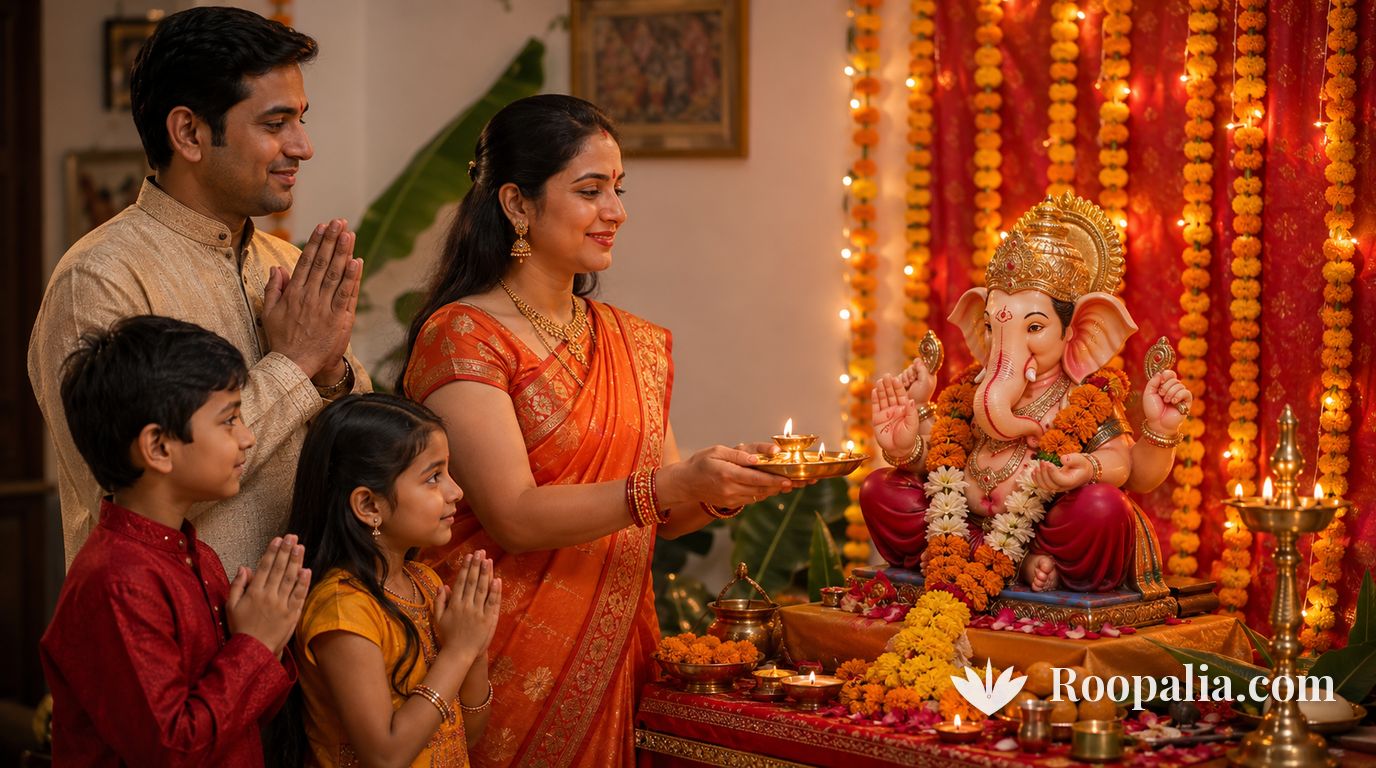
Why is Ganesha always worshipped first?
Every puja, every new venture, every wedding invitation begins with his name. It feels so natural that we never stop to ask why.
The story goes that the gods once argued over who should be worshipped first. It was settled by a race: whoever circled the earth and returned first would win. They set off on their vehicles — Kartikeya on his peacock, fastest of all.
Ganesha's vehicle was a mouse. He was never going to win a race.
So he did something else. He stood up, walked seven times around his parents — Shiva and Parvati — and sat down. Asked to explain, he said: "My parents are my whole world. Circling them is no less than circling the earth."
That day he was granted the boon of being worshipped first, always.
What the story is actually teaching
Ganesha was not the fastest, nor the strongest. He won with intelligence — and not cleverness either, but understanding. That is why he is not only Vighnaharta, the remover of obstacles, but also Buddhi Pradayaka, the giver of wisdom.
And notice that the path to winning ran through respect for his parents. It is the reason this is the first story Indian children are told.
Every part of Ganesha means something
Children always ask why he has an elephant's head. The answer isn't only a story — it's a set of instructions. Tradition attaches a lesson to every feature:
Large head — think big.
Small eyes — concentrate; look closely.
Large ears — listen more.
Small mouth — talk less.
One tusk — keep the good, discard the bad.
The trunk — be adaptable; it is the one limb that can uproot a tree and pick up a needle.
Large stomach — digest everything, the good and the bad alike.
The mouse — keep desires small, and keep them under control.
This list comes from living tradition rather than any single text — but it is the form in which the teaching has travelled through generations, and it works beautifully on a curious eight-year-old.
The sthapana muhurat — and why midday?
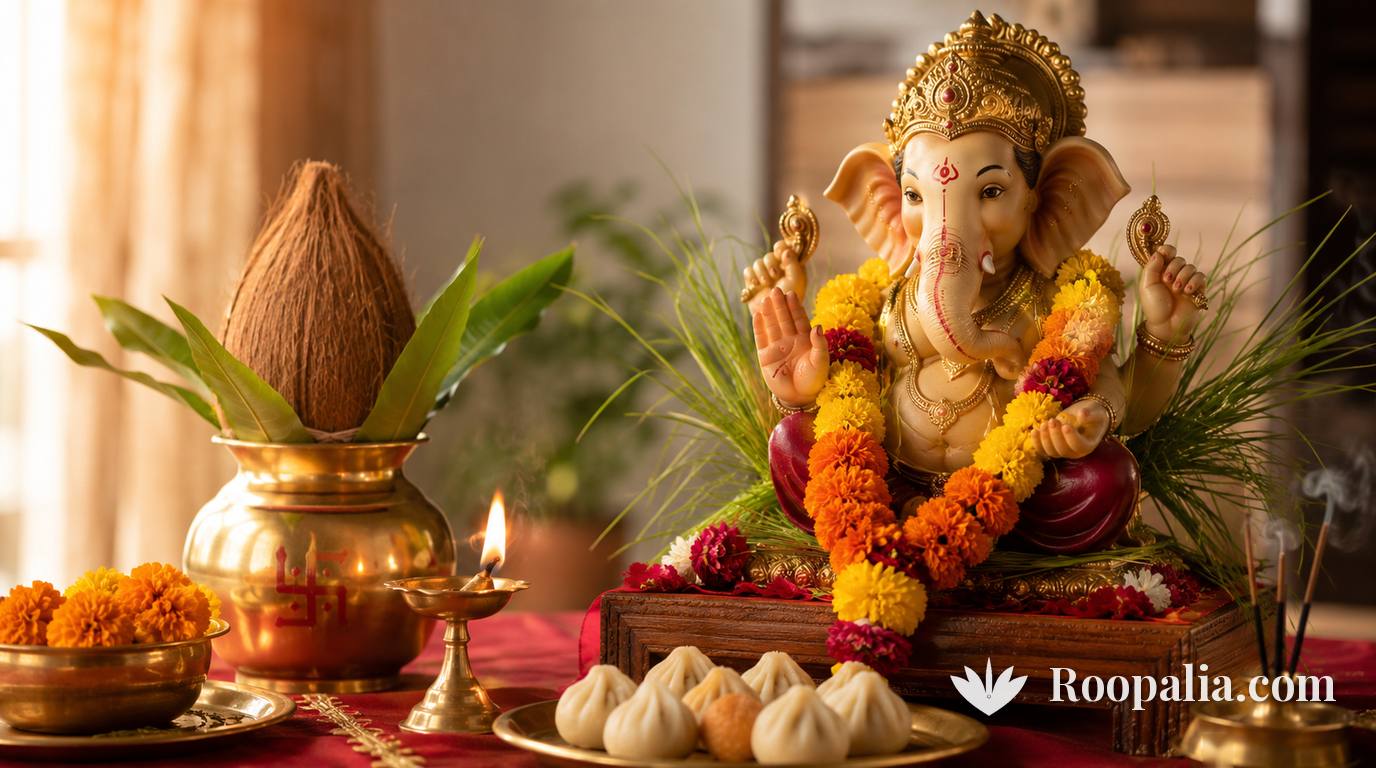
Most pujas happen at dawn. Why is Ganesha installed at noon?
Because Ganesha is believed to have been born during the madhyahna kaal — the middle portion of the day. Divide the time from sunrise to sunset into three parts, and madhyahna is the middle one. The installation mirrors the birth.
The published window for New Delhi in 2026 is 11:02 AM to 1:31 PM.
What if you miss the muhurat?
Don't panic — tradition allows for it. If madhyahna is not possible, sthapana may also be done in the pradosh kaal, just after sunset. Morning hours are acceptable too.
What genuinely matters is that the sthapana happens while the Chaturthi tithi is running. In 2026 Chaturthi begins at 7:06 AM on 14 September and continues into the following morning — so you have the whole day.
The complete Ganesh Chaturthi puja samagri list
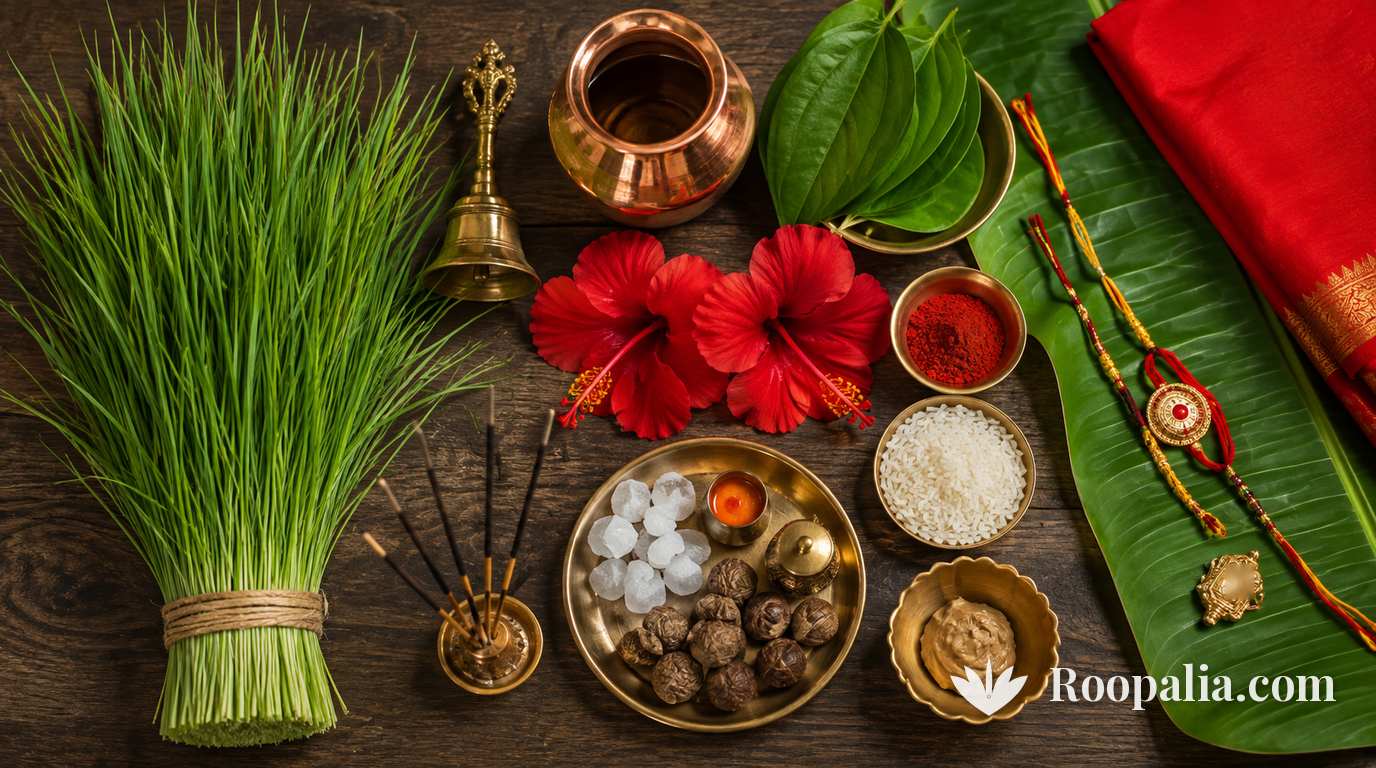
Two things matter above all others — durva grass (21 knots, meaning 21 pairs) and modak. A Ganesh puja without durva is considered incomplete; it is held to be his most beloved offering.
Idol and seat — a clay Ganesha idol, a low wooden platform (chowki), red or yellow cloth, a small mound of rice.
Puja items — roli, akshat (whole rice), turmeric, sandalwood, sindoor, kalava thread, a ghee lamp, cotton wicks, incense, camphor, a bell.
Flowers and leaves — red hibiscus (his favourite), marigold, durva, bel leaves, shami leaves, betel leaves, banana leaves.
Kalash — a copper or brass vessel, water, coconut, mango leaves, betel nut, a coin.
Bhog — modak (21 is the auspicious count), laddoo, banana, coconut, jaggery, mishri, panchamrit.
Also useful — janeu, attar, an aarti thali, and small bowls for distributing prasad.
💡 About the durva
Durva is offered in pairs — two blades tied into one knot, and 21 such knots. The number is not arbitrary; 21 is treated in tradition as the number of completeness.
Can't find durva abroad? Don't let it stop you. Clean, fresh, tender grass is what many families use, and it is accepted. The intention is what carries the offering.
Ganesh Chaturthi puja vidhi — step by step
1. Prepare. Clean the house and the altar the day before. Put up a toran at the door and draw a rangoli.
2. Bring Bappa home. Collect the idol in the morning, before the muhurat. Most families perform a small aarti at the doorway before carrying him inside — the way you would welcome a beloved guest.
3. Sthapana. Spread red or yellow cloth on the chowki, make a small mound of rice, and place the idol on it. Install the kalash to the right.
4. Prana pratishtha. Life is invoked into the idol with mantras. At home, in its simplest form: fold your hands, take a few grains of akshat, say "Please come and stay in our home," and offer the rice.
5. Shodashopachar puja — the sixteen offerings: asana, padya, arghya, achamana, snana, vastra, janeu, chandan, pushpa, dhoop, deep, naivedya, tambula, dakshina, aarti and pradakshina.
6. Durva and modak. Offer the 21 knots of durva and the modaks.
7. Aarti. Sing "Sukhkarta Dukhharta", then distribute prasad.
8. Every day after. For as long as Bappa stays, aarti and bhog morning and evening. This daily rhythm is the real joy of the festival.
🕉️ The simplest mantra
If you remember nothing else, this is enough —
"Om Gam Ganapataye Namah"
And for beginnings: "Vakratunda Mahakaya Suryakoti Samaprabha, Nirvighnam Kuru Me Deva Sarvakaryeshu Sarvada" — the shloka recited before any new undertaking.
Why modak? And why twenty-one?
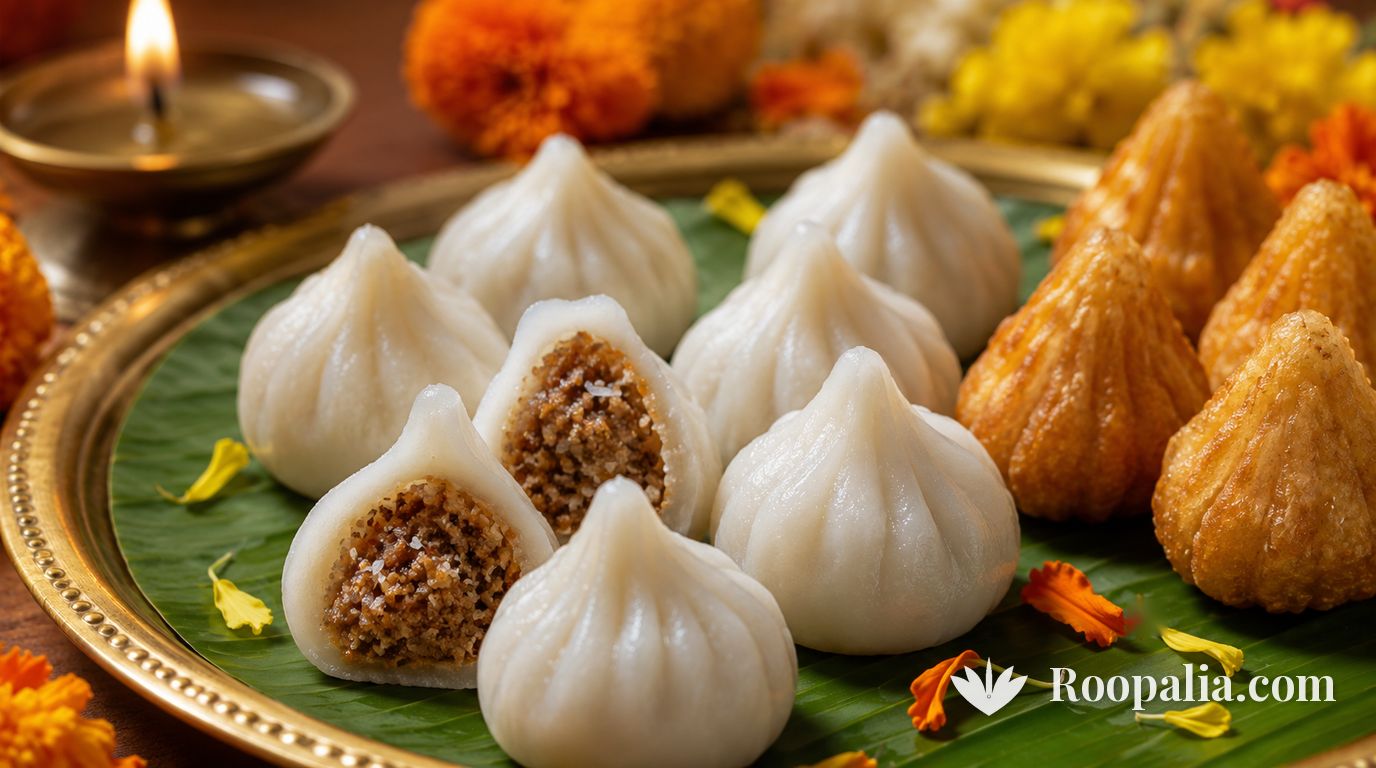
The word itself means "that which gives joy" — from the Sanskrit moda, delight.
But there is a deeper reading. A modak is plain on the outside and sweet within — which is exactly what knowledge is like. Ordinary at first glance; sweet once you go inside. That is why the modak is treated as a symbol of wisdom, not merely a sweet.
Two kinds — ukadiche modak, steamed from rice flour, the Maharashtrian classic; and talniche modak, fried in refined flour. The filling is the same in both: coconut and jaggery.
Why 21? Tradition treats 21 as the number of completeness — five organs of action, five of perception, five pranas, four faculties of mind, and the self. Hence 21 modaks and 21 durva knots.
Why you shouldn't look at the moon — the Mithya Dosha story
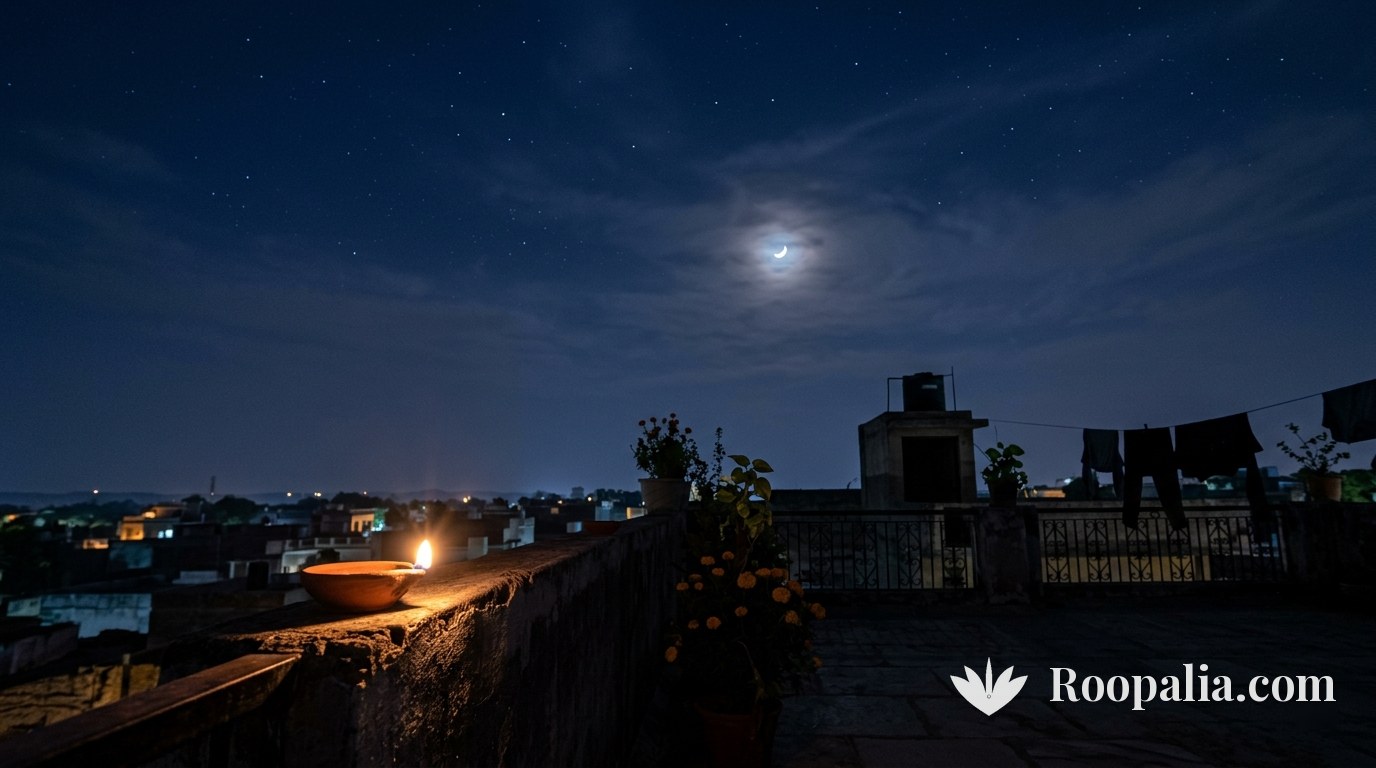
This is the most distinctive rule of the day, and very few people know where it comes from.
The story: Ganesha was riding home on his mouse after a heavy meal of modaks. The mouse startled, and Ganesha fell. Watching from above, the moon laughed.
Ganesha cursed him: whoever looks at you on this Chaturthi will be falsely accused. This is Mithya Dosha — the stain of a false allegation.
The most famous victim of that curse is Krishna himself, who is said to have glimpsed the moon on this day and was promptly accused of stealing the Syamantaka jewel — a theft he had nothing to do with.
The 2026 avoidance window
Roughly 9:00 AM to 8:10 PM on 14 September (New Delhi).
Note that panchangs differ slightly on this. Some publish 9:01 AM–8:09 PM, some 9:06 AM–8:04 PM, and a few give a wider span. We are giving a rounded figure; check your own city's panchang for the precise window.
And if you see it by accident? Tradition provides a remedy — listen to the Syamantaka Mani story, or recite:
"Simhah prasenam avadhit, simho jambavata hatah.
Sukumaraka ma rodih, tava hyesha syamantakah."
And please don't teach this rule to children as a threat. Tell them the story instead — that the moon laughed at someone who had fallen, and that is why he was cursed. The lesson isn't about the moon at all. It is: don't laugh when someone falls. The rule is a piece of upbringing dressed as astronomy.
When to do visarjan — 1.5, 3, 5, 7 or 10 days?
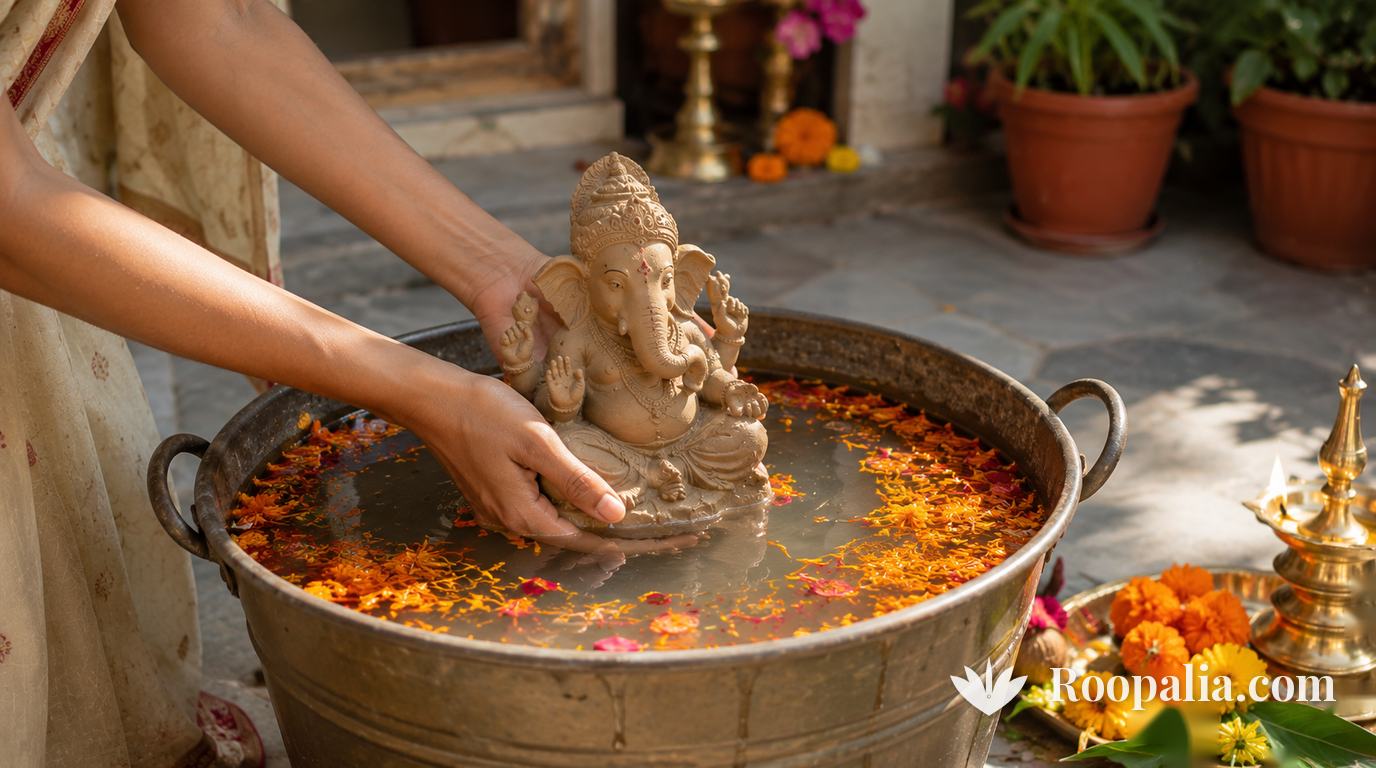
Many people assume the immersion must happen on the tenth day. It does not. Families keep Bappa for 1.5, 3, 5, 7 or 10 days according to their own tradition or a vow — and all durations are equally valid.
The 2026 schedule:
1.5 days — Tuesday, 15 September
3 days — Wednesday, 16 September
5 days — Friday, 18 September
7 days — Sunday, 20 September
10 days (Anant Chaturdashi) — Friday, 25 September
Before the immersion comes uttar puja — a final aarti, a last bhog, and an apology for any error made knowingly or unknowingly during the stay. Only then is the idol lifted and immersed.
🌱 On the environment — now part of the tradition itself
Plaster of Paris idols do not dissolve, and their paints often carry heavy metals. A clay idol is the original tradition — and it is the one that actually returns to the water, which is the whole point of visarjan.
Immersing at home is entirely proper. Use a large vessel or bucket of water, and afterwards pour that water into a plant. Many families now do exactly this, and it is no less sacred than a river.
Making the idol with your children
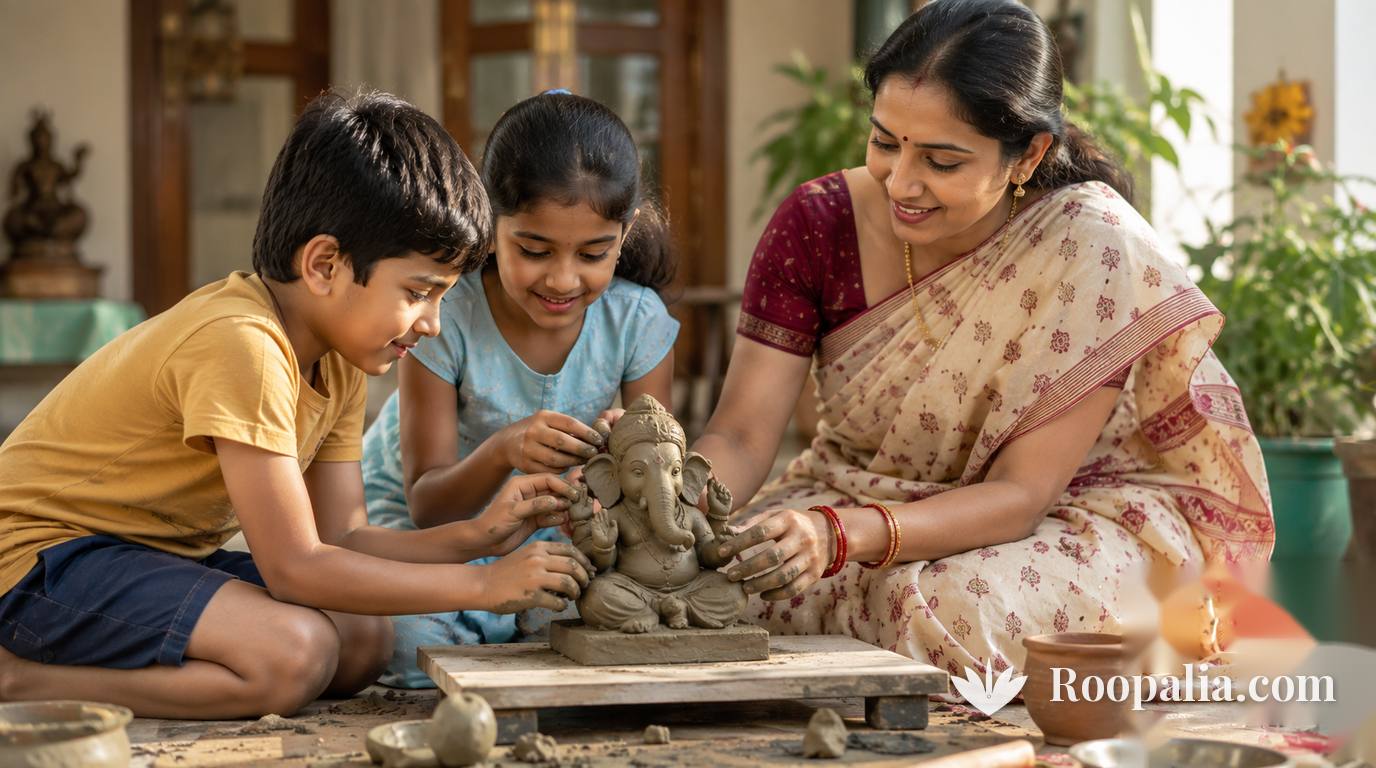
If you take only one suggestion from this page, take this one — this year, don't buy Bappa. Make him.
Get some clay, sit on the floor, and let the children shape it with their own hands. The idol will be lopsided. The trunk will probably fall off. The ears will not match.
And it will be the most beautiful idol of that year.
Because a child who makes something forms a relationship with it. For ten days she will do aarti in front of something she made, and on visarjan day she may well cry. Those tears are the strongest thread a tradition ever gets.
This is not a modern invention, either. Shaping the idol from clay at home is the older practice; market idols came later.
A home festival that spills onto the street
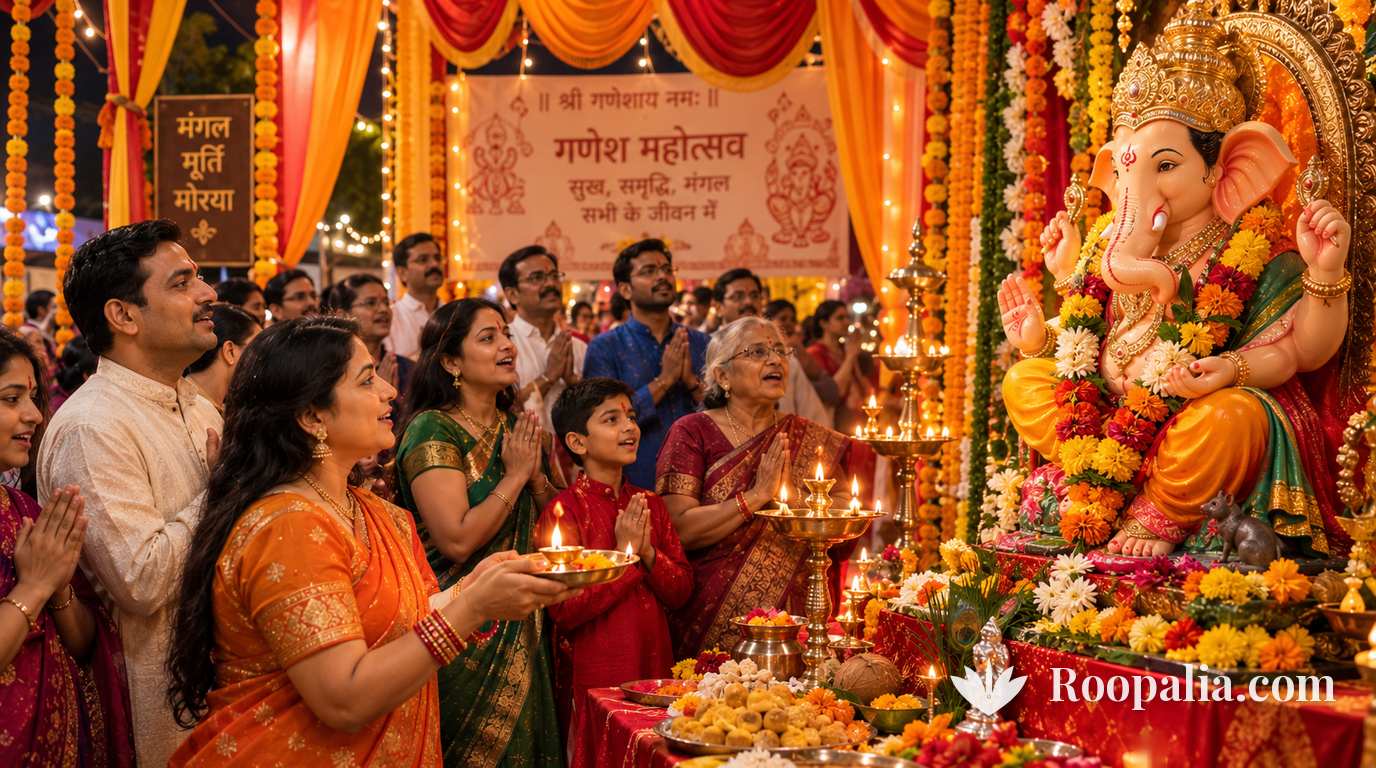
One thing sets Ganesh Chaturthi apart from every other Hindu festival — it leaves the house and takes over the street.
It was not always so. Homes had kept the festival for centuries, and it was celebrated publicly in the time of Chhatrapati Shivaji Maharaj. But the great public Ganeshotsav we know today was revived by Lokmanya Tilak in 1893, for a very specific reason: under colonial rule, public gatherings were restricted — but a religious festival was not. The pandal became a place where an entire society could legally assemble.
So this festival is devotion and solidarity at the same time. In a pandal nobody asks your caste or checks your income; everyone stands in the same queue for prasad. It is worth telling children that part too.
Ganesh Chaturthi abroad — your city's muhurat
The good news first: Ganesh Chaturthi falls on 14 September everywhere in the world. Unlike Navratri or Teej, the date does not shift.
But there is a complication, and it belongs to Australia and New Zealand.
⚠️ In Sydney, Melbourne and Auckland the window is very short
The Chaturthi tithi begins at 7:06 AM Indian time on 14 September. On a Sydney clock that is 11:36 AM, and in Auckland 1:36 PM.
Which means most of the madhyahna period has already passed before the tithi even starts. In Auckland the effective window is just 38 minutes.
| City | Chaturthi begins | Madhyahna | Effective window |
|---|---|---|---|
| Auckland, New Zealand | 14 Sep 1:36 PM | 10:19 AM–2:14 PM | 1:36–2:14 PM (38 min) |
| Sydney, Australia | 14 Sep 11:36 AM | 9:53 AM–1:49 PM | 11:36 AM–1:49 PM |
| Melbourne, Australia | 14 Sep 11:36 AM | 10:18 AM–2:13 PM | 11:36 AM–2:13 PM |
| Singapore | 14 Sep 9:36 AM | 10:59 AM–3:01 PM | 10:59 AM–3:01 PM |
| Dubai, UAE | 14 Sep 5:36 AM | 10:11 AM–2:17 PM | 10:11 AM–2:17 PM |
| London, UK | 14 Sep 2:36 AM | 10:48 AM–3:02 PM | 10:48 AM–3:02 PM |
| Toronto, Canada | 13 Sep 9:36 PM | 11:07 AM–3:18 PM | 11:07 AM–3:18 PM |
| New York / New Jersey | 13 Sep 9:36 PM | 10:46 AM–2:56 PM | 10:46 AM–2:56 PM |
| Chicago, USA | 13 Sep 8:36 PM | 10:40 AM–2:50 PM | 10:40 AM–2:50 PM |
| San Francisco Bay Area | 13 Sep 6:36 PM | 10:58 AM–3:07 PM | 10:58 AM–3:07 PM |
| India (New Delhi) | 14 Sep 7:06 AM | 10:12 AM–2:20 PM | Published: 11:02 AM–1:31 PM |
Madhyahna here follows the classical definition — the middle third of the interval between local sunrise and sunset, calculated astronomically for each city's own coordinates. Published panchangs usually give a narrower slice inside this (as with Delhi's 11:02 AM–1:31 PM). If your local temple or family panchang publishes a timing, follow that.
Where to find samagri outside India
The clay idol. Indian stores in most large cities stock them from late August. They can be ordered online, though breakage is common. The better route: make one with your children. Air-dry clay from any craft shop works perfectly.
Durva grass. The hardest item. Indian grocers sometimes carry it fresh in the days before the festival. If you cannot find it, clean tender grass from your own garden is what many families use — that is practicality, not compromise.
Modak. Frozen modaks are stocked by most Indian stores. To make them at home you need rice flour, coconut and jaggery — all three are easy to find.
Red hibiscus. If unavailable, any red flower will serve. Tradition cares about the colour and the intention, not the botanical name.
Where to do the visarjan? This is the biggest question abroad, and the answer is simple — at home, in a large vessel. Many countries legally prohibit immersing idols in rivers or the sea, and in any case a clay idol dissolves just as devoutly in a bucket. Afterwards, pour the water into a plant. Bappa returns to the earth, which is exactly what the scriptures intend.
A mother in New Jersey once said: "The first year I was miserable — no pandal, no dhol, nothing. Then we set up a small Bappa at home and invited five neighbouring families for aarti. Those five families come every year now. We built our own mohalla."
What to tell your children about Ganesha
For a child growing up abroad, Ganesha risks becoming just "the elephant god". Three things prevent that.
1. He is the god of those who don't win races. He had no fast vehicle, no handsome form, and a broken tusk. He still became first among the worshipped — because he thought instead of running. For a child who knows she is not the fastest in her class, there is no better story in the world.
2. He is the god of writing. While transcribing the Mahabharata, his pen broke — so he snapped off his own tusk and kept writing rather than break the flow. That is what commitment looks like. A child who says his name before an exam should know that story.
3. Every part of him is an instruction. Big ears, listen more. Small mouth, talk less. Big stomach, digest everything. Tell a child that list once and it stays for life.
And if she asks why we put the idol into water — tell her that what comes from the earth returns to the earth, and comes back again next year. That is the whole of it. She will not find a simpler philosophy anywhere.
On visarjan day, when everyone calls out "Ganpati Bappa Morya, pudhchya varshi lavkar ya" — listen to what is actually being said. It is not a goodbye. It is an invitation for next year. In Indian tradition no farewell is ever final; every parting carries a promise of return folded inside it. Make sure your child understands that. It is not really about the idol.
In closing
The god who is worshipped first is also the easiest to please
14 September, sthapana 11:02 to 1:31, visarjan 25 September. The dates are that simple. But what makes this festival different is that it turns God into a member of the household. For ten days he lives as a guest — fed each morning, sung to each evening, and sent off with wet eyes. No other festival brings the divine so close. This year, take a clay idol, make it with your children, and immerse it at home. Bappa asks for no grand idol and no expensive pandal — only twenty-one blades of grass and an honest heart.
Frequently Asked Questions
When is Ganesh Chaturthi in 2026?
Why is Ganesha worshipped before every other god?
Why is the sthapana muhurat at midday?
Why should you not look at the moon on Ganesh Chaturthi?
What do you need for the Ganesh Chaturthi puja?
When is Ganesh Visarjan in 2026?
How do you do Ganesh visarjan at home?
Why is modak offered, and why twenty-one?
What time is Ganesh Chaturthi abroad?
Where can I find durva and modak abroad?
When did the public Ganeshotsav begin?
Can you make the Ganesha idol at home?
📷 AI-generated images. For illustration only.
🙏 Dates and muhurat follow the panchang and vary by city — please verify the timing for your own location. Sources differ slightly on the moon-avoidance window, which is noted in the article.