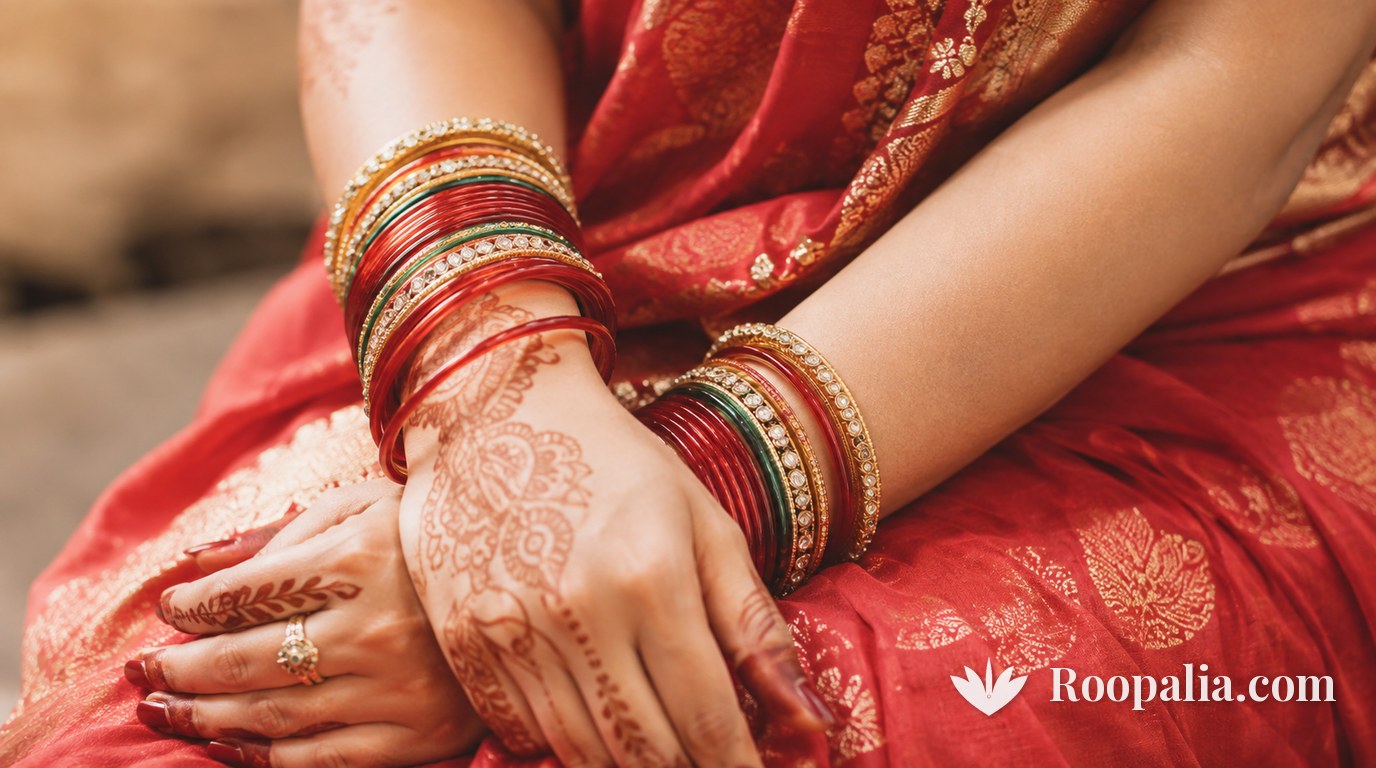
How old is the bangle tradition in India?
Old enough that when it began, there were no temples yet and no scriptures had been written.
In 1926, the excavation at Mohenjo-daro turned up a small bronze figurine the world now knows as the Dancing Girl. It is dated to roughly 2500 BCE — about four and a half thousand years ago. It stands just 10.5 centimetres tall.
And what is on her arms? Twenty-four to twenty-five bangles on the left arm, and four on the right.
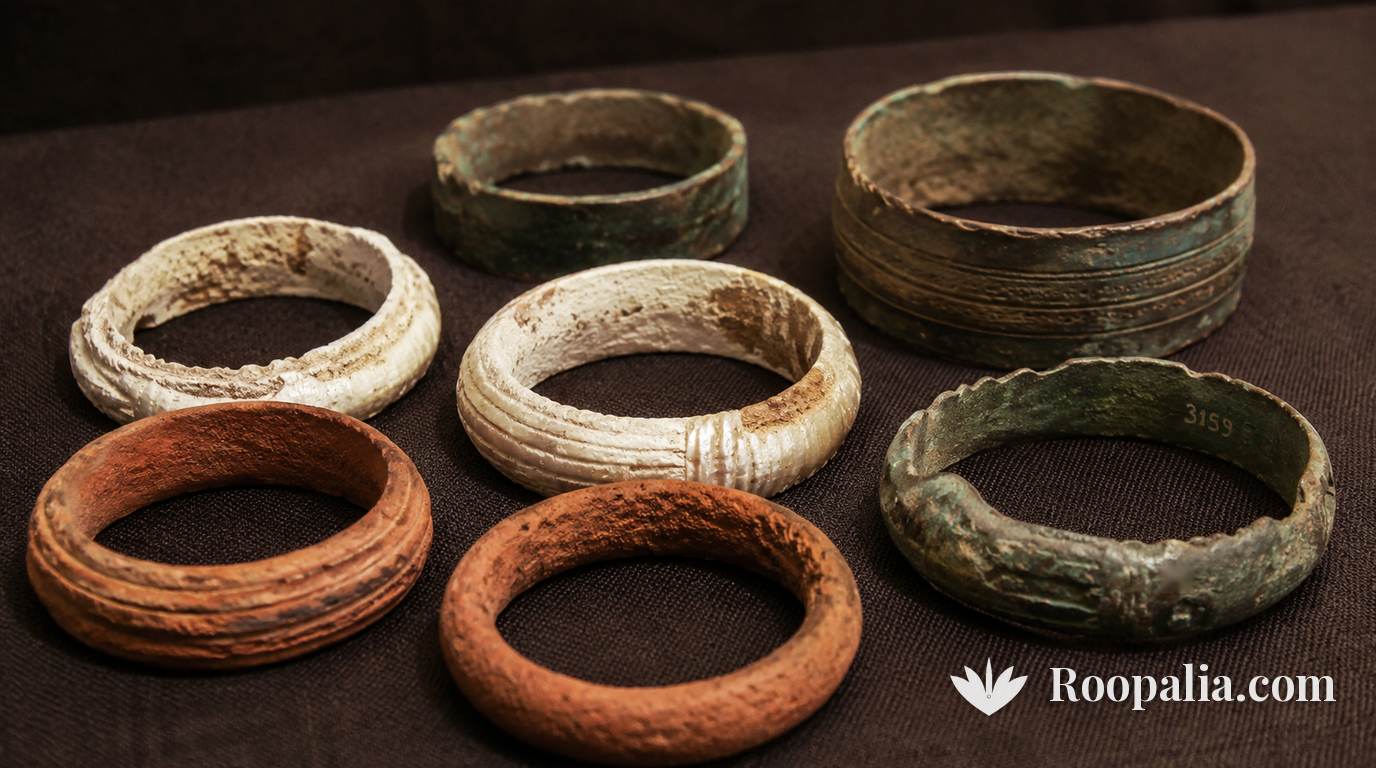
She is not the only evidence. Indus Valley excavations have also yielded bangles made of shell, copper, bronze, stone and terracotta. From Harappa and the Mauryas down to today, the bangle has never once left the Indian woman's wrist.
Something worth pausing on
Twenty-four bangles on the left arm, only four on the right. Which means that four and a half thousand years ago there was already an order to how bangles were worn — a logic, a reason. What that reason was, we no longer know. But we do know the tradition was already a tradition even then.
Why the wrist? There's a forehead, a neck and two ears too
This question is rarely asked.
In Indian tradition, the placement of ornaments was never arbitrary — the bindi between the eyebrows, sindoor in the hair parting, and bangles on the wrist. Each spot comes with its own reasoning.
For the wrist, the traditional argument is that the pulse runs closest to the surface there — which is precisely why a vaidya reads the nadi at that point. The belief holds that the constant light pressure and friction of bangles keeps stimulating it.
Here honesty matters
You will have read that "glass bangles improve blood circulation", "prevent fatigue", "reduce mental stress". There is no scientific evidence available for any of these claims. They are traditional beliefs, not medicine.
Wear bangles — because they're beautiful, because they're yours, because you like the sound. Just don't mistake them for treatment. For any health problem, a doctor is the right place to go.
What do bangles symbolise?
Tradition attaches three meanings to them.
Good fortune — a full wrist is considered auspicious for a married woman. It's why bangles are the first thing put on for any occasion.
Protection — a bangle is a circle, with no beginning and no end. In tradition, the unbroken circle stands for a shield.
The sound — this is the loveliest meaning of all. The belief is that the clink keeps negative energy away. Practically speaking, in old joint families that sound was also a signal — the elders knew where the daughter-in-law was without ever asking.
Bangles are also part of the solah shringar. The full list and the meaning of each is in our solah shringar guide.
A popular claim we could not verify
Many websites state that "the Shiv Purana records that Shiva gifted lac bangles to Parvati at their wedding." The story circulates widely in folk tradition, but we could find no authoritative scriptural reference for it. It is fair to call it a widely held belief; it is not fair to call it "written in the scriptures".
What kinds of bangles are there?
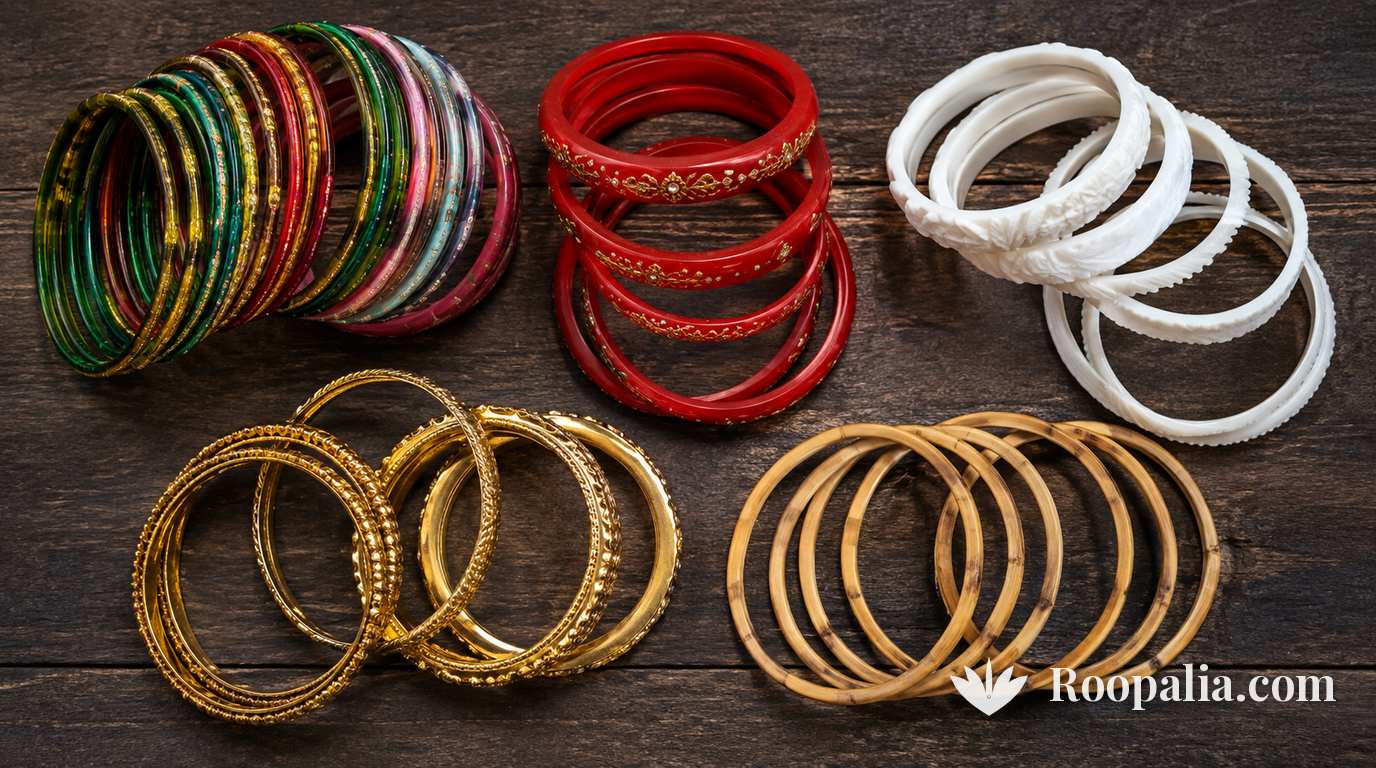
Glass — the most common by far. Firozabad is the great centre for them. Cheap, available in every colour, and the sweetest sound of all belongs to these.
Lac — made from a natural resin harvested from trees. Jaipur's lac bangles are famous worldwide, set with stones and considerably more durable than glass.
Shell — cut from sea conch. Bengal's shankha is made this way, and it is the mark of a married Bengali woman.
Gold and silver — kada, bala, patla. These are investment as much as ornament.
Bamboo and wood — worn across North-East India and by many tribal communities. Light, sustainable, and lately coming back into fashion.
Metal and the rest — brass, oxidised, meenakari, kundan. For festivals, matching kadas with a kundan set are the most reliable pairing.
What do women in different states wear?
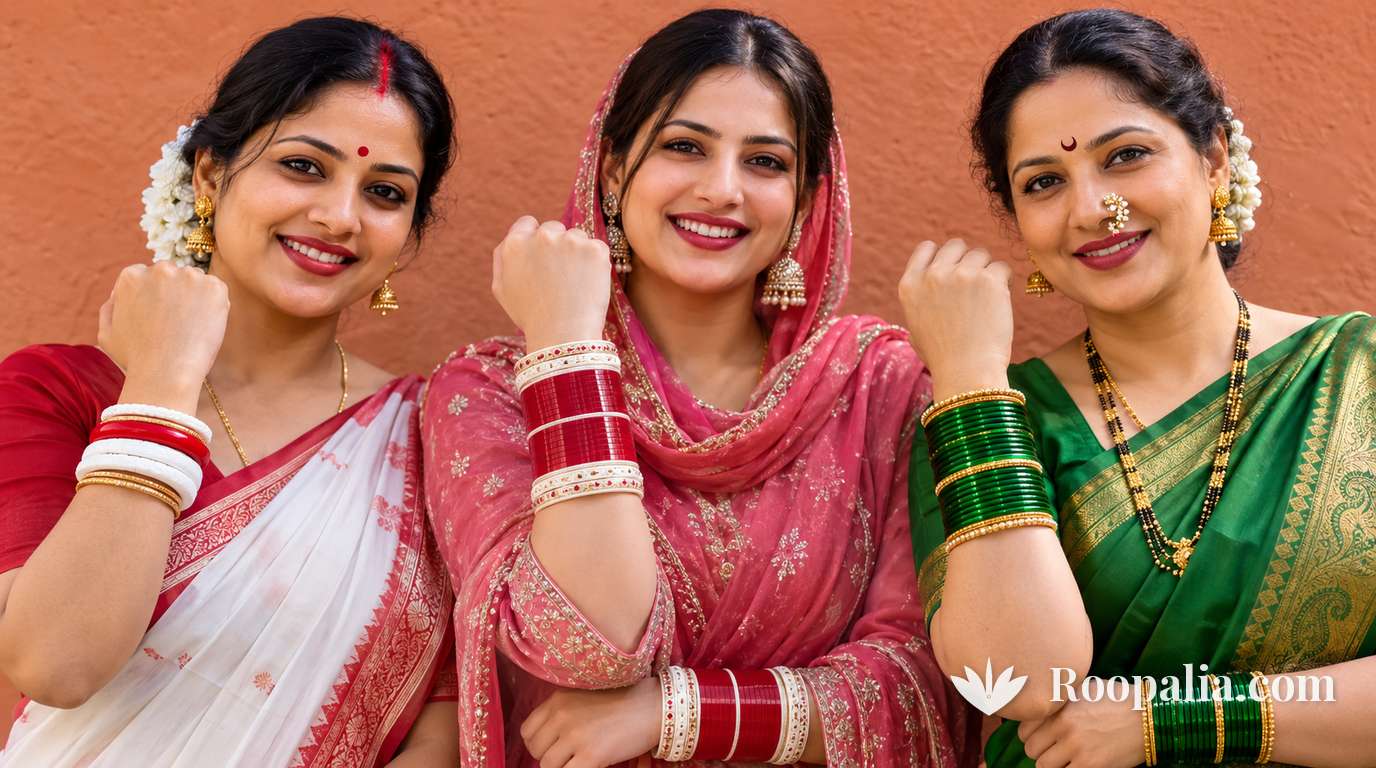
Bengal — shankha and pola. White conch-shell shankha and red coral pola, put on at the wedding. The single clearest marker of a married Bengali woman.
Punjab and Haryana — the chooda. A set of red and white bangles placed on the bride's wrists by her maternal uncle, with golden kalire hanging from them.
Maharashtra — green bangles. Green stands for good fortune and fertility. Green glass bangles worn with a gold patla and toda between them.
Rajasthan — the lac chooda, and ivory-white bangles that climb all the way to the elbow.
South India — gold kadas and glass bangles, usually matched to the jhumkas.
North-East India — bamboo, cane and beaded bangles, each tribe with its own distinct style.
What do the different bangle colours mean?
Red — energy, love and good fortune. Considered the most auspicious for married women.
Green — prosperity, fertility and renewal. Worn most in Sawan, at Teej and on Ganesh Chaturthi.
Yellow — happiness and auspicious beginnings. The colour of the haldi ceremony.
White — peace and purity. In Bengal the white of shankha is auspicious, while in North India white bangles are rarely worn alone.
Gold — prosperity, and it works for every occasion.
Bear in mind — these meanings shift from region to region and family to family. A colour that is auspicious in one place isn't even worn in another. There is no universal rule, and judging a woman's devotion by the colour of her bangles is neither tradition nor good manners.
Why green bangles in Sawan?
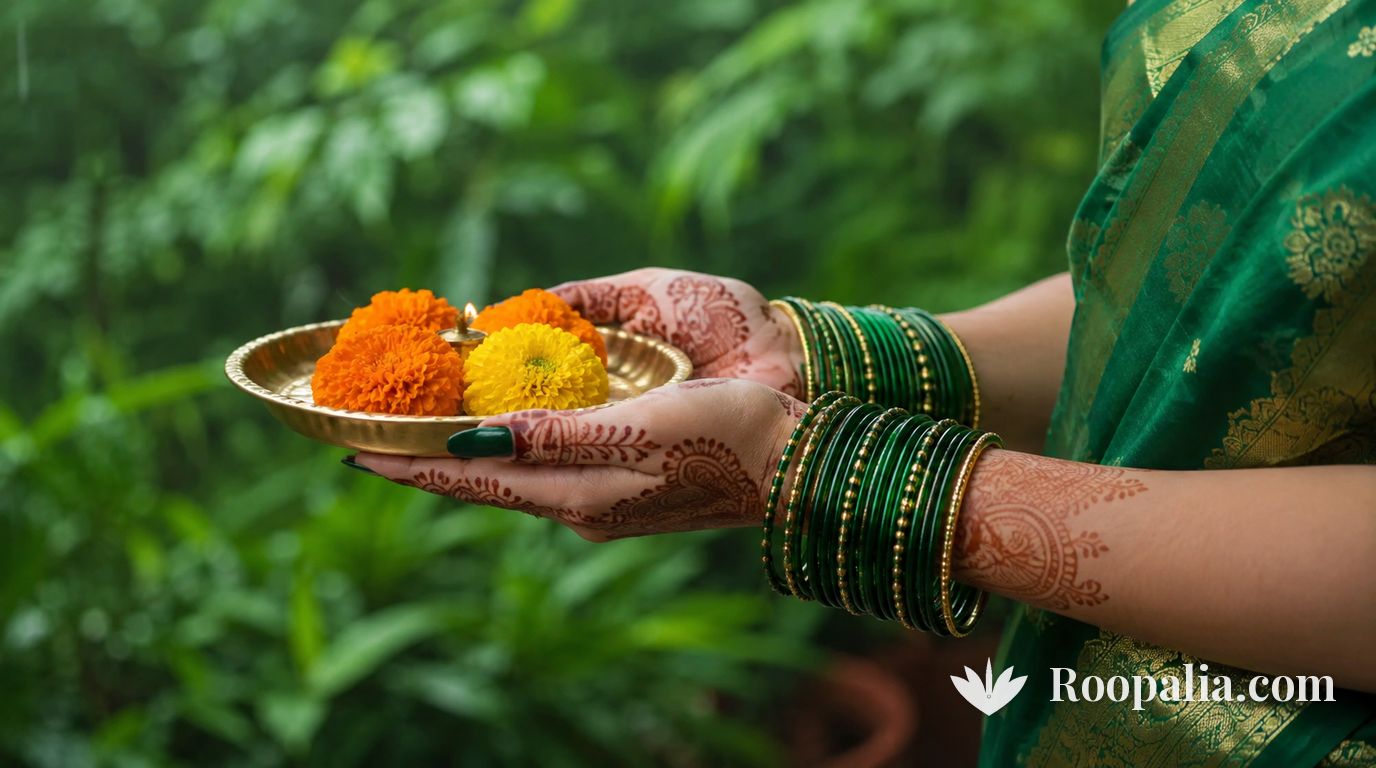
This custom is tied to nature, and the logic behind it is rather beautiful.
Sawan is the month of rain — when dry earth turns green. Green is the colour of that renewal. Sawan belongs to Shiva, and both Hartalika Teej and Hariyali Teej fall in this season, where a green saree, green bangles and mehndi are all treated as essential adornment.
In astrology, green is linked to the planet Mercury (Budh), which is why donating green bangles on a Wednesday is held to be auspicious.
Which day is auspicious for wearing bangles? — here's a problem
This gets searched a great deal, and in answering it I have to be straight with you.
Different sources say different things — and they contradict each other.
What the popular beliefs actually say
Friday — almost every source calls this auspicious. It belongs to Lakshmi and Santoshi Mata, and is considered especially good for buying green and red bangles.
Wednesday — a day of intellect and prosperity, dedicated to Ganesha. Donating green bangles on this day is said to relieve Budh dosha. So yes, you can wear bangles on a Wednesday.
Sunday — some sources call it auspicious, others say avoid it.
Tuesday and Saturday — most sources advise avoiding these.
My view — when the sources themselves don't agree, treating any one of them as a binding rule and carrying that anxiety around isn't sensible. None of this is a scriptural command — it comes from astrology and folk custom, and it varies by region.
The simplest route: take Friday, since almost everyone agrees on it. And if you happen to feel like wearing bangles on some other day, wear them. The point of a tradition is to make you feel beautiful, not afraid.
How many bangles should you wear?
Again, no hard rule, but there are some common customs.
Tradition holds that the wrist should never be left completely bare — at least a bangle or two, or a kada. Many households consider an odd number (7, 9, 11, 21) auspicious, though this too is far from universal.
The practical point — wear fewer in summer. A heavy stack traps sweat, which can lead to prickly heat and itching. That isn't a belief; it's just experience.
Which hand for a gold kada — traditions are divided on this and there is no single scriptural rule. Whatever your family follows is fine.
What should you do with old bangles?
This is asked often, and the answer is both practical and a little sentimental.
The common custom — do not give worn bangles to a stranger. Family members you know can receive them. If you want to donate, buying new bangles to give away is considered more auspicious.
Broken bangles — do not let them accumulate in the house. Tradition suggests immersing them in flowing water or burying them in earth.
And one practical request — do not throw glass shards loose into the bin. Wrap them in paper first, so the person collecting your rubbish doesn't cut their hands. Sometimes the thing tradition never mentioned turns out to matter most.
How are bangles actually made?
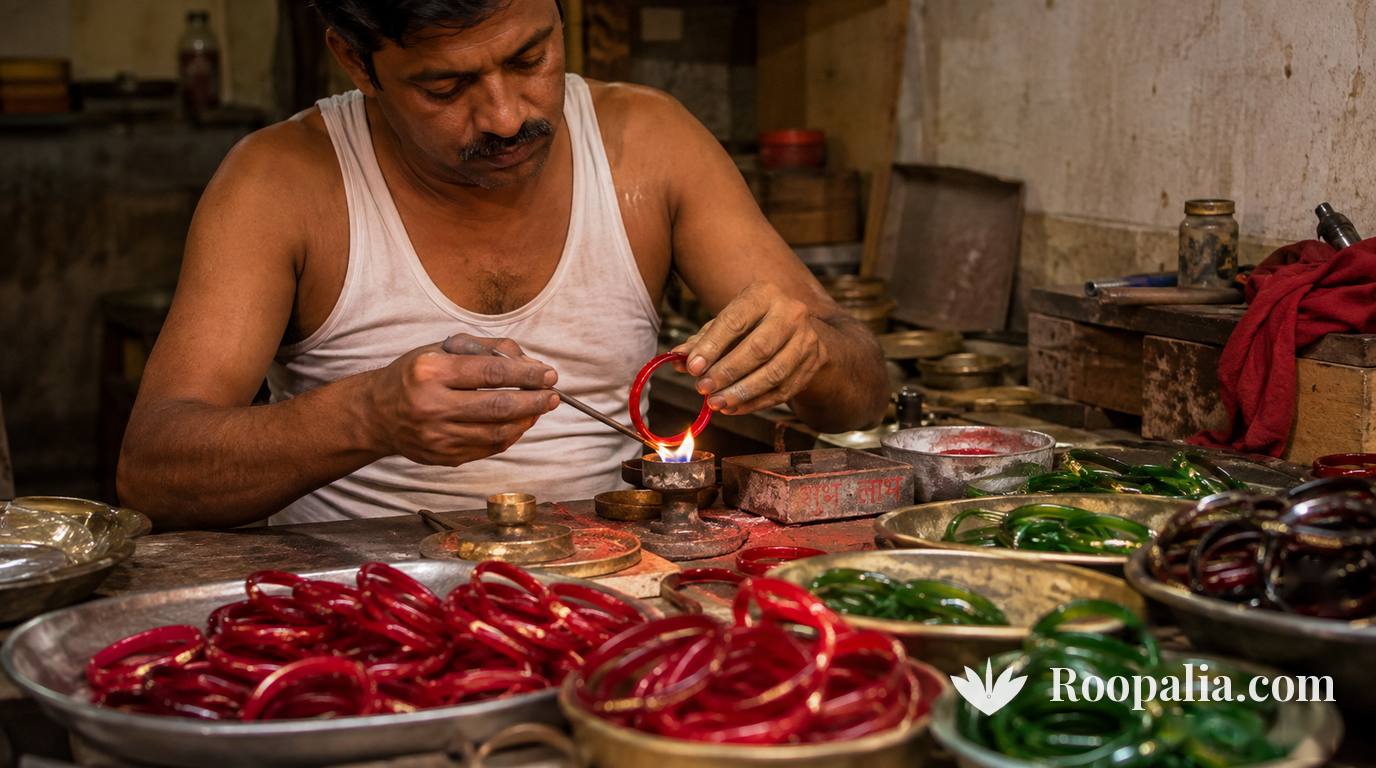
Glass bangles — glass is melted in a furnace and drawn into a long tube, then coiled into rings and the join fused over a flame. Then comes the cutting: designs are ground into the surface on a spinning stone wheel, and the craftsman who does it is called a kataiya. A great many break in the process; the fragments are known as bhangar.
Lac bangles — lac is warmed until soft, then rolled by hand over a cylindrical form to take shape. Stones and mirrors are set in by hand. The manihars of Jaipur have carried this craft through generations.
The next time you buy a dozen bangles for thirty rupees, spare a thought for how much fire, how many fingers and how many generations of skill went into them.
How do you measure your bangle size?
This is the single biggest problem when buying online. The method is simple.
1. Bring your thumb to your little finger, the way you do when slipping a bangle on.
2. Wrap a thread or measuring tape around the widest part of your hand.
3. Measure that circumference and divide by 3.14 — the result is your diameter in centimetres.
4. Example: a circumference of 7.5 cm gives 7.5 ÷ 3.14 = about 2.4 — so your size is 2.4.
Indian sizes run from about 2.2 to 2.10. When in doubt, go slightly larger in glass (less risk of breakage) and exact in metal.
The bridal chooda — the most emotional custom of all
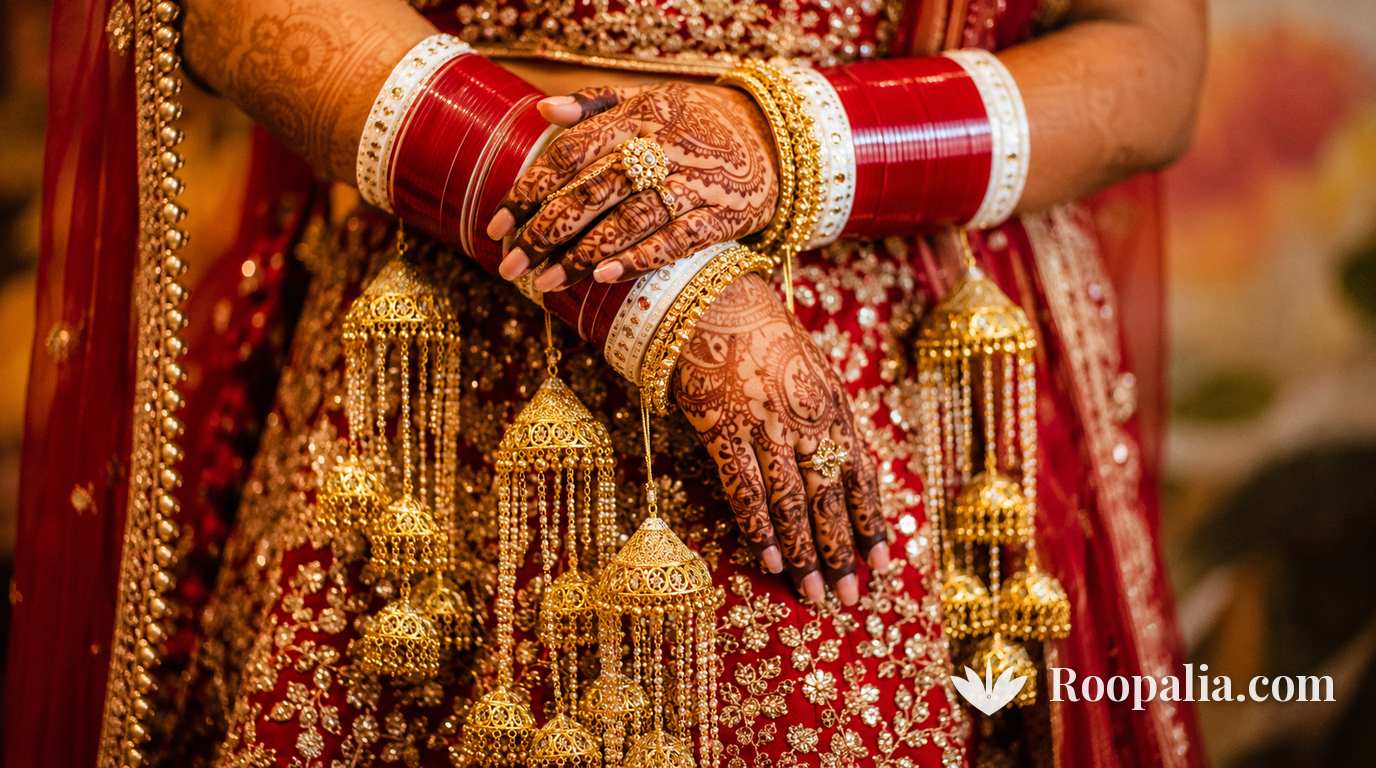
In Punjab and across North India there is a chooda ceremony before the wedding, in which the bride's maternal uncle and aunt place the red and white chooda on her wrists. It is dipped in milk and rose petals to purify it, and the bride does not look at it until the wedding — it stays covered with cloth.
The kalire are tied on by her friends, and there is a lovely custom where the bride shakes them over the heads of her unmarried friends — whoever a kalira falls on is said to be next.
How long the chooda is worn varies — forty days in some families, a year in others, forty-five days elsewhere. It is entirely a family custom. For the bride's full adornment, see our maang tikka guide as well.
Bangles and the woman of today

A dozen glass bangles at the office is neither practical nor necessary. But you don't have to give up the tradition either.
For work — two thin gold bangles, or a single oxidised kada. No noise, no interference with typing, and the identity stays.
For festivals and occasions — wear them fully. Navratri, Karwa Chauth, Teej, a wedding — a full wrist belongs to exactly these days.
For those living abroad — glass bangles shatter in air travel, so wrap them in cloth, put them in a hard box, and pack it in the middle of your case. And if anyone asks what they are, one sentence will do: "It's our oldest tradition — four and a half thousand years old." That usually ends the conversation.
And if your daughter asks why you wear them, don't say "because you have to". Tell her about that dancing girl from Mohenjo-daro, with twenty-four bangles on her arm four and a half thousand years ago. A girl who understands what long line she is standing in doesn't abandon a tradition. She wears it with pride.
In closing
The cheapest ornament, the oldest inheritance
A dozen bangles cost thirty rupees in the market. No gold, no stones, no fine workmanship. And yet those same thirty-rupee bangles belong to a tradition older than the pyramids. That dancing girl at Mohenjo-daro and you on your way to work — four and a half thousand years lie between you, and the wrist is the same. Don't chase the health claims, don't live in fear of the wrong day. Wear bangles because they're yours — and because in that small clink there is the sound of an entire civilisation.
Frequently Asked Questions
Why are bangles worn?
What are the benefits of wearing glass bangles?
How old is the bangle tradition in India?
Which day is auspicious for wearing bangles? Can you wear them on Wednesday?
What is the significance of green bangles in Sawan?
What should you do with old and broken bangles?
How many bangles should you wear on each hand?
What bangles do women in different Indian states wear?
How do you measure the right bangle size?
Are lac bangles good to wear?
📷 AI-generated images. For illustration only.
🙏 The traditional beliefs described here vary by region and family. Nothing in this article should be treated as medical advice; for any health concern, please consult a doctor.