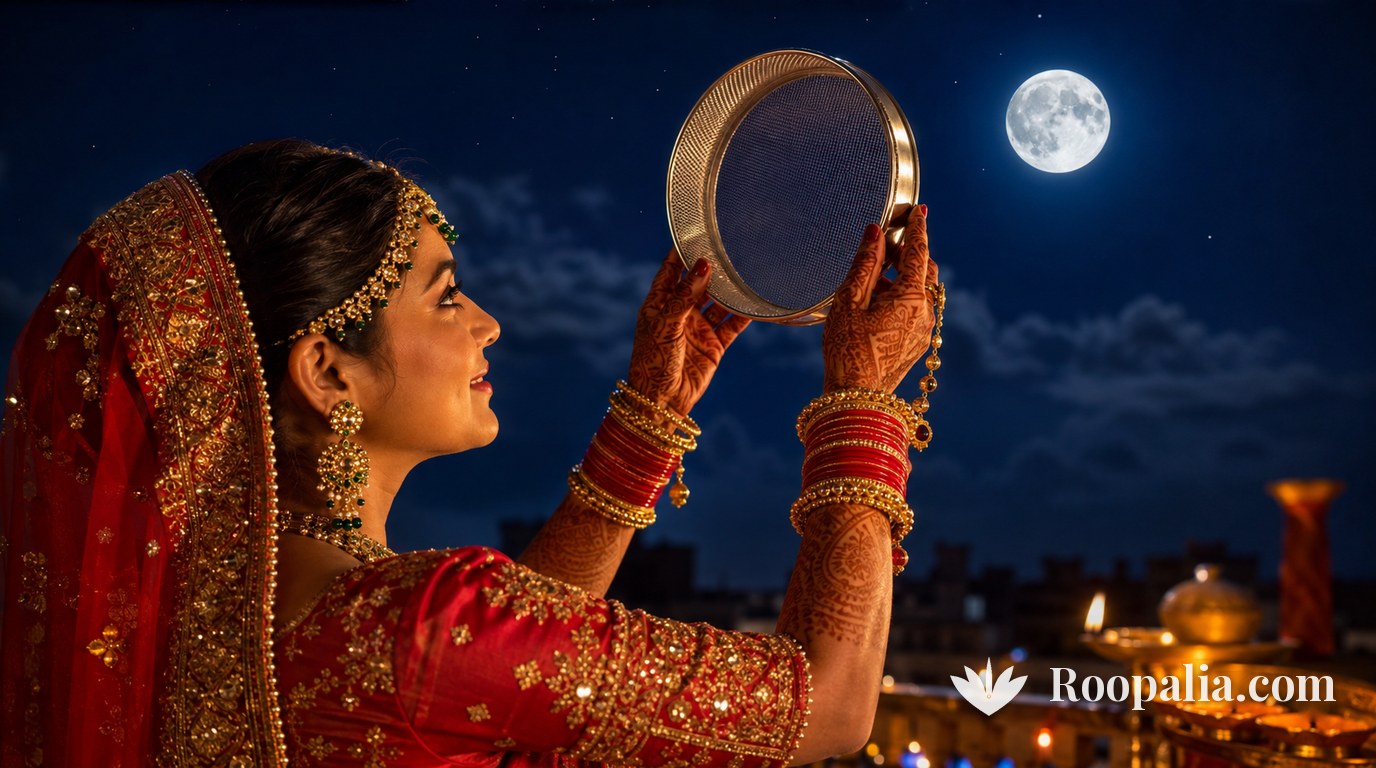
What time will the Karwa Chauth moon rise in your city?
This is the single most important question of the day, because the whole fast turns on that one moment. And it is also where the biggest misunderstanding lies.
Moonrise time differs from city to city. What is 8:17 PM for Delhi is not 8:17 PM for Mumbai. India stretches roughly 2,900 kilometres east to west, so the moon rises earlier in Kolkata and nearly an hour later in Ahmedabad.
⚠️ This is why every website prints a different time
One says 8:11, another says 8:17. Neither is wrong — they are simply for different cities or different calculations. Drik Panchang gives 8:17 PM for New Delhi; some other panchangs list 8:11 PM.
What this means for you: whichever time you take, be on the terrace 15 to 20 minutes early. The moon has never once consulted a clock — cloud cover, buildings and the height of your horizon all make a difference.
To find your own city's time, open a panchang such as Drik Panchang and select your city at the top; they calculate separately for over a hundred thousand locations. Broadly, eastern India (Kolkata, Patna) runs about half an hour earlier, and western India (Mumbai, Ahmedabad) half an hour to an hour later.
What if the moon isn't visible?
Cloud and haze are common in late October, and thousands of women search this every year.
Don't panic. Tradition provides for it — once the moonrise time has passed and the moon still cannot be seen, arghya may be offered in the direction where the moon should be, and the fast broken. The reasoning is that the moon is there; it is only covered.
In many households people now offer arghya after seeing a picture of the moon, or one on a phone. This is not the scriptural method, but in a tradition that values intention it is not considered improper either — particularly when health is at stake.
The Karwa Chauth katha — there isn't one, there are four
Here is something most articles never say: there is no single "correct" Karwa Chauth katha. Different regions tell different stories, and all four belong to living folk tradition.
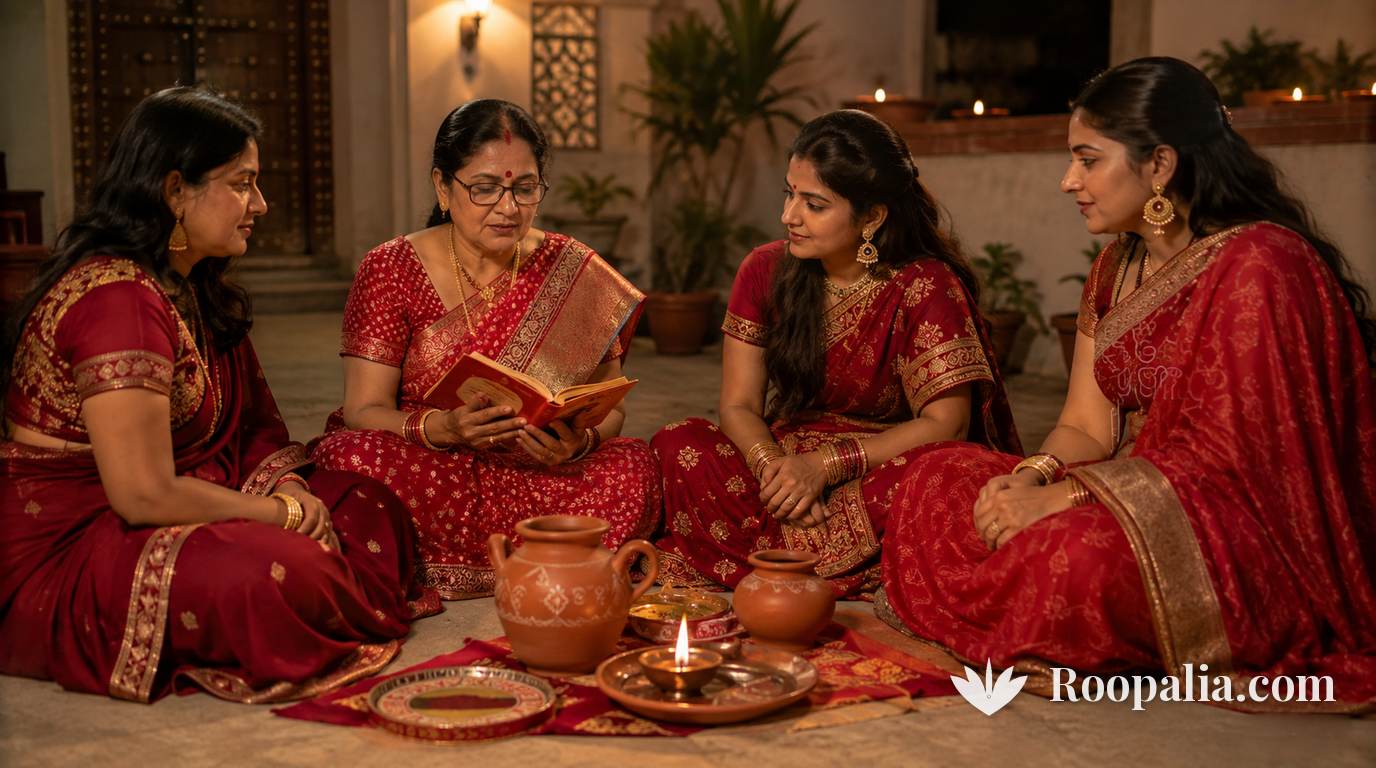
1. Veervati. The best known. Veervati, the only sister of seven brothers, kept the first Karwa Chauth. Unable to bear her distress from hunger, one brother climbed a distant banyan tree holding a sieve and a lamp, while the others woke her saying the moon had risen. She broke her fast on that false moon — and her husband died. She then kept the fast on every chaturthi for twelve months, and finally got him back.
2. The merchant's daughter. Almost the same story with different characters. Here a merchant has seven sons and one daughter; the brothers light a fire in a tree outside the town and call it the moon. The sisters-in-law tell her the truth, but she does not listen — and the fast is broken.
3. Karwa the washerwoman. Karwa lived with her husband by the Tungabhadra river. He was old and frail, and while bathing he was seized by a crocodile. Karwa bound the crocodile with a raw thread and demanded justice from Yamraj himself. The tone of this katha is entirely different — here the woman does not plead. She demands justice.
4. Draupadi. A tradition linked to the Mahabharata holds that when Arjuna left for penance, Draupadi grew anxious. On Indrani's counsel she kept this fast, and Arjuna returned safely.
One thing runs through all four
Notice that in three of them the fast is broken or the husband falls into danger, and it is the woman's resolve that sets everything right again. The real protagonist of these stories is not the moon — it is the stubbornness with which a woman holds to her word. In Karwa's story she takes on Yamraj himself.
All four are folk kathas drawn from the Puranas and regional traditions. Calling any one of them "the only correct version" would be wrong — whichever is told in your family is the one for you.
What is sargi, and who gives it?
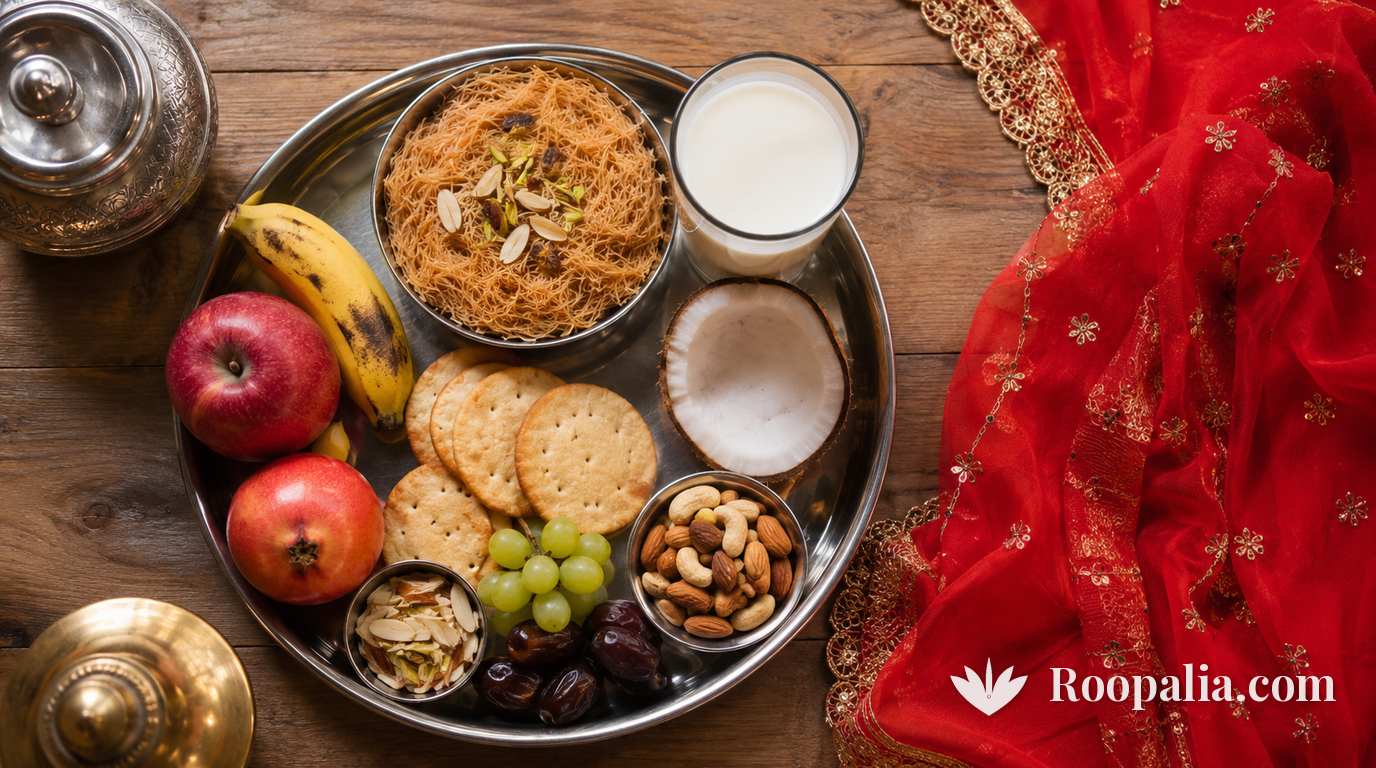
Sargi is the meal eaten before the fast begins, before sunrise — usually between 4 and 5 in the morning.
By tradition the mother-in-law gives the sargi — it is her blessing to her daughter-in-law. The thali holds fenia, dry fruits, seasonal fruit, mathri, coconut, sweets and milk, along with a red chunri and suhag items.
But your question — can a husband give the sargi? Yes, absolutely. In households where there is no mother-in-law, or where the couple lives separately, the husband, a mother, an elder sister-in-law or any elder woman gives it. No scripture states that only a mother-in-law may give sargi. It is a custom of affection, not a rule.
What to keep in your sargi — the health part
Thirteen hours and forty-six minutes without water is not easy. Prioritise three things:
1. Coconut water or milk — hydration that lasts
2. Dry fruits and fresh fruit — slow, steady energy
3. Go light on fried and very salty food — it will leave you thirstier all day
And avoid tea and coffee; they draw water out of the body.
The complete Karwa Chauth puja samagri list
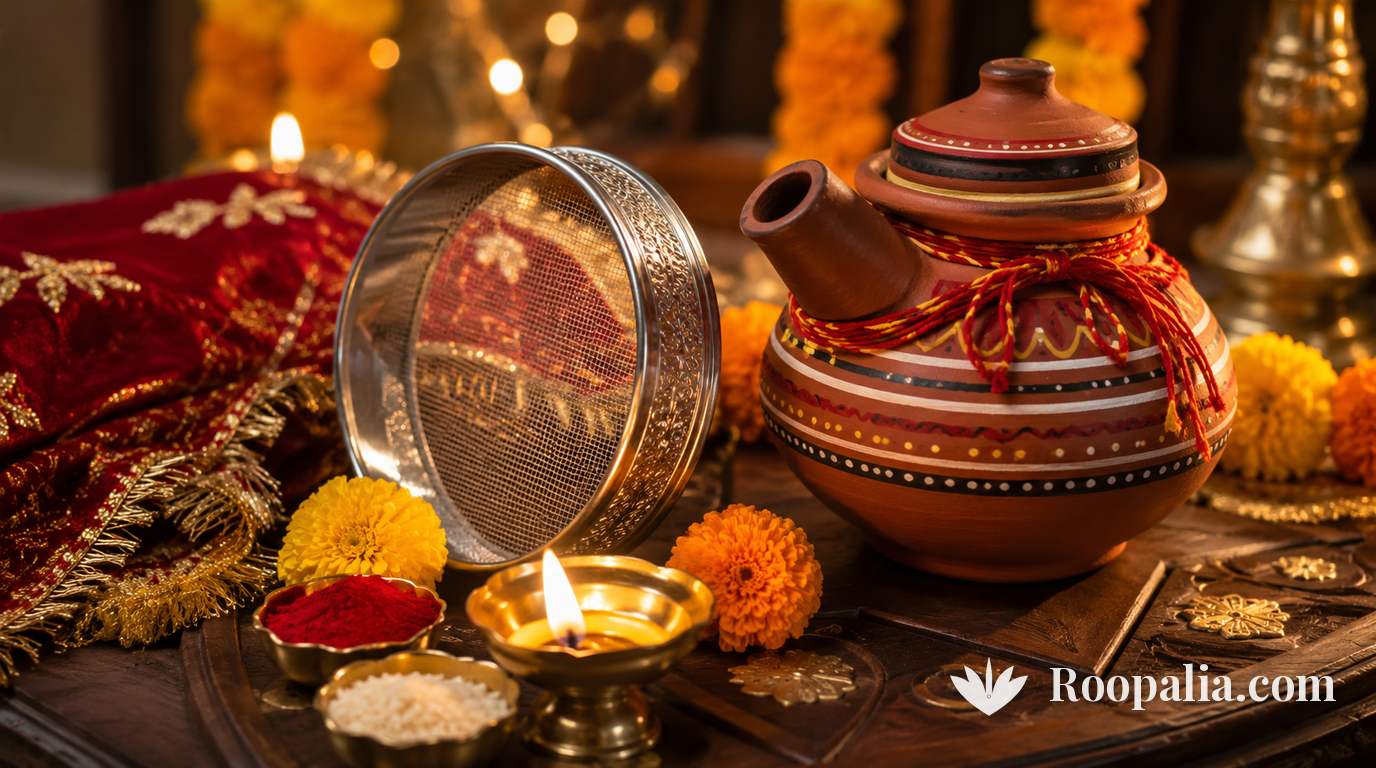
The essentials — an earthen karwa (with spout and lid), a sieve, a water-filled kalash, a lamp, cotton wicks and ghee.
Puja items — roli, akshat (whole rice), turmeric, sandalwood, kumkum, mauli, incense, camphor, flowers and durva grass.
Suhag items — red chunri, sindoor, bindi, bangles, kajal, comb, mehndi and alta.
Bhog and prasad — fenia, mathri, sweets, seasonal fruit, coconut and jaggery.
What goes inside the karwa — water, a little milk, grains of rice and a coin. Some regions add wheat or sugar as well.
Karwa Chauth 2026 puja vidhi — step by step
1. Sankalp. Eat sargi before sunrise, bathe, and take the resolve for the fast.
2. Shringar. Complete the solah shringar during the day. The Abhijit muhurat (11:50 AM to 12:40 PM) is considered the best window for filling the karwa and for getting ready.
3. Setting up. In the evening, prepare the chowki and install the Shiva family — Shiva, Parvati, Ganesha, Kartikeya and Nandi.
4. Direction. The idols should face west, and the woman should sit facing east.
5. Puja. Offer roli, akshat, sandalwood, flowers, incense and lamp. Fill the karwa with water and milk and place the lid on it.
6. Katha. During the 5:38 to 6:56 PM window, sit with the women of the household and listen to the vrat katha. The karwa is passed around afterwards.
7. Moon sighting and arghya. At moonrise, 8:17 PM, view the moon through the sieve, then look at your husband through the same sieve.
8. Paran. Break the fast with water from your husband's hands, followed by something sweet.
How to offer arghya to the moon — and what to say
A small thing, but very often asked, so plainly.
The method: take water in a lota, hold it with both hands, stand facing the moon, and let the stream fall slowly downward — never flung upward toward the moon. Adding a little milk, rice and flowers to the water is considered auspicious.
What to say: there is no need to memorise anything difficult. The mantra commonly used is —
"Om Som Somaya Namah"
And after that, simply say what is in your heart, in your own words. Intention is the real mantra — every tradition says as much.
Why is the moon viewed through a sieve?
It is the most recognisable image of this festival, and two explanations are offered.
The first comes from the katha — in Veervati's story the brother used a sieve and a lamp to fake the moon. Some hold that the custom carries that memory.
The second is symbolic — looking through a thousand small holes means looking with complete attention, at both the moon and the husband. And there is a lovelier reading still: a sieve strains out what is impure, so may a marriage also let grievances fall through and keep only affection.
Immediately after seeing the moon, the same sieve is turned toward the husband's face — the moment the whole day has been waiting for.
Breaking the fast, and the rituals of that night
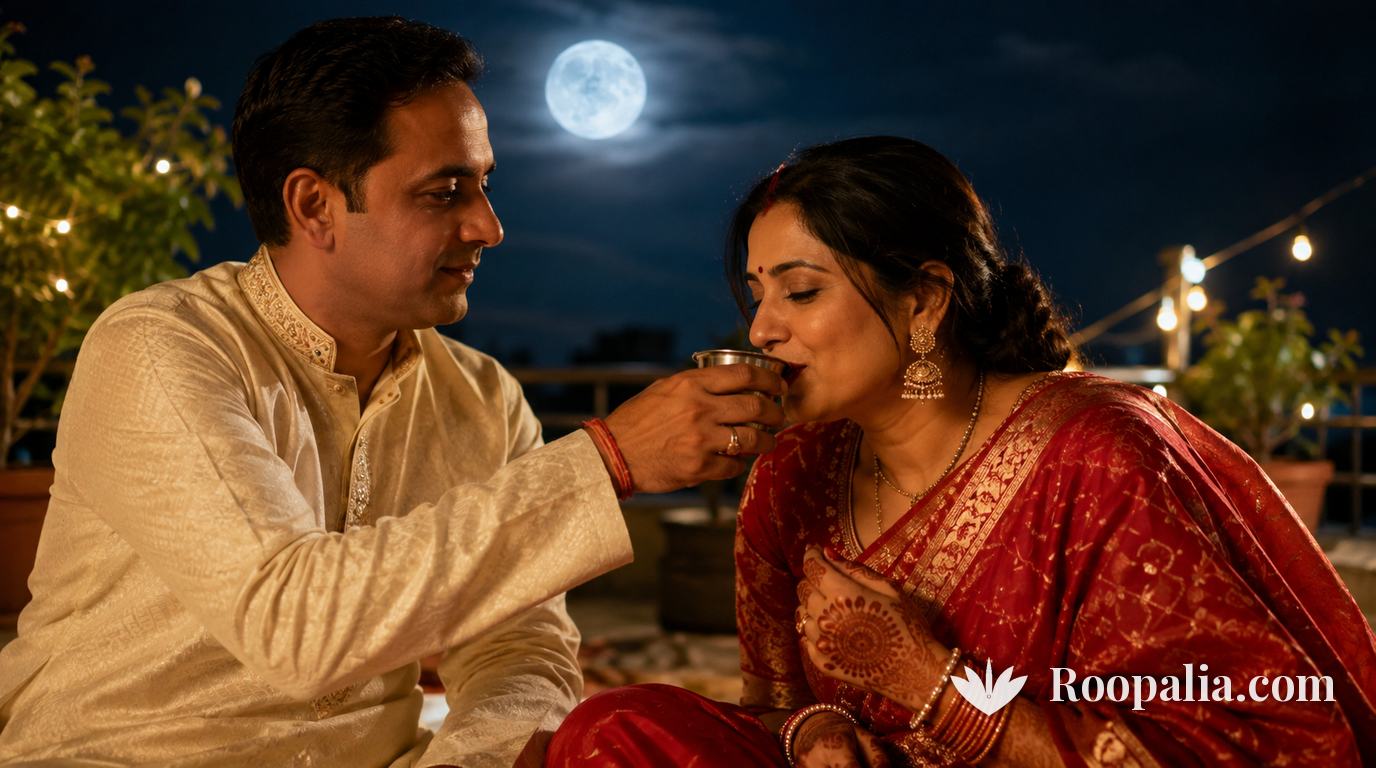
Once the moon has been seen and arghya offered, the puja is complete — and then comes the most tender part of the whole day.
The husband gives his wife water with his own hands and feeds her a morsel of something sweet, breaking her fast. That is the paran. She then touches the feet of the elders for their blessing, and the family sits down to eat together.
In many homes the husband gives a gift at this point — a saree, jewellery, or something she has wanted. It is not a required ritual, but as a gesture of love and regard the custom has grown.
A question that comes up often
The Karwa Chauth fast is complete once the moon has been seen and the paran done. Beyond that, no scripture places any particular restriction on a couple's private life. It is entirely a private matter and nobody needs to be advised on it.
Do keep in mind, though, that after more than thirteen hours without water the body is tired — eat slowly at first and drink enough water.
What to wear on Karwa Chauth
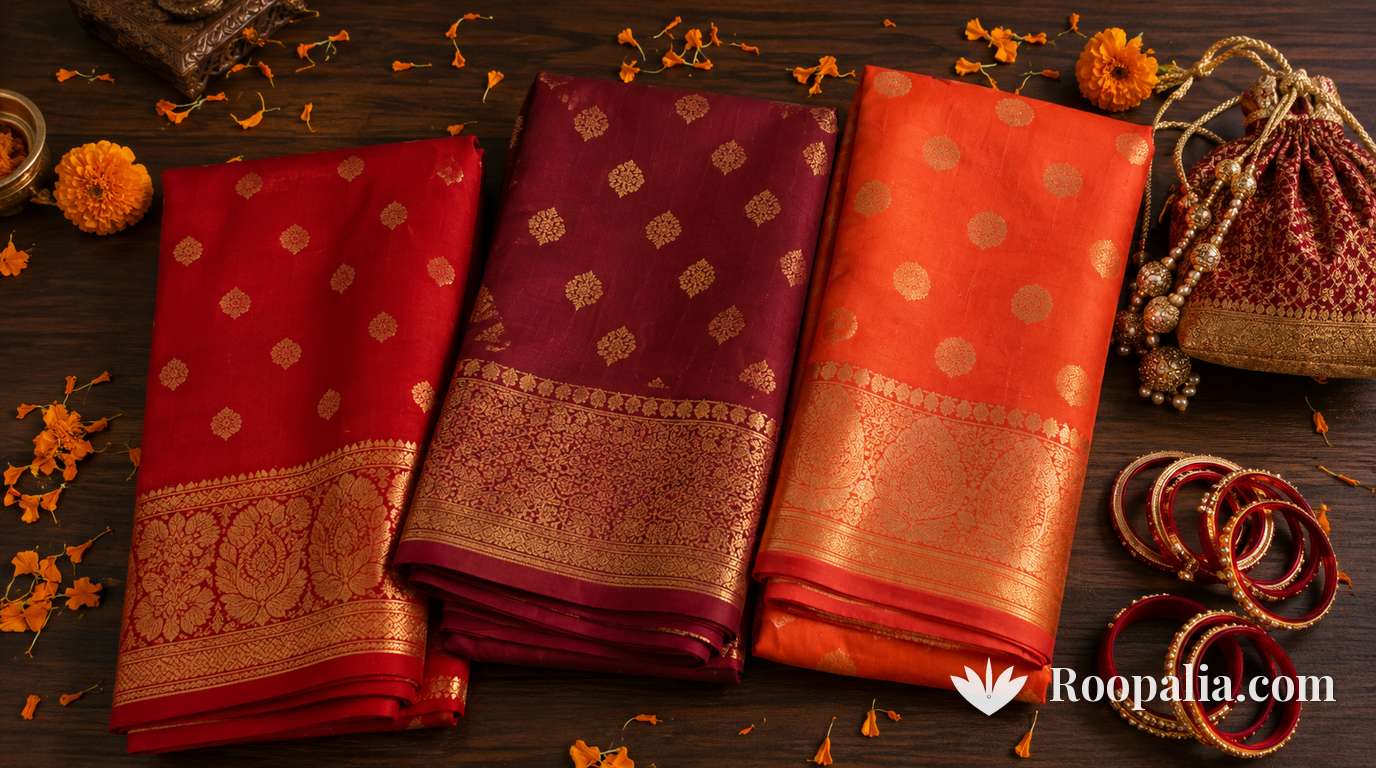
Red is considered the most auspicious — the colour of good fortune, love and energy. It is also the colour of the bridal outfit, which is why many women wear their own wedding saree for their first Karwa Chauth.
Maroon, pink, orange and gold are equally auspicious. Green is worn in regions where it carries the same meaning of saubhagya.
Black and white are usually avoided on this day — social custom rather than scriptural instruction.
If you're choosing a saree, our bandhani georgette saree review may help; it stays light and manageable through a long festival day. And the Anarkali kurta set suits anyone who finds a saree uncomfortable for a full day.
Solah shringar and mehndi

Completing the solah shringar is part of the day. The full list, with the meaning of each element, is in our solah shringar guide.
For the jewellery itself, three of our reviews are the most useful — the kundan necklace set, traditional jhumkas and the maang tikka. And if you want the meaning behind each element, read our pieces on sindoor, the bindi and bangles.
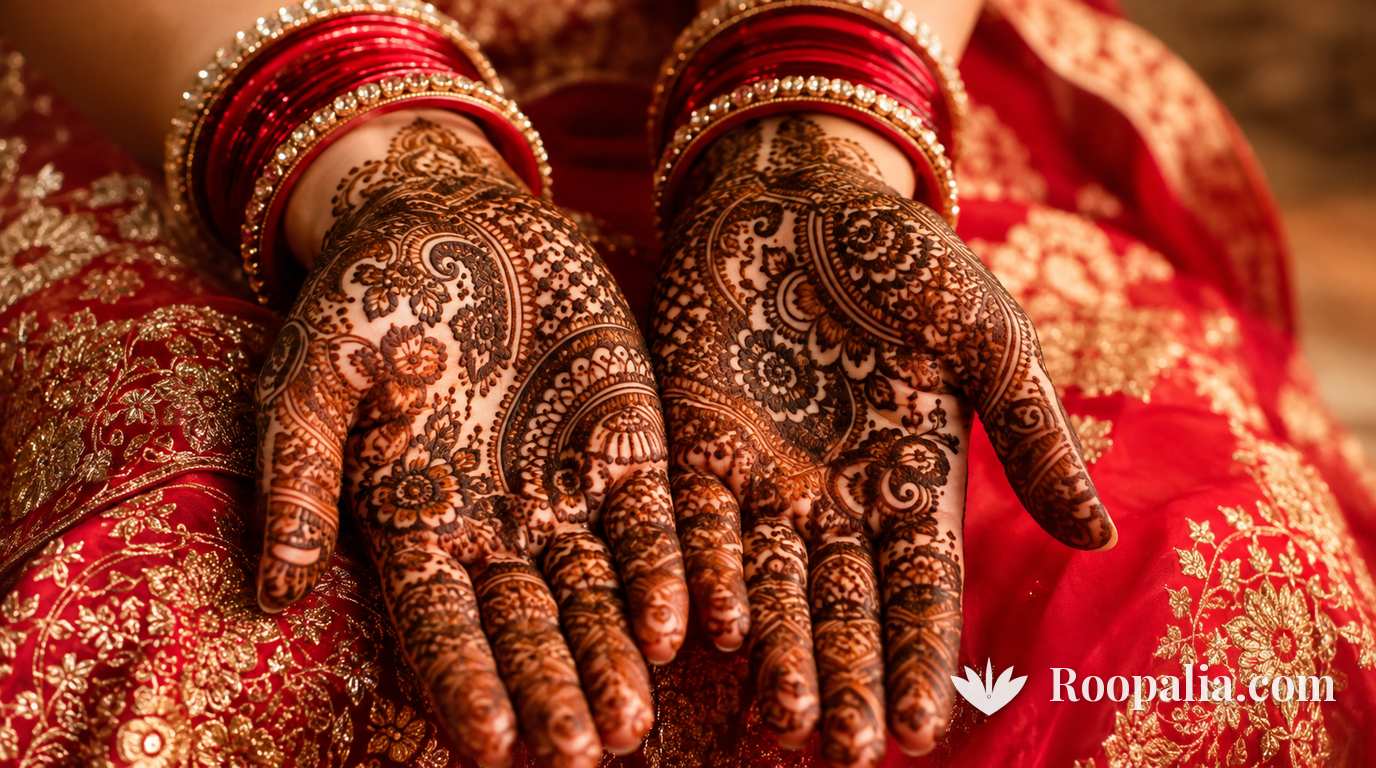
Why is mehndi applied? Three reasons are offered — it is part of the solah shringar; Ayurveda regards mehndi as cooling and calming, which helps on a waterless fast; and folk belief holds that the deeper the colour, the deeper a husband's love. That last one is charming, but there is no evidence for it — read the full mehndi tradition here.
What should a husband gift his wife — and what does a daughter-in-law give?
Asked every year from both sides, so here is both answers.
For the wife — the best gift is the one she actually wants, not the most expensive one. Tradition favours a saree, suhag items and jewellery. But honestly, for a woman who has gone hungry all day, the greatest gift is a husband who comes home early and sits beside her through the puja. That is worth more than any ornament.
If you do want to buy something, our reviews of the kundan choker set and the perfume gift set are a reasonable place to start.
For the mother-in-law — in return for the sargi, the daughter-in-law gives baya: sweets, fruit, suhag items, a garment and dakshina according to means, offered after the puja along with touching her feet.
Can you keep the Karwa Chauth fast during your period?
Many women search this and very few places answer it directly. So, plainly.
No scripture states that this fast cannot be kept during menstruation. The vrat rests on resolve, not on this natural state of the body.
That said, in many households the custom is that during those days a woman does not perform the puja herself — she keeps the fast, listens to the katha and offers arghya, but does not touch the puja thali or the idols. Elsewhere another woman of the family performs the puja on her behalf.
But health matters most here
During menstruation the body is already depleted, and 13 hours and 46 minutes without water can be genuinely risky — blood loss combined with dehydration can bring on dizziness, fainting or severe weakness.
In that situation, keeping the fast with water is entirely appropriate. Tradition has always allowed observance according to capacity. The same applies to pregnant women, breastfeeding mothers, anyone with diabetes or blood-pressure conditions, and anyone unwell.
Dizziness, vision darkening, a racing heartbeat or overwhelming weakness — if any of these occur, take water immediately and see a doctor if needed. No fast is worth more than your health, and no scripture asks a woman to worship by harming her body.
Can unmarried women keep Karwa Chauth?
Yes. In many regions unmarried women keep this fast wishing for the husband they hope for, much as they do at Hartalika Teej.
The only difference is that they break the fast after offering arghya to the moon; the ritual of viewing a husband through the sieve does not apply. In some places they break the fast after seeing the stars instead.
And it is worth saying that treating this fast as reserved for married women is a social assumption, not a scriptural rule.
Which deities are worshipped on Karwa Chauth?
This is not simply a moon festival, as many assume.
The main puja is to the Shiva family — Shiva, Parvati, Ganesha, Kartikeya and Nandi. Parvati is regarded as the goddess of enduring saubhagya, which places her at the centre.
Karwa Mata is also worshipped, and at the end arghya is offered to the moon, who is held to govern longevity and calmness of mind — which is why the wish for long life is addressed there.
And since this is a chaturthi, a tithi dedicated to Ganesha, the puja always opens with a Ganesha vandana.
For women living abroad
We are asked this at every festival, and for Karwa Chauth it is the most tangled, because the whole fast hinges on moonrise.
Take your own city's moonrise, not India's. When the moon rises at 8:17 PM in India, it will still be morning in New York. Your fast begins with your own sunrise and ends at your own moonrise.
If you can't find an earthen karwa — any small clay or copper vessel will serve. Indian grocery stores usually stock them through October; if not, the intention matters and the material is secondary.
Alone, with nobody nearby observing it? The katha can be heard alone. Many women now listen together with their mother or sister-in-law over a video call — and honestly, that is exactly the spirit of the katha: women sitting together.
And one last thing, perhaps the most important. Karwa Chauth is often reduced to "the fast for a husband's long life". But read all four kathas carefully — the protagonist in each is the woman who refuses to give up. Karwa takes on Yamraj himself. This vrat is not a celebration of sacrifice; it is a celebration of resolve — and the women who sit together listening to the katha that evening are, in truth, celebrating one another.
In closing
Remember the date — but health comes first
29 October, moonrise 8:17 PM, puja 5:38 to 6:56 — the timings are that simple, and they shift a little for your city. But if you take one thing from this article, let it be this: the fast is completed by your resolve, not by your suffering. On the day your body refuses, take water. Tradition has always allowed observance according to capacity, and no scripture asks a wife to stake her own health on her husband's long life.
Frequently Asked Questions
When is Karwa Chauth in 2026?
What time will the Karwa Chauth moon rise in 2026?
What should you do if the moon isn't visible on Karwa Chauth?
What is the Karwa Chauth vrat katha?
What is sargi, and can a husband give it?
Can you keep the Karwa Chauth fast during your period?
What do you say while offering arghya to the moon?
Why is the moon viewed through a sieve?
Can unmarried women keep Karwa Chauth?
Which deities are worshipped on Karwa Chauth?
What should a husband gift his wife on Karwa Chauth?
How do I work out the moonrise while living abroad?
📷 AI-generated images. For illustration only.
🙏 Dates, muhurat and moonrise timings follow the panchang and differ by city — please verify the timing for your own location. For any health concern relating to fasting, consult your doctor.