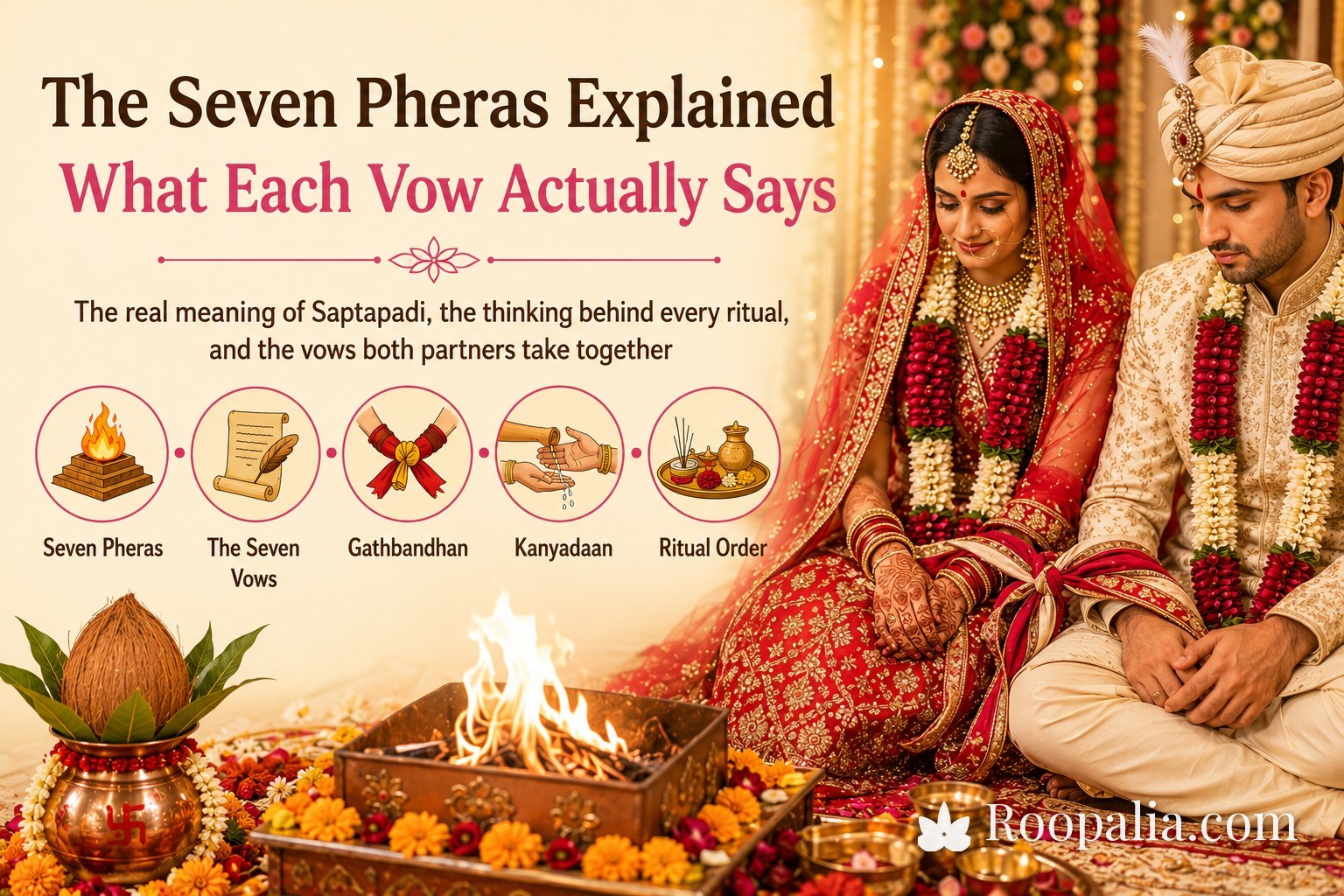
Two rituals that get collapsed into one
Almost every English-language description treats "seven pheras" and "saptapadi" as the same thing. They are not, and separating them makes the whole ceremony legible.
Pheras are circumambulations. The couple stands, and together they walk clockwise around the fire — once for each phera. In Gujarati weddings these are called mangal phera; in parts of North India, bhaanwar.
Saptapadi means "seven steps". Here the couple does not circle anything. They walk seven steps in a straight line, and a mantra is spoken at each step. In many families the bride places her foot on seven small heaps of rice as she goes.
💡 This distinction has a legal consequence. Section 7 of India's Hindu Marriage Act, 1955 states that where the saptapadi is part of the ceremony, the marriage becomes complete and binding at the seventh step. Not at the garland exchange, not at the sindoor. At one specific footfall. If you are attending a Hindu wedding, that step is the legal moment — and almost nobody in the room knows it while it happens.
So how many pheras — seven or four?
Both, depending on where the family is from. This is worth understanding rather than treating as a discrepancy.
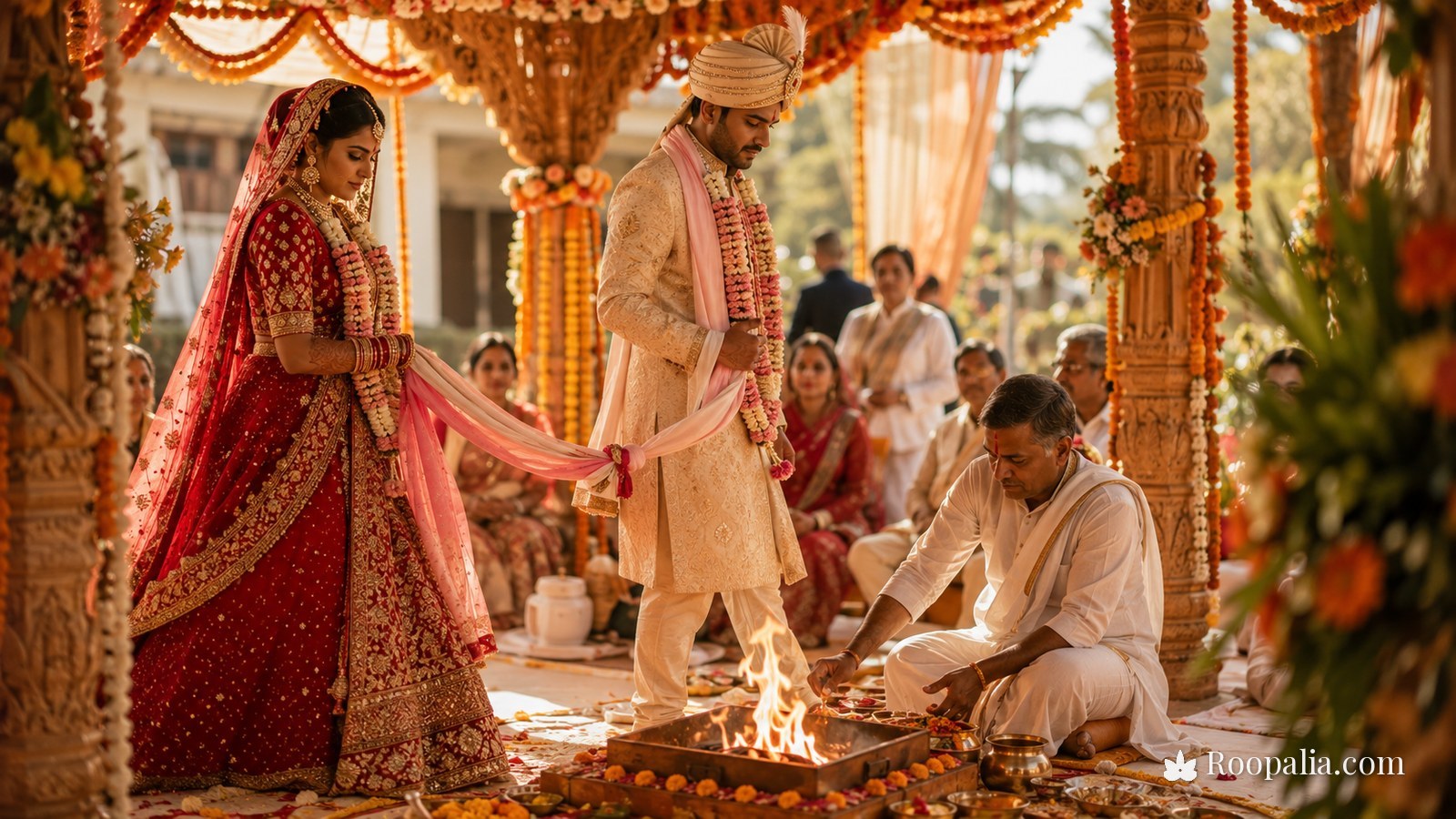
Across most of North India — Uttar Pradesh, Bihar, Rajasthan, Punjab, Haryana, Madhya Pradesh — there are seven. In Bengal the seven circuits are called saat paak, and the bride is traditionally carried around on a low wooden seat.
Gujarati weddings have four mangal phera, understood as the four aims of life in Hindu thought: dharma (duty and ethics), artha (livelihood), kama (desire and pleasure) and moksha (liberation). South Indian ceremonies place much less weight on circling and treat the tying of the mangalsutra or thali as the decisive moment.
One more detail rarely mentioned in English: in many North Indian traditions the bride leads the earlier pheras and the groom the later ones. Where this is followed, the explanation given is that a household begins with the woman. It is not universal, and neither order is considered wrong.
The seven vows — what the Sanskrit actually says
Here is the part this article exists for.
Search for "seven vows of Hindu marriage" and you will find long, elaborate promises in which the bride pledges to please her husband in every way, or to remain chaste while he makes no equivalent promise. Those lines are not in the saptapadi mantras. They are later vernacular expansions, some of them quite recent, and they have been repeated so often that they are now assumed to be scripture.
The actual text comes from the Gṛhya Sūtras — the domestic ritual manuals compiled in the late Vedic period. The version below follows the Pāraskara Gṛhya Sūtra (1.8.1). Read it and notice how short it is. It is almost a counting rhyme.
The seven steps of the Saptapadi
From the Pāraskara Gṛhya Sūtra — one wish at each step
Why the seventh step matters more than the other six
Sakhe saptapadā bhava. Sit with how unusual that is for a text of its age.
Six steps ask for the things any household needs — bread, strength, money, peace, work, good weather. And then, with everything practical already requested, the seventh does something different. It stops asking and starts declaring: you are now my friend.
Not lord. Not servant. Not husband or wife. Sakhā — the ordinary Sanskrit word for a companion you choose.
Two honest qualifications, because this deserves accuracy rather than romance.
First, some recensions append a further line after the seven — in the Pāraskara text, a phrase asking the bride to follow the husband's vows. That line exists and pretending otherwise would be dishonest. But it sits outside the seven steps. The seven themselves ask for shared food, shared strength and shared seasons.
Second, the order varies by school. The Mānava Gṛhya Sūtra places offspring at the third step and prosperity at the fourth, reversing Pāraskara, and closes with an invocation to Sarasvatī. These are not contradictions to be resolved; they are what a living tradition looks like before printing presses standardised anything.
Why a fire, and not an altar or a book
At the centre of every Hindu wedding is a live flame. No idol, no image, no scripture on a lectern. Fire.
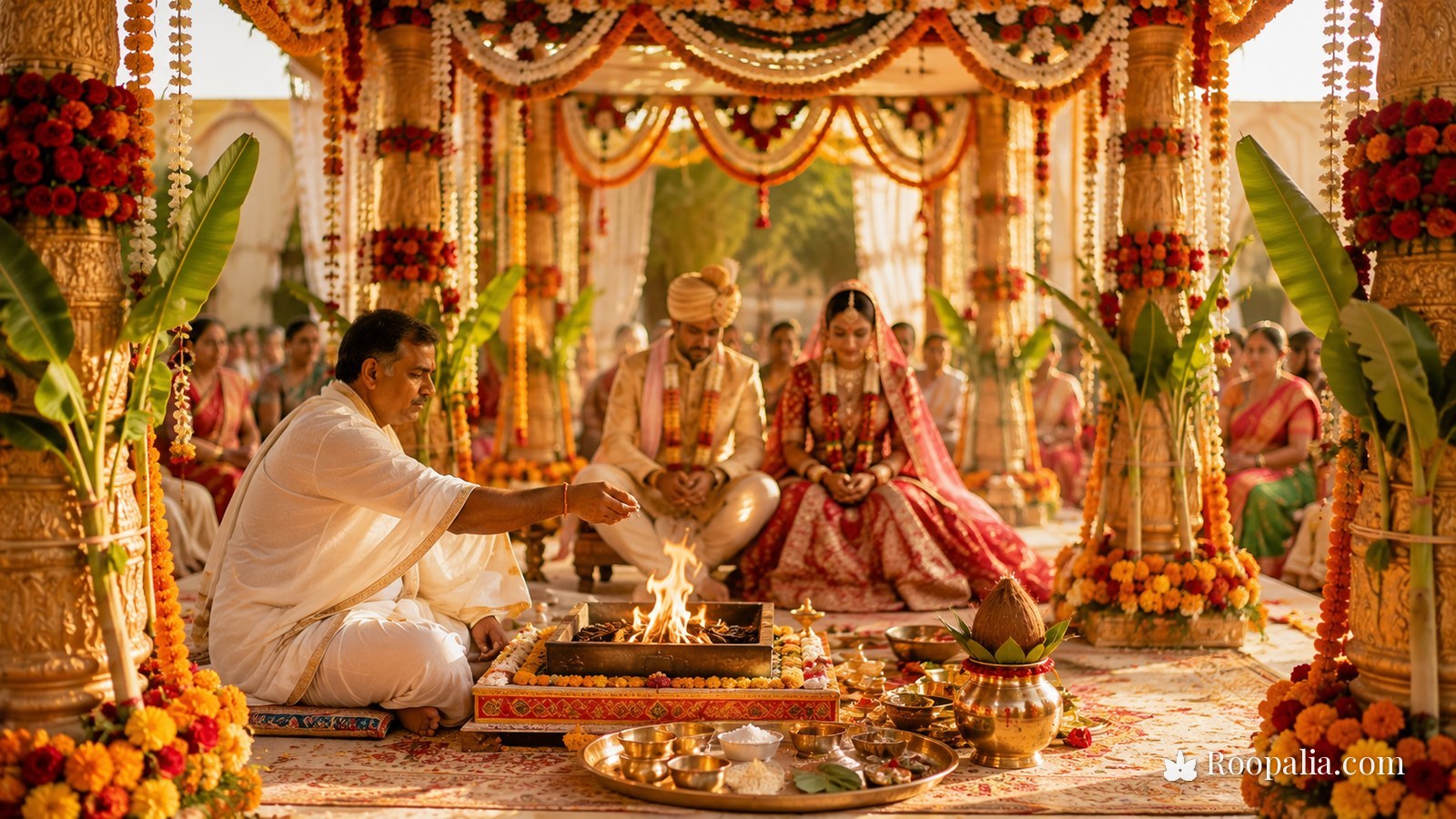
The reasoning is practical rather than mystical. In Vedic thought Agni is the deity who is physically present and visible to everyone in the room. A promise made before fire is not a private undertaking; the entire assembly watched it burn. Fire is the witness precisely because it cannot be argued with afterwards.
The rest of the mandap is equally deliberate. The four pillars stand for the support of both families. Banana leaves are tied to them because the banana plant grows fast and every part of it is usable — a wish for a fruitful household. The kalash, a brass pot topped with a coconut and mango leaves, signifies fullness and new growth. And the offerings poured into the fire make a point that the rest of the ceremony only implies: nothing is gained in a marriage without something being given up.
Gathbandhan — the knot, and what is inside it
Before the pheras, an elder ties the corner of the bride's dupatta to the groom's stole. This is the gathbandhan, and it is the origin of the Hindi word for an alliance.
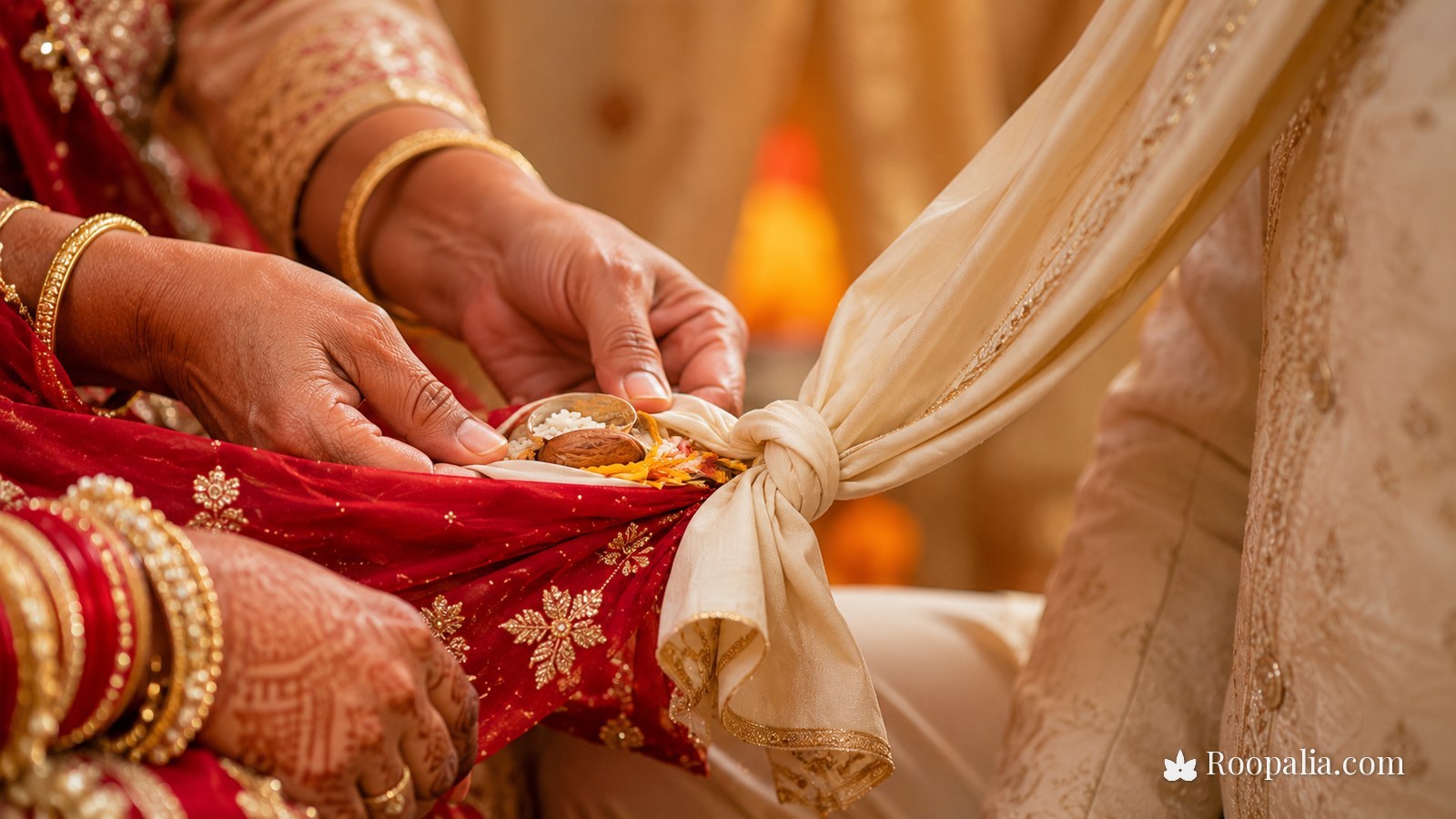
What goes inside the knot
Four small objects, four wishes for the household
Kanyadaan — and the debate around it
This is the most emotional moment of the ceremony and, increasingly, the most argued over.
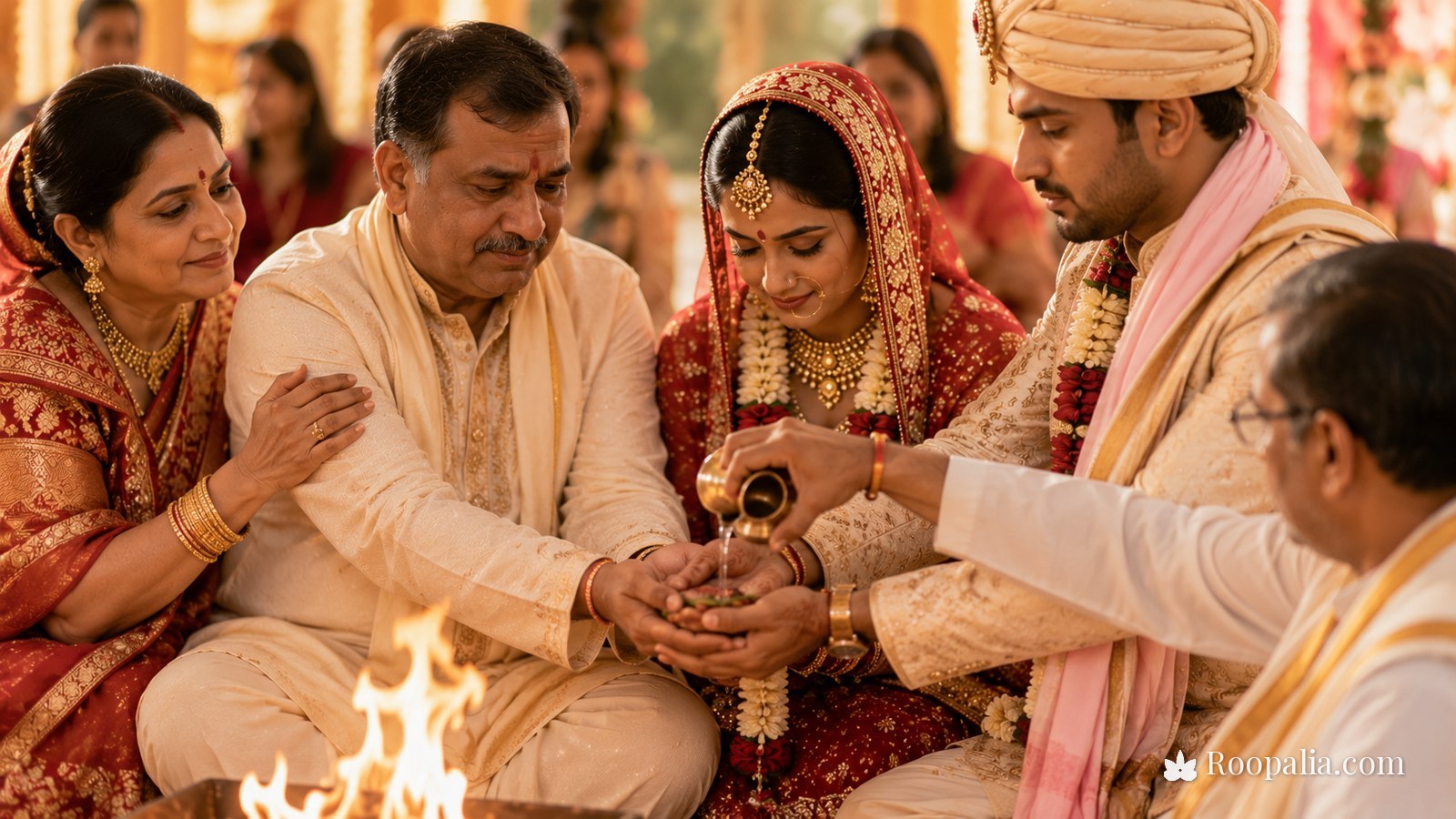
Kanyadaan translates literally as "the giving of the daughter", and the objection is obvious: it appears to treat a woman as property being transferred. That objection deserves a straight answer rather than a defensive one.
Within the tradition, daan carries a specific meaning — it is the giving of something one values most, and critically, the giver relinquishes all claim over it. Read that way, the father is not transferring ownership to the groom; he is announcing that he no longer holds any himself.
What follows immediately makes this clearer. In pāṇigrahaṇa — "the taking of the hand" — the groom takes the bride's hand and states that he does so for good fortune and shared life. The daan flows one way; the hand-holding is mutual.
🪔 How it is changing: in many families today both parents perform the kanyadaan together, and some couples now use only the pāṇigrahaṇa. Where there is no father, a brother or uncle takes the role. Traditions have always shifted — the histories of sindoor and bangles show the same pattern over centuries.
Why the groom arrives on a horse
Guests at their first Indian wedding almost always ask this, usually while a brass band plays and several hundred people dance down a road.
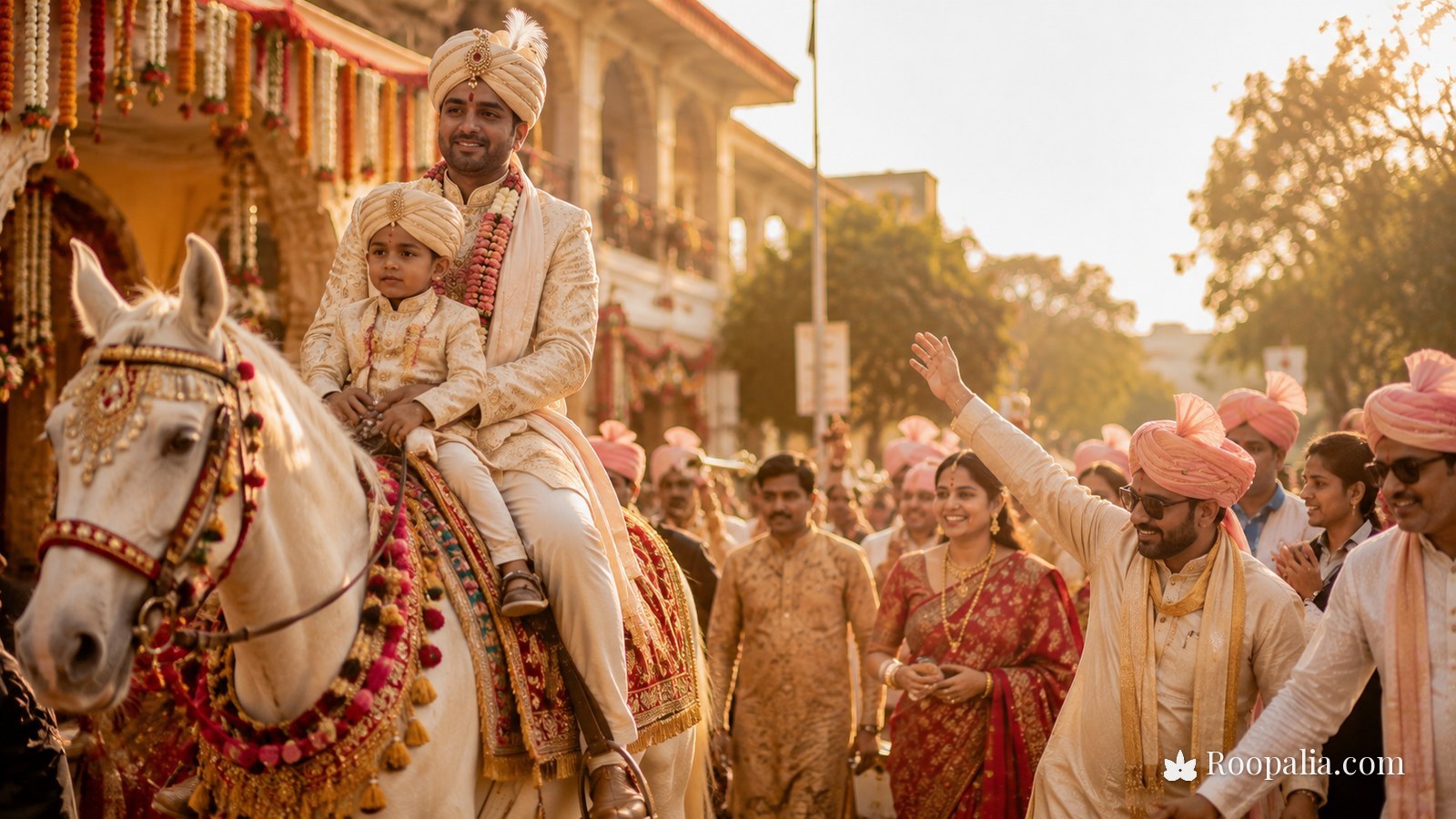
The first reason is historical. Riding was the mark of a warrior and a king, and on his wedding day the groom is treated as one. The baraat — the groom's procession from his home or hotel to the venue — is a small royal progress, and it is meant to be noisy.
The second reason is more interesting and comes from folk tradition. A mare is considered spirited and easily startled; sitting one calmly is taken as evidence of self-command. A man who cannot govern himself, the reasoning goes, will not govern a household.
And the small boy usually seated in front of the groom — typically a sister's son — is called the sehrabandi companion. He represents the next generation travelling with him.
The full order of rituals
If you are attending as a guest, marrying into the family, or planning a ceremony abroad, this is the sequence to follow. Regional and family variation is normal.
A Hindu wedding, in order
From the first invocation to the departure — each ritual in one line
The star at the end
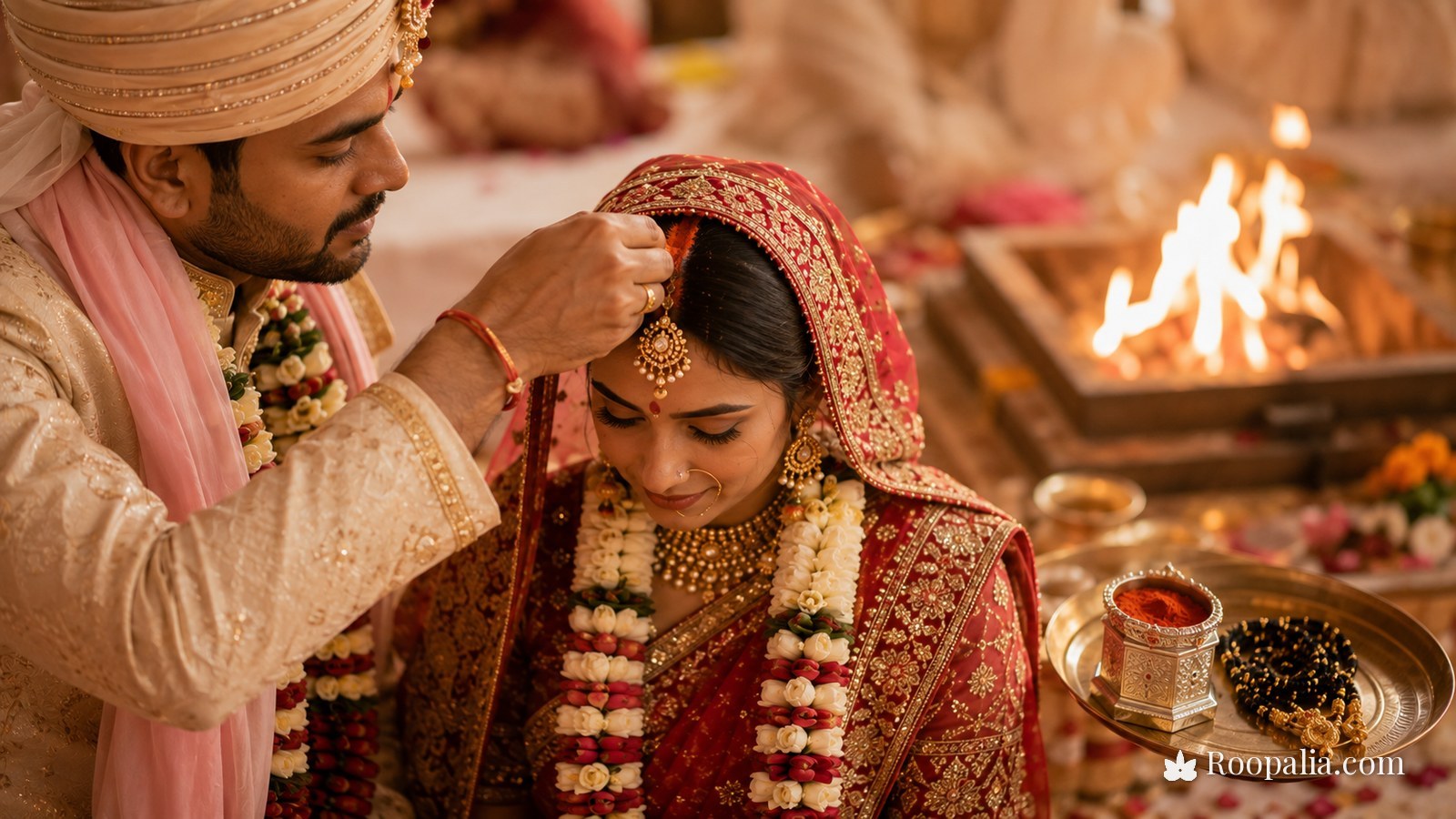
Of everything that follows the pheras, the ritual most worth knowing about is also the one most often skipped. The couple are taken outside and shown Dhruva, the Pole Star.
The reasoning is exact. Every other star in the northern sky appears to rotate through the night; Dhruva does not move. May the marriage be like that. In some traditions the couple are also shown Arundhatī, a faint companion star in the Great Bear, visible only if you already know where to look — a marriage, the tradition suggests, is partly a thing you have to learn to see.
Consider when this ritual must have been devised. No electric light, an open courtyard, ceremonies held at night. A priest pointed upward and an entire gathering looked at the sky together. Today most weddings happen under a banquet hall ceiling, and the star is simply not there to be shown.
If you are attending as a guest
A few things worth knowing, especially at your first Indian wedding.
- It is long, and that is normal. The ceremony itself often runs two to three hours, and guests talk, eat and move around throughout. Nobody expects silence, and leaving your seat is not rude.
- Remove footwear near the mandap if others have, and do not step over the area where offerings are laid out.
- Photography is usually welcome, but stay out of the space between the couple and the fire, and ask before photographing someone mid-prayer.
- Red and gold are auspicious. Guests wearing colour is welcome; pure white or all black is traditionally avoided at weddings in most of North India.
- The seventh step is the moment. If you want to witness the part that actually makes the marriage, that is it — not the garlands, not the sindoor.
In closing
Six wishes, and then a friend
Next time you are at a mandap, watch for the sequence. The first six steps ask for bread, strength, money, ease, work and kind weather — everything a household actually runs on. And then the seventh, with all the practical business concluded, stops asking for anything. Sakhe saptapadā bhava — with these seven steps, become my friend. A tradition often dismissed as archaic saved the highest thing it had to say for last. 🔥
Frequently asked questions
How many pheras are there in a Hindu wedding?
What is the difference between the pheras and the saptapadi?
What are the seven vows in the original Sanskrit?
Why is the seventh vow considered the most important?
At what point is a Hindu marriage legally complete?
What does gathbandhan mean and what is tied inside it?
Is kanyadaan about giving a woman away as property?
Why does the Indian groom ride a horse to the wedding?
What is the Pole Star ritual at a Hindu wedding?
What should I know before attending a Hindu wedding?
📖 A note on variation: Hindu wedding rites differ by region, community and family — the number of pheras, the recension of the mantras and the order of rituals all vary. What is described here is the most widely followed form, with the Sanskrit taken from the Gṛhya Sūtras. Whatever your own family does is right for your family. For your own ceremony, follow the guidance of your officiating priest.