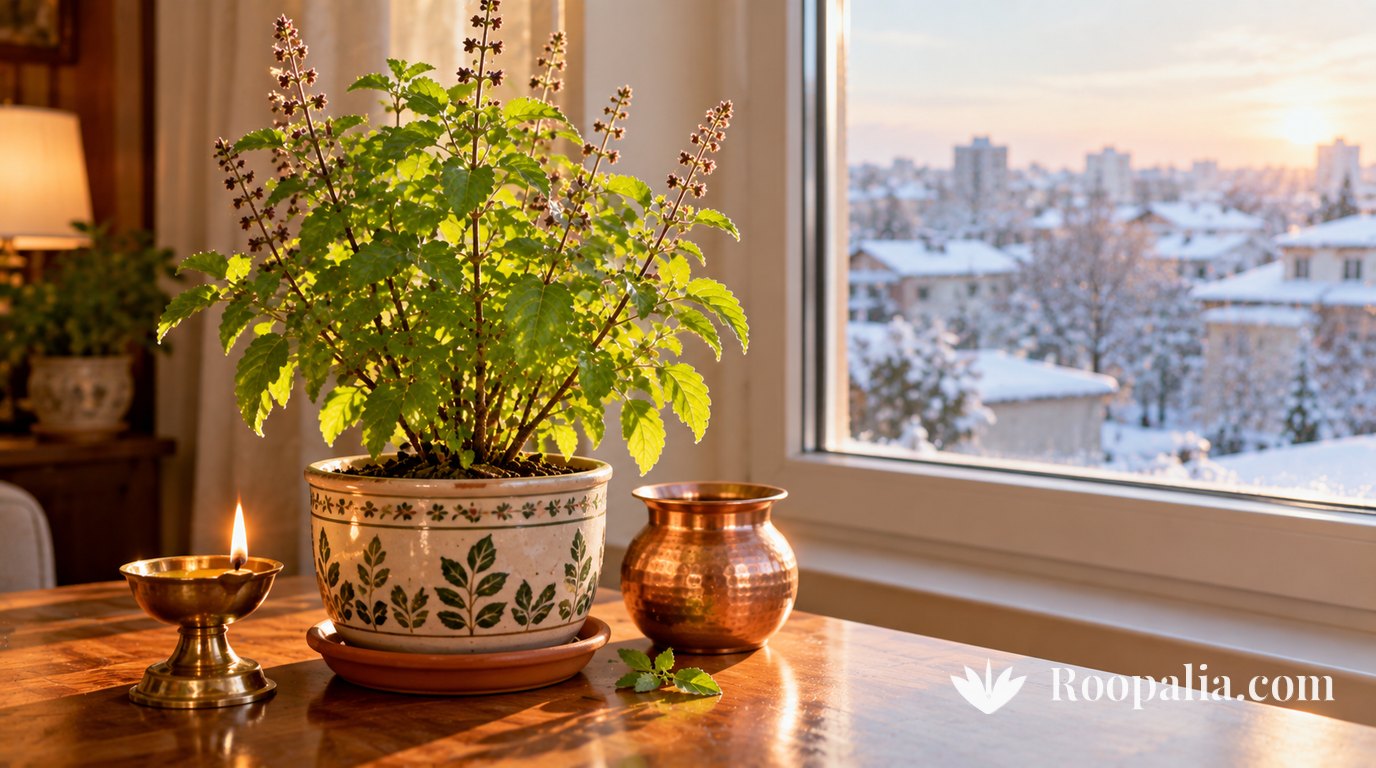
There is a particular kind of guilt that only an Indian household can produce: standing at the windowsill with a cup of water, looking at a wilting tulsi, and wondering whether you are allowed to water it because it is Sunday.
Search Google and you will see you are not alone. The suggestions run straight down the week — can we water tulsi on Sunday, on Tuesday, on Thursday, on Ekadashi, on Amavasya, on Dwadashi. And in the same breath, especially from October onwards: tulsi drying in winter, tulsi dying in winter, tulsi leaves turning yellow and falling.
Those two worries are more connected than they look. In cold countries, the rule that stops you watering on certain days and the cold that is killing the plant often arrive together. So I took both questions seriously — the first to the Puranas, the second to people who actually grow holy basil.
Can we water tulsi on Sunday? Day by day
Here is what I found when I looked for each day in the chapters on tulsi in the Padma Purana, the Karttika-mahatmya of the Skanda Purana and the Brihaddharma Purana:
- Sunday — no rule against watering found. This is the most widely repeated rule, but none of the pages I checked that state it give a text, chapter or verse.
- Tuesday and Thursday — nothing found, either for or against.
- Ekadashi — no rule against watering found. The popular explanation is that Tulsi herself fasts that day; I could not trace it to these texts.
- Amavasya — no rule against watering, but there is one against plucking (below).
- Dwadashi — the clearest rule of all, and again it is about plucking, not watering.
On the question of water itself, the texts point the other way entirely:
“If it is planted, guarded, watered, seen and touched, Tulasī burns down the sins of men.”
— Skanda Purana, Karttika-mahatmya 23.12, tr. G. V. Tagare (courtesy: wisdomlib.org)Watering tulsi is listed as merit, alongside planting and protecting it. In the texts I read, I found no day on which watering is forbidden.
That does not make your family’s Sunday or Ekadashi custom wrong. It is a living folk tradition, and many households keep it with real devotion. But if your plant is struggling through a northern winter, you can water it on a Sunday without believing you are breaking scripture.
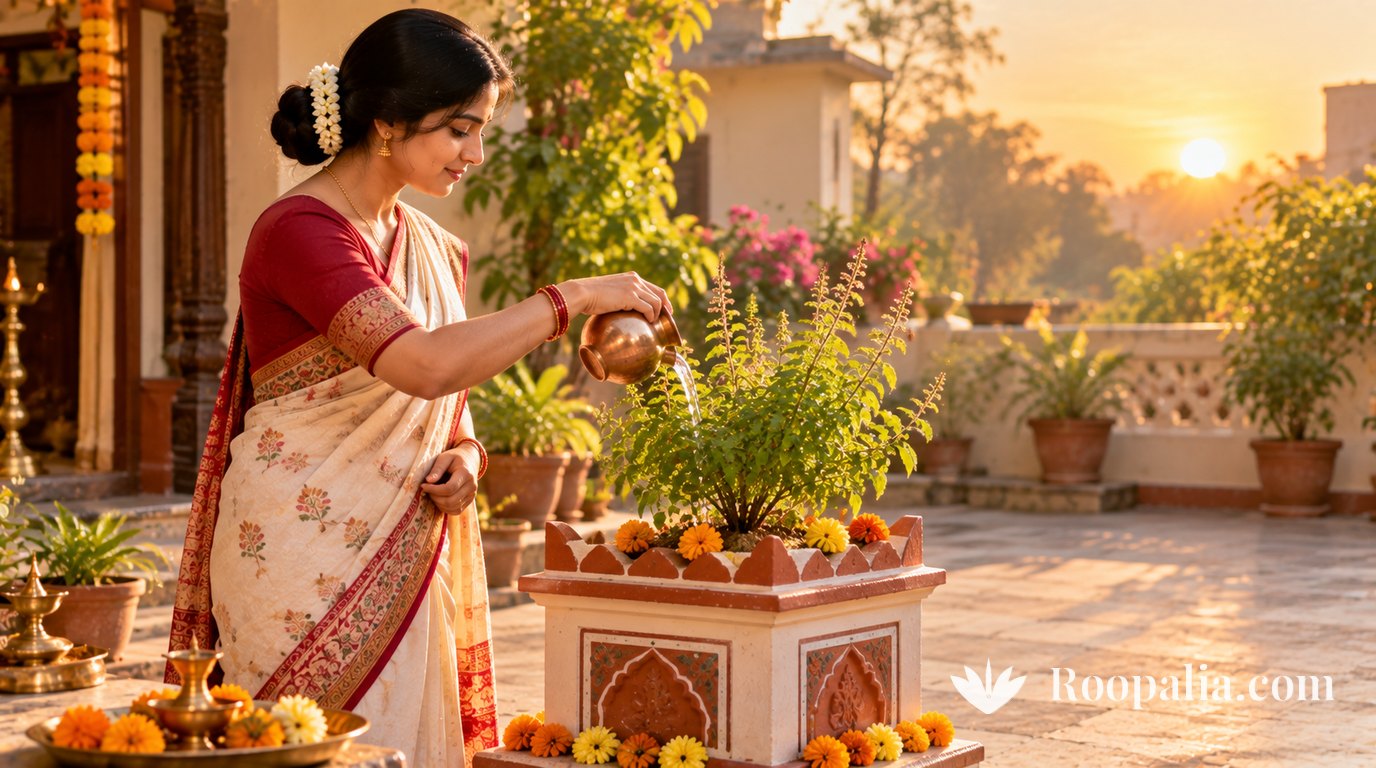
So where did the idea of forbidden days come from? Almost certainly from a real rule — just a different one.
The rule that is actually in the texts: when not to pluck tulsi
“One who plucks a Tulasī-leaf on the twelfth day, and a Dhātrī-fruit in Kārtika, would go to very condemned hells.”
— Padma Purana, Uttara-khanda 105.16–29, tr. N. A. Deshpande (courtesy: wisdomlib.org)The twelfth day of the lunar fortnight is Dwadashi — the day after Ekadashi. The same prohibition appears, in almost the same words, in the Skanda Purana’s Karttika-mahatmya (23.21). Two separate Puranas, one rule.
“Except for the worship of Vishnu, Tulasi leaves should not be plucked on Amavasya Purnima Sankranti or in the evening, or at night.”
— Brihaddharma Purana, chapter 8, tr. Syama Charan Banerji (courtesy: wisdomlib.org)The Brihaddharma Purana extends the list to Amavasya, Purnima, Sankranti, evening and night — but makes an exception for leaves needed in the worship of Vishnu. The same passage adds that the boughs should not be broken and the plant should not be shaken violently.
Put those side by side and the folk rules start to make sense. “Don’t touch tulsi around Ekadashi” may well be the Dwadashi plucking rule, softened and shifted by a day as it passed from one generation to the next. That is my reading, not something the texts say — but it is the most likely bridge I could find.
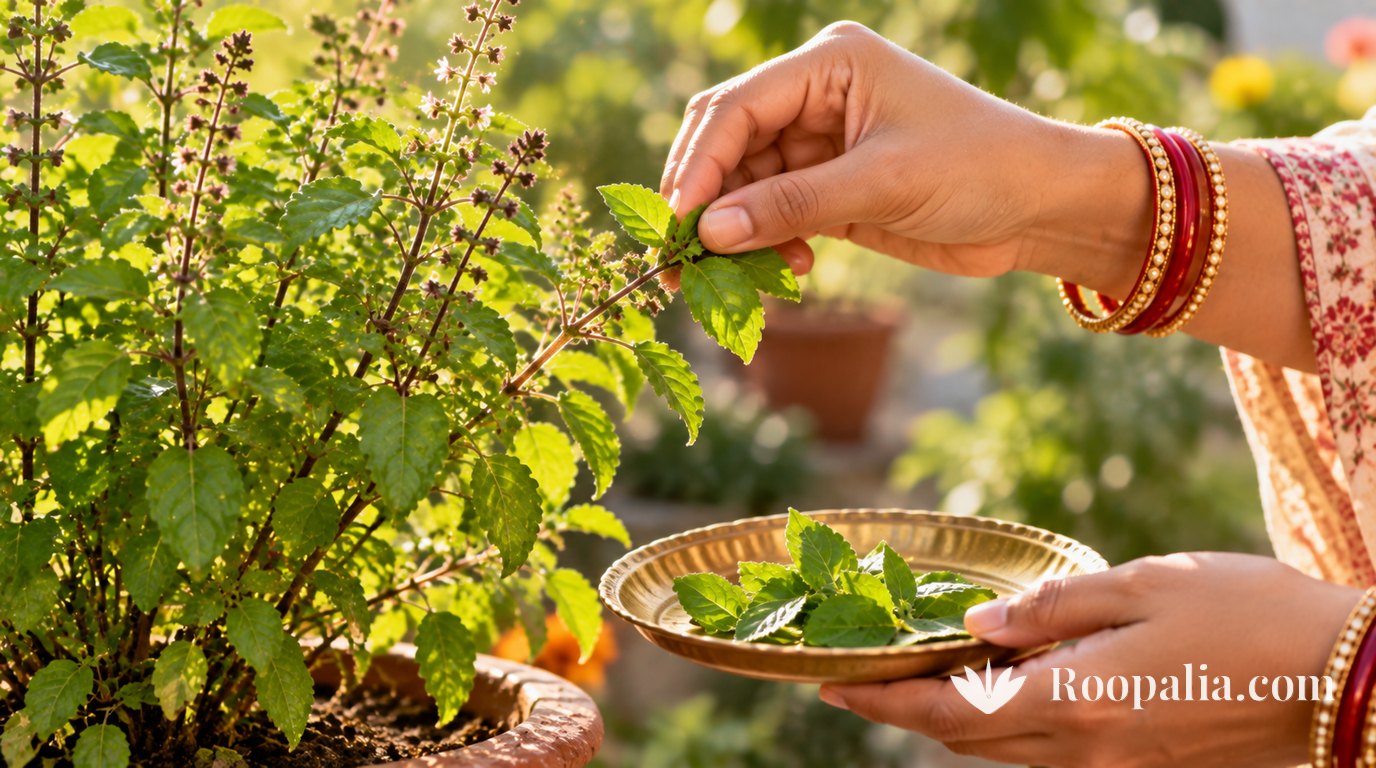
In practice: pick leaves in the morning, from the very tip of a branch, a small cluster at a time. If you need tulsi for a Dwadashi or Purnima offering, pick it the day before. Tip-picking is also exactly what keeps holy basil bushy instead of tall and woody — the old rule and good gardening agree.
Morning water, evening lamp
The texts give no clock time for watering, but they do give a rhythm. The Skanda Purana’s daily routine for Karttika places the worship of tulsi before the midday meal (Karttika-mahatmya 5.25–26) — a morning task. And for the evening:
“There must be a lamp near the Tulasī plant also.”
— Skanda Purana, Karttika-mahatmya 5.16, tr. G. V. Tagare (courtesy: wisdomlib.org)
Indoors, keep the lamp on a plate, a hand’s width from the leaves, and well away from smoke alarms — our guide to a havan at home without a pandit covers apartment fire safety in detail.
Now the part that decides whether there will be a tulsi to water at all.
Tulsi care in winter: keeping it alive outside India
Tulsi — holy basil, Ocimum tenuiflorum — is a warm-climate plant. In Canada, the northern United States, the UK and most of Europe, it cannot stay outdoors through winter. The question is when to bring it in, and the two growing guides I read put the line in different places:
- A US nursery’s tulsi guide says to move the plant indoors when night temperatures are consistently dipping below 60°F (about 15°C).
- A UK guide says to bring it in when nights approach 8–10°C, and that temperatures below 5°C damage or kill it.
A safe rule between the two: when night temperatures reach about 10°C, bring tulsi inside — in most of Canada and the UK, that means late September or October.
Where to put it
- A south-facing window in the northern hemisphere gives the most winter light.
- A little back from the glass. Leaves touching a frosty window pane get cold-damaged even in a warm room.
- Away from doors that let in blasts of cold air, as the UK guide warns.
- If there is no bright window, a grow light — one guide suggests 8 hours a day, the other 12–14.
How much to water in winter
This is where most windowsill tulsi plants die. Growth slows indoors in winter, so the plant drinks far less. Water only when the top inch of soil is dry; the UK guide notes that once a week may be enough indoors. You can still keep the morning offering — just make it a small cup instead of a full lota, and make sure the pot has a drainage hole and a saucer so the roots never sit in water.
Why are my tulsi leaves turning yellow and falling?
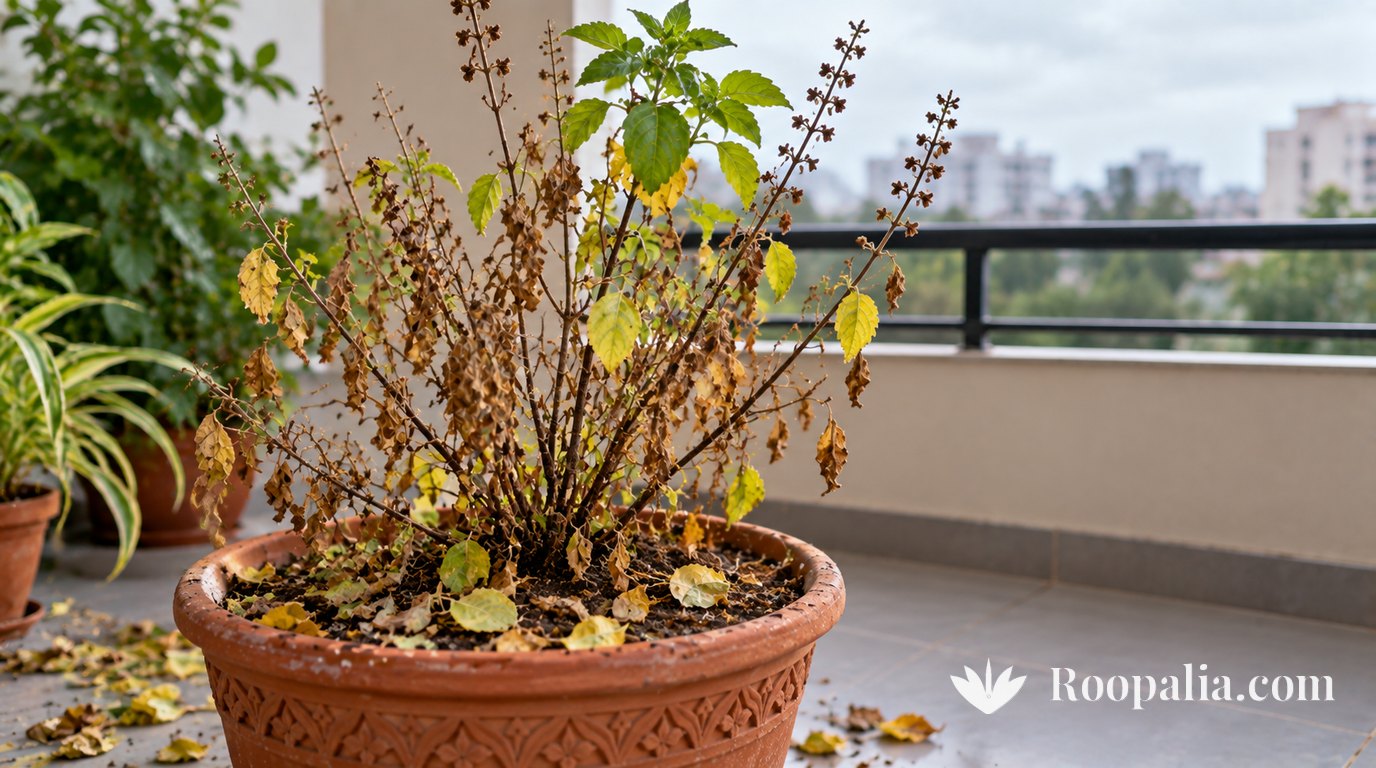
The most common causes, roughly in order:
- Cold — a cold window, a draughty door, or being left out too long in autumn.
- Too much water — especially daily watering in winter in a pot without drainage.
- Too little light — short northern days; the plant sheds leaves it cannot feed.
- Going to seed — when tulsi puts out many manjari (flower and seed spikes), it spends its energy on seed and fewer new leaves appear.
- Nutrient deficiency or disease — NC State Extension notes that yellowing in basil can signal a nutritional deficiency or basil downy mildew, which shows first as yellowing between the veins.
In homes, a drying tulsi is sometimes read as a bad omen. I did not find that in the texts I read. It is far more often a message about the window, the watering can or the thermostat.
When the tulsi dies: seeds, soil and a respectful goodbye
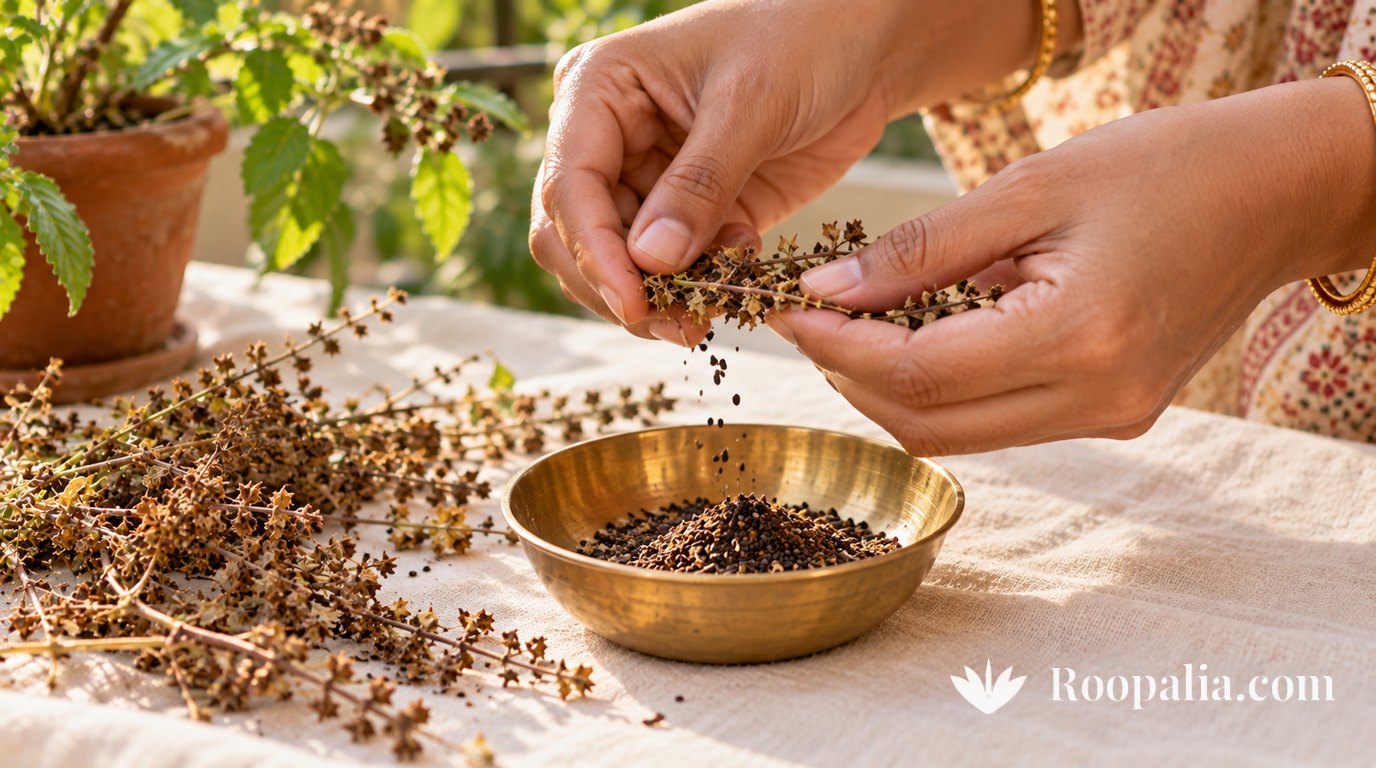
Even with good care, tulsi plants grow old. Before you let one go, rub its dried manjari gently between your palms over a bowl: tiny dark seeds fall out. Store them dry and sow them in spring, once nights stay warm — one tulsi becoming the next is the most natural continuation of the tradition.
The dried plant itself is not thrown in the bin. Many families bury it respectfully at the roots of a tree or in clean garden soil; in India, many place it in flowing water. I found no fixed rite for this in the texts — it is family custom. Outside India, the garden-soil option is the simplest and avoids local rules on putting things in rivers; our article on what to do with old idols and puja items covers those rules.
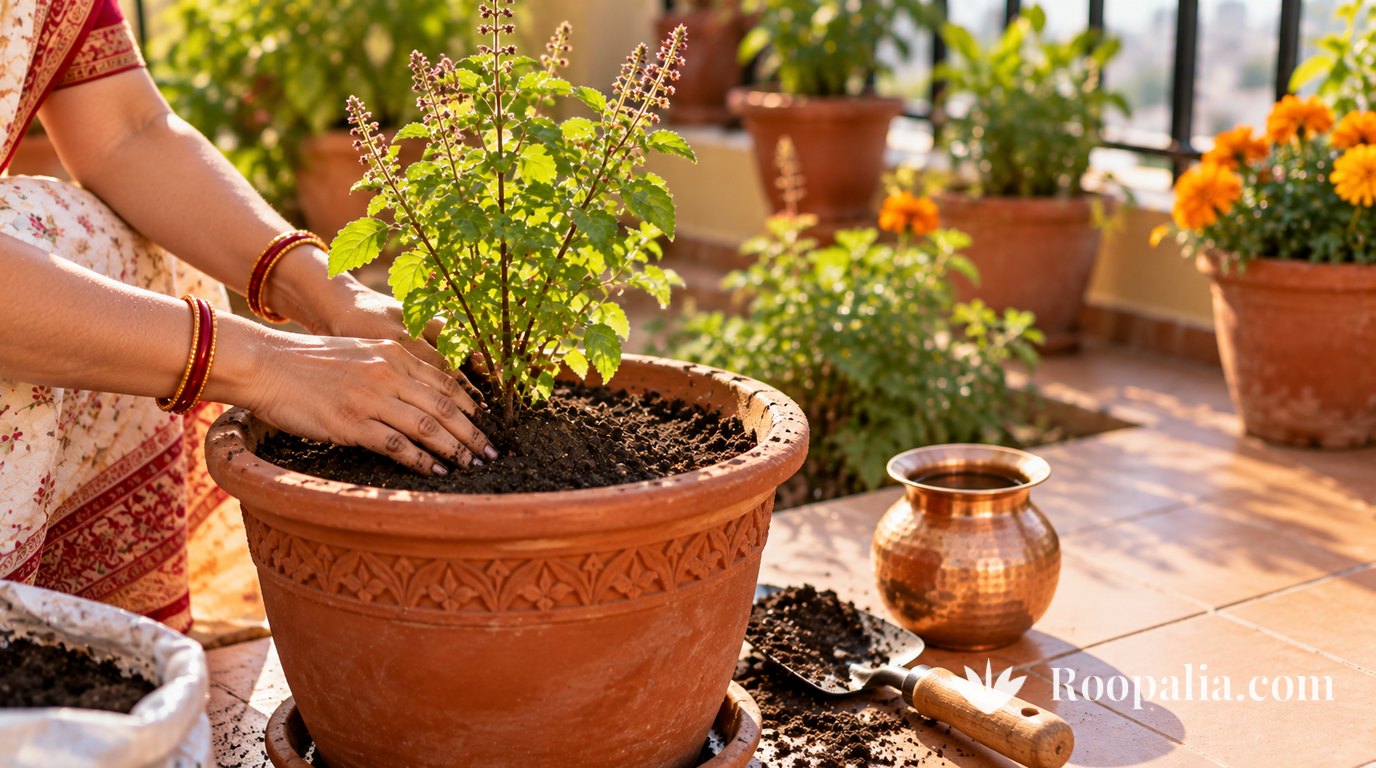
And when you plant the new one, there is even a text for the timing. The Padma Purana (Uttara-khanda 23) recommends planting tulsi on a parvan day, in the month of Shravan, or on a Sankranti — and adds “on any other occasion” too. Shravan is monsoon season in India; outside India, the practical equivalent is late spring, when nights stay above about 10°C.
What I found, and what I did not
| Claim | What I found |
|---|---|
| Watering, planting, protecting tulsi is merit | Found — Skanda Purana, Karttika-mahatmya 23.12 |
| Do not pluck on Dwadashi | Found — Padma Purana Uttara 105; Skanda Purana 23.21 |
| Do not pluck on Amavasya, Purnima, Sankranti, evening, night (except for Vishnu worship) | Found — Brihaddharma Purana, ch. 8 |
| A lamp near tulsi | Found — Skanda Purana, Karttika-mahatmya 5.16 |
| Plant on parvan days, in Shravan or on Sankranti | Found — Padma Purana Uttara 23 |
| Do not water on Sunday | Not found — folk tradition |
| Do not water on Ekadashi / Tuesday / Thursday | Not found — folk tradition |
| A drying tulsi is a bad omen | Not found |
“Not found” does not mean “does not exist”. It is the honest result of my search, not a final verdict.
The short version. In the Puranas I read, watering tulsi is merit on any day; the real restrictions are on plucking — on Dwadashi, Amavasya, Purnima, Sankranti, and in the evening or at night. The Sunday and Ekadashi watering rules are folk tradition: keep them if your family does, but never let them stand between a thirsty plant and a cup of water.
In a cold country, the real threats are frost, a cold window pane and too much water. Bring tulsi in when nights reach about 10°C, give it your sunniest window, water only when the soil is dry — and keep its seeds. For the wider picture of keeping daily rituals going abroad, see puja at home without a temple nearby.
Frequently asked questions
Can we water tulsi on Sunday?
Can we water tulsi on Ekadashi?
Can we water tulsi on Tuesday or Thursday?
When should tulsi leaves not be plucked?
How do I take care of tulsi in winter outside India?
Why are my tulsi leaves turning yellow and falling?
What should I do with a dead or dried tulsi plant?
What is the English name of tulsi, and why is it sacred?
Sources and cautions: the scriptural references were opened and checked — the Padma Purana Uttara-khanda 105 (no plucking on Dwadashi; a house with tulsi is like a holy place) and 23 (planting days), tr. N. A. Deshpande; the Skanda Purana, Vaishnava-khanda, Karttika-mahatmya 5 and 23 (watering as merit, the lamp, the Dwadashi rule), tr. G. V. Tagare; and the Brihaddharma Purana chapter 8 (Amavasya, Purnima, Sankranti, evening, night), tr. Syama Charan Banerji — all courtesy of wisdomlib.org. Winter-care thresholds are from the Kula Nursery and Plants Paradise UK growing guides, and the note on yellowing from NC State Extension. Three things should be said plainly. First, we did not find rules against watering on Sunday, Ekadashi, Tuesday or Thursday, or any statement that a drying tulsi is an omen, in these texts; these are folk traditions. Second, the two growing guides give different temperature thresholds, so the 10°C rule here is a cautious middle. Third, “not found” does not mean “does not exist”; it is an honest report of a search.