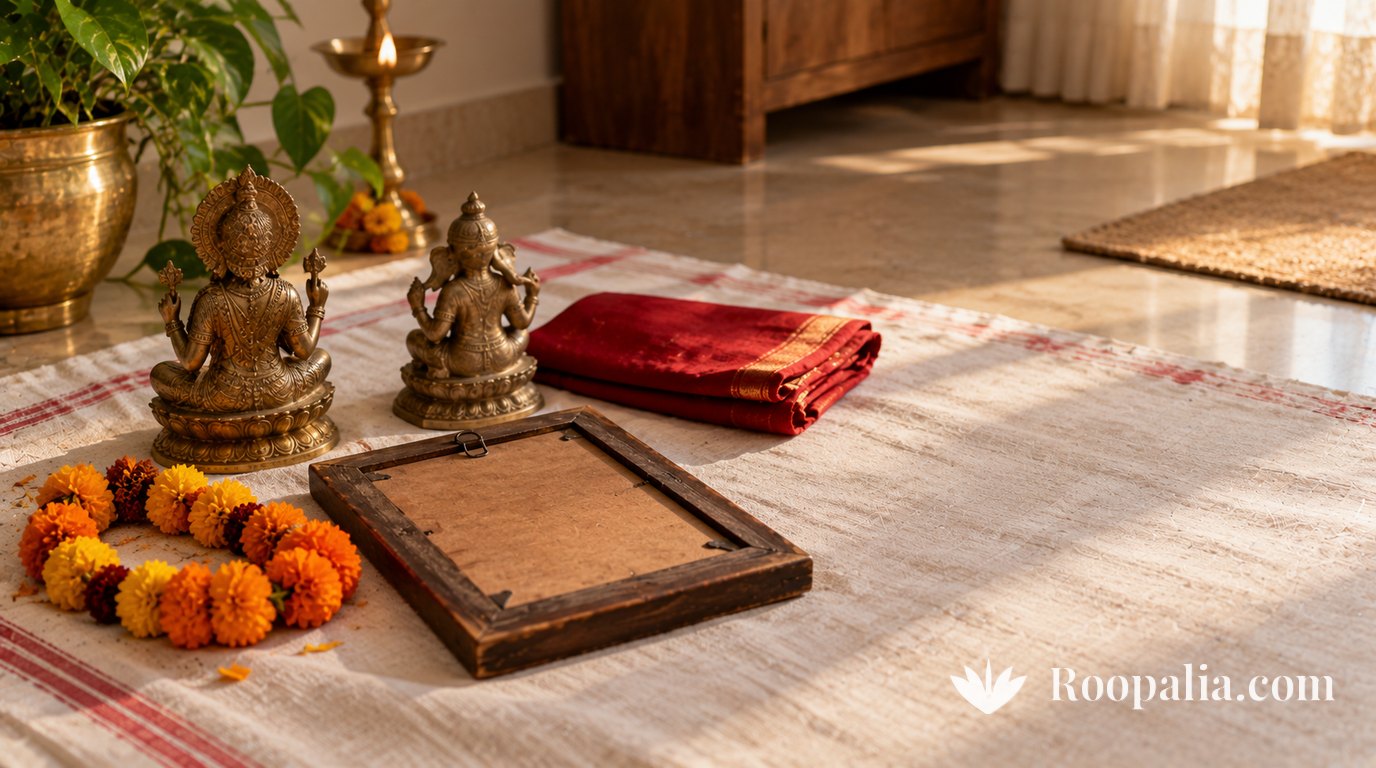
The top shelf of the cupboard. Two brass figures gone black with age. A frame whose glass cracked years ago. A calendar picture that was your grandmother's. Last year's dried garland. And the little wooden shrine that came over in a suitcase and fits nowhere in this house.
You cannot throw them away. You cannot keep them either.
Every article you find says the same thing: immerse it in flowing water, or give it to a temple. Neither is available to you, and the ones written in India do not know that.
So this article starts somewhere else — with what each thing is actually made of. Because one test sorts almost everything on that shelf, and once you have applied it the rest is straightforward.
🙏 Every environmental rule below comes from a named government body with the link beside it. Every scriptural reference was opened and checked. Where nothing is published — and on this subject a great deal is not — this article says so.
The test that sorts everything
The clearest statement of it anywhere is in an American regulation about burial at sea. Flowers may be placed in the ocean at a funeral, but only on one condition:
“Flowers and wreaths consisting of materials which are readily decomposable in the marine environment may be disposed of under the general permit.”
— 40 CFR 229.1, US EPA
The EPA's own guidance spells out what fails the test: plastic or metal flowers and wreaths, which "would not be expected to decompose rapidly."
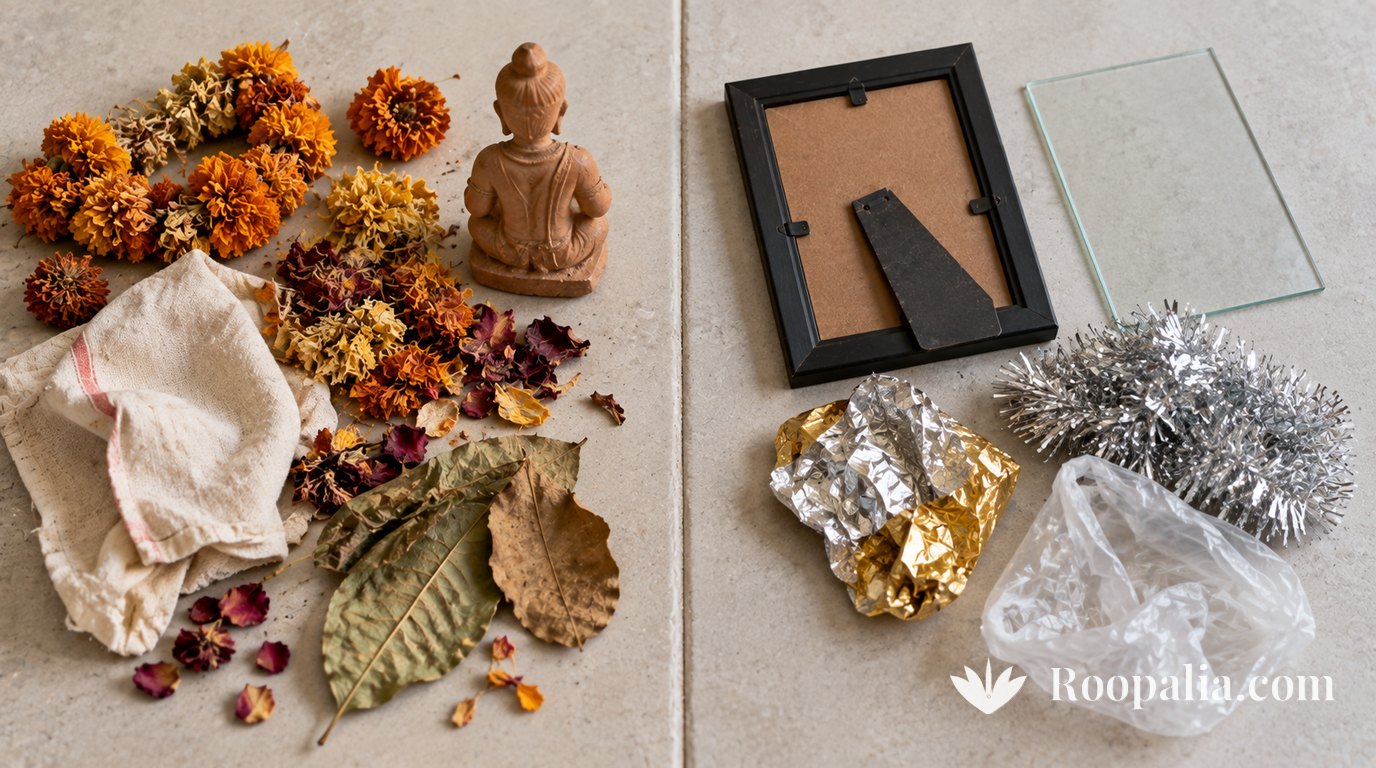
That is the whole principle. What breaks down on its own can be returned to the earth. What does not, cannot. Sort that cupboard into two piles on that basis and you have done most of the work.
| Can go back to the earth | Cannot |
|---|---|
| Dried flowers, garlands, petals, leaves | Plastic frames and mounts |
| Cotton cloth, sacred thread | Frame glass |
| Unpainted clay figures | Foil and tinsel decoration |
| Cooled havan ash | Plaster of Paris figures |
| Untreated wood, paper pictures | Painted or varnished wood |
| — | Brass, copper, any metal |
Metal is on the right, but metal has the best route of all. That comes shortly.
Why the river is closed to you
It is worth knowing exactly why, because the reason is not what most people assume — and it is not about religion at all.
In England, the offence of littering applies in water just as it does on land. Section 87 of the Environmental Protection Act 1990 makes it an offence to deposit litter and leave it, and subsection 4 removes any doubt:
“It is immaterial for the purposes of this section whether the litter is deposited on land or in water.”
— Environmental Protection Act 1990, s.87(4)
Canals are more explicit still. The Canal & River Trust, which manages much of the English and Welsh waterway network, permits ashes to be scattered over water — and then says that "Additional items (such as wreaths or memorabilia) must not be placed into the water or left on the bank."
In Canada, subsection 36(3) of the Fisheries Act prohibits depositing a "deleterious substance" into waters frequented by fish, and Environment and Climate Change Canada names heavy metals among the substances it has in mind — which is where a painted or metal figure sits.
Notice that not one of these rules mentions religion.
The Canal & River Trust policy does not contain the words idol, murti or puja. It bans objects generally, and that general ban happens to catch this practice. That is the honest shape of the problem: the rule was not written against you, but it applies to you.
And we could find no exception anywhere: we looked for a published religious accommodation in the UK, the US, Canada, Australia and the Gulf and found none.
On the US side, one caution worth printing. You will see the Clean Water Act cited for this. The Act's definitions certainly cover the material — "solid waste" and "discarded equipment" are listed pollutants — but the prohibition attaches to discharges from a point source, and a person standing on a riverbank is not obviously one. In practice the rule that would reach a household in America is state or city litter and dumping law, not the Clean Water Act. The outcome is the same; the reason usually given is wrong.
India's own rules now say the same thing
This is the part that surprises people, and it settles the argument better than any Western regulation can.
Immersion in India is itself regulated now. Mizoram's 2019 idol immersion rules require that no Plaster of Paris idol be used, that idols be made from "natural materials i.e. traditional clay, bamboo etc", and that they be painted with "water soluble and non-toxic natural dyes". And then this:
“worship material like flowers, clothes, decorating material (made of paper and plastic) etc. should be removed before immersion of idols.”
— Mizoram idol immersion rules, 2019
Read that beside the Canal & River Trust line and they are the same instruction in two accents. The objection was never really to the figure. It is to the garland, the cloth, the foil and the bag that go in with it.
Which means the sorting you did at the top of this article is not a Western imposition on the tradition. It is what the tradition's own regulators now require.
The four routes
1. Back to the soil
Everything in the left-hand column goes here, and this is the best route there is.
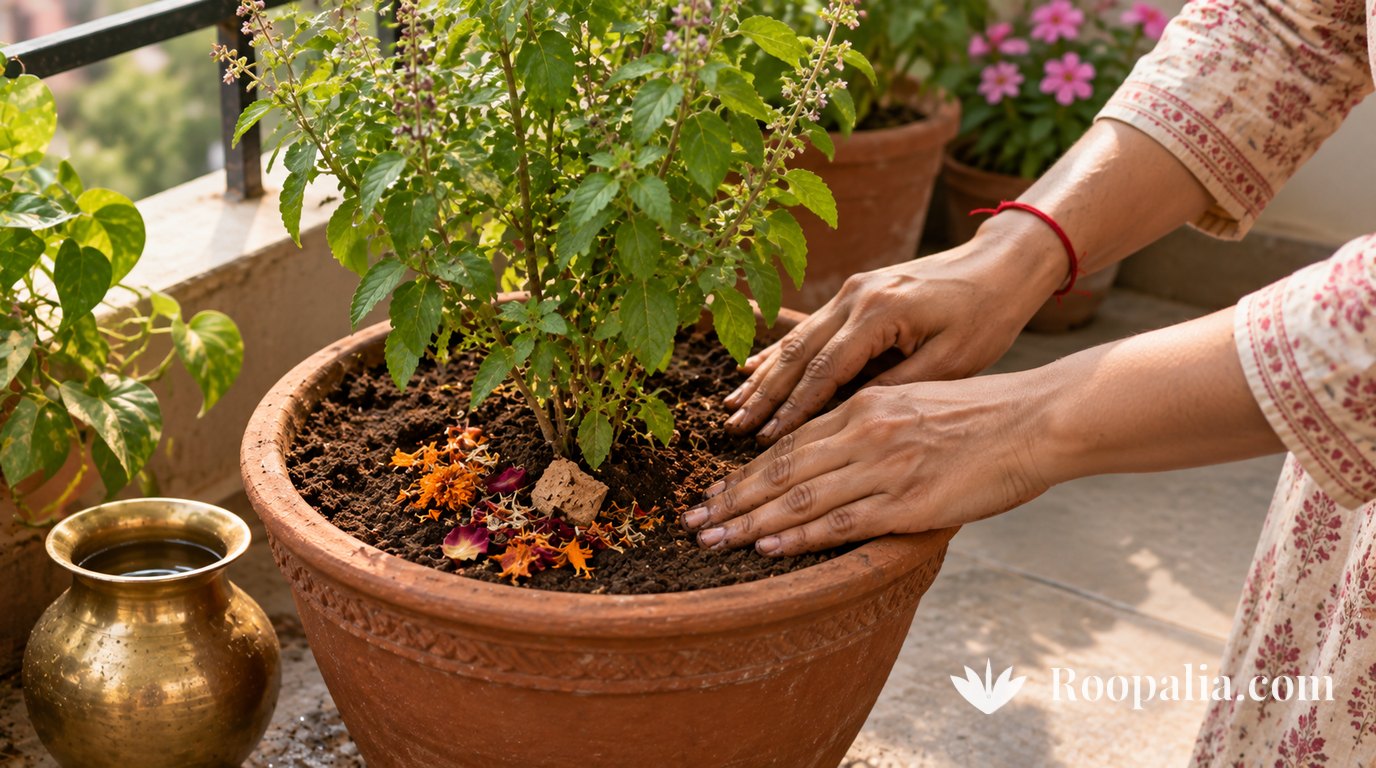
Dried flowers and garlands, sacred thread, a piece of cotton cloth, an unpainted clay figure, cooled ash — all of it can go into the soil of a pot or a garden bed. Returning things to the earth is a recognised route in the tradition, and in practice it collides with no rule anywhere, because nothing leaves your own pot.
One detail that matters: dig a hollow, place it under, and cover it over. Scattered on the surface it stays visible and goes mouldy. A tulsi pot is ideal; any plant will do.
2. Metal goes to be melted, not buried
This is where most people get stuck, and the answer feels wrong before it feels right.
A brass or copper figure belongs in neither water nor soil. It will not break down — that is precisely why every rule above excludes it.
Its proper route is scrap metal recycling, where it is melted and becomes something else. In the UK, Recycle Now directs metal items to the scrap metal facility at a household waste recycling centre; in the US, Canada and Australia this is municipal.
If that sounds irreverent, consider what it actually is. The tradition's own term for renovating a decayed image is jirnoddhara — the old form goes, and a new one is made. Melting is that, in industrial form: the shape ends, the metal continues, something new is cast. Say goodbye first — a lamp, folded hands, a moment. After that it is metal.
One thing not to do: do not sell it. The Agamic texts are severe about selling what has been offered in worship, and the instinct behind that rule applies here.
3. A temple — but ring first
The obvious thought is to take it all to the temple. It may work. But there is something you should know before you go.
We searched for a published policy and could not find one anywhere. The major Hindu temples and umbrella organisations in the UK, the US, Canada, Australia and the Gulf publish nothing on whether they accept old murtis, framed pictures or spent puja material from households — no acceptance policy and no refusal.
So do not leave things at a temple door. Unannounced, it becomes the temple's problem, and in many places such items simply accumulate outside. Make a phone call. And if they say no, that is their right — the other routes here still stand.
4. The right bin for what is left
Plastic frames, glass, foil, tinsel. There is no scriptural disposal for these because they did not exist when the texts were written. They are packaging and decoration, not worship material.
Separate them and put them in their own waste stream. There is no disrespect in that. The disrespect would be putting them somewhere they will never break down.
Dried flowers and plant material can often go in garden or organics collections — Recycle Now lists flowers under garden waste in the UK, and New York City accepts flowers in yard waste. But this genuinely varies: Toronto's accepted list does not name flowers at all, and Metro Vancouver tells residents outright to check with their own municipality. Look up your council's list once and you will know for good.
Sorting the shelf, item by item
| Item | Where it goes |
|---|---|
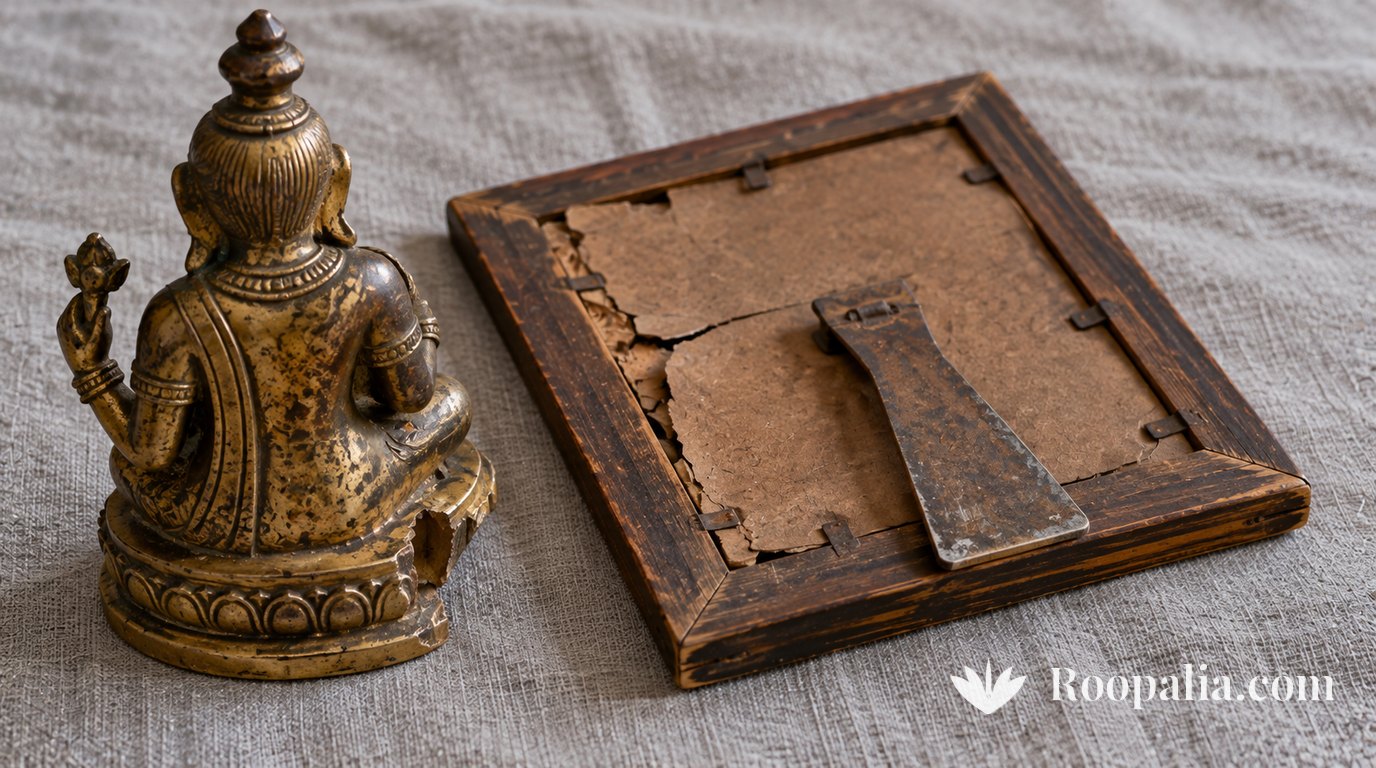
| Brass or copper figure | Scrap metal recycling, after a proper goodbye |
| Unpainted clay figure | Buried in the soil of a pot or bed |
| Plaster of Paris figure | General waste — it dissolves nowhere, and India now restricts it too |
| Paper picture or calendar image | Soil, or paper recycling |
| Frame — plastic or glass | Separate them out; their own waste streams |
| Frame — untreated wood | Soil, or wood waste |
| Dried garlands, petals, thread, cotton cloth | Soil, or garden waste if your council takes it |
| Wooden home shrine | Pass it on if sound; otherwise your council's route for furniture |
The part that makes it bearable
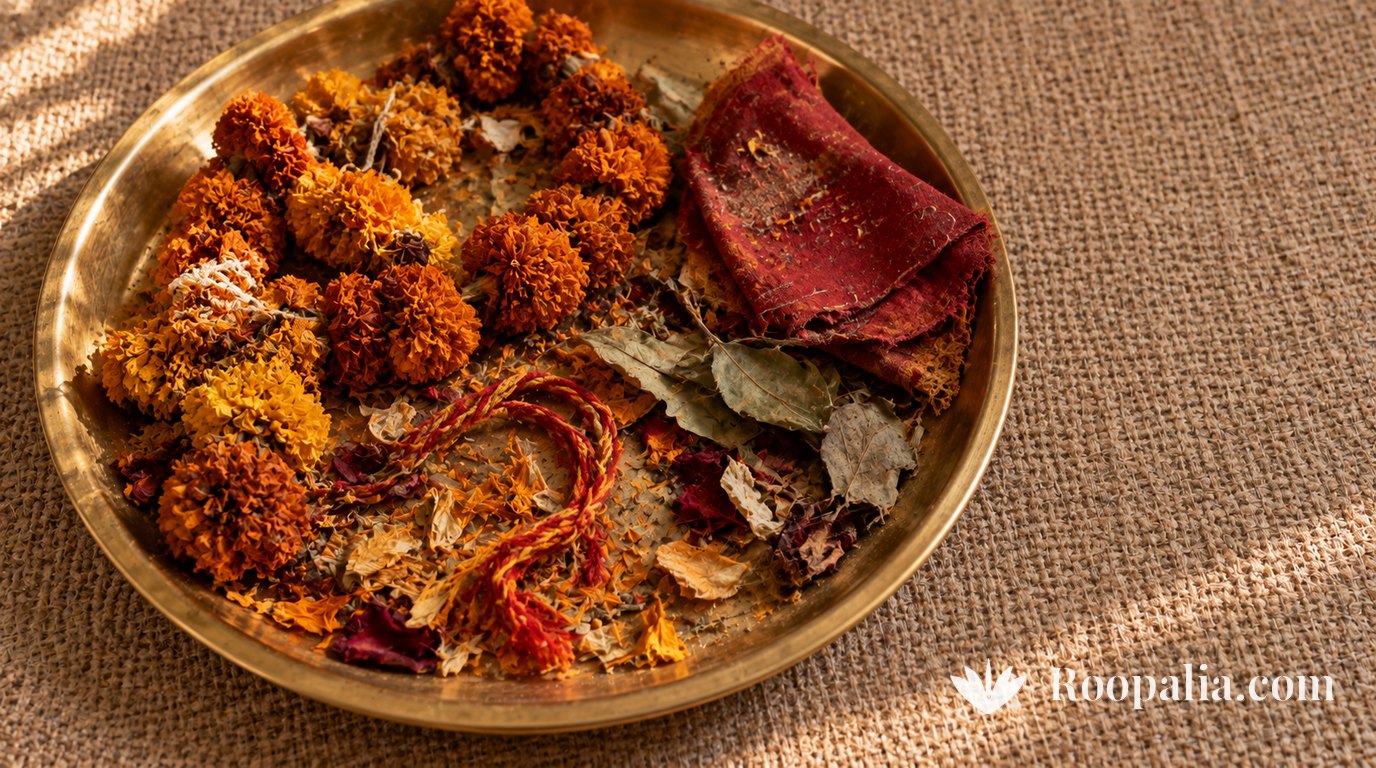
If all of the above still feels like a betrayal, that is usually because of one misunderstanding — the belief that visarjan means water, and that without water it cannot be done at all.
It does not mean water. In the Skanda Purana, visarjana means "bidding adieu to the Deity", and it is listed as one of the sixteen upacharas — the sixteen services of ordinary worship (visarjana, in the texts). The Pancharatra Ishvara Samhita describes it as returning the power that was invited in.
You already do this daily. The moment at the end of the aarti when you fold your hands and ask forgiveness for errors and take leave — that is visarjan. No river involved.
The tradition also has a name for retiring an image properly: udvasana, defined as dismissing the divinity from an image into which it was summoned — and, in the ritual manuals, as what a priest does before a damaged image is removed (udvasana, in the texts). A broken figure is not a catastrophe nobody anticipated. There is a procedure for it.
Water was where the remains were placed after the farewell. It was never the farewell itself.
So the absence of a river does not stop anything. It changes only where what remains ends up.
One practical consequence worth knowing: not every figure was consecrated. Formal prana pratishtha is a rite performed by a priest; a figure bought in a shop, a framed calendar picture or a gift generally never received it. Where there was no installation, no formal removal is required — a respectful farewell is enough. If you are unsure, light a lamp and ask leave; the tradition places intention above technique.
A five-minute rite before you start
Do this before you sort anything. It is what turns a disposal job back into something else.
- Put everything together on a clean cloth.
- Light a lamp.
- With folded hands, give thanks for the years these things were in the house, and ask forgiveness for any lapse.
- Take leave.
- Then sort: soil, metal, bin.
The order is the point. Farewell first, sorting after. What remains after a farewell is material, and there is no fault in treating material as material.
The wooden shrine
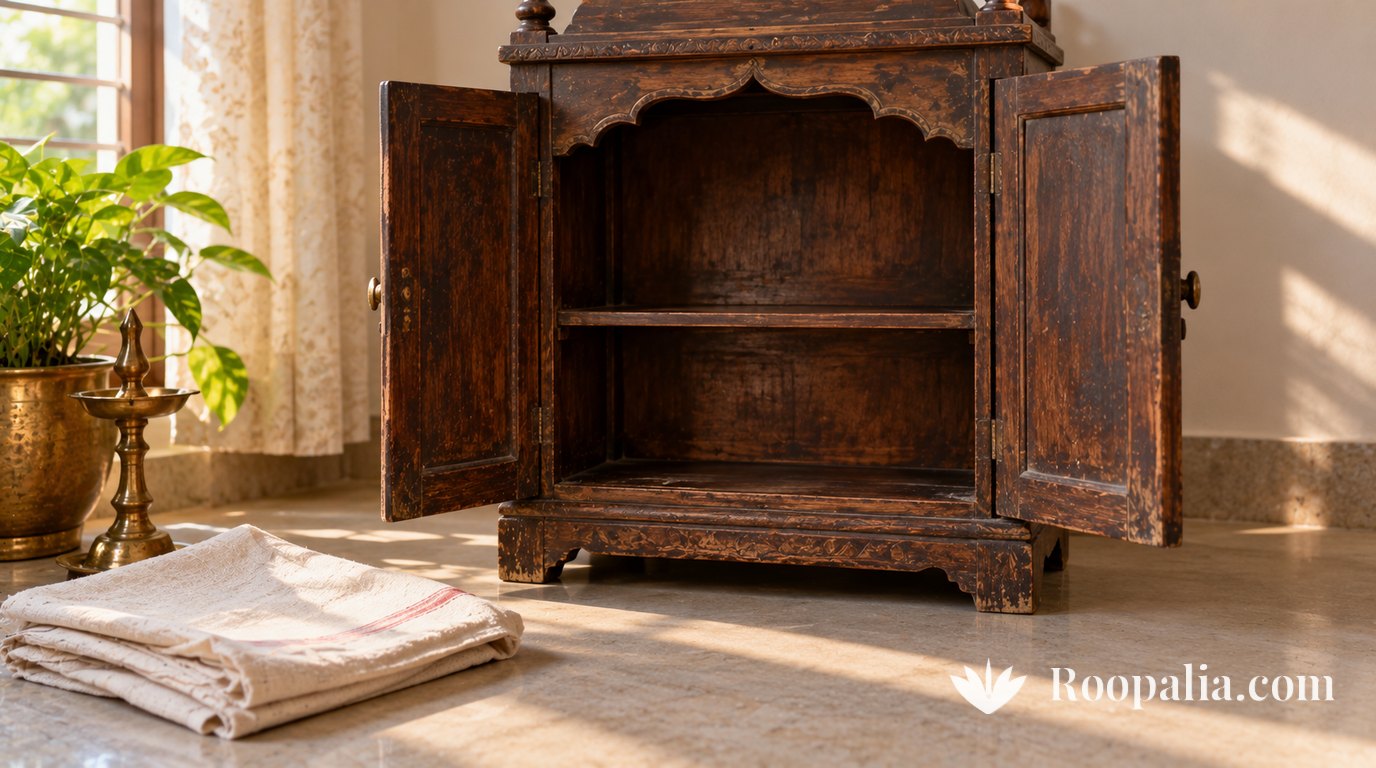
This one feels heaviest and is the simplest.
A home shrine is furniture. What it held was sacred; the cabinet is not. Empty it, deal with the contents as above, wipe it out, light a lamp and take leave. After that it is a wooden cupboard.
If it is sound, give it to another family — that is the best ending it can have. If not, follow your council's route for wooden furniture. One caution: painted or varnished wood must not be burnt and does not belong in garden waste.
What we looked for and could not find
Three searches came back empty, and the emptiness is itself the answer to questions people keep asking.
We could find no waste authority outside India that mentions religious objects at all. We checked the UK's national recycling guidance, New York City, Toronto, Metro Vancouver, Queensland and Dubai Municipality. Puja material does not appear in any of them.
We could find no jurisdiction outside India publishing any accommodation for religious immersion. India appears to be the only place that regulates immersion as immersion — designated tanks, rules on materials, and the requirement to strip flowers and decoration first.
We could find no temple outside India publishing a policy on accepting these items. Which is why the advice above is to telephone rather than assume.
If you have been unable to find the rule that applies to you, that is very likely because in most of these countries it was never written.
The short version
Say goodbye first. Then ask one question of each object: will this break down on its own?
If yes, return it to the soil of a pot. If it is metal, let it be melted and made into something else. If it is plastic or glass, it was decoration, not worship material, and it goes in its own bin. And if you want a temple to take it, telephone before you carry anything there.
The river was a means, not a requirement. What the texts ask for is the leave-taking — and that you can do in any kitchen, in any country, in five minutes.
What should I do with old Hindu idols and god photos?
Can I put an idol or puja items in a river, lake or canal outside India?
Does visarjan have to mean immersion in water?
What is the rule for deciding what can be returned to nature?
Do I need to remove flowers and decorations before immersing anything?
What do I do with a brass or copper idol?
Will a temple take my old idols and pictures?
Was my idol ever actually consecrated?
What should I do with a broken or damaged idol?
Where do old dried flowers and garlands from puja go?
What should I do with an old wooden home mandir?
Is there any official guidance on disposing of religious items?
Sources and cautions: the scriptural definitions of visarjana, udvasana, jirnoddhara, prana pratishtha and nirmalya were each opened on wisdomlib, and the texts cited there are named in the article — Skanda Purana 2.4.26, Ishvara Samhita, Agni Purana ch. 67, Prayogamanjari, Shiva Purana 2.1.13 and the Uttara-Kamikagama. Every environmental rule is from a named body: the Environmental Protection Act 1990 (UK), the Canal & River Trust, the Fisheries Act (Canada), 40 CFR 229.1 (US EPA), Recycle Now, and the Government of Mizoram’s 2019 idol immersion rules. We could not locate a chapter-and-verse citation for the familiar rule against worshipping a broken image, so that point is kept to what the published definitions of udvasana and jirnoddhara actually say. We could find no published policy from any temple or Hindu organisation outside India on accepting such items, which is why the advice is to telephone first. Bin and garden-waste rules are municipal everywhere — check your own council’s list.