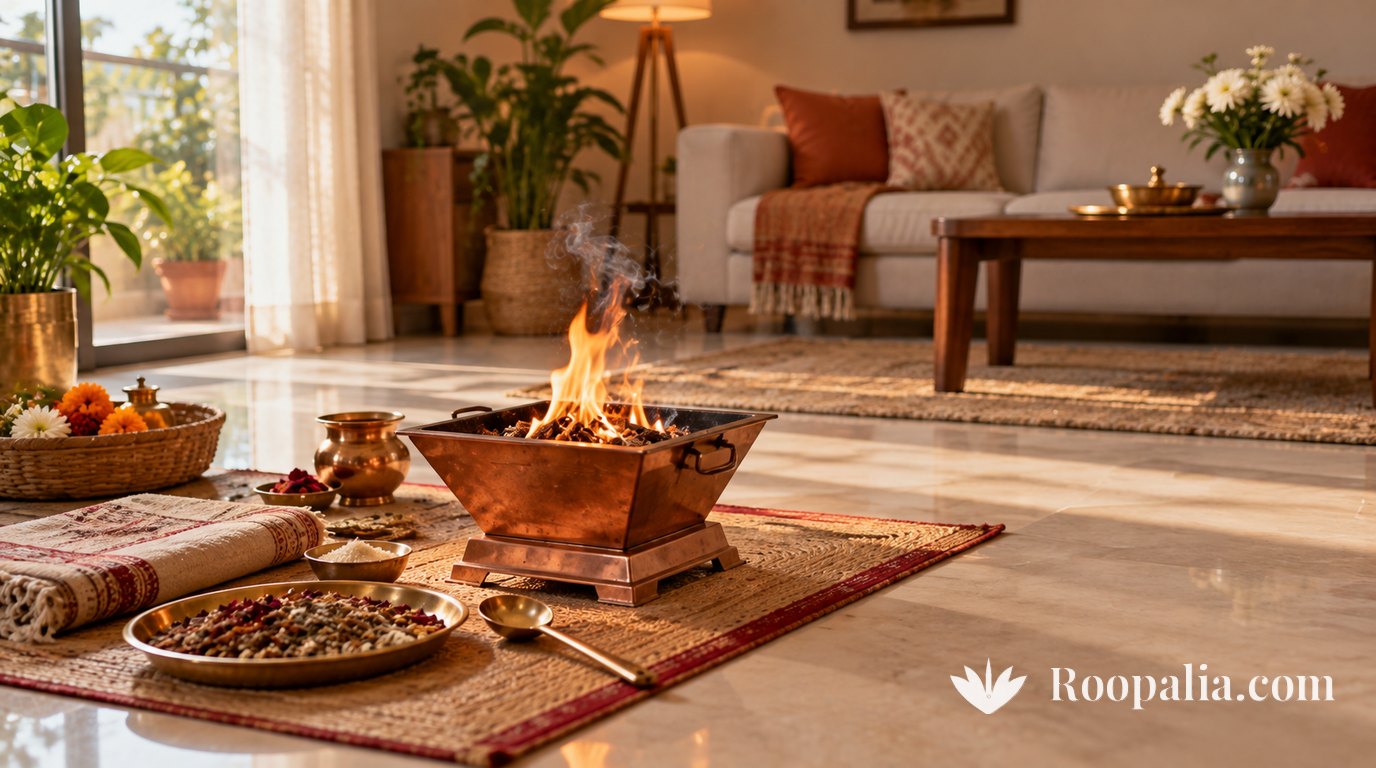
You have decided to do a havan at home. Then you look up.
There is a small white disc on the ceiling, and you have no idea what it is connected to. Last month it went off because someone left bread in the toaster too long.
Most articles about home havan are written in India, for readers in India, where that disc does not exist and the courtyard does. They answer the wrong question first. The priest question has a short answer, and we will get to it — but if you live in a flat in London, a condo in Toronto, an apartment in New Jersey or a strata block in Sydney, the thing standing between you and the fire is not a pandit. It is a building.
🙏 Everything below about fire, alarms and ash comes from a named fire service or government body, with the link next to it. Where no rule exists — and for havan specifically, none does anywhere — this article says so plainly instead of inventing one.
First: find out what your detector is wired to
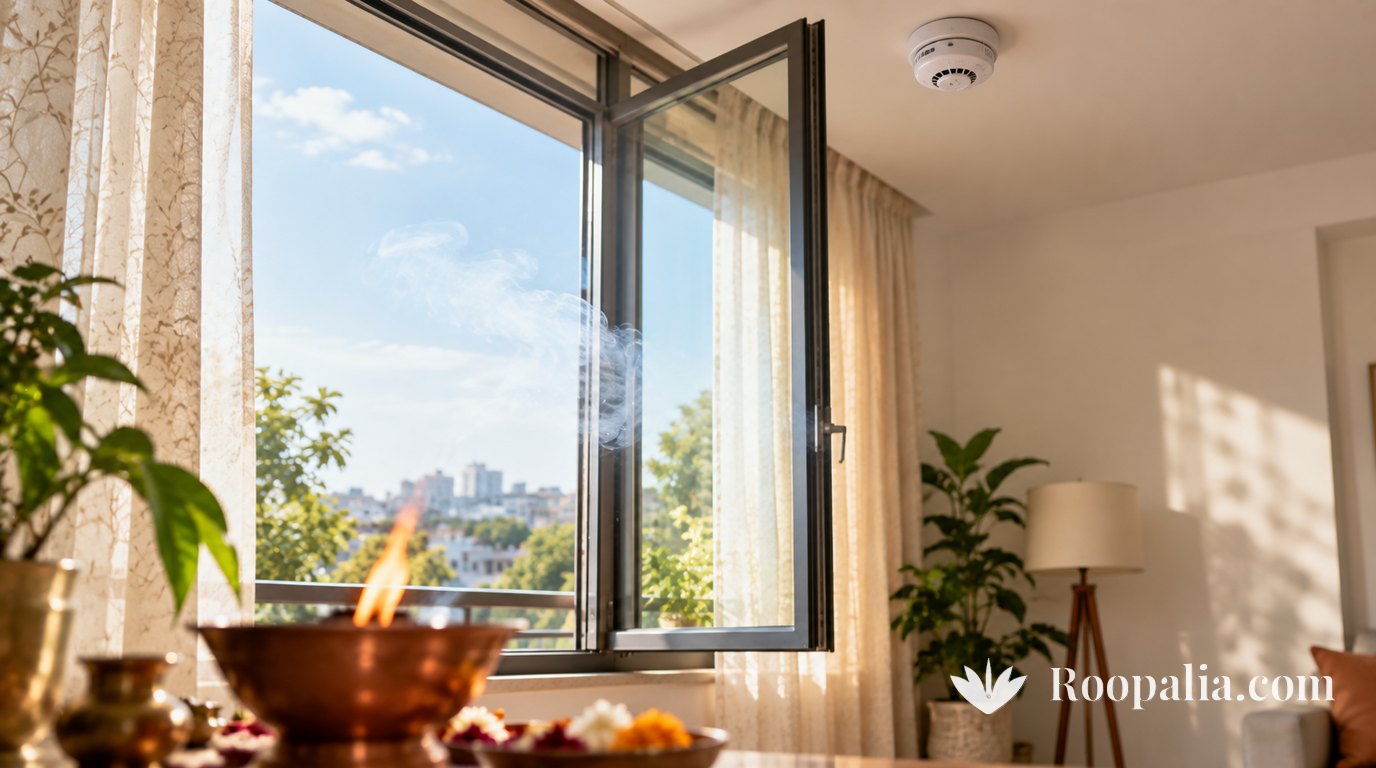
It is the question that matters most, and the answer is not the same in every building. The detector in your ceiling may be a standalone battery unit that only wakes you up. It may be interlinked with the others in your home. Or it may sit on a building-wide system that reports to a monitoring centre — and from there, engines are dispatched.
Fire and Rescue NSW publishes a list of what sets off unwanted automatic alarms. Burnt toast and steam are on it. So, by name, are candles and incense. The same document sets out the charging position: one unwanted activation is allowed in any sixty-day period, and second and subsequent ones may be billed to whoever holds the alarm service contract (Fire and Rescue NSW). Queensland adds a detail worth knowing: crews must attend and investigate even when told in advance the alarm is unwanted. You cannot ring ahead and cancel.
Here is the honest version: this is a property of your building, not of your country.
Two blocks on the same street can be wired differently. Singapore's home device is designed to sound locally only. The UAE goes the other way — the government portal states that homeowners must install fire detection and subscribe to the Civil Defence system. In the UK, the US, Canada and Australia it depends entirely on the building.
So do not guess. Ask your building manager one question: where does this alarm go?
And which kind of alarm is it?
Two common sensor types, and they behave very differently. Research summarised by the US National Institute of Standards and Technology found photoelectric detectors sensed smouldering fires on average thirty minutes earlier than ionisation detectors, while ionisation detectors responded about fifty seconds earlier to flaming fires (NIST).
Thirty minutes against fifty seconds — which is why Queensland now mandates photoelectric alarms and other jurisdictions are following. A havan smoulders before it flames, so the alarm type increasingly being made compulsory is the one most likely to notice it. Not an argument against either kind; an argument for ventilating properly.
Whatever you do, do not cover it
The obvious thought is to tape a bag over the thing for twenty minutes. Every fire authority that addresses this says no, and the US Fire Administration says it most bluntly:
“Disabling a smoke alarm or removing the battery can be a deadly mistake.”
— U.S. Fire Administration (FEMA)
The same page gives the correct alternative, and it takes no longer: “Open a window or door and press the 'hush' button”, or wave a towel to clear the air. Press, don't unplug. Beyond safety, there is the practical reason — a covered alarm is extremely easy to forget about, and in many tenancies disabling one is a breach.
What the law says — and where the real restriction lives
I searched the UK, the US, Canada and Australia. I found no national law in any of them prohibiting an open flame inside your own dwelling unit. The restrictions that do exist are somewhere else entirely:
| Where | What the rule actually is |
|---|---|
| Balconies (US) | In buildings with more than two dwelling units, open-flame devices may not be operated on combustible balconies or within ten feet of combustible construction (NY Dept of State). |
| Balconies (UK) | London Fire Brigade's guide for purpose-built flats says to keep your balcony clear and not to use or store anything on it that might cause a fire. |
| Outdoors (Toronto) | Open air burning is not permitted. The only exception is a small, confined, constantly supervised fire used to cook food (City of Toronto). A havan is not cooking, so it does not fall in the exception. |
| Dormitories (US) | Open flames, candles and incense are prohibited outright in dormitory sleeping units. If you are a student in university housing, this one is real. |
| Your lease | This is usually where the actual prohibition is — and it is contractual, not statutory. |
That last row is the one to act on. In Australia, apartment rules are made as strata by-laws by the owners corporation, and they differ building to building. In North America it is the condo board or the lease. In England, fire safety regulations for flats place duties on the building's responsible person for the common parts — they do not govern what you do inside your own flat.
So the document you need to read is not a fire code. It is your own tenancy agreement. Ten minutes, and then you know.
One finding worth stating plainly, because its absence is informative. I looked for official guidance on havan, homa or yajna from fire and civil defence authorities in six countries. There is none. The closest anything comes: London Fire Brigade names “Diya lamps” used for worship and says never to leave them unattended, and Singapore's Civil Defence Force refers to “burning of religious paraphernalia” in its alarm FAQ. Everything practical in this article is therefore general fire guidance applied to a havan — not an official recommendation about havan, and I will not dress it up as one.
Now the short answer on the pandit
With the building question settled, this one takes two verses.
Manusmriti, listing the duties of the householder, says the domestic rites are performed in the marriage-fire by the gṛhī — the householder himself:
“In the marriage-fire the householder should perform the ‘gṛhya’ rites; as also the rite of the ‘five sacrifices’ and the daily cooking.”
— Manusmriti 3.67, with Medhātithi's commentary
And among the five daily offerings it names, the one made into fire — the offering to the gods — is homa:
“Teaching is the ‘offering to Brahma;’ the Tarpaṇa is the ‘offering to Pitṛs;’ the Homa is ‘offering to Gods;’ the Bali is ‘offering to elementals;’ and the honouring of Guests is ‘offering to men.’”
— Manusmriti 3.70
The actor is named in the verse, and it is not a priest. Medhātithi adds that a gṛhī means one who has married — so this is the household's rite, performed by the couple.
Why theirs rather than a priest's? The preceding verses describe five places in the home where unavoidable harm occurs in ordinary use — the hearth, the grinding stone, the household implements, the mortar and pestle, the water jar — and say the five great sacrifices were ordained to make amends for exactly that. The debt is incurred in your own kitchen. A priest cannot discharge harm he did not cause.
For the elaborate śrauta rites you need trained ritualists. For the domestic fire, a priest is a help, not a condition.
A vessel, some wood, and what you may swap
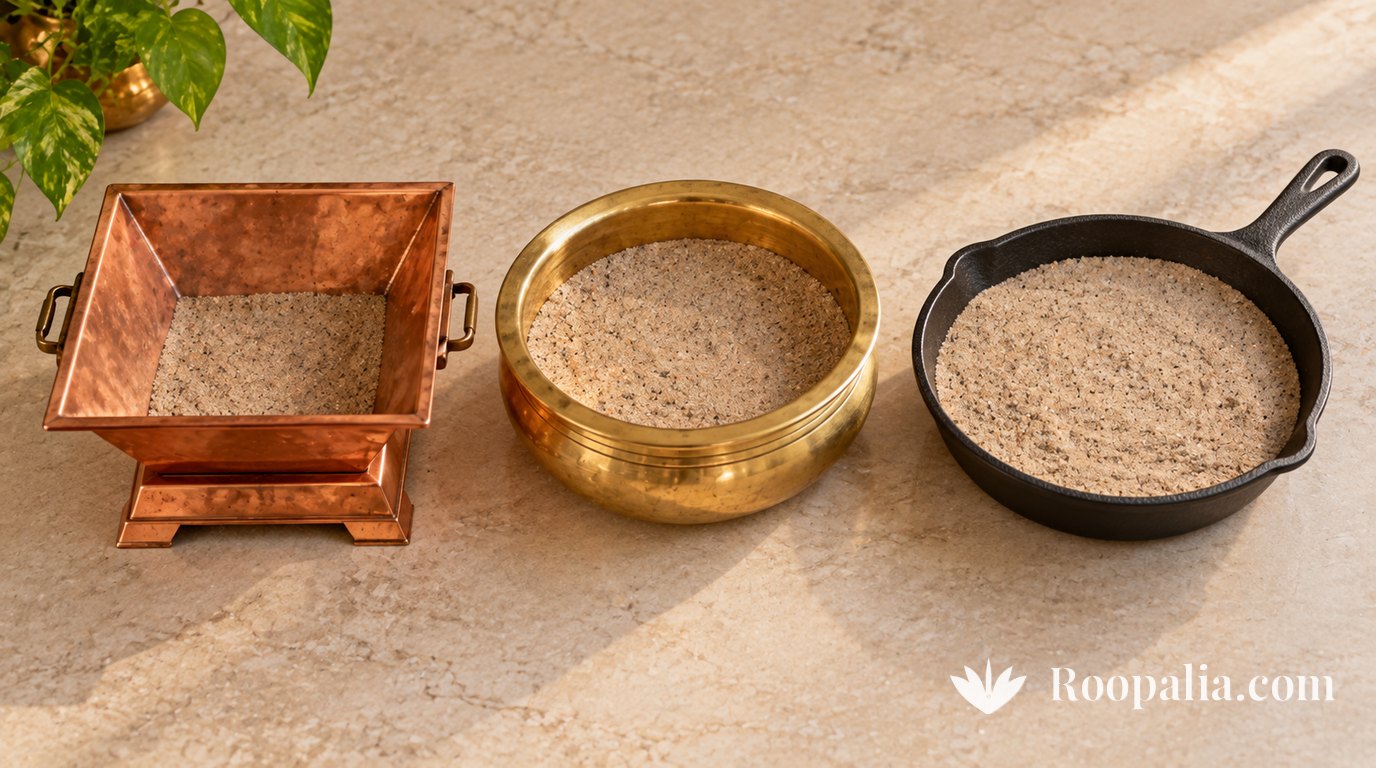
The tradition has detailed prescriptions for the shape and measure of a havan kund. The working rule is simpler: the vessel must take heat, sit steady, and not pass heat to whatever is underneath.
A small copper or brass kund is ideal, better still on feet. A thick-walled brass bowl with two fingers of sand in the bottom works, and so does a heavy cast-iron pan, again with sand — which both insulates and, at the end, smothers.
What is underneath matters more than the vessel. Never directly on a rug, a carpet or a wooden floor. Stone tile, marble, or a wide metal tray, and the vessel on that.
Wood, and the substitution you are allowed
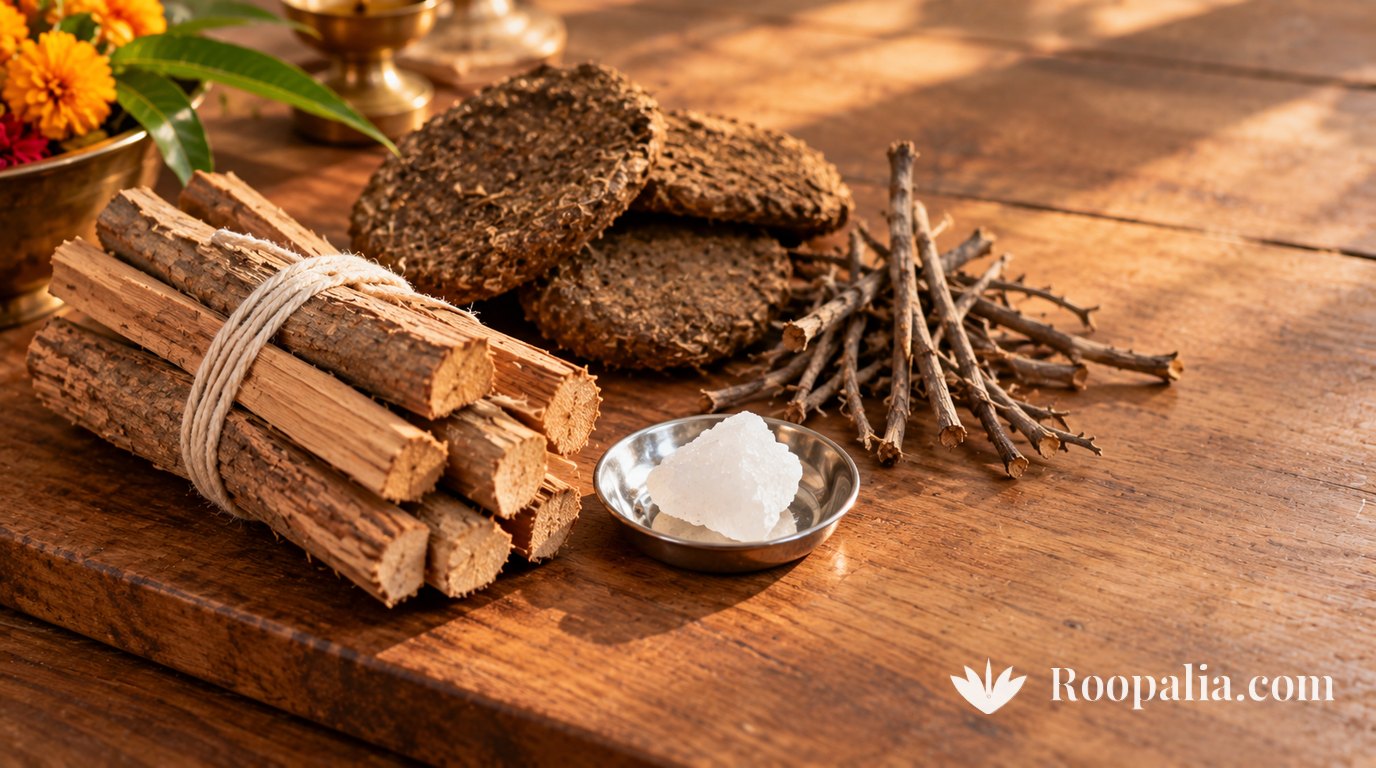
Samidha — the ritual firewood — is prescribed by species: palāśa, khadira, pippala, śamī, udumbara among others, with mango the common domestic choice in north India. Outside India you will find none of them at the supermarket.
The tradition anticipated this. Where the prescribed article cannot be had, an accepted substitute is provided for — this is the principle of anukalpa, and it is part of the rule, not an exception to it. We covered it at length in our piece on doing puja at home when the temple is far.
Applied to fire, it gives you this:
- Instead of mango or palāśa — any dry, untreated hardwood. Kiln-dried firewood is fine.
- Instead of cow-dung cakes — leave them out. They were there to get the fire going; nothing is incomplete without them.
- To light it — pure camphor. Never lighter fluid, spirit or any liquid accelerant.
- Ghee — this is the one thing not substituted. Use less of it, not something else.
- Havan samagri — sesame, rice, barley, dried herbs, dried petals. Dry, not fresh; fresh material smokes far more.
The one absolute: never burn treated wood. No plywood, MDF, particle board, painted or varnished wood, pressure-treated offcuts, or scrap from the garden fence. These are bonded with glues and resins, and what they release indoors is not simply smoke. Untreated kiln-dried firewood, sold everywhere, is both cheaper and correct.
How much — and this is where people go wrong

In India, samagri goes in by the handful. There is a courtyard, and smoke costs nothing. In a flat, every pinch has a price.
The most useful sentence I found on this comes from a British fire service, written about Diwali diyas, and it transfers exactly:
“Use only enough ghee or oil for a diya to last your puja.”
— Dorset & Wiltshire Fire and Rescue Service
As much as this rite needs. No more.
In practice: a pinch of samagri per offering, not a fistful. Ghee by the spoon, not poured in a stream. A pinch completes the offering exactly as a handful does, and produces roughly a quarter of the smoke.
Smoke: distance is the whole game
Now the part everything else depends on.
Singapore's Civil Defence Force, in its FAQ on home fire alarm devices, gives the single most practically useful sentence in this entire article:
“Generally, cooking or burning of religious paraphernalia will not cause false alarms unless these activities are carried out in close proximity to the HFADs.”
— Singapore Civil Defence Force
Read that carefully. Burning religious material does not set off alarms. Burning it near the detector does. Distance is the variable.
Which gives you the whole method:
- Find every detector first, then choose the room. Walk the flat and look at the ceilings. Pick the spot furthest from all of them.
- Open the windows before you light anything — and two of them, on different walls. One open window does not move air; two do.
- Do not point a fan at the smoke. It will distribute it evenly through the flat, including to the detector.
- Not under the kitchen hood. It is tempting, but the most sensitive devices are often nearby.
- Close the door of any room that has a detector in it, if you can.
There is also a reason to keep the smoke down that has nothing to do with alarms. The US Environmental Protection Agency states that the main health concern from wood smoke is fine particulate matter, and that indoor combustion raises indoor particle levels (US EPA).
That is not an argument against havan. It is an argument for the same three things: less material, real cross-ventilation, and a shorter sitting. If there is a baby, an elderly parent or anyone with a breathing condition in the house, sort the ventilation out first and keep it brief. This is general information, not medical advice — anyone with a specific condition should ask their own doctor.
The order of a short home havan
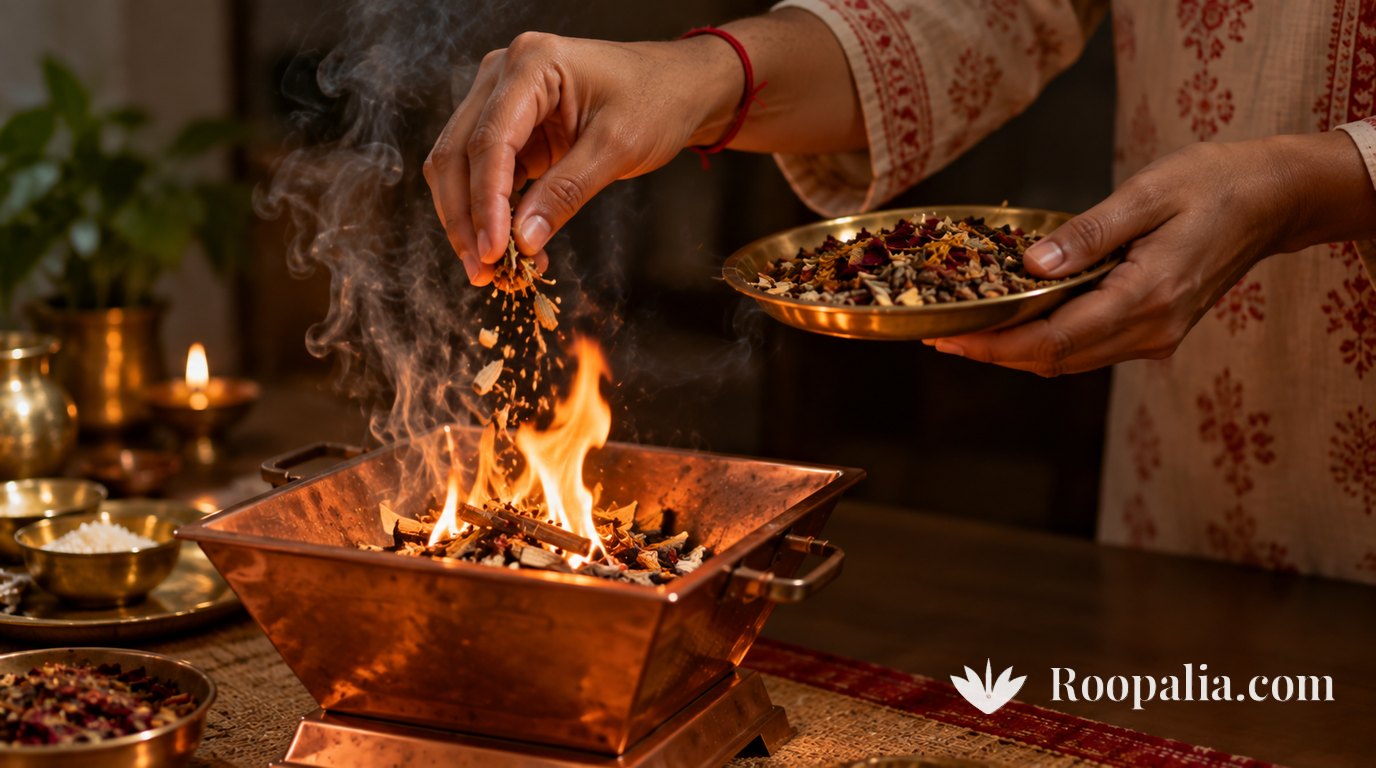
I am not going to print mantras from memory. Mantras should be read from a published text, not reconstructed.
What I can give you is the sequence. This one is taken from the published havan-sandhya text of an Arya Samaj organisation based outside India — which prints the full procedure with the mantras (the published text):
- Āchaman — sipping water
- Aṅga sparsha — touching the body with water
- Īshvara stuti, prārthanā, upāsanā — praise, prayer, communion
- Svasti vāchana
- Shānti karaṇa
- Agni-ādhāna and Agnihotra — kindling the fire and making the offerings
- Pūrṇāhuti — the final complete offering
- Shānti pāṭha — the closing peace recitation
A domestic havan runs twenty to thirty minutes. The saṅkalpa — the stated intention, for whom and for what — matters more than fluency. Get that clear and the rest holds together.
And if you are worried about pronunciation: imperfect recitation is not a new problem in this tradition. That is precisely why every procedure closes with a peace recitation, and why intention is placed above technique.
Ash is what actually starts fires
The havan is over. The vessel feels cool. The ash goes in the kitchen bin.
This is where the fire happens — not during the rite, afterwards.
“Embers often concealed in what appears to be cold ashes, can remain hot enough to rekindle a fire for several days.”
— Montgomery County Fire & Rescue Service, Maryland
Several days. The same service's instructions: use only a metal container with a tight-fitting metal lid, never plastic, cardboard or a bag, never a vacuum cleaner, and store the container outside, away from structures, decks, fences and anything combustible.
A home havan leaves a handful of ash, but the rule does not scale down. The simplest safe method: damp the ash, put it in a metal tin with a lid, leave it outside overnight. By morning it is finished with.
Then what
Tradition treats yajna ash as sacred, and the same principle governs old idols, pictures and puja material — applied to the forehead, returned to the soil of a plant, or given to flowing water. The first two are straightforward wherever you live, and mixing cooled ash into the soil of a pot is both the simplest option and a genuinely good one, since wood ash does the soil no harm.
The third needs care, and the reason is precise. England's Environment Agency policy says individual ceremonies do not need approval, but adds:
“Do not allow other materials such as wreathes and plastic bags to enter the water or to be left on the bank.”
— Environment Agency policy
The objection is not to the ash — it is to everything that travels with it. Garlands, cloth, the bag. In the US, scattering in rivers and lakes is not federally regulated at all, and for ocean burial the EPA's standard for accompanying flowers is that they be readily decomposable. Ash and plant matter yes, everything else no.
If something goes wrong
No fire service publishes guidance on what to keep beside a deliberate indoor flame — all their advice concerns unwanted fires. The following is general guidance assembled for this purpose, not an official recommendation.
Keep within arm's reach: a metal lid or wide plate (smothering is faster than anything else), a fire blanket (the one item UK fire services actively recommend for a household), some sand, and your phone.
And the rule every fire service states identically: if it grows, do not fight it. Get out, close the door behind you, and call. 999 in the UK, 911 in the US and Canada, 000 in Australia, 997 in the UAE, 995 in Singapore.
The short version
The texts name the householder as the one who performs this rite, and give a reason — the debt being repaid is incurred in your own kitchen.
Everything else is logistics. Find out what your detector is wired to. Read your lease, not the fire code. Untreated wood, a pinch at a time, two windows open, well away from the ceiling. Damp the ash and put it outside in a metal tin.
None of that is a compromise. The tradition has always let the arrangements change with the place. What does not change is who the fire is lit for.
Can I do a havan at home without a pandit?
Is it legal to do a havan in an apartment?
How do I stop the smoke alarm going off during a havan?
Can I cover the smoke detector during a puja or havan?
What is the difference between ionisation and photoelectric smoke alarms?
What can I use instead of mango wood or samidha?
What can I use if I don't have a havan kund?
What is the order of a short home havan?
What should I do with the ash after a havan?
Can I put havan offerings or ash into a river or the sea?
Is havan smoke harmful indoors?
Has any government published safety guidance on havan?
Sources and cautions: Manusmriti 3.67, 3.68, 3.69 and 3.70 were each opened on wisdomlib with Medhātithi’s commentary, and the translations are quoted from there. The order of the rite is from the published havan-sandhya text of an Arya Samaj organisation. Everything on fire, alarms and ash is from a named body — U.S. Fire Administration, NIST, Fire and Rescue NSW, London Fire Brigade, Dorset & Wiltshire Fire and Rescue, Singapore Civil Defence Force, Montgomery County Fire & Rescue, US EPA, the Environment Agency, the New York State Department of State, the City of Toronto and the UAE government portal. No fire or civil defence authority in any of the six countries checked publishes guidance on havan, homa or yajna — so the safety advice here is general guidance applied to the practice, not an official recommendation about it. Mantras are deliberately not printed; read them from a published text. The note on smoke and air quality is general information, not medical advice. Rules vary by building and municipality — check your own lease and local authority.