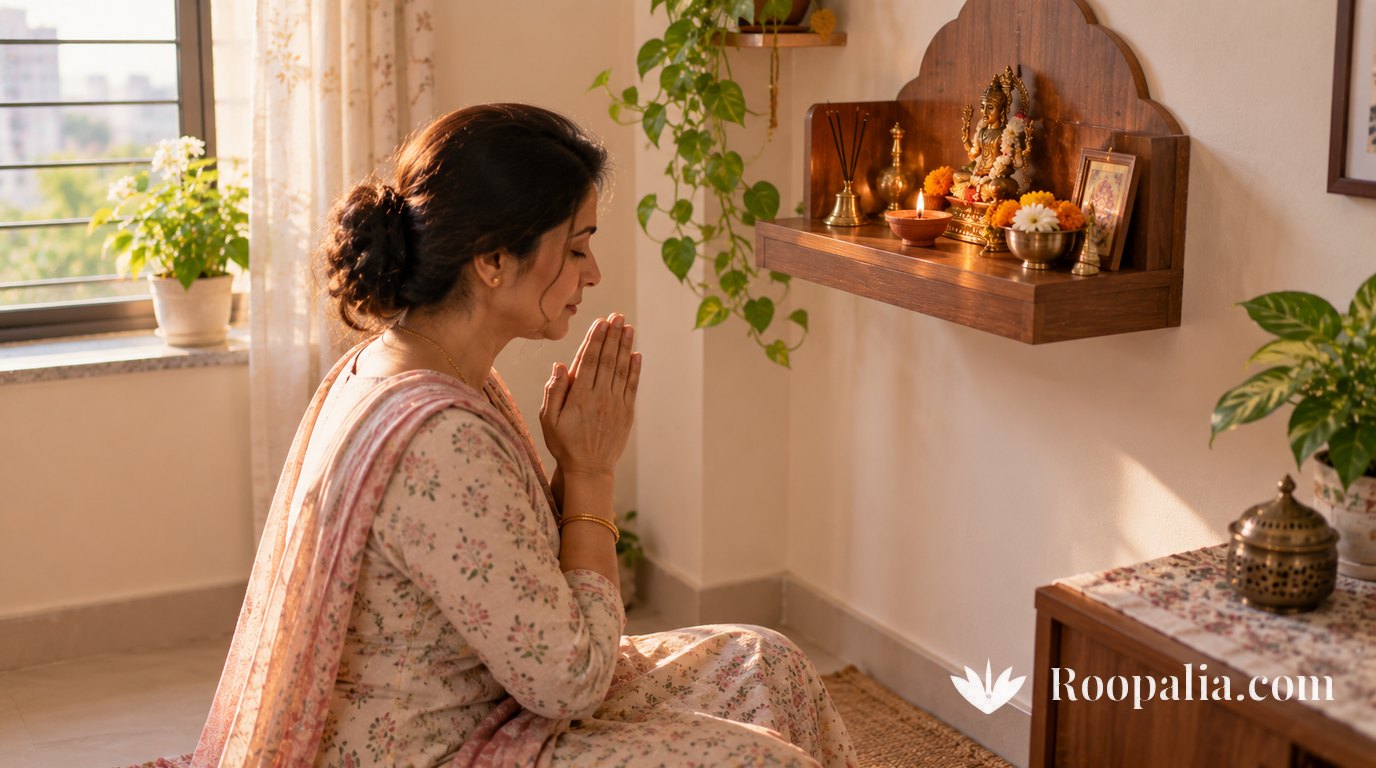
Type how to do puja at home without into Google and watch what it fills in. Without a pandit. Without a shivling. Without a kalash. Then the same question again in Hindi, in Gujarati, in Marathi, in Telugu.
Five languages, one question. What do I do when I do not have the thing the ritual asks for?
You are nowhere near the first to ask it, and the tradition's answer is more generous than most people expect.
🙏 Where this article touches fire safety or local rules it links to the published source, so you can check it against your own building. It is not legal advice. And where your family's way differs from what is written here, your family's way wins.
First, what a puja actually is
Most people reading this have seen a hundred pujas and have never been told what one is. You knew when to fold your hands and when to take the aarti flame. Nobody explained the grammar of it, because nobody explains the grammar of anything you grow up inside.
So, plainly: a puja is hospitality.
Its unit is the upachara — an act of service, the sort of thing you do for a guest. You call them in (aavahana). You offer a seat (asana), water (arghya), something fragrant, a flower, incense, a lamp, something to eat. At the end you see them off properly instead of letting them find the door themselves (visarjana).
That is the whole structure, and once you see it, two things stop being confusing. There is no fixed shopping list, because a host offers what a host has, and nobody thinks less of a family that serves tea in a steel tumbler. And the short version is not a lesser version: sixteen upacharas is a state reception, five is how you welcome someone on an ordinary weekday, and the tradition wrote down both on purpose.
Which brings us to the part most people have never been told exists.
Start with what the tradition already allows
The elaborate form everybody pictures, with a priest and an hour of Sanskrit, is shodashopachara — sixteen upacharas. It is what a temple does, and what a family does for a wedding or a housewarming.
The everyday form is panchopachara. Five:
| # | Upachara | What it is |
|---|---|---|
| 1 | Gandha | Sandalwood paste, or anything fragrant |
| 2 | Pushpa | A flower |
| 3 | Dhupa | Incense |
| 4 | Deepa | A lamp |
| 5 | Naivedya | Something to eat — a sweet, a fruit, whatever is in the kitchen |
That is a complete puja. Not a shortcut, not a version you do until you have time for the real one. It is the form household practice settled on centuries ago, precisely so it could be done daily by people with work to get to.
Worth saying plainly, because the commonest reason people outside India stop doing puja is not disbelief. It is that they began with the elaborate version, kept it up for three weeks, and quietly let the whole thing lapse.
A small puja done daily is worth more than an elaborate one done twice a year and then abandoned. Pick the version you can manage in your worst week, and let festivals be the days you do more.
A daily puja that takes seven minutes
- Wash. A shower if it is morning, hands and face if evening, and change out of what you wore outside.
- Clear the shelf. Yesterday's flowers and ash, ten seconds with a dry cloth.
- Light the lamp first. Everything else follows the lamp.
- Achamana. A sip of water from your palm, three times.
- Sankalpa. Hold a little water and a few grains of rice and say in your head what this is for. (Sankalpa is the intention set before a ritual — who you are, where you are, what you are about to do.) You can say it in English. It is a statement, not a spell.
- The five upacharas, in order: fragrance, flower, incense, lamp, food.
- Aarti. Circle the lamp clockwise in front of the murti and sing whatever your family sings.
- Pranam, and an apology for whatever you got wrong. The apology is part of the form, not a politeness; priests recite a verse for it at the end of every puja.
Seven to ten minutes. It fits before the school run.
Must it be morning? Morning is the custom, and there is sense in it. But an evening puja you actually do beats a morning one you keep meaning to. Must it be daily? No — plenty of families keep a daily lamp and do the fuller thing on one weekday that matters to them.
The method is the easy part. The flat is where it gets complicated.
Setting up a shrine in a rented apartment
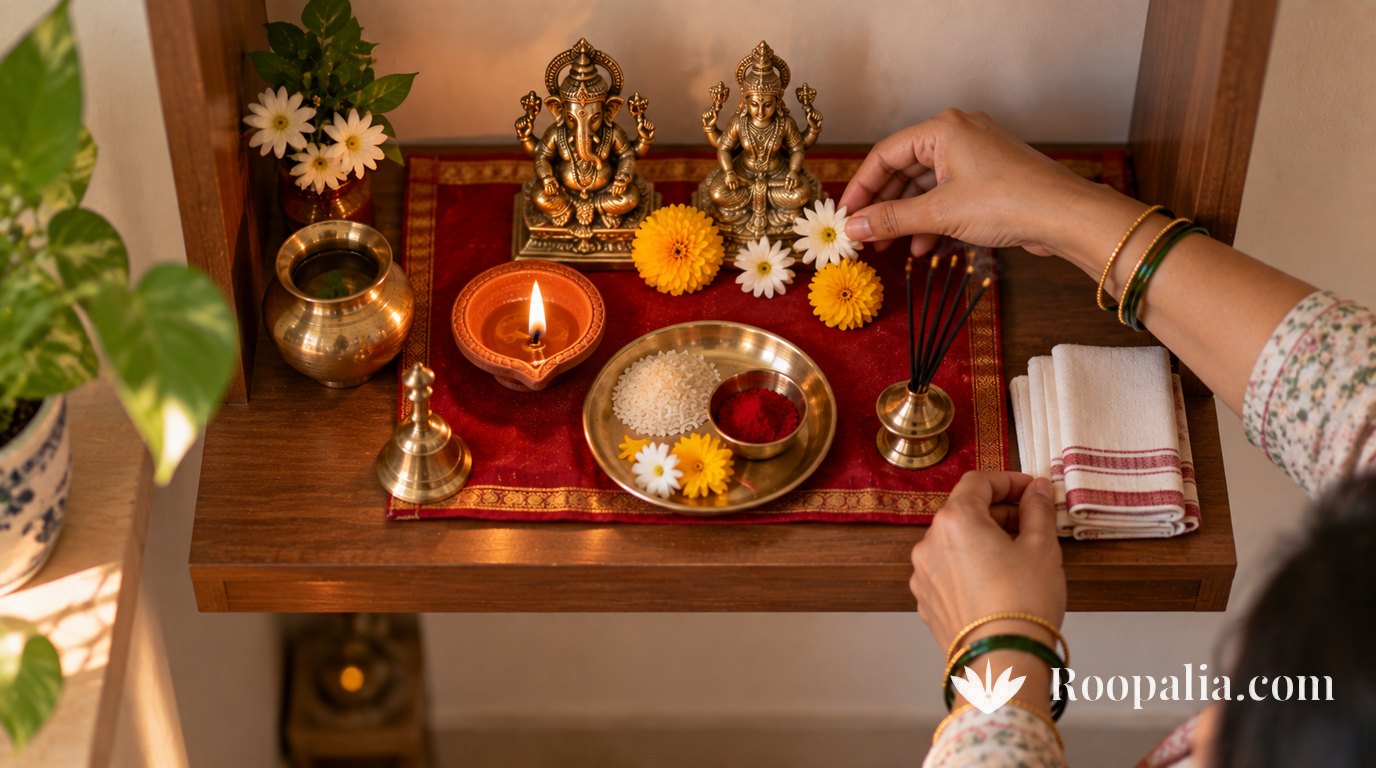
Forget the phrase "puja room". Unless you have bought a house and planned for one, you are not getting a room. You are looking for a shelf.
What works, roughly in order of preference: a wall shelf at chest height in a corner that is not on the way to anywhere; the top of a low cabinet, cleared and not shared with keys and post; a wooden mandir unit with doors, which keep dust out and let you close the shrine when the flat is full of people who did not come for that; or a plain wooden chowki on the floor, which is what a great many homes in India use.
What rented walls will take. Most tenancy agreements allow small picture hooks and require you to fill the holes when you leave; many forbid drilling into masonry. A floating shelf on two wall plugs is usually fine, a marble slab on brackets usually is not.
Height matters more than furniture. The murti sits above your waist when you stand and above your head when you sit in front of it. Nothing goes on top of it, and it never sits directly on the floor. Get that right and a twelve-pound shelf from a hardware shop is a perfectly good mandir.
What to avoid: under a staircase, because people walk over it; sharing a wall with the toilet, or directly above or below one; the kitchen; under a beam. Less superstition than shorthand — give it a place where it will not be stepped over or constantly interrupted.
Can the shrine go in a bedroom?
Yes. In a one-bedroom flat or a shared house it is often the only private space there is, and the tradition has never said a bedroom shrine is invalid.
People ask this so anxiously that it is worth naming where the hesitation comes from. The classical texts assume a house with a devgriha, a separate room for the household deities, and a rented two-bedroom flat does not come with one. What those texts protect is not the floor plan but the idea that a shrine should be somewhere respectful and reasonably undisturbed. A bedroom can be that:
- Against the north or east wall, in the north-east corner of the room if you can work it out.
- Not at the foot of the bed, and not where your feet point at it while you sleep.
- A unit with doors, or a small curtain, closed at night. This solves the whole problem, and it is what most families in small flats do.
- Shoes and the laundry pile out of that corner. That is most of what "respectful" means in practice.
If you have a second option — a hallway alcove, the top of a bookshelf — take it. If you do not, the bedroom is fine, and you can stop worrying about it.
When you cannot face the right direction
The rule you will have heard is to face east or north, which puts the shrine against the east or north wall.
Direction, first of all, is the same everywhere. North-east in Toronto is north-east in Chennai. Open the compass app, stand in the room, find it; there is no separate calculation for other countries.
But you also live where you live, and flats get built facing whichever way the road runs. The order of preference is north-east, then east, then north, then whatever is left, and no shastra says that facing another way brings harm. An order of preference is not a threat. The full reasoning, and the verse behind it, is in our guide to pooja room direction as per vastu.
Now the problem nobody's grandmother had to solve.
Diyas, incense and the smoke alarm
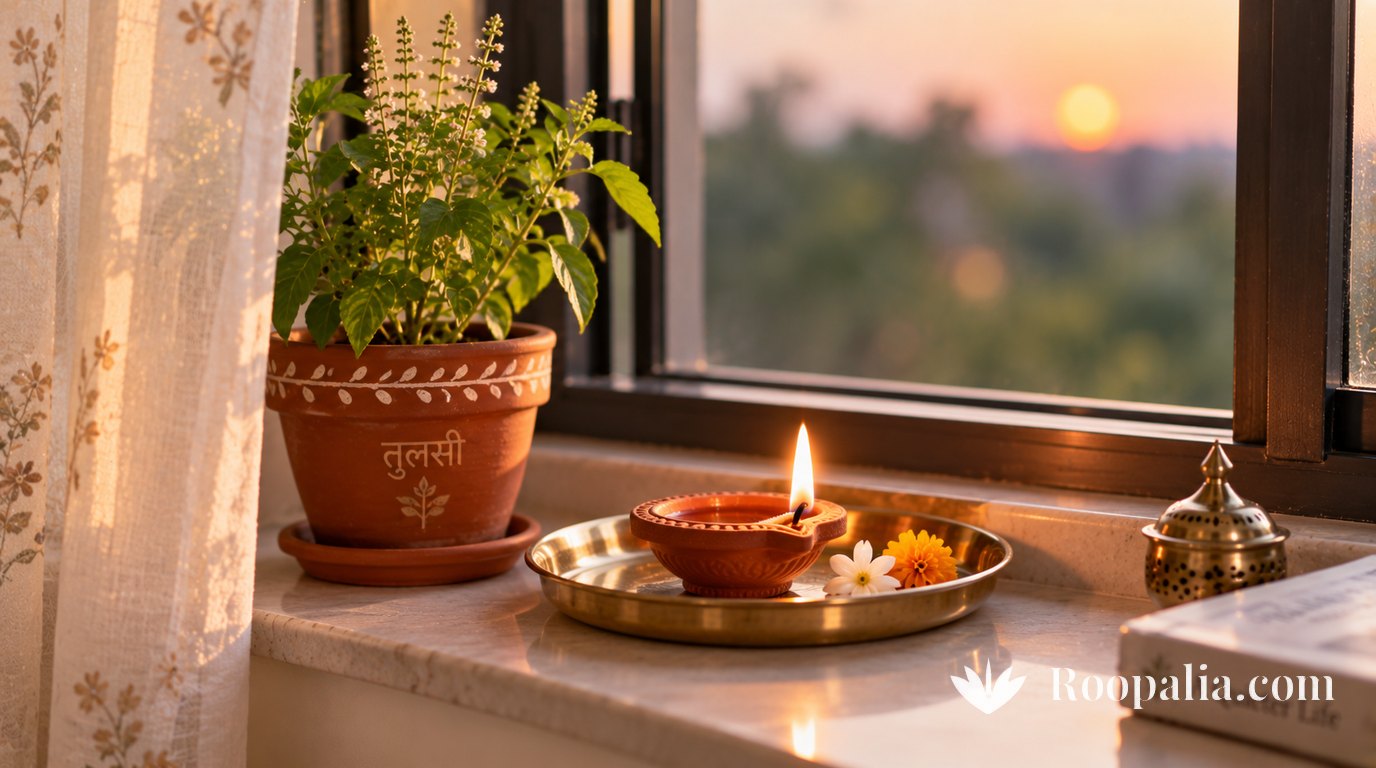
This is the most searched practical problem in the whole subject, and the guides do not touch it. Household alarms come in two kinds, and the US National Institute of Standards and Technology explains the difference plainly:
“Ionization-based alarms tend to detect small black soot particles from flaming fires more quickly… Photoelectric detectors tend to be more sensitive to particles that are larger in size and white or light-colored, and thus more reflective, like those emitted by smoldering fires.”
— National Institute of Standards and Technology, on how smoke detectors work
Incense is a smouldering fire. It produces exactly the pale, large, reflective particles the second kind of alarm is built to notice. That is why the stick your mother lit every day of her life in India sets off the alarm in your flat in Croydon, and why nothing is wrong with either the incense or the alarm. NIST makes the same point about kitchens: "Sometimes something as simple as turning on a toaster can set them off."
What to do about it, in order of how much difference it makes:
- Open a window before you light anything. Most of the problem is a still room.
- Move the shrine away from the alarm. Fire services give ten feet as the working distance for cooking, and it is a sensible minimum here too — Honolulu's fire department puts it as "Smoke detectors should not be installed within 10 feet of a cooking appliance." Hallway alarms outside bedrooms are the usual culprits.
- Burn less. One stick, not three, and break it in half. A dhoop cone in a covered holder smokes far less than a loose stick.
- Change what you burn. Camphor burns clean and fast, and so does a ghee lamp with a proper cotton wick. Most of the smoke from a diya comes from a wick left too long or oil that has run low.
- Never cover the alarm. Not with tape, not with a shower cap, not for five minutes. People forget, and that is how people die. If the alarm genuinely cannot cope, ask the landlord for a photoelectric or dual-sensor unit in that spot rather than disabling the one you have.
On open flames and your lease. Check the agreement rather than guessing. Many blocks of flats, and nearly all student housing, ban candles and incense outright as a term of tenancy. If yours does, an LED diya daily and a real one on festival days, at the kitchen sink with the extractor running, is where most families land. The lamp stands for light, and that meaning survives the switch.
What to substitute when you cannot find an item
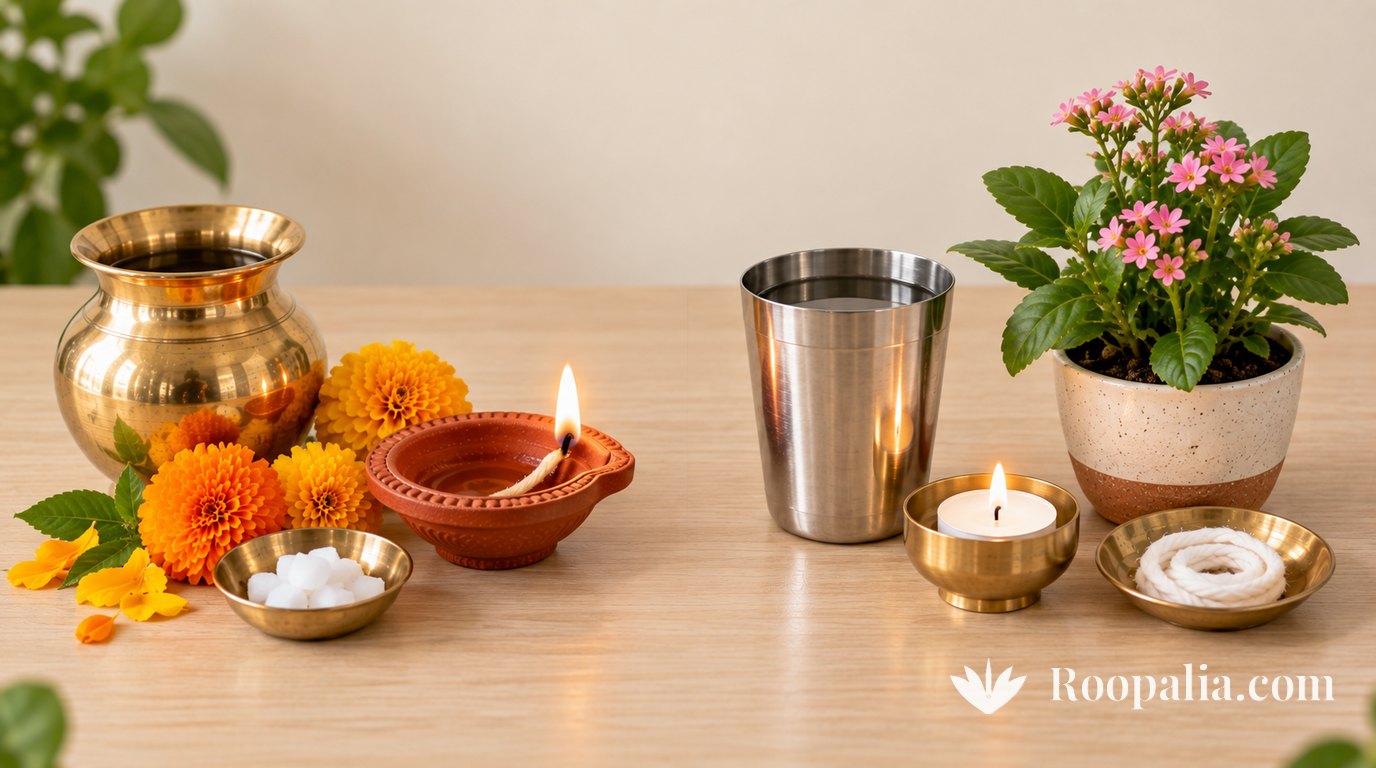
The tradition has a word for this: anukalpa (which also governs what you may burn when samidha is unavailable), the secondary provision: the alternative permitted when the prescribed item is genuinely not available. The texts give their own example: where barley is prescribed and there is no barley, wheat or rice may be used.
The condition attached is the interesting part: the allowance is for someone who cannot, not for someone who cannot be bothered. Manusmriti frames it as a warning to the person perfectly able to do the main thing who takes the easier route anyway. Read the right way round, that is permission — and if Gangajal is not sold within two hundred miles of you, you are the person the provision was written for.
| If you cannot get | Use | Why it holds |
|---|---|---|
| Gangajal | Clean water with a tulsi leaf in it | Purifying the water is the point, and tulsi is what does it |
| Fresh flowers | A flower from a pot on the sill, or akshat | Unbroken rice stands in for any upachara |
| A clay diya | A brass or steel lamp, or a ghee tealight | The vessel is incidental; the flame is the upachara |
| Cow ghee | Sesame oil, or any clean vegetable oil | Oil lamps are older than ghee lamps in household practice |
| Camphor | The ghee lamp itself, for aarti | Aarti is the lamp; camphor is a later refinement |
| Tulsi | Any clean green leaf, or akshat | Anukalpa |
| Roli | Turmeric with a pinch of slaked lime, or sandalwood | That is how kumkum has always been made |
| Panchamrit | Whatever of the five you have; milk and sugar will do | Anukalpa |
| A clay murti at festival time | A picture, a yantra, or a supari | Invoking a deity into a supari is long-standing practice |
| A pandit | Yourself, for daily puja | Household daily puja never required one |
Where to actually buy things, since nobody writes this part down. The Indian grocery covers roli, akshat, camphor, incense and ghee, and most keep a small puja shelf near the till — Edison and Devon Avenue, Southall and Belgrave Road, Brampton and Gerrard Street, Harris Park and Dandenong. Brass lamps and murtis are easier to find at a temple's own shop, and a murti is worth buying in person. One trip a year covers a year of daily puja; this is a tradition with very low running costs.
Growing tulsi indoors
One item on the list you need never buy again, because it grows on a windowsill. Tulsi is Ocimum tenuiflorum, holy basil, and it behaves like basil. North Carolina State University's extension service gives its light requirement as "full sun (6 or more hours of direct sunlight a day)" and notes it is best kept in a container — which happens to suit a flat.
Six hours through glass is a lot to ask in a northern winter. What works:
- A south-facing window in the northern hemisphere, north-facing in Australia. East or west does in summer and struggles in December.
- A grow light when the window cannot deliver — extension services suggest twelve to sixteen hours a day, six to twelve inches above the leaves. That only sounds excessive next to "six hours of sun" because lamp light is far weaker; the plant receives roughly the same total.
- Off the cold glass in winter. Tulsi is tropical, and a leaf against a freezing pane overnight will blacken.
- Water when the top inch is dry, in a pot that drains. More tulsi dies of wet feet than of neglect.
- Pinch off the flower spikes unless you want seed, or the plant puts everything into flowering and gives up.
It will not look like the tulsi in your grandmother's courtyard, and that is fine. If it dies over winter that is the plant's nature, not a judgement on you. Keep a few seeds for spring.
Which leaves the question people are most embarrassed to ask out loud.
What to do with flowers, water and old idols
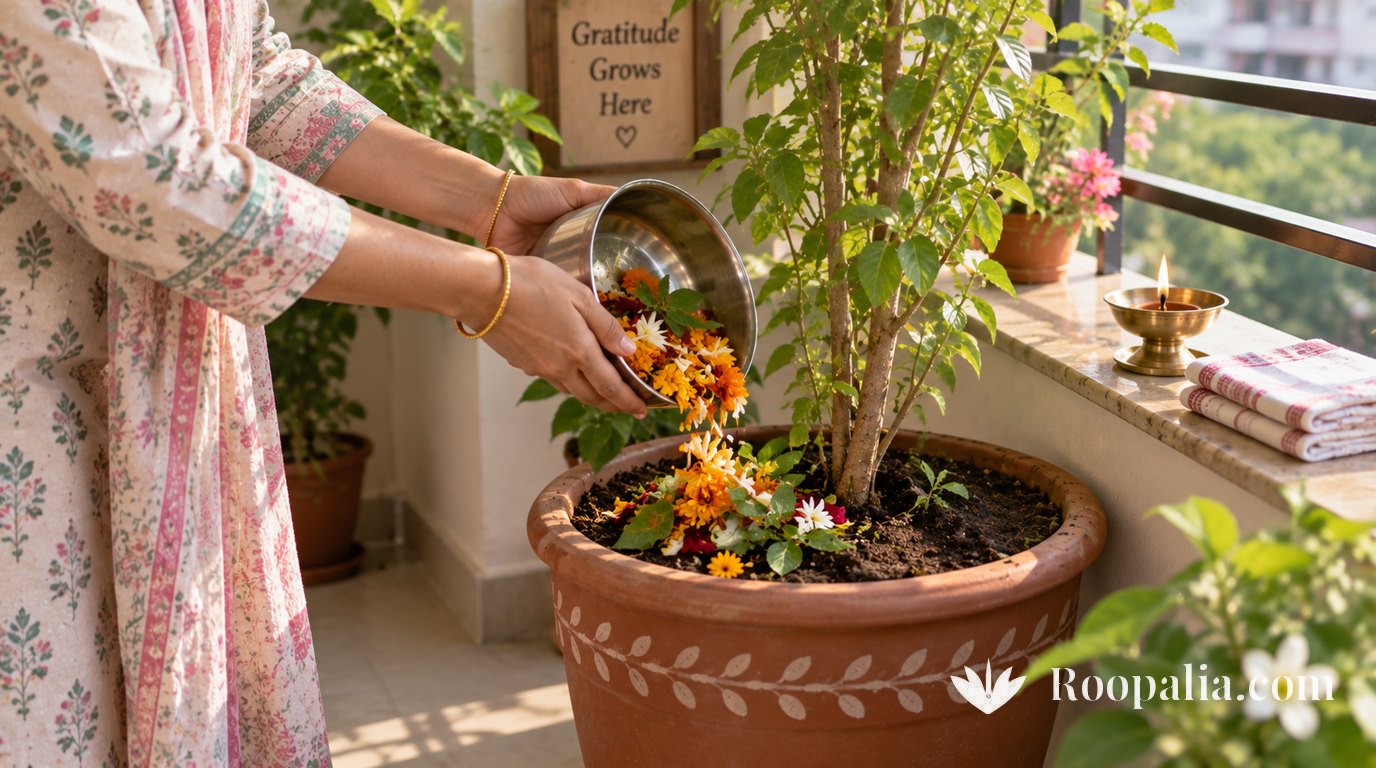
In India the answer was the river and nobody had to think about it. Outside India the river is illegal, frozen or forty minutes away, and the flowers sit on the shelf while you feel bad about them.
The leftovers of a puja are nirmalya, and what the tradition asks is that they return to earth or water rather than going out with the rubbish. It does not specify which river.
The clearest guidance published anywhere on this comes from Canada, where the Hindu Federation held a forum with the Toronto and Region and Peel Region conservation authorities and a dozen temples, precisely because congregants were putting offerings into local rivers:
“Only bio-degradable items (such as leaves and flowers) are allowed to be disposed of in bodies of running water. Other items (such as fruits, murthis, plastic, etc. are not allowed).” Congregants were encouraged to “compost non bio-degradable items in their backyard.”
— Hindu Federation, Canada, forum on the disposition of religious offerings, July 2021
The US federal position runs the same way. The Environmental Protection Agency allows only “flowers and wreaths consisting of materials that are readily decomposable in the marine environment”, and excludes plastic and metal by name.
So, practically:
- Flowers, leaves, nirmalya: into a pot on the balcony, the garden, or the compost bin. That is returning them to the earth, which is what was being asked for.
- Abhishek water: onto the plants.
- Food offerings: eaten. Prasad is meant to be eaten; what cannot be goes to the birds or the compost.
- Clay murtis at festival time: a bucket at home, and once the clay dissolves the water goes into a large pot. Temples in Britain have said so for years — the Hindu Temple Society in Coventry has advised visarjan "at home in the sink or in a clean bucket" since 2018.
- Never the household bin, and never a public waterway for anything that is not a leaf or a flower.
Old metal idols — the question people get stuck on
We have since written this up in full: what to do with old idols and god photos, with the routes for brass, clay, frames and an old wooden shrine.
An honest admission first. We looked for published guidance on this from temples and Hindu organisations in the United States, Britain, Canada and Australia, and found none. The searches people run — what to do with old brass idols, what to do with old silver idols — return pages answering a different question. So what follows is not a citation. It is what the tradition implies, and what priests in these countries tell people who ring up and ask.
Start with the distinction that matters. Clay is made to dissolve; a clay Ganesh is immersed because that is the end its material was chosen for. Metal is not. A brass or silver murti was made to last generations and be handed down, and putting it in a lake is neither traditional nor, in most of these countries, legal. So the question is not how to dispose of it. It is how to pass it on.
- If it is intact, keep it in the family. A murti that has been in daily puja for thirty years is exactly the thing to give a child setting up a first home. That is the traditional answer, and the right one more often than people think.
- If nobody wants it, ask your temple. Most will take a metal murti and many have a quiet arrangement for it. Ring and ask rather than leaving it at the door.
- If it is damaged, ask a priest, not the internet. A broken image is traditionally not kept in worship, and a priest can say whether repair and re-consecration is appropriate.
- Do not put metal in water. Not a river, not a lake, not the sea. The EPA rule above is explicit about metal, and it is the wrong end for the object in any case.
- If it truly must go, wrap it in clean cloth and bury it in earth — a deep pot, or a garden. Earth is the traditional destination for what cannot be immersed.
Photographs are easier. Take off the frame and glass; the picture goes into the earth or is burned, and the frame is only a frame.
Explaining it to someone who has never seen it
A flatmate. A partner who did not grow up with this. A colleague invited for Diwali. A child who has been to two temples and found both of them loud.
Most people fumble this because they reach for theology first. Don't. Start with the hospitality, which everybody already understands.
"We keep a small shrine. Every morning we light a lamp, offer a flower and something sweet, and say a few words. It's the way you'd look after a guest in the house. That's really all it is."
That has ended more awkward conversations than any explanation of Advaita ever has. If they want more, they will ask.
For children, three things work better than explanation. Give them a job — the lamp, the bell, the plate. Answer the question they actually asked, not the one you wish they had asked. And let them see you do it on ordinary days, not only festival days, because that is what makes it look like part of life instead of a performance for visitors. More on that in how to raise children with Indian values.
And if you are the one who never learnt: you are allowed to start now, badly. Light a lamp. Say something. The belief that there is a correct procedure you have missed and can no longer be taught is the single biggest reason people in their thirties never begin. There is no entrance exam.
A short checklist you can print
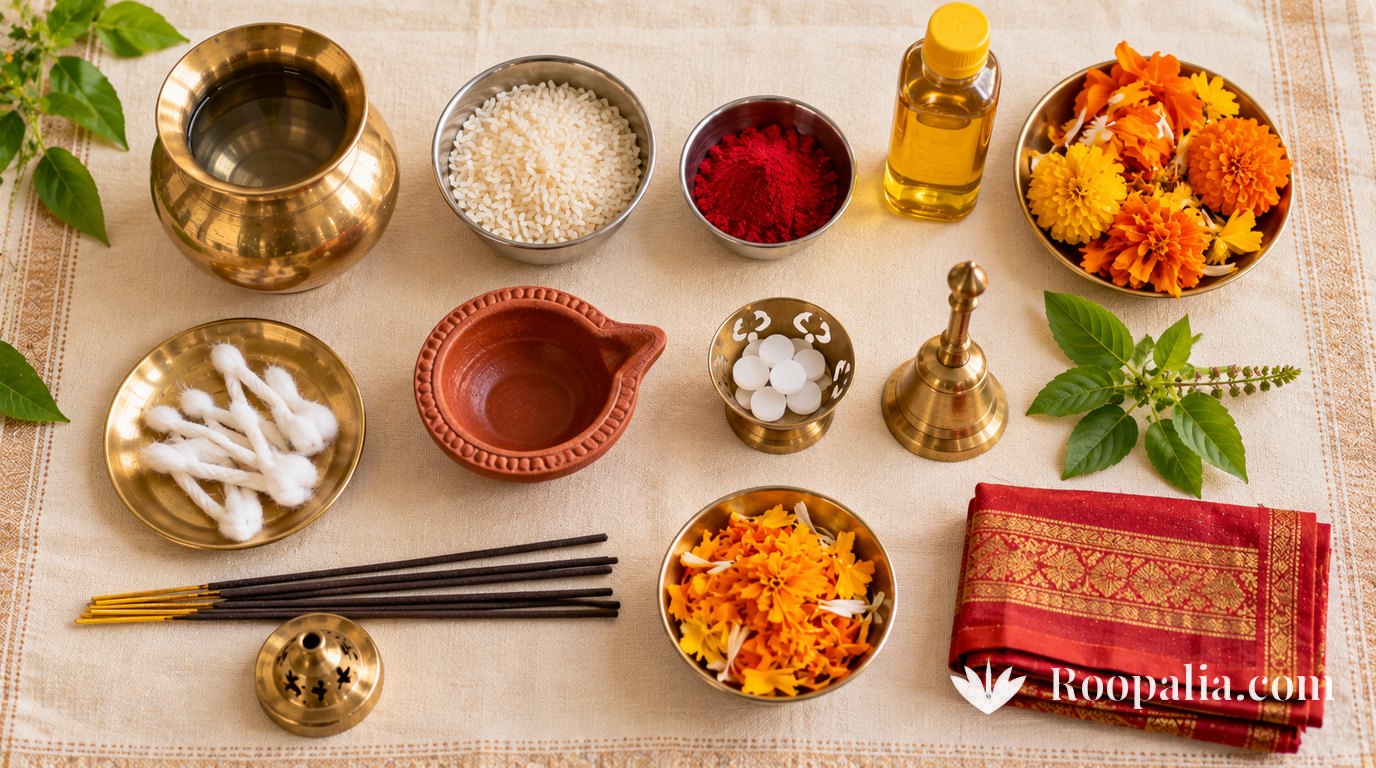
All of it fits in one carrier bag and lasts most of a year.
| Group | Item | Daily? |
|---|---|---|
| The lamp | Diya — clay, brass, or a ghee tealight | Yes |
| Cotton wicks | Yes | |
| Ghee or sesame oil | Yes | |
| Matches, kept at the shrine | Yes | |
| The offering | Akshat — whole raw rice, unbroken | Yes |
| Roli or kumkum | Yes | |
| A flower, or a leaf | Yes | |
| Something sweet, or a fruit | Yes | |
| Vessels | Small lota or steel glass for water | Yes |
| A small plate for aarti | Yes | |
| Bell | No | |
| Festival days | Incense or dhoop | No |
| Camphor | No | |
| Sandalwood paste | No | |
| Coconut, kalava, betel | No | |
| Bring from India | Gangajal, if you want it | No |
| Dry panchamrit ingredients | No |
Nine things in the "yes" column. That is the whole cost of keeping this up.
One last thing worth knowing
It is easy to feel like an outlier doing this in a flat in Leeds or Mississauga. You are not. The 2021 census recorded a million Hindus in England and Wales, and in Harrow, north-west London, a quarter of the borough. (You will often read that Hinduism is Australia's fastest-growing religion. The Australian Bureau of Statistics does not say that — its own 2021 figures name a different group. The 55.3% growth in five years is real; the superlative is not.)
And the temples do exist. The 2020 U.S. Religion Census counted around 400 traditional Hindu temples in the United States, reaching 280 of them directly against 258 a decade earlier — spread across a country the size of a continent. Which is why the drive is long, and why the shelf at home matters.
A puja is hospitality, and the tradition wrote down a five-minute version of it on purpose. The shelf in a rented flat, the tealight instead of the diya, the tulsi under a grow light, the flowers into the balcony pot — none of that is a lesser form of the thing. It is the thing, done by someone who is where they are.
Light the lamp. The rest follows.
Frequently asked questions
What is a puja, in simple terms?
Can I do puja without a priest?
Is it okay to keep a shrine in the bedroom?
What if I cannot face east?
What can I use instead of Gangajal?
Will incense set off my smoke alarm?
Can I light a diya in a rented apartment?
Can tulsi grow indoors?
What is the shortest proper puja?
What do I do with old flowers and leftover items?
How do I respectfully retire an old brass or silver idol?
Does a shorter puja count?
Sources and cautions: the smoke-alarm explanation is from the US National Institute of Standards and Technology and the ten-foot figure from the Honolulu Fire Department; tulsi's light requirement is from NC State Extension. Guidance on offerings and waterways is from the Hindu Federation of Canada's July 2021 forum with the Toronto and Region and Peel Region conservation authorities, and from the US Environmental Protection Agency. Population figures are from the ONS Census 2021 (England and Wales) and the Australian Bureau of Statistics 2021 Census; the temple count is from the 2020 U.S. Religion Census, Appendix H. None of this is legal advice, and rules differ by building, city and country — check your own. Where the article says no published guidance exists, that is what our search found and is stated as such.