
Karwa Chauth 2026 is on Thursday, 29 October. That is what every Indian newspaper will print, and for India it is correct.
If you live in New Jersey, or Toronto, or anywhere in North America, your date is probably Wednesday, 28 October — a day earlier. The Indian press prints India's date, which is the right date for India, so you either fast on the wrong day or spend the week arguing with your mother about who has it right.
Let us settle that first, then get through the day.
🙏 Every date, moonrise and health line below carries a link to where it came from, so you can check it against your own city. This is not medical advice — if you are pregnant, diabetic, on regular medication or unwell, speak to your doctor before keeping a waterless fast.
Your date may not be India's date
The reason is a rule, not a mistake.
Karwa Chauth is tied to the fourth day of the waning fortnight, the Chaturthi tithi, and the rule is that the tithi must be running at the moment the moon rises where you are. The term for it is chandrodaya-vyapini. (Vyapini means "prevailing at that moment". Different vrats use different anchors — Ekadashi is fixed by sunrise, Karwa Chauth by moonrise.) Why festival dates differ from India's at all — the calendar, the tithi and the rule — is set out separately. The panchangkar Pandit Mahesh Shastri states it plainly:
“Karwa Chauth to be observed at moonrise (chandrodaya vyapini)… the specific time for karwa chauth is moonrise time. This means the chaturthi tithi needs to be visible at the moonrise time.”
— mypanchang.com. The rule comes from the nibandha texts Nirnaya Sindhu and Dharma Sindhu — though in fairness we could not locate the exact passage in an edition of either, so treat it as what the panchang authorities state, not as a verified chapter-and-verse citation.
A tithi is not a day. It is a stretch of time with its own start and end, and those hours land differently on each side of the planet. Move far enough west and the Chaturthi has already ended by the time your moon comes up, so the observance falls on the previous evening. Which is why the split is not "India versus abroad" — it is longitude:
| Where you are | Karwa Chauth 2026 | Moonrise |
|---|---|---|
| New Delhi | Thursday 29 October | 8:17 PM |
| London | Thursday 29 October | 6:31 PM |
| Frankfurt | Thursday 29 October | 7:03 PM |
| Sydney | Thursday 29 October | 11:14 PM |
| New York | Wednesday 28 October | 7:35 PM |
| Toronto | Wednesday 28 October | 7:45 PM |
(Read off drikpanchang's city pages on 22 September 2026. Panchangs differ by a few minutes; the date itself is the part to note.)
Read that table once more. Britain and Europe keep India's date. North America does not. And Sydney keeps the date but the moon does not appear until eleven at night, which is a different problem altogether.
So the first job is not shopping. It is finding out which evening is yours.
How to find your own moonrise time
Open the drikpanchang link above. Near the top there is a place-selector: type your own city into it and the whole page recalculates — date, moonrise, puja muhurat, tithi window. Do it now, not on the day, when you will be sixteen hours into a fast and in no mood to work a website.
Check two things while you are there. The moonrise time, because before seven in the evening and after eleven at night are completely different days to plan. And whether your city agrees with the rest of the family group chat, because you may be the only one on a different date.
It happens constantly — your mother in Delhi on the 29th, you in Toronto on the 28th, your sister in London back on the 29th. Nobody is wrong. Each of you keeps the fast on the day the moon rises under a running Chaturthi where you are standing. If you want to do it together, one of you simply keeps it on the other's date; the tradition has no objection to a woman fasting on a day the tithi covers.
What Karwa Chauth actually is
Skip this if you grew up with it.
It is a day-long fast from before sunrise until the moon appears, traditionally kept by a married woman for her husband's long life. Its formal name is Karaka Chaturthi — karaka is Sanskrit for an earthen water pot, chaturthi the fourth day. The pot is what the festival is named after: the water offered to the moon is poured from it.
In the evening there is a puja and a katha, a story read aloud. At moonrise the woman looks at the moon through a sieve, offers water, then looks at her husband through the same sieve and takes her first sip from his hand.
One honest note about the stories. Three circulate — Draupadi advised by Krishna, Queen Veeravati tricked by her brothers, and Karva who fought Yama for her husband. All three are told as katha, and we could not find a chapter-and-verse citation in the Mahabharata for the Draupadi episode; the standard reference works treat them as legend rather than cited scripture. The name Karaka Chaturthi does sit in the Puranic tradition. The stories lose nothing by being called stories — inventing a citation for them would be the real disrespect.
That is the what. The hard part is the when — and it starts before sunrise.
Sargi, when nobody is awake to make it
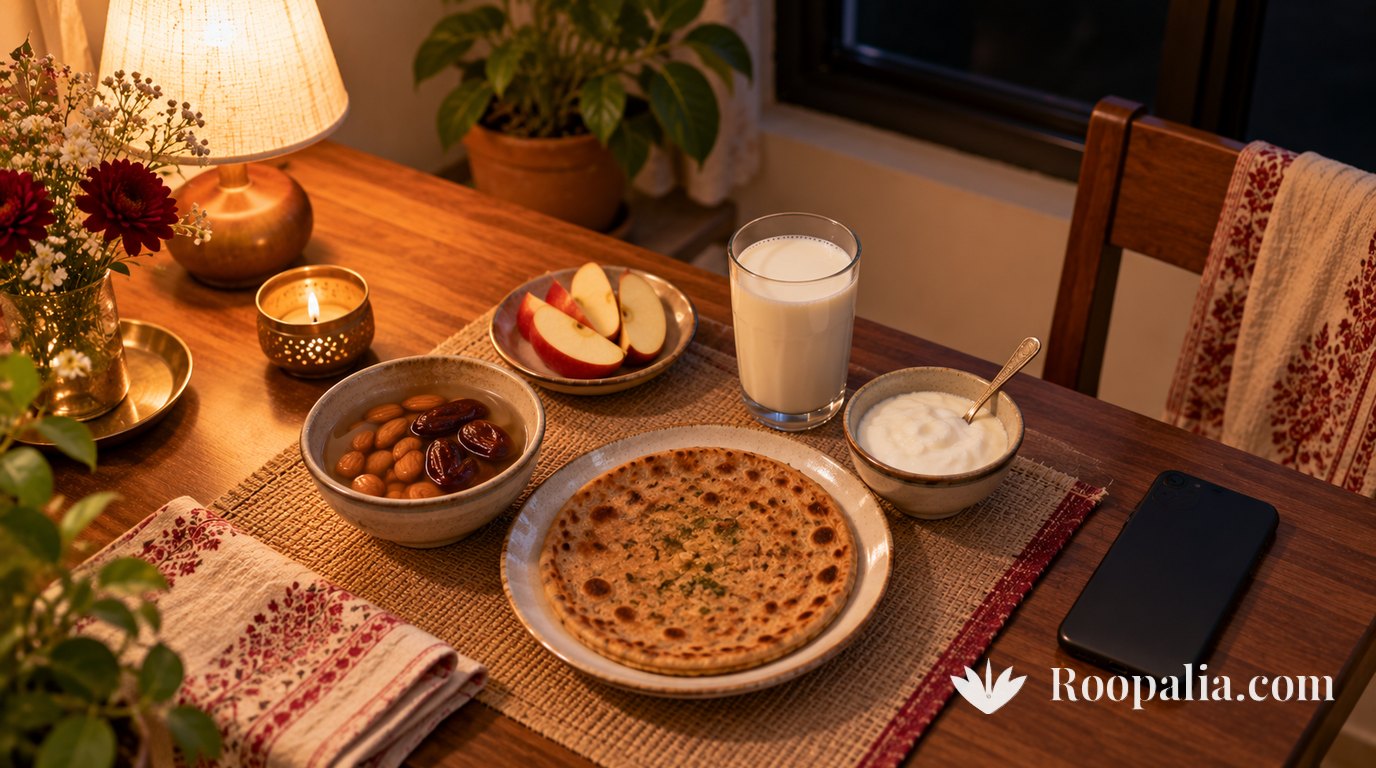
Sargi is the meal eaten before sunrise, and by custom the mother-in-law makes it and hands it over. It is a Punjabi and Haryanvi practice; large parts of India keep this fast with no sargi at all.
If nobody is making it for you: making it yourself takes nothing away from the fast. Sargi is a gift within the ritual, not a condition of it, and plenty of families now handle it with a bank transfer and a video call. What matters is what the meal has to do — carry you sixteen hours without water. So eat what lasts and does not make you thirsty.
| Eat | Why |
|---|---|
| Soaked almonds, walnuts, dates | Slow energy that holds through the afternoon |
| Curd or milk | Keeps fluid in you longer than water alone |
| A paratha with ghee | Fat delays hunger better than anything else |
| Apple, banana, coconut water | Water and potassium |
| A glass or two of water, slowly | Load up before sunrise, not in gulps |
| Skip: very salty, very sweet, fried, tea and coffee | All of them make the afternoon thirstier; caffeine actively drains you |
The coffee is the hardest to give up and the most important. A 4 a.m. flat white is a 2 p.m. headache.
Hour by hour, through a working day

Both dates fall mid-week — Wednesday the 28th in North America, Thursday the 29th everywhere else. Either way you are working. Print this and stick it on the fridge:
| When | What |
|---|---|
| The night before | Put every thali item in one place. Lay out what you are wearing. Set the sargi food on the counter. Set the alarm. |
| 4:00–4:30 a.m. | Sargi. Eat slowly. Sip water rather than downing it. |
| Before sunrise | Sankalpa — say in your head who the fast is for. The fast starts here. |
| 6:00–7:00 a.m. | Go back to sleep for an hour if you possibly can. Best decision of the day. |
| 9:00 a.m.–1:00 p.m. | Work. Put the demanding things here while you still have fuel. |
| 1:00–4:00 p.m. | The hard three hours. Keep meetings light, stay out of the sun, take twenty quiet minutes if you can. |
| 4:00–5:00 p.m. | Home. Bathe, change, set out the thali. |
| Your puja muhurat | Puja and katha. Check the muhurat for your own city on the link above. |
| 30 min before moonrise | Sieve, diya and water out on the balcony or by an east-facing window. Work out the spot in daylight, not in the dark. |
| Moonrise | Offer water, look through the sieve, break the fast. |
Three things that help at work. Keep the water bottle closed — an open one gets picked up without thinking. Skip the lunchroom and walk instead; watching people eat is worse than being hungry. And if the fast will run past your commute, as it does in Sydney, plan to be home before the light goes.
Then there is the question every first-timer asks and very few ask out loud.
Water, or no water — what the rule actually is
By custom this fast is kept nirjala — without food and without water, sunrise to moonrise.
But the strictest form has never been the only form. Tradition recognises three, and all three are valid:
| Form | What you may take | Who it is for |
|---|---|---|
| Nirjala | Nothing at all | Those in good health who have chosen it |
| Phalahar | Fruit, milk, water | Anyone for whom nirjala is too much |
| Ordinary upvas | One simple meal in the day | Illness, pregnancy, medication |
And this needs saying plainly: changing the fast on a doctor's advice does not break it. The tradition has a category for exactly this — apaddharma, the relaxation of a rule when circumstances make it impossible. (We looked for a verse on this tied specifically to Karwa Chauth and could not verify one with a chapter and verse, so treat it as the tradition's principle rather than a quoted shloka.)
What the fast turns on is the sankalpa, the intention. Not the thirst.
Who should not keep a nirjala fast
Read this even if you are sure it does not apply to you.
Dr Priyanka Deswal, consultant obstetrician and gynaecologist, in published advice on fasting during pregnancy:
“Dehydration can cause dizziness, fatigue, and even affect the baby’s health.”
“If you have any health issues, such as low blood pressure, gestational diabetes, or risk of preterm labour, fasting can be unsafe.”
— Dr Priyanka Deswal, quoted in India TV
Talk to your doctor first if any of these apply: pregnancy · breastfeeding · diabetes or gestational diabetes · low blood pressure · any regular medication, especially one taken with food · migraine · kidney trouble or stones · a recent illness or surgery.
If the answer is no, keep a phalahar fast instead. The merit is in the resolve, not in the suffering.
The thali, when you cannot find a karwa
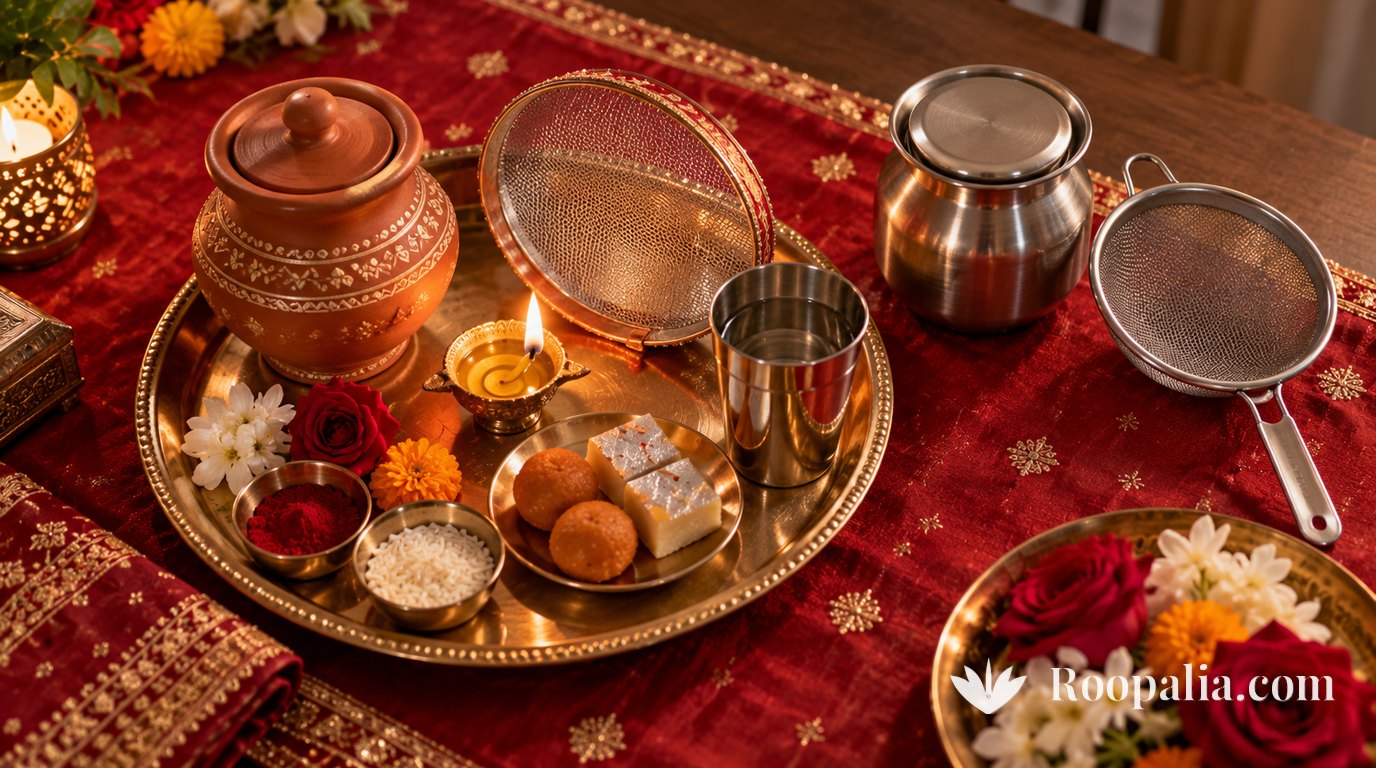
In Edison, Brampton or Wembley you will find everything in an Indian grocery from early October. Outside those pockets — most of Europe, most of small-town America — you will not. Here is what stands in:
| Traditional | Use instead | Why it holds |
|---|---|---|
| Clay karwa | A small steel or brass pot | The offering is the water; the vessel is secondary |
| Sieve | A fine kitchen strainer, or the weave of a dupatta | Looking through a dupatta is already accepted practice |
| Clay diya | Brass lamp, or a ghee tealight | The flame is the offering |
| Karwa Mata picture | An image on a tablet, propped on a stand | Worship before an image, where no murti exists, is long-standing |
| Roli | Turmeric with a pinch of slaked lime, or sandalwood | That is how kumkum has always been made |
| Marigold | Any fresh flower, or a few grains of rice | Akshat substitutes for any offering |
| Mathri, feni | Any home-made sweet | The food offered has always varied by region |
If this reasoning is new to you, our piece on puja at home when there is no temple nearby sets out where the tradition's permission for substitutes comes from.
The katha, and when to read it
In India the katha is usually a group event. Away from India it is often you, alone in a flat — and that is the part that stings, not the fasting.
When: during the puja muhurat, before moonrise.
How: bathe, wear clean clothes, sit facing east or north with the thali in front of you and a few grains of rice in your hand. Read or listen to the katha, then offer the rice.
Reading it alone is entirely valid. The requirement is shravana — hearing it. Reading aloud to yourself satisfies that, and so does listening to your mother read it over a video call, which is now how a great many households do it. The full story, and what it means, is in our Karwa Chauth katha and moonrise guide.
And then the moment the whole day has been pointing at — which, where you live, may not arrive.
If the moon does not show
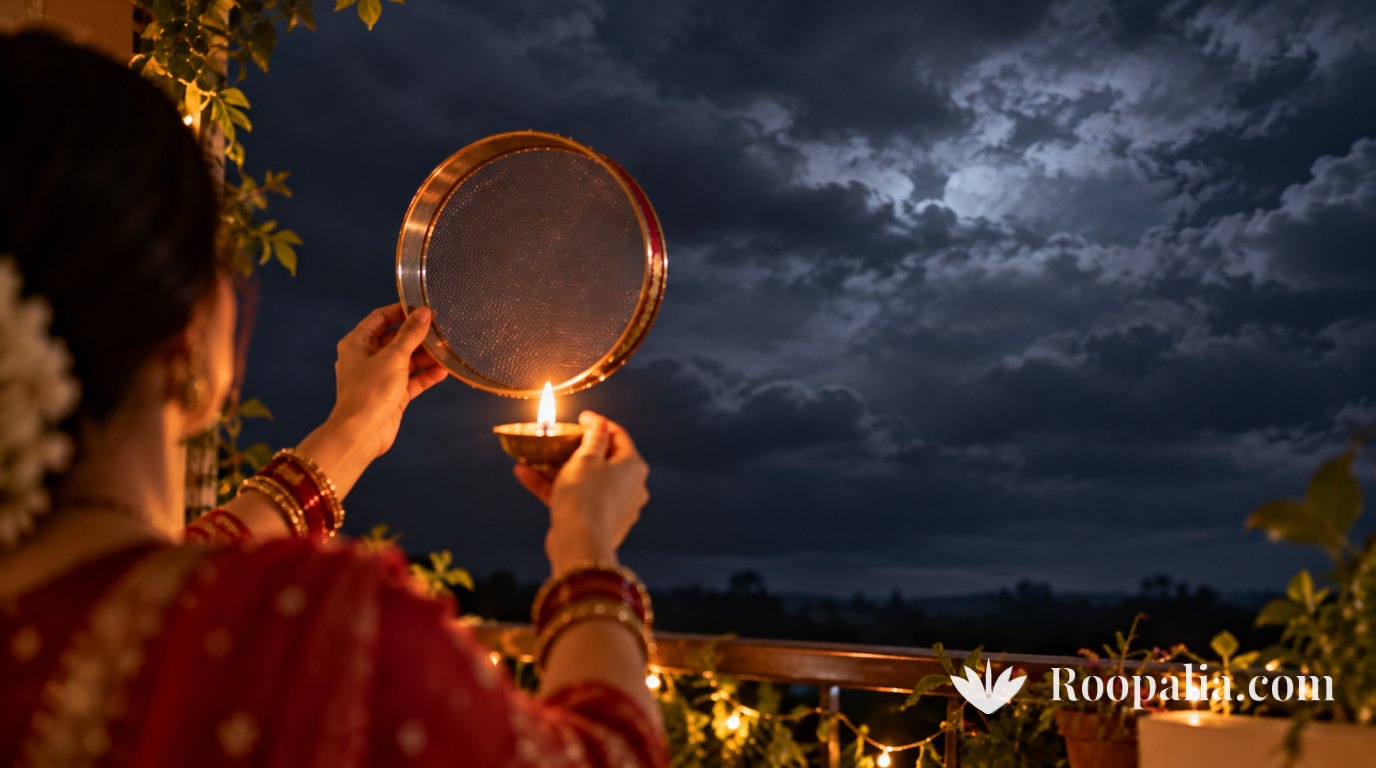
This is the section nobody writes for you, and in northern Europe and Canada it is the likeliest thing to go wrong. Look at what October actually is in Britain. Met Office records for London Heathrow show the month averaging 96.5 hours of sunshine across fifteen years (2011–2025) — about three hours a day, in a month with roughly ten hours of daylight. The worst of those years, 2020, managed 51.6 hours: an hour and a half a day. (Computed from the Met Office's published Heathrow station file; the averaging is ours, the monthly figures are theirs.)
So an overcast Karwa Chauth in London, Manchester, Toronto or Seattle is not bad luck. It is the ordinary weather. Plan for it.
- Wait fifteen or twenty minutes. The moon is usually late rather than absent, and cloud moves.
- Change position. Balcony to roof, front of the building to back. In a flat it is far more often the next building in the way than the sky.
- Check the direction. Open the compass on your phone and face east.
- Confirm the moon is actually up. You looked up your city's moonrise time in advance — if that hour has passed and there is nothing, it is cloud.
- If it still does not clear, offer the water towards where the moon is, complete the puja, and break the fast.
People hesitate at the last step, so here it is from somewhere other than us: India TV, writing on exactly this question, advises waiting for the cloud to shift, then looking for the moon's reflection in water or praying towards the direction of moonrise, and completing the puja and breaking the fast regardless.
What about seeing the moon on a video call? Couples separated by distance do this, and it is a real practice. We looked for a temple or priest who has formally ruled that a screen satisfies the sighting, and found none published. So it is a custom, not a ruling. If your family is comfortable with it, it is fine; if not, offering towards the direction is the older answer.
Breaking the fast
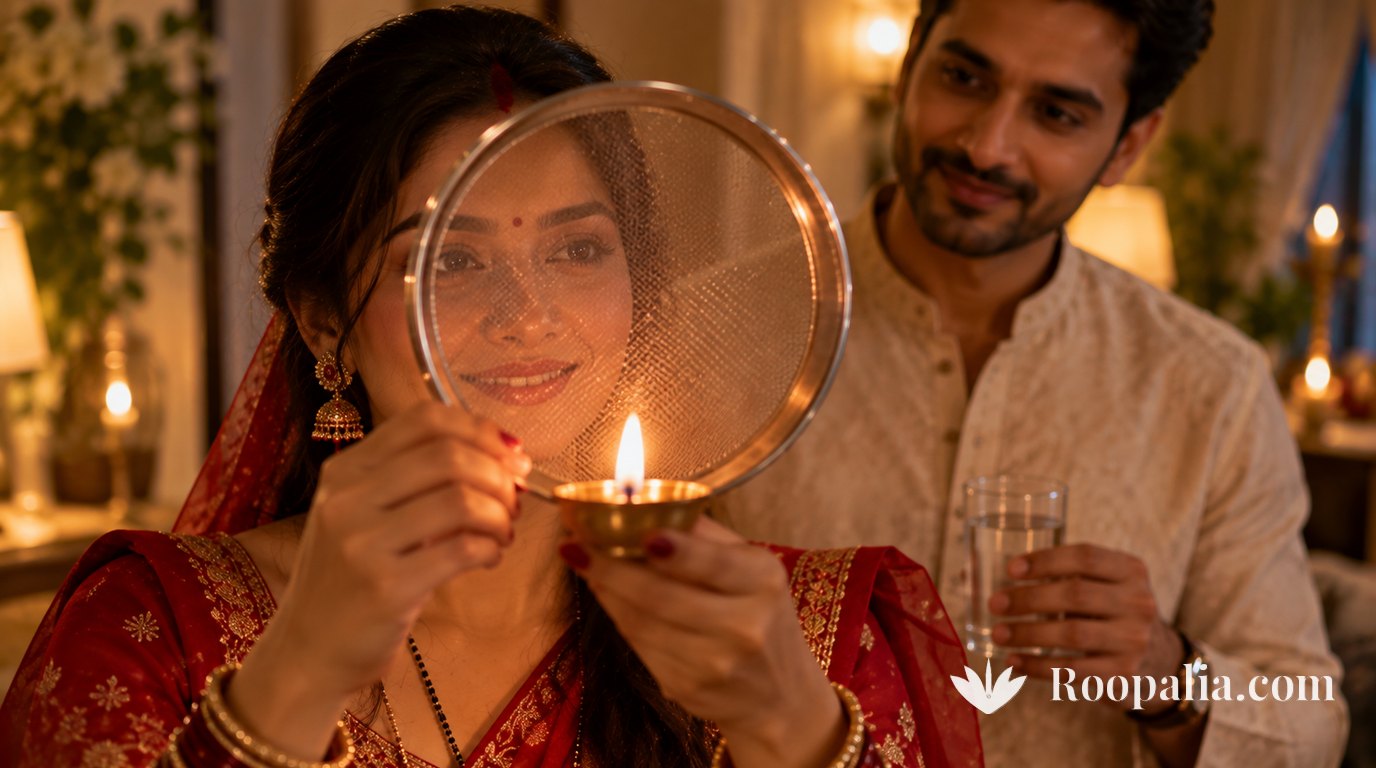
The order is: see the moon through the sieve, offer the water, turn and see your husband's face through the same sieve, and take the first sip from his hand.
Sip, do not gulp. A full glass after sixteen dry hours usually buys you nausea and a headache. Dr Deswal's advice on this is worth following exactly:
“When it’s time to break the fast, don’t reach for heavy or fried foods. Start with water or fresh juice, followed by light, homemade food, khichdi, daliya, or vegetable soup.”
— Dr Priyanka Deswal, India TV
Water, then something sweet, then a light meal. The puris can wait — and you have work in the morning.
If the people around you have no idea what this is
A full working day of fasting in an office where not one person knows the day exists. Nobody writes about this, and first-timers find it the hardest part.
You owe no one an explanation. If someone notices you skipping lunch, one line closes it: "I'm fasting today, I'll eat this evening." That is a complete answer, and it usually ends the conversation.
If you want to say more, say the smallest true thing: "It's a festival day — I fast from sunrise until the moon comes up, then we eat." Leave the theology out; most workplaces have someone who has kept Lent or Ramadan.
For a partner who did not grow up with this, the useful brief is practical rather than devotional: here is roughly when the moon comes up, I need you there for ten minutes, and you hand me the water. That is the whole job, and most partners are glad to be told plainly.
And it is worth knowing that the festival itself is moving. The Tribune reported in 2024 that "husbands are joining their wives for the day to go without any food or water" and that it is "now a pan-India festival with women in Bihar, Maharashtra and as far as Karnataka observing the fast". Through all of that, the same piece notes, "the evening katha has remained sacrosanct".
Which is the shape of the thing. The centre holds; everything arranged around it bends.
Check your own date before you do anything else — in North America it is most likely 28 October, in Britain, Europe and Australia the 29th. Look up your city's moonrise while you are at it and write it on a piece of paper.
After that it is a long day and a short ritual, and you will have done the hard part already.
Frequently asked questions
Is Karwa Chauth on a different date outside India?
How do I find the moonrise time for my city?
What is Karwa Chauth, in short?
What time does the fast start?
Can I drink water during Karwa Chauth?
What do I eat for sargi if nobody makes it for me?
Can I keep the fast while working a full day?
What if I cannot see the moon because of clouds?
Can I break the fast by seeing the moon on a video call?
What do I use if I cannot find a karwa?
Should I fast if I am pregnant?
Does a modified fast still count?
What if my workplace does not know what Karwa Chauth is?
Sources and cautions: every date, moonrise and puja muhurat was read off drikpanchang's own city pages on 22 September 2026 — New Delhi, London, Frankfurt, Sydney, New York and Toronto. The chandrodaya-vyapini rule is quoted from mypanchang. The London sunshine figure is our own average of the Met Office's published Heathrow station data for Octobers 2011–2025: the monthly figures are theirs, the averaging is ours. Health guidance is quoted from Dr Priyanka Deswal in India TV, and the note on changing practice from The Tribune, 20 October 2024. None of this is medical advice — if you are pregnant, diabetic, on regular medication or unwell, ask your doctor before keeping a waterless fast. Panchangs vary by a few minutes, so check your own city. Where we could not verify a scriptural citation, the article says so rather than inventing one.