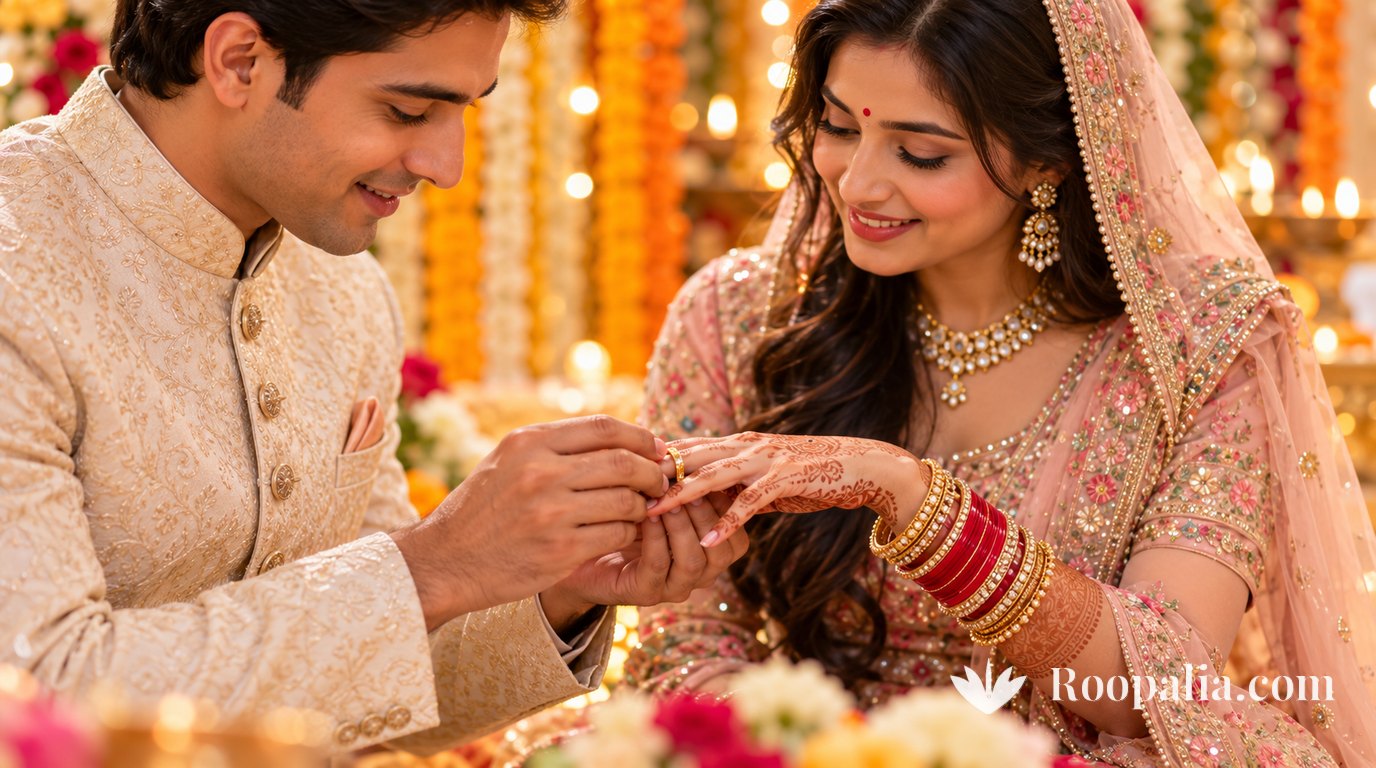
If you have been invited to a “tilak” and are not sure whether it is a puja, an engagement or a party, you are not alone. The word covers all three, depending on who you ask. Here is what actually happens, what to give, and how the ceremony has changed within a single lifetime.
Fifty years ago in a Rajasthan village, a tilak ended with a brass tray of golden country sugar and a crowd of children shouting for a fistful. Today it often takes five minutes on a banquet-hall stage. Why it shrank is one of the more surprising parts of this story — it comes near the end.
What is a tilak ceremony?
A tilak ceremony is a North Indian pre-wedding rite in which the bride’s family visits the groom’s home and marks his forehead with red roli and rice, then gives him a coconut, clothes, sweets and a cash gift to seal the match. It is the bride’s side publicly accepting him as their son-in-law. In many regions it is the engagement: Wikipedia’s Hindu wedding article lists “Tilak (engagement)” among North Indian customs. In Rajasthan and Haryana it is also called “tika”.
At a glance:
- Who: the bride’s side — usually her father, his elder brother or her brother.
- Where: traditionally the groom’s home; today often a banquet hall.
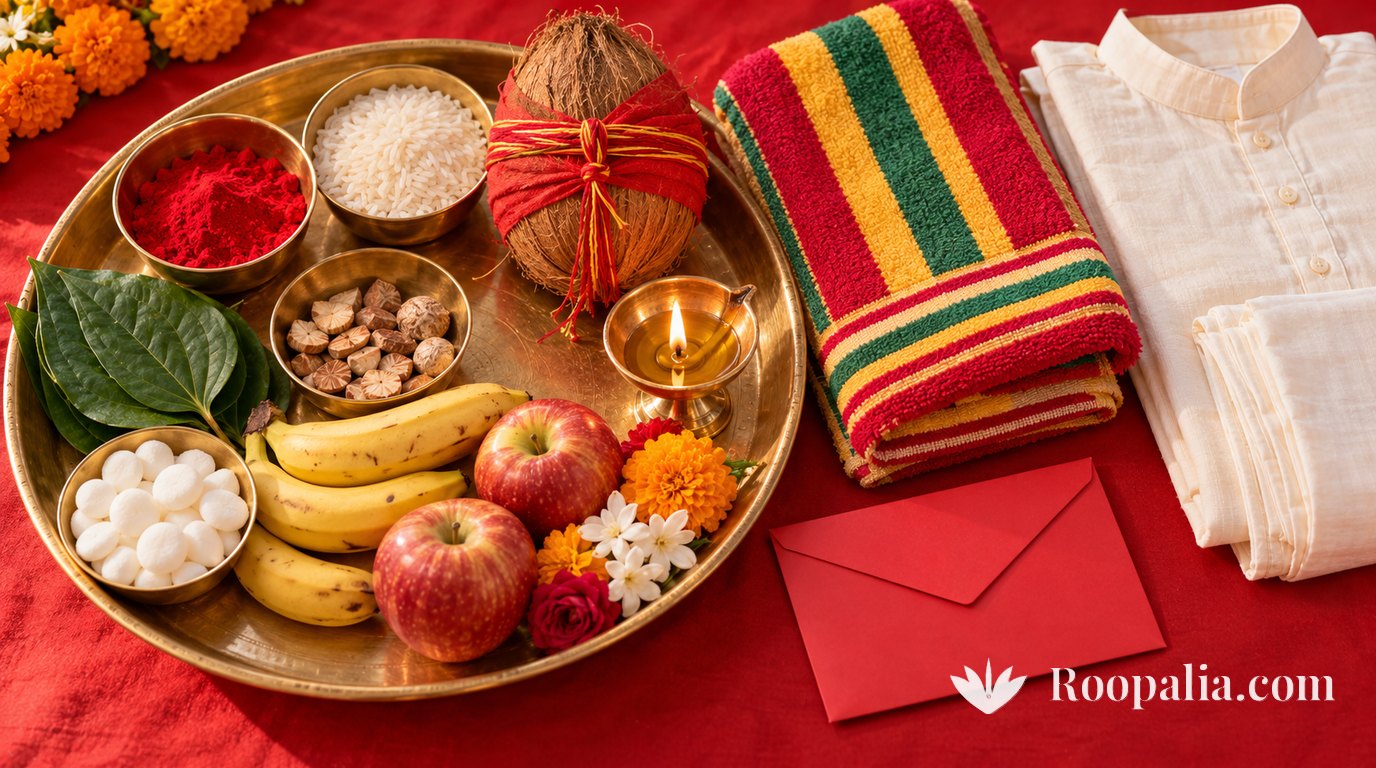
- What is given: roli and rice, a coconut tied with red thread, clothes for the groom, a coloured towel, sweets and cash.
- The other half: the groom’s side does godh bharai for the bride.
- Today’s order on one day: tilak first, then godh bharai, then the ring exchange.
What happens at a tilak ceremony, step by step
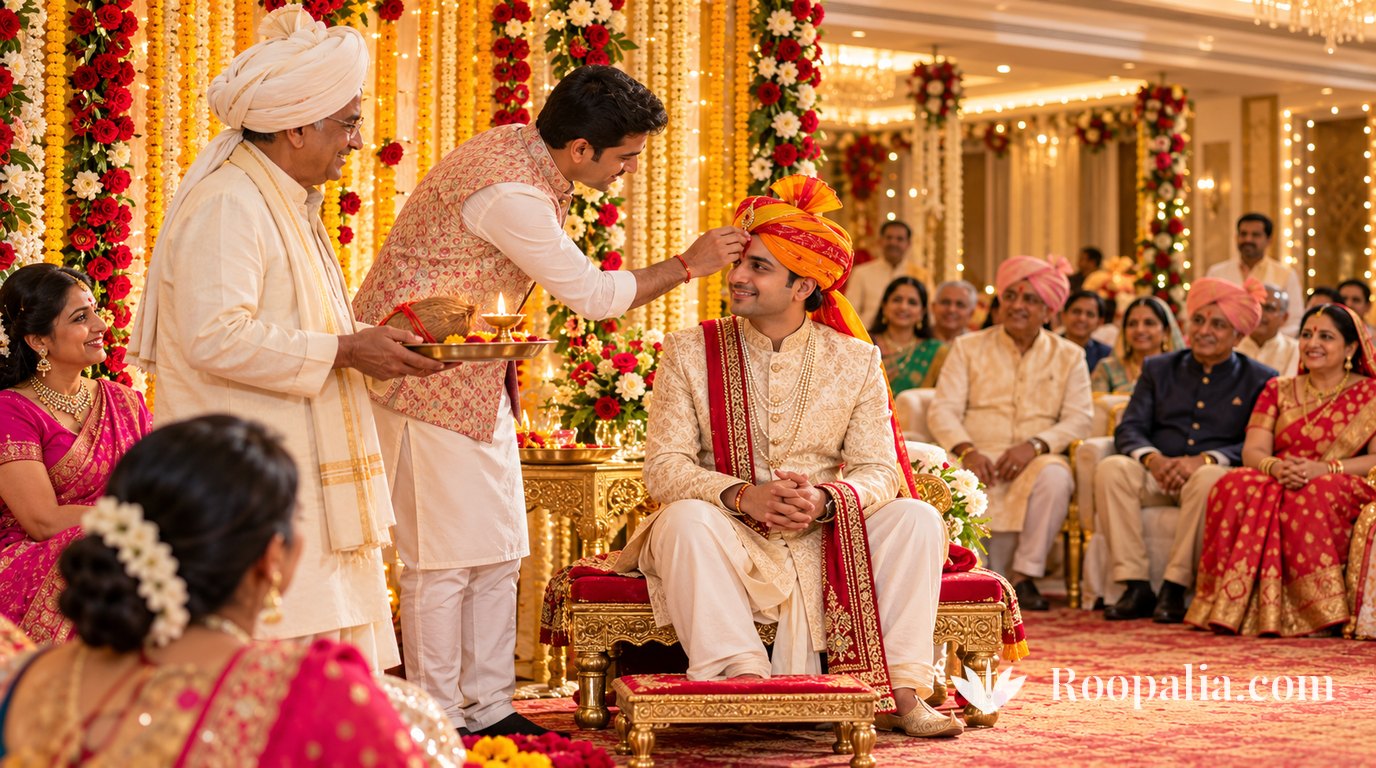
- The groom sits facing east on a low wooden seat, a coloured towel or turban on his head.
- A priest, if present, leads a short Ganesh puja and sankalp.
- An elder from the bride’s side applies a tilak of red roli with the thumb or ring finger and presses a few grains of rice onto it.
- A coconut tied with red mauli thread, clothes, sweets and a cash gift are placed in the groom’s hands.
- The groom touches the elders’ feet — the gesture explained in our piece on charan sparsh.
- Everyone’s mouth is sweetened, and sweets are shared.
What to give at a tilak ceremony
This is the question most guests and families search for. Items vary by community; below is what is usual in Rajasthan and Haryana.
| Item | Why |
|---|---|
| Roli (red kumkum) and rice | The tilak itself |
| Coconut tied with mauli thread | The knot of the match; handed over with cash |
| Coloured cotton towel | Placed on the groom’s head — traditionally bright and striped, not white |
| Clothes for the groom | Kurta-pyjama, or fabric for a sherwani or suit |
| Batashe (sugar drops) and sweets | To sweeten the occasion |
| Fruit, betel leaves and supari | For the puja plate |
| Cash in an envelope | Shagun — whatever the family can comfortably give |
| Turbans (safa) for the groom’s elders | A mark of respect in many families |
A word on cash. “The bigger the tika, the bigger the family’s name” was once the village rule. India’s Dowry Prohibition Act, 1961 draws the line clearly: according to a legal explainer on the iPleaders law blog, property given or agreed to be given “in connection with the marriage” — before, at or after it — counts as dowry, while presents given without any demand, of a customary kind and within the giver’s means, and recorded in a list, do not. Wikipedia’s Dowry Prohibition Act, 1961 page likewise notes that voluntary presents are not dowry. A shagun given with love is a gift; a sum demanded is not.
What to wear to a tilak ceremony
The groom usually wears a cream or pastel kurta or sherwani with a safa; the bride’s family dresses in festive Indian clothes. Guests can wear any Indian outfit — a saree, a suit or a kurta. Avoid all-black or all-white, which many families associate with mourning. Women attending a village tilak traditionally covered their heads; follow the hosts’ lead.
Roka vs sagai vs tilak vs godh bharai
| Rite | Who does it | Where | Meaning |
|---|---|---|---|
| Roka | Both families | Either home | The match is “stopped” — no more searching (a Punjabi word) |
| Tilak / tika | Bride’s side | Groom’s home | The bride’s family accepts the groom |
| Godh bharai (before marriage) | Women of the groom’s side | Bride’s home | The groom’s family accepts the bride |
| Sagai / ring ceremony | Bride and groom | Often one shared stage | Exchange of rings — the newest of the four |
Wikipedia’s Punjabi wedding traditions explains that roka means “to stop”. Is roka the same as engagement? In many families roka is a small home event and the sagai a larger function; in others both happen on the same day. Our guide to godh bharai before marriage covers the bride’s side in detail.
Tilak, godh bharai and ring on one day — the order
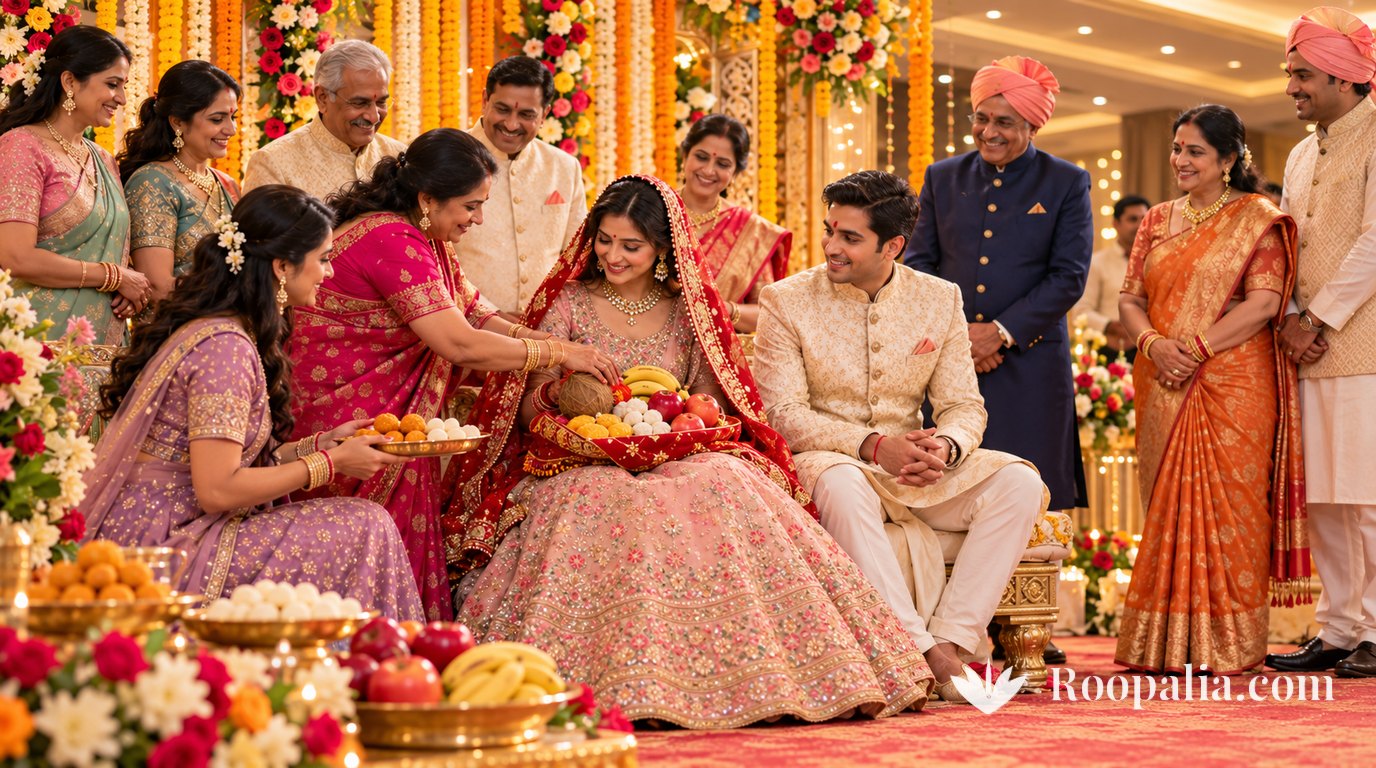
According to the experience of families in Rajasthan and Haryana, when both families meet in one hall the order is: tilak first, then godh bharai for the bride, and the ring exchange last, which completes the engagement.
Which hand does the engagement ring go on in an Indian engagement?
The engagement section of the Shankhayana Grihya Sutra that I checked in translation has no ring at all, so there is no scriptural rule for the hand. Today the ring usually goes on the ring finger — often the woman’s left hand and the man’s right — but many families use the same hand for both. Who goes first is custom too; in many families the groom places the ring first. Follow your family.
For the bride, a red bindi in the middle of the forehead is usual at an engagement, while sindoor in the hair parting is kept for after the wedding.
Holding a tilak and engagement outside India
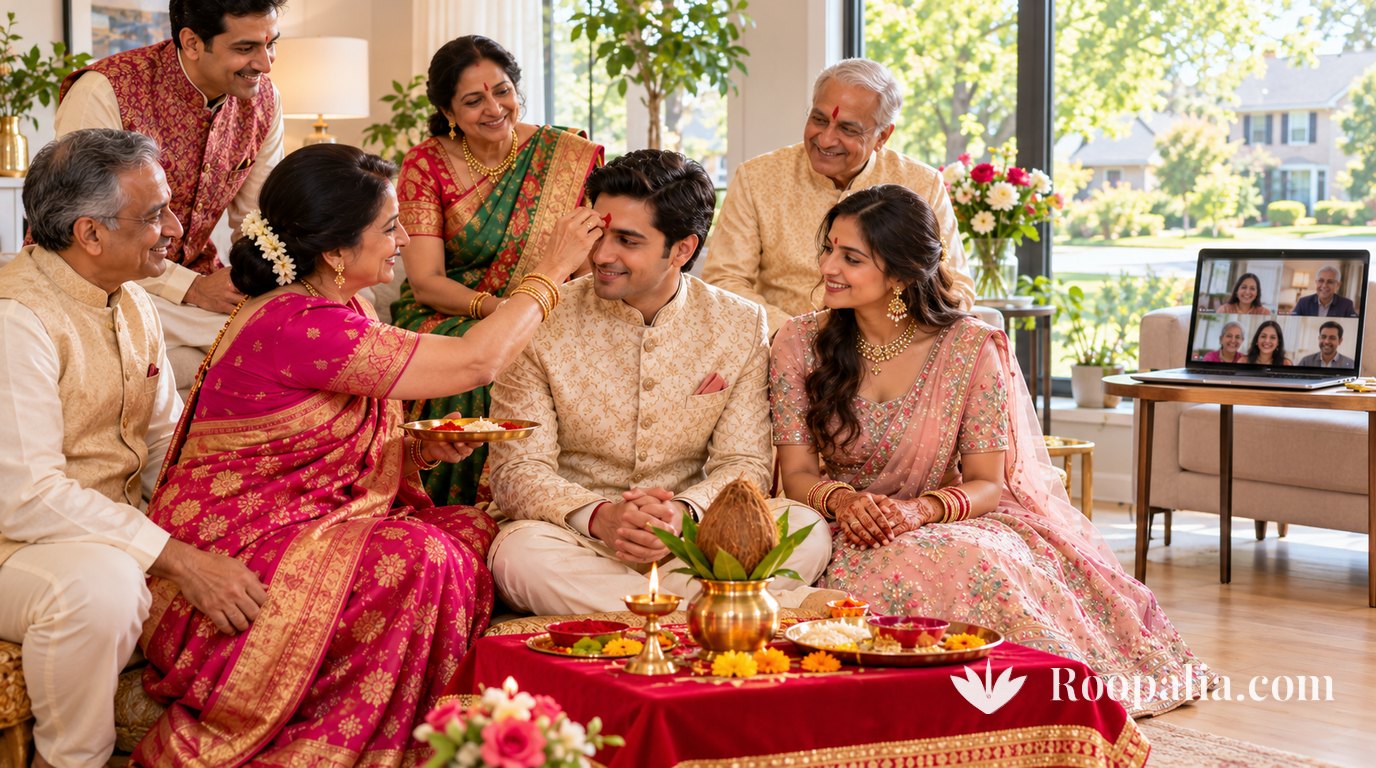
- Keep it at home: a red cloth, a plate with roli, rice, a diya and a coconut, and a kalash with mango leaves. Any elder from the bride’s side can apply the tilak; a priest is welcome but not essential.
- Bring India in by video: grandparents can watch and bless on a call.
- Mind the smoke alarm: in a rented flat, an LED diya does the job.
- Supplies: roli, mauli and coconuts are stocked by most Indian grocers.
For more on keeping rites at home, see puja at home without a temple nearby.
What the old texts say about engagement
The classical word for engagement is vagdana — the “gift by word”, the promise of a daughter in marriage (see the wisdomlib definition). I checked the Shankhayana Grihya Sutra, book 1, section 6, in Hermann Oldenberg’s translation (courtesy: sacred-texts.com):
- The groom sends his people to the girl’s father, carrying flowers, fruit, barley and a pot of water.
- They ask for the girl in marriage, reciting the clan names.
- If both sides agree, all touch a full vessel holding flowers, fried grain, fruit, barley and gold.
- The family’s teacher then places the vessel on the girl’s head, wishing her offspring, cattle and splendour.
Flowers, fruit, barley, gold: centuries later, much the same things fill a tilak or godh bharai plate. The word “tilak” and the ring are later, regional additions.
A village tilak, fifty years ago
From the author’s own memory of a village on the Rajasthan–Haryana side, as a boy of eleven: the tilak — called tika — was the biggest event before a wedding, held in daylight, with no ring ceremony at all. Five, seven or eleven men of the bride’s family arrived with clothes for the groom, a towel and batashe. A man from a particular village community went door to door with the invitation, and the whole village — men, women and children — gathered in the courtyard.
The groom sat on a wooden patta spread with a durrie while the priest chanted. The bride’s father or his elder brother applied the tilak, placed a bright striped towel on the groom’s head, and handed him a coconut tied with mauli along with cash; a fixed sum went on the plate. The larger the sum, the larger the “tika” — and villages remembered for years whose was the biggest.
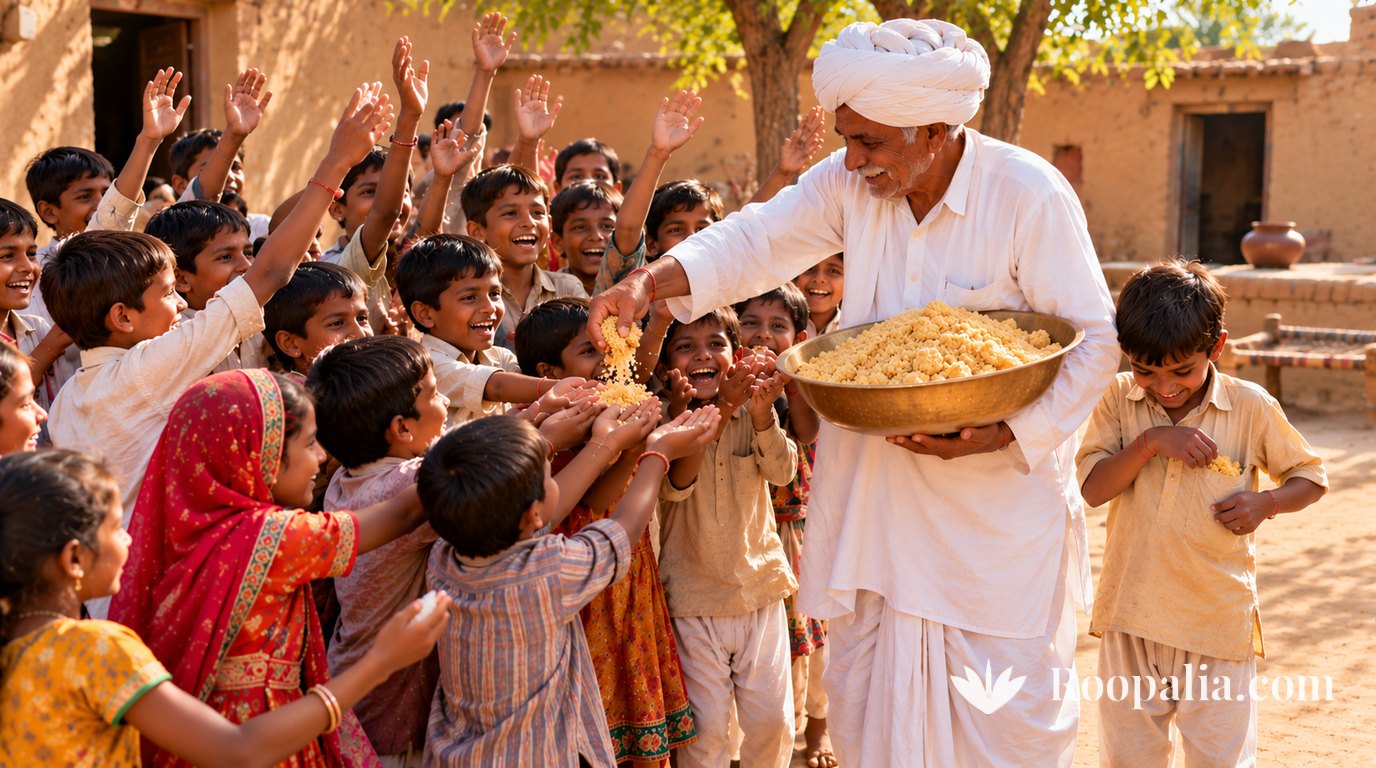
Then two or three men carried brass trays of pale golden country sugar — crumbly, with small unbroken lumps, nothing like white table sugar — and handed it out by the fistful. The children cared nothing for the size of the tika; the contest was who could get sugar the most times. “Tau, me first! Kaka, me first!” A boy would stuff his share into a pocket and rush back for more.
Why it changed. In the same families’ experience, the tika faded as the sex ratio worsened. With fewer girls than boys, the balance of the match shifted, and the bride’s family travelling with a large sum to the groom’s house gave way to godh bharai — the groom’s side visiting the bride — and then the ring ceremony. Some communities still keep the tika in full.
| Claim | Result |
|---|---|
| An engagement rite in the grihya sutras | Found — Shankhayana 1.6: the vessel of flowers, grain, fruit, barley and gold |
| “Tilak (engagement)” | Found — Wikipedia, Hindu wedding |
| A special mantra for the groom’s tilak | Not found in this section |
| A rule for the ring hand | Not found — modern custom |
| Voluntary gifts are not dowry | Found — Dowry Prohibition Act, as explained by iPleaders and Wikipedia |
The short version: A tilak is the bride’s family accepting the groom, just as godh bharai is the groom’s family accepting the bride; together, with the rings, they make the engagement. The old texts sealed a match with a vessel of flowers, fruit, barley and gold — the ring came much later. Give shagun with love and within your means, never on demand. And if you can, let the children have the sugar.
Disclaimer: This article is for educational purposes and general information. References have been checked against published translations and reliable sources, and customs vary by family and region — follow your elders or family priest. All images in this article are AI-generated as examples for illustration only; they do not show real people, places or events. It is not medical, legal or astrological advice.
Frequently asked questions
What is a tilak ceremony?
What do you give the groom at a tilak ceremony?
What is the difference between roka, sagai, tilak and godh bharai?
What happens at a Hindu engagement ceremony?
Which hand does the engagement ring go on in India?
What should you wear to a tilak ceremony?
Is money given at a tilak considered dowry?
How do you hold a tilak or engagement outside India?
Sources and cautions: sources consulted — Shankhayana Grihya Sutra 1.6 (The Grihya Sutras, Part 1, SBE 29, tr. Hermann Oldenberg, courtesy: sacred-texts.com); wisdomlib.org (Vagdana); Wikipedia (Hindu wedding; Punjabi wedding traditions; Dowry Prohibition Act, 1961); the dowry explanation from the iPleaders law blog, cited in words only. The village tilak, the sugar, the one-day order and the change after the sex ratio worsened are from the author’s own experience of families in Rajasthan and Haryana. Three things should be said plainly. First, a special mantra for the groom’s tilak and a scriptural rule for the ring hand were not found; that is the result of a search, not a final verdict. Second, every family and community keeps these rites differently. Third, the legal information is general information for educational purposes, not legal advice. No brand or shop is recommended.