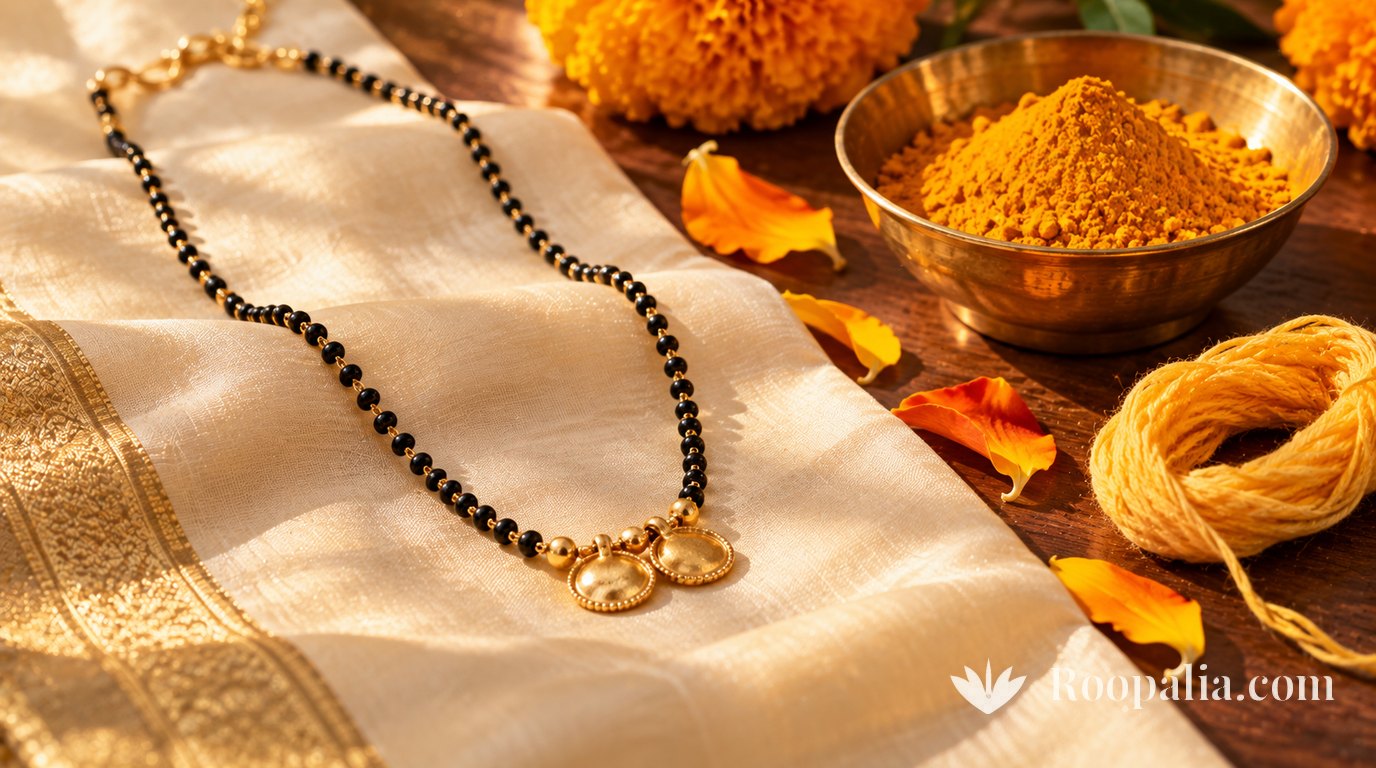
Here is a small thing worth noticing before anything else. Search for what a mangalsutra means and count how many of the first ten results belong to somebody who sells them.
It will be most of them. Often all of them.
That is not a scandal — jewellers are entitled to write about jewellery. But it does explain why the same four sentences appear on every page, why none of them carries a chapter and verse, and why an object at the centre of hundreds of millions of lives has an origin story that nobody seems to have checked.
So this piece checks it. Not to debunk anything — what I found made the mangalsutra more interesting, not less — but because a thing this loved deserves an accurate account of itself.
What a Vedic wedding actually contained
Start with the obvious place. The Ashvalayana Grihya Sutra is among the most authoritative manuals of Vedic domestic ritual, and its first chapter sets out a wedding step by step.
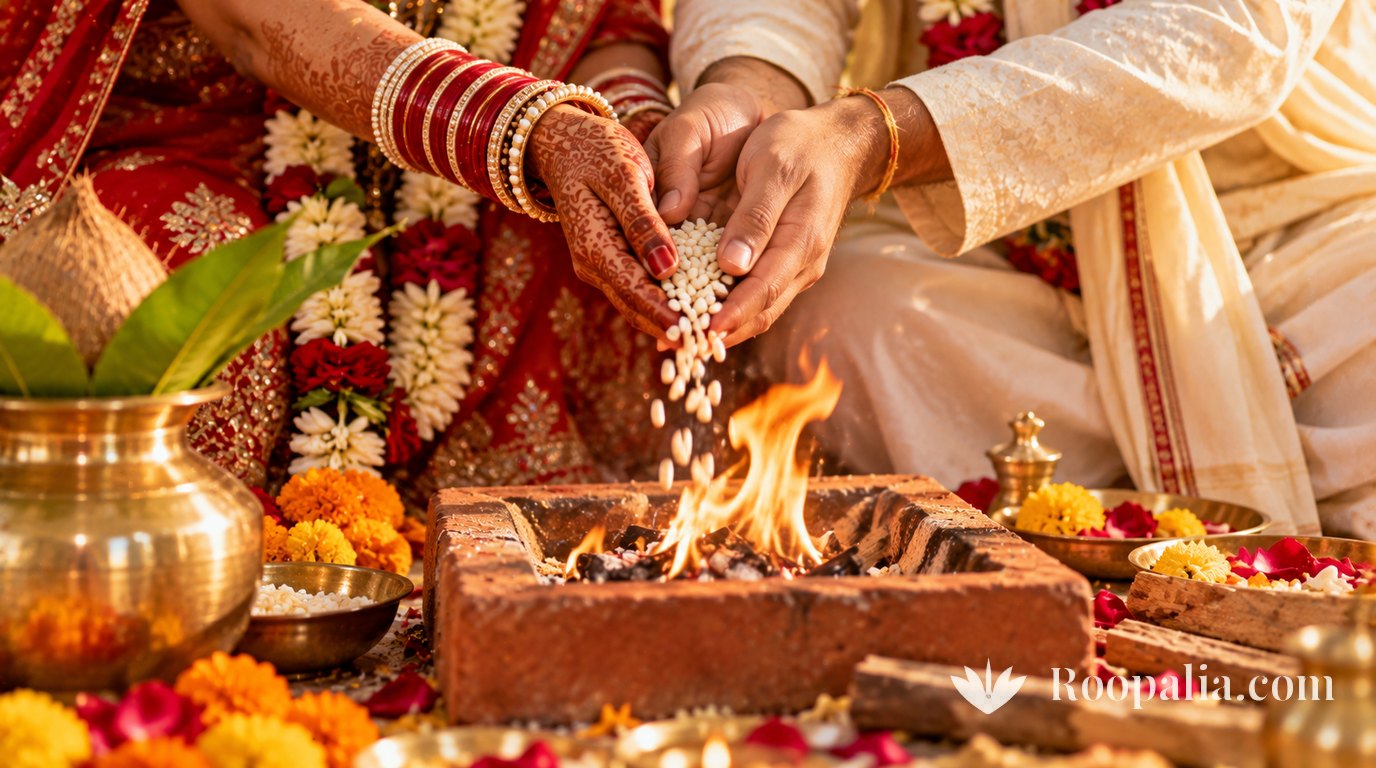
The groom takes the bride's hand — “I seize thy hand for the sake of happiness.” Three circuits of the fire and the water pot, with the bride treading on a stone after each. Fried grain poured into her joined hands and falling into the flame. Two tufts of wool bound in her hair are then loosened. Seven steps towards the north-east. A vow spoken while looking at the pole star.
Nowhere in that sequence is anything tied around her neck.
No cord, no chain, no pendant, no thread. The one thing in the whole ceremony that arrives already tied — those two tufts of wool — is deliberately untied during the rite.
This is not an interpretation. It is a list, and anyone can read it.
Which leaves an obvious problem. If the mangalsutra is not in the oldest manual of Hindu marriage, where did three thousand years of authority come from?
The thread that is genuinely ancient
From the thread. Just not from the necklace.
Rigveda 10.85 is the Surya Sukta, the bridal hymn, and it is still the source of wedding mantras today. Verse 28, in Griffith's translation:
“Her hue is blue and red: the fiend who clingeth close is driven off.
Well thrive the kinsmen of this bride; the husband is bound fast in bonds.”
Rigveda 10.85.28
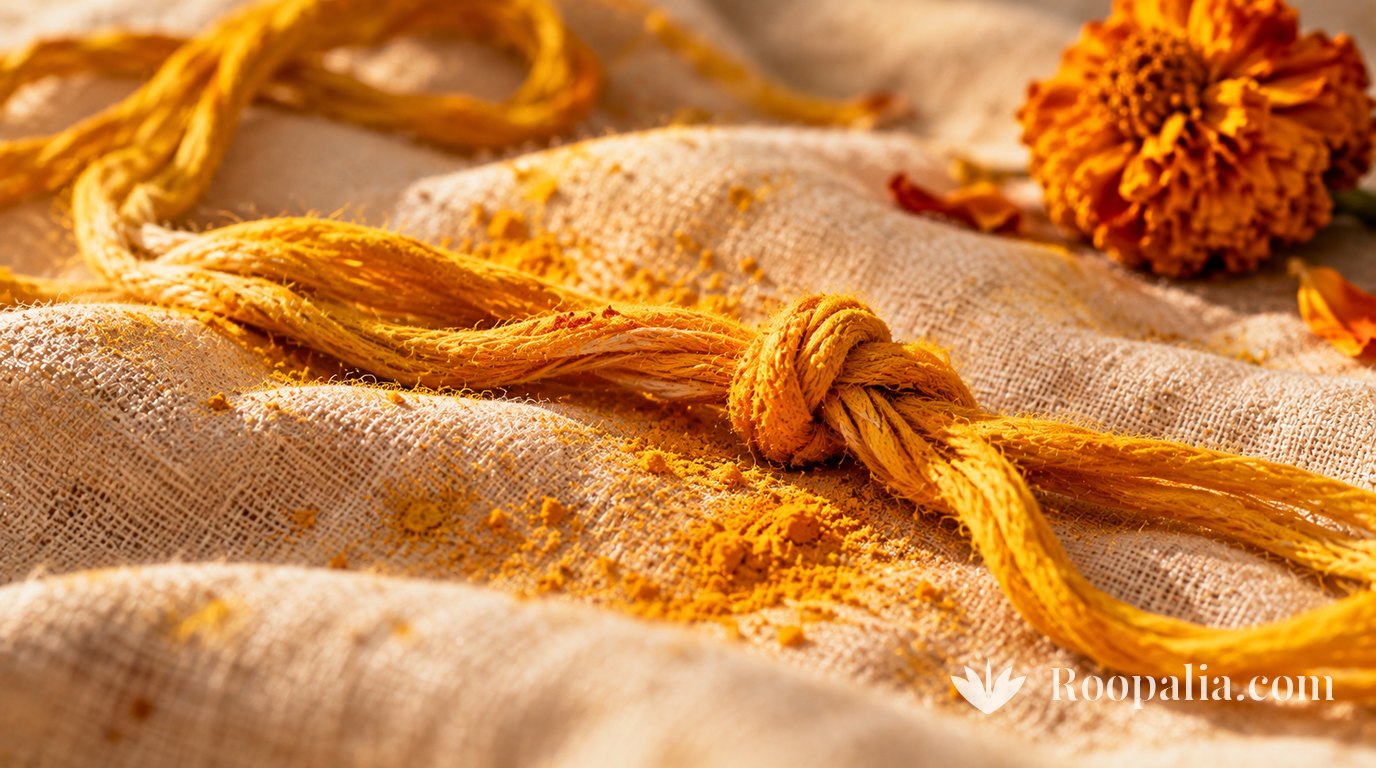
The blue-and-red being described is the ritual thread that Sanskrit texts call kautuka or pratisara — a protective cord tied at weddings, which also appears in the Atharvaveda at 2.11. It was tied on the bride, on the groom, and on objects in the house. Its job was apotropaic: to keep something away.
So the honest summary is not that the mangalsutra is a modern invention. It is this:
The thread is Vedic. The necklace is not. What hangs around a married woman's neck today is a very late descendant of an old protective cord — one that acquired gold, beads, weight and a price. The word sutra still means thread, even on pieces that no longer contain one.
Notice, too, who is being bound in that verse. Not the bride.
The mantra everybody recites, and nobody can place
At the moment the knot is tied, one verse is spoken:
माङ्गल्यं तन्तुनानेन मम जीवन हेतुना।
कण्ठे बध्नामि सुभगे त्वं जीव शरदः शतम्॥
The mangalya dharanam verse
“With this auspicious thread, which is the means of my life, I bind it about your neck. O fortunate one, may you live a hundred autumns.”
I could not find it in any Veda or any Grihya Sutra.
The most careful treatment I found comes from a traditionalist writer, Jayasree Saranathan, whose series on Vedic marriage argues that the śruti-sanctioned wedding has five parts — the search for bride and groom, panigrahana, the principal homa, saptapadi, and laja homa. On her reading, kanyadana and mangalya dharanam are both later additions, the verse traces to the Vayu Purana, and the practice is roughly a thousand years old.
That verdict is worth weighing precisely because of where it comes from. It is not a sceptic dismissing ritual from outside; it is someone working within the tradition, reading its own texts, and reporting what is and is not there.
A thousand years is not nothing. Most of what any of us calls heritage is younger.
It began as a piece of string
The trail runs south. Purananuru, a Sangam-era Tamil text, refers to a marriage tali worn by women of the Ay country. The phrase mangalya sutra turns up in the Lalita Sahasranama, though its dating is contested enough that I would not rest an argument on it.
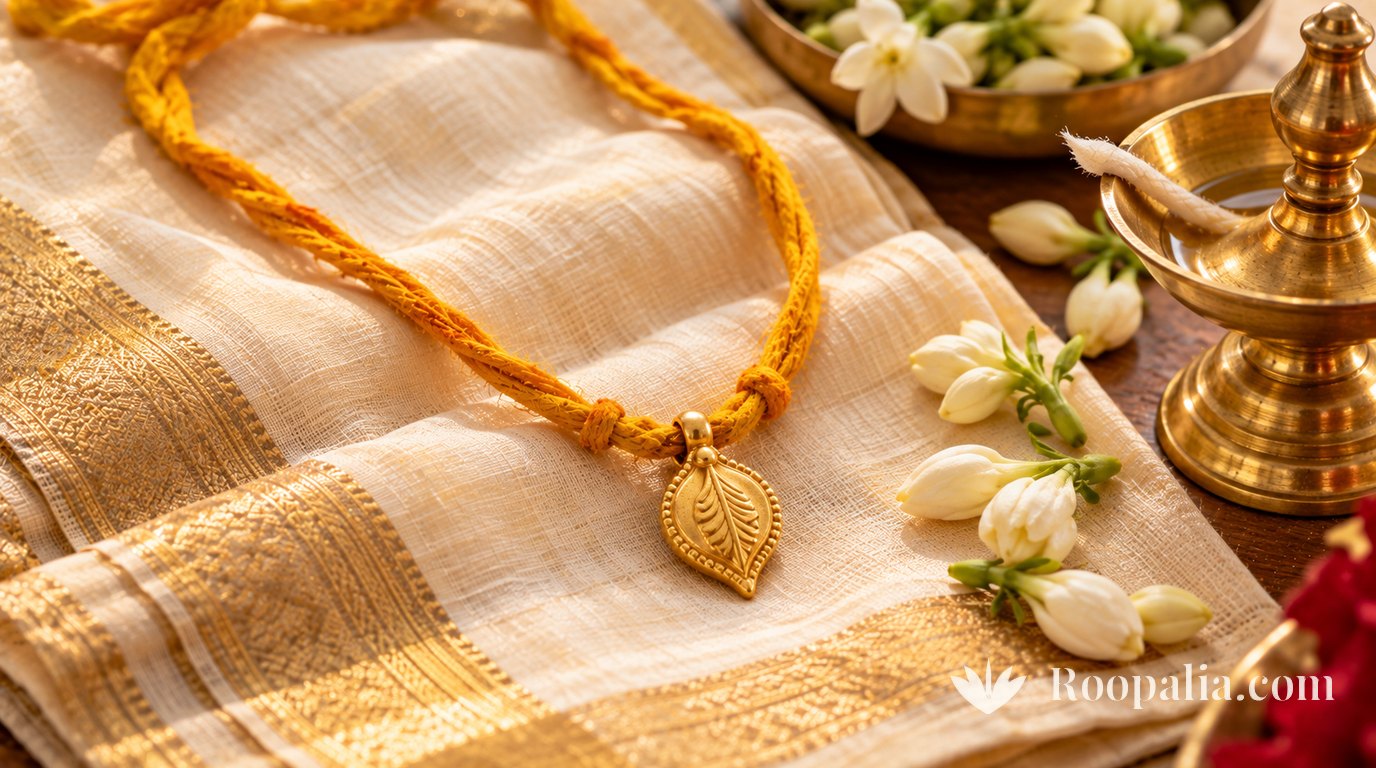
The description that tells you most is a sixth-century one, and it is startlingly plain. What was tied around the bride's neck was a single yellow thread, dyed with turmeric.
No gold. No beads. No pendant. String and a kitchen spice.
Sit with that for a second, because of what it implies. If the original mangalsutra was turmeric-dyed cotton, then for most of its history this symbol cost nothing at all. The poorest bride in the village had one as complete as the richest. There was no version to envy and no version to fall short of.
Everything that now causes anxiety around it — the weight in grams, the design, the comparison at a wedding — arrived with the gold, and the gold arrived late.
Traces of the older object survive. In much of Tamil Nadu the thali still hangs on a turmeric-yellow cord rather than a chain, and in many households that cord is replaced every year as a matter of routine. The gold stays; the thread is understood to be temporary.
The map nobody draws
Now the part that surprises Indian readers as often as foreign ones.
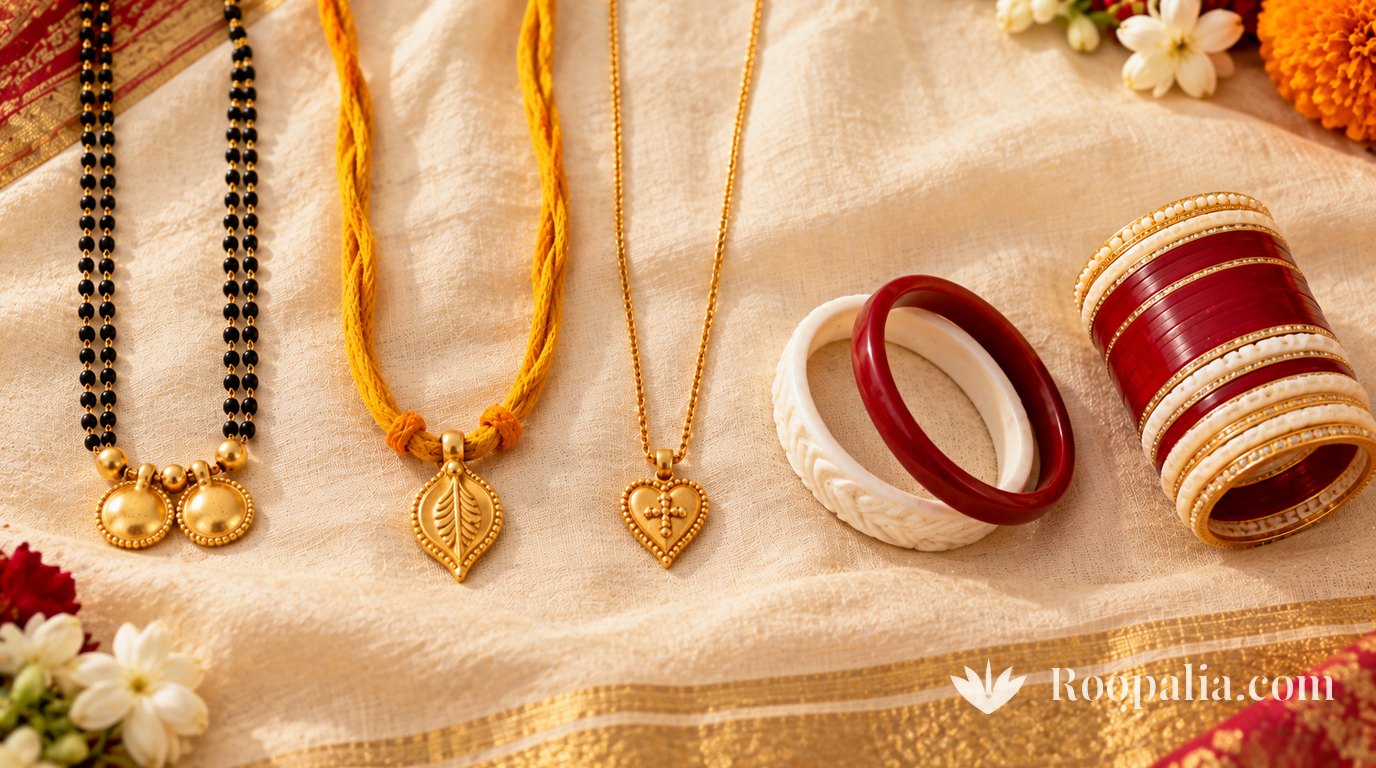
The mangalsutra was never a pan-Indian custom. It belonged to the south and to Maharashtra. Across the north and the east, a married woman was recognised by something else entirely.
In Bengal, shakha and pola — a white conch bangle and a red coral one — with sindoor. In Punjab, the red-and-ivory chooda. Across much of the north, sindoor and toe rings. Bangles carry their own long tradition with no connection to the mangalsutra at all.
| Region | Name | Form |
|---|---|---|
| Tamil Nadu | Thali · Thirumangalyam | Gold pendant on a turmeric-dyed cord |
| Karnataka | Mangalya sutra · Tali | Usually a single cupped disc |
| Andhra & Telangana | Mangalyamu · Pustelu | Two gold discs |
| Maharashtra | Mangalsutra | Two cups, two strands of black beads |
| Kerala | Minnu · Ela tali | Leaf-shaped pendant |
| Bengal | — | No mangalsutra — shakha, pola, loha and sindoor |
| Punjab | — | No mangalsutra — chooda and kalire |
How did it travel north? Not by decree. Reporting in Open magazine ties its spread to the later twentieth century and gives a substantial share of the credit to television serials — and notes a 2013 observation that some Muslim women in India and Pakistan had taken to wearing one too.
A custom that spread by television is still a custom. But it is worth knowing when someone tells a young bride that this is how it has always been done here. In a great many houses, "always" means since about 1995.
One thread, more than one religion
The most moving thing I came across has nothing to do with Hinduism.
In Kerala, Syrian Christian weddings also tie a tali. Theirs is called a minnu — a small heart-shaped gold pendant with a cross picked out in raised dots.
The pendant is not the interesting part. The cord is.
It is made from twenty-one threads drawn out of the manthrakodi, the wedding sari itself, twisted into seven groups of three. The seven stand for the bride, the groom, both sets of parents, and the Church. It is worn for three days, and only then replaced with a gold chain.
Which means that for three days in a Kerala Christian household, the object at a bride's throat is the same object that was there in a sixth-century Hindu wedding: a piece of thread. The prayers changed. The scripture changed. The thread stayed.
It is a useful corrective to a common assumption. The tali is a South Indian cultural form, not the property of a single religion — and the people who kept its oldest shape alive were, in this case, Christians.
The black beads have no scripture behind them
Now the detail everyone asks about.
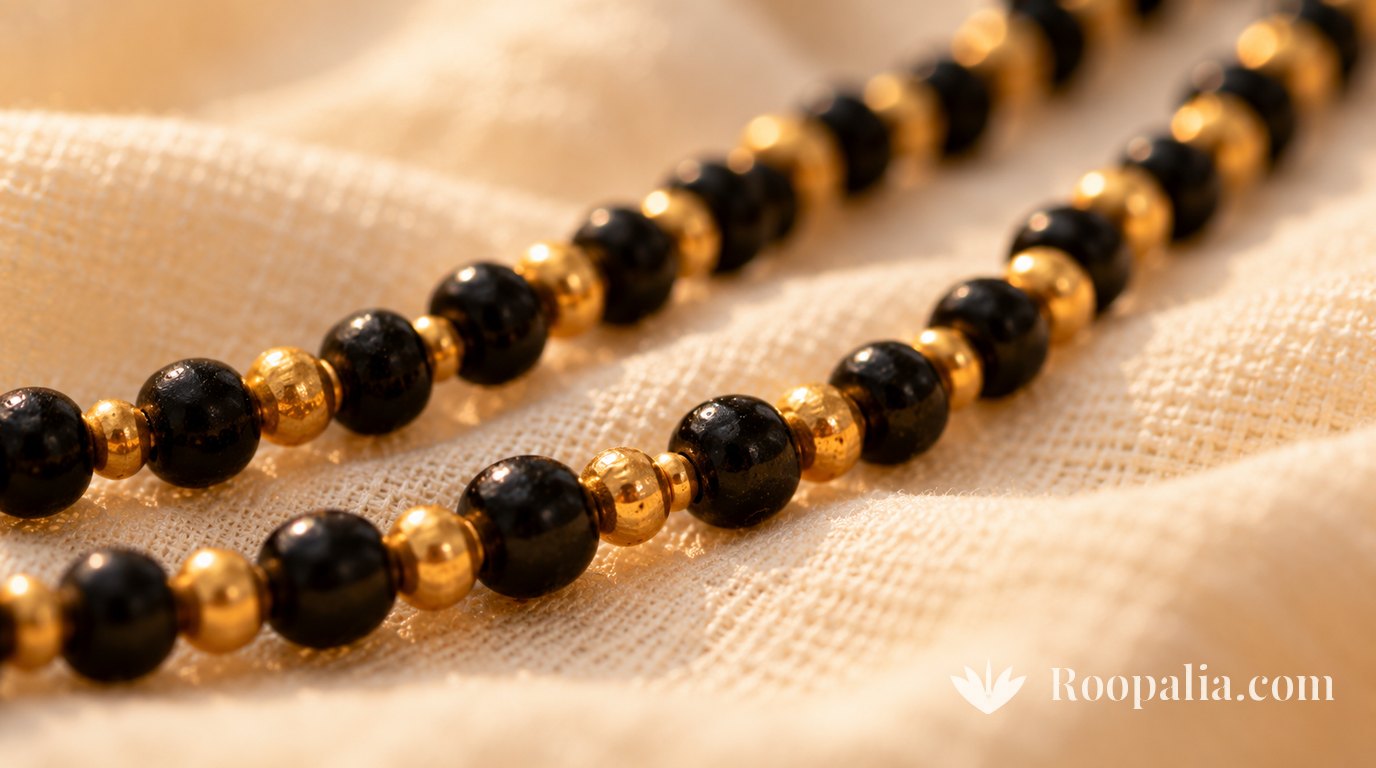
Every page will tell you the black beads ward off the evil eye and absorb negative energy. I went looking for the textual basis. There is none I could find — not in the Vedas, not in the Grihya Sutras, not in the Smritis. The claim is asserted everywhere and sourced nowhere.
This does not make it false. It makes it folklore, which is a different thing and not a lesser one. Protection against the evil eye is among the most alive of Indian practices — the smear of kajal on a baby's temple, the lemon and chillies over a shop door, the black thread on a new car. Millions of people mean it sincerely.
What is worth resisting is the upgrade. Calling a folk belief a folk belief costs nothing; dressing it as scripture is what does the damage, because it makes a warm human habit into a rule that someone can be judged against.
And there is a genuine puzzle inside it that the jewellery pages never raise. Black is avoided in Hindu auspicious contexts — no black at weddings, no black at pujas. So why put it at the centre of the most auspicious object a woman owns?
The most coherent answer is not scriptural but structural: you use the inauspicious to guard the auspicious. It is the same logic as the black dot on the cheek of a beautiful child. Beauty attracts the eye, so you introduce a deliberate flaw. Read that way, the black beads are not decoration at all. They are a line of small deliberate shadows set into the gold.
Gold, and the question of who owns it
Here is the section I would most like men to read.
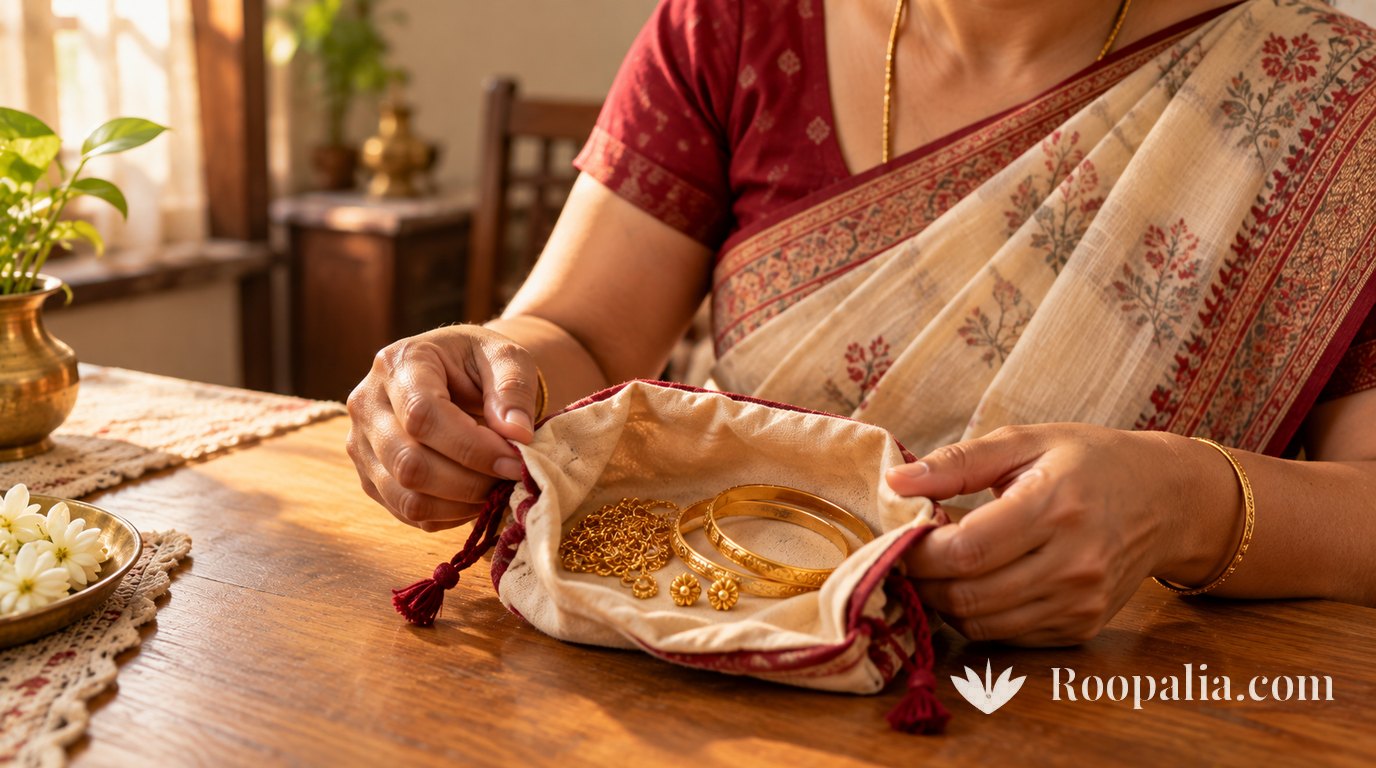
Manusmriti 9.194 defines six kinds of stridhana, a woman's own property: what was given before the fire, what was given at the time of her departure, what was given in affection, and what came from her brother, her mother and her father.
The commentarial tradition is unambiguous about what follows: neither her husband, nor her sons, nor her brother-in-law, nor her husband's kinsmen have any right over her stridhana.
A mangalsutra is given before the fire. By definition, therefore, it is hers.
Not the family's. Not the household's. Not an asset the in-laws are safeguarding on her behalf. And this is not a historical curiosity — stridhan survives as a live concept in Indian property law, which is why the question surfaces in court whenever a marriage ends badly.
It also explains the gold in practical terms. Gold does not spoil, is recognised everywhere, and converts to cash in an afternoon. In a society where land rarely stood in a woman's name, the weight at her throat was frequently the only capital she independently controlled. It was ornament and insurance at once, and the second function was not the lesser one.
So when a woman is told that her mangalsutra is "family gold", the correct reply is roughly three thousand years old, and it is written in the same texts usually quoted at her.
What the courts have decided — in both directions
A symbol becomes something else once it enters evidence, and this one has.
In 2026 the Madurai bench of the Madras High Court held in V v. C (C.M.S.A(MD) No. 44 of 2021, Justice P Vadamalai) that a wife's removal of the thali reflected mental cruelty, and upheld a decree of divorce. A Division Bench of the same court had earlier gone further, calling removal during the husband's lifetime “mental cruelty of the highest order.”
Other courts have gone the other way, holding that a woman's refusal to wear one is not by itself a ground for divorce.
Both can be true at once, because judgments turn on the facts in front of them and not on the object in the abstract. The practical point for a reader is that no general rule should be extracted from either — this is reporting, not legal advice, and an individual situation needs a lawyer rather than an article.
What the litigation does reveal is how much weight this thread carries in Indian life. It is not measured in grams.
Why there is no version for men
The question is being asked openly now, and dodging it would be dishonest.

The plain fact is that the entire system of visible marital marking is close to one-sided. Sindoor, mangalsutra, toe rings, chooda, shakha-pola — all of it sits on the wife. No region has maintained an equivalent obligation for husbands.
Which returns us to that line from the oldest wedding hymn in the tradition: the husband is bound fast in bonds. In Rigveda 10.85.28 the person described as bound is the man. The visible sign migrated to the woman somewhere in the intervening three thousand years, and no text I could find records the decision.
Some couples now wear rings together; in some households the husband has taken to wearing something of his own. Whether that is an improvement is not for an article to rule on. It is enough to note that the asymmetry is real, that it is not commanded by the oldest sources, and that it is a fair question to ask.
And perhaps that is the right place to leave it. Of everything the mangalsutra has been — a turmeric-dyed string, a Tamil pendant, a Maharashtrian pair of cups, a Christian cross on a sari-thread cord, a court exhibit, an item of property — the one constant across fifteen centuries is not the gold and not the beads. It is the thread: cheap, ordinary, available in every house, and belonging to whoever wears it. Alongside the rest of the solah shringar, it has outlived every explanation anyone has offered for it.
This article has been prepared for educational purposes. The information in it has been drawn from a range of sources — classical texts, published scholarship, news reporting and court judgments — which were studied and compiled into this account. Every source is listed at the end. Where a widely repeated belief has no textual basis, that is stated plainly rather than glossed over. This is not religious, legal or financial advice.
Frequently asked questions
Is the mangalsutra mentioned in the Vedas?
What did the first mangalsutra actually look like?
Who legally owns a woman’s mangalsutra in India?
Why are the beads black, and does any scripture say so?
Why do South Indian and North Indian mangalsutras look so different?
Do non-Hindus wear a tali?
Can refusing to wear a mangalsutra end a marriage in law?
Why is there no equivalent of a mangalsutra for men?
Sources
- Ashvalayana Grihya Sutra 1.7 — the full marriage sequence: panigrahana, circumambulation, stone-treading, laja homa, saptapadi, pole-star vow
- Ashvalayana Grihya Sutra 1.6 — the eight forms of marriage
- Rigveda 10.85.28 — Sanskrit text with Wilson’s translation
- Rigveda 10.85 — Griffith’s translation of the Surya Sukta
- Manusmriti 9.194 — the six kinds of stridhana, with commentary
- Mangalasutra — Purananuru, Lalita Sahasranama and the sixth-century turmeric thread; regional names and forms
- Kautuka — the ritual protection thread, citing Rigveda 10.85.28 and Atharvaveda 2.11
- Jayasree Saranathan, Maangalya dhaaraNam — the five śruti-sanctioned parts of marriage, and the Vayu Purana attribution of the mangalya verse
- LiveLaw — V v. C, 2026 LiveLaw (Mad) 228, C.M.S.A(MD) No. 44 of 2021, Justice P Vadamalai
- Bar and Bench — the earlier Madras High Court Division Bench ruling
- Open magazine — The Mangalsutra: Chained to Tradition — the custom’s spread in North India and the role of television serials
- Nasrani Syrian Christians of Kerala — the minnu, the manthrakodi and the twenty-one-thread cord
This article describes tradition and what the texts record. It does not tell anyone what to wear — that decision belongs to each woman and each family. The court rulings described here are based on news reporting and are not legal advice. No brand, shop or product is recommended anywhere in this article, and it contains no affiliate links.