Can you buy bangles on Wednesday, Tuesday or Saturday?
Here is what the common beliefs say, day by day. I looked for the source of these rules; the pages I found were mostly astrology blogs and jewellers’ articles, and none of them cited a text. So read this table as custom, not commandment.
If you want one safe answer, buy on a Friday. If your mother or mother-in-law follows a different day, follow hers; that is the rule that matters in your home.
How many bangles should a married woman wear?
There is no fixed number. What families usually follow:
- Never a bare wrist. At least one bangle or a kada on each hand.
- Odd numbers such as 7, 9, 11 or 21 are preferred in many homes, though not everywhere.
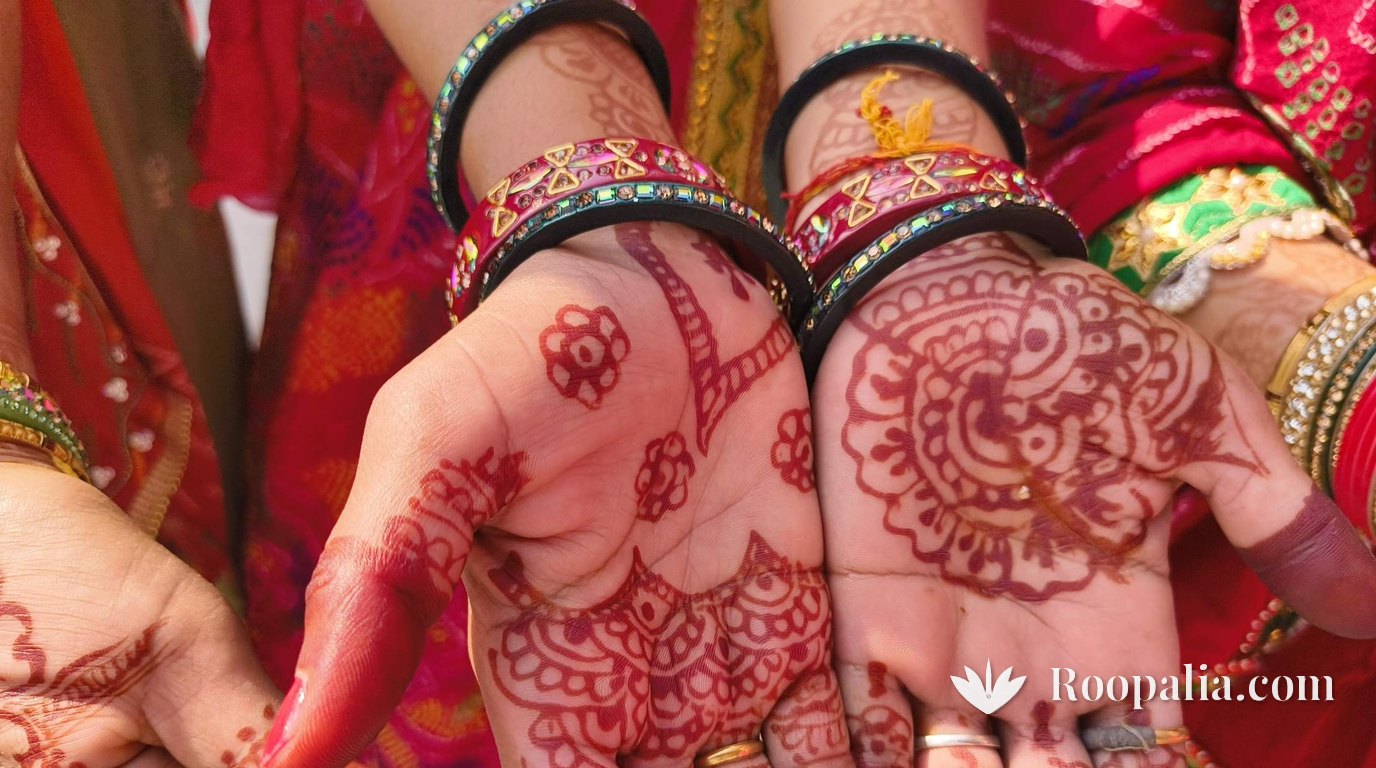
- Festivals and weddings mean full stacks from wrist to mid-forearm, like the photo above.
- Hot weather or office work means fewer; a heavy stack makes the wrist sweat and itch.
Glass, lac, shell or gold: what is the difference?
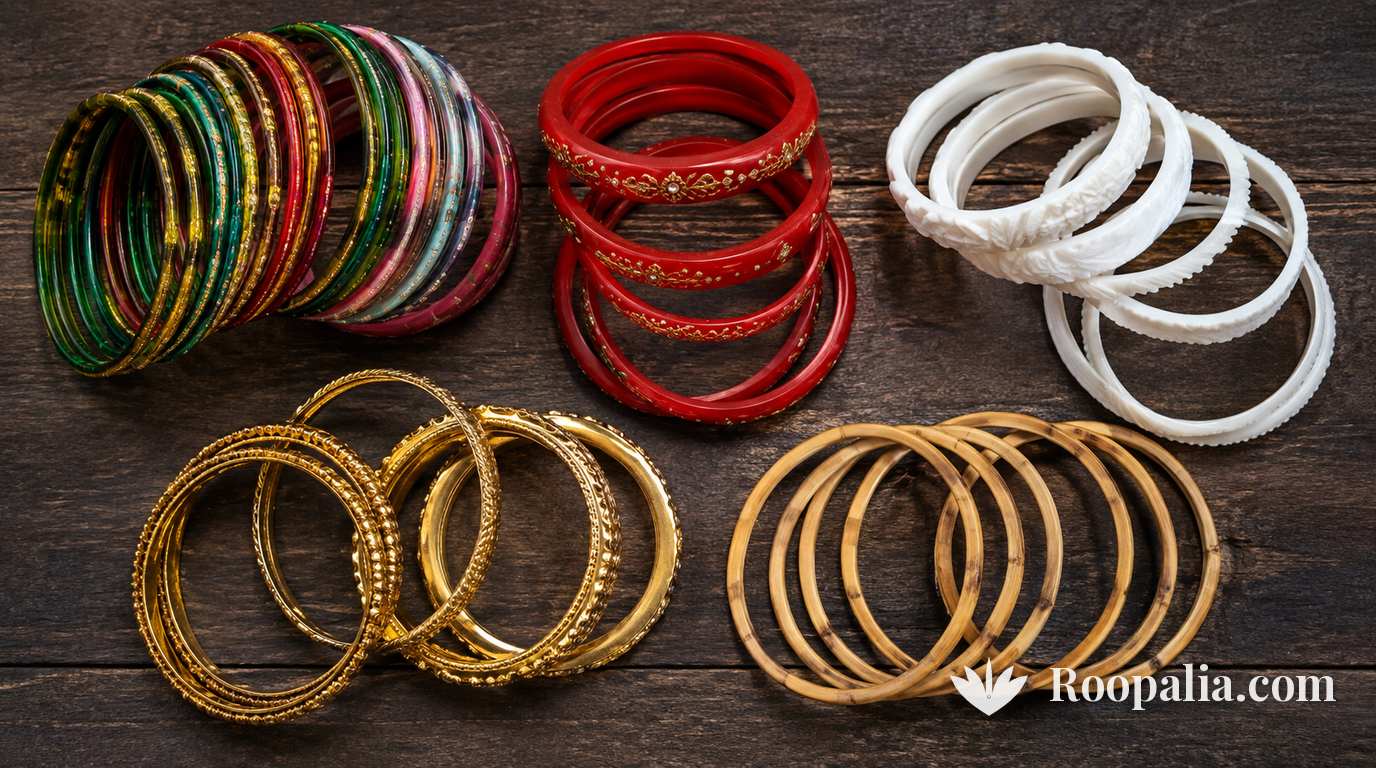
- Glass. The everyday bangle of North India. Firozabad in Uttar Pradesh makes about 46% of India’s bangles (Wikipedia: Firozabad). Cheap and colourful, but they break.
- Lac (lakh). Made from a resin secreted by insects, heated and moulded, often set with small stones. Popular in Rajasthan; beautiful but brittle (Wikipedia: Bangle). The hero photo shows maroon bangles set with small stones, worn with plain black ones.
- Shell (shankha). White sea-shell bangles worn by married Bengali and Odia Hindu women.
- Gold and silver. Usually a kada or a pair of thin bangles for daily wear, and a gift at weddings.
What do the colours mean, and why green in Sawan?
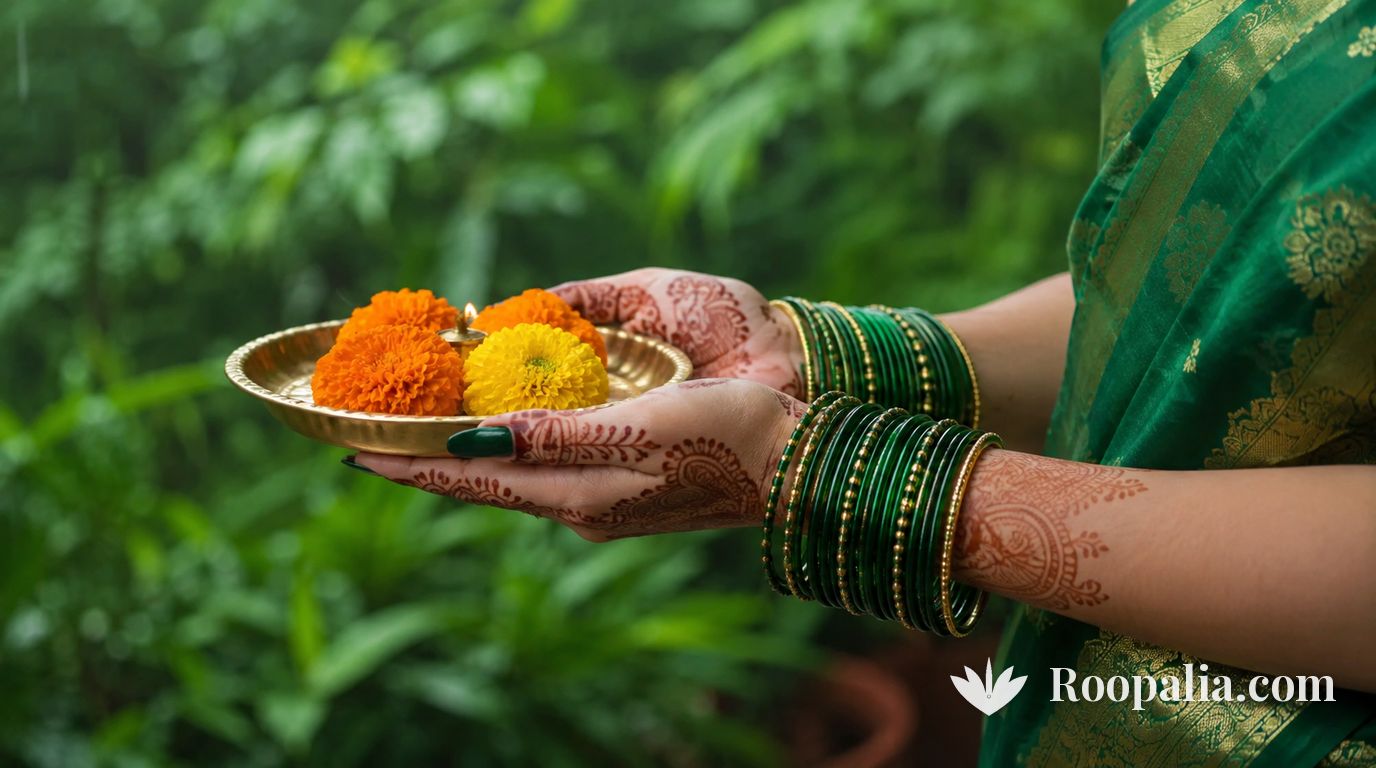
Red is the colour of marriage and the bride. Green stands for growth and plenty, which is why women wear green bangles in Sawan, the monsoon month, and on Hariyali Teej. Yellow and saffron appear at haldi and other auspicious ceremonies, and gold bangles hold a coloured stack together. These meanings come from custom, and you will find small differences between regions.
Why do Indian women wear bangles at all?
Mainly as a sign of marriage. A married woman’s wrists are not left bare, and the sound of bangles in the house is considered auspicious. The custom is very old. The bronze "Dancing Girl" excavated at Mohenjo-daro in 1926 wears 24 to 25 bangles on her left arm and 4 on her right; she is now in the National Museum, New Delhi (Wikipedia: Dancing Girl).
You will also read online that bangles improve blood circulation or "balance energy". I did not find any scientific study behind those claims, so I am not repeating them as fact.
The bridal chooda
In a Punjabi wedding, the bride’s side begins the wedding-day rituals with the chooda ceremony. The set of red bangles is gifted by her mama (mother’s brother), and relatives and friends then tie kaleere, dangling gold or silver ornaments, to her bangles (Wikipedia: Punjabi wedding traditions). How long the chooda is worn after the wedding varies from family to family.
Sizing and care
- Size: a bangle has to pass over the widest part of the hand, not the wrist. Bring your thumb and little finger together and measure across the knuckles, or try one of your own bangles against the new ones.
- Glass in luggage: pack glass and lac bangles upright in a hard box with cloth between them, and buy a few extra; one or two usually break on the way.
- Old and broken bangles: many families do not pass worn bangles to strangers and give new ones as gifts. Wrap broken glass in paper before throwing it away so no one cuts a hand.
Wearing your first Teej or Karwa Chauth stack? Our guide to solah shringar, the sixteen adornments shows where bangles fit in the full set.
Day, colour and number all change from home to home. What stays the same is the idea behind them: a full, ringing wrist is a sign of a happy marriage, and that idea is older than any of the rules.
Frequently Asked Questions
Can we buy bangles on Wednesday?
Which day is good to wear new bangles?
How many bangles should a married woman wear?
Why do women wear green bangles in Sawan?
Who gives the bridal chooda?
Sources: Wikipedia (Bangle, Dancing Girl, Firozabad, Punjabi wedding traditions). This article is for general, educational information; customs differ by region and family.
Photos credited 'Photo: Dhanpat Singh' are real photographs; the other images are AI-generated illustrations to explain the topic.