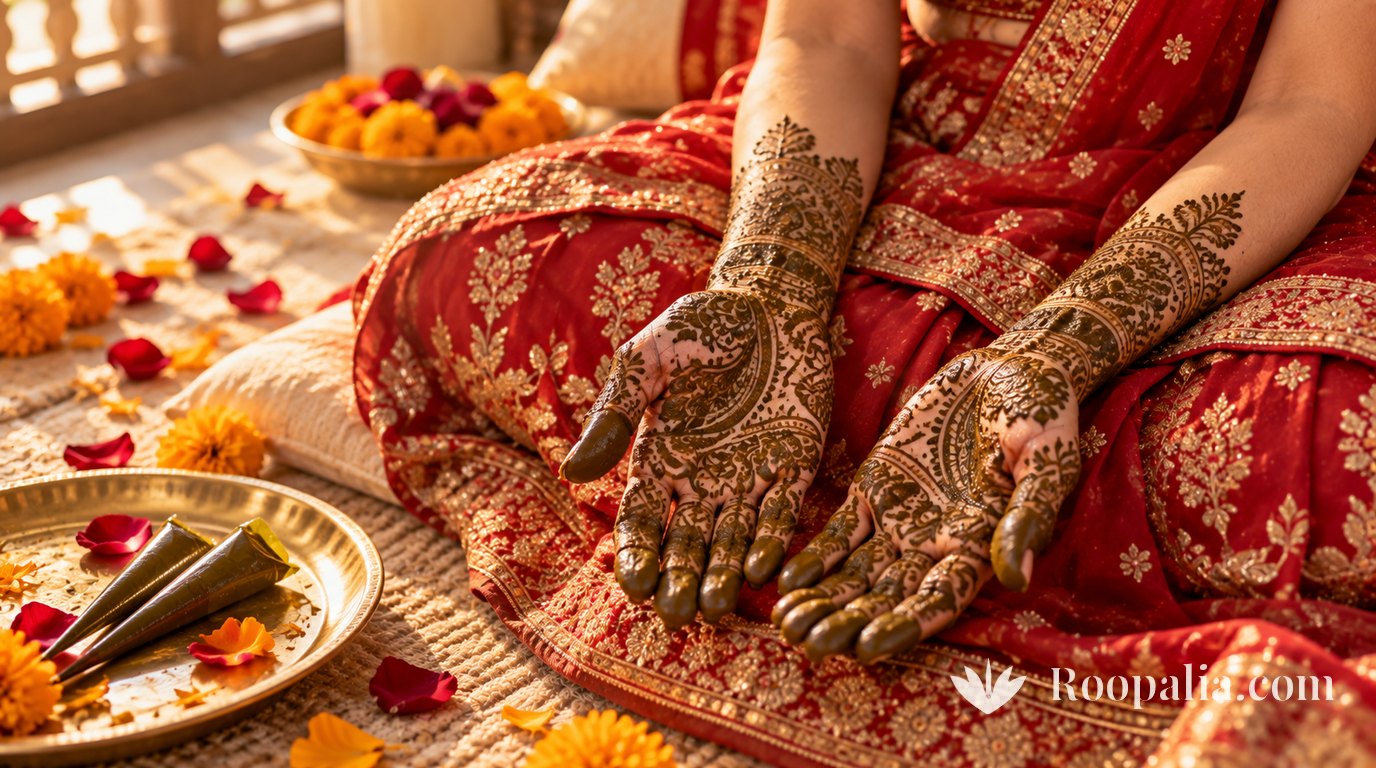
The most common henna disaster is not a bad design. It is a good design on a stain that never arrived — because the paste was mixed an hour before it was needed, scraped off after forty minutes, and judged the same evening while it was still orange.
Henna is a slow chemical process wearing the costume of a quick beauty ritual. Once you see the clock it actually runs on, almost every “why didn’t mine go dark?” question answers itself.
The whole timeline on one screen
| Stage | Time | What is happening |
|---|---|---|
| Paste resting after mixing | 8–12 h at room temperature; about 1 h in real heat | The dye is being released from the leaf |
| Mixed paste, refrigerated | About 2 days | Dye slowly degrading |
| Paste on skin | At least 4–6 h; bridal work often overnight | Dye migrating into the skin while the paste is damp |
| Just after removal | — | Bright orange, as it should be |
| Darkening | Over roughly three days | Oxidation to red-brown |
| Fading | Typically 1–3 weeks | Stained skin exfoliating away |
Two rows on that table are where nearly everyone goes wrong, and neither of them is the one about how long to leave it on.
Why the paste has to wait before it works
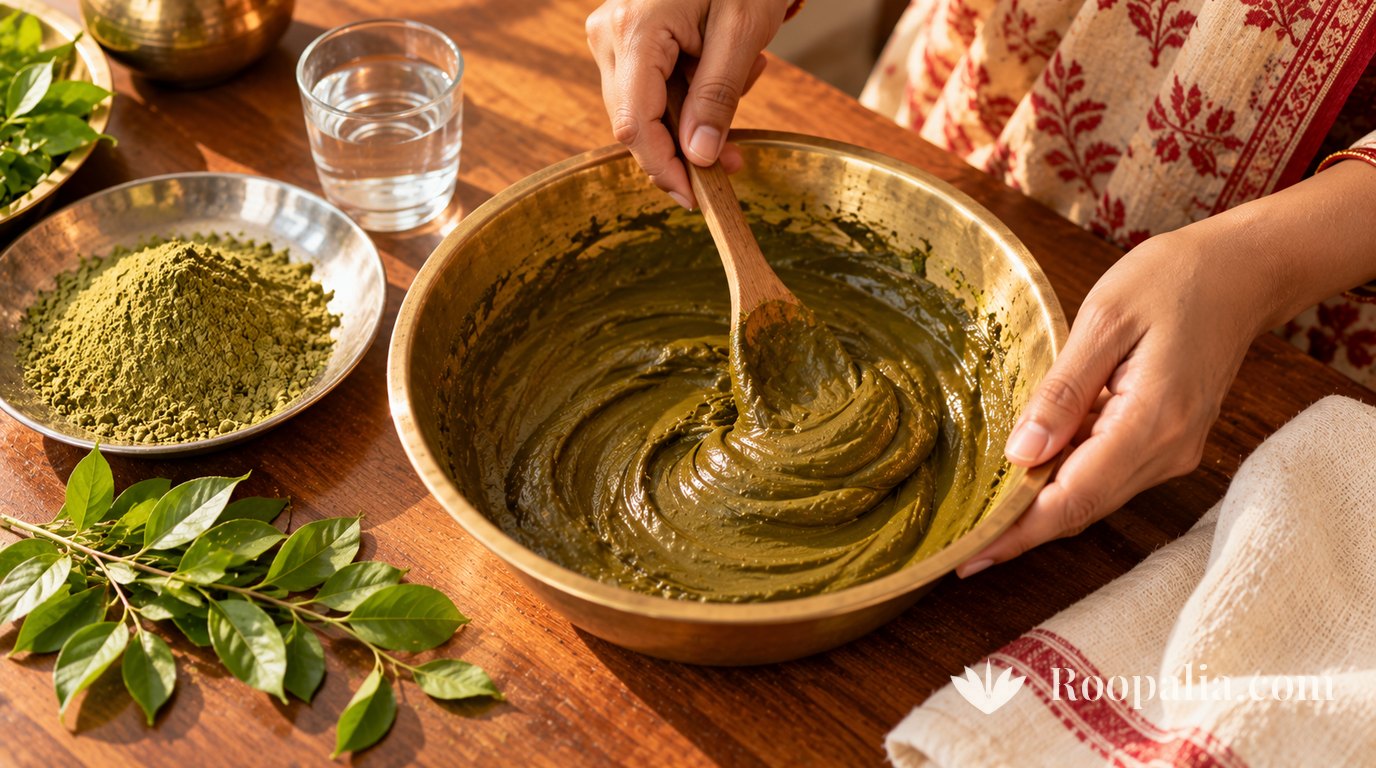
The colouring molecule in henna is lawsone, and in the dried leaf it is locked up in a form that does not stain. Adding liquid starts a slow reaction that frees it. Henna practitioners call this dye release, and until it has happened, the paste can look perfect and do almost nothing.
Catherine Cartwright-Jones, who has written on henna chemistry for decades, puts it at eight to twelve hours at ordinary room temperature, and around an hour somewhere genuinely hot. Paste mixed on the morning of an event is, in most climates, not yet paste.
She offers a test that takes a minute. Dab a little on your palm, wipe it off after sixty seconds, and look: a bright orange mark means the dye is out. Pale yellow or nothing means wait.
She also recommends a mildly acidic liquid over plain water, on the grounds that water-only mixes give a weaker release that deteriorates faster. Many South Asian families add strained tea or a squeeze of citrus for exactly this reason, arrived at by experience rather than chemistry.
Why it comes off orange
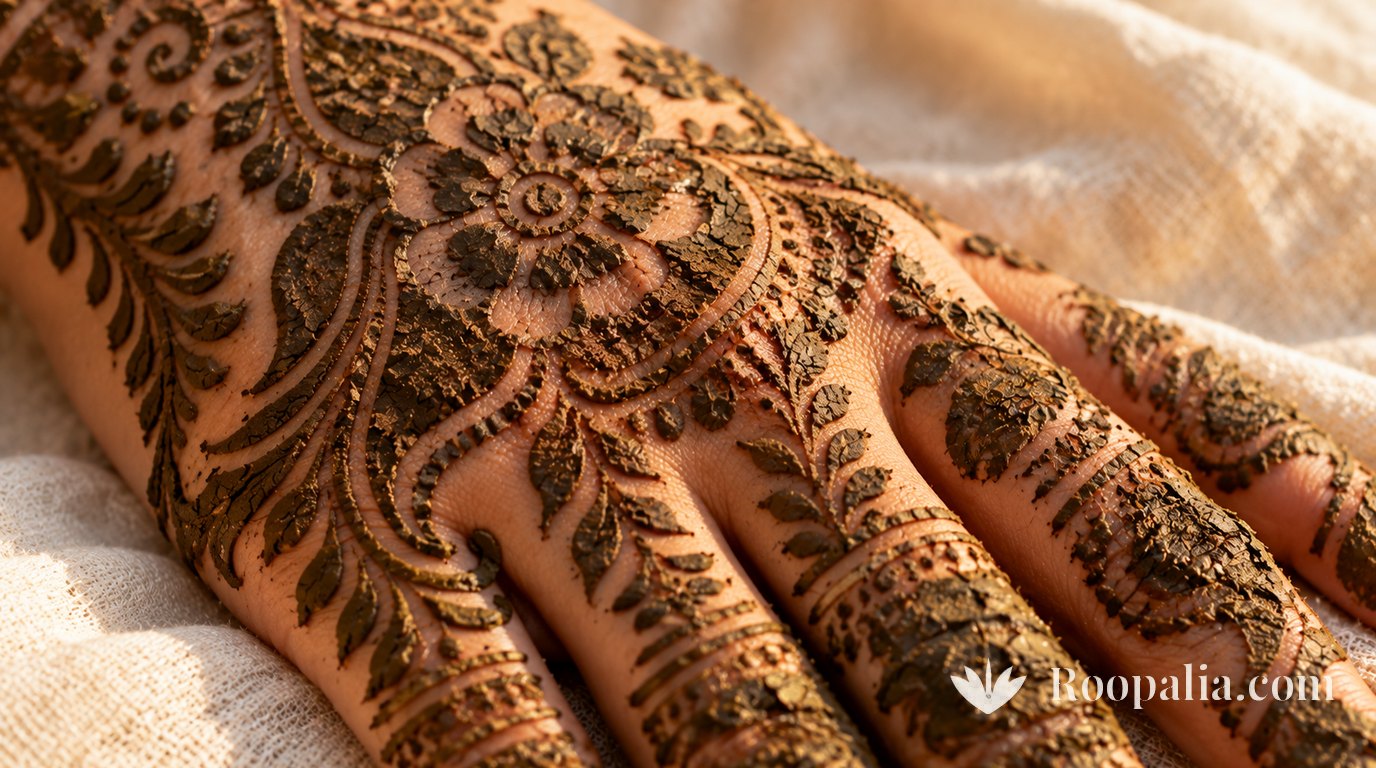
The moment people panic is the scrape. Hours of patience, and what emerges is carrot orange.
That is correct. Fresh henna is always orange when the paste comes off, and it then darkens through oxidation over roughly the next three days to a deep red-brown. Day one orange, day two red, day three maroon.
Which gives you the single most useful safety rule on this page, and it is worth stating on its own line:
Real henna cannot be black on removal. If a stain is black or near-black the moment the paste comes off, something other than henna did it.
We will come back to what that something usually is.
What “leave it overnight” actually buys you
Lawsone moves from paste into the outer layer of skin and binds to its proteins — but only while the paste stays damp and in contact. Once it dries hard, cracks and flakes away, transfer slows to almost nothing.
So the useful measure is not hours on the clock but hours of contact. Four to six hours is the common minimum; bridal henna is often left overnight, not because the eighth hour is magic, but because sleeping keeps you from picking at it and wrapping keeps it from falling off.
This is also why the traditional sugar-and-lemon glaze exists. Dabbed onto drying paste, it makes it tacky, keeps it moist and stops it flaking off. It does work. There is one caveat, though — and it applies to anyone reading this in a sunny place. Lemon contains compounds that react with sunlight on skin, which our piece on lemon juice and skin covers in detail. Keep lemon-glazed hands out of direct sun and wipe them before going outside; plain sugar water does the sticking job without the risk.
The three-day curve — and why Indian weddings put mehndi first
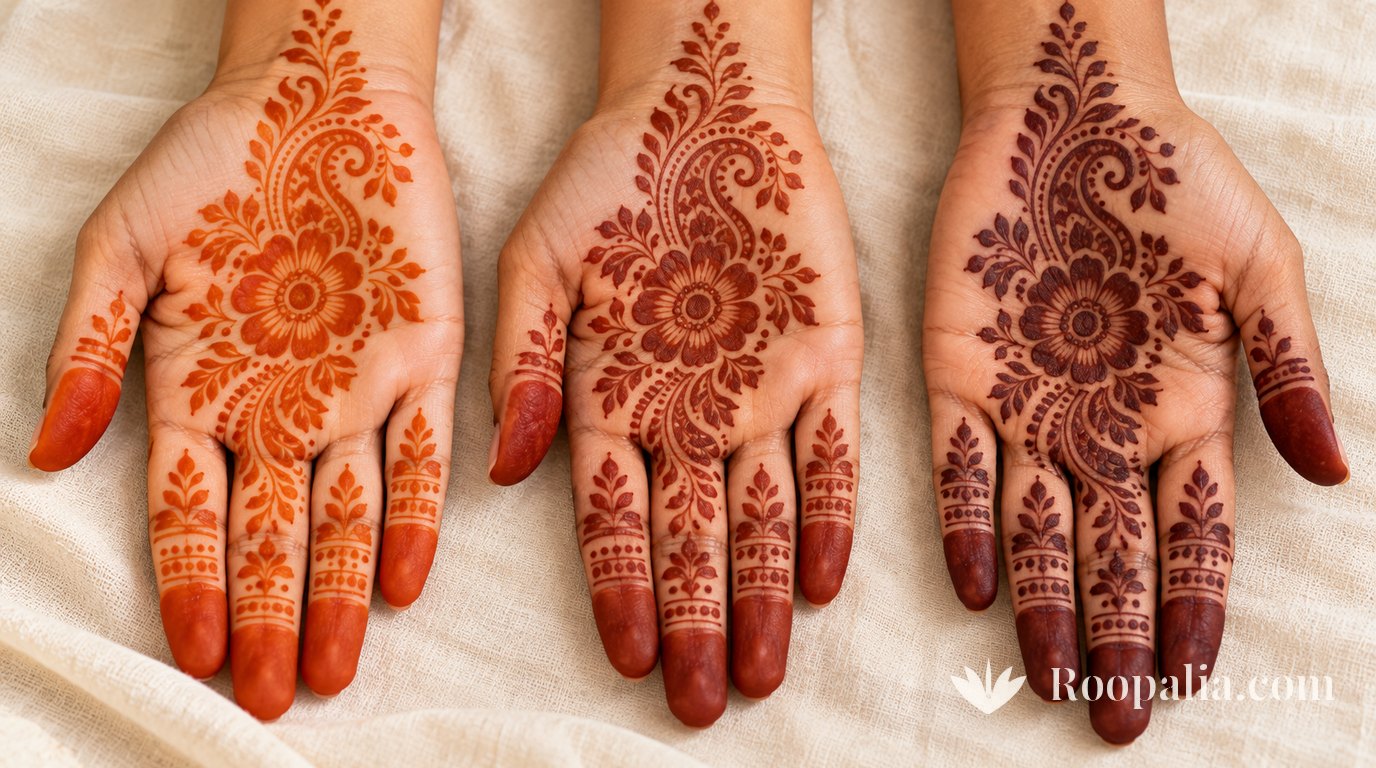
Put the numbers together and something interesting falls out.
If a stain takes around three days to reach full depth, then henna applied on the wedding morning will photograph orange. Henna applied one or two days before will be at its darkest on the day itself.
In most Indian families the mehndi ceremony falls one or two days before the wedding. The usual explanations are social — gathering the women of the family, songs, a day set aside for the bride. Those are real. But the timing also happens to be exactly what the chemistry would ask for, and it was settled long before anyone could have named the molecule.
The practical version for anyone planning around a date — a wedding, a festival, a photograph: apply one to two days early, not on the day.
What darkens a stain, rated honestly
The internet’s list of darkening tricks is long. Here it is sorted by whether there is a mechanism behind it.
- Properly dye-released paste. The foundation. Nothing downstream compensates for paste that was never ready.
- Longer damp contact. Directly supported by how the dye transfers.
- Warmth. Heat speeds the process; cold hands stain more slowly.
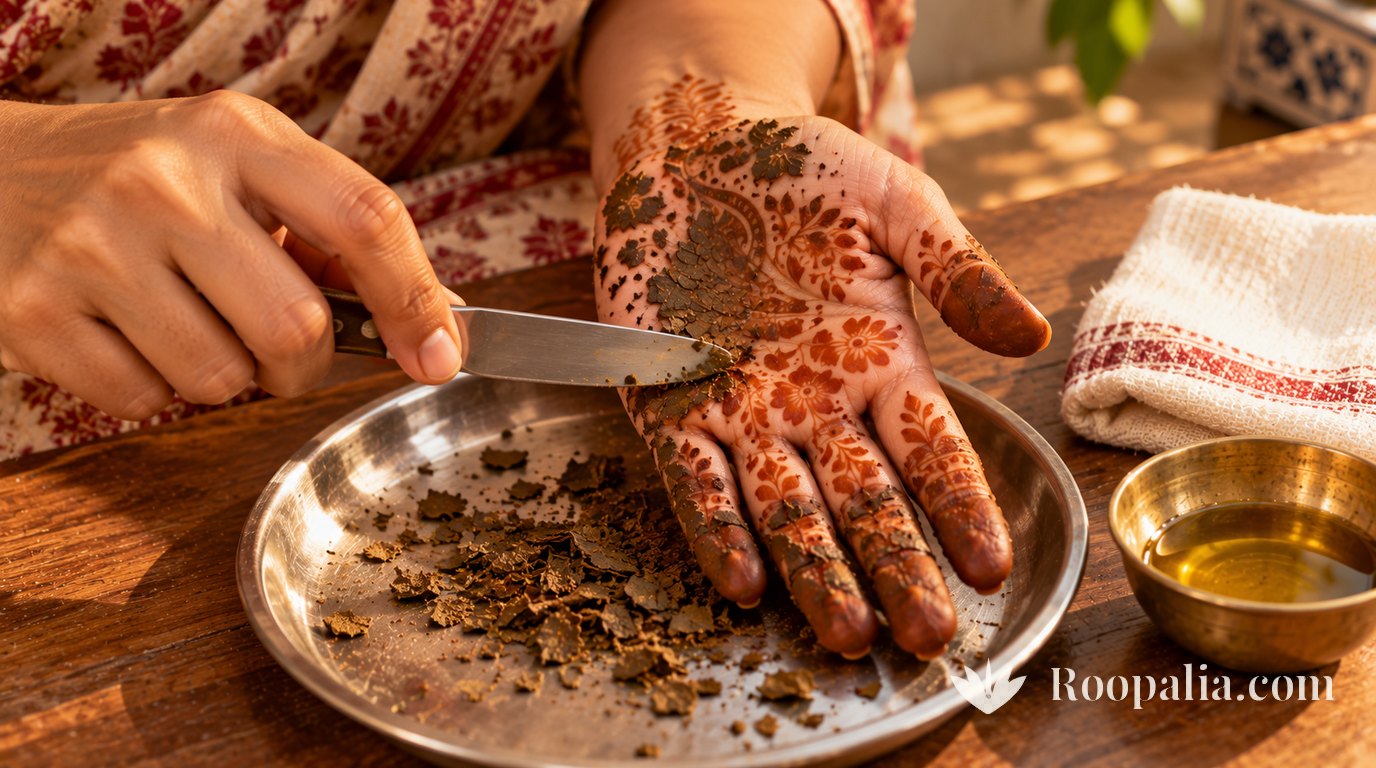
- Removing paste by scraping, not washing. A blunt edge, then a smear of oil to lift the last flakes. Common advice is to keep hands away from water until the next day while the colour develops.
- Clove smoke. Widely recommended, no published evidence found, and it means holding smoke close to your face. Skip it.
- Mustard or coconut oil after removal. Harmless and helpful for getting flakes off; no evidence it deepens the colour itself.
Why palms go darkest and the backs of hands fade first
Everybody notices it, and most people assume they did something wrong.
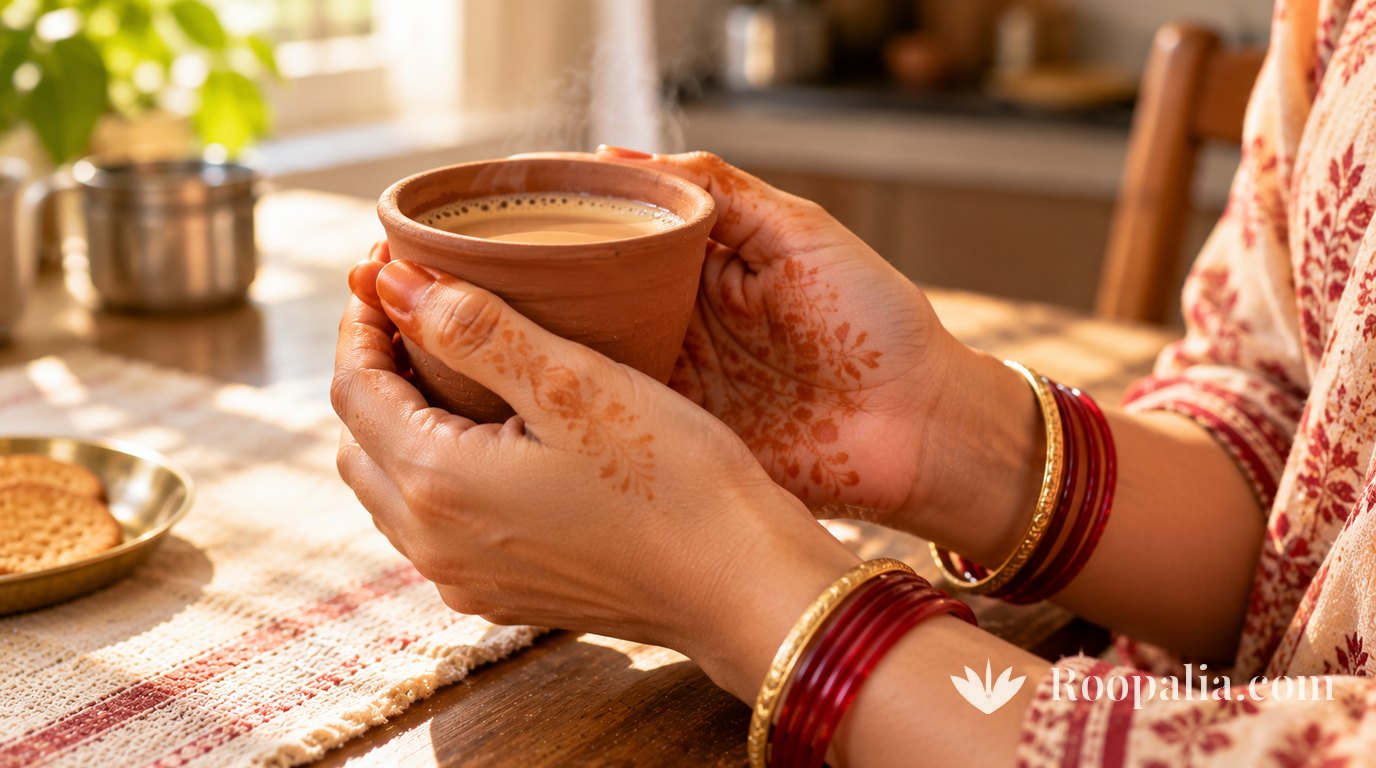
They didn’t. Palms and soles have the thickest skin on the body, so they take up the most lawsone and take it deepest. The backs of the hands, and the tops of the fingers, have thin skin — the stain there is paler and wears off first.
That is why, ten days later, the centre of the palm and the fingertips still carry a clear design while the backs of the fingers are almost bare. The stain fades as the outer skin exfoliates, typically over one to three weeks, and faster on hands that spend a lot of time in water and soap.
Henna on hair runs on a different clock and a different goal — typically one to three hours, depending on the depth of colour wanted. And if the real worry is hair loss rather than colour, start with the cause: hair fall in women: causes, deficiencies and what helps.
Before henna, there was lac
A short detour into Sanskrit poetry, because it reframes the whole tradition.
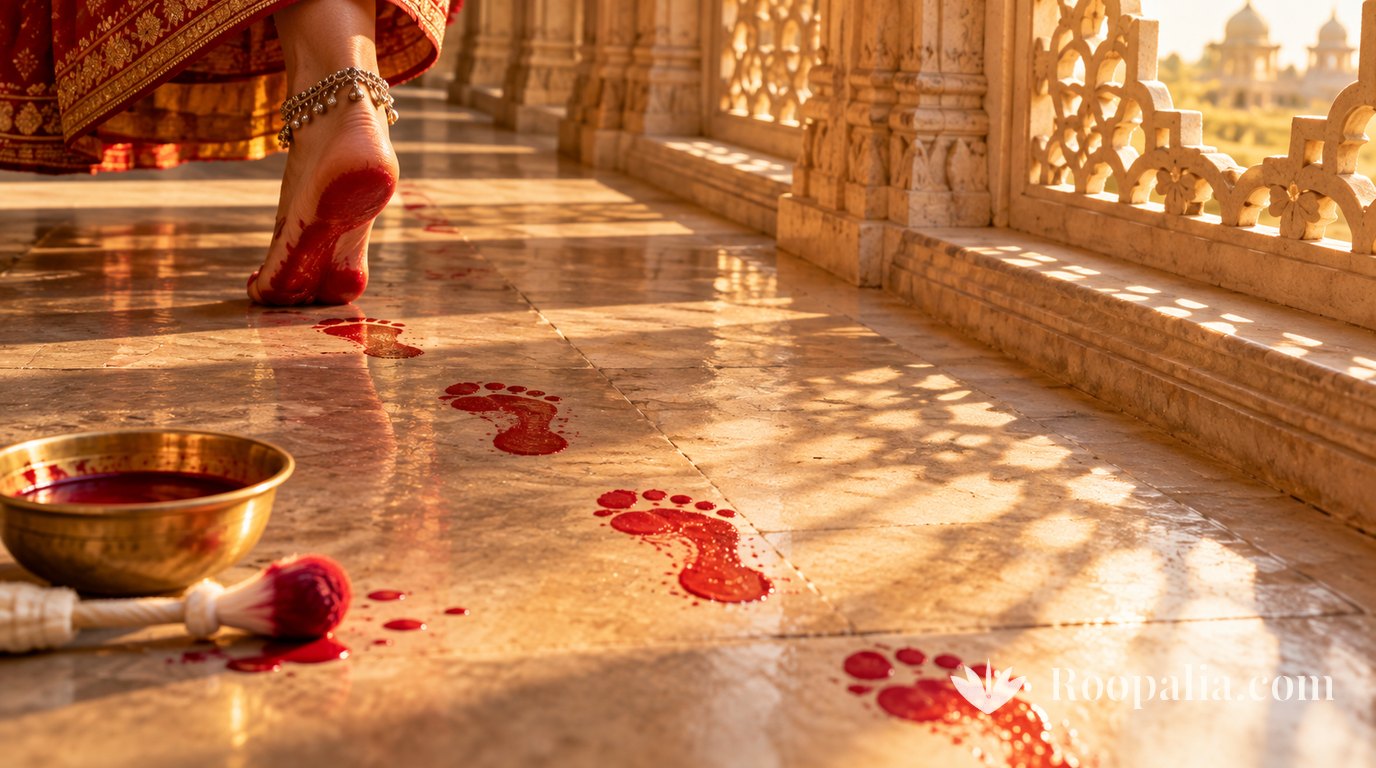
In the seventh canto of Kalidasa’s Raghuvamsha, the women of a city abandon whatever they are doing to rush to their windows as a prince’s wedding procession passes. One of them snatches her foot away from the attendant who was painting it red — and runs, still wet, leaving a trail of red footprints across the floor all the way to the window.
प्रसाधिकालम्बितमग्रपादमाक्षिप्य काचिद्द्रवरागमेव।
उत्सृष्टलीलागतिरागवाक्षादलक्तकाङ्कां पदवीं ततान॥
Raghuvamsha 7.7
It is the oldest picture I know of someone ruining their colour by not waiting. But notice what the colour is. The word is alaktaka — lac dye, a resin-based red — not henna. The same substance paints feet and lips across classical Sanskrit literature: in the Kamasutra, the Shiva Purana, the Nilamata Purana, and elsewhere in Kalidasa. It survives today as alta, still applied to brides’ feet in Bengal and parts of North India.
Henna itself does appear in Ayurvedic sources, generally identified with the plant madayantika — but as a medicine for skin conditions and fever, not as bridal adornment. And even that identification is not settled; several classical Sanskrit dictionaries give madayantika as Arabian jasmine instead. The confident claim that ancient texts describe mehndi on brides’ hands turns out to be much shakier than its popularity suggests.
Black henna, chemical cones, and the one group who should skip henna
Three genuine risks, all avoidable.
“Black henna” is not henna. The US Food and Drug Administration states that natural henna produces brown, orange-brown or reddish-brown tones, and that “black henna” is typically darkened with p-phenylenediamine (PPD), a coal-tar hair dye that is not permitted in products applied to skin. It is sold widely at beach resorts and holiday markets as a temporary tattoo. Reactions include blistering, intense itching, permanent scarring and a lasting sensitivity that can make ordinary hair dye dangerous for you for life. If a stall promises a black design in minutes, walk on.
Cones are not always what they say. In January 2024, drug-control officials in Hyderabad raided a unit producing mehndi cones sold as “Special Karachi Mehendi” and found picramic acid, a synthetic dye, in breach of India’s henna standard, BIS IS 17318:2020. Any cone promising instant dark colour deserves the same suspicion as the black tattoo.
Babies with G6PD deficiency. A 1996 study in the Annals of Tropical Paediatrics described fifteen newborns with glucose-6-phosphate dehydrogenase deficiency who developed acute haemolysis — the breakdown of red blood cells — after henna was applied to their skin. The authors concluded that henna is absorbed through the skin. The deficiency is more common in boys. Ask a doctor before putting henna on an infant or young child, particularly if G6PD deficiency runs in the family.
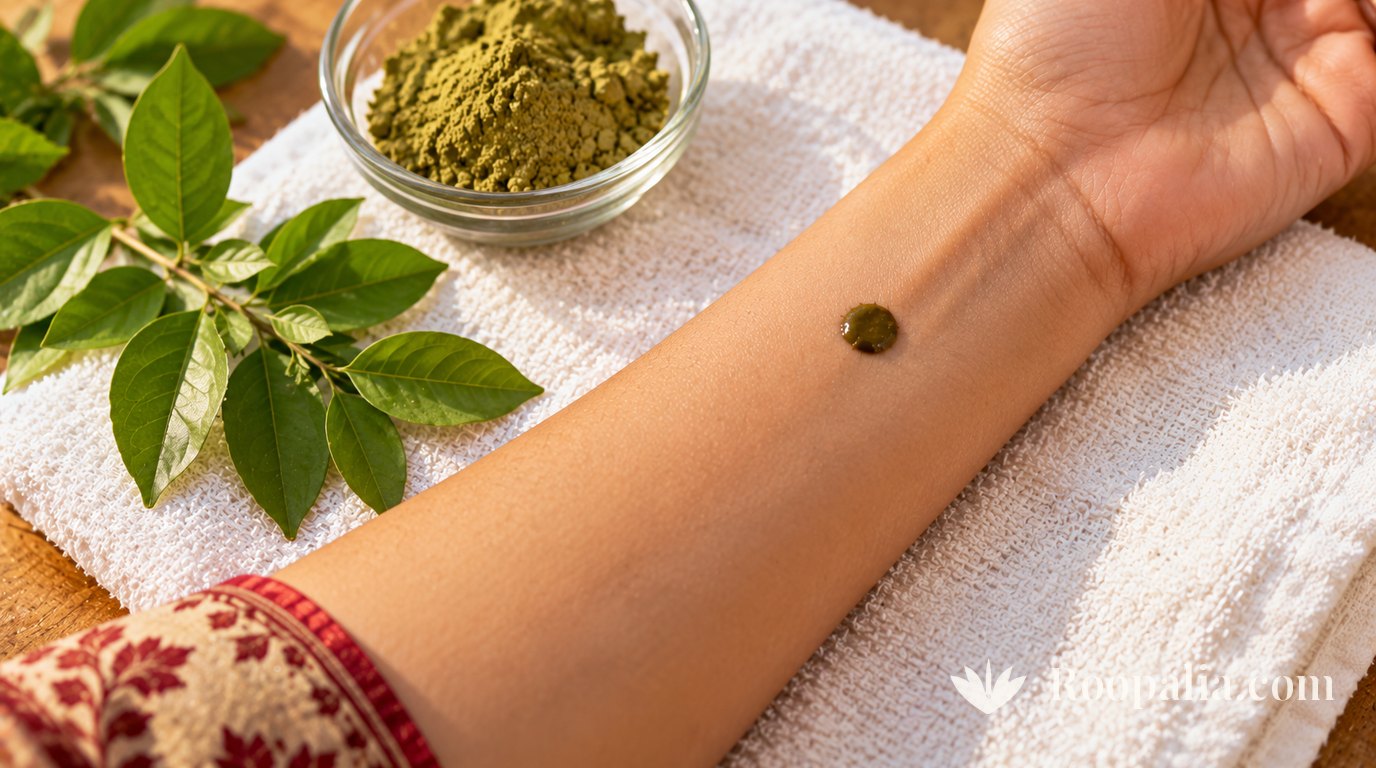
And for everyone else, a patch test: a single dot on the inner wrist, left for a while and watched for redness or itching, before committing both hands to a new batch or brand of cone.
Real henna is unhurried. It wants a night to wake up, an evening to soak in and three days to finish. The products that promise to skip all of that are the ones to be afraid of.
This article has been prepared for educational purposes. The information in it has been drawn from a range of sources — classical texts, published research, regulatory fact sheets, news reporting and the writing of henna specialists — which were studied and compiled into this account. Every source is listed at the end. Where a popular tip or belief has no evidence behind it, that is said plainly. This is not medical advice.
Frequently asked questions
How long should I keep mehndi on my hands?
How long should henna paste sit before I use it?
Why is my henna orange after I take it off?
When should I apply mehndi before a wedding or festival?
Is black henna safe?
How long does a henna stain last?
Is henna safe for babies and young children?
Did ancient Indian brides use henna?
Sources
- FDA — Temporary Tattoos, Henna/Mehndi, and “Black Henna”: Fact Sheet
- Henna — Wikipedia — lawsone, darkening over three days, 1–3 weeks, palms and soles, PPD
- Catherine Cartwright-Jones — Henna 101: How to Dye-Release Henna
- Kandil HH et al. Henna inducing haemolysis among G6PD-deficient newborns. Ann Trop Paediatr. 1996 — PubMed 8985525
- NewsMeter — DCA Hyderabad, picramic acid in mehendi cones (Jan 2024)
- Raghuvamsha, canto 7 — verse 7
- Alaktaka — wisdomlib — Kamasutra 1.4, Shiva Purana 2.3.45, Nilamata Purana 417, Kumarasambhava, Mrichchhakatika 4.15
- Cosmetics in ancient India — wisdomlib
- Madayantika — wisdomlib · Mendhi — wisdomlib
- Comprehensive review on Madayantika (Lawsonia inermis) — JAIMS
This article is for information only and is not medical advice. See a dermatologist for any blistering, itching or allergic reaction, and ask a doctor before using henna on an infant. No brand, shop or product is recommended anywhere in this article, and it contains no affiliate links.