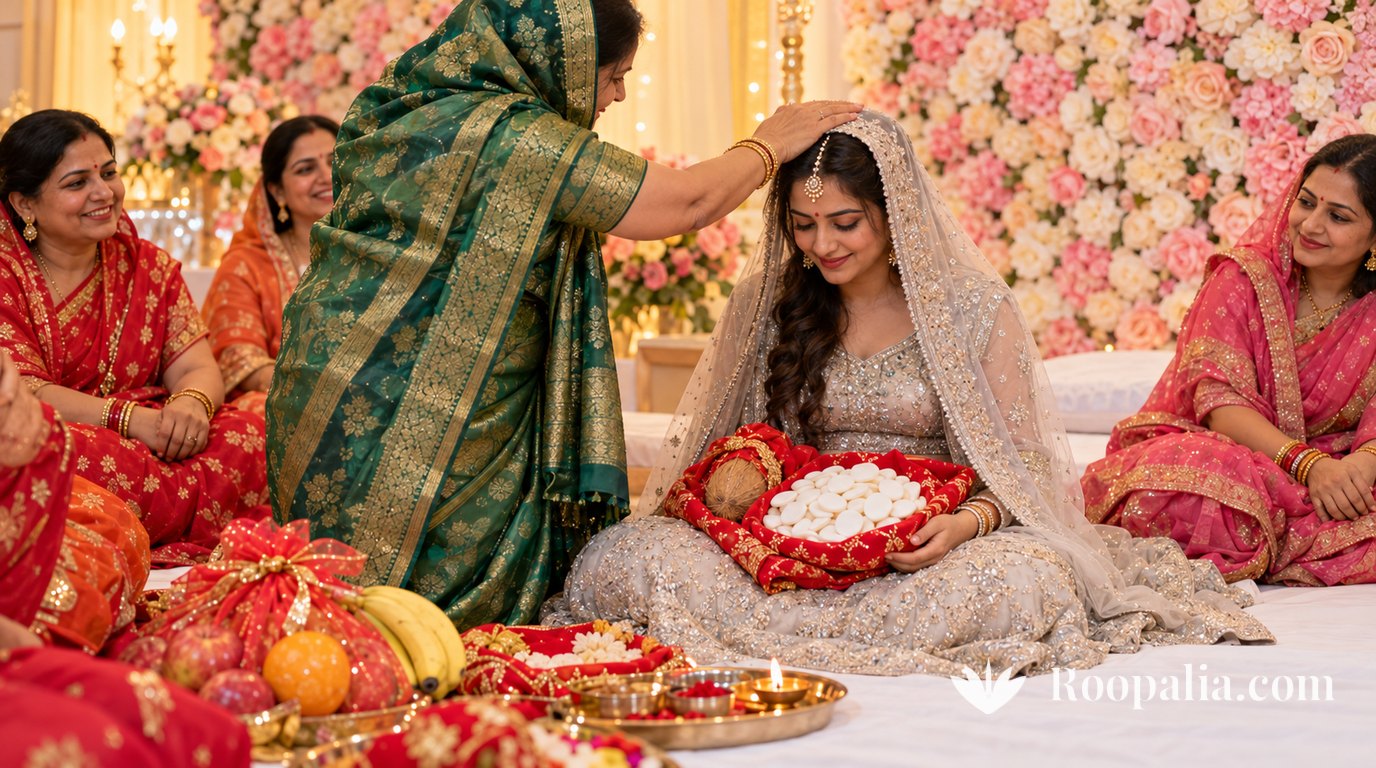
The invitation says “Tilak, Godh Bharai & Ring Ceremony”, and if you search the middle phrase, almost every result is about pregnancy. That is the confusion this guide clears up. In North India — especially in Rajasthan, Haryana and western Uttar Pradesh — godh bharai is also a pre-wedding ceremony, and it has nothing to do with a baby.
When I searched for a reliable written account of this ceremony, I found very little. So this guide rests on two things, kept clearly apart: what I could open and verify in encyclopaedic and government sources, and what families in Rajasthan and Haryana have practised for generations.
What is godh bharai before marriage? (in English)
Godh bharai before marriage is the ceremony in which, after the match is fixed, the women of the groom’s family drape a red chunri over the bride-to-be, put a tilak of vermilion and rice on her forehead, and fill her lap with a coconut, patashe (white sugar drops), fruit, sweets, clothes and shagun (a gift of money or jewellery). It says one thing: you are now one of us.
The words themselves mean “filling the lap”. Wikipedia’s article on baby showers gives the same literal meaning — “In most parts of northern and central India, it is known as godhbharāi (गोदभराई) literally ‘filling the lap’” (Baby shower, courtesy: Wikipedia) — but that article describes the pregnancy rite. There is no single fixed English name for the pre-wedding one; “pre-wedding godh bharai” or “the lap-filling ceremony for the bride-to-be” describes it best.
What happens at a godh bharai ceremony — minute by minute
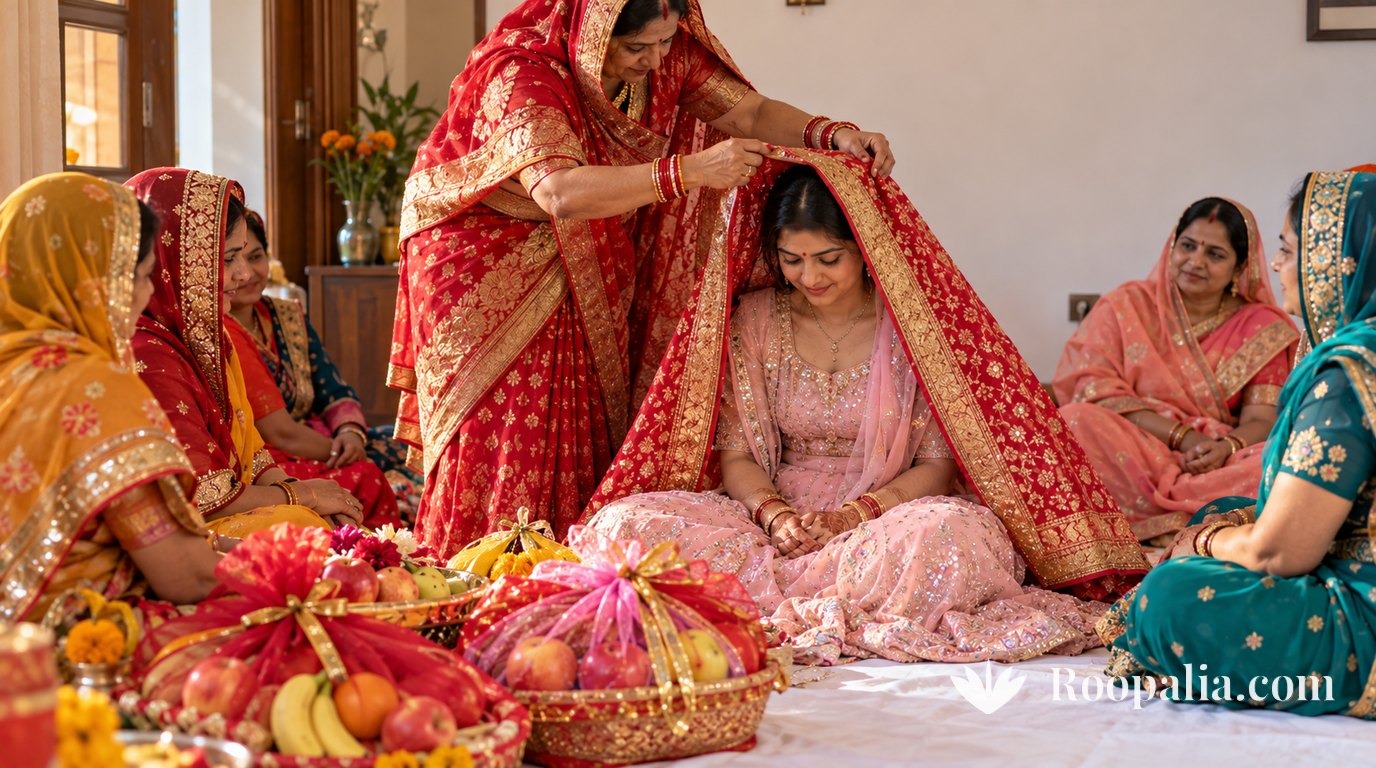
According to the experience of families in Rajasthan and Haryana, the ceremony used to happen on its own day: the bride’s family would go to the groom’s home for the tilak, and on a separate day the groom’s family would come to the bride’s home for the godh bharai. Today most families hold one combined function, often in a banquet hall. If you are a guest, this is roughly what you will see:
- The tilak comes first. The bride’s father or brother marks the groom’s forehead with roli (vermilion) and rice, and gives him shagun.
- The bride is seated. She sits on a white sheet on the floor or on a low stool, with a plate of roli, rice, a sacred red-yellow thread (mauli) and a lamp in front of her.
- The chunri. Her future mother-in-law, or the senior woman of the family, drapes a red or pink chunri with gold borders over her head.
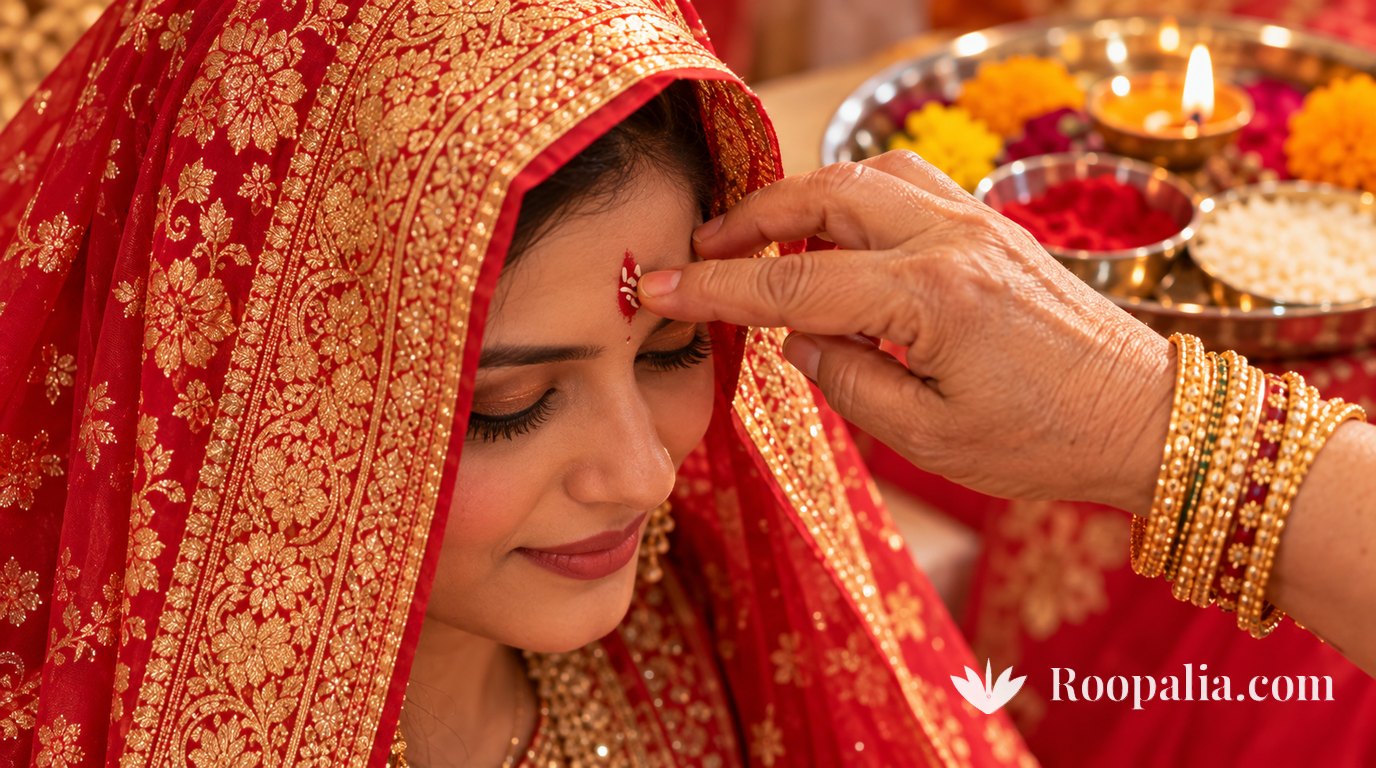
- The tilak for the bride. A roli mark with a few grains of rice at the centre of her forehead.
- The coconut first. A coconut wrapped in red cloth and tied with mauli is placed in her lap before anything else.
- Then everything else. Patashe, dry fruit, sweets, fruit, clothes, bangles, and an envelope or a piece of jewellery — by the mother-in-law alone in some families, by five married women in turn in others.
- Blessings. The women place a hand on her head, feed her something sweet, and sing.
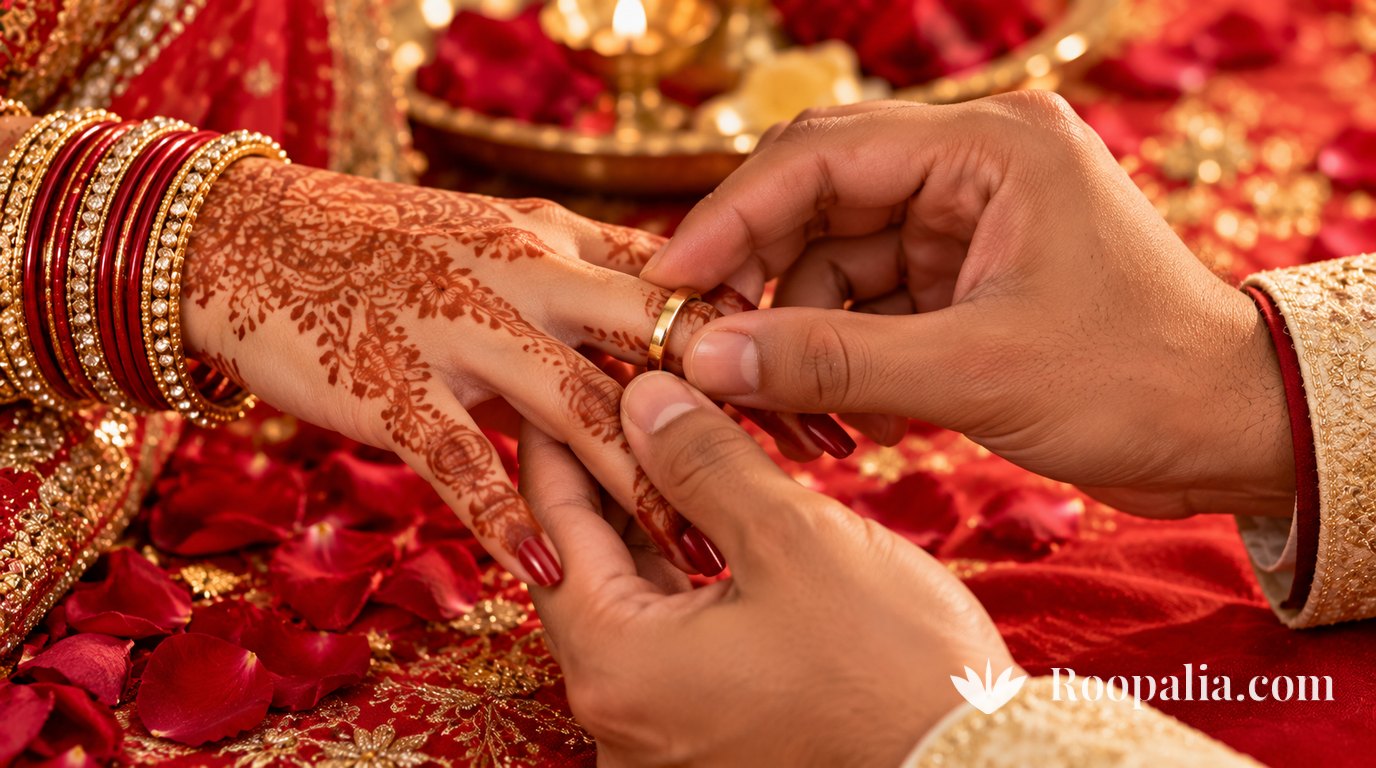
- The rings. Last of all, the couple exchange rings, and the sagai is complete.
Four names get mixed up at this point — roka, sagai, tilak and godh bharai. They are different steps, in a particular order.
Roka vs sagai vs tilak vs godh bharai
What is a roka ceremony? The word comes from the Hindi and Punjabi verb “to stop”. As Wikipedia puts it, “The word Rokka means “to stop” and symbolizes the end of the courtship process.” In Punjabi custom it is also when “the groom’s family gives the bride a chunni (headscarf) that symbolizes her acceptance into the family” (Punjabi wedding traditions, courtesy: Wikipedia). The chunri at a godh bharai carries the same meaning.
The sagai is the formal promise. Wikipedia lists among Hindu pre-wedding rituals “engagement, which involves vagdana (betrothal) and Lagna-patra (written declaration)”, and in some regions “a ceremony for the Tilak (engagement)” (Hindu wedding, courtesy: Wikipedia). Names and directions vary by community: Priya Malik’s account of Jat Haryanvi weddings describes the sagai as the occasion “when the groom’s family goes to the bride’s family to finalise the wedding” (Jat Haryanvi Marriage Rituals and Songs, courtesy: Sahapedia). Ask your own elders what each step is called in your family.
| Ceremony | Who, for whom | What happens | When |
|---|---|---|---|
| Roka | Both families, close relatives only | The match is sealed; shagun, fruit and sweets exchanged | First |
| Tilak | Bride’s family → groom | Roli and rice on the groom’s forehead, shagun | After the roka |
| Godh bharai | Groom’s family → bride | Chunri, tilak, coconut, patashe, fruit and shagun in her lap | With the tilak, or on its own day |
| Ring ceremony | The couple | Exchange of rings | Today, after the tilak and godh bharai |
The table reflects the experience of families in Rajasthan and Haryana; the meanings of roka and sagai are checked against the Wikipedia sources above. In short: a roka needs no ring; at a sagai the ring is the main event.
What goes into the bride’s lap
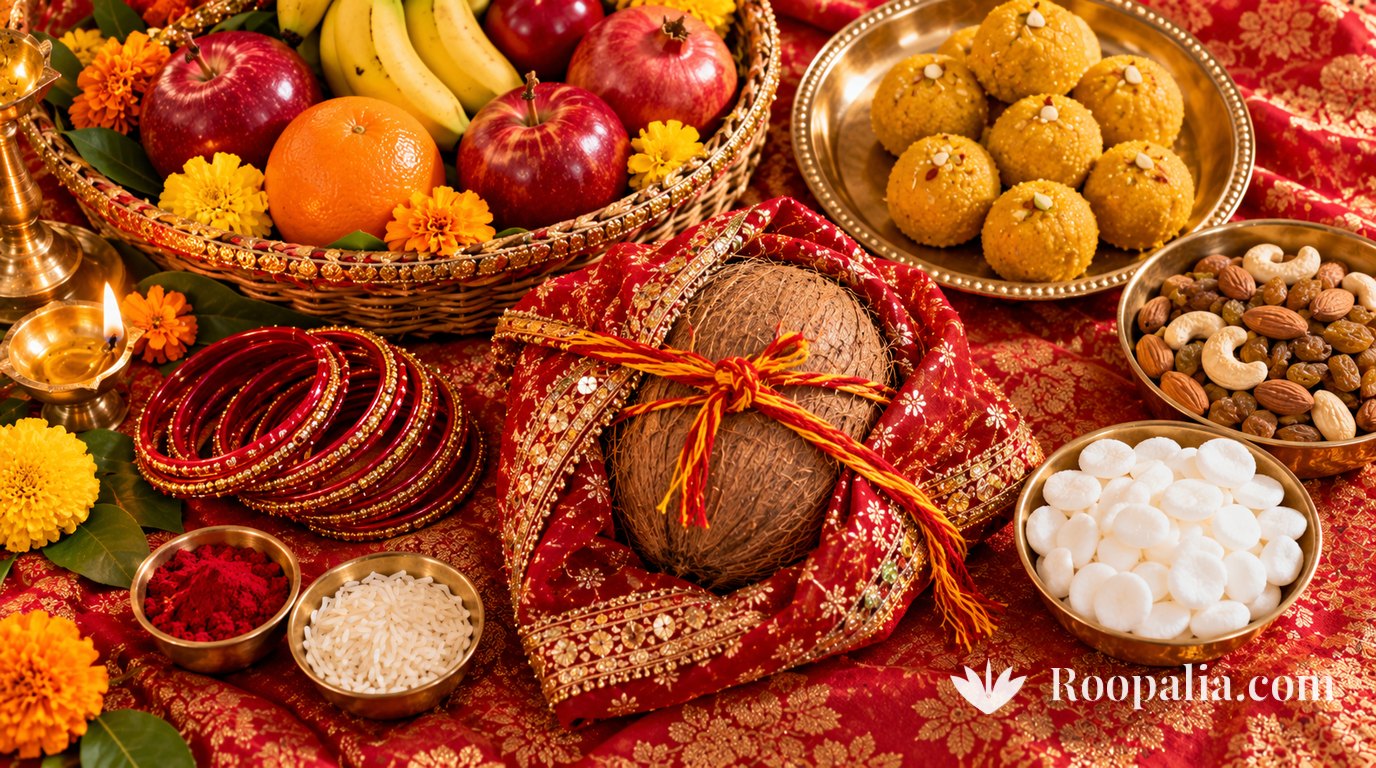
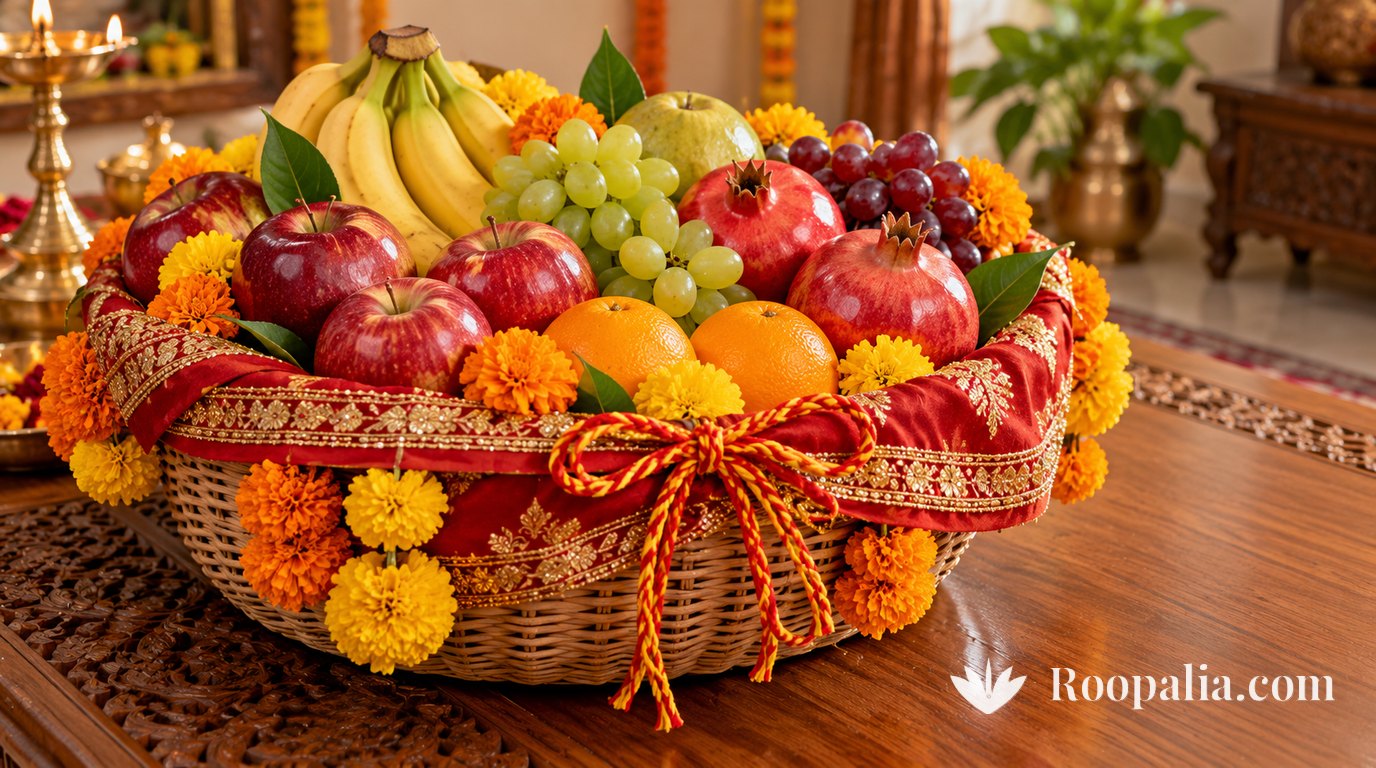
According to the experience of families in Rajasthan and Haryana, the usual items are below. None of them is compulsory; each family decides by its custom and its means.
- Coconut — wrapped in red cloth, tied with mauli.
- Patashe — flat, round white sugar drops; some families also add mishri (crystal sugar).
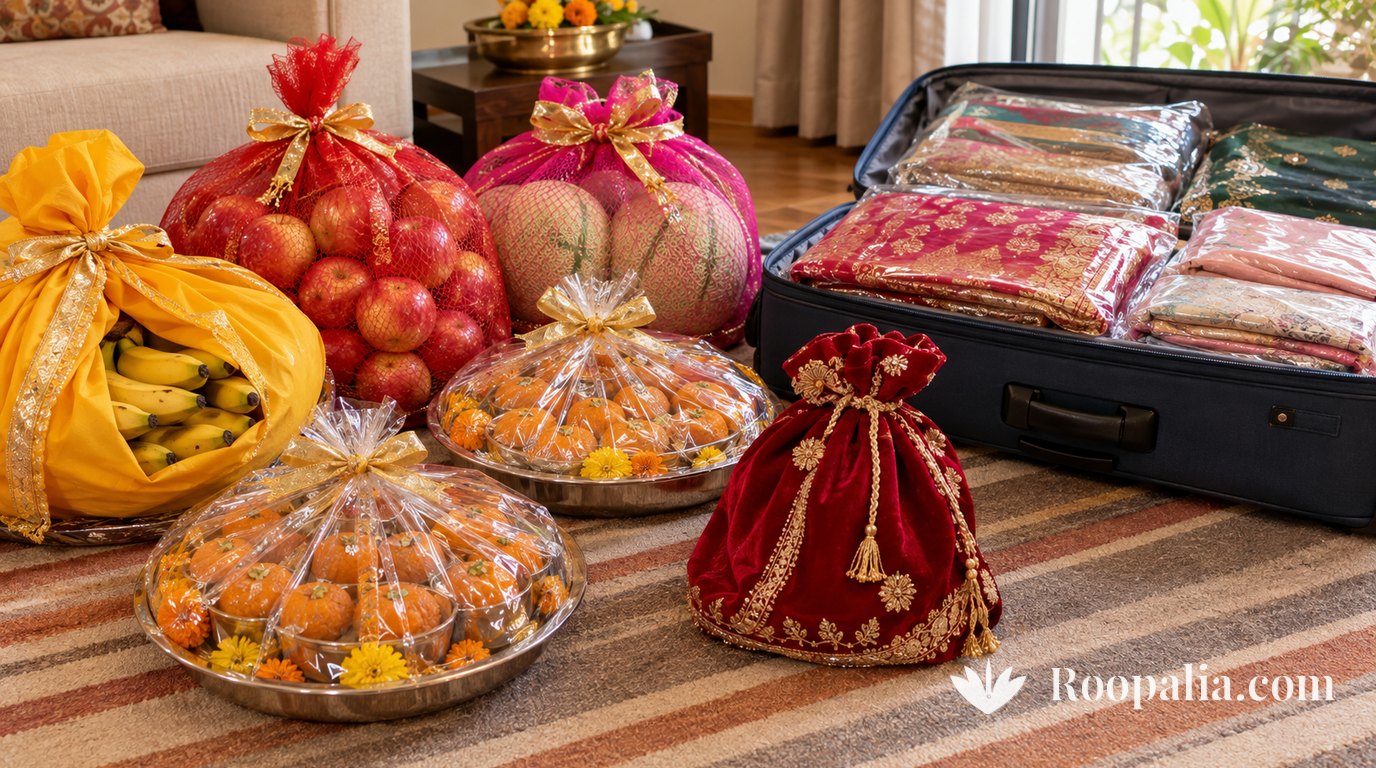
- Fruit — five kinds of seasonal fruit, often in a decorated basket or in net bags tied with ribbon.
- Sweets and dry fruit — yellow sweets such as besan laddoos; cashews, almonds, raisins.
- Clothes — a saree or suit for the bride, and the gota-patti chunri.
- Shringar — bangles (lac bangles in Rajasthan), mehndi, bindi.
- Shagun — cash in an envelope, or a ring or other jewellery.
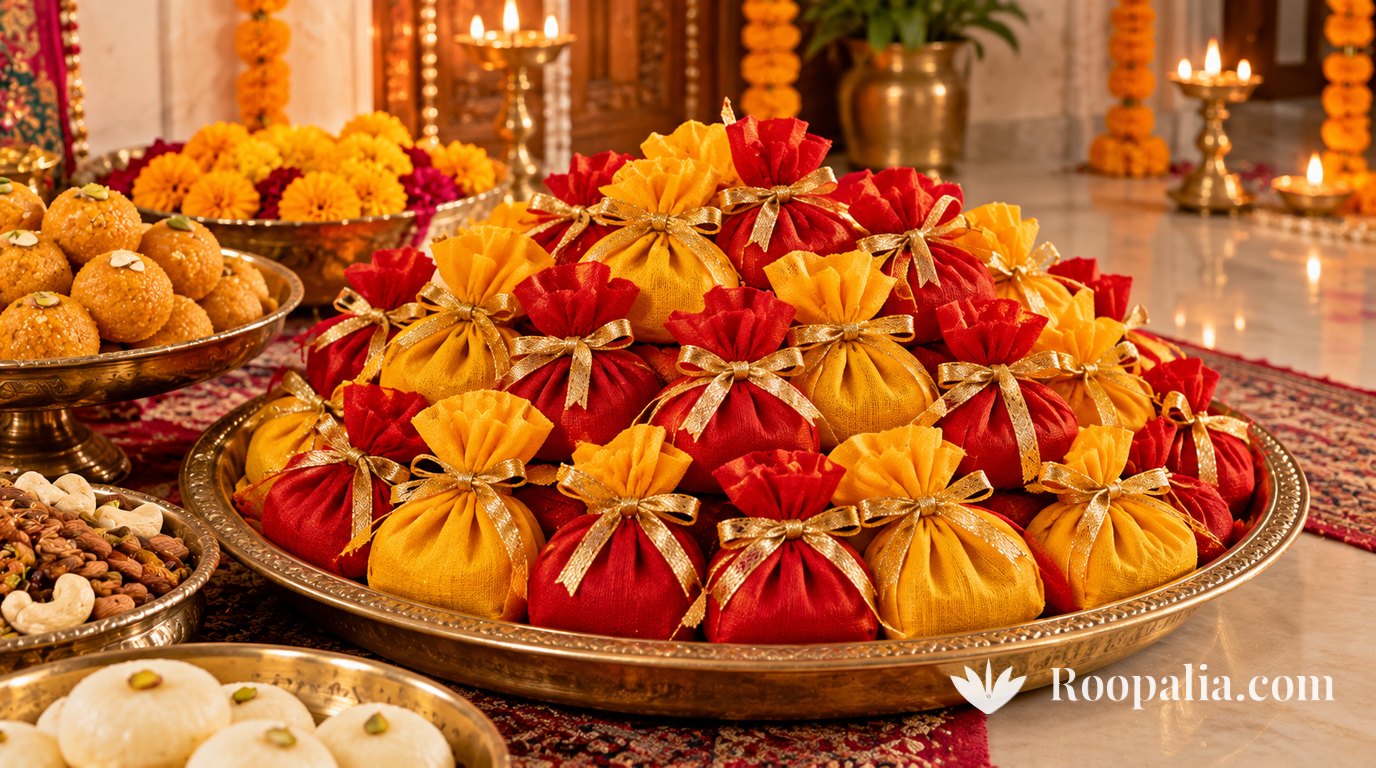
Marwari and Rajput families add a few things of their own: whole coriander seeds, whole green gram (moong), gond laddoos, and kothli — little cloth pouches of shagun, given in counts of 11, 21, 31 or 51 (according to the experience of families in Rajasthan and Haryana).
What to wear for a godh bharai
- The bride: a lehenga, saree or suit in pink, red or a soft pastel. A chunri will be placed over her head, so a light dupatta works better than a heavy one. Bindi, bangles and mehndi are all fine — no sindoor in the parting, which belongs to married life. At a combined function she usually wears her engagement outfit. For bridal make-up, see our bridal make-up guide.
- Women of the groom’s family: sarees or Rajasthani poshak; in traditional families, heads covered.
- Guests: any Indian festive wear. If you are new to it, a saree or a salwar suit is always right.
And now the part of this story that surprised many readers outside Haryana: for some families, the godh bharai became the whole wedding.
Haryana: a mahapanchayat, and the godh bharai wedding
Rising wedding costs are a real social worry in Haryana. On 6 September 2026, a mahapanchayat of the 52 Pal of the 36 Biradari met at Mandkola village in Palwal district. According to the Haryana government’s press release, it took decisions to curb extravagant wedding spending — including on this ceremony:
“महापंचायत में लड़की की गोद भराई की रस्म को लेकर भी महत्वपूर्ण निर्णय लिया गया। … लड़की के लिए एक अंगूठी, एक जोड़ी कपड़े और एक किलो मिठाई देने की व्यवस्था रहेगी।”
(“The mahapanchayat also took an important decision on the girl’s godh bharai ceremony… the girl is to be given one ring, one pair of clothes and one kilogram of sweets.” — translation: Roopalia)
— Press release, Palwal, 6 September 2026, Haryana government public relations portal (courtesy: Government of Haryana)The release also says only a limited number of men and women will attend, and gives the reason plainly: families should not be burdened financially in the name of rituals. It calls it “the girl’s godh bharai” and places it right after the decision on the sagai. It is a community decision, not a state law.
Haryana found another way to cut costs about twenty years ago, and I have seen hundreds of such weddings myself. Seven or eleven people from the groom’s side take the groom to the bride’s home “for the godh bharai”; during it, the pheras are performed by custom; and the bride comes home with them the same day. No baraat, no noise, no big bill — a complete wedding, quietly, in one day. The practice is now slowly fading, as younger couples want a wedding to remember.
I could not find a reliable written source on this custom; the account above is first-hand. One legal point is worth knowing: under the Hindu Marriage Act, 1955, a marriage may be performed by the customary rites of either party, and where those include the saptapadi, “the marriage becomes complete and binding when the seventh step is taken” (Hindu Marriage Act, 1955, courtesy: Wikipedia). The procession does not make the marriage; the rites do. Registration under section 8 helps prove a marriage, so whatever its size, register it — and especially if the couple will live outside India, where visa and residence applications usually ask for proof of marriage. This is not legal advice; check the rules with your local marriage registrar. On the pheras themselves, see the seven pheras explained.
Hosting a godh bharai outside India
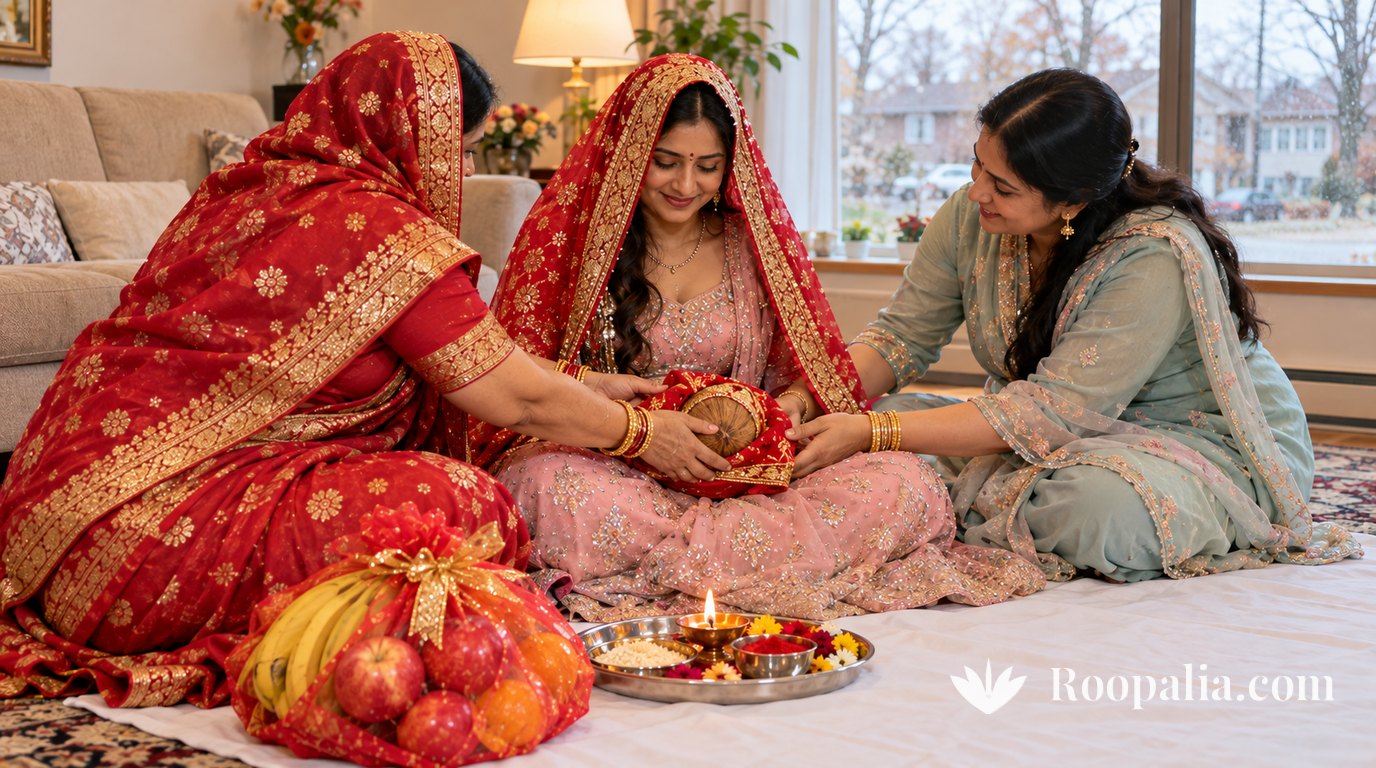
- Keep it at home. A sheet on the living-room floor is enough; no hall is needed.
- Shopping. Coconut, mauli, roli and patashe or mishri are usually stocked by Indian grocery stores; buy the fruit locally and in season.
- Grandparents on video. Elders in India can bless and sing from a screen.
- The lamp. In flats with smoke alarms, use a small diya near a window.
- Guests from other backgrounds. One line explains it: “The groom’s family is welcoming the bride into their family by filling her lap with a coconut, sweets, fruit and gifts.”
Is it the same as the godh bharai baby shower?
No. Same name, different ceremony. The pregnancy godh bharai is linked to the simantonnayana samskara, which appears in the old Vedic household texts, and is about mother and baby. The pre-wedding godh bharai is a folk custom about welcoming a bride. If that is the one you were looking for, read godh bharai in pregnancy: the Indian baby shower.
What I found, and what I did not
| Question | Result |
|---|---|
| Literal meaning of godh bharai | Found — “filling the lap” (Wikipedia) |
| Roka meaning; chunni as acceptance | Found — Wikipedia (Punjabi wedding traditions) |
| Sagai as vagdana / tilak | Found — Wikipedia (Hindu wedding); Haryana sagai — Sahapedia |
| An official mention of the ceremony | Found — Haryana government press release, 6 September 2026 |
| A full written description of the pre-wedding rite | Not found in an encyclopaedic or official source — steps from family experience |
| Any scriptural basis | Not found — a folk custom |
| A written source on the one-day godh bharai wedding | Not found — first-hand account |
“Not found” does not mean “does not exist”. It is the honest result of my search, not a final verdict.
In short. Godh bharai before marriage is the groom’s family welcoming the bride-to-be — a chunri, a tilak, and a lap filled with a coconut, patashe, fruit and shagun. It once had its own day at the bride’s home; today it usually sits between the tilak and the ring exchange at one combined function.
No list of gifts is compulsory, and a Haryana mahapanchayat has said as much: the ceremony is honoured by its meaning, not its price.
Frequently asked questions
What is godh bharai before marriage?
What is the godh bharai ceremony called in English?
What happens in a godh bharai?
Is godh bharai done before marriage in UP?
What is the difference between roka and sagai?
What is the difference between godh bharai and sagai?
What gifts are given at a godh bharai before marriage?
What should I wear to a godh bharai?
Sources and cautions: sources consulted — a Government of Haryana press release (Palwal, 6 September 2026; the 52 Pal mahapanchayat), Wikipedia (Baby shower; Punjabi wedding traditions; Hindu wedding; Hindu Marriage Act, 1955) and Priya Malik’s article on Sahapedia (Jat Haryanvi Marriage Rituals and Songs). The steps, order and items of the ceremony are written according to the experience of families in Rajasthan and Haryana. Three things should be said plainly. First, I found no full description of the pre-wedding godh bharai in an encyclopaedic, official or scriptural source, and no written source on the one-day godh bharai wedding; that is the result of a search, not a final verdict. Second, customs differ by community, village and family; your elders’ word comes first. Third, nothing here is legal advice; ask your marriage registrar about registration. No brand or shop is recommended.