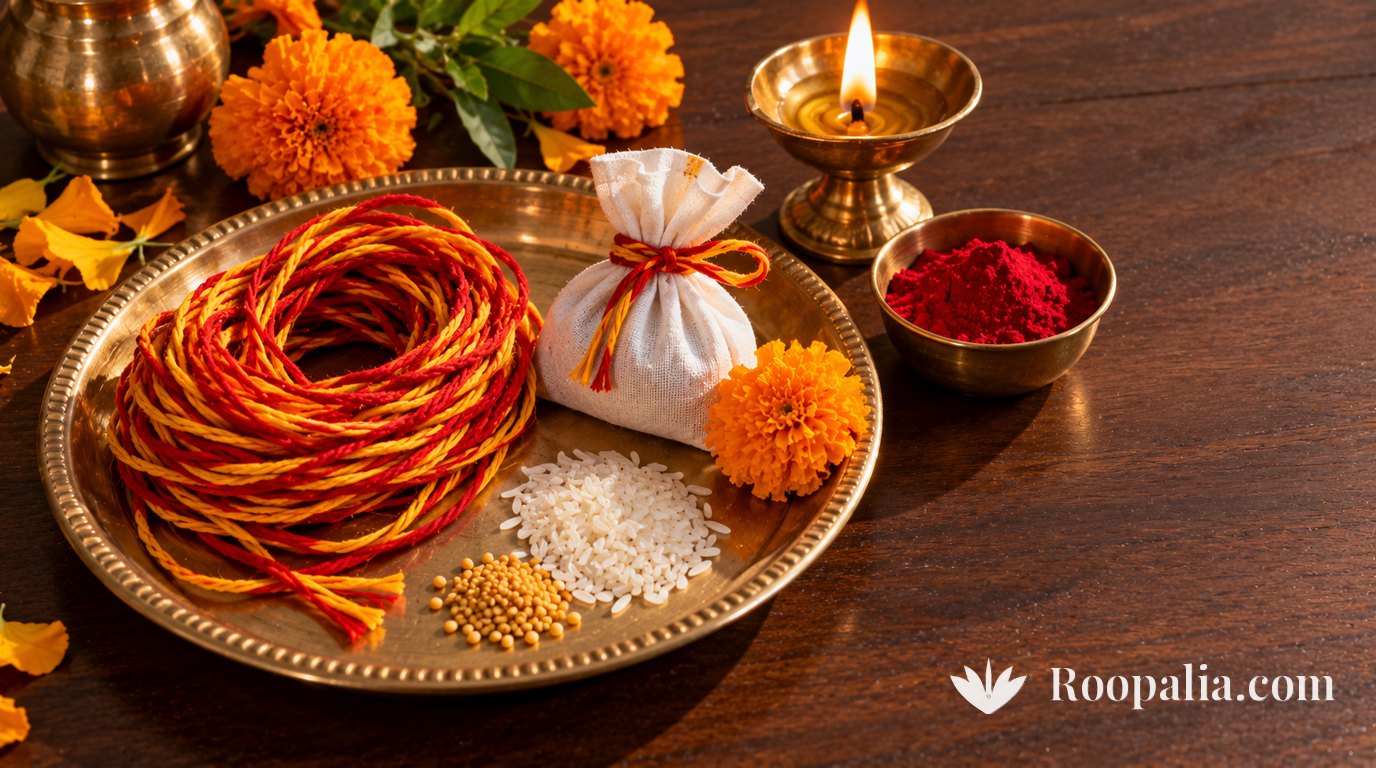
Sooner or later, someone at work points at your wrist. “What’s that red string?” Or you are the one asking — about a friend’s wrist, a cricketer’s on television, a colleague’s in a meeting. The thread is cheap, cotton and slightly faded, and it is almost certainly a kalava.
The usual answers online are confident and oddly specific: “wear it for 21 days”, “only remove it on a Tuesday”, “it presses a nerve and controls blood pressure”. I went looking for where those answers come from — in the Bhavishya Purana, an old Vedic household manual, Hindi and Sanskrit dictionaries, and a medical fact-check. Here is what I found, and what I went looking for and did not find.
Why do Hindus wear a red thread on the wrist?
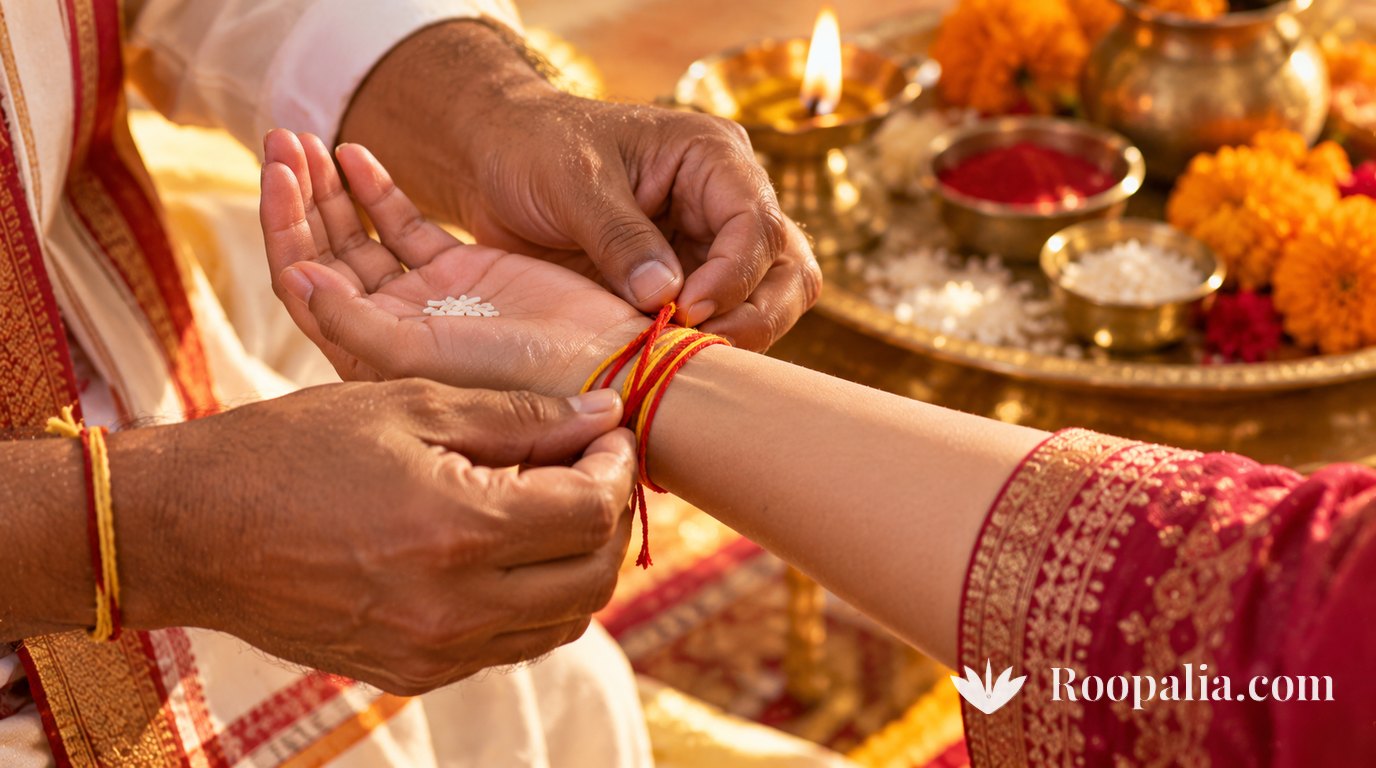
The short answer: it is a protective blessing. After a puja, a fire ritual or a family ceremony, the priest or an elder ties the thread on your wrist as a wish for your safety and wellbeing. Wikipedia’s definition is a good one:
“a red-yellow coloured ritual protection thread, sometimes with knots” … “tied by the priest or oldest family member on the wrist of a devotee, patron, loved one”
— Kautuka, Wikipedia (courtesy: Wikipedia)Kalava meaning — and its other names
A Hindi–English dictionary gives kalāvā as “a red thread (tied on the wrist by the Hindus on auspicious occasions)” (A practical Hindi-English dictionary, courtesy: wisdomlib.org). The same thread goes by several names: mauli (or moli), raksha sutra (“protection thread”), pratisara, and kaapu in parts of the south. So if you searched “mauli thread”, “moli” or “raksha sutra”, it is the same thing.
One honest footnote: you will read that mauli means “the topmost” and therefore “the best thread”. Sanskrit dictionaries do give mauli as “head” or “crown” — but I could not find the thread meaning in any dictionary. The name for the thread appears to come from everyday use, and I would not lean on that etymology.
Hindus are far from the only people who tie a thread on the wrist for luck — which is exactly why the question comes up so often abroad.
Red strings around the world
If a colleague asks, the most useful thing to know is that they may have seen something similar in their own culture:
- Jewish folk custom. Wikipedia describes wearing “a thin scarlet or a crimson string” as a folk practice to ward off misfortune brought by the “evil eye” — and notes that “Hinduism and Chinese culture have also worn a red string or bracelet for luck, love, and to ward off evil” (Red string (Kabbalah), courtesy: Wikipedia).
- Laos and Thailand. At a baci ceremony, guests tie “a thread of white cotton or silk” on the wrist; it is traditionally “worn for a minimum of three days” and left to fall off on its own (Baci, courtesy: Wikipedia).
- Hindu kalava. Red and yellow, cotton, tied by a priest or elder after worship.
A simple line for the office: “It’s a blessing thread — tied after a prayer at home.” That is accurate and needs no more explanation.
Why do Hindus wear a red thread on the waist?
That is a different custom. In South Asia, and especially South India, small children often wear a thin cord or chain around the waist. Wikipedia calls it aranjanam: “a thin waist ornament often worn by infants and children in southern Asia”, “usually made of gold or silver but can also be a red or black cotton thread tied around the waist”, worn in the belief that it “protects against bad spirits and brings good luck” (Aranjanam, courtesy: Wikipedia). It is related in spirit to the kalava — protection — but it is not the same ritual.
Right wrist or left?
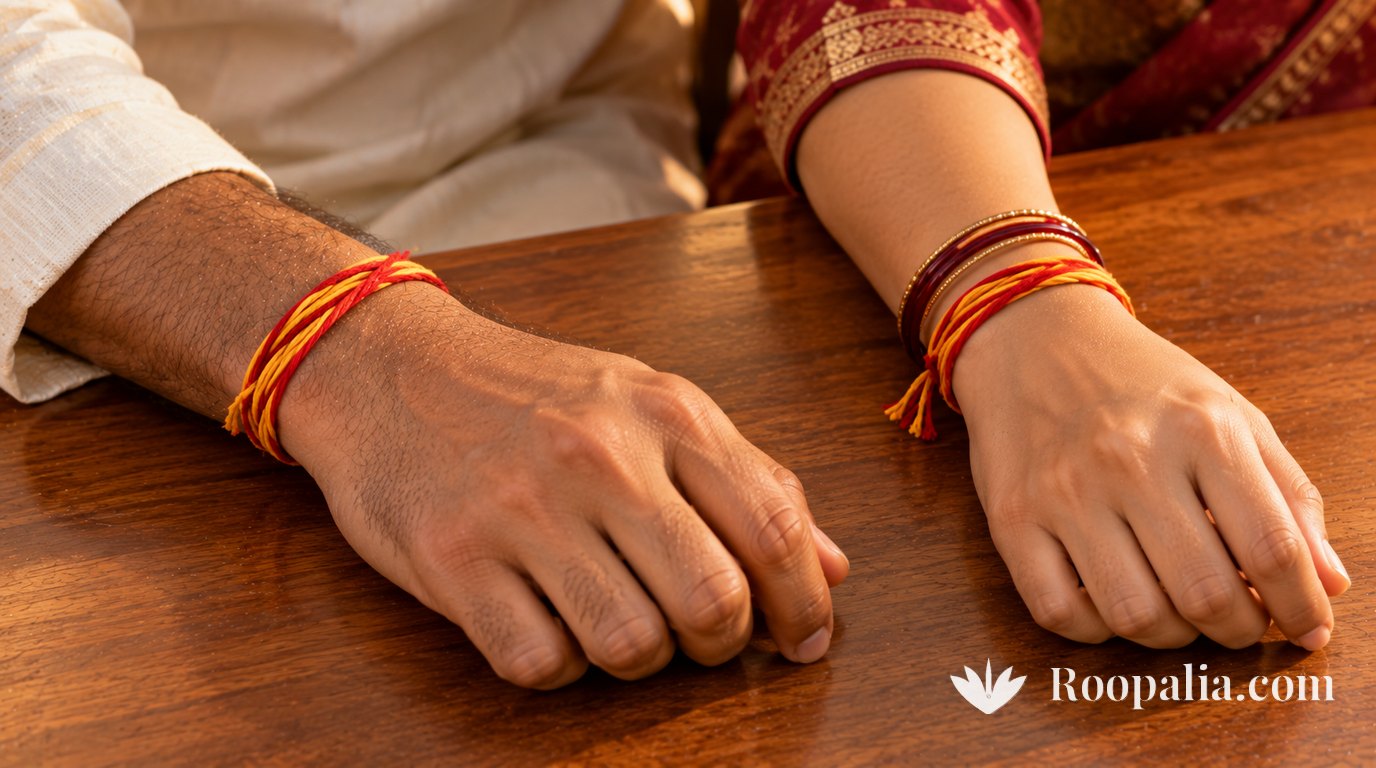
The most common custom is right wrist for men, left for women; Wikipedia says the thread is “traditionally worn on the right wrist or arm by the males and on the left by the females.” Many families, though, tie it on everyone’s right hand, and some switch hands for married women only.
I looked for a scriptural rule on this and did not find one. The oldest written instance of a wedding wrist-thread that I read actually puts it in the bride’s right hand: in the Shankhayana Grihya Sutra (1.12), the groom “gives her into her right hand … a string of three twisted threads”, and her relatives tie on “a red and black, woollen or linen cord” (The Grihya Sutras, SBE 29, tr. Hermann Oldenberg, courtesy: sacred-texts.com). So follow your family’s or your priest’s practice; both are living traditions.
Does a kalava have health benefits?
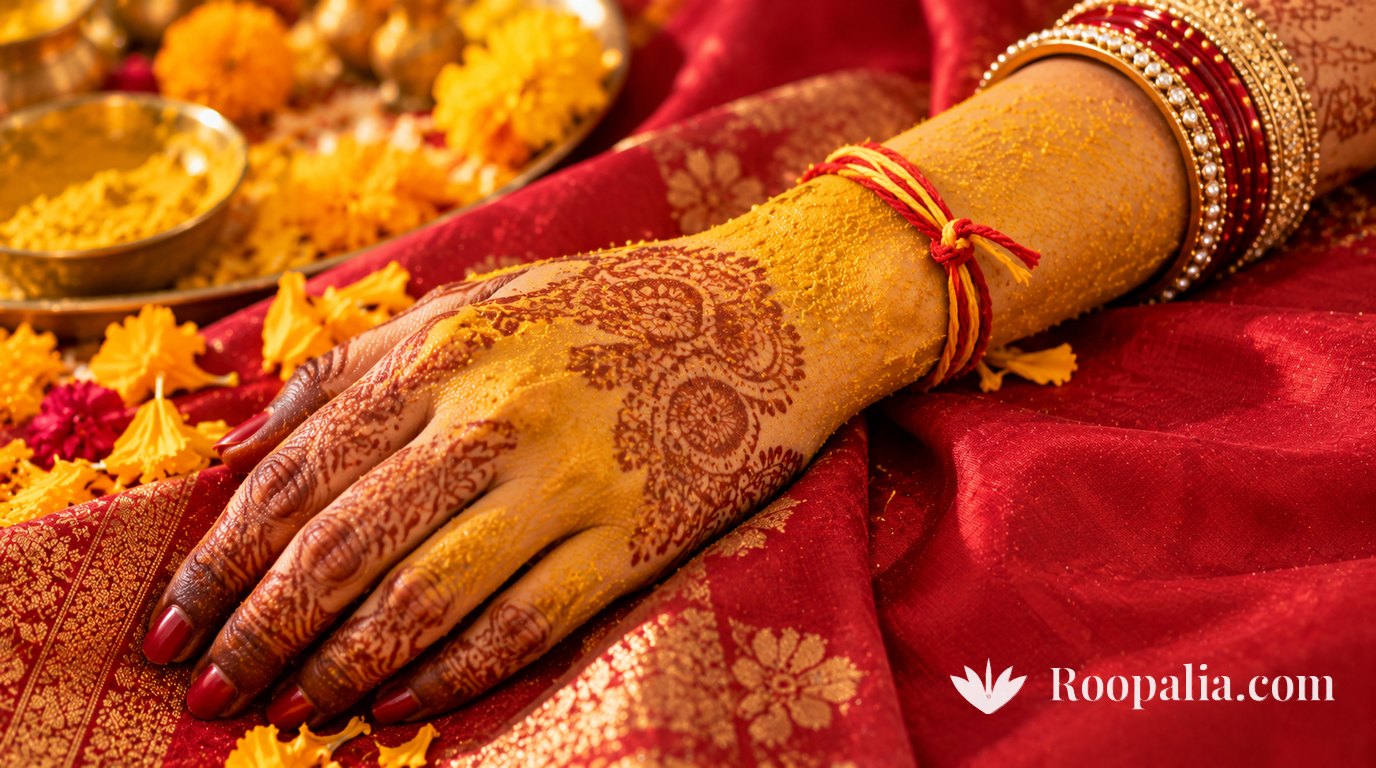
You will read that it presses on a nerve, balances blood pressure or prevents paralysis. I looked for evidence and found none. A health fact-check by THIP Media tested the paralysis claim, quoted a consultant neurologist at Apollo Multi-speciality Hospital, Kolkata, and rated it false:
“there is no scientific evidence to support the notion that a kalava has any health benefits”
— THIP Media fact-check (courtesy: THIP)The meaning of a kalava is faith, blessing and memory — not medicine. One genuine health point: some people react to textile dyes. DermNet notes that “Allergy to textile dye is confirmed by performing special allergy tests, i.e. patch tests” (Textile dye allergy, courtesy: DermNet). If the skin under the thread itches, reddens or breaks out, take it off and see a doctor if it does not settle.
Faith or not, a thread on the wrist meets real workplace rules outside India. Here is what they say.
Wearing a kalava at work outside India

- Hospitals. NHS England’s uniform guidance lists wearing “any jewellery, including a wrist-watch, on the hands or wrists during direct patient care activity” as poor practice. For religious bracelets it asks staff to “ensure that sleeves or bracelets can be pushed up the arm and secured in place for hand washing” (NHS England, courtesy: NHS England). A kalava cannot be pushed up the arm, so check with your ward; many nurses and doctors remove it before shifts and have a new one tied at the next puja.
- Kitchens and food work. Food-hygiene rules in many countries ask staff not to wear wrist jewellery while preparing food. A thread can fall under the same rule — ask your manager.
- Schools. Uniform and jewellery policies vary from school to school; if in doubt, ask the school directly.
How long should you wear a kalava?
Here is the plain answer from my search: no scripture I read sets a number of days. The popular “21 days”, “change it on Tuesday or Saturday” and “wrap it three, five or seven times” are family customs; I could not trace any of them to a text.
The only time span I found in scripture comes from the Bhavishya Purana’s account of the raksha rite: the person who has it tied “sukhī saṃvatsaraṃ bhavet” — “remains happy for a year” (Uttaraparva 137.22; Sanskrit text courtesy: wisdomlib.org, meaning Roopalia’s). That is a promised blessing, not an instruction to keep the thread for a year.
In practice, most families follow some version of this:
- Wear it until the next puja or festival, when a fresh one is tied.
- Replace it sooner if it is dirty, damp or fraying.
- Remove it at once if the skin reacts.
- If your family keeps a particular day for changing it, keep that day.
How to remove it
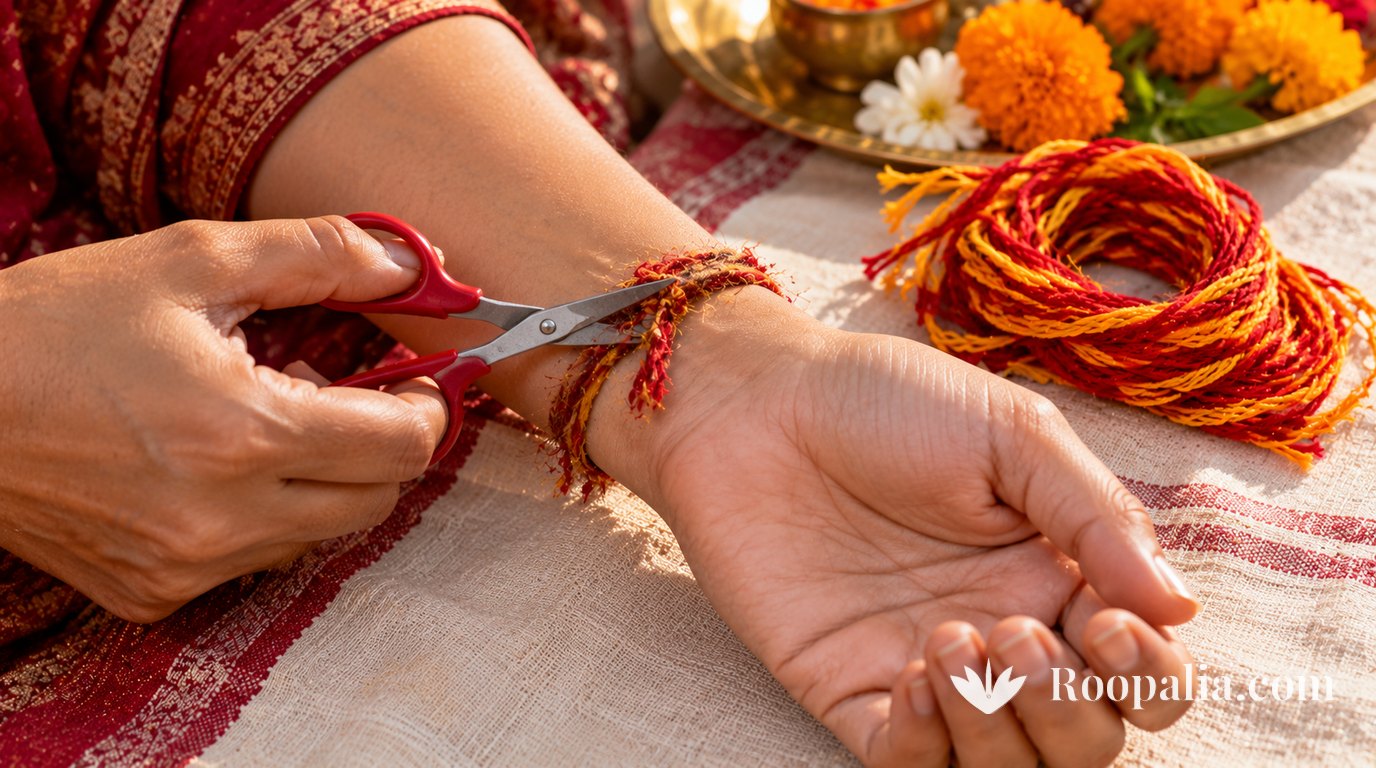
Untie the knot if you can; otherwise slip small scissors under the thread, away from the skin, and cut it. The easiest moment is just before a new one is tied.
What to do with an old red thread
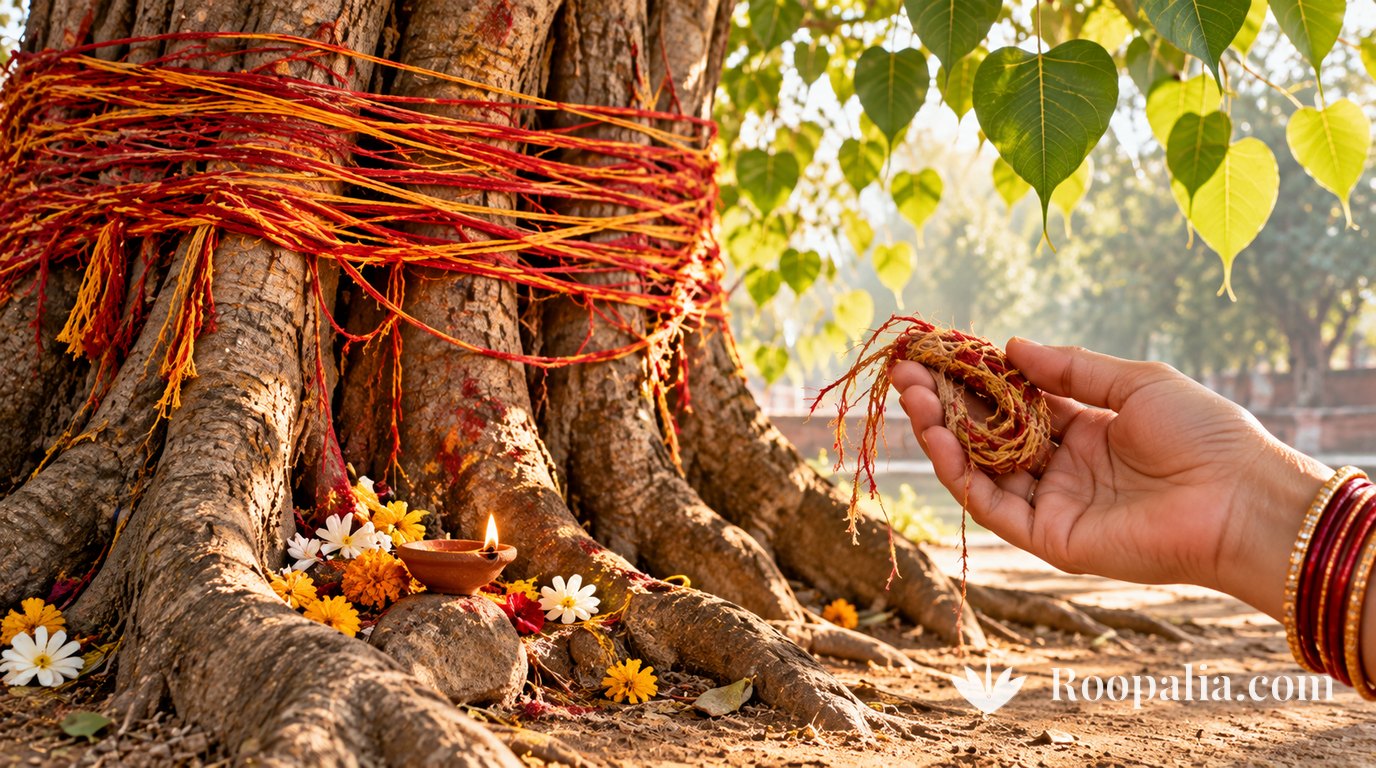
In India, old threads are traditionally left beneath a peepal tree, placed in flowing water, or buried. I found no scriptural rule for any of these; they are acts of respect.
Outside India, do not put it in a river. A leaflet from the Environment Agency in England, written for families scattering ashes, says plainly that “other items should not be placed in the water with the ashes” (Bedford Borough Council / Environment Agency (PDF), courtesy). A traditional kalava is plain cotton, so the simplest respectful option is to bury it in the soil of a garden or plant pot. More on disposing of puja items respectfully: what to do with old idols and god photos.
The verse said while tying it — and where it comes from
Almost every priest says the same verse as the knot is tied:
येन बद्धो बली राजा दानवेन्द्रो महाबलः।
तेन त्वामभिबध्नामि रक्षे मा चल मा चल॥
yena baddho balī rājā dānavendro mahābalaḥ / tena tvāmabhibadhnāmi rakṣe mā cala mā cala
Meaning (Roopalia): “With that by which the mighty Bali, king of the demons, was bound, I bind you. O protection, do not slip, do not slip.”
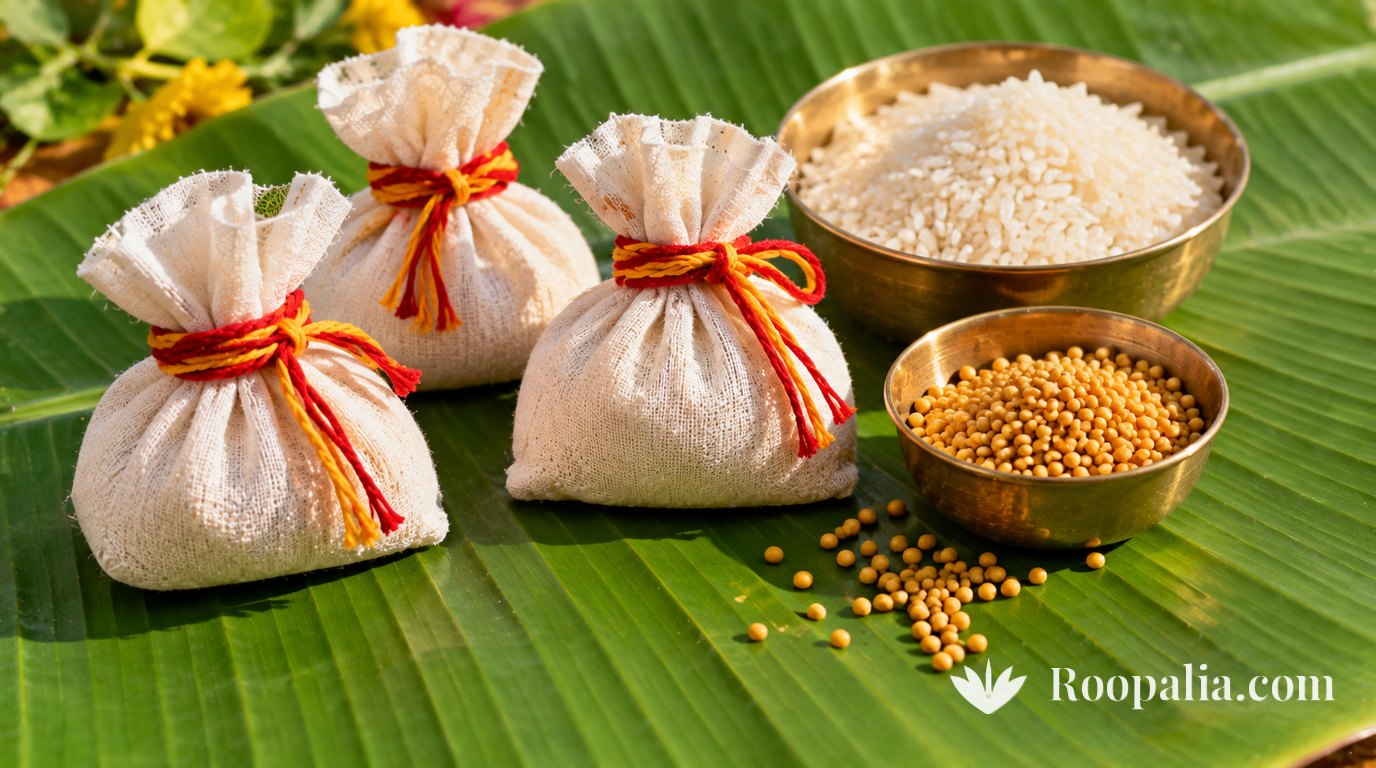
I traced it to the Bhavishya Purana, Uttaraparva, chapter 137, verse 20 (Sanskrit text, courtesy: wisdomlib.org). The historian R. C. Hazra lists that chapter as “137 (on sravana-purnima-raksa-bandhana-vidhi)” — the rite of tying protection on the full moon of Shravana (Studies in the Upapuranas, courtesy: wisdomlib.org). The same chapter describes the original raksha not as a bare thread but as little “rakṣāpoṭalikāḥ”, pouches made with unbroken rice and white mustard seed (verse 14). Today the pouch has gone and the thread remains.
A small textual note: the verse is often printed as “tena tvāṃ pratibadhnāmi, rakṣa”. The authoritative text I read has “tvāmabhibadhnāmi” and “rakṣe”; I could not find the other reading on a reliable page. The meaning is nearly the same.
What I looked for — found and not found
| Question | Result |
|---|---|
| Source of “yena baddho balī rājā” | Found — Bhavishya Purana, Uttaraparva 137.20. |
| Original form of the raksha | Found — rice-and-mustard pouches, Shravana full moon (137.10, 14). |
| Wedding wrist-thread | Found — Shankhayana Grihya Sutra 1.12, bride’s right hand. |
| Right for men, left for women | Found as custom (Wikipedia); no scriptural rule found. |
| 21 days, Tuesday/Saturday, number of wraps | Not found in any text — family customs. |
| Blood pressure / paralysis benefits | No evidence found; claim rated false. |
| Similar threads elsewhere | Found — Jewish red string, Lao/Thai baci, South Indian waist thread. |
The bottom line. A kalava is a blessing — a thread of protection tied by a priest or an elder, with a verse from the Bhavishya Purana. The day-counts and the Tuesday rules are family customs, not scripture, and the health claims do not hold up.
Wear it until your next puja, change it when it frays, take it off for patient care or the kitchen if your job asks, and bury the old one in soil. For more on the meaning behind everyday Hindu customs, read why bangles are worn.
Frequently asked questions
Why do Hindus wear a red thread on the wrist?
What is the meaning of kalava?
How long should you wear a mauli or kalava thread?
Which wrist should the red thread be tied on?
What do you do with an old red thread?
Does a kalava thread have health benefits?
Can I wear a kalava at work as a nurse or doctor?
What mantra is said while tying the kalava?
Sources and cautions: the textual references were checked against published translations — the Bhavishya Purana, Uttaraparva, chapter 137 (verses 10, 14, 20, 22; Sanskrit only, meanings Roopalia’s; courtesy: wisdomlib.org), R. C. Hazra’s Studies in the Upapuranas (courtesy: wisdomlib.org), the Shankhayana Grihya Sutra 1.12 (SBE 29, tr. Hermann Oldenberg; courtesy: sacred-texts.com) and a Hindi–English dictionary. Custom: Wikipedia (Kautuka, Red string, Baci, Aranjanam); health: THIP Media fact-check, DermNet; abroad: NHS England, Environment Agency leaflet. Three things should be said plainly. First, I found no scriptural source for “21 days”, Tuesday/Saturday changing, the number of wraps, the wrist rule or disposal in water or under a peepal; that is the result of a search, not a final verdict. Second, the “pratibadhnāmi” reading was not found on a reliable page, so the reading found is given. Third, a kalava is not a treatment; see a doctor for any skin reaction or illness. No brand or shop is recommended.