Most families learn the Satyanarayan puja as a full-moon ritual. Its own Sanskrit text says something simpler: any day, at dusk.
That one line changes how easy this puja is to keep — especially if you live outside India, far from a priest and with a weekend that rarely lines up with the purnima.
Below: what the puja is for, when to do it, how to do it yourself, the prasad, and the five-chapter story in plain English.
🙏 Every Sanskrit line quoted here was checked against the online Sanskrit text of the katha (courtesy: sanskritdocuments.org). The full katha, chapter by chapter, is in the Hindi version of this article.
What is Satyanarayan puja, and what is it done for?
Satyanarayan puja is a household worship of Vishnu as Satya-Narayana — “God as Truth” — with an offering of sweet prasad and a reading of a five-chapter story, the Satyanarayan vrat katha. It is done to give thanks, to mark a new beginning, or to fulfil a vow: after a wish comes true, on a full moon, at a housewarming, a wedding, a birthday, a new job.
The katha opens with the sage Narada asking Vishnu for a simple remedy for the suffering he sees on earth in the Kali age; the answer is this vrat. Scholars note that it is a comparatively recent and very widespread household rite (courtesy: Wikipedia, Satyanarayan Puja) — more on its history below.
What is the best time to do Satyanarayan puja — morning or evening?
The text itself says: any day, in the evening.
यस्मिन् कस्मिन् दिने मर्त्यो भक्तिश्रद्धासमन्वितः ।
सत्यनारायणं देवं यजेच्चैव निशामुखे ॥१८॥
“On whatever day a person, full of devotion and faith, should worship Lord Satyanarayana — at nightfall.”
— Satyanarayan Vrat Katha, chapter 1, verse 18, tr. Roopalia (courtesy: sanskritdocuments.org)Nishamukhe means “at the mouth of night” — dusk. The full moon and sankranti do appear in the text, but in chapter 4, verse 43, as what one merchant did: “paurnamasyam cha sankrantau krtavan satyasya pujanam” — he worshipped on the full moon and at sankranti. It is an example, not a rule.
| When | Basis |
|---|---|
| Any day, at dusk | The Sanskrit text, 1.18 |
| Purnima and sankranti | The text, 4.43 (as an example) — and the most common custom |
| Kartik, Sharad, Guru or Buddha Purnima | Popular dates; the text names no particular full moon |
| Housewarming, wedding, birthday, a wish fulfilled | Custom; no separate rule in the text |
I read the text looking for days on which it must not be done and found none. Families often postpone pujas during a period of mourning or ritual impurity; that is a separate custom, best checked with your family priest.
Can you do Satyanarayan puja at home without a pandit?
Yes. In the katha itself, a poor Brahmin and then a woodcutter each perform the puja at home with their own families, and in chapter 3 a mother and daughter perform it on their own. A simple order:
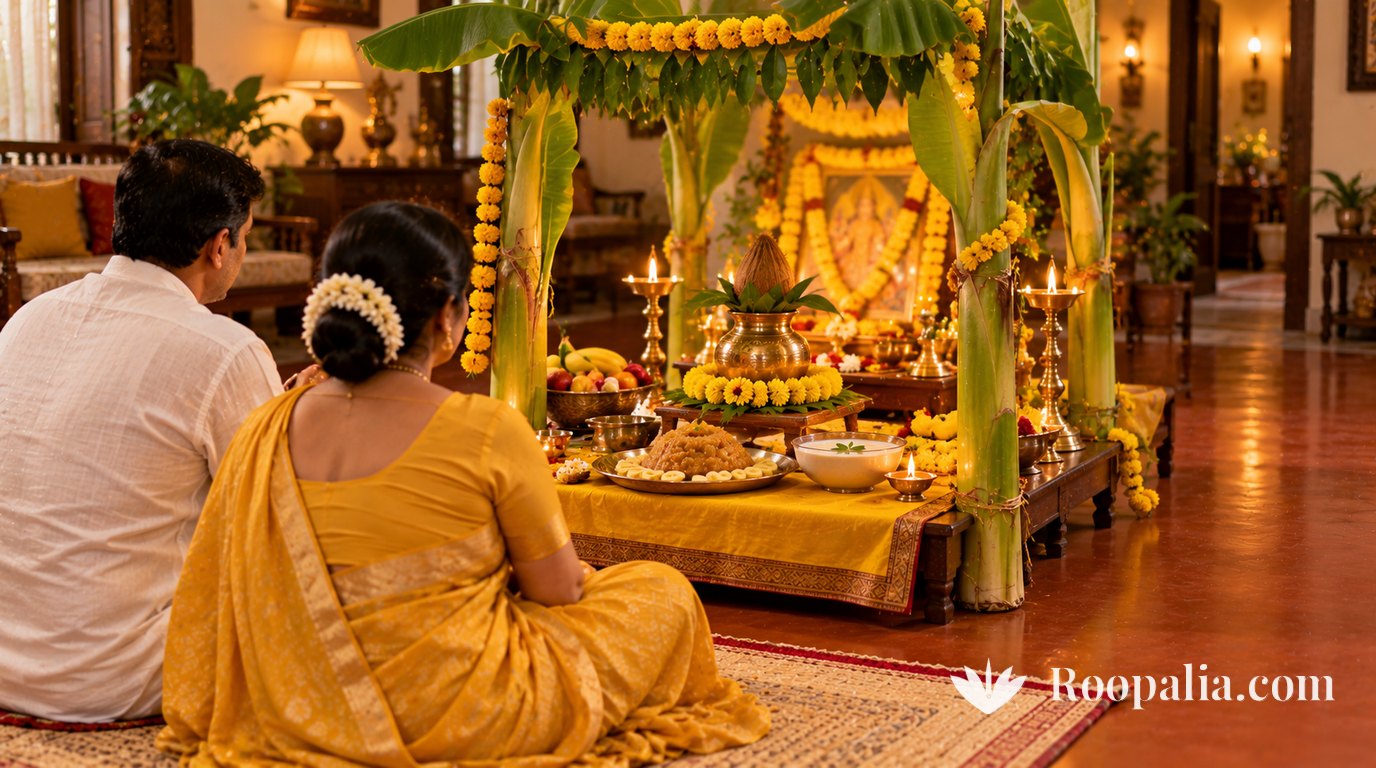
- Pick an evening. A full moon if it suits you; otherwise any day the family is together.
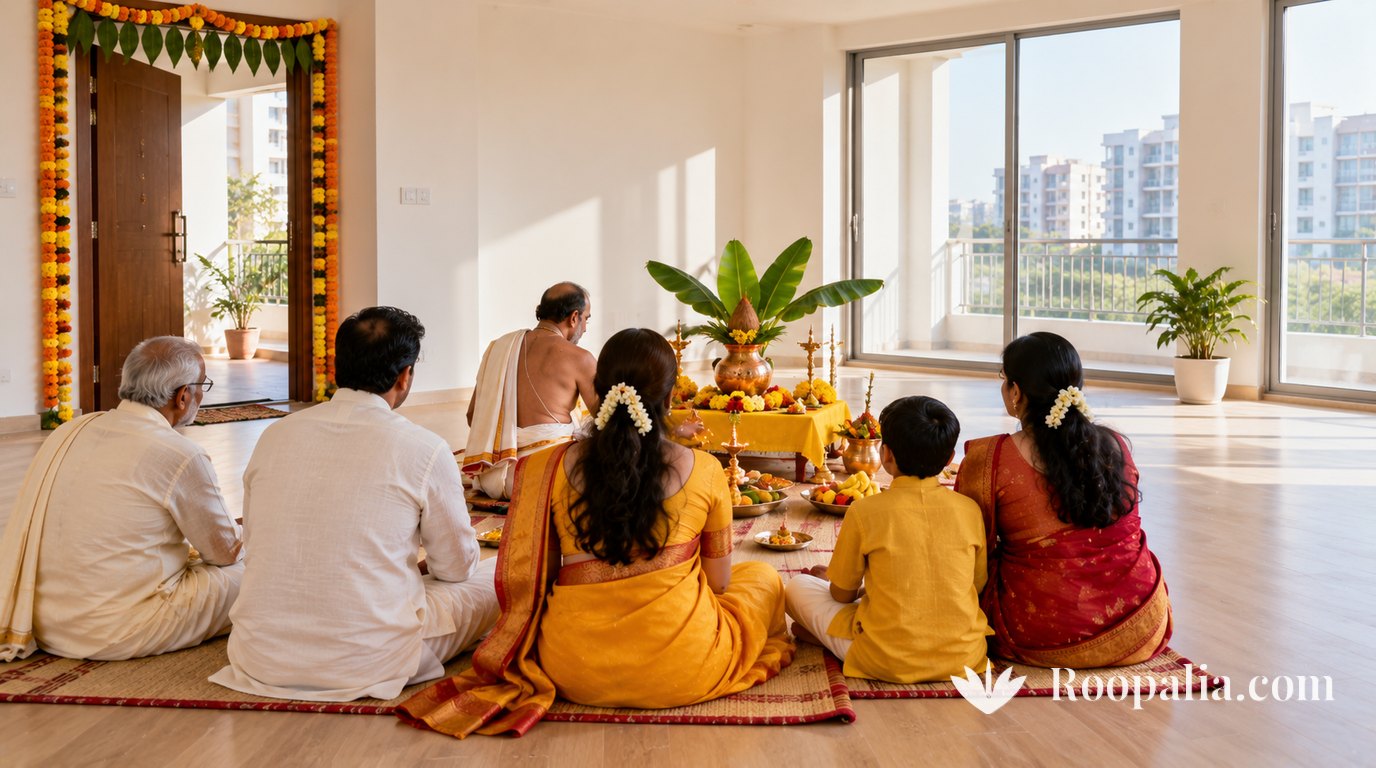
- Set up a low table with a yellow cloth, a picture of Vishnu or Satyanarayan, a kalash and a lamp. For where to place it, see pooja room direction.
- Make the prasad in advance (below) and add a tulsi leaf.
- State your intention (sankalp) in your own words.
- Read the five chapters in order. Different family members can take one chapter each.
- Aarti, then prasad — and make sure every single person present receives it. That is the story’s strongest lesson.
For a fuller guide to worship without a temple nearby, see puja at home without a temple.
Satyanarayan prasad: what “sawaya” means, and the measurements
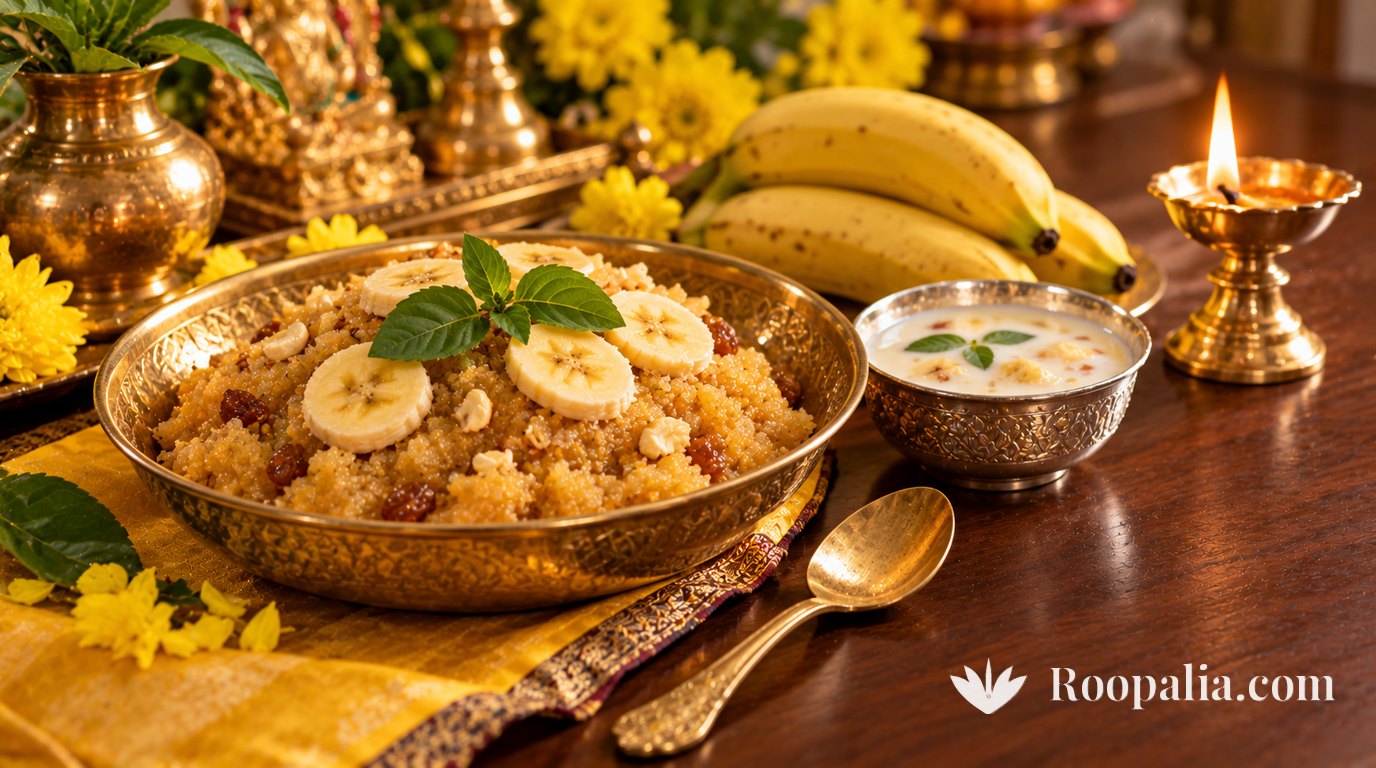
The text names the prasad and its measure: banana, ghee, milk and wheat flour, offered sapada — one and a quarter.
नैवेद्यं भक्तितो दद्यात् सपादं भक्ष्यमुत्तमम् ।
रम्भाफलं घृतं क्षीरं गोधूमस्य च चूर्णकम् ॥२०॥
“With devotion, offer the finest food, one and a quarter in measure: plantain, ghee, milk and wheat flour.” If these are lacking, the next line allows rice flour, sugar or jaggery.
— Satyanarayan Vrat Katha, chapter 1, verse 20, tr. Roopalia (courtesy: sanskritdocuments.org)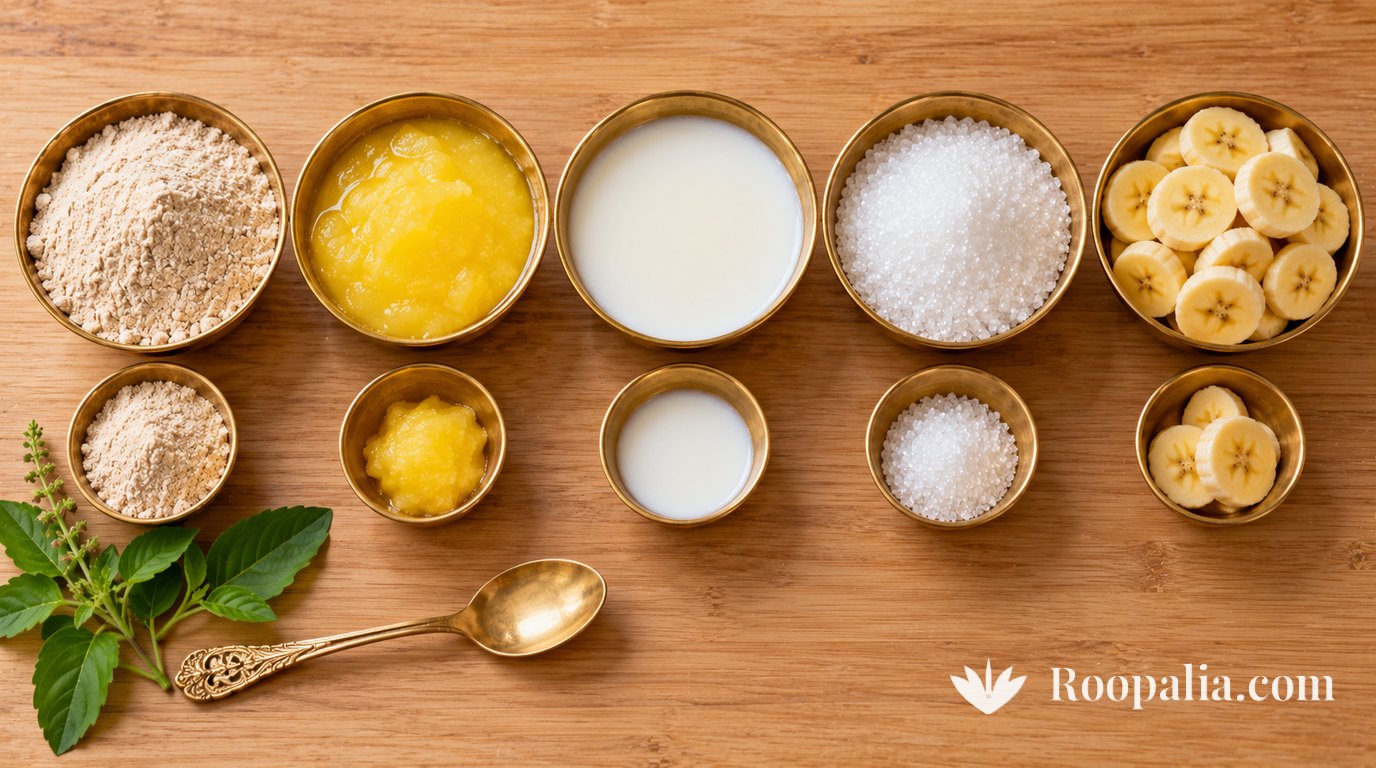
- Sawaya = sapada = 1¼. Take any measure you like and add a quarter of it again.
- Equal measures are the family custom: 1¼ cups each of flour (or semolina), ghee, milk, sugar and mashed banana. The text says “sawaya”; the equal ratio is tradition.
- Sheera or panjiri? In Maharashtra and the south, the ingredients become sheera — flour or semolina roasted in ghee, cooked with milk, sugar and banana. In much of north India it is panjiri (roasted flour with sugar) with panchamrit. Both start from the same five things.
And here is the story that all of this is built around, in five short parts.
Satyanarayan katha in English — the short version
1. Narada’s question. Narada asks Vishnu how ordinary people in the Kali age can be freed from suffering. Vishnu describes the Satyanarayan vrat: worship at dusk, offer sawaya prasad, hear the story with family and friends, and feed them before eating yourself.
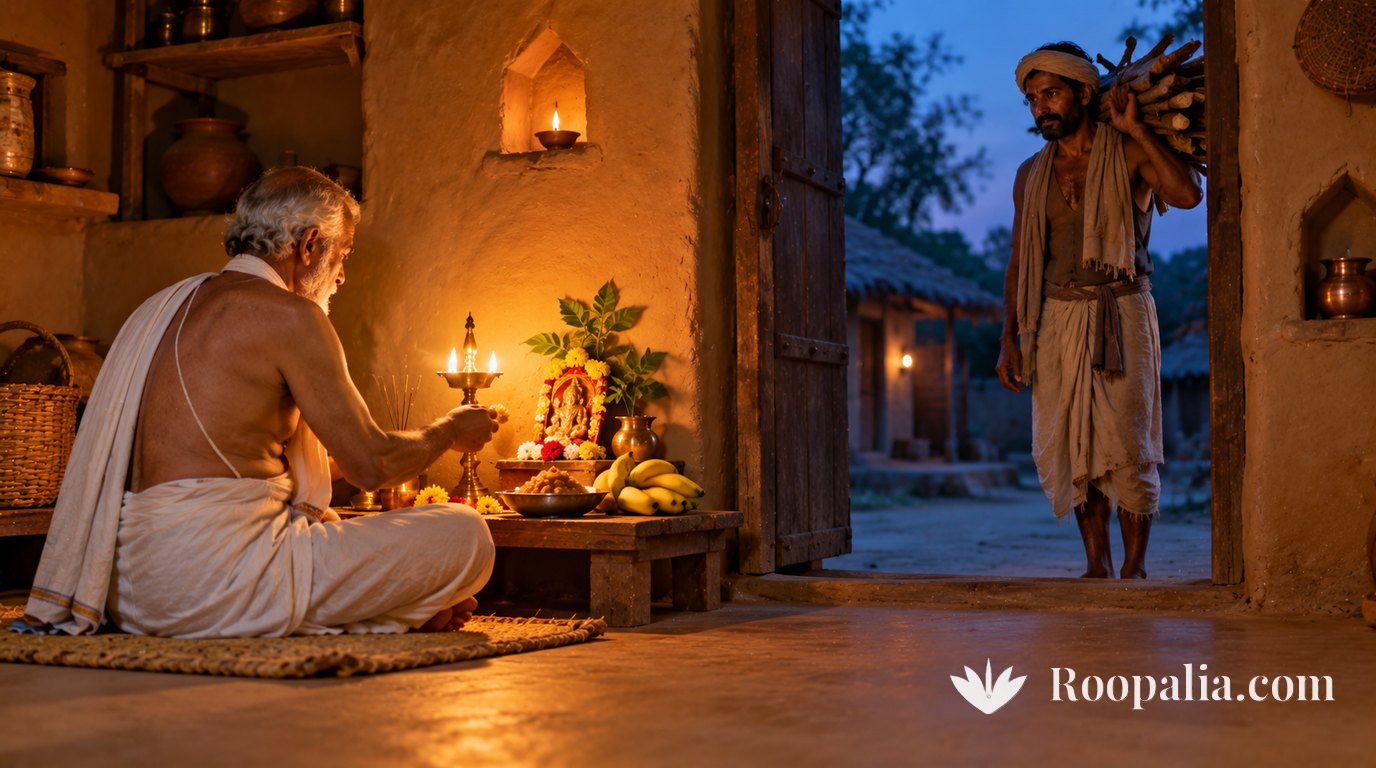
2. The Brahmin and the woodcutter. A poor Brahmin in Kashi is taught the vrat by the Lord, who comes to him as an old Brahmin. He performs it with what he receives as alms, and prospers. A woodcutter watching at his door resolves to do the same with that day’s earnings — and receives four times the usual price for his wood.
3. The merchant who kept postponing. A merchant named Sadhu sees King Ulkamukha performing the vrat on a riverbank and vows to do it if he is blessed with a child. A daughter, Kalavati, is born to his wife Lilavati — and he postpones: at her wedding. The wedding comes and goes. On a trading trip with his son-in-law, both are falsely accused of theft in King Chandraketu’s city and imprisoned. Back home, Kalavati sees the katha at a Brahmin’s house; she and her mother perform it, and the king, told in a dream, releases the two men with double their wealth.

4. “Only leaves and creepers.” On the way home, an ascetic (the Lord in disguise) asks what is in the boat. The merchant mocks him: only leaves and creepers. “So be it,” says the ascetic — and the cargo turns to leaves. The merchant begs forgiveness and is restored. Then, when word of his return reaches home, Kalavati runs to meet her husband leaving the prasad behind, and the boat with her husband vanishes into the water. Only when she goes back and eats the prasad does he return.

5. The king who refused the cowherds’ prasad. King Tungadhvaja comes upon cowherds worshipping Satyanarayan in the forest and, too proud to join, leaves their prasad untouched. He returns to find his sons and wealth lost — “tasya putrashatam nashtam”, says the text: his hundred sons were lost. He goes back, worships with the cowherds, eats the prasad, and all is restored.
Every punishment in the story follows a lapse of truth: a vow postponed, a lie told to a stranger, prasad abandoned, and prasad refused because it came from “lesser” people. That is the meaning of the name. The god of this puja is Satya — truth itself.
The Sanskrit text ends with who these characters became in later lives; the first is the poor Brahmin, Shatananda, reborn as Sudama, Krishna’s friend (chapter 5, verse 19).
Where does the Satyanarayan katha come from?
Every chapter of the Sanskrit text ends by naming the Skanda Purana, Reva Khanda — but scholars dispute that attribution. What I found:
- R. C. Hazra notes that the worship is described in the Pratisarga Parva of the Bhavishya Purana and in the Reva Khanda of the Vangavasi Press (Calcutta) edition of the Skanda Purana — and that the whole Reva Khanda is found only in that edition, whose editor added chapters from Bengal manuscripts.
- G. V. Tagare, in the introduction to his English translation of the Venkateshwar Press Skanda Purana, calls the Satyanarayana mahatmya “spurious”.
- The Bhavishya Purana version uses different names — the merchant Lakshapati, King Chandrachuda, the son-in-law Shankhapati — and scholars date the Pratisarga Parva itself to the 18th–19th centuries (courtesy: Wikipedia, Bhavishya Purana).
- Several scholars connect the puja with Satya Pir, a figure revered by Hindus and Muslims alike in Bengal, and date the Sanskrit form to around the 17th–18th century (courtesy: Wikipedia, Satya Pir).
- The University of Pennsylvania holds an 18th–19th-century manuscript of the Satyanarayanakatha, written on blue paper, whose colophon also names the Skanda Purana’s Reva Khanda (courtesy: UPenn, Ms. Coll. 390 Item 2778).
None of this lessens the puja. It simply places the story where its details already point: merchants, river boats, ghats and a king’s prison — a world a few centuries old, not a Vedic one.
Satyanarayan puja outside India
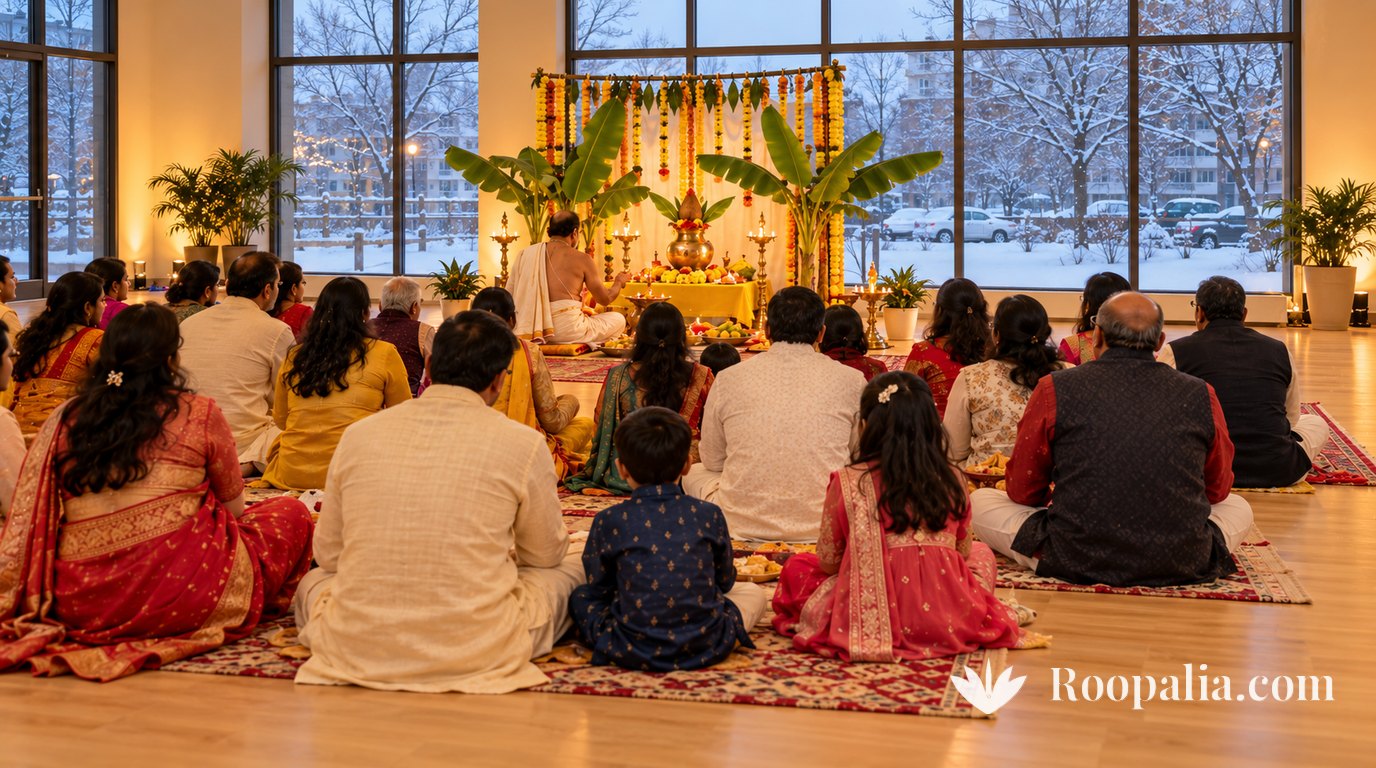
- The weekend problem is solved by the text. “Any day, at dusk” means a Saturday evening is as valid as the full moon.
- Full-moon dates should be taken from a calendar for your own city; they can differ from India’s by a day. See why your festival date differs from India.
- Ingredients — flour, ghee, milk, sugar, bananas — are in any grocery store. Banana stems for a canopy are a custom, not a requirement of the text.
- Community kathas: ask your nearest temple or Indian community association whether they hold one on the full moon; for families living far from relatives it becomes a gathering in itself.
- Housewarming: a Satyanarayan katha is customary for a new home almost everywhere; the text has no separate rule for it, but its warning about postponed vows explains why families do it on the day the wish comes true.
👨👩👧 Telling the katha to children
Give each child one chapter to “own”, and let them retell it in their own words after it is read. The fourth chapter works best: ask them why the cargo turned into leaves. They will get there on their own — because he lied. Then ask why the boat sank when Kalavati ran. That one takes longer, and it is the conversation worth having: about not leaving a shared thing half-finished, and about honouring what someone else has offered you. More ideas in how to explain Hinduism to a child.
Why no aarti lyrics? The popular aarti sung after the katha appears with different lines on different sites, and I could not check it against a reliable printed source. Read it from your family’s booklet.
What I found, and what I did not
| Question | Result |
|---|---|
| Number of chapters | Found — five, in the Sanskrit text |
| Best time | Found — any day, at dusk (1.18) |
| Full moon and sankranti | Found — 4.43, as one merchant’s practice |
| Sawaya prasad | Found — 1.20: banana, ghee, milk, wheat flour |
| Equal 1¼ measures of each | Custom — the text says sawaya, not equal parts |
| Rule for housewarming; banana-stem canopy | Not found — custom |
| Origin in the Skanda Purana | Disputed — named in the colophons; Hazra and Tagare treat it as a later addition |
| A verified aarti text | Not found — lyrics not printed |
“Not found” does not mean “does not exist”. It is the honest result of my search, not a final verdict.
A puja whose god is named Truth
The Satyanarayan puja asks for very little: one evening, five ordinary ingredients in a measure of one and a quarter, and a story read aloud. What it asks you to avoid is harder — a vow postponed, a careless lie, and prasad left behind or turned away. Its own text sets no special day for it. Any evening on which a family sits down together will do.
What is Satyanarayan puja done for?
What is the best time to do Satyanarayan puja, morning or evening?
Can we do Satyanarayan puja at home by ourselves, without a pandit?
What are the measurements for Satyanarayan prasad (sheera)?
Can you tell the Satyanarayan katha in English, in short?
Is the Satyanarayan katha really from the Skanda Purana?
How many chapters are there in the Satyanarayan katha?
Why is Satyanarayan katha done at a housewarming (griha pravesh)?
Sources and cautions: the Sanskrit verses (1.18, 1.20, 4.43, 5.19) and the colophons were checked against the Satyanarayan Vrat Katha text on sanskritdocuments.org; the English renderings are Roopalia’s. The order of the story was checked against the five chapters on bhaktibharat.com. Scholarly views (R. C. Hazra, G. V. Tagare, the Bhavishya Purana version, Satya Pir) are from Wikipedia’s Satyanarayan Puja, Satya Pir and Bhavishya Purana articles; the manuscript is University of Pennsylvania Ms. Coll. 390 Item 2778. Three things should be said plainly. First, I did not find a seven-chapter version, a separate rule for housewarmings, or the banana-stem canopy in the text; these are customs, and this is the result of a search, not a final verdict. Second, no verified printed text of the aarti was found, so its lyrics are not printed. Third, this article does not ask anyone to fast; with diabetes, blood-pressure problems, pregnancy or any illness, ask your doctor first.