
Your daughter comes home and says a friend told her you worship statues.
Or your son, at bedtime, asks why God cannot be seen. Or a teacher sends a note home asking whether he can bring something in for a class on world religions, and you find yourself with no idea what to send.
And the strange part is that you are not short of belief. You are short of words. Nobody ever had to explain this to you — you grew up inside it, where the street, the calendar and the school holidays did the explaining. Your child is growing up somewhere that explains nothing.
Here is what Google's own suggestions say when you begin typing how to explain hinduism to. The first is "to a christian". The second is "to a child". That ordering is the whole problem in two lines — the difficulty is not the subject. It is the listener.
🙏 Every scriptural passage below was opened and checked, with the Sanskrit and the link beside it. Where we could not find something, we say so. Nothing here asks anyone to believe anything — it only sets out what the tradition itself has said.
First, why this is harder here than it was for your parents

In India nobody teaches a child what a diya is. The child simply sees several hundred of them a year.
Repetition did the work. Outside India that repetition stops at your own front door, and whatever is not said inside the house is not going to arrive from anywhere else. That is the honest reason this feels like a job — because for the first time in the family's history, it actually is one.
Which is also the reason it does not need a curriculum. It needs a handful of sentences you can reach for when the moment comes. That is what this article is.
What you will find if you search, and why it will not help
We looked at what currently ranks for how to explain hinduism to a child, because you will look too.
The first page is almost entirely school-curriculum material: a lesson-plan site, a children's encyclopaedia, a teacher-resource library, a page written for primary school topic work, and — genuinely — a local council's committee papers. One result is a toy shop's blog.
All of it is written from outside, for a classroom. It answers "what is Hinduism" for someone studying it as a subject.
We could find almost nothing written for the parent whose own child is asking.
Those are not the same job. A teacher needs a syllabus. You need an answer in the next thirty seconds, in the dark, at bedtime, from someone who is inside this and is being asked by someone they love.
The one thing not to do
Do not start with a list.
The instinct is to explain the scale of it — the gods, the four Vedas, the ages of the world — because that feels like being thorough. It is the fastest way to lose a child's attention, and it teaches them that this subject is homework.
There is also a quieter cost. A child who is told a great deal and shown nothing learns that the family's tradition is a body of information they are behind on. That feeling does not go away easily.
The alternative is not a shorter lecture. It is a different move altogether, and the tradition's own texts make it.
Three conversations, and what actually works in each
1. "Why can't I see God?"
Do not answer this one with words. Answer it with a seed.
Cut an apple in half. Take out a seed. Ask the child where, inside that seed, the whole tree is hiding — and whether they can see it. They will say no. Then say: "So something you can't see can still be what everything comes out of."
This is not a modern teaching trick. It is a passage from the Chandogya Upanishad, in which the sage Uddalaka teaches his son Shvetaketu. He gives no sermon. He gives an instruction:
“Uddālaka said, 'Bring me a fruit from this banyan tree.'” — and then: break it, what do you see; break the seed, what do you see now.
— Chandogya Upanishad 6.12.1
The boy finds nothing inside the seed. And the father says:
“O Somya, the finest part in that seed is not visible to you. But in that finest part lies hidden the huge banyan tree.”
— Chandogya Upanishad 6.12.2
Three thousand years old, and it is still the best answer available — because the child holds the evidence in their own hand.
2. "My friend says you worship statues"
This one is about tone more than content, and the first rule is counter-intuitive: do not criticise the friend. Your child will play with that friend tomorrow. Make the friend an opponent and you put your child in the middle of something they did not start.
The second rule is the useful one. Teach your child to show, not to defend. Defending requires someone to be wrong. Showing requires nobody to be wrong.
So: "A statue isn't the god — it's more like a photo of your grandmother. You don't think the photo is Nani. But you wouldn't put it on the floor either."
Most children work out the rest themselves, and most eight-year-olds find that answer entirely satisfying.
3. "Do I have to do this?"

The honest answer is the one that works: "Not today if you don't want to. Stay and watch. If you feel like joining in later, the door's open."
Compulsion at a shrine is the most reliable way to lose a teenager. And the tradition itself puts the explaining before the believing, not after. In that same Chandogya passage the father says śraddhatsva somya — "have faith, dear boy" — but he says it after the seed is broken open, never before.
What the tradition actually asks you to pass on

Many parents never begin because they believe they must first know everything themselves.
So it is worth looking at what the tradition said at the very moment it mattered most — the teacher's final address to a student whose education was complete. It is in the Taittiriya Upanishad:
सत्यं वद । धर्मं चर ।
“Speak the true. Follow Dharma.”मातृदेवो भव । पितृदेवो भव । आचार्यदेवो भव । अतिथिदेवो भव ।
— Taittiriya Upanishad 1.11
“Treat thy mother as a God; as a God treat thou thy father; as a God shalt thou treat thy teacher; thy guests as Gods shalt thou treat.”
Now read it again for what is missing.
Not one deity is named. Not one story is told. There is nothing at all to memorise.
What is handed over is conduct — tell the truth, live rightly, honour your mother, father, teacher and guest.
Which means the thing you are most anxious about not knowing was never the thing being transmitted. You already have what is being asked for.
One honest caveat. This address was given to a grown student leaving years of study, not to a small child. We quote it to show what the tradition ranks highest, not as a prescription for teaching children.
If your child asks something you cannot answer
Say so. And then tell them about Nachiketa.
In the Katha Upanishad a boy puts a question to Yama, the lord of death, about what lies beyond dying. Yama does not want to answer. He offers the boy gold, horses and elephants, long life, chariots, music and dancers — anything, if he will drop the question.
The boy hands it all back:
“Ephemeral these; Oh Death, these tend to the decay of the fire (vigour) of all the senses in man.”
— Katha Upanishad 1.1.26
He keeps the question instead.
The tradition did not call that boy difficult. It made him the hero of an entire Upanishad, and the teaching Yama finally gave him is still read today.
So a child who will not stop asking is not drifting away from this. They are standing exactly where Nachiketa stood. Telling them that is worth more than any answer you could have improvised.
If the school asks you to come in
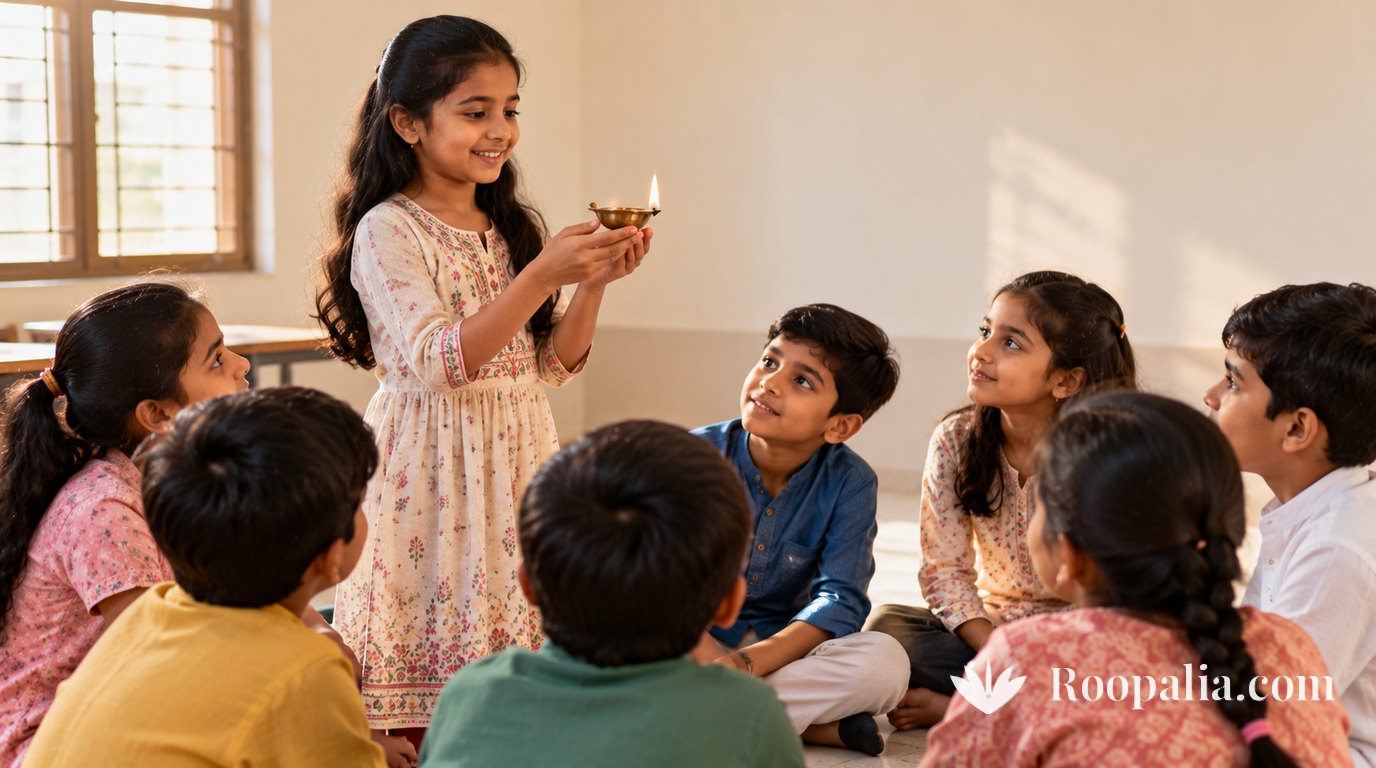
Say yes, and keep it small.
The mistake is to try to cover a religion in fifteen minutes. Bring one object instead — a diya is the best of them — light it if you are allowed, and talk about what it is for. Children remember a flame. They do not remember a definition.
Two things worth knowing before you go. Ask the teacher about naked flames first, because many schools do not allow them and a battery light is a fine substitute. And if there is a question you cannot answer, say you do not know and that you will find out — that answer does your child more good in front of their class than a confident guess.
There is a quieter benefit too. A child who has once stood up and shown their own class something from home loses a particular kind of self-consciousness, and it usually does not come back.
The short version

Do not begin with a list. Begin with something the child can hold.
Cut a seed for the invisible. Use a photograph of a grandmother for the statue. Let "not today, but watch" stand as an answer. Ask a grandparent for a five-minute story rather than explaining it yourself — what a parent says sounds like a rule, what a grandmother says sounds like a story, and stories reach places rules never do.
And when you are out of answers, tell them about the boy who was offered the world to stop asking, and did not take it.
How do I explain Hinduism to a child?
What do I say when my child asks why God can't be seen?
My child says a friend told them we worship statues. What should I say?
Do I need to know everything about Hinduism before I can teach my child?
Should I make my child sit for puja?
What if my child asks a religious question I cannot answer?
How do I explain Hinduism to someone who is Christian, or of another faith?
What should I bring if my child's school asks me to talk about our festival?
Why is it harder to pass this on outside India?
Is it better for grandparents to explain these things?
Sources and cautions: all three scriptural passages here were opened on wisdomlib with the Sanskrit beside them and are linked in the article — Katha Upanishad 1.1.26 (Nachiketa), Chandogya Upanishad 6.12.1 and 6.12.2 (the banyan fruit and the seed), and Taittiriya Upanishad 1.11 (satyaṃ vada, dharmaṃ cara; mātṛdevo bhava). One caveat we want stated plainly: the Taittiriya address was given to a grown student leaving years of study, not to a small child — we cite it to show what the tradition ranks highest, not as a method for teaching children. The search results described here are our own check of what currently ranks, and rankings and autocomplete suggestions change with time, place and language. School rules on naked flames are set by each school — ask yours. Nothing here asks anyone to believe anything.