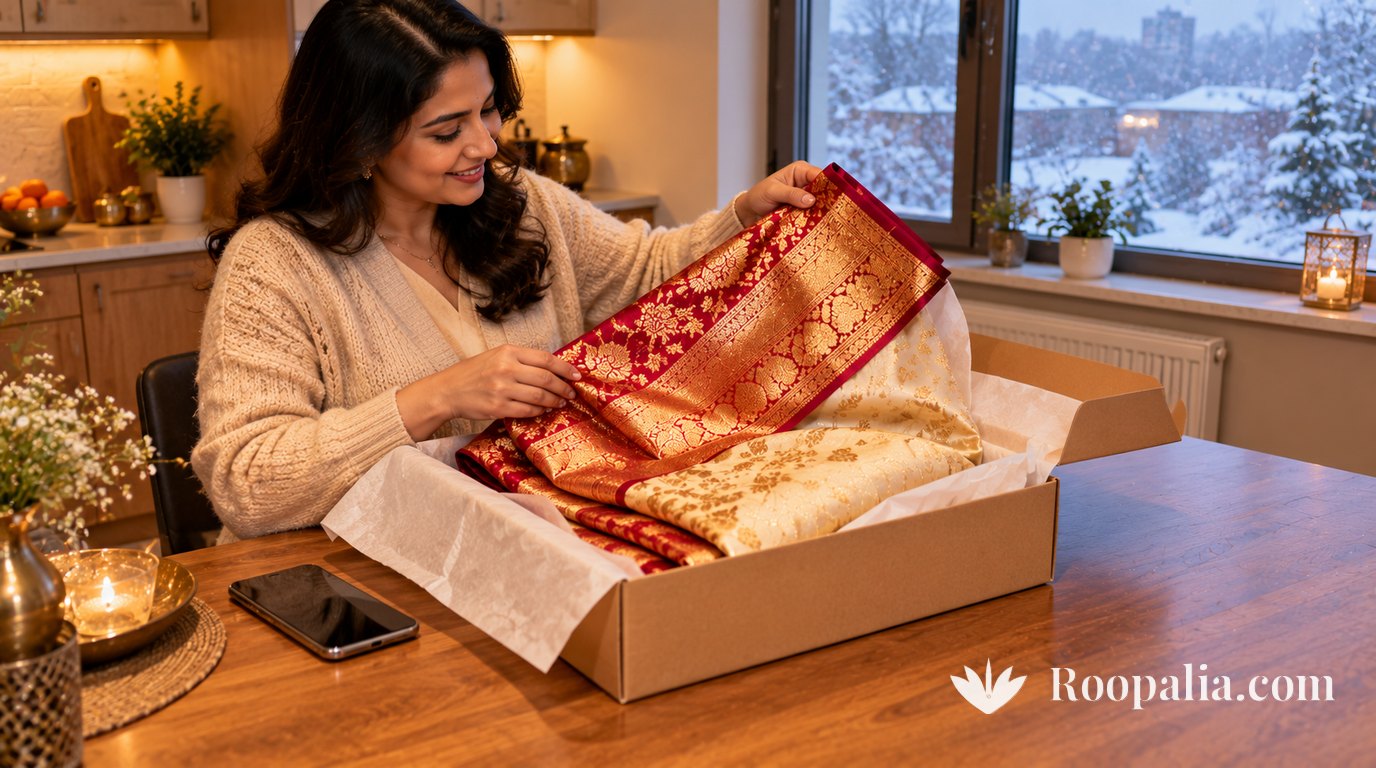
The video call is grainy. On the other end, a shopkeeper in Varanasi lifts a red pallu to the light and promises it is pure handloom. You are in Leicester, or New Jersey, or Brampton, the wedding is in eleven weeks, and the saree will cost more than the flight home. You have about thirty seconds to decide whether to trust a phone screen.
Search “how to identify real Banarasi saree” and the answers that rise to the top, including Google’s AI Overview, come largely from shops that sell sarees. Their advice isn’t wrong, but it is written by the people you are trying to check.
So I went to public records instead. Two facts changed how I would buy: the name “Banarasi” is legally limited to six districts, and the Silk Mark — the label most buyers look for — does not certify what many people assume it does.
The short version: to tell a real Banarasi, check three things — the GI region (Banaras Brocades and Sarees received its Geographical Indication certificate on 4 September 2009, and sarees made outside six Uttar Pradesh districts cannot legally be sold as Banarasi), the reverse side (handloom shows loose floating threads behind the motifs; powerloom is smooth), and the Silk Mark, which certifies pure natural silk but not handloom. A Kanjivaram is identified by its korvai joint, where the border and body are woven separately and interlocked.
Buying from outside India: what to ask before you pay
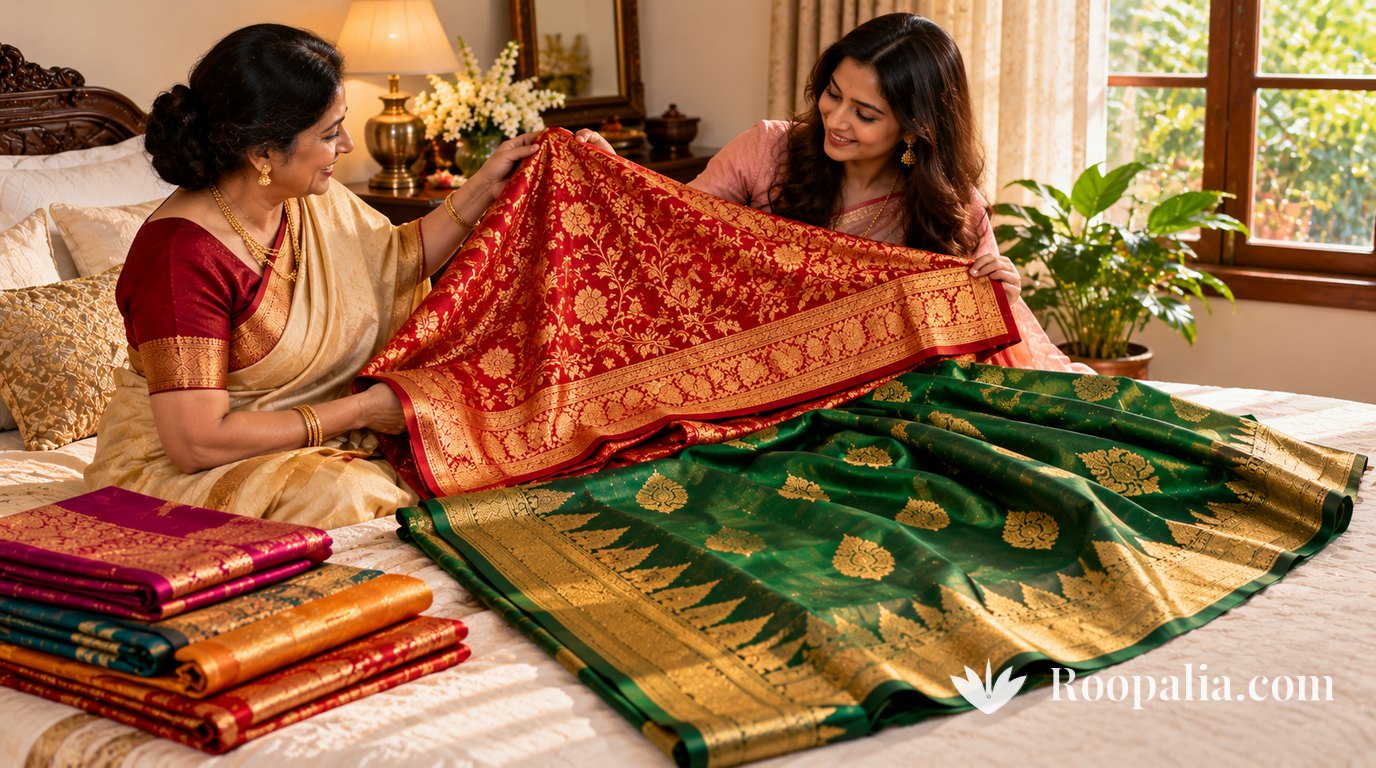
- A close photo of the reverse side, behind a motif. This is the single most useful picture you can request.
- A photo of the Silk Mark tag with its number visible.
- If it is sold as Banarasi: which district was it woven in? The answer should be one of Varanasi, Mirzapur, Chandauli, Bhadohi, Jaunpur or Azamgarh.
- If it is a Kanjivaram: a close photo of where the border meets the body.
- An invoice that states the fabric (“pure silk”), the weave (“handloom”) and the return terms in writing.
A seller who has a genuine handloom saree has no reason to refuse any of these.
When the parcel arrives
- Photograph it before you unfold it fully, then the reverse side, the tag and the invoice.
- Compare the reverse with the photo the seller sent.
- Check the Silk Mark tag is attached and matches the number you were shown.
- For a Kanjivaram, run your fingers along the border joint.
- If anything differs, raise it immediately, in writing, within the return window.
Most buyers treat the Silk Mark as the final word. Here is what it actually certifies.
What the labels prove — and what they don’t
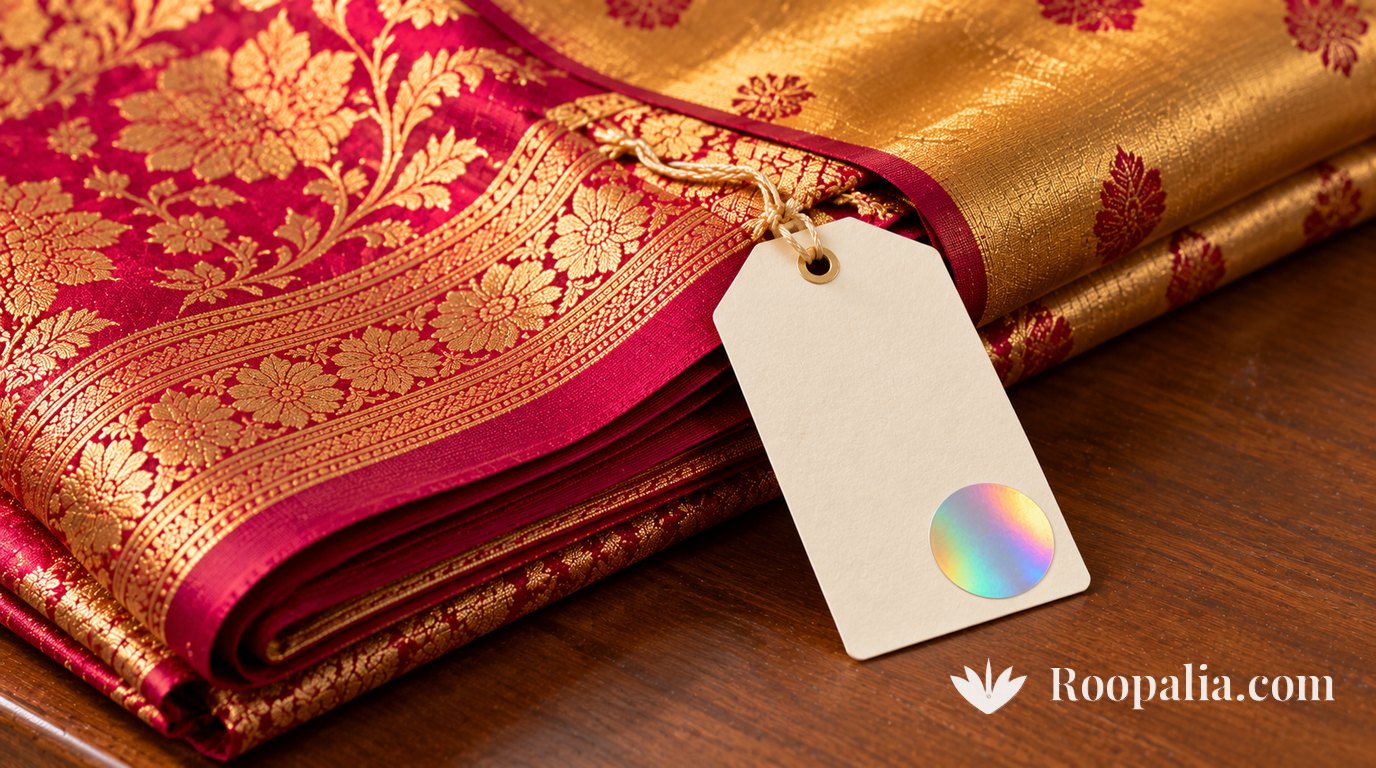
The Silk Mark
According to Wikipedia’s article on the Silk Mark, it is a certification mark set up by India’s Central Silk Board in 2004 and run by the Silk Mark Organisation of India:
“The mark certifies that the piece of textile which bears the mark is made of pure natural silk.”
— Wikipedia, Silk Mark (courtesy: Wikipedia)- It proves: the fabric is pure natural silk.
- It does not prove: that the saree is handloom, or that it is a Banarasi or Kanjivaram. A powerloom saree woven in pure silk can carry it.
- Labels originally used a hang tag with a uniquely numbered hologram; because of counterfeiting, weaving the mark into the fabric has been proposed.
- If in doubt, Silk Mark products can be tested free of charge at accredited labs (Silk Mark Chapters).
The GI tag
The official website of the Varanasi district administration lists “Banaras Brocades and Sarees” with a GI certificate dated 4 September 2009. Wikipedia’s Banarasi sari article records the consequence: no sari or brocade made outside six districts of Uttar Pradesh — Varanasi, Mirzapur, Chandauli, Bhadohi, Jaunpur and Azamgarh — can legally be sold under the Banaras name. “Banarasi-style” is a description; “Banarasi” is a protected origin. Kanchipuram silk received GI recognition in 2005–06.
Reading the weave: handloom vs powerloom
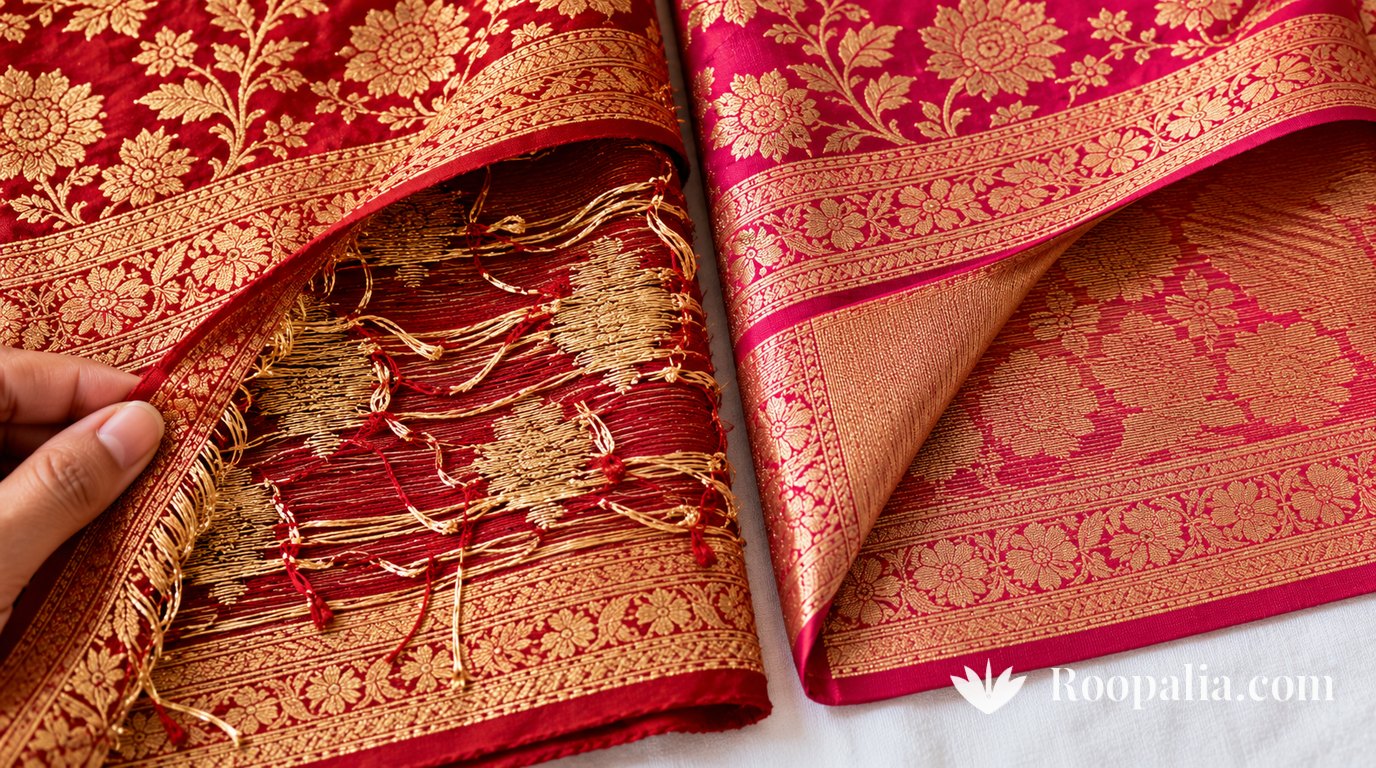
- Handloom Banarasi: behind each motif, zari and silk threads float in longer and shorter lengths, with clipped ends. The back looks a little uneven — it was done by hand.
- Powerloom: the reverse is usually clean, flat and uniform, with no loose threads, and every motif is identical.
I did not find this method written up in a government guide. It is weavers’ and traders’ experience, consistent across almost every source. Treat it as the first check, not the last word.
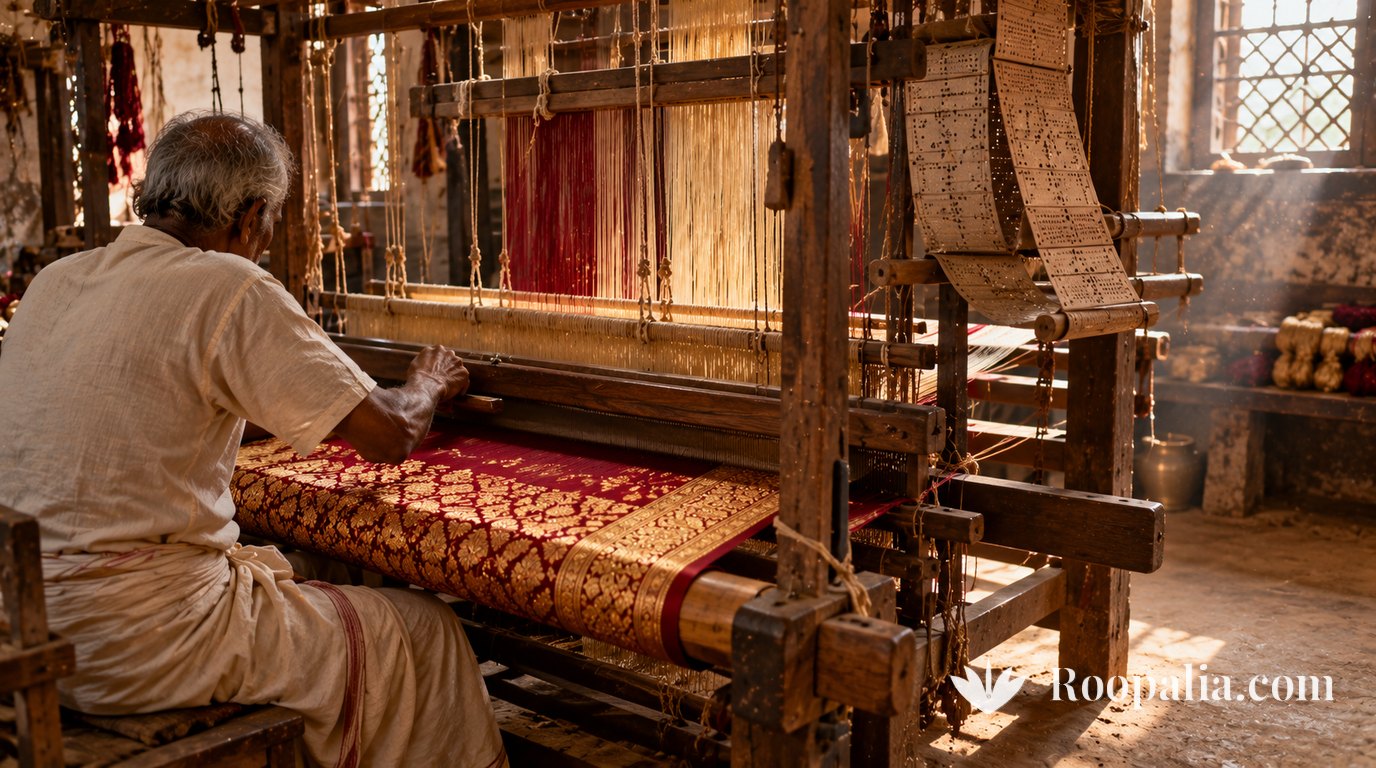
Wikipedia notes that one Banarasi can take 15 days to a month, and sometimes up to six months, depending on the design — and that the craft faces competition from faster, cheaper mechanised units and synthetic substitutes for silk. That gap in time is exactly why imitations exist.
The Kanjivaram korvai joint
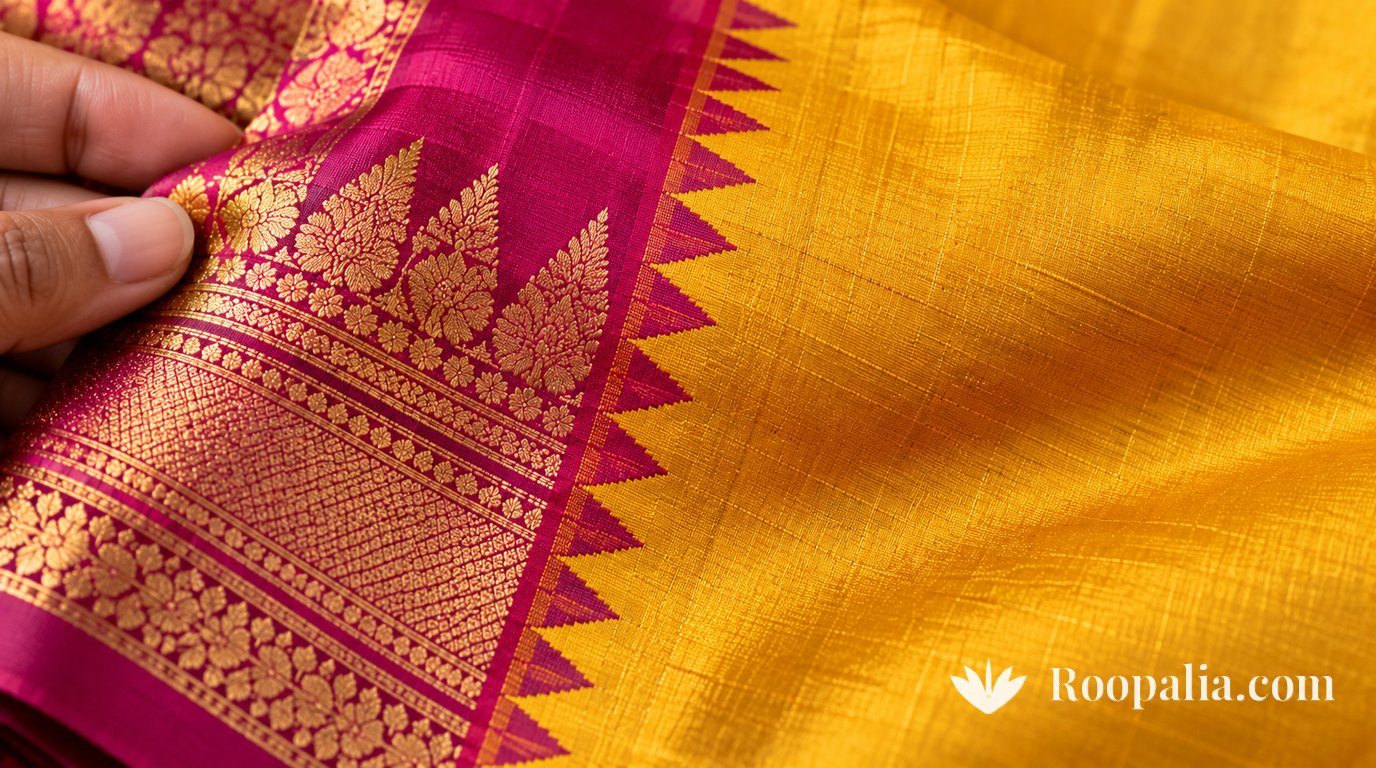
Wikipedia’s Kanchipuram silk sari article describes the technique: the body and border are woven separately and then interlocked, and the joint is so strong that even if the sari tears, the border will not detach. This is commonly called the korvai. A pallu in a different colour is also woven separately and joined. The same article notes that the pure mulberry silk and zari used come from South India.
Banarasi vs Kanjivaram
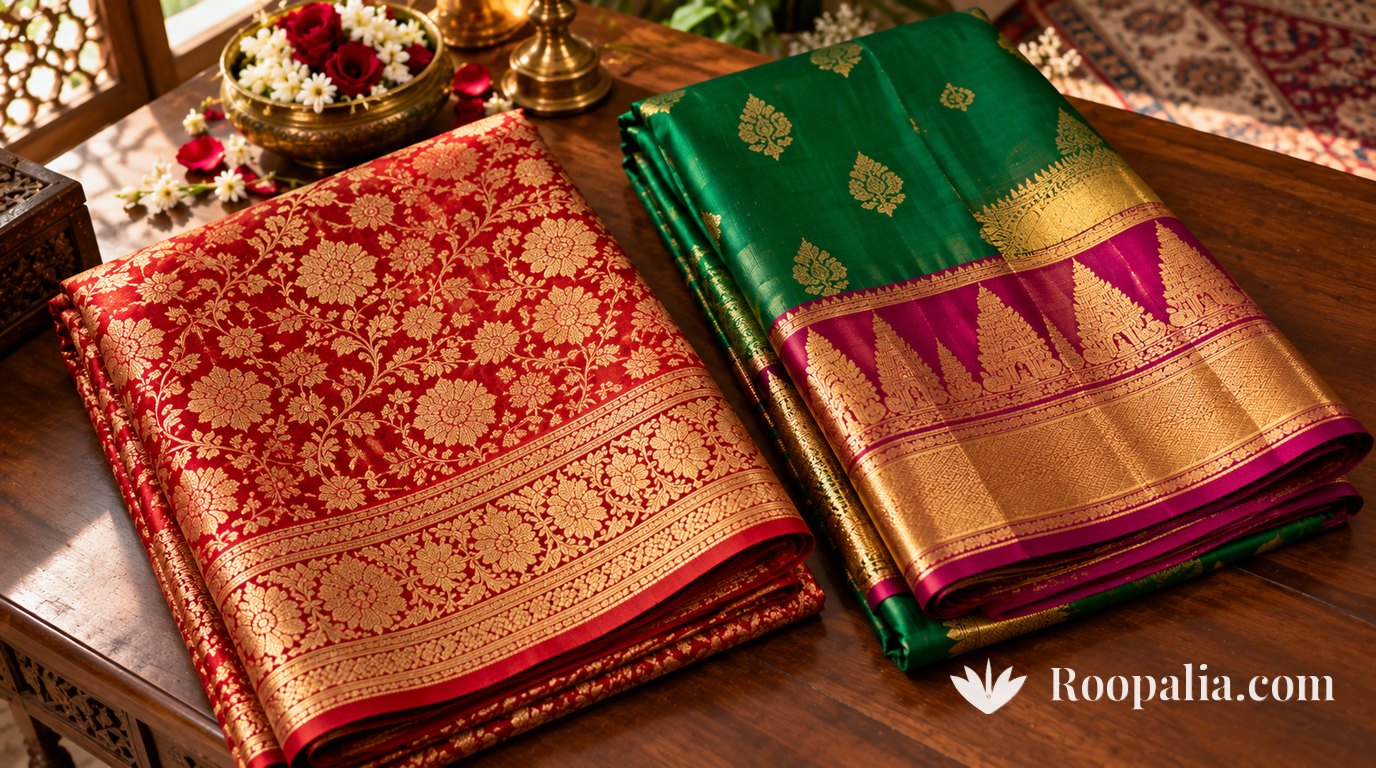
| Banarasi | Kanjivaram | |
|---|---|---|
| Origin | Six districts of Uttar Pradesh, including Varanasi | Kanchipuram, Tamil Nadu |
| GI | Certificate dated 4 September 2009 | 2005–06 |
| Look | Fine brocade, dense gold florals, jangla and buttis | Broad contrast border, temple motifs |
| Tell-tale sign | Floats on the reverse | Korvai border joint |
| Fabric | Katan, organza (kora), georgette, shattir | Heavy mulberry silk |
Which is more expensive? It depends on the zari, the design and the weaving time, not on the name. I found no reliable public price source, so I am not giving figures. “Kanjivaram” and “Kanchipuram” are the same saree; the second is the town’s name.
Real zari vs imitation
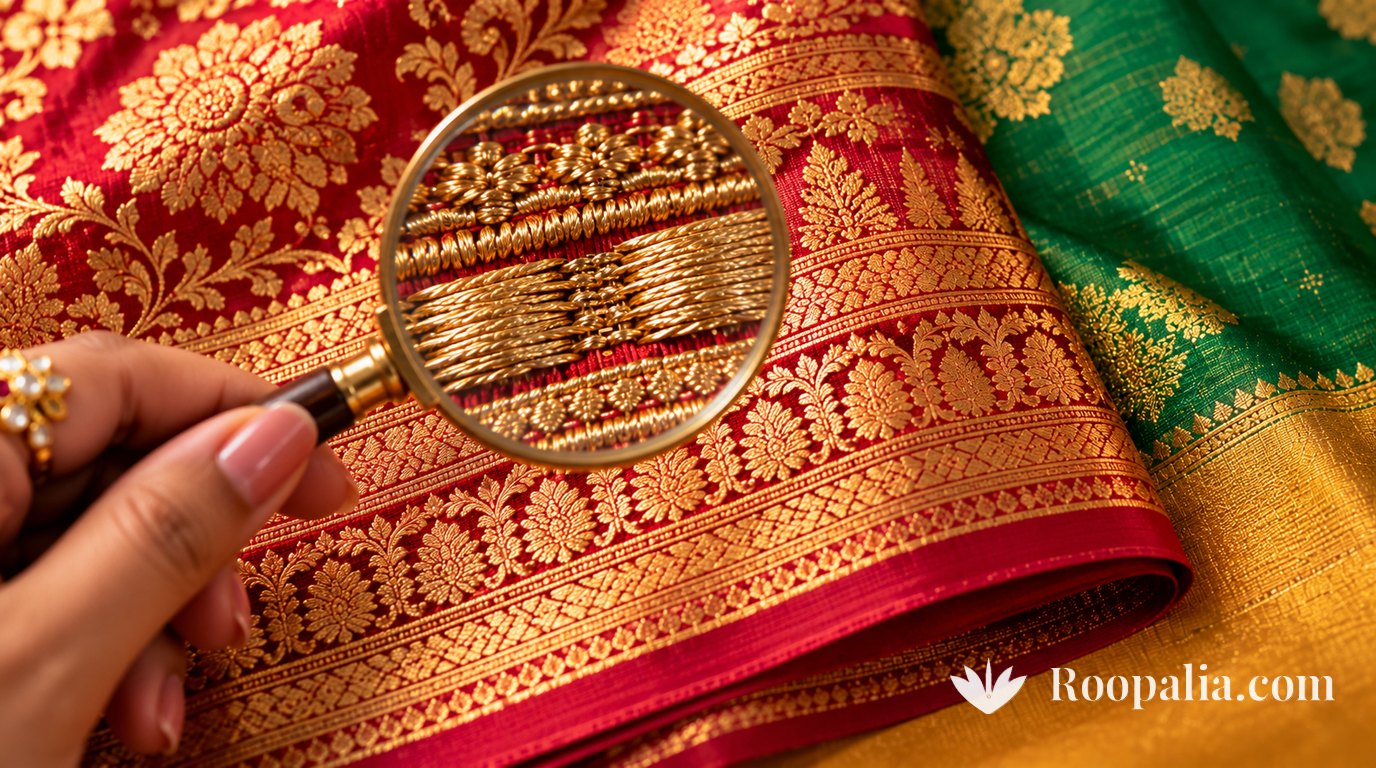
Wikipedia lists three kinds of zari: real zari, drawn from silver or gold alloys and flattened; imitation zari, copper wire electroplated with silver; and metallic zari, a modern, lighter substitute. Shop blogs often say real zari dulls gently with age while imitation blackens, or that scraping reveals the silk core. I did not find these tests in any government or laboratory source, so treat them as anecdote.
What about the burn test?
Many shop pages say silk smells like burning hair and leaves a crushable ash. I looked for a government or laboratory source for this and found none. Setting fire to a thread from an expensive wedding saree is also a poor idea. The better route for a Silk Mark product is the free test at an accredited lab.
Storing a silk saree in a cold or damp climate
I found no official guide on this, so here is common household practice: wrap it in muslin or cotton rather than plastic, keep it out of direct sunlight, and refold it along different lines every few months so the zari does not crack at the creases. To wear it, see how to drape a saree; for the face that goes with it, Indian bridal makeup.
What I found — and what I didn’t
| Question | Result |
|---|---|
| When Banarasi got its GI | Found — certificate dated 4 September 2009 (Varanasi district administration) |
| Which districts can use the name | Found — six, per Wikipedia |
| Kanjivaram GI and korvai | Found — 2005–06; border and body interlocked |
| What the Silk Mark certifies | Found — pure natural silk only; free lab testing |
| Types of zari | Found — real, imitation, metallic |
| An official source for the burn test | Not found |
| Reliable price or weight figures | Not found — none given |
“Not found” does not mean “does not exist”. It is the honest result of my search, not a final verdict.
The bottom line. Ask for the reverse side, the Silk Mark number and the district before you pay; check the same three things when the parcel opens. Remember the Silk Mark proves pure silk, not handloom — the GI region and the weave tell you that.
A saree that will be handed down deserves more evidence than a promise on a video call. Asking for it is not rude; it is how genuine weavers get paid what their work is worth.
Frequently asked questions
How do you identify a real Banarasi saree?
Does the Banarasi saree have a GI tag, and which state is it from?
How do you identify a pure Kanjivaram (Kanchipuram) saree?
What is the difference between Banarasi and Kanjivaram sarees?
Does the Silk Mark prove a saree is handloom?
Is the burn test a reliable way to check pure silk?
What should I ask the seller when buying a Banarasi saree online from outside India?
What is the difference between real zari and imitation zari?
Sources and cautions: checked against the official website of the Varanasi district administration (GI certificate date) and Wikipedia’s articles on the Banarasi sari, Kanchipuram silk sari, Silk Mark and Zari (courtesy: Wikipedia). Three things should be said plainly. First, the reverse-side float check is weavers’ and traders’ experience; I found no official source for the burn test or zari-scraping tests. Second, I found no reliable public source for prices or weights, so none is given, nor a GI registration number. Third, no shop, brand or seller is recommended and there are no affiliate links. “Not found” does not mean “does not exist”.