
Why children push back — and why it is not defiance
Somewhere between two and six, a child works out something enormous: I am separate, and I want things of my own. This is not a flaw in your parenting. It is a developmental milestone, and child psychologists worry more about the child who never shows it.
The trouble is that the wanting arrives long before the vocabulary does, and long before the part of the brain that regulates emotion is anywhere near finished — that keeps developing well into the twenties. So when a storm rises inside a five-year-old, they have no way to describe it. What comes out is a scream.
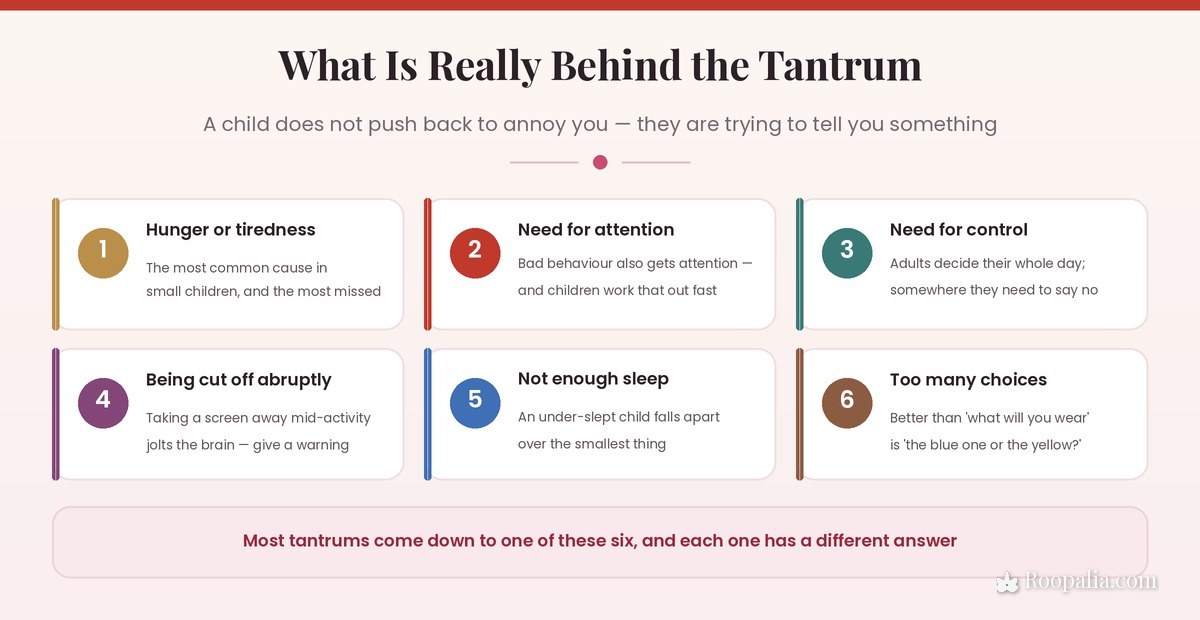
Hunger and tiredness are the most common and the most overlooked. A child at five in the afternoon is running on empty. Expecting reasonableness then is like expecting it from an adult at two in the morning.
Attention is the uncomfortable one. Children learn quickly that good behaviour goes unnoticed while shouting brings everyone running — and at that age, attention in the form of a telling-off still counts as attention.
Control deserves a moment's thought. Consider how much of a child's day they actually decide. When to wake, what to wear, what to eat, when to sleep — all chosen by someone else. Somewhere they are going to say no, and it usually lands on something trivial like the wrong colour cup.
Then there is being cut off abruptly — the one we cause ourselves, which the next section is about — plus not enough sleep, and too many open-ended choices. "What do you want to wear" is a hard question for a four-year-old. "The blue one or the yellow one" is an easy one, and it hands them back a little control at the same time.
Screens: the fight most evenings are actually about
Let's start with something that might take the weight off a little. Research suggests that close to half of parents admit they use screens to manage difficult behaviour. Not a moral failing — a Tuesday evening with dinner on the stove and a child attached to your leg.
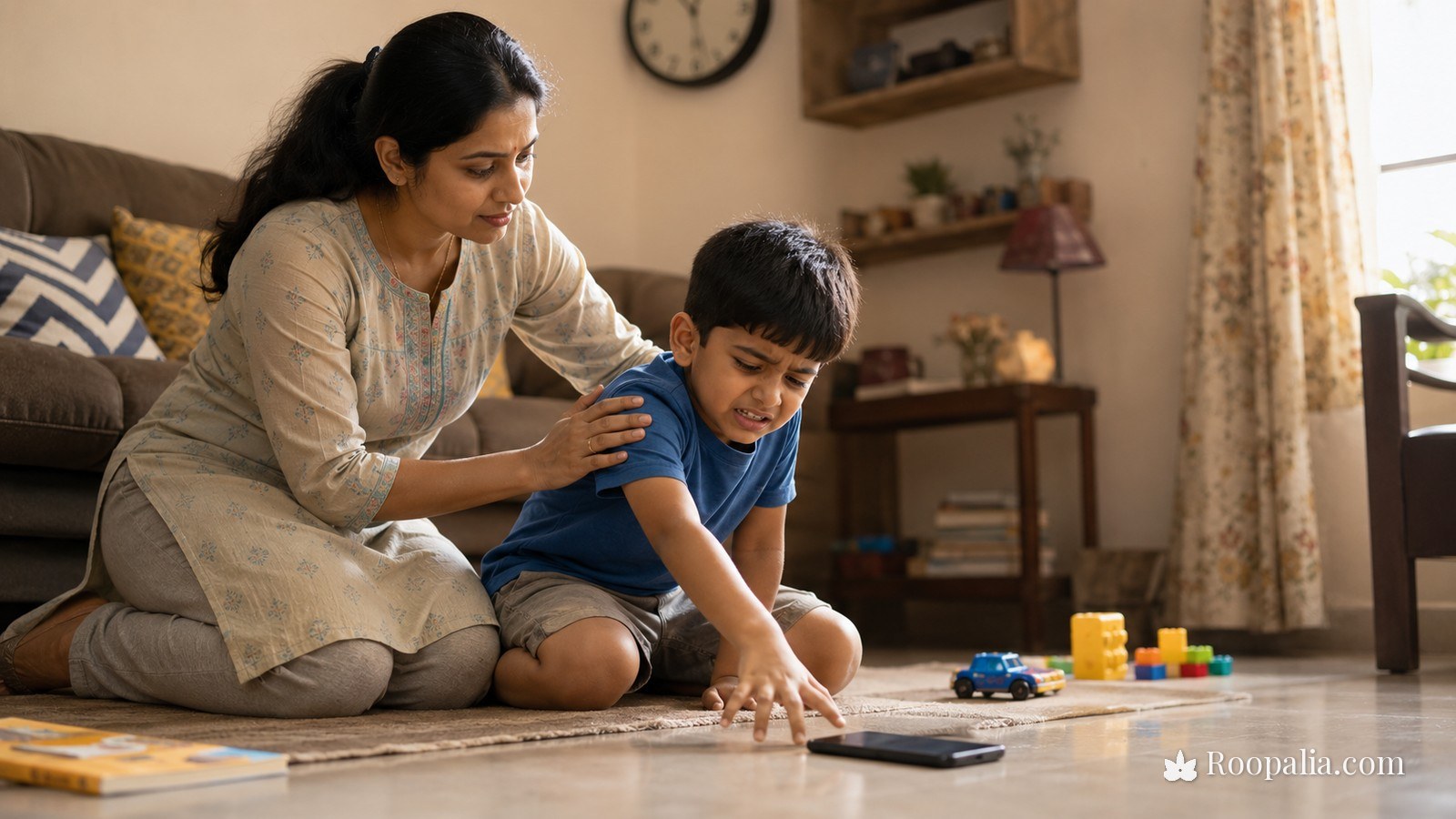
Here is what changes the picture. Taking a screen away mid-activity is a genuine jolt to a child's brain. They are inside a story, a level, a video. Then it is gone. Adults find the same thing irritating; the difference is that adults have learned to swallow it.
Do not remove — signal. "When this episode finishes." Or "five more minutes," followed by a second reminder at two. It gives the child's brain a runway, and it dissolves a surprising share of the fighting. Free, and available from this evening.
How much screen time, by age
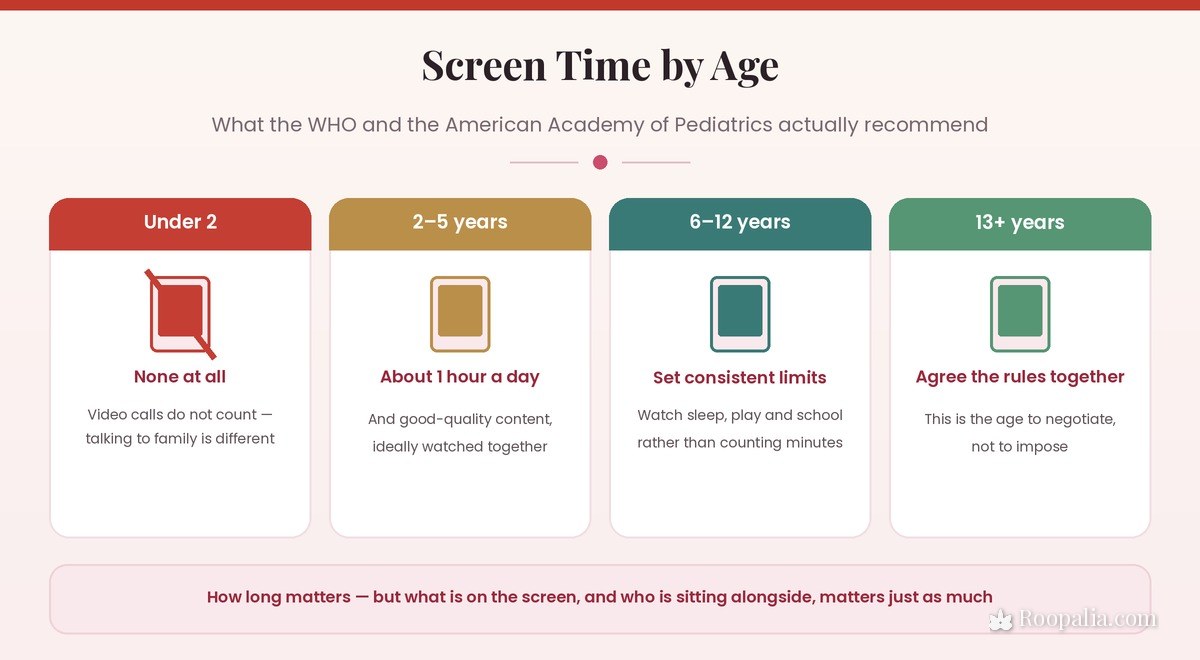
The WHO advises no screen time at all under one, and no more than an hour a day between two and four, with less considered better. The American Academy of Pediatrics advises avoiding screens before roughly 18 to 24 months, apart from video chat, and around an hour of good-quality content for ages two to five — ideally watched alongside an adult rather than alone.
But the more useful development is recent. In its 2026 guidance the AAP moved away from counting hours, toward asking what screens are displacing. Their framing is about the individual child, the content, whether the household is calm, whether screens are crowding out sleep, play and family time, and whether any of it is being talked about.
Which is liberating, honestly. An hour that leaves sleep, outdoor play and conversation intact is a different hour from thirty minutes that eats into bedtime. Watch the displacement, not the clock.
💡 The exception that matters: even under two, video calls do not count as screen time. A child talking to a grandparent, showing them a toy, being asked a question and answering it — that is not passive consumption, it is a relationship. Hold on to this. It becomes the whole point by the end of this article.
On hitting — what the evidence actually shows
This section is difficult to write for an Indian audience, because most of us were smacked and most of us feel we turned out fine. So before the evidence, one thing: this is not written to shame anyone. The parent who lost their temper last night and lay awake afterwards is exactly who this is for.
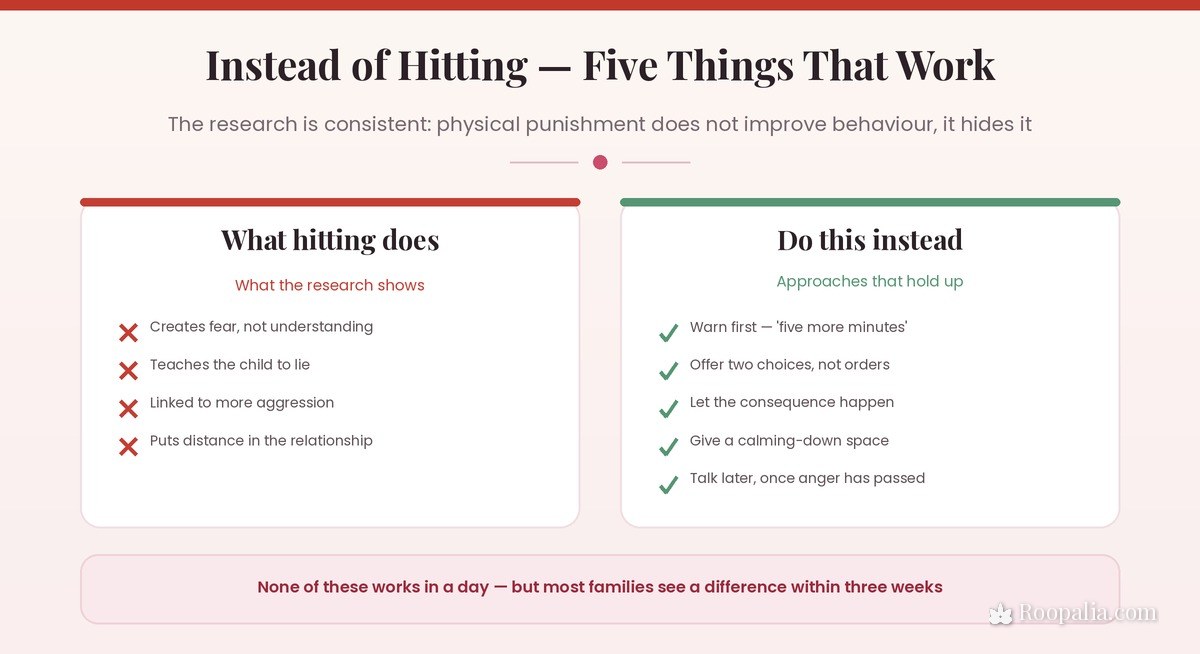
A meta-analysis covering five decades and more than 160,000 children found that the more children were smacked, the more aggression, defiance, mental-health difficulty and academic struggle appeared later.
The finding that should stop us is the absence: not one of those studies found that physical punishment improved behaviour. A 2025 analysis reported negative associations across sixteen of nineteen outcomes examined — and no positive ones at all.
So why does it feel effective? Because in the moment it is. The child stops. But what stopped them was fear, not comprehension — and fear teaches two lessons nobody intends: that power settles arguments, and that the real skill is not getting caught. That is where lying begins.
One more finding, and it deserves saying plainly. In homes where parents were warm and affectionate, the harm was reduced — but not erased. "We love them so much though" turns out to be less of a shield than we would like it to be.
Five things to do instead
"Don't hit" is easy to say. The real question is what to do at the moment your child is on the floor and your patience has run out.
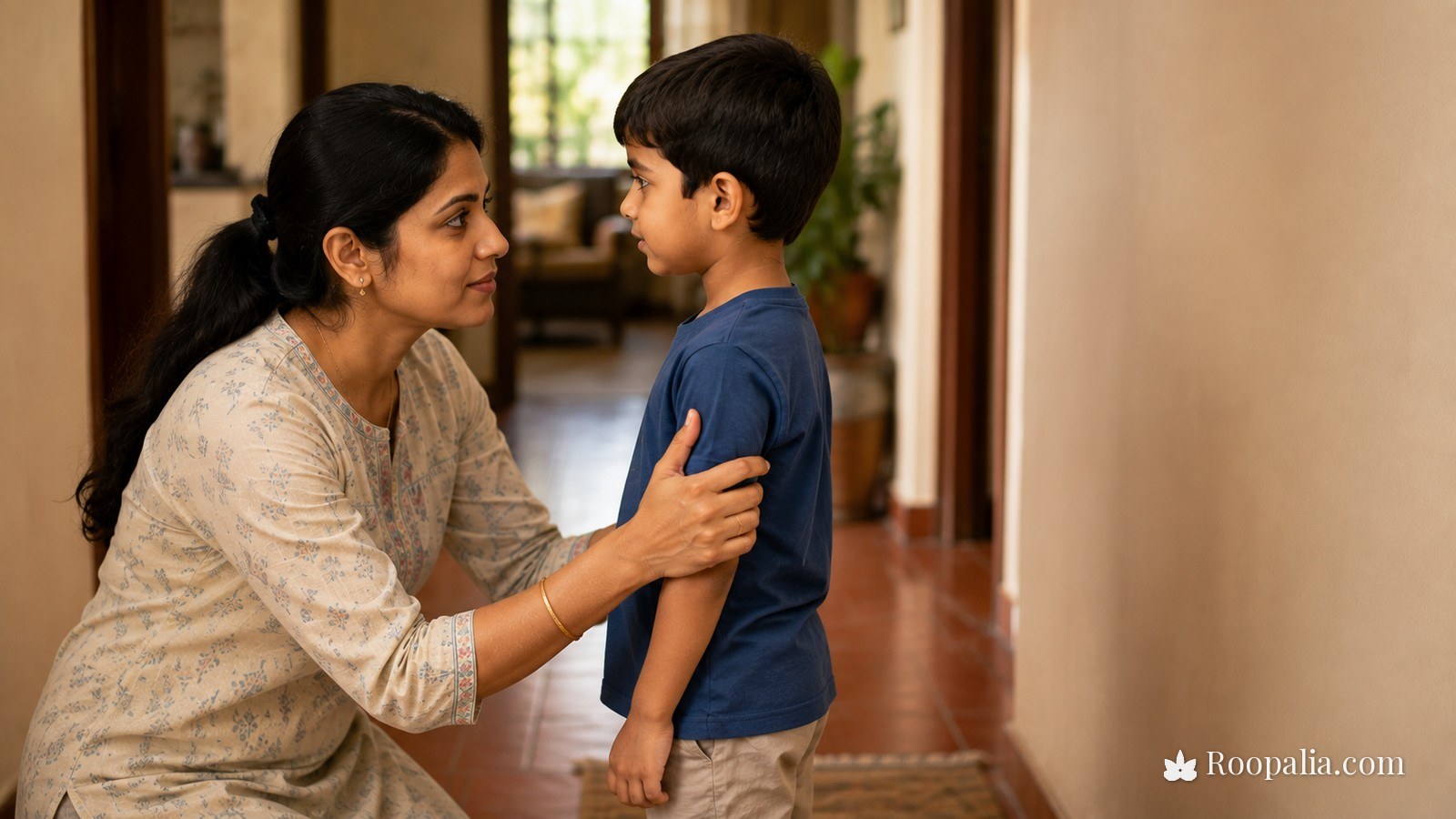
One — warn first. Worth repeating because it does the heaviest lifting. Nothing gets interrupted without notice: not play, not television, not a bath.
Two — offer two options instead of an instruction. Not "go to bed now" but "teeth first or story first?" Both roads arrive where you were going. The child gets to steer, which is what they wanted.
Three — let the consequence land. No shoes means arriving at the park late. Toys not put away means they are not out tomorrow. A consequence is not a punishment: a punishment is something you impose, a consequence is what their own decision produced. The second one teaches.
Four — give them somewhere to cool down. At peak fury a child physically cannot process what you are saying. Let them sit, let them cry, stay nearby, say nothing. Do not turn this into a punishment corner — it is a place to breathe, not a sentence.
Five — talk afterwards. Ten minutes later, on your lap. "You were really angry, weren't you? I get angry too." Name the feeling first, then discuss the behaviour. That is the window where a child actually hears you.
⚠️ And when it is your own patience going: leave the room. Ten seconds. Drink some water. This is not losing — it is the most sensible move available. Children also learn what an adult does with anger, and they repeat it later.
Ask what you are putting in the gap
Everything above is about reducing screens. But there is a point that gets missed, and it may be the single most useful sentence here: a child does not actually want the phone. They want it because nothing better is available right then.
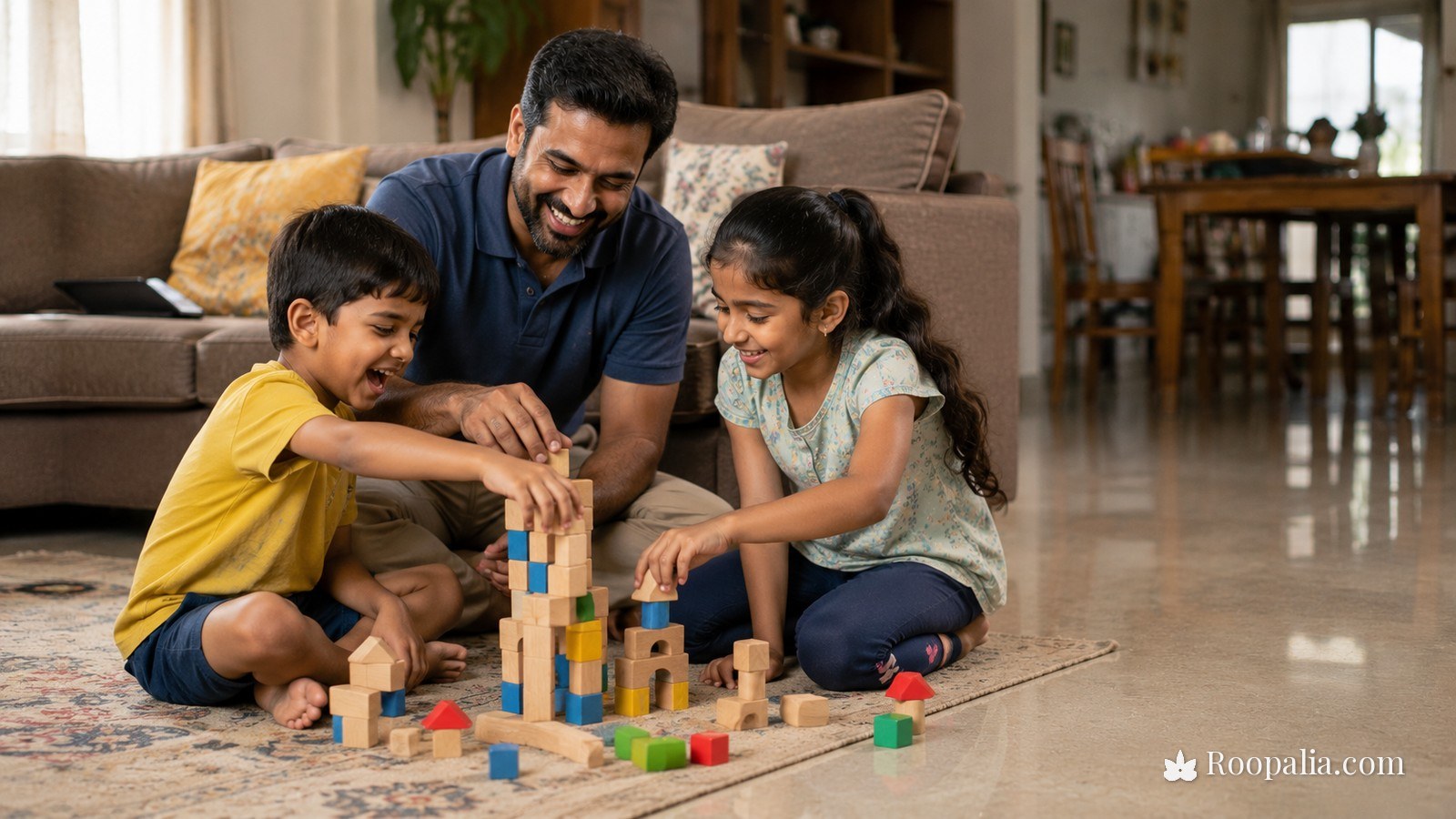
Take the screen away with nothing to follow and what remains is a vacuum, and a vacuum produces exactly what it always produces. But if something else begins the moment it goes off, the fight simply does not happen.
It does not need to be elaborate. Fifteen phone-free minutes, being allowed to help with the dough, a walk around the block — or the oldest and most effective option available to us: a story.
One caution, because it is the mistake families make most often once they finally decide to cut down. Do not announce a total ban on a Sunday evening and expect it to survive the week. A screen that has been part of a child's day for two years is a habit, and habits come down in steps. Shorten the slot rather than deleting it. Move it earlier in the evening so it is not the last thing before sleep. Take one meal a week and make it phone-free for everyone, adults included — and expect to be called out the first time you check your own phone at the table, because you will be.
Stories are the oldest tool we have — and still the strongest
In Indian homes, values were never transmitted by explanation. They were transmitted by story.
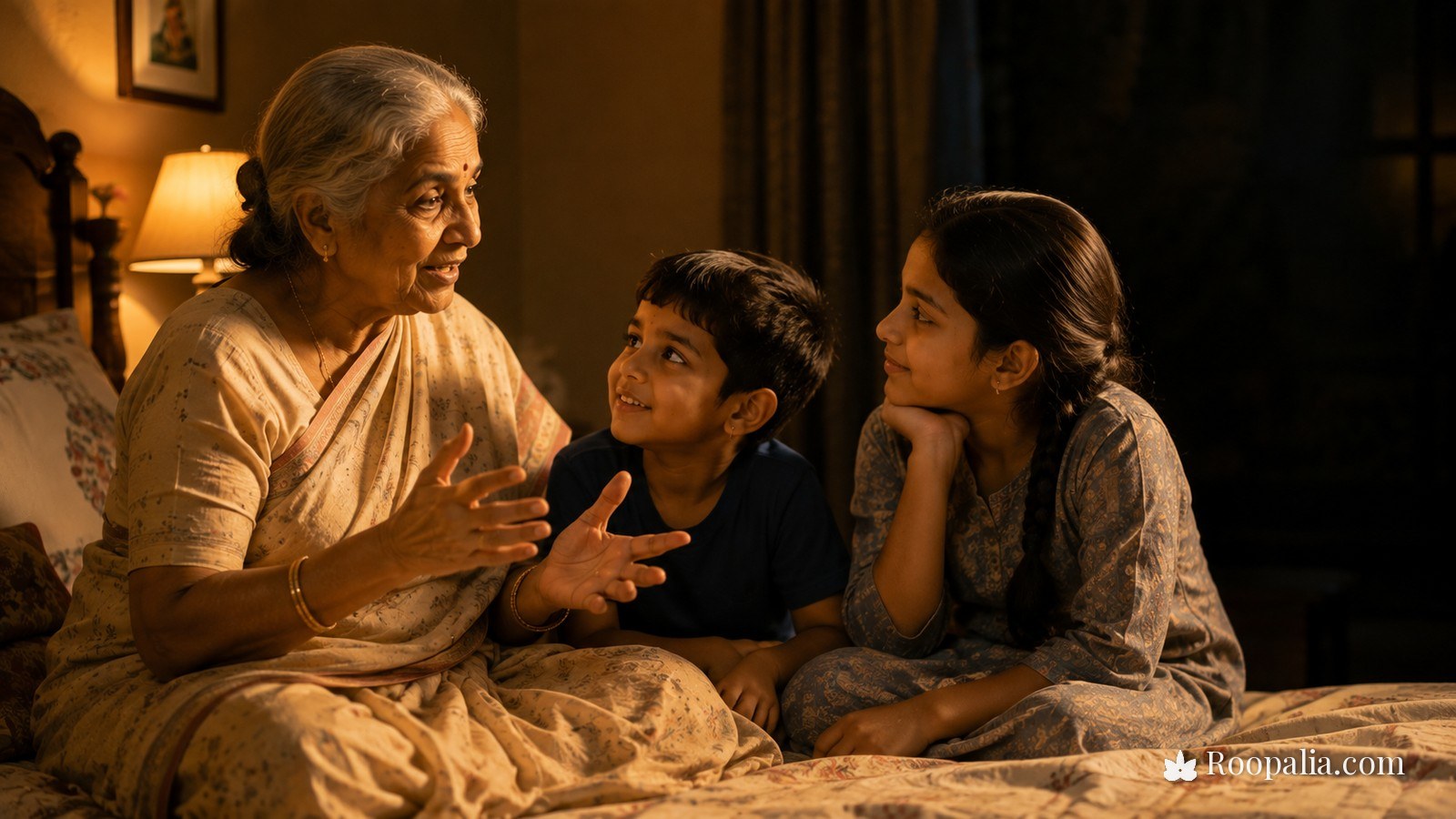
No child in history has learned honesty from the sentence "you should be honest." But a child who hears the story of Raja Harishchandra understands what it costs. "Respect your elders" achieves nothing; the story of Shravan Kumar leaves a mark. The Panchatantra taught strategy through a clever rabbit, and the stories behind our own rituals quietly tell a child what they are part of.
And a story carries something no screen does — a teller. The voice, the pause at "and then what do you think happened?", the hand on the shoulder. That is what a child keeps coming back for.
A true story — from Charlotte to Sadulpur
Now the account that reframed this entire article for me.
A relative of mine — Shri Ramkumar ji, a retired lecturer from Sadulpur, Rajasthan — went to stay with his software-engineer son in Charlotte, North Carolina. He was there a month. When he came back he described plenty: the roads, the weather, the particular loneliness of a suburb where nobody walks anywhere.
But I asked him something else. His grandchildren — eight years old and four and a half — what were their days like, and what had struck him most about them?

His answer was this. Every night the two of them attached themselves to him and would not let go. He told them stories from the village — the fields, the bullock cart, the well, his own childhood. And they listened with such appetite that they would not release him until he had told five or six. "Dadaji, one more."
It was mostly the eight-year-old who insisted. The four-and-a-half-year-old said little, but listened to every word.
Sit with that for a second. These are children born in America, being raised in America, in American schools. Every screen on earth is within arm's reach. And each night they were negotiating hard for one more story about a village in Rajasthan they have never seen.
Then came the day he left
The month ended. His flight was booked. His son and both children came to Charlotte airport to see him off.
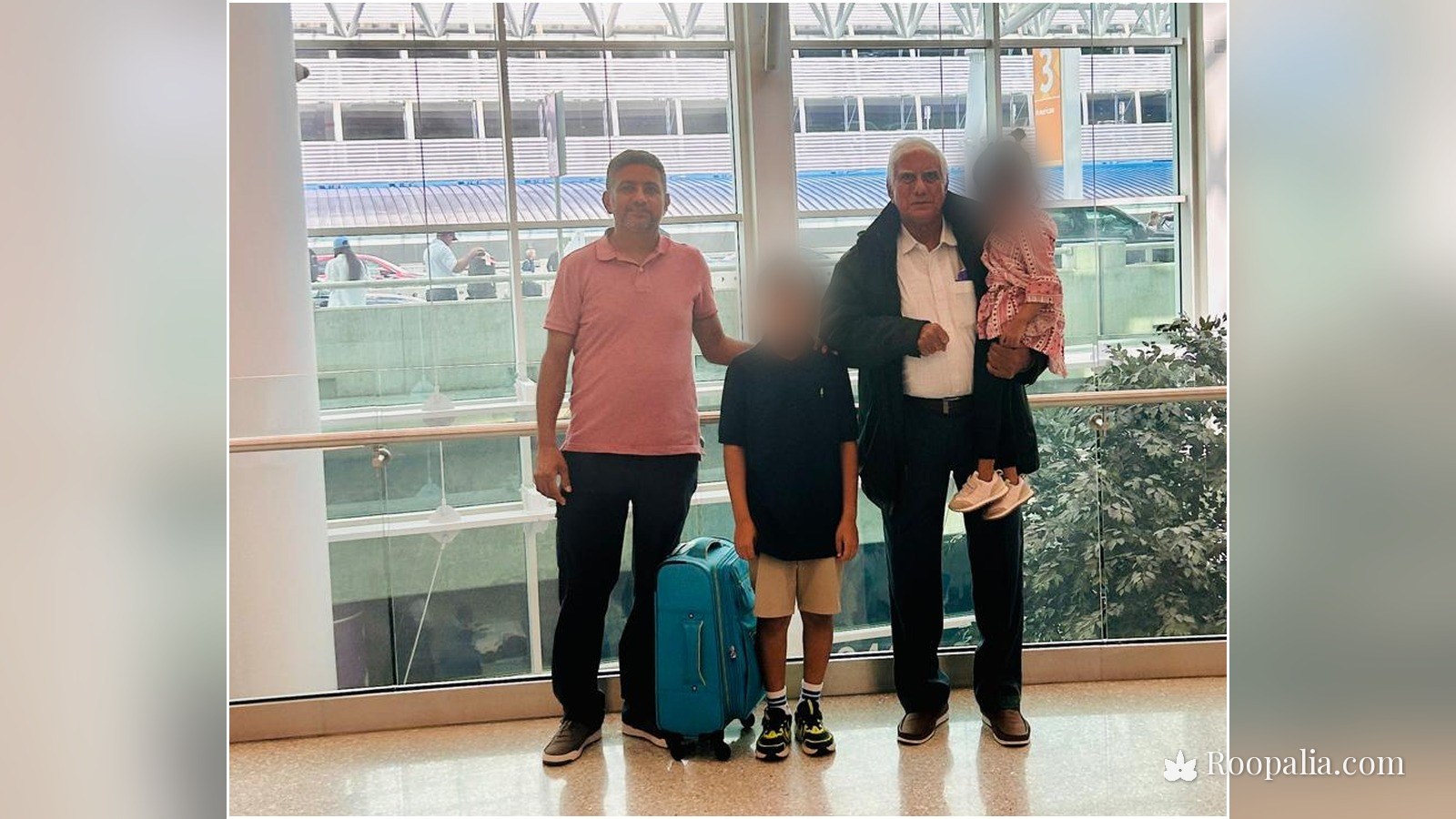
Inside the terminal, both children started crying. And what they said was not "don't go."
"Dadaji, now who will tell us stories?"
In one month they had not become attached to their grandfather. They had become attached to the stories. What frightened them was not that he was leaving — it was that the fields and the wells and the bullock carts were leaving with him.
Except they didn't
This is where the story stops being touching and starts being useful.
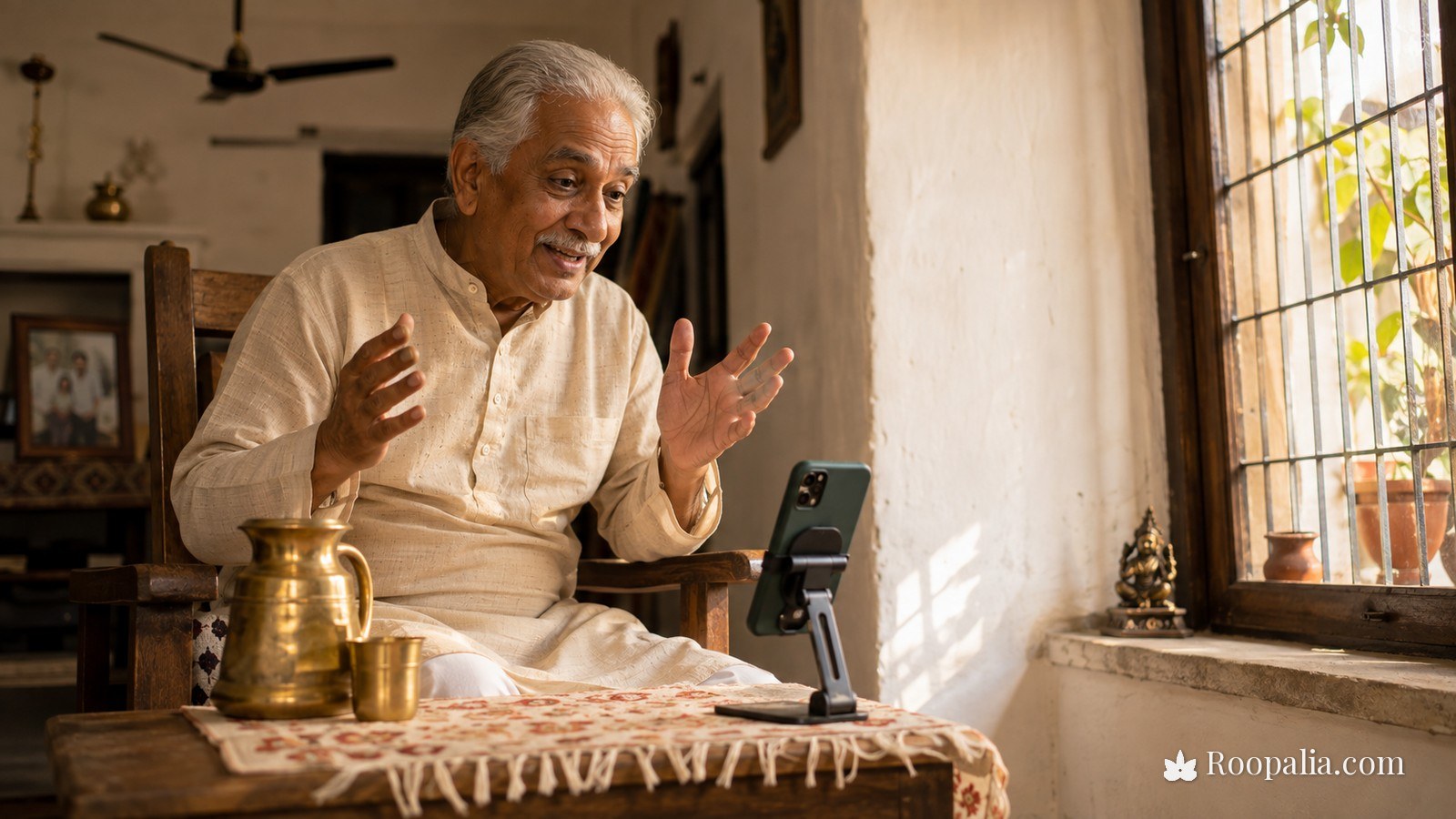
Once home, Ramkumar ji refused to let the thread break. He now tells those same two children stories every single day over a WhatsApp video call — about India, about festivals, about the village.
He has kept it up, daily, for a year.
Which is where this whole article turns over
We have spent this entire piece discussing how to keep a screen away from a child. And the same screen, with a grandfather's face on it, becomes a bridge across seven thousand miles.
So the screen was never the problem. The question is what is on it, and who is on the other side. The identical device that isolated your child at four in the afternoon can connect them to their roots at eight in the evening. The difference is not in the hardware.
And the second lesson runs deeper. Ramkumar ji never took a phone away from those children. He simply put something better in front of it — his voice, his time, and a village they had never seen but can now describe.
That is what sanskar actually is. It does not travel in lectures, it does not survive being enforced, and it does not stop at a national border. It arrives through the person who picks up the phone every evening and says, "right, listen to this one."
What this looks like in practice, abroad
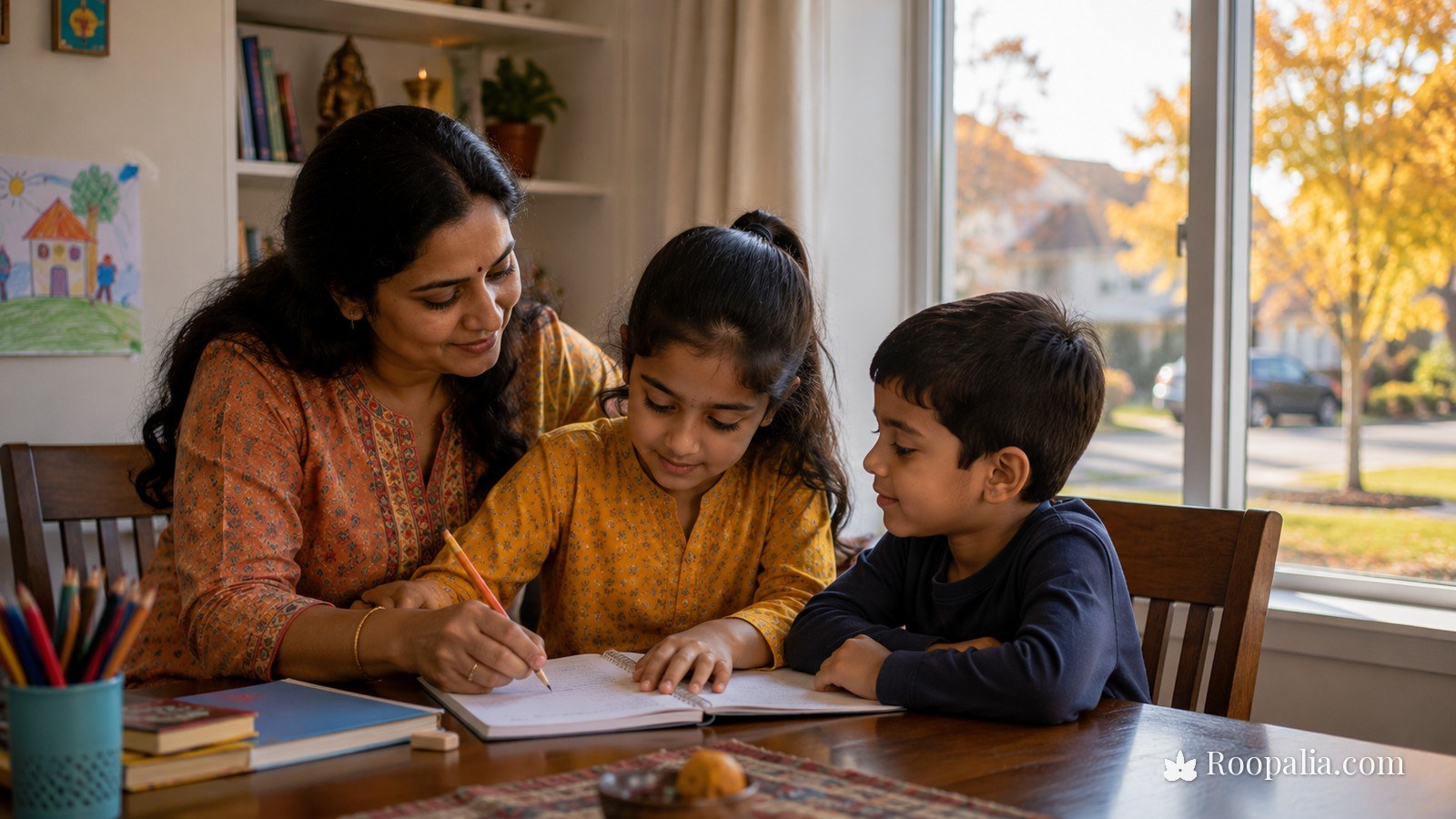
The fear most NRI parents carry is that their children simply will not be interested. Ramkumar ji's grandchildren are the direct rebuttal: they were not merely interested, they were insistent. Children do not find culture boring. They find it boring when it arrives as instruction.
Some things that work:
- Fix a daily slot with grandparents, not a weekly one. One long Sunday call does far less than fifteen minutes every evening. The child starts waiting for it — and waiting is what builds the habit.
- Ask the elders to tell, not to interrogate. "How was school, what marks did you get" makes children flee. "When I was small…" brings them closer.
- Keep speaking the language at home. Even when they answer in English, keep going in Hindi. Comprehension comes first and speech follows, sometimes years later — but only if the input never stopped.
- Give them a job at festivals rather than a seat. Arranging diyas, setting the thali, kneading dough. What the hands do, the memory keeps.
- Let them hear the language sung, not just spoken. Old film songs, bhajans, folk songs in the car. Rhythm carries vocabulary past resistance.
And remember it runs both ways. The grandfather telling stories every evening is being kept alive by it too. Distance produces loneliness at both ends, and those fifteen minutes fill both.
When to speak to a doctor
Now the section most parenting articles leave out, and whose absence leaves children without help for years.
Most stubbornness is ordinary and fades with age. But occasionally what presents as defiance is something else — and scolding or smacking it makes it worse.
- Meltdowns that are extremely intense, run past twenty minutes, and happen several times a day
- The child hurting themselves during rage — headbanging, biting or scratching themselves
- Beyond four or five, still unable to settle anywhere or hold attention on anything
- Delayed speech, or apparent difficulty understanding what is said
- Persistent trouble connecting with other children
- A sudden change — previously settled, now irritable, withdrawn or fearful
- Sleep or eating patterns disrupted over a long period
🩺 If any of these apply, see a paediatrician. Often there is something underneath — ADHD, anxiety, a sleep disorder, a hearing problem — that the child has no way of reporting. Identified early, it saves them years. Going is not an admission that your parenting failed, any more than taking them in with a fever is.
In closing
Before you take something away, ask what you are putting in its place
Stop treating stubbornness as something to defeat. Your child is trying to say something and does not have the words. Warn before you take, offer two choices instead of an order, and talk once the storm has passed. And on screens: the reliable way to switch one off is never to snatch it — it is to put something better in front of it. Those two children at Charlotte airport were not crying for a story. They were crying for the person who told it. 🌻
Frequently asked questions
Why is my child so stubborn?
How much screen time should a child have?
Do video calls count as screen time?
Does smacking children work?
What is gentle parenting, and does it actually work?
How do I stop the daily fight over the tablet?
How do I teach my child Hindi when we live abroad?
How do I pass on Indian culture to children born abroad?
When should tantrums be discussed with a doctor?
🩺 A note: this article draws on general research and lived experience and is not a substitute for advice from a paediatrician or child psychologist. Every child is different, and what works for one may not work for another. If you have concerns about your child's behaviour, development or emotional wellbeing, seek personalised advice from a qualified professional.