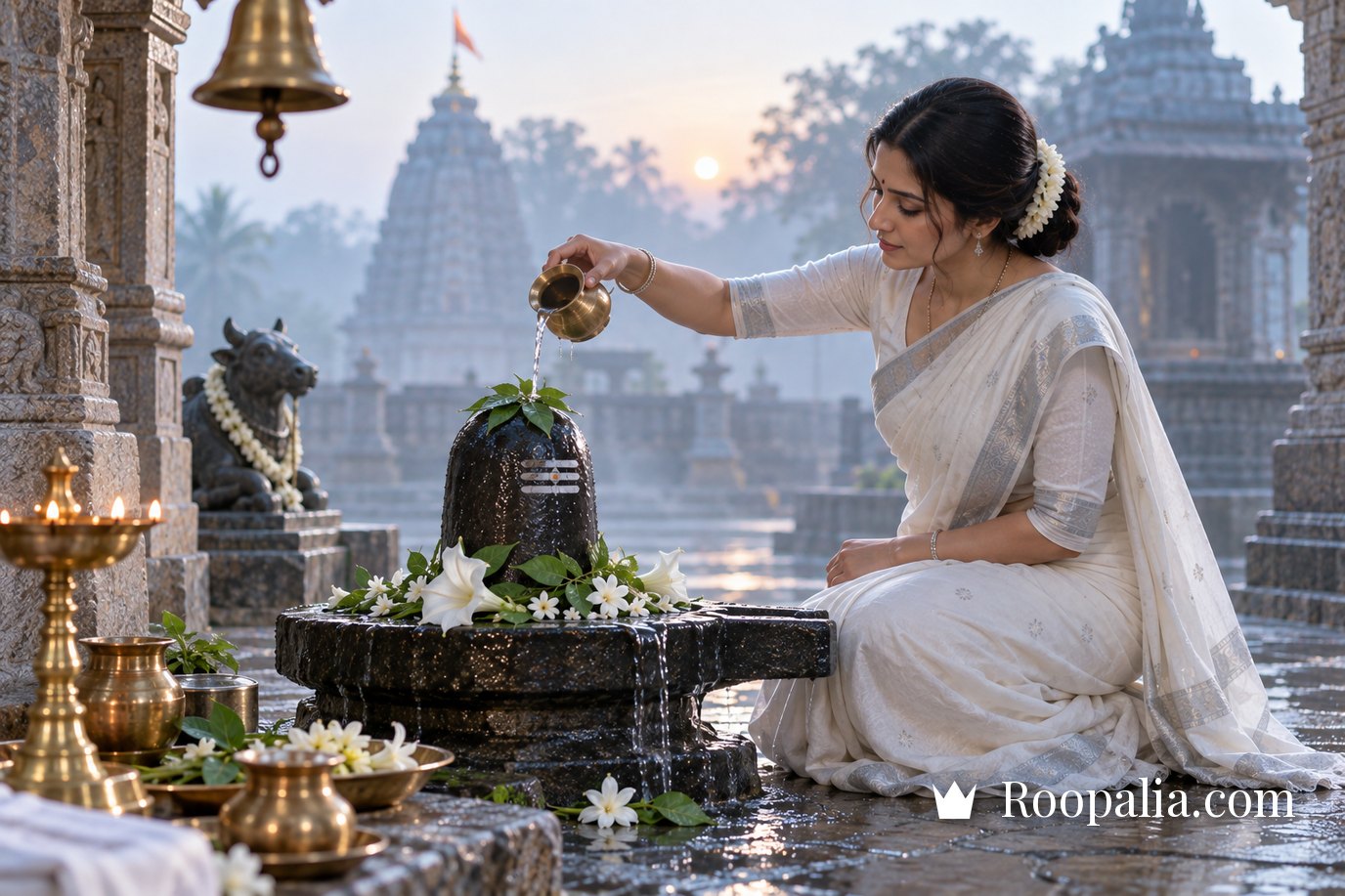
Is Monday Shiva's day or the Moon's day?
You will find both answers online, which is why the question keeps coming back. The honest answer is that they are the same answer.
Soma is a Sanskrit name for the Moon. Shiva carries the crescent in his matted hair, so one of his thousand names is Someshwar — lord of Soma. Monday belongs to Soma, and Soma sits on Shiva's forehead. That is why the day's worship goes to Shiva while the tradition also asks you to look at the Moon at night.
But the real point sits deeper than the naming. In the Vedas the Moon is not merely a body in the sky. The Purusha Sukta contains this line:
chandramā manaso jātaḥ chakṣoḥ sūryo ajāyata
— Purusha Sukta, Rigveda 10.90.13 (also in Yajurveda 31)
"The Moon was born of the mind of the cosmic Purusha; the Sun was born of his eyes." This is why classical jyotish treats the Moon as the karaka, the significator, of the mind.
That single line changes what the fast is for. If the Moon is born of mind, and Monday is the Moon's day, then the Monday fast is a fast of the mind — against anger, restlessness, insomnia, envy, a scattered head. When your grandmother said keeping Somvar vrat "settles the mind", she was repeating the Veda, whether or not anyone told her so.
And here is where it gets genuinely strange.
🌙 Three civilisations, one Moon
English Monday comes from Old English mōnandæg, "the Moon's day". That was a loan-translation of Latin dies Lūnae, which itself translated the Greek hēmérā Selḗnēs. German has Montag, French lundi, Spanish lunes, Italian lunedì — all the Moon.
Among the seven weekday names, Monday is the only one that needed no swap of gods. The Germanic peoples had to substitute Tīw for Mars, Wōden for Mercury, Þunor for Jupiter. For the Moon they substituted nothing. Everyone was looking at the same Moon.
Stranger still: the English word lunatic also comes from luna, from the old belief that the Moon disturbs the mind. So the idea packed into chandramā manaso jātaḥ — Moon born of mind — surfaced independently in Europe as well. Two civilisations, two routes, one conclusion: the Moon has something to do with the mind.
The order of the weekdays is not arbitrary either. The Surya Siddhanta (Bhugoladhyaya 12.78–79) gives the arithmetic: counting downward from Saturn, every fourth planet becomes the lord of the following day, because the planet ruling the first hora of a day rules the whole day. Run that cycle and you get Sun, Moon, Mars, Mercury, Jupiter, Venus, Saturn — the order the entire world still uses.
So Monday is the Moon's, the Moon governs the mind, and the mind's master is Shiva. Which leaves one question: why did the Moon need Shiva's protection in the first place?
The story that created Somnath — and started the Monday fast
The answer sits in the Prabhasa Khanda of the Skanda Purana, and it is rarely told in full.
The Moon had married twenty-seven daughters of Daksha Prajapati, but gave all his affection to Rohini alone. The other twenty-six were neglected. Daksha warned him repeatedly. When the Moon would not listen, Daksha cursed him with kshaya roga — the wasting disease. The Moon began to shrink. His digits faded, his brilliance dimmed, and darkness spread through creation.
Broken, he came to the seashore at the place now called Prabhasa. There he had Brahma install a Shivalinga, and performed penance for a thousand years. Shiva appeared. The Moon asked two boons: that the curse be lessened, and that Shiva remain in that linga forever, with Uma beside him.
Shiva answered that Daksha's curse could not be erased, only divided. So for the fifteen days of the dark fortnight the Moon would wane, and for the fifteen days of the bright fortnight he would wax. And since this linga had been installed by Soma —
"Here my name shall be Somnath. And this place shall be called Prabhasa, because it was here that your prabha, your radiance, came back to you."
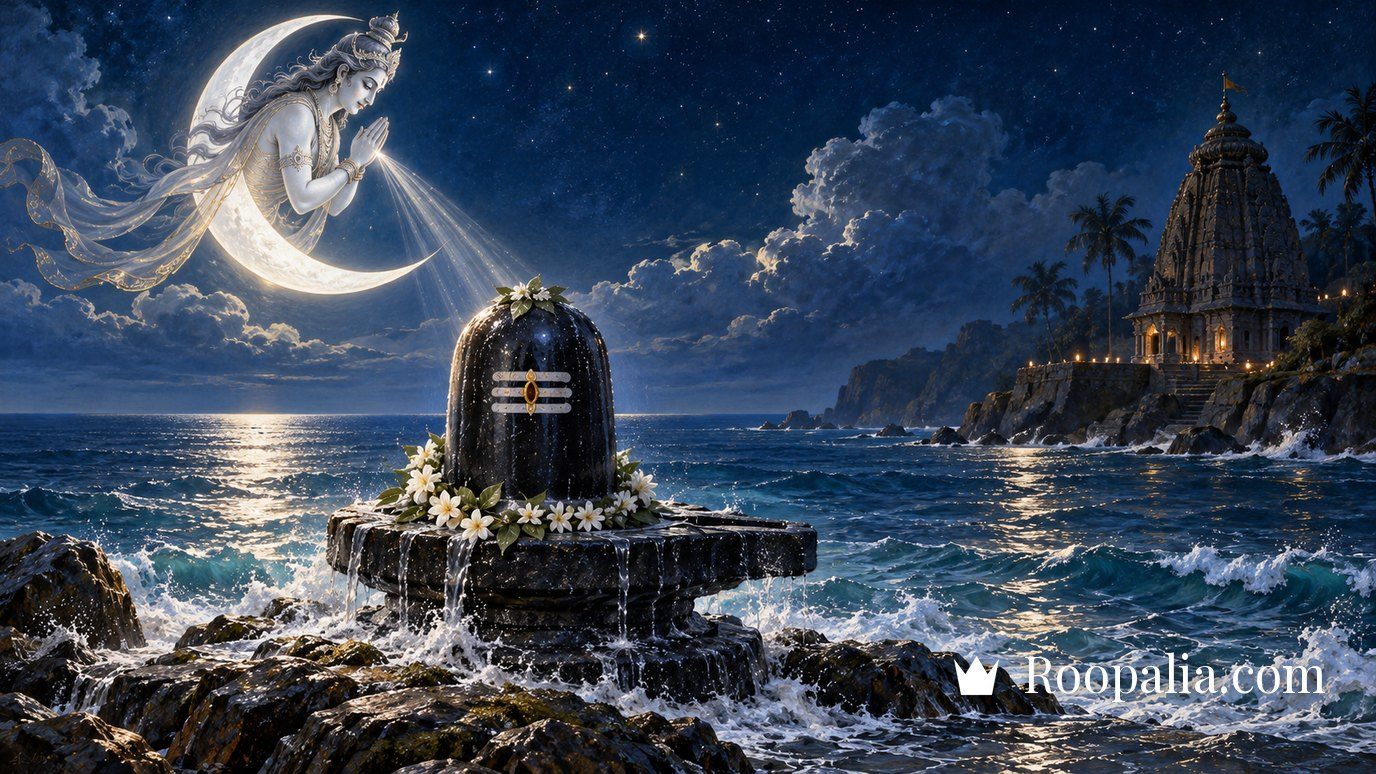
Three things lock together in that story, and together they are the root of the Monday fast.
- The first of the twelve Jyotirlingas, Somnath, was installed by the Moon. Its very name is built from Soma.
- The waxing and waning of the Moon is presented not as astronomy but as the settlement between a curse and a mercy — and that settlement is the basis of the Hindu calendar, its dark and bright fortnights.
- The first person to keep the Monday fast was the Moon himself — not for a boon, but to climb out of illness and darkness. The Skanda Purana says the vrat was performed by Somaraja when he was overwhelmed by Daksha's curse, and that his body became clear again.
Which brings up something almost nobody mentions.
📜 In the Purana the vrat is eight Mondays, not sixteen
Chapter 25 of the Prabhasa Khanda lays out a Somvar Vrat of eight Mondays, and each Monday is different. The first is worshipped with white flowers; the second uses a Karanja twig for cleaning the teeth, with lotuses and an orange; the third uses Apamarga and a pomegranate; the fourth a Udumbara twig and a coconut; the fifth a Peepal twig and kunda flowers — and so on to the eighth. Udyapan falls on the ninth Monday.
The sixteen-Monday vrat kept in households today is a later and separate tradition. Neither contradicts the other. But it is worth knowing how deep the roots of your grandmother's fast actually go. We are writing a full guide to Solah Somvar separately.
Sankalp — the step people skip
A vrat does not begin with hunger. It begins with sankalp. Without it you are simply skipping meals.
Preparation starts on Sunday evening: one sattvic meal before sunset, no onion or garlic, nothing fried or heavy, and an early night.
On Monday, wake in Brahma muhurta, roughly ninety minutes before sunrise. Bathe in cool water — a little Gangajal mixed in is traditional. Wear clean clothes; white is considered best for this day. Sprinkle the puja space with Gangajal.
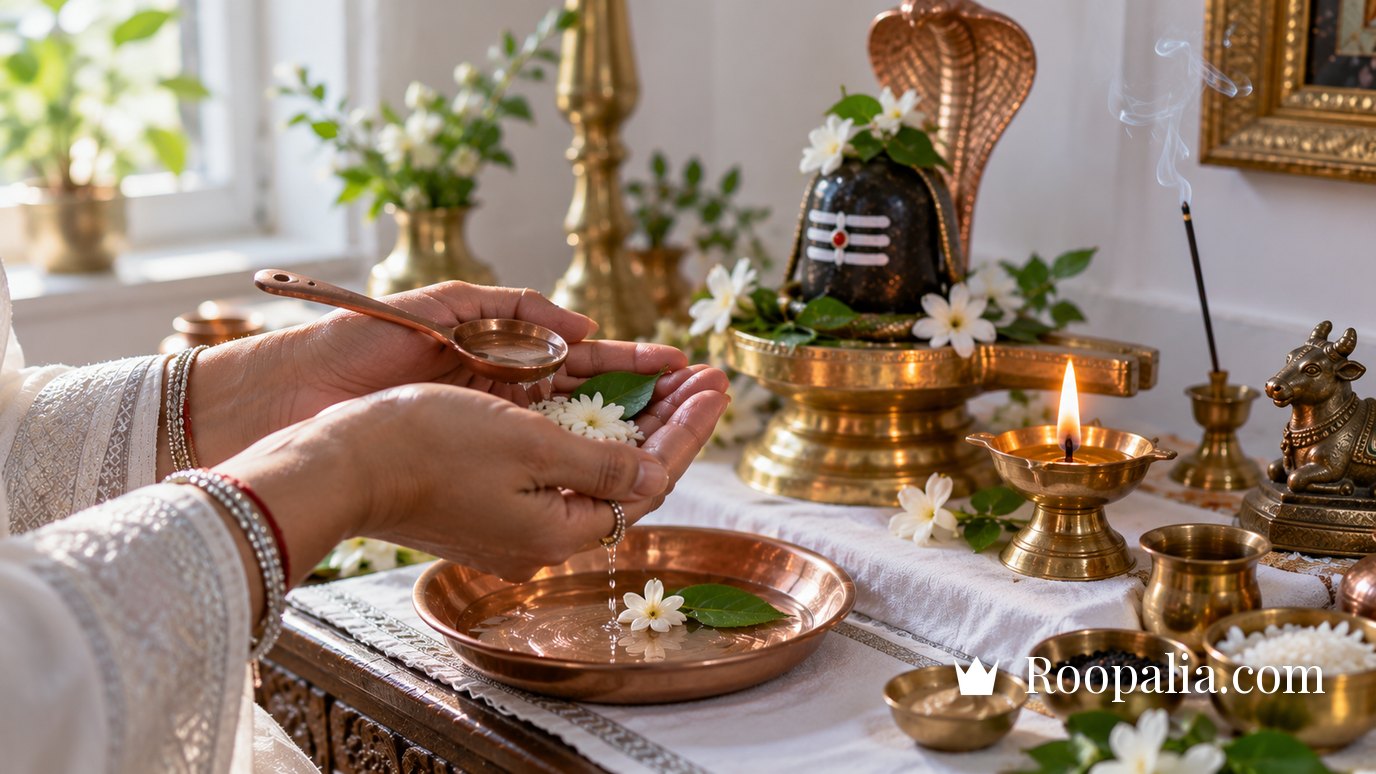
Now hold a few whole rice grains, a flower and a little water, stand before the Shivling or Shiva's image, and say the sankalp aloud. It does not have to be in Sanskrit. Your own language is fine. Three things should be in it:
- What you are doing — "I am keeping the Monday fast today."
- For how long — "This is my third Monday; I have taken a sankalp of eleven."
- Why — your specific wish, or simply "for the grace of Lord Shiva".
Then release the water and rice into a copper vessel. The sankalp is made. Take on only what you can finish: five Mondays completed is worth more than sixteen abandoned at the sixth.
Somvar Vrat puja vidhi, step by step
At home or at a temple, the sequence is the same.
- Bathe and purify. Bathe before sunrise, wear clean white clothes, clean the puja space and sprinkle it with Gangajal.
- Take the sankalp with water, rice and a flower in hand, as above.
- Jalabhishek. Pour water over the Shivling from a copper or brass lota in a thin, unbroken stream — never all at once. Face north or east and keep chanting Om Namah Shivaya as you pour.
- Panchamrit abhishek. In order: milk, curd, ghee, honey, sugar. Rinse with a little clean water after each, and finish with a full water abhishek so nothing is left clinging to the stone.
- Sandalwood and bhasma. Apply sandalwood paste, then draw the tripundra with bhasma.
- Offer. Bilva leaves with the smooth side facing down, white flowers, datura, arka blossoms, black sesame and rice. Bilva leaves should be three-lobed and unbroken.
- Lamp, incense, naivedya. Light a ghee lamp and incense; offer white sweets, kheer, or milk with mishri.
- Japa and katha. Chant Om Namah Shivaya 108 times on a rudraksha mala, then read the Shiv Chalisa and the Somvar Vrat Katha.
- Aarti and prasad. Perform the Shiva aarti, take the charanamrit, distribute prasad.
- Evening puja. In this vrat the evening puja matters as much as the morning one. Around sunset, in Pradosh kaal, light the lamp again, remember Shiva and hear the katha. The fast is broken after this.
Somvar Vrat samagri list
Here is the full list. Do not be intimidated by it — half of these can be missing and the puja still stands. A single lota of water offered with faith is accepted.
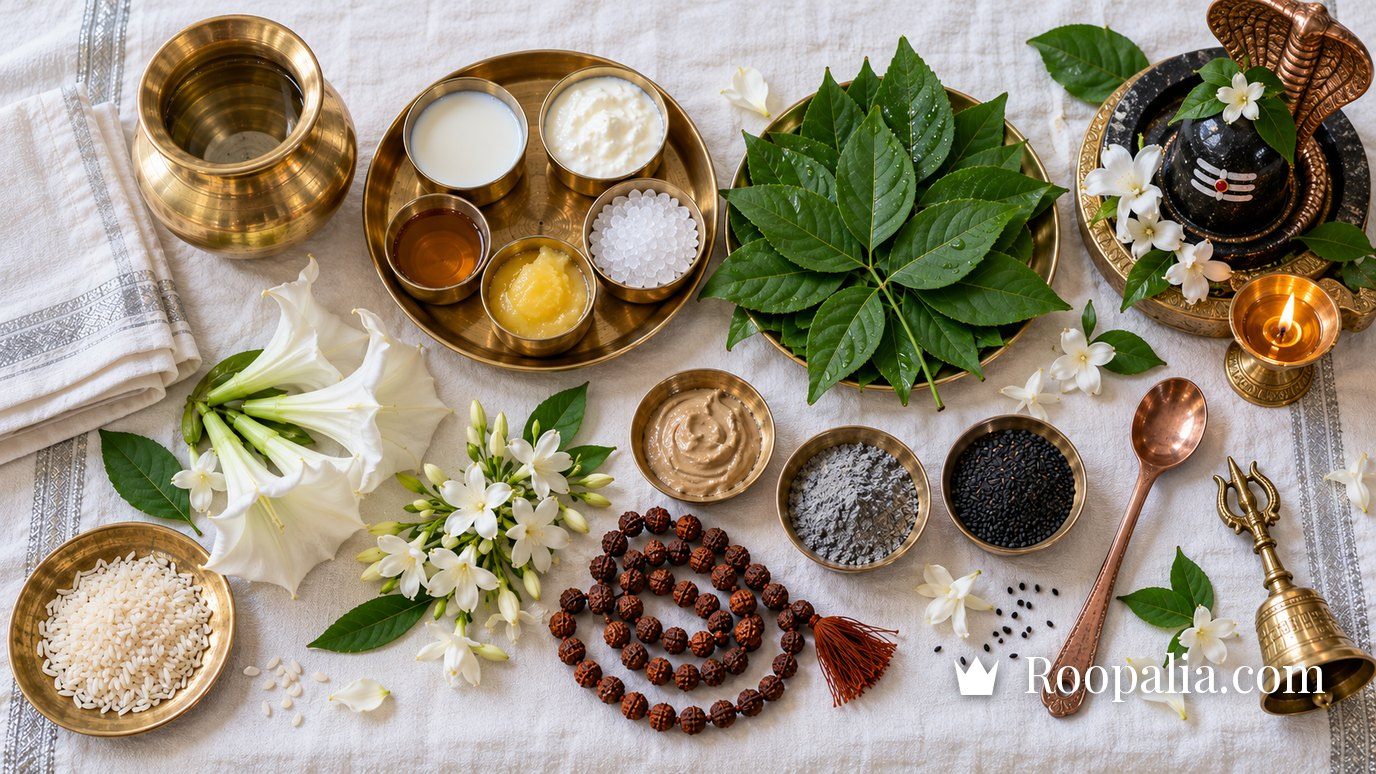
| Category | Items |
|---|---|
| Abhishek | Clean water (Gangajal if possible), raw milk, curd, ghee, honey, sugar — these five are the panchamrit |
| Leaves & flowers | Bilva leaves, white flowers (oleander, jasmine, madar), datura, arka blossoms, shami leaves |
| Pastes | White or red sandalwood, bhasma (vibhuti) |
| Other offerings | Whole rice, black sesame, sugarcane juice, bhang where the tradition exists, a sacred thread |
| Vessels | Copper or brass lota, thali, achmani spoon, a gadgadi drip pot |
| Lamp & incense | Ghee lamp, cotton wicks, incense sticks, camphor |
| Naivedya | Mishri, white sweets, kheer, seasonal fruit, coconut |
| Japa | Rudraksha mala |
| Cloth | White clothes for the observer, white cloth for the puja chowki |
What to offer on a Shivling — and what never to offer
This is the most-asked question about Monday worship and the one that gets muddled most often. Both lists, plainly:
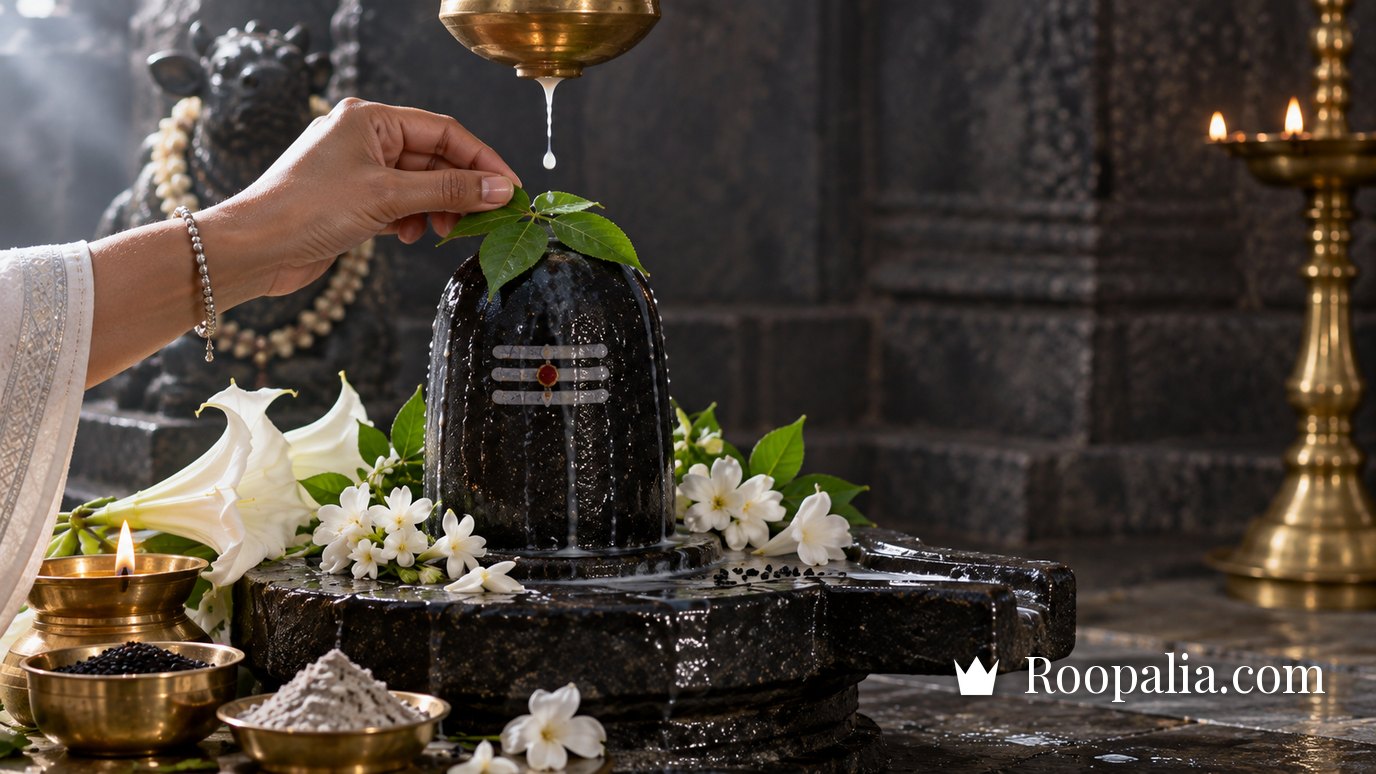
✓ Offer these
- Water — first and most important
- Raw milk, curd, ghee, honey, sugar
- Bilva leaves — three-lobed, unbroken
- Datura and arka (madar) flowers
- White oleander, jasmine, lotus
- Bhasma and sandalwood paste
- Black sesame, whole rice, shami leaves
- Sugarcane juice, dry coconut
✗ Never offer these
- Ketaki (kewda) flowers
- Tulsi leaves
- Turmeric and kumkum
- Sindoor and roli
- Water poured from a conch
- Stale, wilted or fallen flowers
- Torn or insect-eaten bilva leaves
- Broken rice grains
Why not ketaki? The Shiva Purana tells of an argument between Brahma and Vishnu over who was greater, settled by a contest to find the end of an infinite Jyotirlinga. Neither could. Vishnu admitted it; Brahma produced a ketaki flower as a false witness to his claim. Shiva appeared and cursed the ketaki never to be accepted in his worship again.
Why not a conch? The conch is associated with the demon Shankhachuda, slain by Shiva. So water is never poured from a shankha onto a Shivling, even though the conch is essential in Vishnu worship.
One detail almost no guide carries: the Purana ranks flowers. The Skanda Purana states that a single arka flower equals a gift of ten gold coins, that oleander is worth a thousand arka flowers, and that one shami flower equals a thousand kusha blossoms. Notice what that ranking implies — arka and shami grow wild and free, while lotuses must be bought. The message is not subtle: what comes to you easily ranks highest.
What to eat during the Monday fast
Somvar Vrat is not a waterless fast. It was designed for ordinary householders to sustain for a lifetime, so it comes with flexibility built in. Three levels are common:
- Phalahar — fruit, milk and buttermilk through the day, then one sattvic meal in the evening after the Shiva puja. This is the most widespread form.
- Ek bhukt — a single meal in the day, water or milk otherwise. The usual South Indian practice.
- Complete upvas — water only, with parana after sunrise the next day. Demanding, and not for everyone.
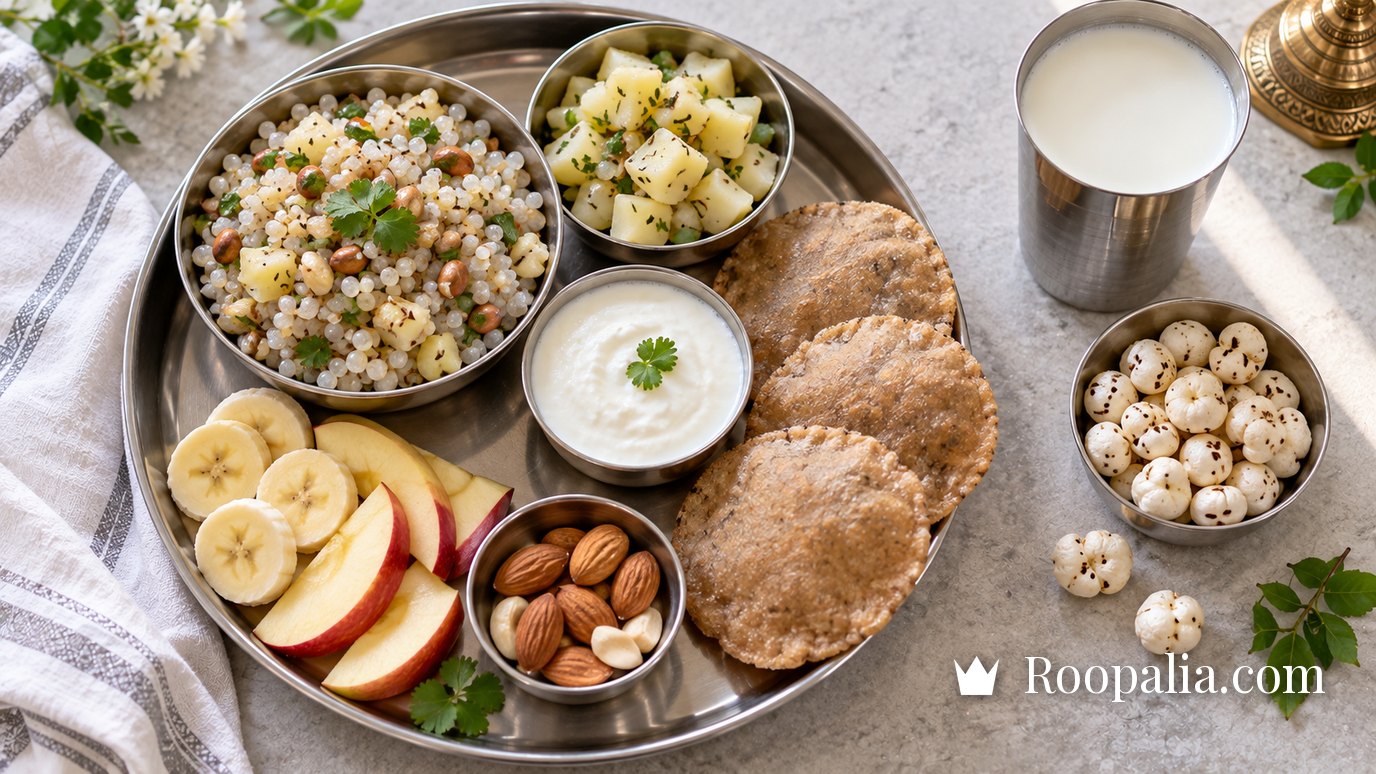
Allowed: seasonal fruit, milk, curd, buttermilk, paneer, sabudana, samak rice, kuttu and singhada flour, potato, sweet potato, bottle gourd, colocasia, makhana, nuts, coconut, jaggery and mishri. For seasoning: rock salt (sendha namak), black pepper and cumin.
Avoided: grains (wheat, rice, lentils), ordinary table salt, onion and garlic, meat, fish, eggs, alcohol, and anything tamasic or deep-fried.
One honest note. Eating fried sabudana tikkis and heavy potato chaat all day and calling it a fast defeats the purpose. The "one meal" of the texts is a light meal. The word upavasa literally means "sitting near" — near the divine. A heavy stomach sits near nothing.
⚠️ Health — please read this part
- Pregnant and breastfeeding women should not attempt a full fast; fruit and milk are enough
- If you have diabetes, a long fast can drop your blood sugar — never change medication or meal timing without asking your doctor
- With blood pressure, thyroid, kidney or heart conditions, speak to your physician before extended fasting
- Waterless or complete fasts are not appropriate for elderly people or young children
- Dizziness, palpitations, severe weakness or a cold sweat mean you break the fast immediately — protecting the body is the first duty in the texts too
Keep drinking water through the day. Water is not restricted in this vrat.
When should you break the Monday fast?
The direct answer first: the most widely followed rule is to break the fast the same evening, in Pradosh kaal — around sunset — after the Shiva puja and the vrat katha.
But three traditions exist, and all three are valid. That is why people get confused.
| Practice | When to break | Where it is followed |
|---|---|---|
| Pradosh kaal | Around sunset, after the evening puja and katha | Most widespread — North and Central India |
| By the third prahar | Roughly between 3 and 4 pm | Many family traditions |
| At the next sunrise | Tuesday morning, after bathing | South India, Kartik Somvar vrat |
What is a "prahar"? The daytime is divided into four prahars of roughly three hours each. If sunrise is at six, the first prahar runs to nine, the second to twelve, the third to three. So the third prahar ends around 3 pm — which is what people mean by "breaking the fast at three".
The best approach is to follow your own family's practice. If there is none, adopt the Pradosh kaal rule; it is the most common and the most suited to Shiva worship.
How many Mondays, and when to start?
For the ordinary Somvar Vrat there is no required number. One Monday is valid; so is a lifetime of them. That flexibility is the whole character of this fast.
If you want to take a sankalp, the usual counts are 5, 7, 11 or 16 — and the Puranic original, as noted above, is eight with udyapan on the ninth.
When to begin? The Skanda Purana says the vrat may be started on any Monday in the bright fortnight of any month. That is worth knowing, because the common claim that you "must start in Sawan" is not a rule anywhere in the texts.
In practice these months are considered best:
- Shravana (Sawan) — the most auspicious; Shiva's own month
- Kartik — the principal month in South and West India
- Vaishakh and Margashirsha — their Mondays are also held special
- Phalgun — the month of Mahashivratri
The Solah Somvar vrat has its own vidhi, katha and udyapan; a full guide to it is coming.
Which mantra to chant on Monday
Three mantras are enough for this day. You do not need more.
| Mantra | When and how many |
|---|---|
| Om Namah Shivaya the Panchakshara | While pouring water, and 108 times on a rudraksha mala after the puja. This is the day's principal mantra. |
| Om Som Somaya Namah | For the Moon — 11 or 21 times at night while looking at the Moon |
| Mahamrityunjaya Mantra Om tryambakam yajamahe… | In illness, fear or crisis — 11, 21 or 108 times |
A word on the Mahamrityunjaya, because it is widely reduced to "the mantra that prevents death". It is in fact a verse of the Rigveda (7.59.12), addressed to Tryambaka, the three-eyed Rudra, and it carries a beautiful image: as a ripe cucumber is freed from its stalk without being pulled, so may I be freed from the bond of death — but not from immortality. That is not a plea to stay alive. It is a plea to ripen. A separate article on it is planned.
Som Pradosh — the Monday that counts double
Every month has two Pradosh vrats, on the trayodashi of each fortnight. When a trayodashi falls on a Monday it becomes Som Pradosh — Shiva's day and Shiva's tithi together — and it is counted among the most auspicious Shiva days of the year.
Pradosh kaal is the window around sunset, roughly forty-five minutes on either side of it. The puja happens inside that window, so the Som Pradosh fast is kept all day and broken there.
Som Pradosh does not occur every month; only two or three fall in a year, which is why it is looked forward to.
📅 Upcoming Som Pradosh dates
2027 — Monday 19 April (Chaitra Shukla), Monday 30 August (Bhadrapada Krishna), Monday 13 September (Bhadrapada Shukla)
Dates follow the Kashi sunrise. Outside India or in distant cities they can shift by a day — check your local panchang.
Sawan Mondays and Kartik Mondays — one vrat, two months
This is the point that confuses North and South Indian families when they compare notes, and the explanation is simple.
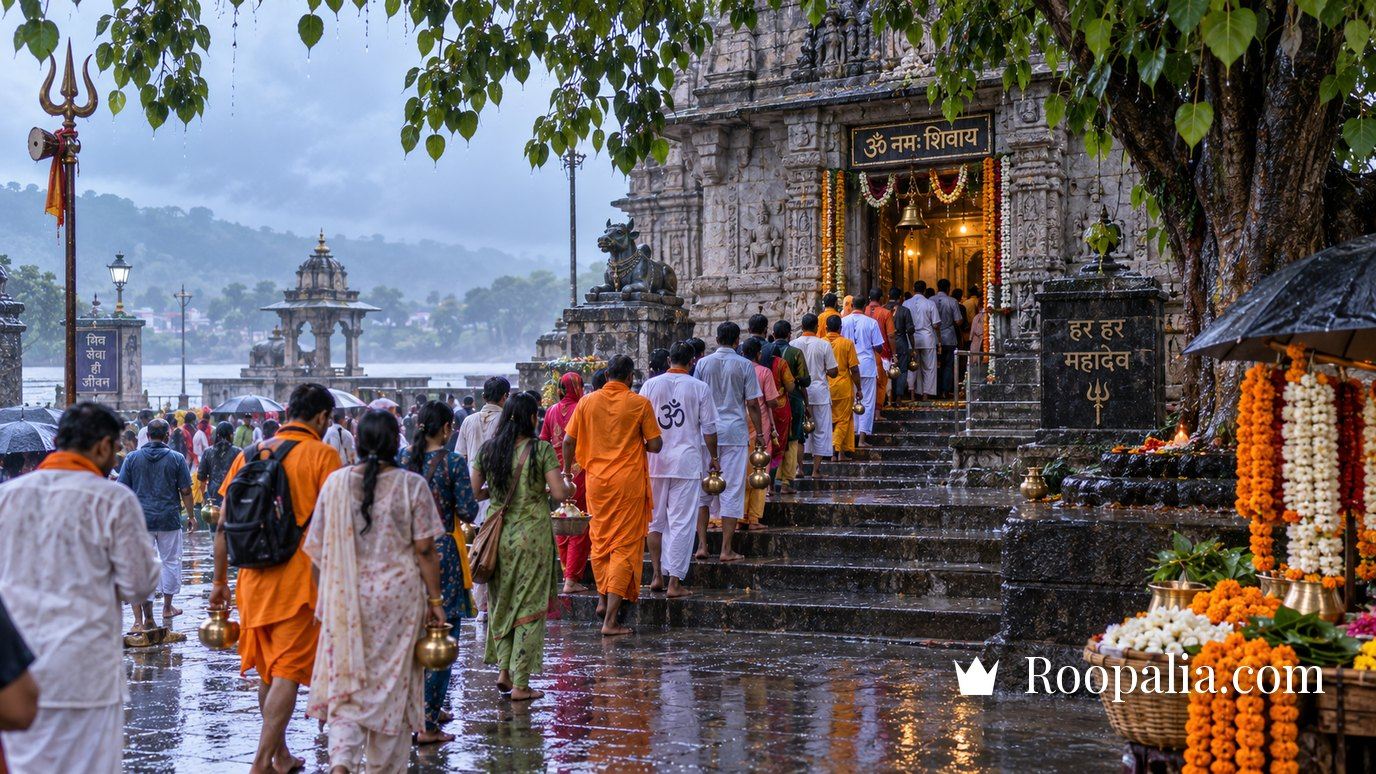
In North India, Maharashtra and Gujarat, the Mondays of Shravana are the great ones. The tradition holds that the churning of the ocean happened in this month and that Shiva drank the halahala poison to save creation — so his throat is cooled with water all month long. These are also the weeks of the Kanwar Yatra, when pilgrims carry Ganga water on foot from Haridwar, Gangotri and Sultanganj to their village Shiva temple.
In Karnataka, Andhra Pradesh, Telangana and Tamil Nadu, the same weight falls on the Mondays of Kartik — Kartik Somvar, or Karthigai Somavaram in Tamil. There the fast runs from sunrise to the next sunrise, and many take it up for twelve years or for life.
Why do the dates differ? North India follows the purnimanta calendar, where the month ends at the full moon; the south and west follow the amanta calendar, ending at the new moon. That produces a gap of about a fortnight.
📅 Upcoming special Mondays
Kartik Somvar 2026 — 16, 23, 30 November and 7 December
Sawan Somvar 2027 (North India, purnimanta) — 19 and 26 July; 2, 9 and 16 August (five in all)
Sawan Somvar 2027 (amanta regions) — 9, 16, 23 and 30 August (four in all)
And not only India. In Nepal, the four Mondays of Shravana carry their own colour — women wear green, red and yellow bangles all month, a green pote at the neck, and mehndi on the hands. Green is the month's colour there, the colour of paddy fields in the rain. Even girls who live in jeans put on bangles that month.
There is one southern custom worth carrying home. On Kartik Somvar a devoted Shiva-worshipping couple is invited and fed, and then honoured as Uma and Maheshwara themselves. Worship, in other words, is not only for stone; the same divinity is looked for in a living household.
How to perform Somvar Vrat udyapan
Udyapan follows the last of the Mondays you committed to. If you are keeping ordinary Mondays without a sankalp, no udyapan is needed.
- Bathe in the morning, wear white, and purify the puja space with Gangajal.
- Build a square mandap with four banana stems and decorate it with mango leaves and white flowers.
- Place a chowki in the centre, spread new white cloth, and install images of Shiva and Parvati — along with a vessel representing the Moon.
- Sit facing east. Take the sankalp and perform the full shodashopachara puja, abhishek and aarti.
- Perform a havan with sesame, barley, ghee and kheer, offering the ahutis with Shiva mantras.
- Feed brahmins or those in need with kheer and puri, and give cloth and dakshina according to your means.
- End with the kshama-prarthana, asking forgiveness for any lapse in the ritual.
The Skanda Purana describes something far grander — golden pots, eight shaktis installed in the eight directions, an all-night vigil. But the same text says that whoever performs this vrat at home, within his means, earns the merit of a pilgrimage. Display beyond your means was never asked for.
What not to do on a Monday
Fasting or not, some things are traditionally avoided on Mondays. Some rest on scripture, some on plain sense, and some purely on custom — worth separating so you can decide for yourself.
- Anger, harsh words, quarrels. This matters most. The Moon governs the mind; wrecking your mind on the mind's own day empties the fast of meaning.
- Meat, alcohol and tamasic food are kept out of the house, fast or no fast.
- Milk. The observer offers milk to Shiva rather than drinking it during the day, and may take it after the evening puja. This varies by family.
- Washing hair and cutting nails. Avoided in many households on Mondays. This is custom, not scriptural instruction — some families are strict about it, others ignore it entirely.
- Sleeping during the day is discouraged on a fast day, so that the vrat does not reduce to hunger alone.
- Turning anyone away. No one should leave your door empty-handed on this day.
Everything else — work, travel, shopping, study — proceeds normally. Monday is regarded as a good day for auspicious undertakings, not a restricted one.
Keeping the Monday fast abroad
First, kill the question that troubles everyone: do I follow the Indian date or my own? Your own. The ordinary Somvar Vrat runs on the weekday, not the tithi. When it is Monday where you live, it is your fast — your sunrise, your sunset, your Pradosh kaal.
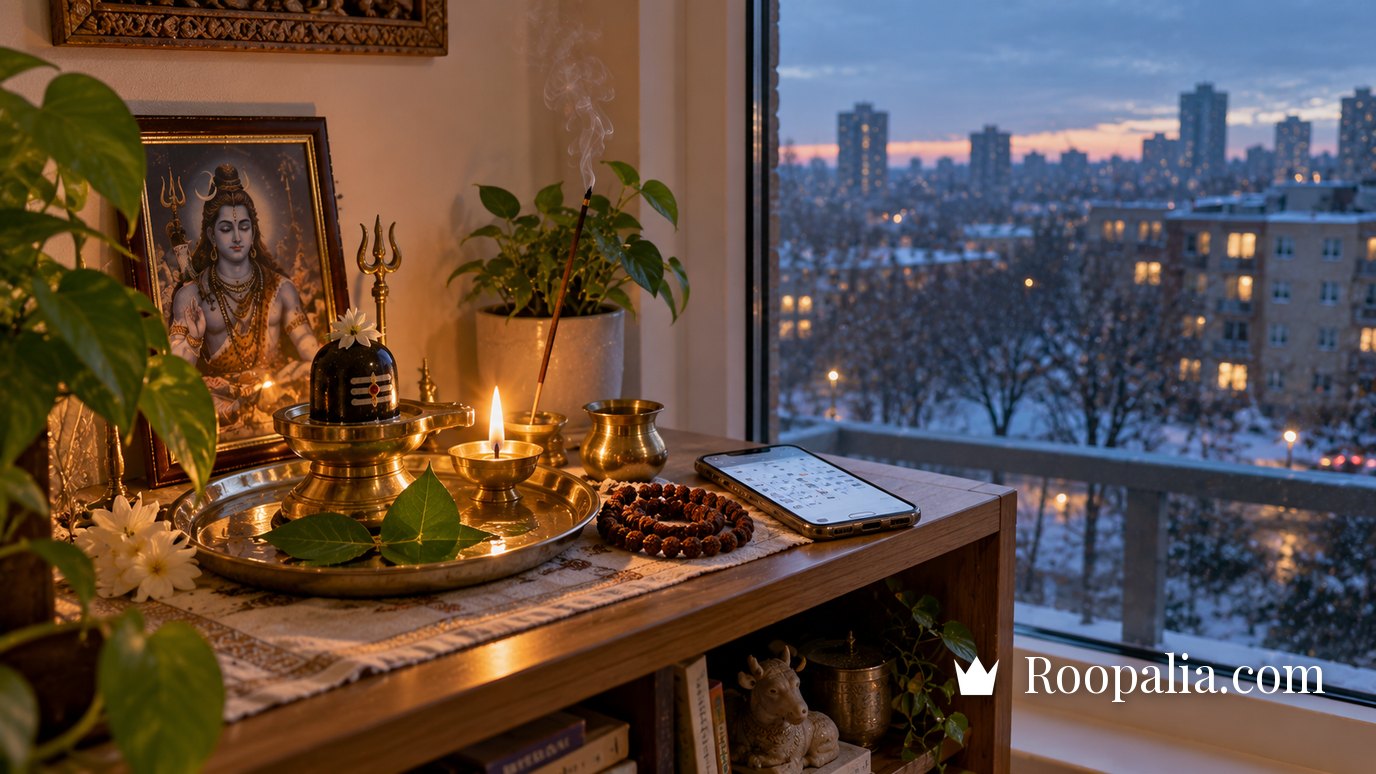
The one exception is Som Pradosh, which is tied to the trayodashi tithi. For that, check a panchang set to your city, or simply keep it on the Indian date with your family. Either works — just decide once.
- No Shivling? An image of Shiva is fine. Small brass parthiv lingas are easy to order online now.
- No bilva leaves? Indian grocers stock dried ones and they are accepted. If you cannot find any, a single lota of water offered with faith is enough — the Purana says so itself.
- No datura or arka? You will not find them abroad. Any white flower works — chrysanthemum, lily, carnation.
- Smoke alarms? Keep the ghee lamp very small, use a short piece of incense, or switch to an electric diya. Summoning the fire brigade is not part of the vidhi.
- Where does the abhishek water go? Do the whole abhishek over a thali and pour the water into a plant — a pot on the balcony counts.
- Who gets the prasad? Colleagues, neighbours, your children's friends. If there is no one, donate something to a food bank. Prasad exists to be shared.
One more thing worth saying. Doing this abroad is genuinely hard — no time, no ingredients, cold mornings, a meeting at nine. But on the Monday you manage it, you will find yourself remembering the small temple in your village, and a grandmother who once walked you there holding your finger. That memory has value. And there is only one way to give it to your own children: let them watch you do it.
How to explain this day to your children
Children ask why. "Because we do" does not preserve a tradition; it only postpones the question. Monday happens to have unusually good answers.
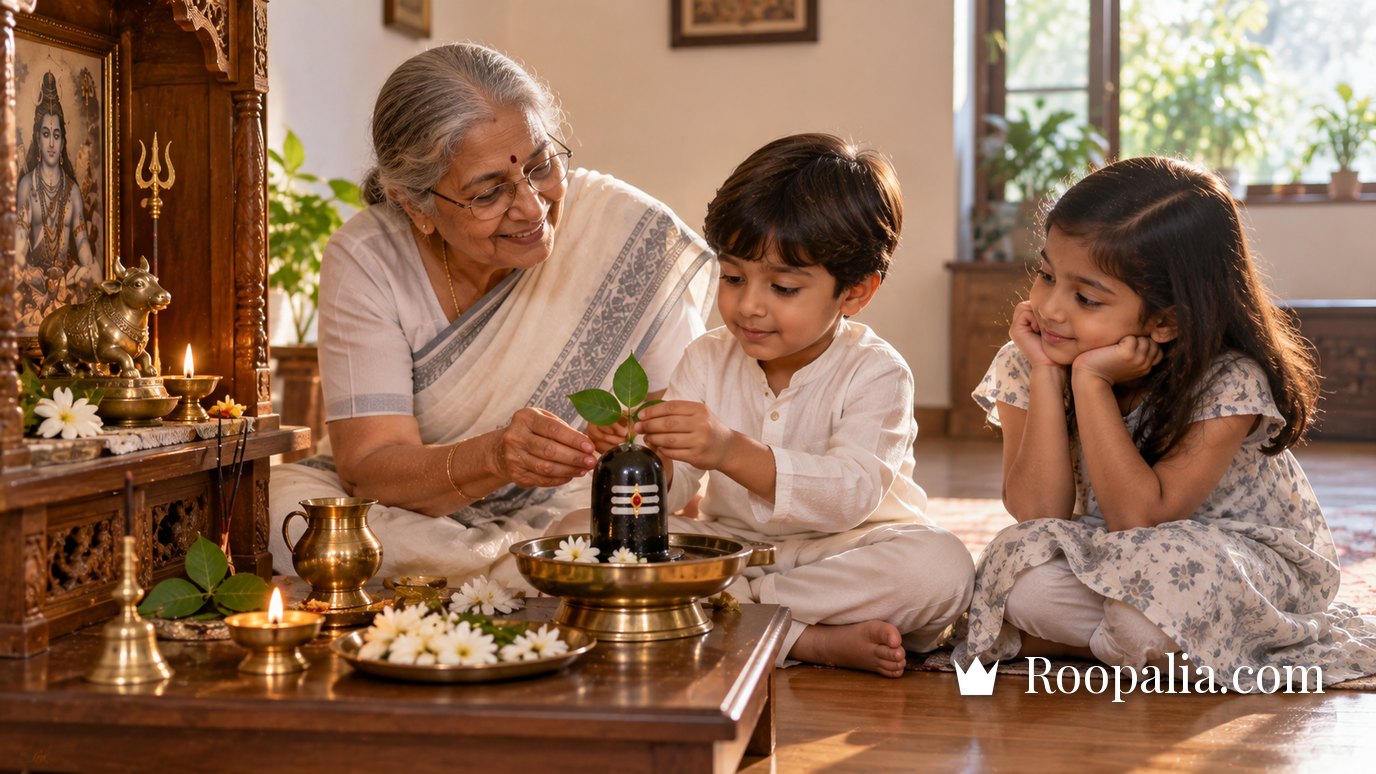
For younger children (4–8). Show them the Moon at night and ask whether it looked the same yesterday. Then tell them the Moon shrinks a little each day and grows back, because long ago the Moon made a serious mistake, and Shiva forgave him and took away half the punishment — which is why the Moon never disappears completely, it always returns. There is a first lesson about forgiveness hidden in that.
For older children (9–14). Ask them why "Moon" is hiding inside "Monday". When they look surprised, give them Montag, lundi and lunes. In one stroke it shows them that their tradition is not something small and local, but part of the oldest shared idea humanity has. For children growing up outside India, this one is worth its weight.
For teenagers. Tell them the Skanda Purana story of the gandharva girl who declared that no one in the three worlds matched even a fraction of her beauty. What Shiva's gana said as he left — that high birth, beauty, learning and wealth all count for nothing once pride sets in, and the person is ruined — lands harder in the age of social media than it possibly did when it was written. The full story is in our Somvar Vrat Katha article.
And the best method of all: do not make a child fast. Include the child in the puja. Let them pour one lota of water and place one bilva leaf. Five minutes is plenty. Hands remember what ears forget.
In closing
Somvar Vrat is among the simplest fasts India has. No difficult tithi calculations, no expensive materials, no social gatekeeping. Man or woman, in a village or in a flat in New York — the vidhi is the same and the promised fruit is the same.
Its real message sits in the story it grew out of. The Moon erred, was cursed, waned almost to nothing — and returned by taking refuge in Shiva. The curse was not erased; its shape changed. Total annihilation became a cycle of waning and waxing. The Moon still shrinks every month, and every month it fills again.
🌙 If you remember only one line from this guide
The Monday fast is a fast of the mind. The greatest offering of the day is not milk or a bilva leaf — it is keeping your mind quiet from morning to night. Fast all day and then shout at someone, and the vrat both happened and did not. Be unable to fast at all but speak to no one harshly, and the vrat happened.
Everything else is procedure. That is the substance.
Disclaimer: This article describes religious tradition, Puranic sources and popular belief for informational purposes. Procedures, dates and rules vary by region, sampradaya and family custom — give priority to your own family's practice and your local panchang. Nothing here is medical advice. Please consult your doctor before fasting, particularly in pregnancy or with diabetes, blood pressure, thyroid or any chronic condition.