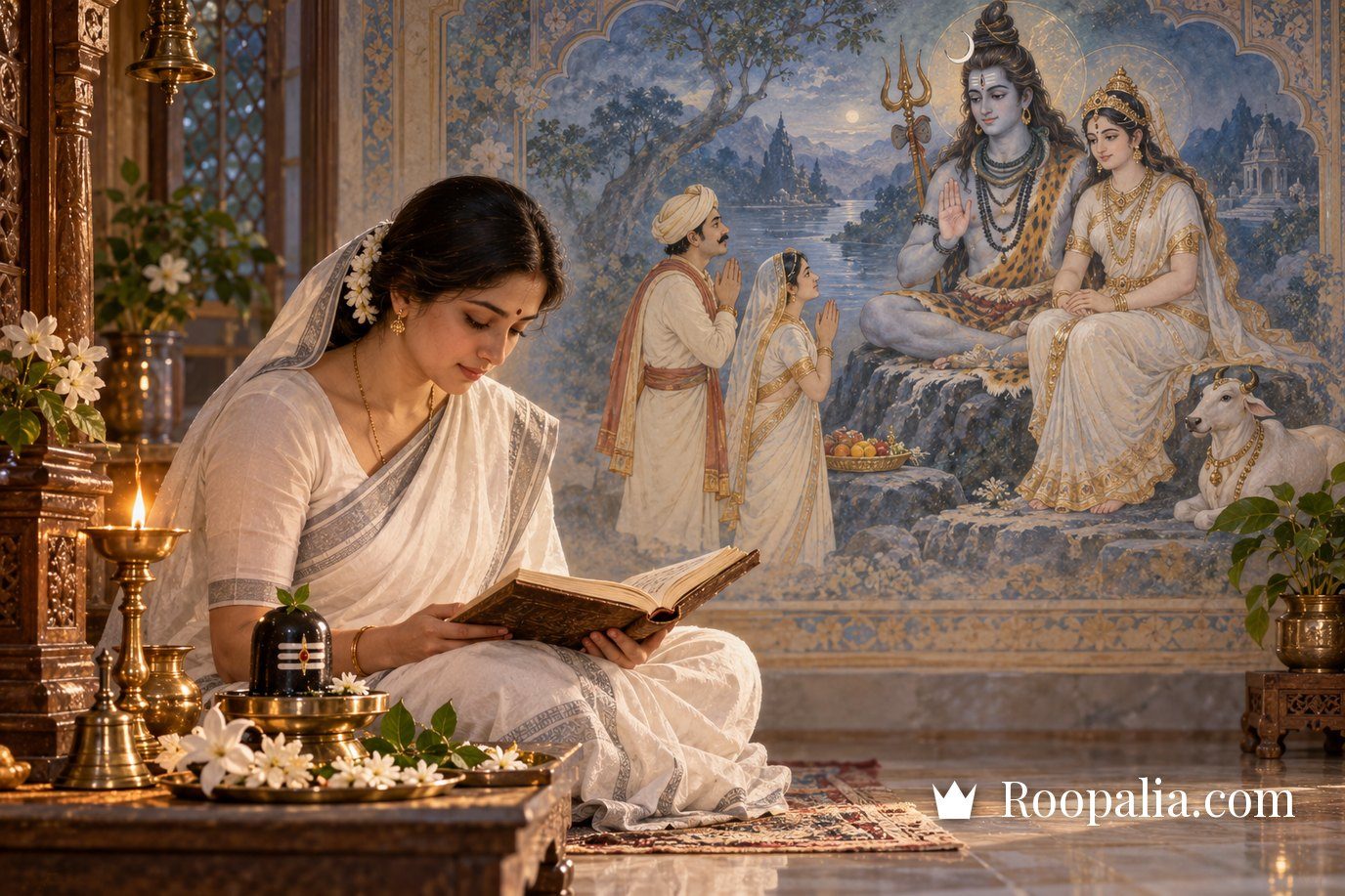
Somvar Vrat Katha — the story of the merchant and his son
In a certain town there lived a merchant. He wanted for nothing; his wealth was considerable. But one sorrow gnawed at him quietly — he had no child. Hoping for a son, he kept a fast every Monday and went to the Shiva temple, where he worshipped Shiva and Parvati with complete sincerity.
Years passed this way. One day Parvati, seeing his devotion, asked Shiva to grant the man his wish.
Shiva replied, "Parvati, every being in this world receives according to its own deeds. What is written must be lived."
But Parvati would not let it go. She pressed him to honour the merchant's devotion. Shiva then granted the boon, with a condition attached: "A son will be born in his house. But he will live only twelve years."
The merchant overheard this entire exchange. And here comes the first turn in the story, the one readers usually rush past — he showed neither joy nor grief. He simply went on worshipping Shiva as before.
In time a son was born. When the boy was eleven, the merchant decided to send him to Kashi to study. He called his brother-in-law, the boy's maternal uncle, gave him a large sum of money, and said, "Take him to Kashi. Wherever you halt on the way, perform a yajna, feed brahmins and give dakshina."
So uncle and nephew set out for Kashi, holding yajnas and giving alms along the road.
The town on the way
On the way they came to a town where the king's daughter was being married. But there was a problem. The prince she was to marry was blind in one eye, and his father wanted this concealed.
His eye fell on the merchant's son — handsome, well-mannered, unknown here. Why not, he thought, dress this boy as the groom and let him take the seven rounds; afterwards we can pay him off, send him away, and take the princess home with us.
And so it was done. The boy was dressed in the groom's clothes and married to the princess.
But the merchant's son was an honest boy, and the deception sat badly with him. Finding a moment alone, he wrote on the end of the princess's dupatta: "You have been married to me. But the prince you will be sent away with is blind in one eye. As for me, I am going to Kashi to study."
The princess read the words on her dupatta and went straight to her parents. The king refused to send his daughter away, and the wedding party returned empty-handed.
The twelfth year, in Kashi
Meanwhile uncle and nephew reached Kashi and arranged a yajna there. The yajna happened to fall on the very day the boy completed twelve years of age.
"Uncle," the boy said, "I don't feel well today."
"Go inside and lie down," his uncle answered. "I'll see to the yajna."
Within moments, exactly as Shiva's boon had specified, the boy's life left him.
When his uncle came inside and found him lifeless, he broke down and wept.
It so happened that Shiva and Parvati were passing overhead at that moment. "My lord," Parvati said, "I cannot bear this man's weeping. Please end his sorrow."
Shiva went to the dead boy and said, "Parvati, this is that same merchant's son to whom I granted a life of twelve years. His time is finished."
But Parvati said, "Mahadev, grant this child more years. Otherwise his parents too will waste away and die of grief."
At her insistence Shiva granted the boy his life again. By Shiva's grace, he sat up.
The road home
His studies finished, the boy and his uncle turned towards home. On the way they came again to the town where the wedding had taken place, and again they held a yajna there.
The princess's father recognised him at once. He brought the boy to the palace, honoured him, and this time sent his daughter away with him properly.
At home, the merchant and his wife had been waiting without food or water. They had vowed that if news came of their son's death, they would give up their own lives. When word arrived that he was returning alive, their joy knew no limit.
That night Shiva appeared to the merchant in a dream and said:
"Merchant, pleased by your Monday fast and by your listening to the vrat katha, I have granted your son a long life. Whoever keeps the Monday fast, or reads and hears this story, is freed from sorrow and has his wishes fulfilled."
॥ Om Namah Shivaya ॥
What the story is actually saying
On the surface this reads as a miracle story. Look closer and three things have been placed in it with real care.
First: the merchant's neither joy nor grief. He had overheard the entire conversation. He knew the son he was being given would be taken back in twelve years. An ordinary man would either have refused the boon or spent twelve years in dread. He did neither, and he did not stop worshipping. That is the story's first lesson — accept what is given, and keep doing what is yours to do.
Second: the sentence written on the dupatta. This is the real hinge of the story, and the least discussed part of it. A twelve-year-old, far from home, with nothing at stake and nothing to gain, could have walked away. He wrote the truth instead. The fast did not bear fruit because meals were skipped; it bore fruit because that household had taught its child to be honest. Say this part out loud to your children.
Third: Parvati's argument. She did not plead that the boy was good and deserved saving. She said that without him his parents would not survive either. The appeal was made on behalf of a third party. Compassion in these stories keeps taking that shape.
The Skanda Purana version — a gandharva girl and her pride
The story above comes from popular tradition. But a Somvar Vrat story is also recorded in the Skanda Purana itself, in the same Prabhasa Khanda chapter that sets out the vrat's procedure. It is rarely retold, so here it is in brief.
North of Kailasa, on Mount Nishadha, stood a city called Svayamprabha, ruled by a gandharva king named Ghanavahana. After eight sons, a daughter was born to him — Gandharvasena. She was counted the most beautiful among thousands and was accomplished in every art.
One day her mother said it was not right for such a daughter to remain unmarried. Her father called her and asked whether any suitor pleased her, promising to find the worthiest gandharva alive.
At this the girl's eyes went red with anger. "Is there anyone in the three worlds," she demanded, "who has even a ten-millionth part of my beauty?"
Her parents were stunned. But it did not end there.
It was spring. She was in the garden on a swing, with singing and dancing around her, repeating the same boast. Just then Shikhandi, chief of Shiva's ganas, passed overhead in his vimana and came down for the midday sandhya. He heard her.
"You see me standing here," he said, furious, "and still you call gandharvas, gods and everyone else beneath you? All this pride over your looks?" And he cursed her, that her limbs be covered with leprosy.
Terrified, she fell at his feet and begged forgiveness — "I am wretched; I will never do it again." Shikhandi relented. He did not take back the curse, but what he said next is the whole point of the story:
"A person may be given high birth, beauty, learning, wealth — but if pride takes hold of him over any of it, he is destroyed. So never be arrogant."
— Shikhandi's words, Skanda Purana, Prabhasa Khanda
He then told her the remedy: in a forest of the Himalaya lived a sage named Goshringa, who would show her the way.
She travelled there with her parents. Having heard everything, the sage told her that Someshwara dwells on the seashore in Bharatavarsha; go there, take the rule of a single meal a day, and keep the Somvar Vrat, and the disease will leave you.
The gandharva king took his daughter to Prabhasa. There they had the darshan of Someshwara and kept the Monday fast as prescribed — and the girl was cured. The Purana adds that Maheshwara was so pleased with that devotee that he granted her both the kingdom of the gandharvas and unbroken devotion to himself.
Why the two stories belong together
Notice that Shiva punishes no one in either story. In the first he states the law of karma and then, out of compassion, sets it aside. In the second the curse is not even his — it belongs to one of his ganas, and Shiva serves only as the door out of it.
Notice too that what actually gets healed in each is neither illness nor death. In the first story the real affliction was fear — twelve years with a sword hanging overhead, which the merchant defeated through worship. In the second the real affliction was not leprosy but pride; the disease was only its symptom.
This is why Somvar Vrat is called a fast of the mind. The day belongs to the Moon; the Veda says the Moon was born of the mind of the cosmic Purusha; and the day's two stories settle, between them, on the two great diseases of the mind. That is not an accident.
🕉️ How the katha is traditionally heard
• Read or heard after the puja and aarti, before the prasad is shared
• Sit holding a few rice grains and a flower; offer them to Shiva when the story ends
• One should not get up in the middle of the katha
• Everyone in the house may listen, whether or not they are fasting
• Close by saying "Om Namah Shivaya" three times, then perform the aarti
Disclaimer: The stories here are drawn from popular tradition and the Puranas, and have been retold in plain language in our own words. Versions vary by region and family. This article is for religious and cultural information and contains no medical advice.