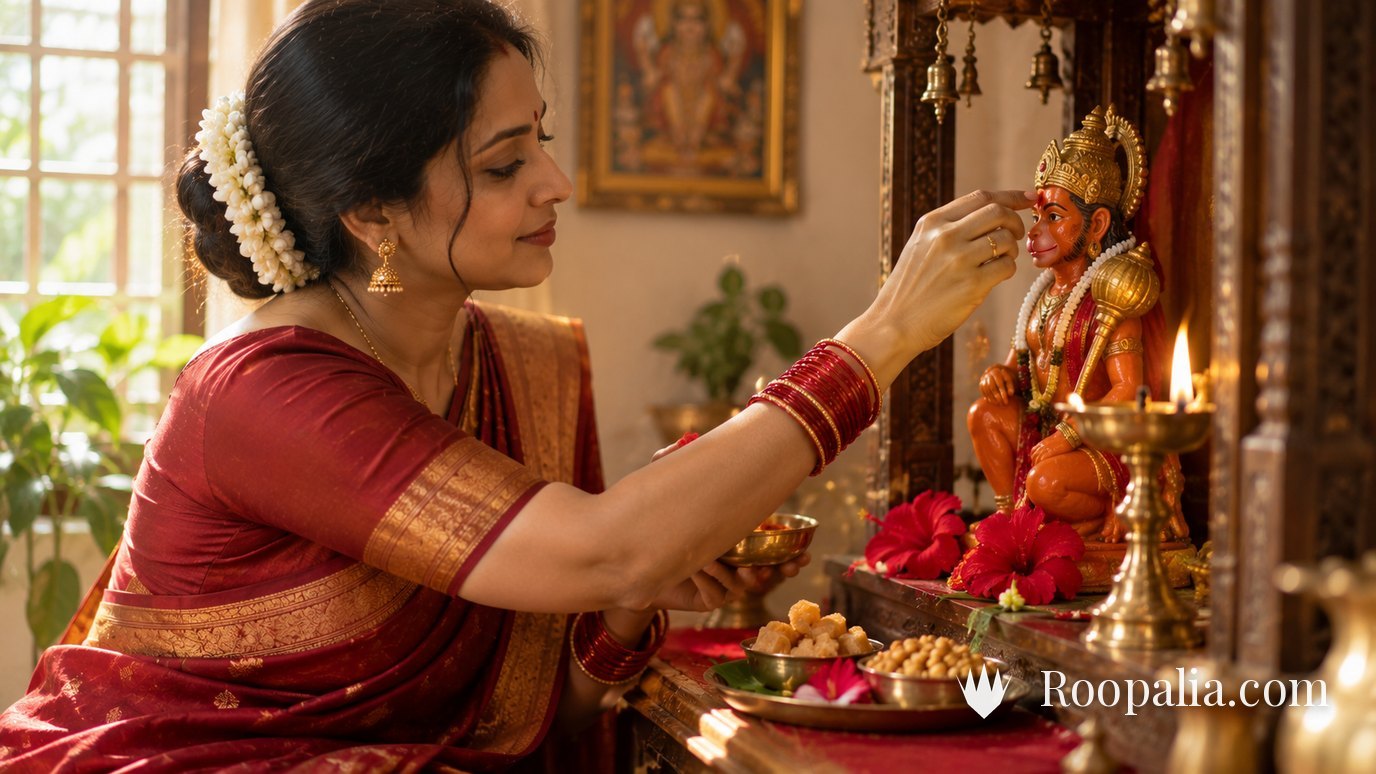
Whose day is Tuesday — Hanuman's or Mars's?
This is the first thing people get stuck on, and most guides sidestep it. Both answers are right, and they are connected.
Mangala is one of the nine grahas. He is called Angaraka — red as a burning ember; Bhauma — son of the Earth; Lohita — the red one; and in the south, Chevvai or Kuja. His mount is a ram, his direction south, his stone the red coral. He governs courage, energy, land, blood, siblings and conflict. In Sanskrit the word mangala also means "auspicious" — yet as a planet Mangala is counted among the malefics. That contradiction is the whole character of Mars in one word: the same force that protects you destroys you when it runs loose.
Hanuman is that force lived out and mastered. The strongest proof of his power in the Ramayana is not that he burned Lanka. It is that he was able to carry Sita away single-handedly and did not — because the decision was Rama's to make. Having strength is one thing; holding it back is another. That is the bridge between Hanuman and the day of Mars.
📜 Where Mars appears in the texts
Rigveda — no independent hymn to Mangala, but hymns to the Earth; the idea of Bhauma, "son of the Earth", grew out of that.
Skanda Purana, Avantikhanda — the fullest account of Mangala's birth, naming Ujjain as his birthplace.
Brahmavaivarta Purana — names his consort Medha. Note that: the war god's companion is called "intellect".
Ganesha Purana, Upasana Khanda — the origin of Angarki Chaturthi and Mangala's penance to Ganesha.
Ramcharitmanas, Sundarkand — the portrait of Hanuman on which this entire vrat rests.
Brihat Parashara Hora Shastra — the foundational astrological text whose treatment of Mars in the houses gave rise to the idea of Mangal dosha.
So in practice: the puja is offered to Hanuman, and the peace is sought from Mangal. Some households worship only Hanuman; others also visit a Navagraha shrine and offer red cloth and masoor dal to Mars. Whichever your family follows is correct. There is nothing to argue about here.
🌐 A language link children love
English Tuesday comes from the Germanic war god Tīw (Týr). In Latin the same day is Martis — the day of Mars, the Roman god of war. And in Hindi it is Mangalvar — named for the planet we call Mars in English. Three civilisations, with no consultation between them, handed this one day of the week to a god of courage and war. Tell a child growing up abroad this, and the tradition stops sounding like "something from India" and starts sounding like something the whole world quietly agreed on.
Something else worth noticing. Hanuman is the one deity whose worship carries no requirement of grandeur — no golden throne, no silk, no elaborate sixteen-step ritual. Sindoor, oil, a red flower, some jaggery and gram. This is why a vermilion-smeared stone under a village peepal tree becomes a Hanuman shrine, and why his is probably the most numerous temple in India.
The tradition kept this deity deliberately accessible, so that someone with nothing could still worship. That same allowance is what makes this vrat entirely keepable in a flat in Toronto with no temple within driving distance.
The sankalp — where the vrat actually begins
A vrat does not begin with skipping food. It begins with the sankalp, and this is the step most people leave out entirely.
On the first Tuesday, after your bath, stand before Hanuman with water, akshat (whole rice grains) and a red flower in your hand, and make three things clear in your mind: how many Tuesdays you are committing to, in what spirit, and when you will do the udyapan. Then release the water at the root of a tulsi or any plant.
The number has to be fixed in advance — that is part of the rule. A fast kept "for as long as it works out" is not a sankalp in the traditional sense. And choose a number you can honestly finish. Committing to 21 and stopping at nine is worse than committing to seven and completing it.
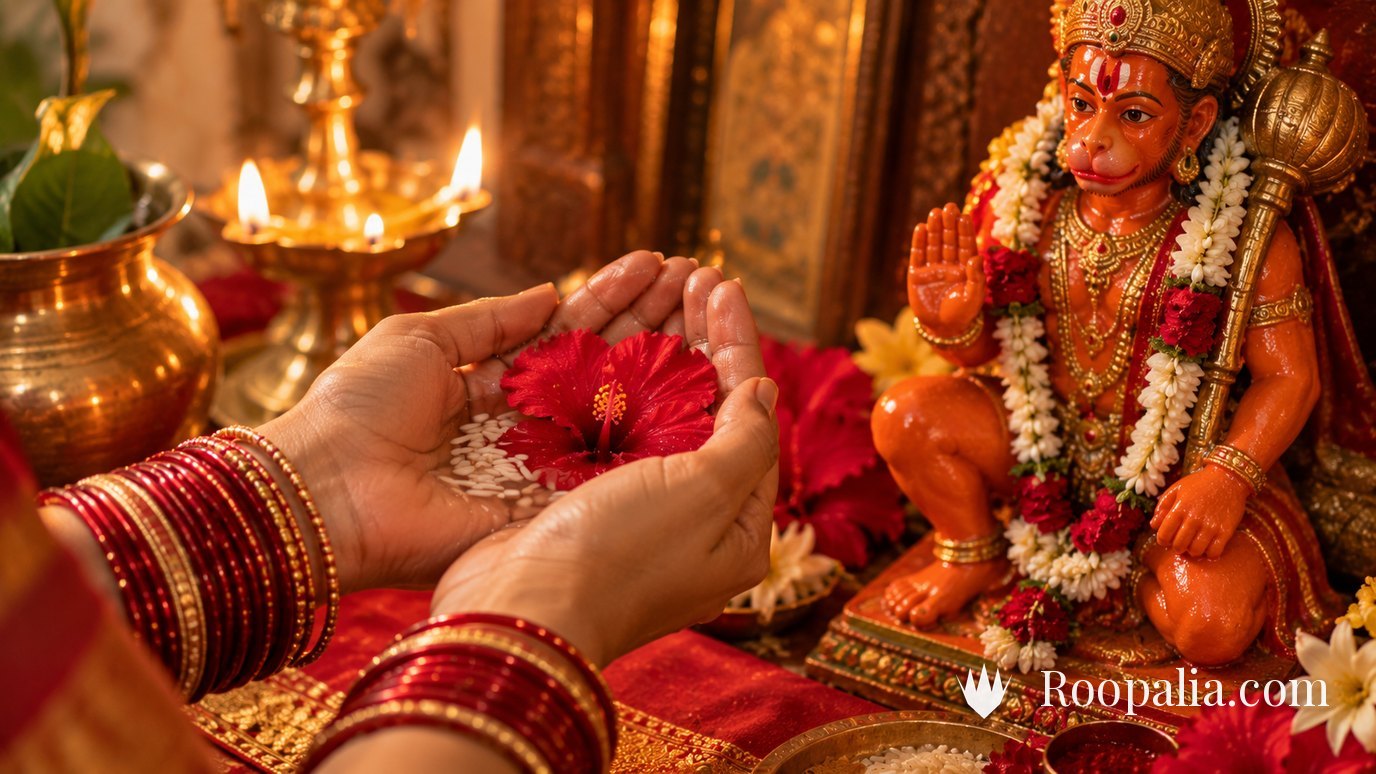
Mangalwar Vrat puja vidhi — step by step
This is the full version. A shorter one follows for anyone tight on time — both are valid.
1. Bathe before sunrise. Add a little Gangajal to the water if you have it. Wear red or vermilion. Black and dark blue are avoided on Tuesdays.
2. Set the place. Wash the puja area, spread a red cloth, and place an image or idol of Hanuman on it. Many families keep a picture of Ram and Sita alongside — Hanuman's worship is considered incomplete without Rama, and the stories repeat this again and again.
3. Sankalp and lamp. Light a lamp with jasmine (chameli) oil or sesame oil. Jasmine oil is the one most associated with Hanuman on Tuesdays. Light dhoop or a guggul incense stick.
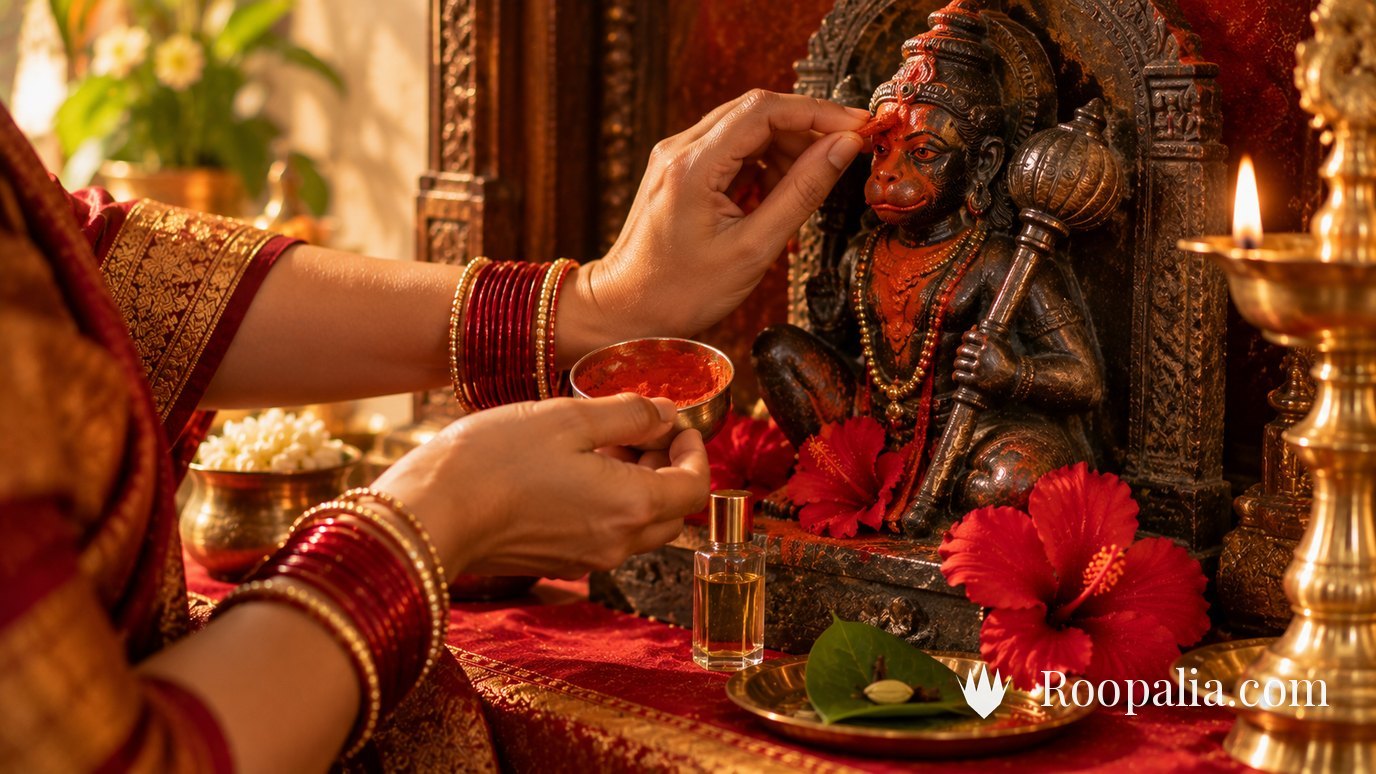
4. Offering sindoor. This is the most distinctive part of Tuesday worship. Sindoor mixed into jasmine oil is applied to the idol as a chola, or at minimum to the feet and forehead. The tradition holds that when Hanuman saw Sita applying sindoor to her parting and learned it was for Rama's long life, he covered his entire body in it. Sindoor has been his offering ever since. Do not offer sindoor taken from your own maang — this is a common mistake; keep a separate packet for offering.
5. Offerings. Red flowers (hibiscus above all), a red sandalwood tilak, a paan beeda, and a bhog of gur-chana or boondi laddu. Some traditions also offer kewda attar.
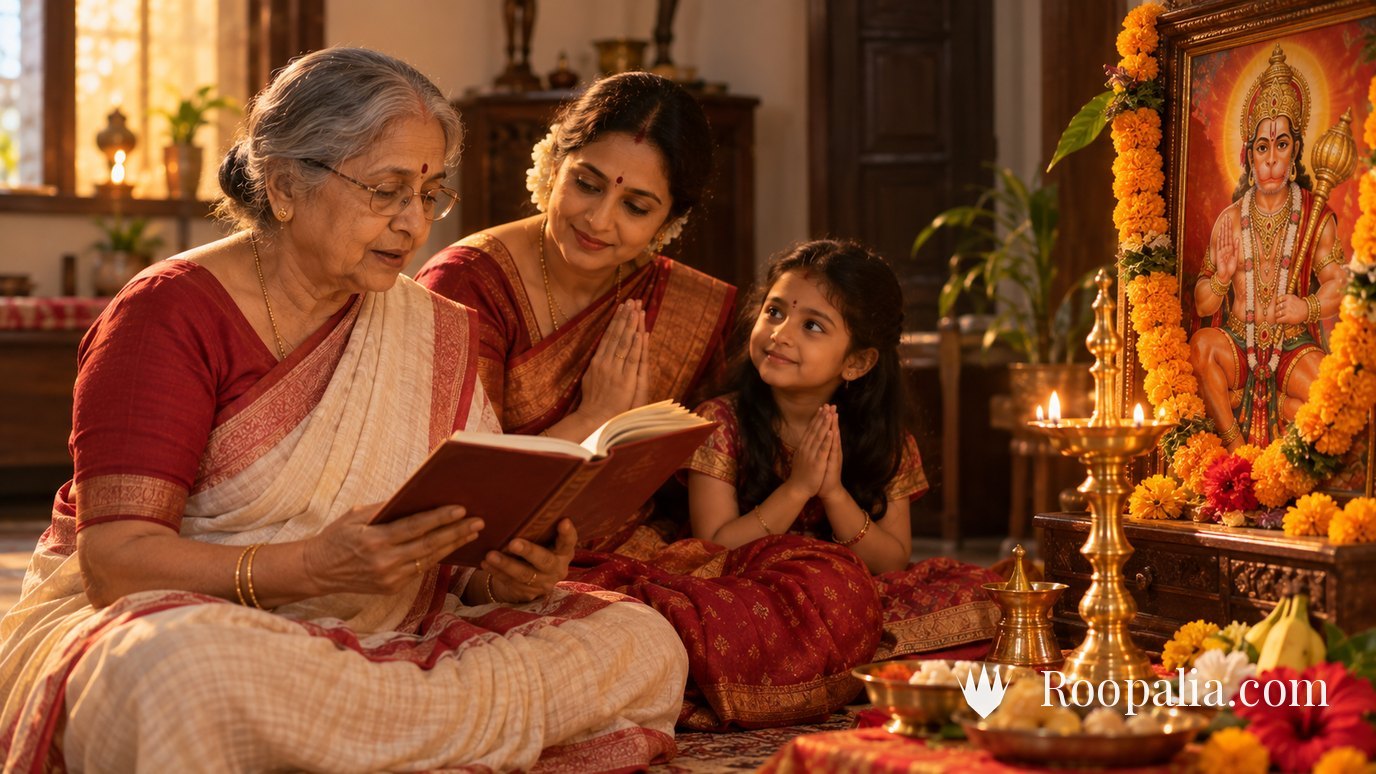
6. Recitation. The Hanuman Chalisa is the heart of Tuesday worship. Those with more time read the Sundarkand — the one chapter of the Ramcharitmanas given entirely to Hanuman. The Bajrang Baan is recited in times of crisis, but tradition asks that it be read with discipline and purity, so if you are just beginning, start with the Chalisa.
7. The vrat katha. After the recitation, the Mangalwar Vrat Katha is read or told aloud. A summary appears further down; the full story is in a separate article.
8. Aarti and prasad. Sing "Aarti kije Hanuman lala ki", then distribute the prasad. Sharing gur-chana with children — and traditionally with monkeys — is a very old part of this day.
⏱️ If you only have fifteen minutes
Bath → red clothes → lamp → red flowers and gur-chana for Hanuman → one reading of the Hanuman Chalisa → aarti → prasad. That is a complete vrat. Tradition has always allowed for doing what you are able to, and that allowance was written for busy householders, not for anyone else.
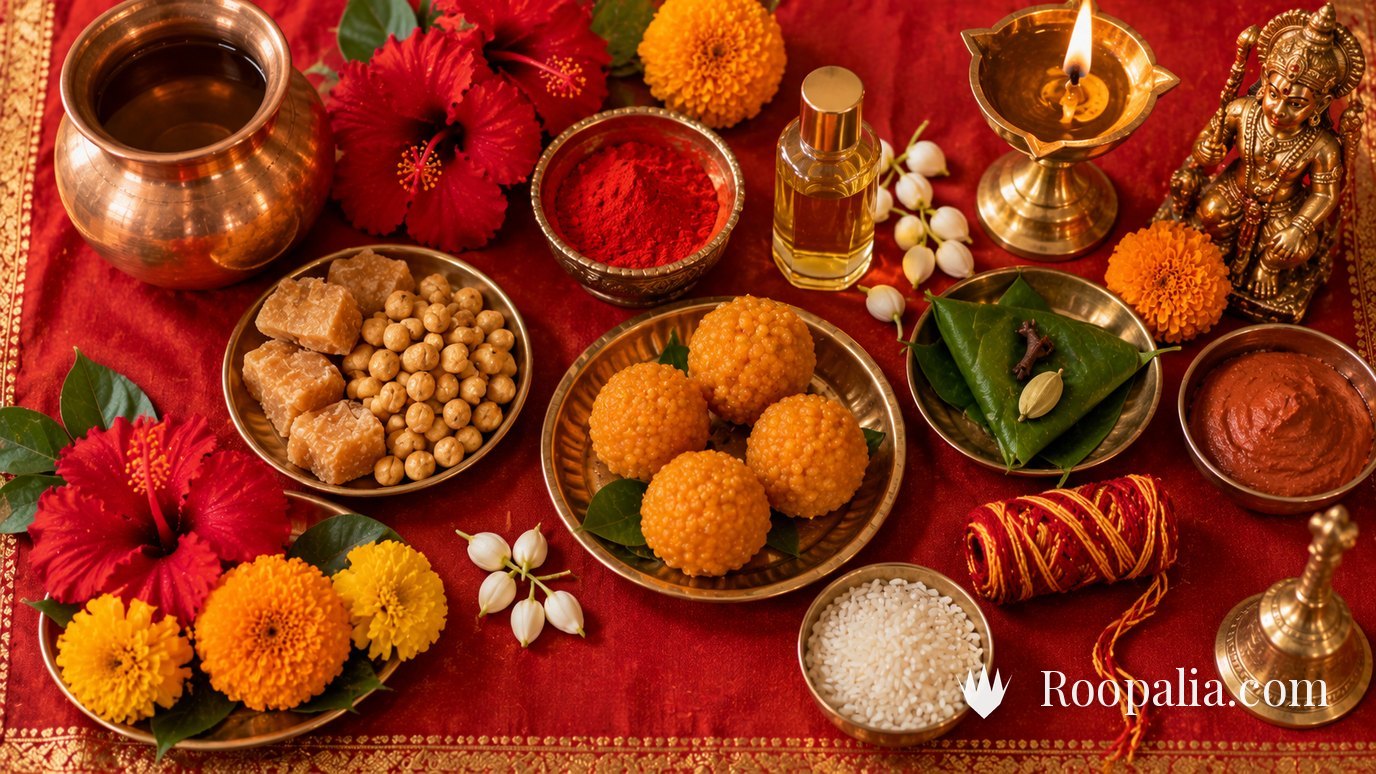
Puja samagri list
The full list is below. Anything you cannot find, the puja works without — this is here for completeness, not to add pressure.
- An idol or image of Hanuman — with a Ram Darbar picture alongside
- Sindoor — a separate packet for offering — and jasmine oil
- Red cloth — for the seat, and for the chola
- Red flowers — hibiscus, rose or marigold
- A lamp — sesame or jasmine oil, cotton wick
- Dhoop, incense, guggul, camphor
- Bhog — jaggery, roasted gram, boondi laddu, churma, banana
- Paan beeda — with supari, clove and cardamom
- Red sandalwood or roli, and akshat (whole rice)
- A water pot, preferably copper
- Mauli (sacred thread), and masoor dal with red cloth if you are also doing Navagraha puja
- A Hanuman Chalisa or Sundarkand book
Tuesday fasting rules — the dos and don'ts
Read these in two layers. Treating them all as one is what causes most of the confusion.
✓ What to do
- Bathe before sunrise
- Wear red or vermilion
- One sattvik meal in the day
- Read the Hanuman Chalisa or Sundarkand
- Read or hear the vrat katha
- Share gur-chana as prasad
- Keep speech and conduct restrained
- Give food or something red to someone in need
✗ What to avoid
- Salt in food
- Meat, alcohol, onion, garlic
- Anger, harsh words, quarrels
- Cutting hair, beard or nails
- Black or dark blue clothes
- Sleeping with the head to the south
- Lending or borrowing money (folk custom)
- Blaming anyone without cause
Now the part that rarely gets said. These rules are not all of the same weight. The salt restriction and the sattvik diet are scriptural. Not cutting hair or nails, and not lending money, are folk customs — they vary by region and in some places do not exist at all.
But there is one rule people treat lightly that is in fact the entire point of this fast: do not get angry. Mars is the planet of anger and impulse. If you have gone without food all day and still snapped at everyone in the house, the tradition would say the fast missed its purpose. Giving up salt is easy. Giving up anger is the actual vrat.
What can you eat during the Tuesday fast?
This is the most-asked question, so here it is in detail.
The core rule — one meal in the day, and that meal without salt. This is the defining condition of the Tuesday fast. Some regional traditions allow rock salt (sendha namak), but the mainstream North Indian practice is to avoid salt entirely for the day.
What you can have — wheat-based food made without salt, milk and milk products, curd, fruit (especially bananas and red fruit), jaggery, jaggery kheer, churma, boondi laddu, sweet roti, dry fruits, coconut, and milk tea.
What to avoid — salt, meat, fish and eggs, alcohol, onion and garlic, and traditionally masoor dal, which on this day is meant for offering, not eating. Brinjal and deep-fried food are also avoided.
What to eat in the evening? After the evening puja, katha and aarti, take your one meal. The most suitable: jaggery kheer or jaggery rice, salt-free roti or puri, milk, banana, and the gur-chana prasad. That is the paran. There is no tradition of a second, heavier meal later at night.
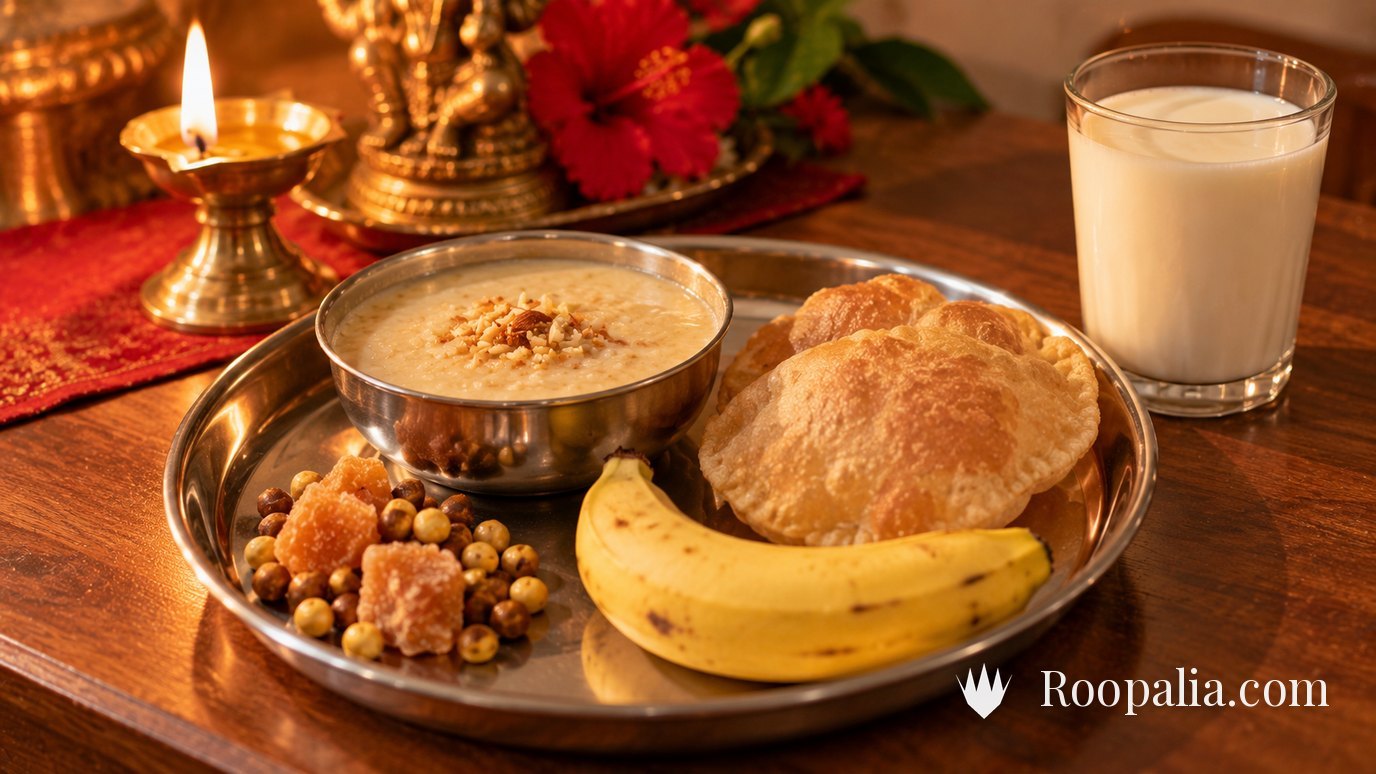
A health note that should not be skipped — a salt-free, one-meal fast is not for everyone. If you are pregnant or breastfeeding, or living with diabetes, high or low blood pressure, a thyroid condition or kidney problems, or if you are elderly or unwell, speak to your doctor before taking this on. Going a whole day without food can be dangerous with diabetes, and cutting salt is not advisable alongside some blood-pressure medication. In such cases a fruit-only fast, or simply doing the puja and the Chalisa, fulfils the spirit of the vrat completely. No fast is more important than your health — and the tradition never claimed otherwise.
What time should you break the Tuesday fast?
The Tuesday fast is broken the same day, not the next morning. The order is: light the lamp around sunset, do the evening puja, read the Hanuman Chalisa, read the vrat katha, do the aarti, take the prasad, and then eat your one meal.
Some families eat just before sunset, others after. Both are practised. The only firm rule is that nothing is eaten before the puja and the katha. If you work and cannot manage the evening, complete the puja in the morning and simply light a lamp before eating in the evening — that is accepted too.
How many Tuesdays, and when to start?
The number — the most common sankalp is 21 Tuesdays, with the udyapan on the following Tuesday. Sankalps of 5, 7, 11 and 45 also exist. Some people keep every Tuesday for life, in which case there is no udyapan.
When to begin — from the first Tuesday of the Shukla Paksha of any month. Two months are considered especially auspicious:
- Jyeshtha (May–June) — tradition holds that Hanuman first met Rama on a Tuesday in Jyeshtha. This is why the Tuesdays of Jyeshtha are called Bada Mangal.
- Shravan (July–August) — the Tuesdays of Shravan belong to Mangala Gauri, covered further down.
Some panchangs also recommend the first Tuesday after Chaitra Purnima (Hanuman Jayanti). If your family has followed one particular month for generations, keep to it — in matters of vrat, continuity counts for more than the calendar.
Which mantra to chant on Tuesday
There are two sets — one for Hanuman, one for Mars.
For Hanuman
Om Ham Hanumate Namah — the simplest seed mantra, 108 times
Om Namo Bhagavate Anjaneyaya Mahabalaya Swaha — for strength and protection
Manojavam Marutatulyavegam Jitendriyam Buddhimatam Varishtham — note that this verse praises Hanuman's intellect and self-mastery, not only his strength
For Mangal (Mars)
Om Am Angarakaya Namah — the seed mantra of Mars
Om Kram Krim Kraum Sah Bhaumaya Namah — the tantric beeja mantra
Dharanigarbha Sambhutam Vidyutkanti Samaprabham — the Vedic dhyana shloka, describing Mars as born of the Earth and bright as lightning
The usual method: 108 repetitions on a rudraksha or red sandalwood mala, facing south or east. If Sanskrit pronunciation makes you hesitant, use only Om Ham Hanumate Namah — it is both simple and complete. Tradition has consistently placed intent above pronunciation, and that is not a modern concession; the stories say it repeatedly.
Mangal dosha — what to do if you are "manglik"
This is the subject that has done the most to popularise the Tuesday fast, and also the most to spread fear around it.
In Hindu astrology, when Mars occupies the 1st, 4th, 7th, 8th or 12th house of a chart, it is called Mangal dosha — colloquially, being "manglik". It is associated with obstacles in marriage and marital discord. The belief runs deep in North and West India, while several traditions in the South and East give it far less weight.
The remedies prescribed within the tradition are: keeping the Tuesday fast, regular recitation of the Hanuman Chalisa and Sundarkand, donating masoor dal and red cloth on Tuesdays, feeding gur-chana to monkeys, and — on the advice of a qualified astrologer — wearing a red coral.
One thing has to be said here, and it may be the most useful sentence in this article. The word "manglik" has caused an enormous amount of needless anxiety, especially to young women — and families have turned down good matches over it. Notice that the tradition itself always offered remedies, which means it never treated the condition as fixed. A thing that has a remedy is not a curse. Do not let any astrological reading become more important than your daughter's happiness.
🌍 One thing about Mars that almost nobody mentions
One of Mangala's names is Bhauma — son of the Earth. From that comes a very old custom: Tuesday is considered auspicious for anything to do with land, buildings and immovable property — bhoomi pujan, laying a foundation, a griha pravesh. The planet held to obstruct marriage is the same one held to help you build a house.
That is not a contradiction; it is the balance. Mars destroys and Mars settles, and the only difference is which way the energy was pointed. Which is the whole premise of Hindu astrology in one line: no planet is evil, only unbridled.
Mangalwar Vrat udyapan — completing the fast
Once the number in your sankalp is complete, the udyapan is done on the next Tuesday. If you committed to 21, the udyapan falls on the 22nd.
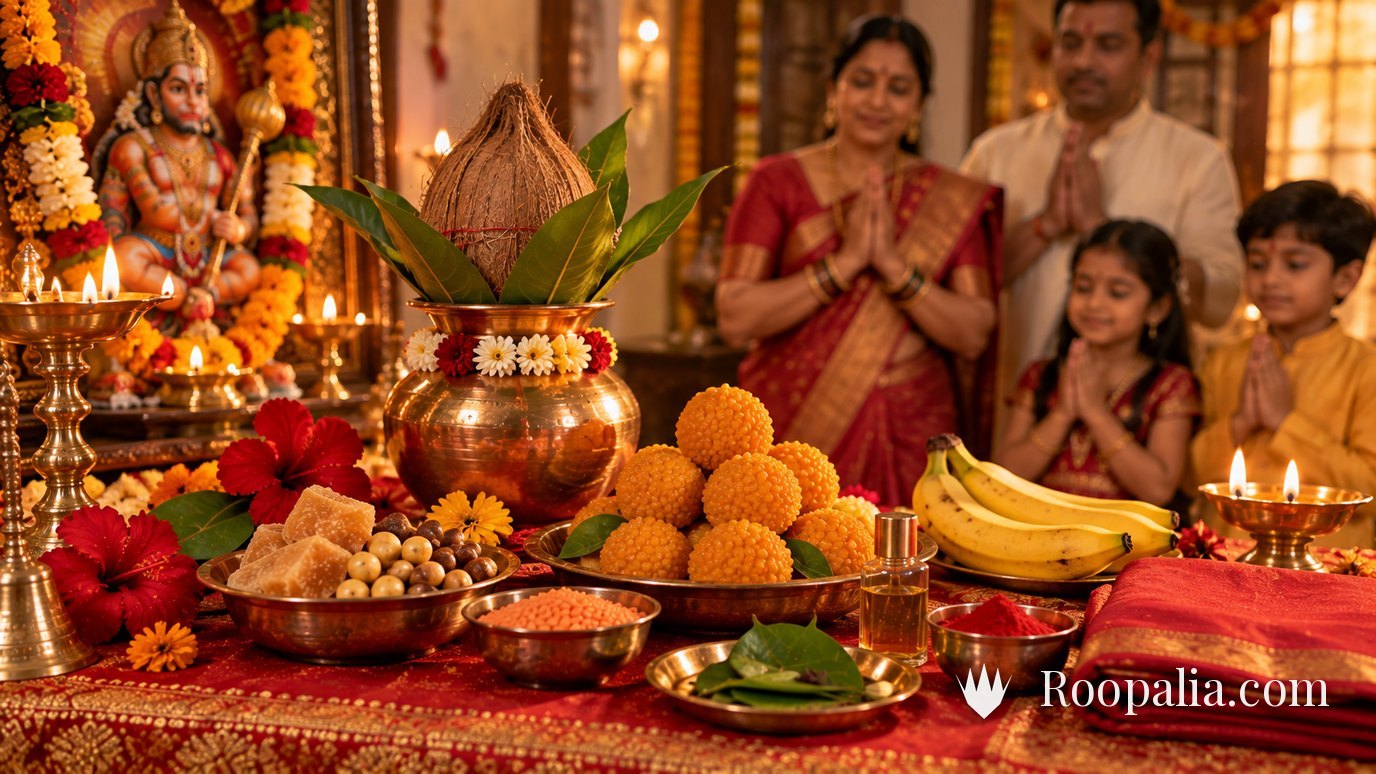
Preparation — clean the house, spread a red cloth for the puja seat, install a kalash, and decorate the Hanuman idol. A new chola is traditionally offered on this day.
The ritual — after your morning bath, perform the puja announcing the completion of the sankalp. Have the Sundarkand recited, or read it yourself. Where a havan is customary, offerings are made with the Mars mantra.
🔱 The Mangalwar Vrat udyapan mantra
On udyapan day the completion is offered with folded hands before Hanuman:
Om Ham Hanumate Namah — 108 times
Then, before the havan or the lamp —
Om Am Angarakaya Namah Swaha — 21 offerings or 21 repetitions
And finally the verse said at the close of every vrat, which carries the loveliest idea in the whole tradition:
"Mantraheenam kriyaheenam bhaktiheenam Hanumate,
yat poojitam maya deva paripoornam tadastu me."
Meaning — "My mantras were lacking, my method was lacking, even my devotion was lacking. Whatever I have offered, please accept it as complete."
That single verse is the whole of the Indian vrat tradition in miniature: admitting the imperfection of the ritual is itself the final step of the ritual. For anyone who never begins a vrat for fear of getting something wrong, this apology was written into the tradition in advance.
Udyapan samagri — 21 boondi laddus (or as many as your sankalp), gur-chana, a coconut, red cloth, sindoor, jasmine oil, bananas, and masoor dal for donation.
Daan and bhoj — feed a Brahmin or someone in need, and give red cloth, jaggery, masoor dal and a dakshina as you are able. In many places a bhandara is arranged at a Hanuman temple. Feeding gur-chana to monkeys is a widely loved part of the udyapan.
🙏 What if you miss a Tuesday?
Do not panic, and do not restart the count from zero. The accepted route is simple: any Tuesday missed through illness, travel or genuine circumstance is made up by adding an extra Tuesday at the end of the sankalp. There is a difference between skipping deliberately and being prevented — and the tradition has always recognised it.
The Mangalwar Vrat Katha — in short
The story is old and told in almost every household. In brief:
A Brahmin couple in a certain town had no child, and the grief of it had settled deep into them. Every Tuesday the husband walked to a Hanuman shrine in the forest and asked for a son. His wife kept the fast at home and would eat only after offering the bhog to Hanuman. Years of this devotion moved Hanuman, who granted them a son. Because he came by Hanuman's grace on a Tuesday, they named him Mangal.
The real turn comes later. The Brahmin returned from a long journey, found an unfamiliar boy in his house, and refused to believe his wife's account of the blessing. Consumed by suspicion, he took the boy out and threw him into a well. He walked home — and found Mangal coming up behind him, smiling. That night Hanuman appeared in his dream and told him plainly that the child was his own gift. The Brahmin was left ashamed and grateful in equal measure. From that day the couple kept the Tuesday fast for life.
📖 What the katha is actually saying
On the surface this reads as a story about childlessness. But look closely — the real crisis in the story is not the missing child; it is the husband's suspicion. After years of prayer, when the blessing was standing in front of him, he could not recognise it, and in anger he did something unforgivable. Mars is the planet of anger and impulse, and this story is precisely a warning about it. Which is why the hardest rule of this fast is not going without food — it is not losing your temper.
📖 Read the full Mangalwar Vrat Katha and aarti →
Mangala Gauri Vrat — the Tuesdays of Shravan that belong to women
This is the tradition that most English-language guides skip entirely, even though in Maharashtra, Gujarat and the Telugu states it is the most alive of all Tuesday observances.
On every Tuesday of Shravan, the Mangala Gauri Vrat is kept — worship of Parvati in her Mangala Gauri form. It is observed mainly by newly married women, for five years after the wedding, for the wellbeing of the husband and the new family. In Maharashtra it is called Mangala Gaur, and the pahili Mangala Gaur — a bride's first one after marriage — is one of the biggest occasions in her early married life. In the Telugu states it is Mangala Gauri Vratam, where married women are given thamboolam: betel leaves, areca nut, turmeric, kumkum and bangles.
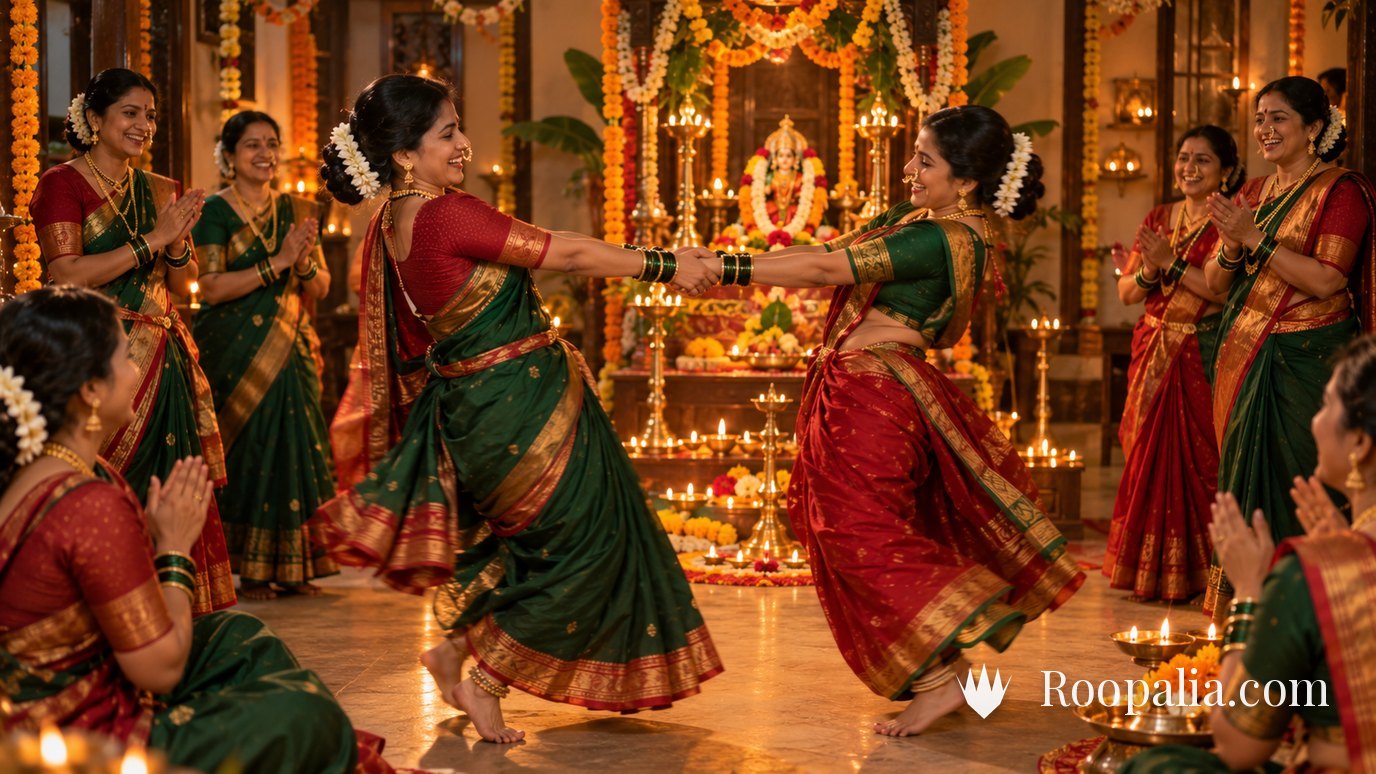
The most beautiful part comes after the puja, and it is the least written about. In Maharashtra, the women do not sleep on Mangala Gaur night. Women from across the neighbourhood gather and play traditional games — fugdi, where two women lock hands and spin until they are breathless; zimma, played to clapping rhythms and songs; aagote-paagote, kombda, and dozens more. Along with them come ukhane — short rhyming couplets in which the new bride says her husband's name aloud in company for the first time, something older custom never allowed her to do directly.
Look at what that really is. Under the name of a "fast", a space was built where a young bride — newly arrived in an unfamiliar house — could laugh, play, collapse from exhaustion, and find company among women her own age. A society that made her life lonely also carved out a few nights a year that were entirely hers. This is not a solitary vrat. It is a festival of women's company.
Bada Mangal — a Hindu festival that has never belonged to Hindus alone
If you ever need one living example of India's shared culture to show your children, this may be the best one there is.
In Lucknow, every Tuesday of the month of Jyeshtha is observed as Bada Mangal, centred on the old Hanuman temple at Aliganj. Its history reaches back into the Nawabi era. Janab-e-Alia, the Hindu wife of Shuja-ud-Daula, the third Nawab of Awadh, is often credited with founding the Aliganj Hanuman temple and inspiring Bada Mangal, though historians hold that the temple was actually built by her son, Saadat Ali Khan.
What the festival looks like today matters more than its disputed origins. Bhandaras — free community kitchens — appear across the city: puri and sabzi, halwa, chhole-bhature, and in the summer heat, sharbat and chilled water. And they are not put up by Hindu families alone. Muslim shopkeepers set up canopies handing out sharbat to anyone walking past, Sikh families run langars, Christian neighbours arrive with cold lassi. For two centuries this festival has refused to belong to only one community.
There is also a direct link to the Tuesday fast here: the belief that Hanuman first met Rama on a Tuesday in Jyeshtha. That is why beginning the Mangalwar Vrat in Jyeshtha is considered especially auspicious.
Tuesday across the regions of India
One day, and remarkably different traditions. That range is itself the point.
- North India — Hanuman's day. Tuesdays and Saturdays both draw crowds at Hanuman temples.
- Maharashtra — Mangala Gaur, and Angarki Sankashti Chaturthi, which occurs when the Krishna Paksha Chaturthi falls on a Tuesday. It is regarded as the most sacred of all the Sankashti Chaturthis. The legend holds that Mangala performed severe penance to Ganesha, who granted him the boon that the day of that darshan would carry his own name.
- Tamil Nadu — Mars is Chevvai. Vaitheeswaran Koil has a separate shrine to Angaraka and counts as the Mars temple among the Navagraha sthalas, tied to the story of Shiva curing Angaraka of his affliction.
- Ujjain — the Mangalnath temple. The Avantikhanda of the Skanda Purana names Ujjain as the birthplace of Mangala, and people still travel from across India to have the Bhaat puja performed here for Mangal dosha.
- South India — several traditions connect the planet Mars with Kartikeya (Murugan), both being commanders of the divine army and figures of martial power.
- Gujarat and Rajasthan — Tuesday darshan at Balaji (Hanuman) temples, with churma as the customary offering.
How to keep the Tuesday fast when you live abroad
This is the part most needed and least written, so it gets proper space.
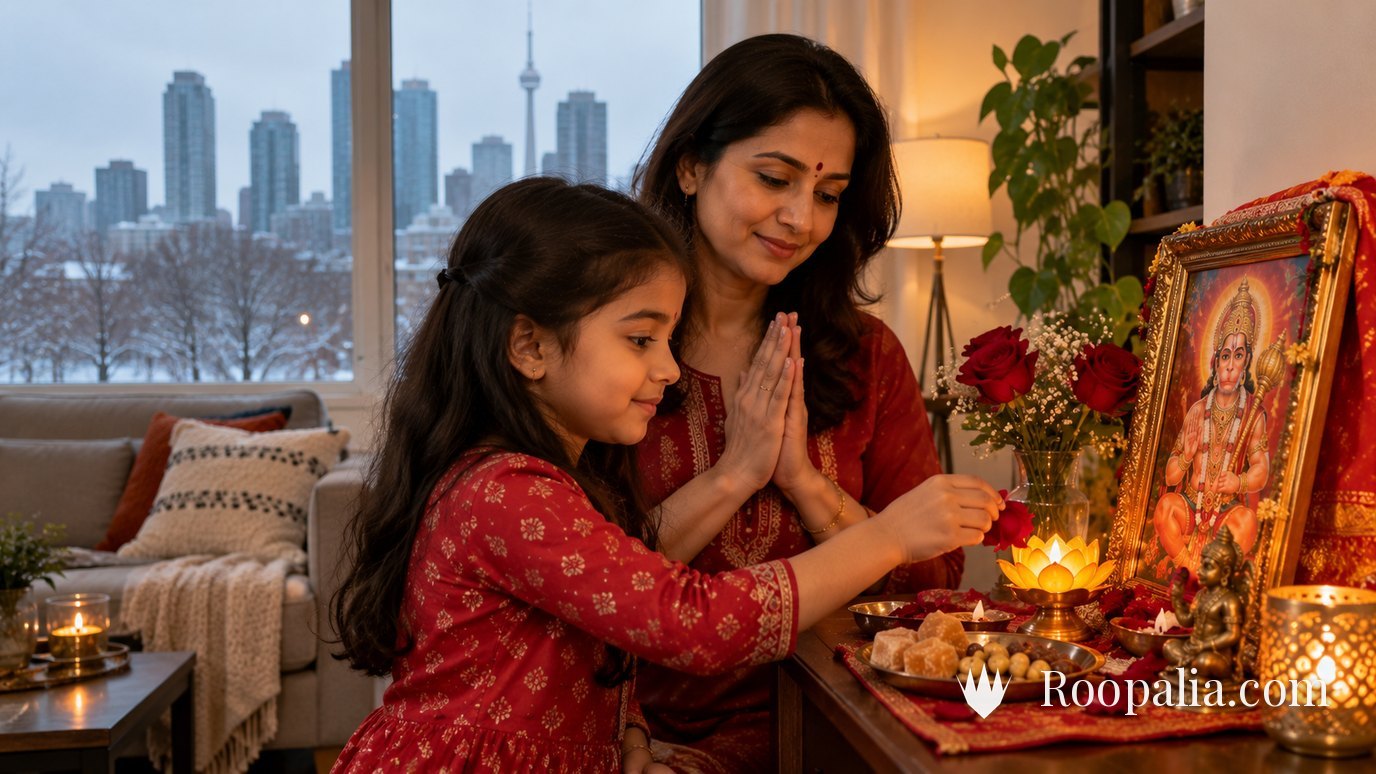
No temple nearby? You do not need one. A picture of Hanuman at home, a lamp, and a red flower is enough. Hanuman has always been regarded as the most accessible of deities; elaborate ritual was never a condition of his worship.
Where to find the samagri. Sindoor, jasmine oil, mauli and jaggery are now stocked in Indian grocery stores in most large cities — Edison, Southall, Brampton, Harris Park, Fremont — and are easy to order online. If hibiscus is unavailable, any red flower works; a red rose is the simplest substitute. If you cannot light an oil lamp because the smoke alarm is unforgiving, an electric diya or a tealight is perfectly acceptable.
Managing a working Tuesday. Tuesday is a working day, and that is the real obstacle. Finish the puja and the Chalisa in fifteen minutes before the house wakes. Carry something salt-free with you, because you will not find it outside. Read the katha in the evening. And if one Tuesday falls apart entirely, do not carry guilt about it — that allowance has always existed in the tradition, and it was written for lives exactly like yours.
And where do you feed gur-chana to monkeys? The question gets asked as a joke, but it is a fair one. The intent behind it was that the prasad should leave the house rather than stay in it. Abroad, the direct translation is simply this: give the prasad away. To a colleague, a neighbour, a food bank. The purpose is served.
How to explain this day to your children
A child growing up in New Jersey or Melbourne will not absorb this the way you did — from a grandmother, from the street, from a neighbourhood preparing together. If it is going to reach them, it will reach them through you. And saying "this is our tradition" does not do it.
For young children — tell the Hanuman story, but linger on the part where he carries an entire mountain back because he could not tell which herb was the right one. Children always love that bit, and there is a lesson inside it: when you are not certain, act anyway.
For older children — give them the Tuesday–Mangalvar language link. Teenagers respond strongly to the discovery that their two worlds, which they keep carefully separate, came from the same place somewhere far back.
For teenagers — tell them the real rule, which is restraint over anger. "Today I will not lose my temper" is something a thirteen-year-old understands immediately and translates into their own life without help. Mars is not a frightening external force; it is the energy inside them, and the fast is practice at steering it.
And the method that works best of all — include them. Let them count the laddus, choose the flowers, repeat a line of the Chalisa. A child who helps with the preparation treats the tradition as their own. A child who only watches files it away as their mother's.
🗓️ Seven days, seven planets — an old and very practical system
Each day of the Hindu week belongs to a planet and a deity, and the arrangement was as practical as it was religious: it gave an ordinary household a rhythm across the week.
Sunday Surya — vitality and health · Monday Chandra and Shiva — calm of mind · Tuesday Mangal and Hanuman — strength and restraint · Wednesday Budha and Ganesha — intellect and trade · Thursday Brihaspati and Vishnu — knowledge and learning · Friday Shukra and Lakshmi — beauty and abundance · Saturday Shani — action and its consequences
Notice that Hanuman is the only figure who occupies two days — Tuesday for strength, Saturday for protection from Shani. No one else in the week was given that.
In closing
This fast is not about asking for strength. It is about carrying it.
A Mars problem is never weakness. It is always energy moving without direction — the decision taken in a hurry, the sentence said in anger, the confrontation that could have been avoided. The Brahmin in the katha was not weak. He was carried away by suspicion and impulse, and it nearly cost him his son.
Red cloth, sindoor and gur-chana are only the markers. The real vrat is the moment anger reaches your mouth and stops there. On the day that becomes possible, Mars has not been weakened. It has been settled.
Frequently Asked Questions
Tuesday fasting is for which god?
What are the rules of the Tuesday fast?
What to eat in the Tuesday fast?
What should you eat in the evening on a Tuesday fast?
Can you eat salt during the Tuesday fast?
When should you break the Tuesday fast?
Tuesday fast is for how many days?
When should you start the Tuesday fast?
What is the Mangalwar Vrat udyapan mantra?
Can an unmarried girl keep the Tuesday fast?
Does the Tuesday fast help with Mangal dosha?
Which mantra should you chant on Tuesday?
What is the difference between Mangala Gauri Vrat and the ordinary Tuesday fast?
What is Angarki Chaturthi?
How do you keep the Tuesday fast while living abroad?
Disclaimer: This article describes religious tradition, folk belief and cultural practice. Anything relating to fasting and diet is general information only. If you are pregnant or breastfeeding, or taking medication for diabetes, blood pressure, thyroid or any other condition, please consult your doctor before fasting.