Whose day is Thursday — Vishnu's or Brihaspati's?
Almost everyone who keeps this fast has been confused by this, and almost no one explains it. Both answers are correct, and they are connected.
Brihaspati was the son of the sage Angira and the guru of the devas — devaguru. He was not a god of war or of wealth. He was the advisor. When the gods were in trouble they did not send him into battle; they went to him for counsel. Knowledge, judgement, dharma, education, good decisions — these are his domain. In Indian astrology, the planet Guru (Jupiter) signifies exactly the same things.
Vishnu is the preserver of the world. And the thread that ties the two together in practice is the colour yellow — Vishnu's pitambara, Brihaspati's golden hue, turmeric, chana dal, banana, the yellow sapphire. They belong to one family of symbols.
So what happens in practice is this: the puja is offered to Vishnu, and the blessing is sought from Brihaspati. In some homes both are worshipped side by side. Whichever your family follows is correct. There is nothing to argue about here — tradition has carried both together for centuries.
💡 A detail worth noticing
In English, Thursday is Thor's day. But in French it is Jeudi and in Italian Giovedì — both from Jupiter. And in Indian astrology, Brihaspati's planet is also Jupiter. Two civilisations, with no knowledge of each other, assigned the same day to the same planet. If you live abroad, this is a lovely bridge to hand your child: their Thursday and your Guruvar are, at some old root, the same day.
The sankalp — where the vrat actually begins
The fast does not begin with shopping for samagri. It begins with sankalp, the vow — and this is the step most people skip.
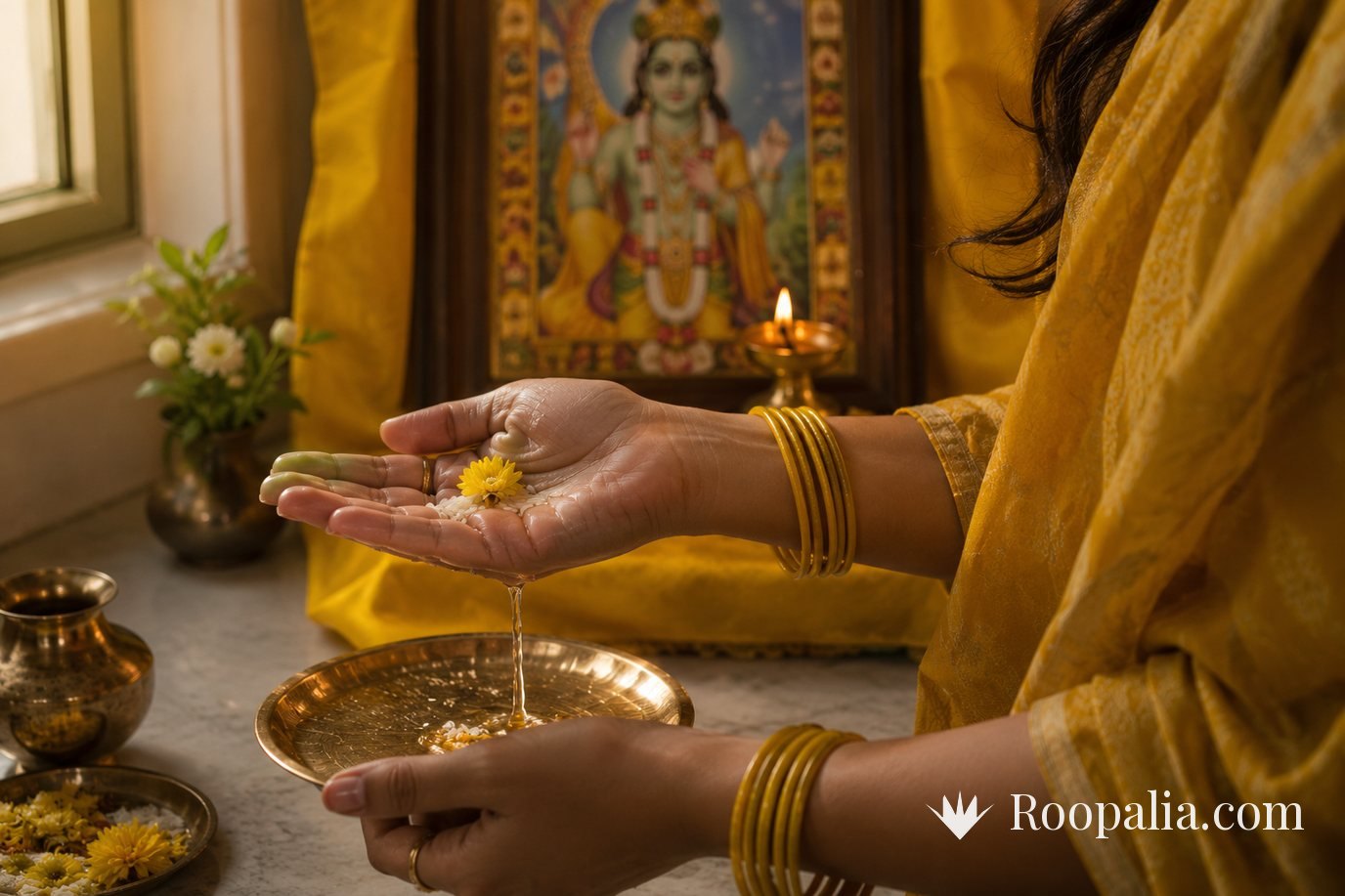
On the first Thursday, after bathing, sit at your puja space and take a few grains of rice, a flower and a little water in your right palm. State clearly in your mind how many Thursdays you intend to keep and why. Then release the water into a small vessel or onto the earth.
This is not a formality. Sankalp means you have made a promise to yourself. In this tradition, abandoning a fast is considered less serious than beginning one without thinking.
The full Guruvar Vrat Katha
This story is told in homes across India and exists in several versions. The most widespread runs like this.
In a certain town lived a wealthy merchant. His house lacked nothing — but his wife was extremely miserly and idle. The merchant wanted to give in charity; she stopped him every time. There was Lakshmi in that house, but she never left it to help anyone.
One Thursday, Brihaspati Dev came to their door in the guise of a sadhu and asked for alms. The wife answered curtly that she was sick of this endless business of giving, and asked him to tell her some way to be rid of all this wealth so she could live in peace.
The sadhu replied calmly: "Very well. On Thursdays, scrub the floors, wash your hair, wash the clothes, sweep the house. Put salt in your food. Keep doing that."
She did exactly so. Within a short time the prosperity of that house drained away. The merchant was reduced to poverty, the servants left, and the family had nothing to eat.
The same merchant now cut wood in the forest to survive. One day his small daughter asked for curd. There was not enough money in the house to buy it. He comforted her, walked into the forest, sat under a tree and wept, remembering what he had once been.
It was a Thursday. The same sadhu appeared and asked, "Man, what worry has brought you to sit in this forest?"
The merchant told him everything. The sadhu said: "This is the fruit of what your wife did. Now listen. Keep the Brihaspati vrat every Thursday, hear the katha, distribute chana dal and jaggery as prasad, and from whatever little you have, give something to someone in need."
He did as told. Slowly his condition improved. Wealth returned to the house — but this time it came with an understanding: what comes to you is not to be held shut, it is to be kept flowing.
What the katha is really saying
This story is often told as a warning — "see, sweep the floor on Thursday and Lakshmi will leave." Read it again. That is not what it says.
The villains of the story are miserliness and idleness. The wife's fault was not the broom; her fault was that she refused to give. And the merchant's fortune returned at the moment he began giving while he still had nothing. The man with empty hands shared anyway.
This is precisely why daan and distributing prasad are treated as non-negotiable parts of this vrat — as essential as the fasting itself. Going hungry was never the point.
And think about the word once more. Gu means darkness; ru means the one who removes it. A guru is not a title — it is an action. In this katha, what got removed was not poverty. It was a way of thinking that keeps the fist closed.
Guruvar Vrat puja vidhi — step by step
The method is simple and takes no more than twenty to twenty-five minutes.
1. Bathe before sunrise. If you can, add a pinch of turmeric to the water.
2. Wear yellow. A saree, a kurta, even a plain yellow top — the colour holds the mind in the mood of the day.
3. Apply a turmeric tilak on the forehead. Some families use saffron or sandalwood instead. Why the mark sits between the brows is explained fully in our article on the bindi.
4. Clean the puja space and take the sankalp as described above.
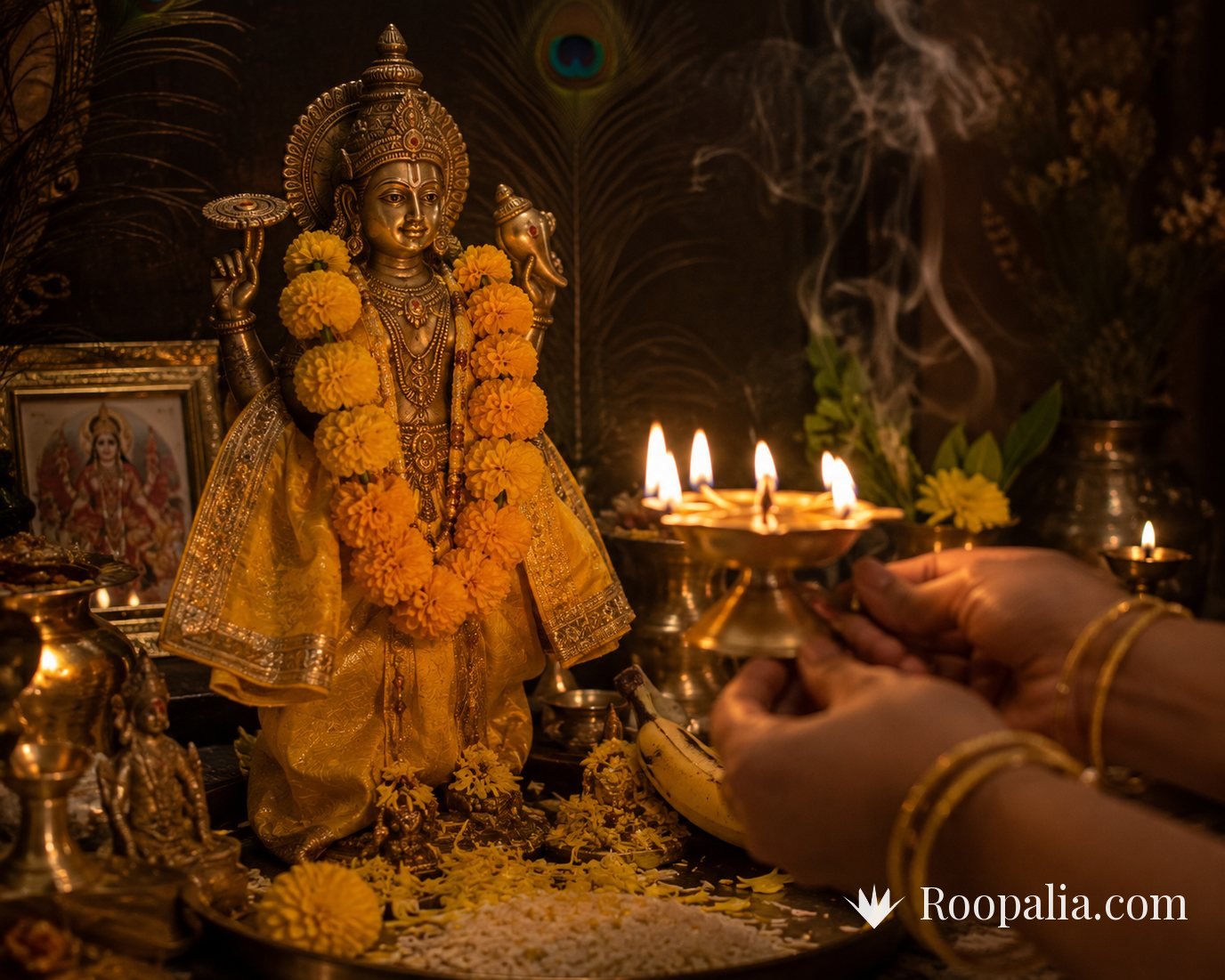
5. Place an image or idol of Lord Vishnu on a yellow cloth. Bathe it with panchamrit or clean water, then offer yellow flowers, turmeric, rice grains and sandalwood.
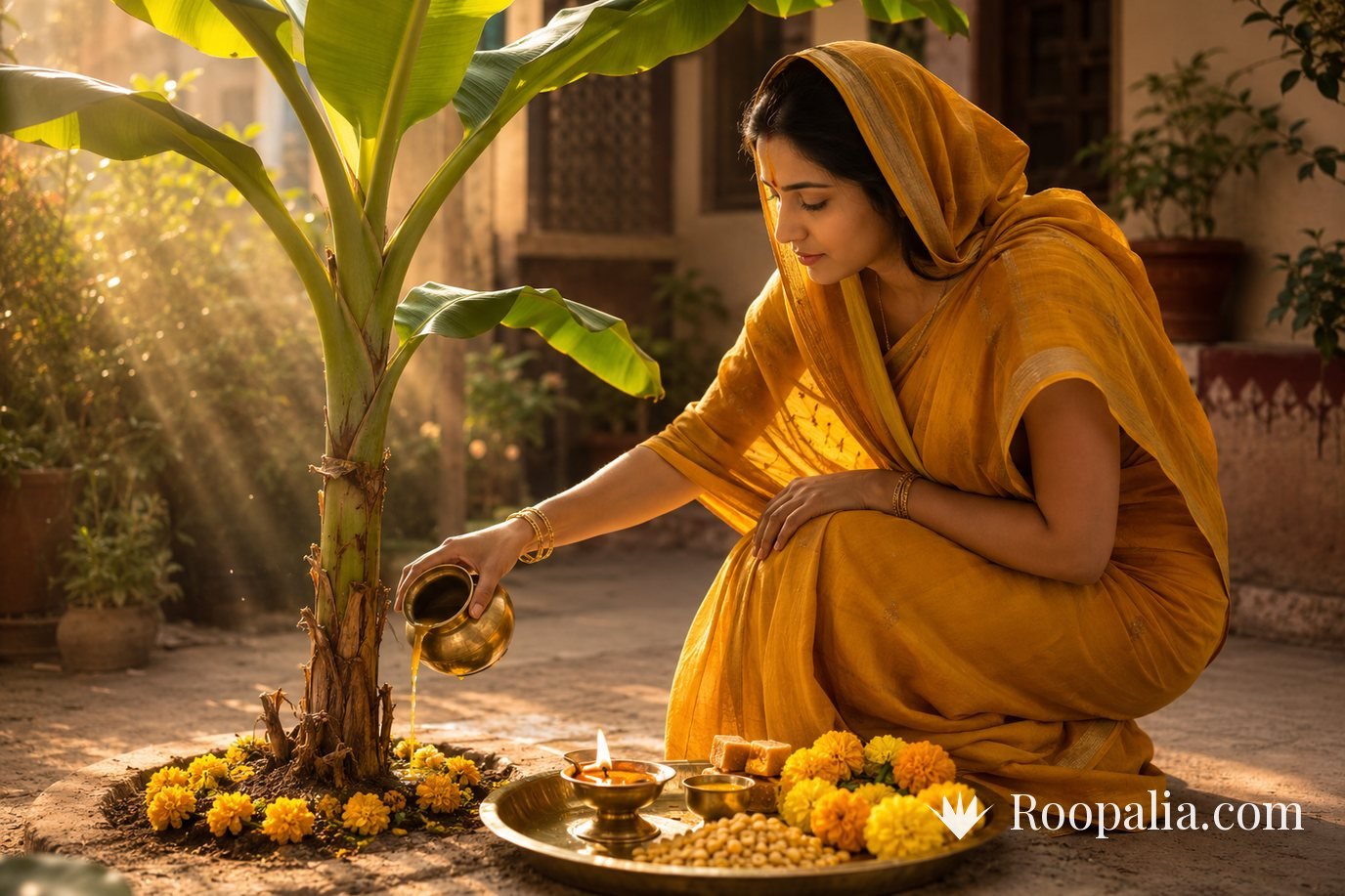
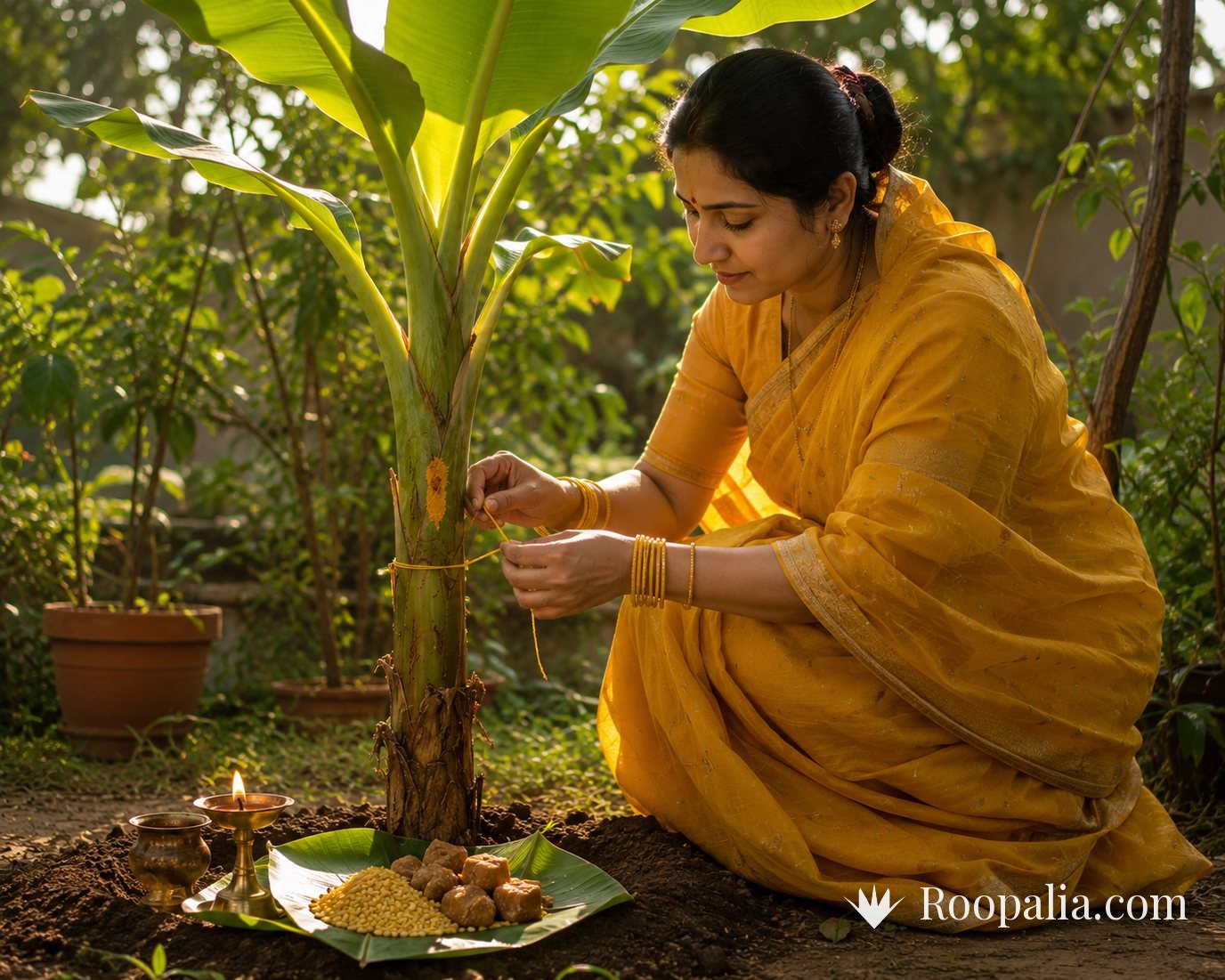
6. Worship the banana plant. If you have one, pour turmeric water at its root, apply a turmeric mark on the trunk, tie a yellow thread around it, and place chana dal and jaggery at its base. Brihaspati is believed to reside in the banana plant. (No banana plant? See the section further down — there is a proper answer for this.)
7. Light a ghee lamp and offer incense.
8. Chant the mantra at least 108 times, on a tulsi or turmeric-bead mala.
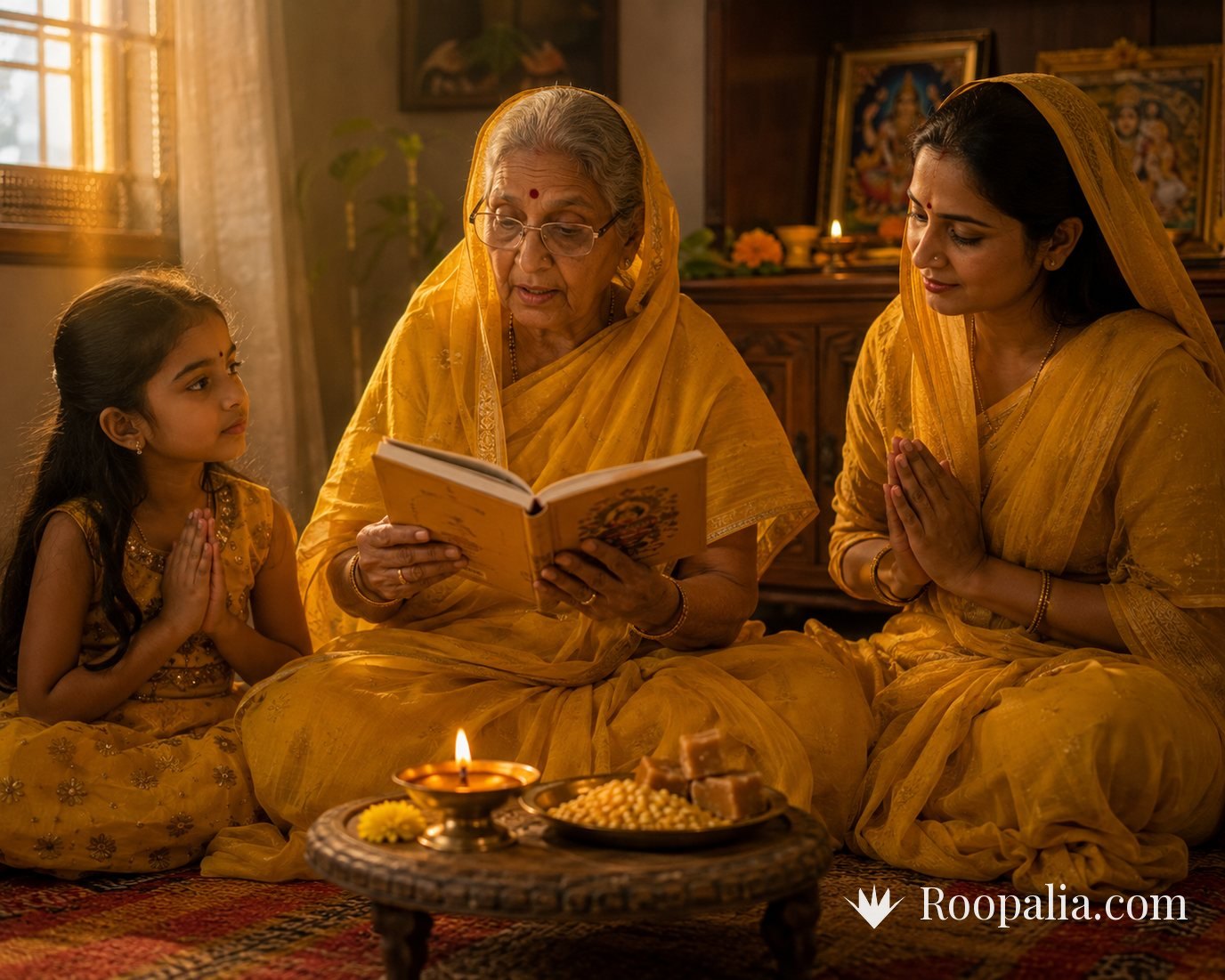
9. Read or listen to the vrat katha. If anyone else is home, read it aloud together. If there are children, better still.
10. Perform the aarti and distribute prasad — at home, to neighbours, or to anyone in need.
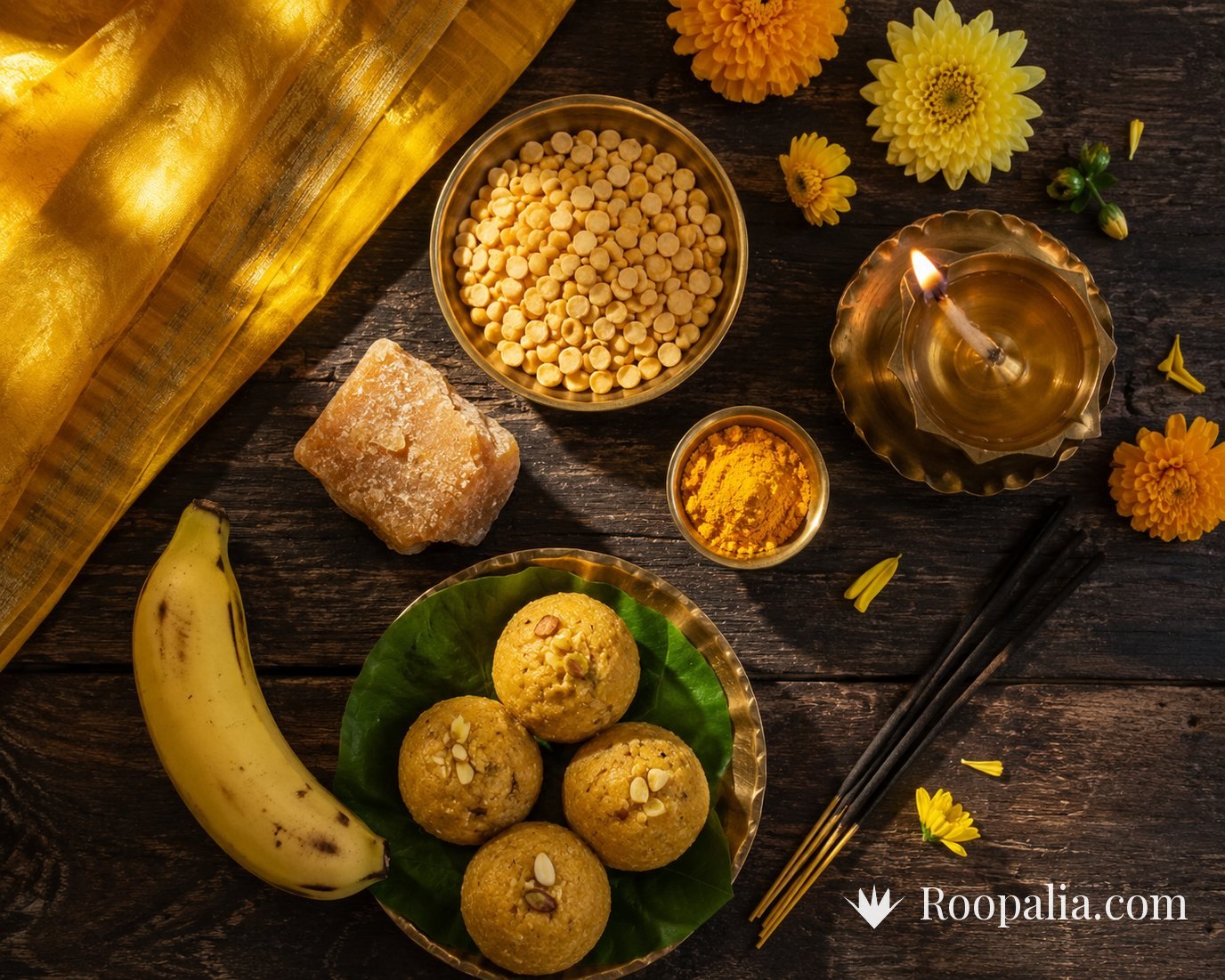
Puja samagri list
The list looks long, but most of it is already in an Indian kitchen.
| Category | Items |
|---|---|
| Main offerings | Chana dal, jaggery, banana, besan laddu, yellow sweets |
| Puja items | Turmeric, rice grains, yellow flowers (marigold, chrysanthemum), sandalwood, roli |
| Cloth | Yellow cloth for the altar; yellow clothes to wear |
| Lamp & incense | Ghee lamp, cotton wick, incense sticks, camphor |
| Vessels | Brass or copper lota, thali, small bowls, kalash |
| Other | Yellow thread or mauli, tulsi or turmeric mala, panchamrit (milk, curd, ghee, honey, sugar) |
If some of this is unavailable, do not worry. Tradition is explicit that doing what you are able to do is sufficient. One lamp, a little turmeric, a banana and an honest mind is a complete vrat.
Guruvar Vrat rules — the dos and don'ts
This is where most of the confusion lives. And one honest note before the list: some of these rules come from scripture, and some from local custom. Where there is a difference, it is marked.
✔ Do
• Wear yellow
• Apply a turmeric tilak
• Chant a Vishnu or Brihaspati mantra
• Read or hear the vrat katha
• Distribute chana dal and jaggery as prasad
• Give something in charity, however small
• Eat one sattvic meal in the day
• Greet a teacher, elder or mentor
✘ Avoid
• Salt in food
• Cutting hair, beard or nails
• Washing clothes or washing your hair
• Scrubbing floors or deep-cleaning the house
• Rice and khichdi (in some regions)
• Meat, alcohol, onion and garlic — entirely
• Insulting anyone, lying, losing your temper
• Lending or borrowing money (local custom)
Now, the honest part. The rule about not washing hair or clothes does not appear in any Purana — it is folk custom, and it likely grew out of an older arrangement in which a vrat day was kept free of physical labour so the mind could stay on the puja. The rule about lending money is social, not scriptural.
The avoidance of salt, however, is old and near-universal, followed in almost every region. Unlike Ekadashi, most traditions do not permit rock salt either.
What can you eat during Guruvar Vrat?
This is the most-asked question, so here it is in detail.
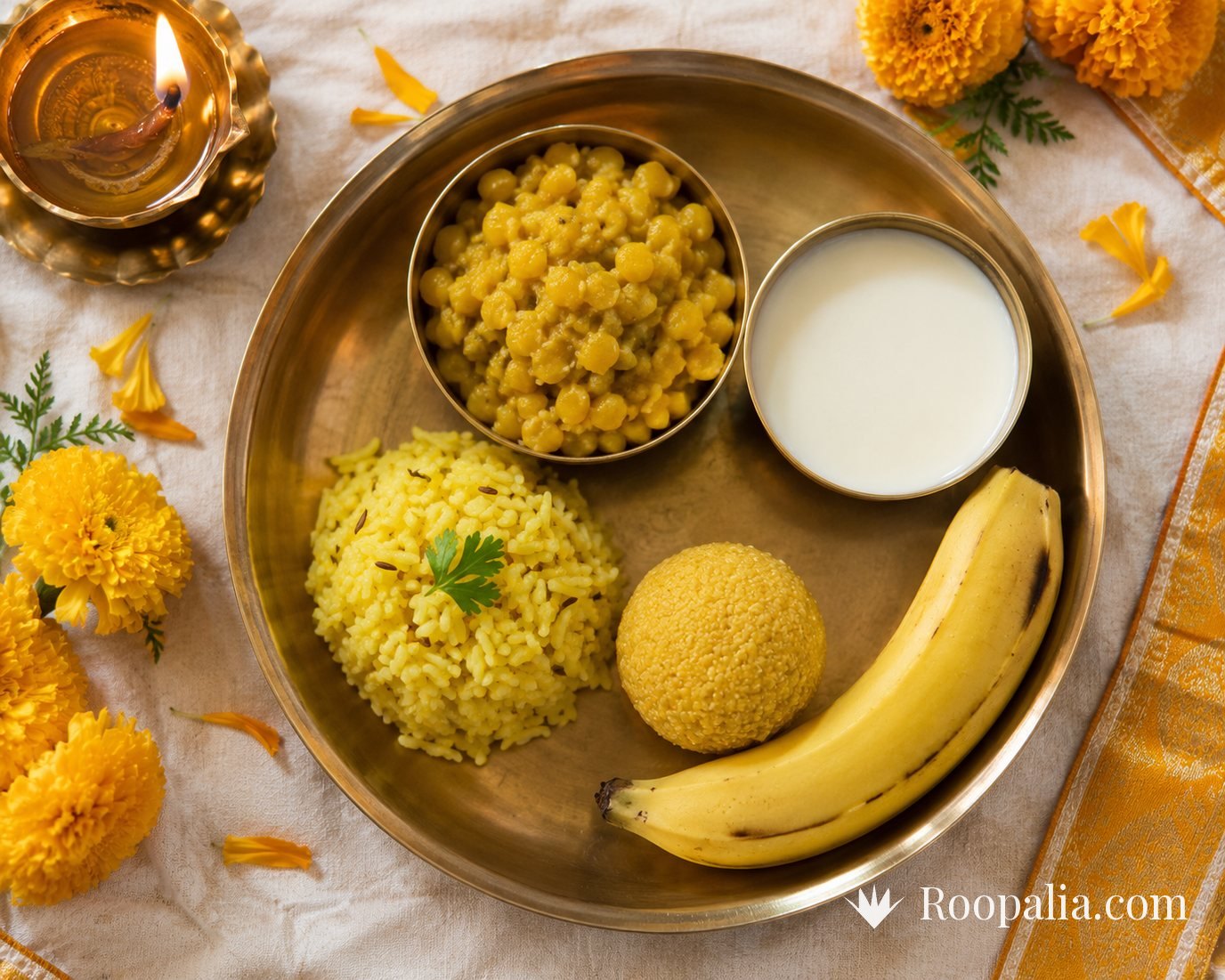
Guruvar Vrat is not a nirjala (waterless) fast. It is an ekahar vrat — one sattvic, salt-free meal in the day, before sunset.
What counts as "yellow food"? This is the distinctive part of the fast — the meal is built around yellow:
• Chana dal — the most important and most auspicious
• Turmeric rice or yellow khichdi (where rice is not avoided)
• Besan laddu or besan halwa
• Banana
• Milk and milk products
• Yellow fruit — banana, mango, papaya, pineapple
• Jaggery and jaggery sweets
Which fruit should you eat? Banana is considered the most auspicious, since the banana plant itself is linked to Brihaspati. After that, other yellow fruits. No fresh fruit is forbidden.
Can you drink tea? Yes — milk tea is allowed. Milk is acceptable in this fast and there is no scriptural bar on tea. Keep in mind, though, that this is a day of restraint, so drinking tea all day runs against the spirit of it. One or two cups is enough. Not with biscuits, namkeen or anything fried and salted.
What about dinner? The main meal is taken after the evening puja and katha, before sunset — that is the paran. There is no tradition of a second heavy meal at night. If you are hungry, milk, fruit or a little curd is fine.
What time should you break the Thursday fast?
There is real confusion about this, so let us be clear.
Guruvar Vrat is not broken the next morning. It is not like Karwa Chauth or Hartalika Teej. The paran happens the same day, before sunset.
The order is: light the lamp in the evening, read the katha, do the aarti, offer the prasad. Then take the prasad and eat your one meal. The vrat is complete.
Some families eat this meal after sunset, and that is not considered wrong. The essential rule is only this: eat nothing before the katha and puja are done. After that, timing is a matter of convenience.
How many Thursdays, and when to start?
Sixteen Thursdays is the most common sankalp, with the udyapan performed on the 17th. But it is not the only option.
• 7 Thursdays — a shorter vow, good for a first attempt
• 11 Thursdays — for a specific wish
• 16 Thursdays — the most widespread
• Lifelong — some women keep it every Thursday without counting
When to begin: on the first Thursday of the Shukla Paksha of any month, avoiding Paush — new vows and auspicious undertakings are traditionally not begun in that month. Some regions consider Margashirsha and Magha especially favourable.
And if you miss a Thursday? Do not panic. Continue from the next one and add the missed Thursday at the end of your count. This tradition has never been so brittle that one lapse undoes everything.
Which mantra to chant on Thursday
Three are commonly used. Pick one and chant it 108 times — you do not need all three.
Beej Mantra (simplest and most widely used)
ॐ बृं बृहस्पतये नमः॥
Om Brim Brihaspataye Namah
Guru Graha Mantra
ॐ ग्रां ग्रीं ग्रौं सः गुरवे नमः॥
Om Graam Greem Graum Sah Gurave Namah
Pauranik Mantra
देवानां च ऋषीणां च गुरुं काञ्चनसंनिभम्।
बुद्धिभूतं त्रिलोकेशं तं नमामि बृहस्पतिम्॥
Devanam cha rishinam cha gurum kanchana-sannibham,
Buddhi-bhutam trilokesham tam namami Brihaspatim.
Meaning — I bow to Brihaspati, guru of the gods and the sages, radiant like gold, the embodiment of intellect, lord of the three worlds.
For Vishnu, Om Namo Bhagavate Vasudevaya is equally appropriate, and is what many households use.
The best time is the first hour after sunrise. A tulsi or turmeric-bead mala helps, but counting on your fingers is entirely valid.
Remedies for a weak Guru in the chart
In astrology, a weak Jupiter is said to show up as difficulty in making decisions, delays in education or marriage, and an absence of good guidance.
What is interesting is that the traditional remedies all point in one direction:
• Keep the Thursday vrat and hear the katha
• Donate yellow things — chana dal, turmeric, jaggery, yellow cloth
• Care for a banana plant, or plant a new one
• Respect your parents, teachers and elders
• Help a student with their education; donate books
• Share what you know — teach someone something
Notice that more than half of these are not rituals at all. They are conduct. Jupiter is the planet of knowledge, and tradition says the road to it runs less through worship and more through learning and teaching.
This is a description of astrological belief, not a guarantee of outcomes. For any serious problem, please seek appropriate professional advice.
Guruvar Vrat udyapan — how to complete the fast
Once the Thursdays of your sankalp are complete, the udyapan is performed — the formal conclusion. If you vowed 16 Thursdays, the udyapan falls on the 17th.
Udyapan samagri
| Item | Quantity |
|---|---|
| Chana dal | 1.25 kg |
| Jaggery | 250 g |
| Besan laddu | 1.25 kg |
| Yellow cloth | 1.25 metres |
| Dhoti | one pair |
| Janeu (sacred thread) | one pair |
| Ghee | 250 g |
| Turmeric, camphor, sindoor, incense | one packet each |
| Raisins | 25 g |
| Kalash, mango leaves, betel nut, coconut | one each |
| Yellow flowers or garland, lamp | as needed |
The method
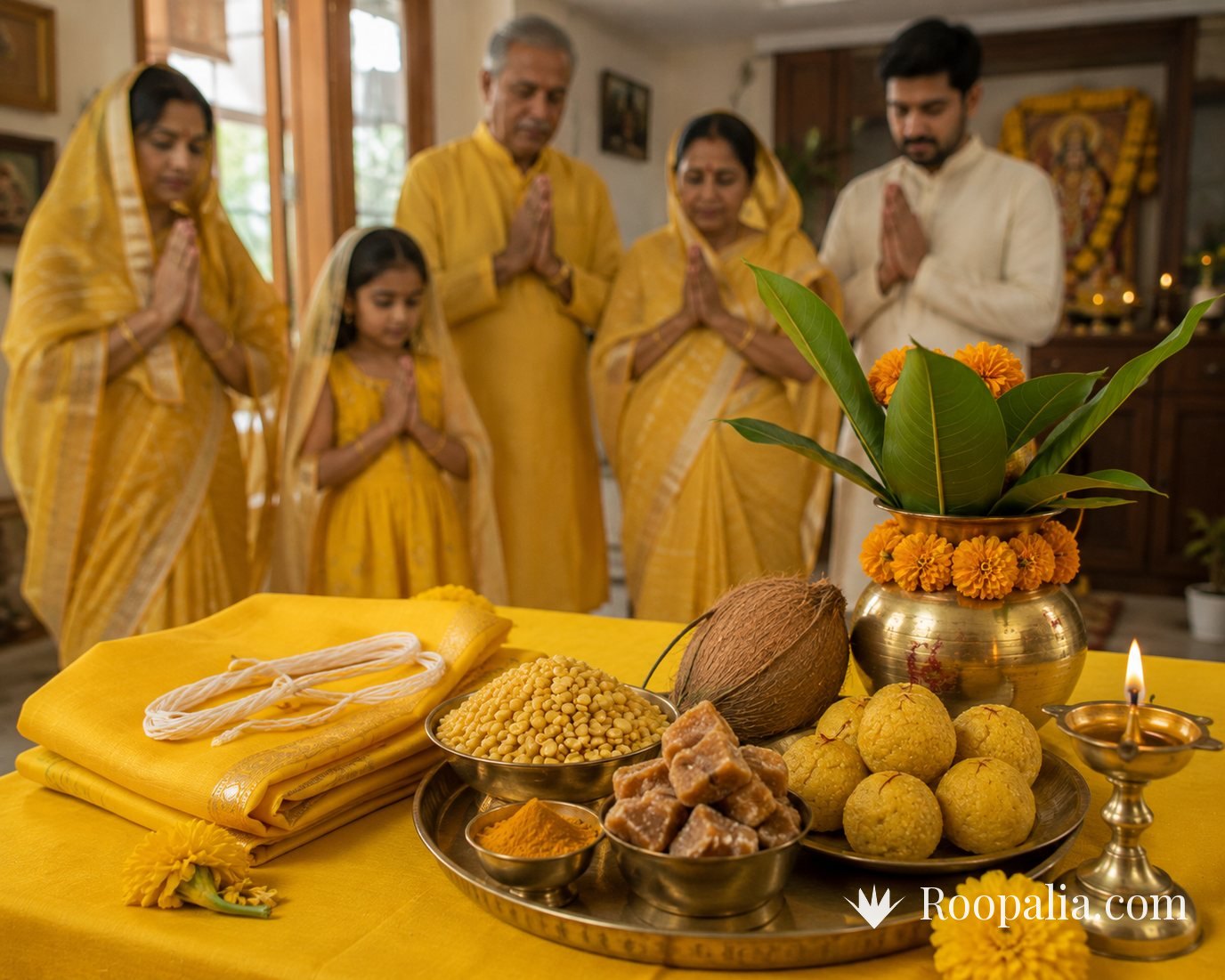
Rise early, bathe, and purify the puja space by sprinkling Gangajal. Wear yellow. Spread a yellow cloth on a low wooden stool, place the image of Vishnu on it, and set the kalash beside it with mango leaves and a coconut.
Then perform the usual Thursday puja — turmeric tilak, yellow flowers, lamp, incense, mantra and katha. After the katha, fold your hands and state that you have completed the vrats of your sankalp and are now performing the udyapan.
Offer all the samagri before the deity, then give it in daan to a brahmin, a priest or someone in need, and take their blessing. If you can, feed a few people. Distribute prasad to everyone present.
Traditionally, evening is considered the best time for the daan.
The guru tradition — what India gave the world
Step away from the ritual for a moment and look at the word this whole day rests on.
Most civilisations named the days of their week after warriors, kings and powerful gods. India did the same — Ravi, Soma, Mangal, Shani. And then it gave one day to a teacher. That is not a small thing.
It comes from the same instinct that said acharya devo bhava — let the teacher be as a god to you. That ranked the giving of knowledge above the giving of wealth. That built gurukuls where a king's son and a cowherd's son sat on the same floor. That named an entire body of scripture the Upanishads — upa-ni-shad, "to sit down near." The texts were named after the posture of a student sitting beside a teacher.
And guru itself: gu, darkness; ru, its remover.
So what the Thursday vrat honours is not an idol. It is a value — the memory of a society that decided the greatest wealth is the kind that grows when you give it away.
The same instinct is woven through the rest of these traditions — the meaning behind the solah shringar, the four-and-a-half-thousand-year history behind bangles, the reasoning behind sindoor. Every sign was given a meaning before it became a habit.
This is the part that travels. It needs no temple, no priest and no banana tree. It is the one piece of this tradition that will make complete sense to a child growing up in Chicago or Melbourne, because teachers exist everywhere.
How to keep Guruvar Vrat when you live abroad
In India, this fast carries itself. There is a temple nearby, a banana plant somewhere on the street, chana dal in the kitchen, and someone in the neighbourhood keeping the same fast on the same day. In New Jersey, London, Toronto or Sydney, none of that arrives on its own. Thursday is a working day — meetings, the school run, and nobody around who knows what day it is.
The hard part is not the hunger. It is the solitude. And the answer is not to dilute the fast, but to fit the method to the life you actually have.
No banana plant — what then? This is the single most common question. The banana plant is worshipped because Brihaspati is believed to reside in it — but the object of the puja is Brihaspati, not the plant.
So: use any healthy green plant in your home — a money plant, tulsi, any potted plant — and place the yellow offerings before it. Or simply do the puja before an image or idol of Lord Vishnu. Both are fully valid and nothing is considered lacking. Urban Indian households without a garden have done exactly this for generations.
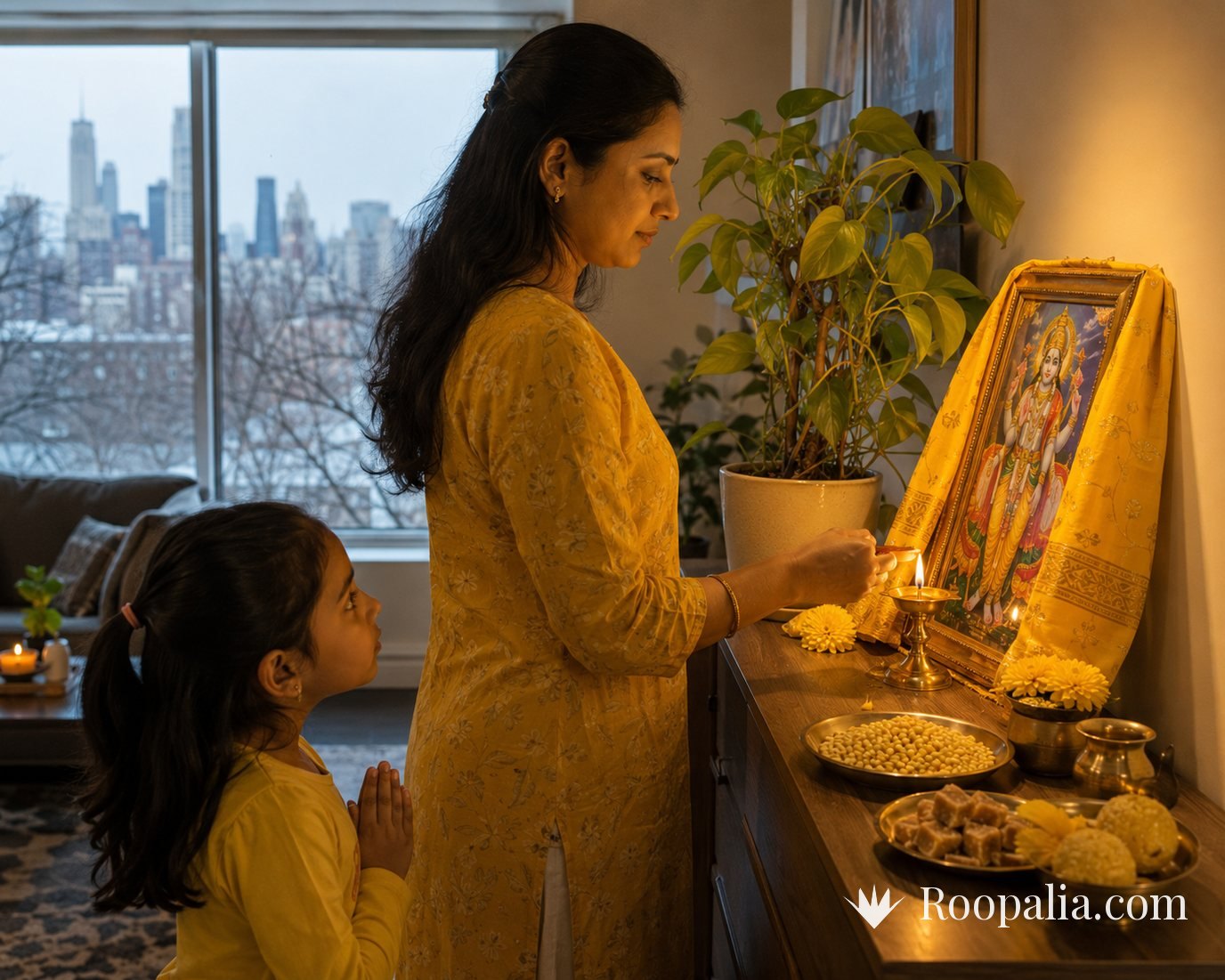
The time zone question. The answer is simple and there is no need to agonise over it: follow your local time, not IST. Your sunrise and your sunset are your authority. Where your day is, there your Guruvar is. What the clock says in India has no bearing on your fast. The same principle applies to every other vrat — for Karwa Chauth the moonrise you follow is the one in your own city, and our Hartalika Teej guide lists overseas city timings separately.
One practical note. In Norway, Sweden or northern Canada, winter sunset can fall at three in the afternoon and summer sunset at ten at night. In such places, tradition allows you to perform the evening puja and paran in the afternoon, holding the intent of sandhya. Where circumstances are genuinely different, the shastras treat capacity and good judgement as authority.
Where to find the samagri. Chana dal, turmeric, jaggery and besan are in every Indian grocery and now in most large supermarkets. Bananas are everywhere. If yellow marigolds are unavailable, any yellow flower will do — daffodils, chrysanthemums, even a yellow bloom from a pot on the windowsill. If you cannot light a ghee lamp because the smoke alarm is sensitive (a very real problem in apartments), a tealight or an electric diya is acceptable. In areas with large Indian communities — Edison, Southall, Brampton, Harris Park — everything is available locally.
Managing a working Thursday. Do the morning puja before the house wakes — twenty minutes is enough. Carry something salt-free with you, because you will not find it outside. Read the katha in the evening. And if a Thursday slips away entirely, do not carry guilt about it. Tradition has always allowed for doing what you are able to do, and that allowance was written for lives exactly like yours.
A word on health, which matters more when you are far from family — there is no one nearby to notice that you are unwell. If you are pregnant, breastfeeding, diabetic, hypertensive or unwell, speak to your doctor before keeping a salt-free single-meal fast. Going without food all day can be genuinely dangerous with diabetes. In such cases, keeping the fast on fruit, or simply doing the puja and katha without fasting, fulfils the spirit of it completely. No vrat is worth more than your health.
How to explain this day to your children
If you live abroad, this may be the most valuable thing you do on a Thursday.
A child growing up in Chicago or Melbourne will not absorb this the way you did — from a grandmother, from the street, from the shared preparation of a whole neighbourhood. If it is going to reach them, it will reach them through you. And the commonest mistake parents make is to deliver it as a set of rules: today is Thursday, don't eat that, don't do this. Children do not remember rules. They remember meaning.
So begin with the meaning — and in this vrat, the meaning is unusually beautiful.
Ask your child: "Who is your favourite teacher at school?" They will name someone. Then say: "We believe the gods had a teacher too. His name was Brihaspati. Whenever the gods had a problem, they didn't go and fight — they went to their teacher for advice. And one day of the week belongs to him. That day is today."
A seven-year-old anywhere in the world understands this, because teachers exist everywhere.
Then involve them. Children pull themselves into Navratri and Ganesh Chaturthi on their own; this one they have to be invited into. Let them wear a yellow t-shirt — they will enjoy it. Call them over when you light the lamp. Let them place the bowl of chana dal. Put a small turmeric tilak on their forehead too, and show them in the mirror.
And build one small ritual that belongs only to your house. Every Thursday, your child tells you one new thing they learned that week — at school, in a book, anywhere. Anything. And you tell them one thing you learned.
That is the whole of this vrat, in a child's language. Thursday is the day of knowledge. And the truest way to honour knowledge is to admit that you are still learning. Your child may forget the mantra. They will not forget that in their house there was one day of the week when everybody shared something new they had learned.
And here is the one thing never to tell them: that keeping this fast brings money, or arranges a marriage. The katha does not say that. The katha says that what you give is what returns. Tell your child that instead. It is true, and it stays true in every language and every country.
In closing
This fast is not about an empty stomach. It is about keeping the mind a student.
The other days of the week belong to power — to strength, to splendour, to destruction. Thursday alone belongs to learning. The merchant's wife in the katha had everything and did not know how to give, and it all left. The merchant had nothing left and learned to share, and it all came back. The yellow cloth, the turmeric tilak and the chana dal are only signs. The real vrat is opening a fist that has grown used to staying closed.
Frequently Asked Questions
What are the rules of Guruvar Vrat?
What time should the Thursday fast be broken?
What should you eat in the evening during Guruvar Vrat?
Can you drink tea during the Thursday fast?
Which fruit should be eaten during Guruvar Vrat?
How many Thursdays should the fast be kept?
In which month should you start the Thursday fast?
Which mantra should be chanted on Thursday?
How is the Brihaspativar vrat udyapan performed, and what is needed?
What should not be done on Brihaspativar?
What should someone with a weak Jupiter (Guru) do?
How do you keep Guruvar Vrat abroad without a banana tree?
📷 AI-generated images. For illustration only.
🙏 The vidhi, rules and beliefs described here are based on prevailing tradition and folk practice, and vary by region and family. Where a rule comes from local custom rather than scripture, this has been stated in the article. For any health concern relating to fasting — especially with diabetes, blood pressure, pregnancy or breastfeeding — please consult your doctor.