Ask for the Sunday fast story and you will be given an old woman, a cow, and dung that turns to gold.
Ask where it comes from and the trail stops. Page after page calls it a Pauranik katha — a story from the Puranas — and not one of them names the Purana.
I went looking. I could not find that story in any Purana. What I did find was a different Sunday story, one with chapter numbers you can check, involving Krishna's son, a curse, a river, and a community that still traces its name to it.
Both are below. The one with a source comes first, because if you are telling these stories to a child far from India, you will eventually be asked where they came from.
🙏 Every source here is named and linked, and what I could not find is stated as plainly as what I could.
🎧 The video of this katha is not made yet. When it is, it will appear in this article.
The story that is in the texts: Samba

The Samba Purana is an upapurana devoted entirely to the worship of Surya. Scholars treat it as the original source for the Puranic literature on sun worship — much of what later appears in the Bhavishya Purana's Brahma Parva is drawn from it.
Samba was a son of Krishna, and famously handsome. The text says that through a sequence Narada set in motion, his father came to suspect him, and cursed him: he would become a leper (Samba Purana, chapter 3).
The curse held. Samba left.
He came to the great river Chandrabhaga, and from there to the holy grove called Mitravana. There he praised the Sun — and the Sun, the text says, granted him devotion and cured his leprosy (chapter 24).
The Sun then told him to establish an image of the Sun on the bank of the Chandrabhaga, and said the town that grew there would carry Samba's own name. Samba built the temple (chapter 26).
That left one problem: who would perform the worship? On the Sun's instruction, Samba brought eighteen families of Maga brahmins from Shakadvipa and settled them at Mitravana (chapter 26).
This story left marks you can still visit.
The tradition of sun temples that runs down to Konark in Odisha is connected by scholars to exactly this account. And the Shakadvipiya brahmins are a living community today whose identity descends from these eighteen families.
So when a child asks whether the story is true, there is something honest to say: this one is written down, and you can point at a building.
The story that is told at home
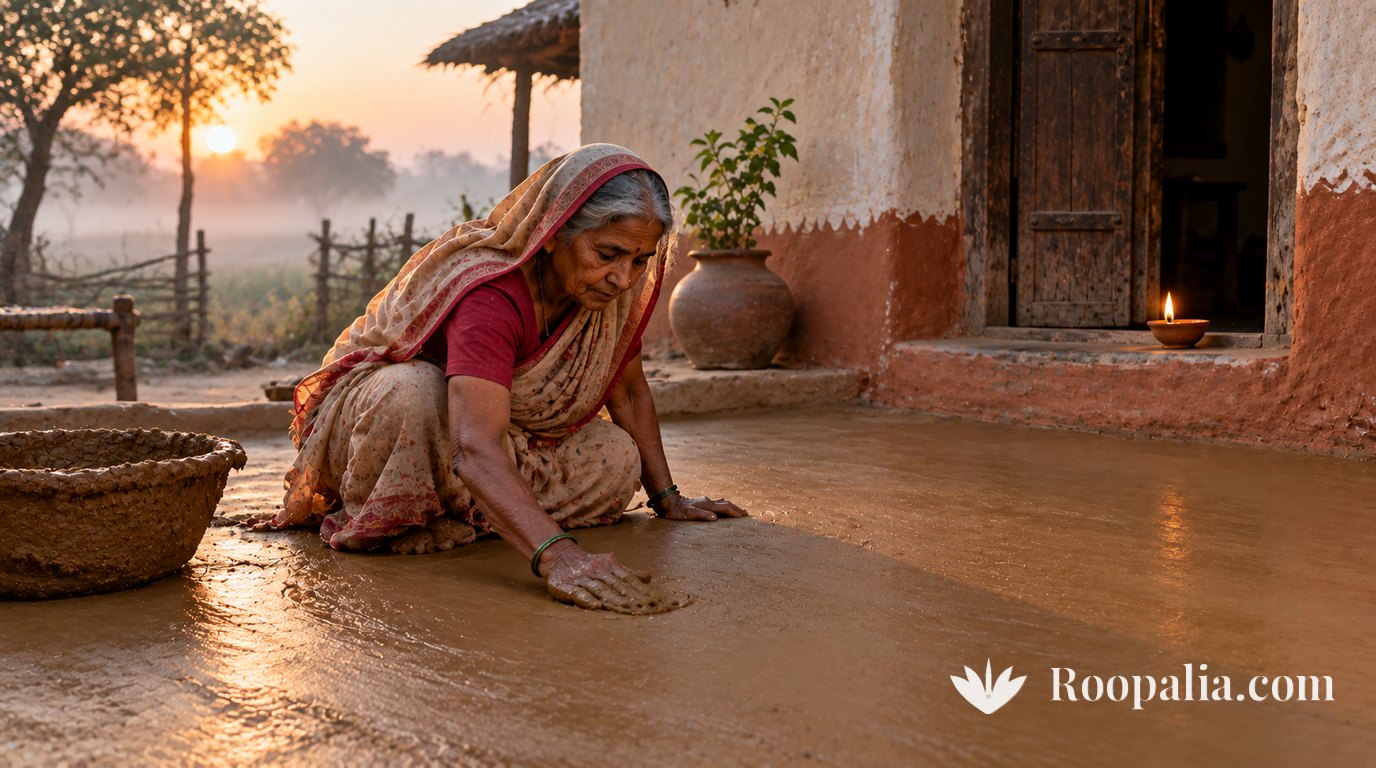
In a village there lived an old woman who kept the Sunday fast, every Sunday, without fail. Her order was fixed: rise before the sun, bathe, and plaster the courtyard with cow dung — because in that tradition an unplastered courtyard is not fit for worship. Then the puja, the katha, the bhog, and one meal.
She had no cow of her own. The dung came from her neighbour's cow.
And the neighbour had begun to resent it. She could see that the old woman's household, poor as it was, never quite ran short.
The Sunday the courtyard stayed bare
One Sunday the neighbour tied her cow indoors.
The old woman came, found nothing, waited, and went back.
The courtyard was not plastered that day. By her own rule, no puja followed. No bhog was offered. And because no bhog was offered, she ate nothing herself.
She slept hungry and thirsty.
Notice what she does not do. She does not argue with the neighbour, does not complain, does not ask anyone for anything. When her rule could not be kept, she took the penalty herself. Everything that follows follows from that silence.
Morning
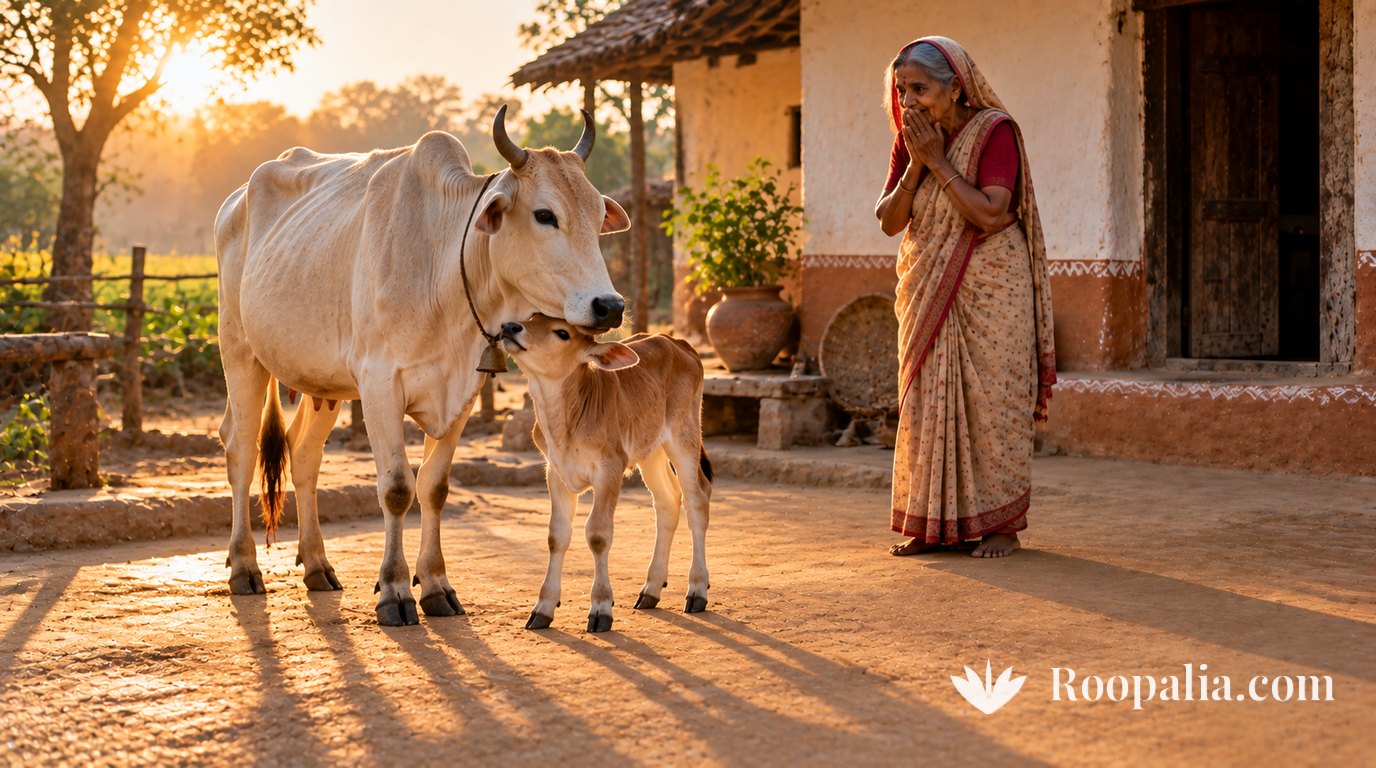
They say Surya came to her that night in a dream. And in the morning there stood in her courtyard a cow and a calf. Nobody knew whose they were.
Now she had her own dung. The courtyard was plastered daily, the puja went on.
And after some days she noticed that the dung was not ordinary. There was gold in it.
What the neighbour did
The neighbour saw it too.
So every morning, before the old woman woke, she came quietly, took away the golden dung and left her own cow's ordinary dung in its place.
The old woman noticed nothing. She assumed the cow had stopped producing anything unusual, and went on plastering her courtyard. The neighbour's house grew rich.
The storm
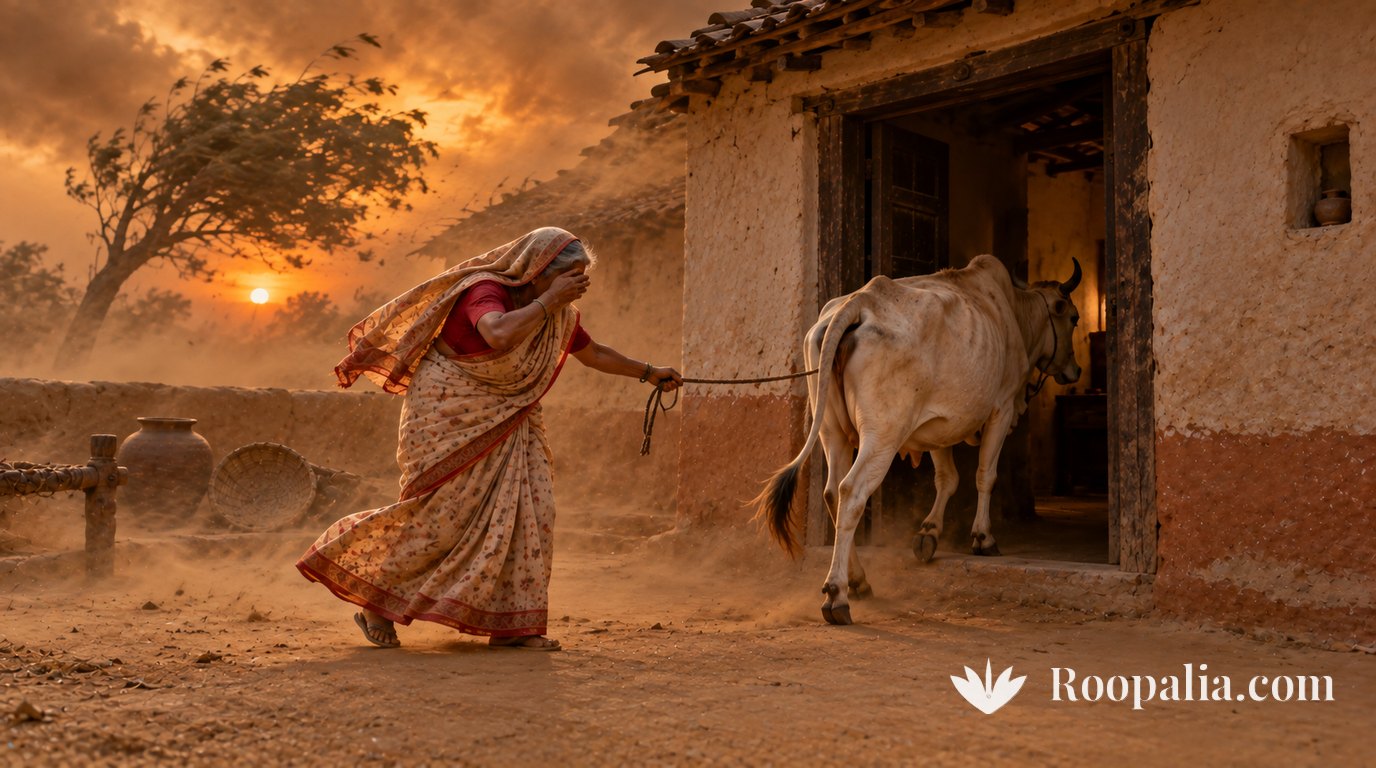
One evening a dust storm came up without warning.
The old woman thought only that an animal should not be left standing in it. She untied the cow and the calf and brought them inside the house.
In the morning there was gold scattered across her floor.
Only then did she understand what had been happening. The neighbour came at dawn as usual, found the courtyard empty, and understood that it was finished.
The king
The neighbour could not bear it. She sent her husband to the king with word that an old woman in the village owned a cow that produced gold.
The king sent men. The cow and calf were taken.
The old woman did not resist. Here too, in the story, she says nothing.
That night Surya came to the king in a dream and warned him: the cow was not his, and if he did not return it, his house would not stand.
By morning the king had returned the cow and calf, given her wealth besides, and punished the neighbour and her husband. Then he had it proclaimed through the kingdom that the Sunday fast should be kept — and the kingdom, the story says, prospered.
Where this one comes from — and where it does not
Here is the finding this article started with, stated plainly.
I could not find this story in any Purana. Wherever I looked, it appeared in vrat-katha collections, in printed pamphlets and in priests' notebooks — not in the Sanskrit texts. One widely-read Hindi page prints it under a heading calling it Pauranik, and then names no Purana anywhere on the page.
This is not a flaw in the story. Most vrat kathas are like this. They come from oral tradition, and they survive precisely because people keep telling them. But the word Pauranik makes a claim, and that claim did not check out.
And the usual caution applies: "not found" is not the same as "does not exist." My search has limits.
The versions differ, and that is normal
A story carried by voice rather than by print will vary. Here are the differences I actually found across sources, so you can stop wondering which version is the correct one:
- Dream or no dream. In most tellings Surya appears in a dream and asks why no bhog was offered. In others the cow simply appears in the courtyard.
- Daily or only Sundays. A Hindi site based in New Zealand tells it with the old woman fetching dung every day. Most versions make it a Sunday routine.
- Who sent the storm. Some versions say Surya raised it deliberately, so that the cow would be taken indoors and the theft exposed. In others it is simply weather.
- The ending. Sometimes the king gives her wealth as well; sometimes he only returns the cow and asks forgiveness.
Tell the version your family tells. There is no authorised text to be wrong about.
What the story is actually about
Read as a story about getting rich, it is thin. Read properly, it is not about that at all.
The old woman never asks for anything. Not from the neighbour, not from the king, not from Surya. On the day her rule broke, she took the loss herself rather than blame anyone.
And the neighbour's offence is not violence, and not quite open theft either. It is a quiet substitution — take the gold, leave something that looks the same. That is the crime the story is built around: the one nobody can see, and therefore nobody catches.
It is caught only when the cow goes indoors. And the cow goes indoors because of an act with no visible benefit at all — kindness to an animal in a storm.
This is the hinge of the whole thing. She did not bring the cow inside to protect the gold. She did not know there was gold.
She brought it inside because there was a storm. And that one act, which was entirely without calculation, returned everything.
👨👩👧 Telling this to children born outside India
The gold is what they will remember, so do not end there. Finish the story and then ask: "Why did she bring the cow inside?" They will say — to save the gold. Tell them no; she did not know about the gold. She did it because there was a storm outside. That is the moment the story stops being a folk tale and becomes something they can use. And if they ask whether it really happened, you have an honest answer ready: this one is a story people have told for a very long time, and there is another Sunday story that is written in a book, about a prince and a river, and a temple you can still go and see.
When and how to read the katha

When: in the Sunday puja, after the arghya to the sun and before the aarti. The order is arghya → lamp → katha → aarti → prasad → the meal.
Preparation: a ghee or sesame-oil lamp, red flowers, jaggery and wheat as bhog. Take a little water and rice in your hand for the sankalp, set it aside, and when the katha ends give that water to a plant.
Who reads: anyone. One person reads and the rest listen — in this tradition listening counts equally, which is why these are called kathas and not recitations.
If you are alone: read it alone. That is a very common situation outside India and there is no rule against it. Nothing in the tradition requires an audience.
One practical thing: once you begin, do not get up in the middle, and put the phone away. The katha takes under five minutes. Those five minutes being unbroken is the whole of the rule.
The aarti — which one, when, and how
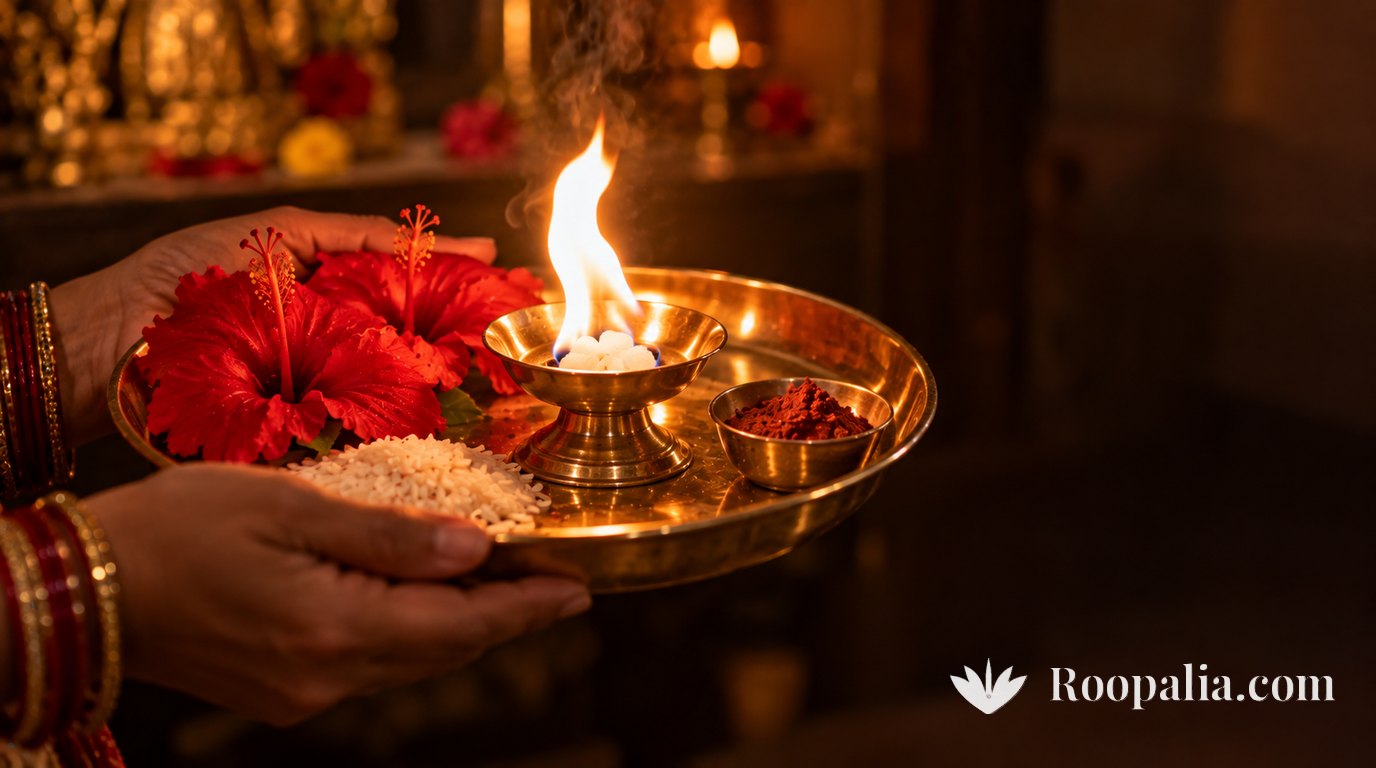
The aarti follows immediately after the katha. Most households use one of the common Surya aartis printed at the back of Surya Chalisa booklets.
One thing worth knowing, which turned up while checking this. What several sites print under the heading "Shri Ravivar ki Aarti" carries the name of Sant Namdev in its closing line. So it is not a composition made for Sundays at all — it is a Namdev pada that came to be sung as an aarti. Singing it is not wrong; it is simply worth knowing what it is.
The verses of the aarti are not printed in this article — it is this site's practice not to reproduce devotional verse. The version your family already uses is the right one, and you will find it at the back of a Surya Chalisa booklet.
How it is done: take a camphor flame or a five-wick lamp. Circle it four times at the feet, twice at the face, then seven times over the whole figure, always clockwise.
If you do not know it: the puja does not stop. Light the camphor, fold your hands, bow. The tradition is explicit about this concession.
After: share the prasad, and send some of it out of the house.
🔗 The full method is in the main guide
This article covers the katha, its sources and the aarti. How and when to offer arghya — including the sunrise problem if you live outside India — the full puja, what to eat, the salt question, how many Sundays and the udyapan are all in the main article, which also sets out Matsya Purana chapter 97 in full —
Ravivar Vrat — the complete Sunday fast guide →
Two stories, and the distance between them
One is in a book: a prince, a curse, a river, a temple, and a community that still carries the name. The other is in no book I could find: an old woman, a cow, and a courtyard that could not be plastered. And the one told in every house is the second. Perhaps because the first records what the Sun once gave to someone important, while the second describes who the Sun gives to — the person who brings an animal in out of a storm, without knowing there is anything in it for her.
What is the Ravivar Vrat Katha?
Is the Ravivar Vrat Katha in any Purana?
Who was Samba and what is his connection to Sunday?
When should the Sunday katha be read?
Which aarti is sung for Surya on Sunday?
What is the real meaning of the Ravivar Vrat Katha?
Does the Sunday fast cure disease?
Why do different versions of this katha exist?
Sources and cautions: the Samba story is taken from the Samba Purana, chapters 3, 24 and 26, checked against the account in R. C. Hazra’s Studies in the Upapuranas — the father’s curse and the leprosy (ch. 3), the Chandrabhaga and Mitravana, the praise of the Sun and the cure (ch. 24), and the installation of the image together with the eighteen Maga families brought from Shakadvipa (ch. 26). Two caveats worth stating plainly. First, we could not find the old-woman-and-golden-dung story in any Purana; wherever we looked it appeared in vrat-katha collections and pamphlets, and the pages that call it Pauranik name no Purana. That is a report of what our search found, not a claim that no such passage exists anywhere. Second, a katha is a story and not medicine — no fast treats any disease, and this article does not ask anyone to fast.