You typed Sunday fast into Google and got Lent, Ramadan and intermittent fasting. None of those is what you were looking for.
This is about Ravivar Vrat — the weekly Hindu fast kept for Surya Dev, the sun. Its older name in the texts is Adityavara, and the chapter of the Matsya Purana that prescribes it is titled, in Sanskrit, exactly that: Adityavara-vrata-kathanam.
And if you are keeping it outside India, there is one thing to get right before anything else. It is not the food. It is not the mantra.
It is what time the sun comes up where you live.
🙏 Every scriptural citation here was opened and checked, and the link is given. What I could not find is stated just as plainly as what I could — and one of the missing things is a rule almost every household follows.
🩺 This article does not ask anyone to fast. It records what the tradition says. There is a section on medical caution near the end, with named sources.
The problem no guide written in India will mention

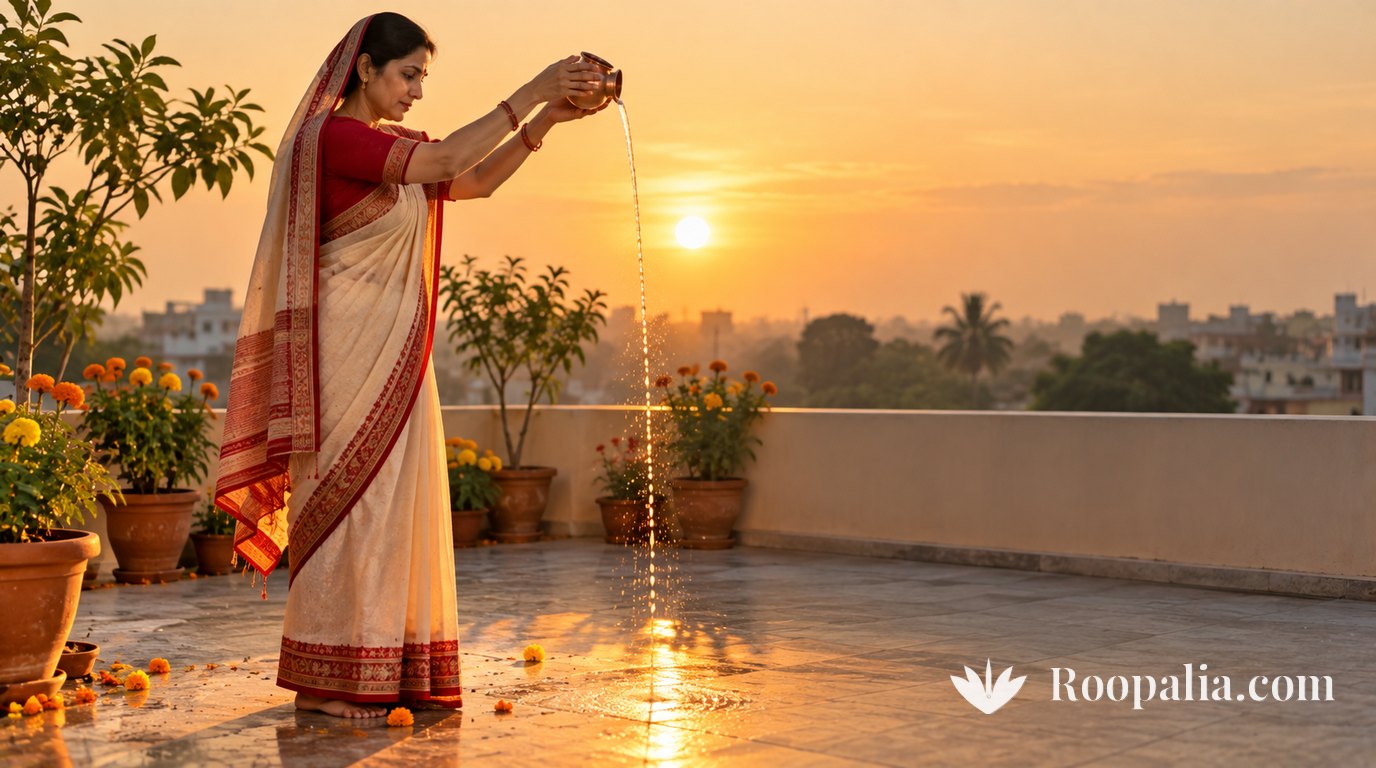
The central act of this vrat is arghya — pouring water toward the rising sun. Every guide says "at sunrise." In India that is a reliable instruction, because sunrise moves by perhaps an hour across the year.
Where you live, it does not behave like that.
In London, the sun rises around 08:00 in late December, and the latest sunrise of the year falls on 30 or 31 December. By late May it is up before 05:00. That is a swing of more than three hours. Toronto, Chicago, Frankfurt and Melbourne all have their own version of this.
So the rule is: use your own city's sunrise, not India's.
A winter arghya in Britain happens at breakfast time, in a lit kitchen, with the heating on. That is not a compromise or a shortcut. That is sunrise where you are standing, and sunrise is what the tradition asks for.
Look up your city's time for that Sunday the night before. It takes ten seconds and removes the one doubt that makes people give up on this fast.
There is a second half to this, and it is the reason your festival dates sometimes differ from your parents' — the whole calculation runs on local sunrise and local moonrise. We worked through that in Why your festival date does not match India's.
How to give arghya when there is no ground, no balcony, and no sun
Three obstacles come up again and again in a flat or a cold country. Each has a workable answer.
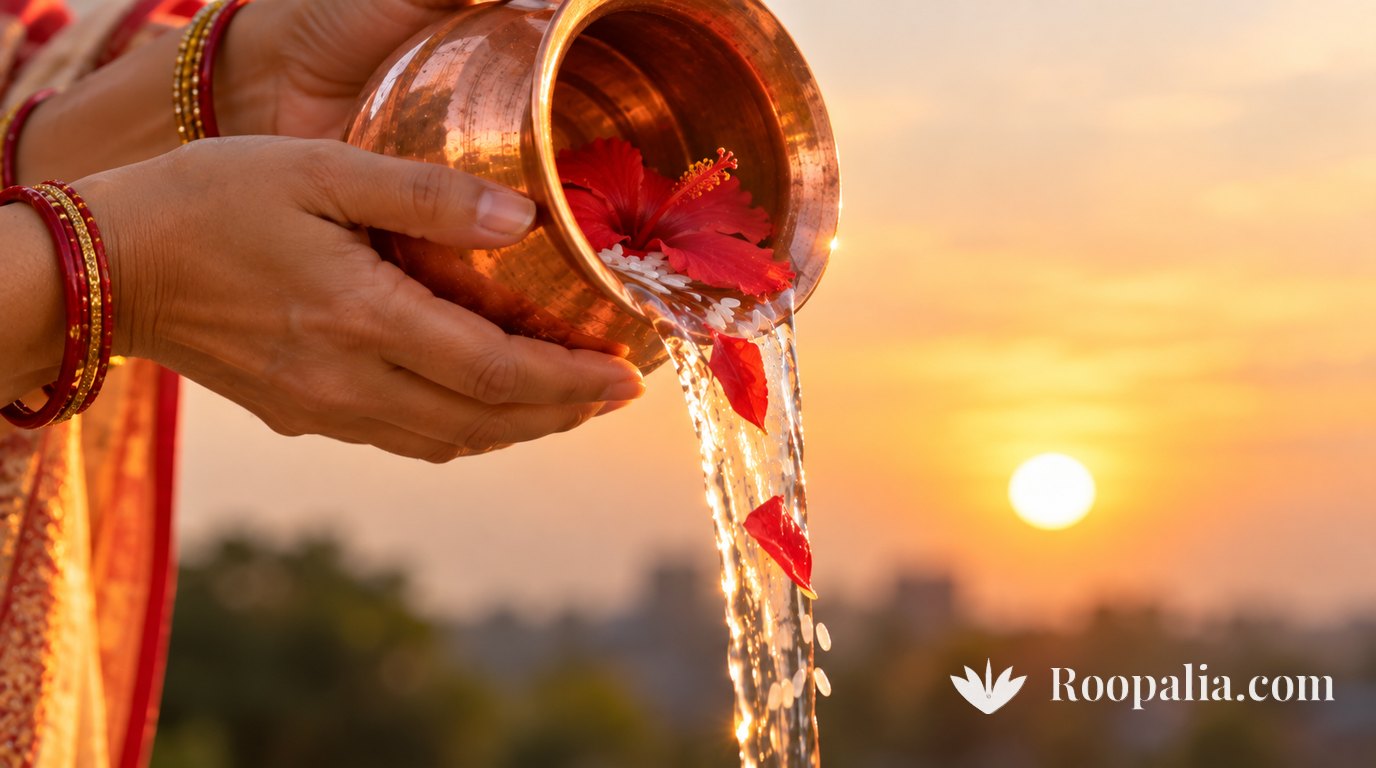
No open ground. Hold a wide copper plate or a large bowl in one hand and pour the arghya into it. Afterwards, give that water to a houseplant or to the soil outside. The rule the tradition actually cares about is that the water reaches earth and is not walked over — the plate is simply the route.
You cannot see the sun. Cloud, fog, a building opposite, a window facing the wrong way. Face east and offer anyway. Arghya is offered to a direction, not to a sighting. This is why it is still offered on overcast mornings in India.
It is freezing and the window is shut. Offer indoors, at the window, facing east. Nothing in the tradition requires you to be cold.
I should be straight about these three. I could not find any of them written in a text. They are practical adaptations that people living outside India have worked out for themselves. What I could find is the older rule they are protecting — the water should reach the earth. Judge them by that.
If you are setting up worship at home for the first time, the fuller version of this problem is in Puja at home when there is no temple nearby.
The rule most pages get backwards
Search this fast and you will read, on page after page, that you should eat once, before sunset.
The Matsya Purana says the opposite.
“…therefore on Sundays one should regularly observe the discipline of naktāśana — eating only at night.”
— Matsya Purana 97.3, Adityavara-vrata-kathanam
Nakta means night. Naktashana is the meal taken after dark. That is what the chapter prescribes for Sunday, and it is the clearest scriptural instruction on this fast that I was able to find.
I looked at the pages currently ranking for this question in Hindi and in English. Not one of them cites a chapter. They repeat each other.
And this happens to suit a life lived outside India rather well.
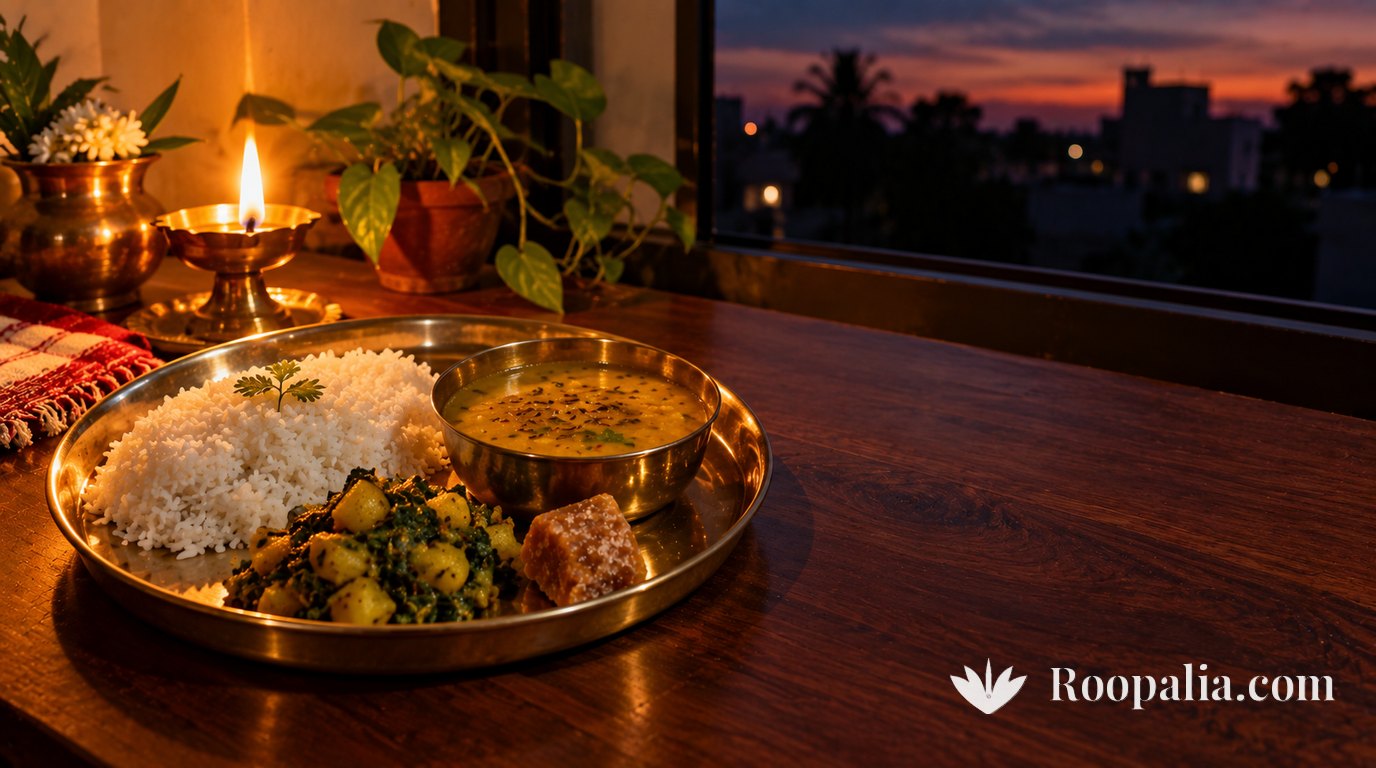
A daytime ritual is hard to fit around a Western week. An evening meal is not — it is dinner. You keep the fast through the day on fruit and milk, offer arghya in the morning, and eat one simple meal after sunset with your family. No leave taken, no explaining yourself at work.
The same chapter adds a detail that most food lists get right by accident: at 97.13, the concluding meal is to be free from oil. So "no fried food" is not folklore. It is in the text.
What is actually in the chapter
Matsya Purana chapter 97 runs to twenty verses. Nandikeshvara teaches the vrat to Narada. Briefly, what it contains:
- 97.3 — Sunday is kept with nakta, the night meal.
- 97.4 — when Sunday falls with the Hasta nakshatra, one keeps ekabhakta, a single meal, on the Saturday before.
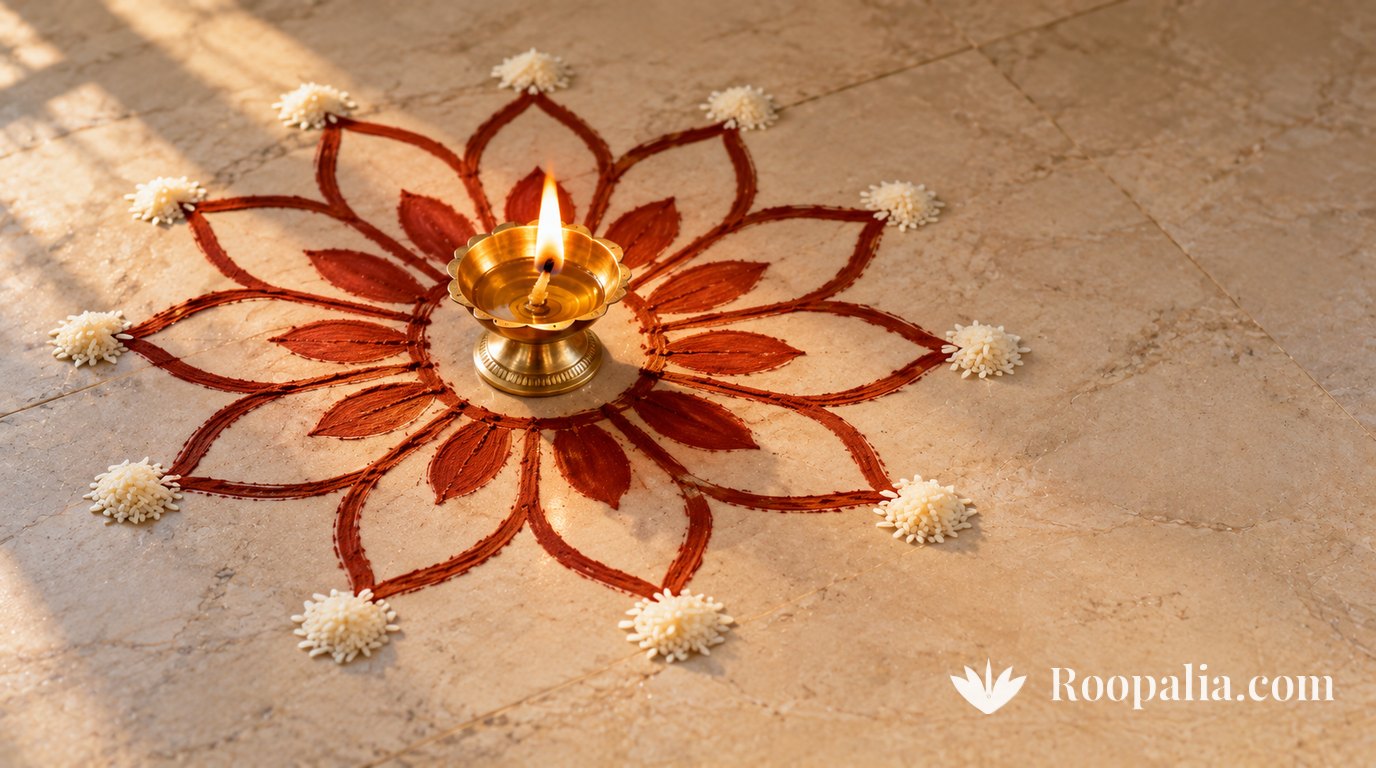
- 97.5 — on Sunday evening, after feeding brahmins, a twelve-petalled lotus is drawn in red sandal paste.
- 97.8 — the horses of Surya are marked before that lotus.
- 97.13 — the concluding meal is free from oil.
- 97.17 — kept for a year, it is said to destroy sin and lead to the solar region.
- the arghya is offered with red flowers and sesame.
One more thing, which I only noticed after reading three texts side by side. The number twelve turns up three separate times. There are twelve Adityas, the sons of Aditi, named in the Agni Purana, chapter 51. There are twelve petals on this lotus. And the Bhavishya Purana names twelve Sundays — Nanda, Bhadra, Saumya, Kamada, Putrada, Jaya, Jayanta, Vijaya, Adityabhimukha, Hridaya, Rogaha and Mahashveta.
Which suggests the lotus is not decoration. It is twelve places for twelve deities. And the household habit of keeping "twelve Sundays" probably descends from the same count.
The method, start to finish
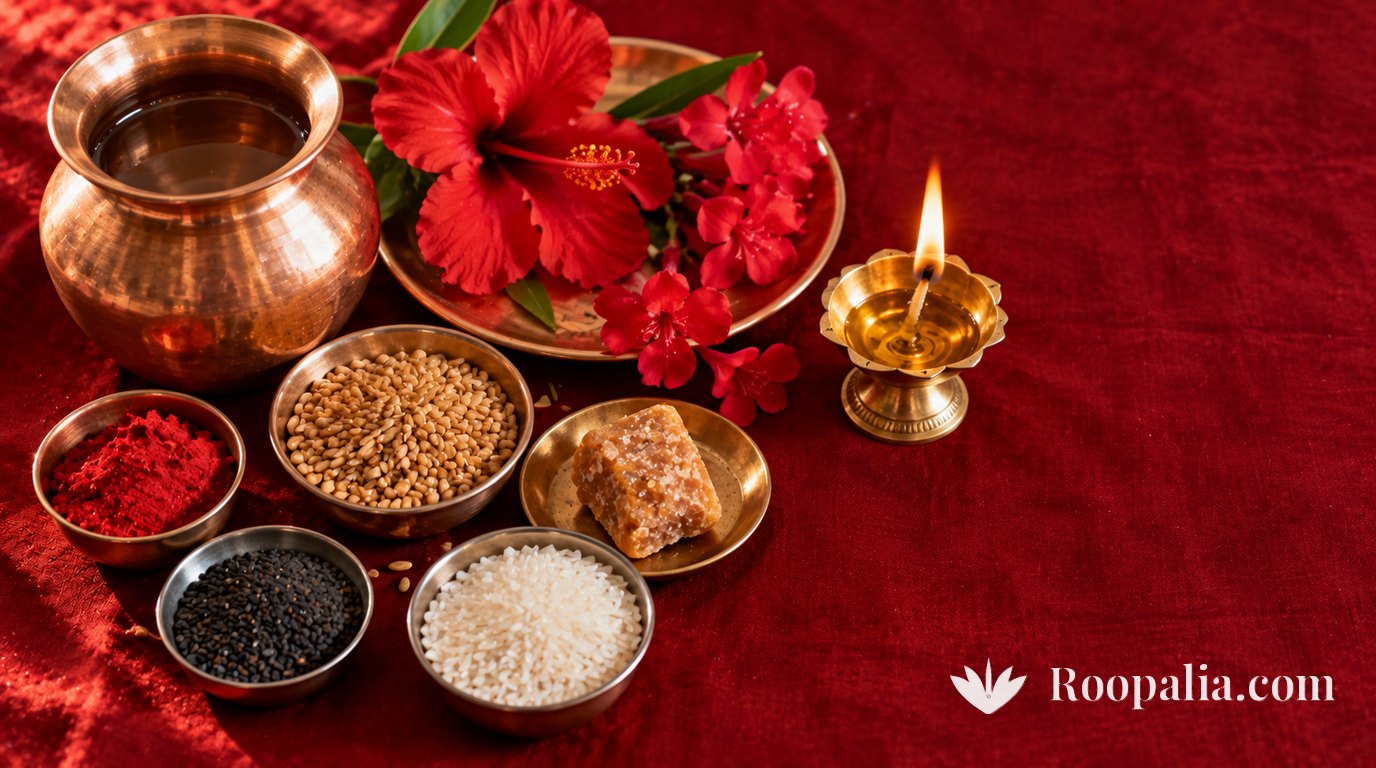
- Bathe before your local sunrise. In winter this may mean before eight, not before six.
- Sankalp. Decide, out loud or in your mind, how many Sundays you are committing to. This step is skipped more than any other, and without it the day is just a skipped lunch.
- Arghya. Face east. Copper lota. Red flower and a few sesame seeds in the water. Raise it to head height and pour a thin, unbroken stream. Look at the sun through the falling water, never directly. Three times is the commonest count.
- Lamp — ghee, or sesame oil.
- Red flowers, then roli and rice.
- Bhog — jaggery, wheat, something sweet.
- Mantra — Om Suryaya Namah is the simplest and the most widely attested. Some also recite the Aditya Hridaya, which is in the Valmiki Ramayana, Yuddha Kanda sarga 105 (numbered 107 in some translations), where the sage Agastya teaches it to an exhausted Rama on the battlefield.
- Katha — the full Ravivar Vrat Katha and aarti is set out separately, along with the Sunday story that is genuinely in a Purana — then prasad, and send some of it out of the house.
- The meal after sunset. One, simple, no oil.
What to eat
Through the day: fruit, milk, curd, nuts, coconut water. Wheat and jaggery are considered auspicious on this day.
After sunset, once: rice or wheat, one dal, one vegetable. No oil, no frying. No onion or garlic. No meat, fish or egg.
If you are standing in a supermarket aisle trying to work out whether something counts, the general method — how to read an ingredients label when nothing on the shelf was written with a vrat in mind — is in What to eat during a Hindu fast.
Salt: the rule with no text behind it
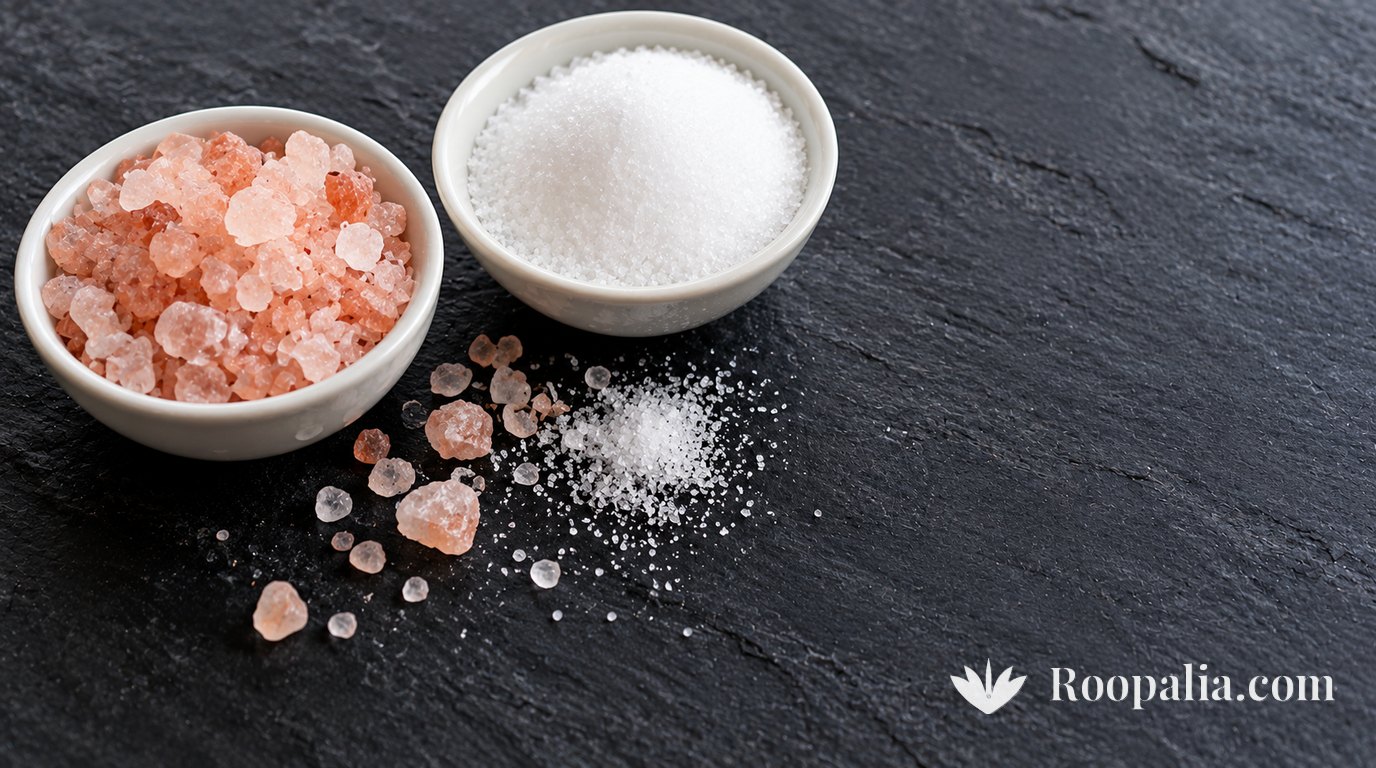
"No salt on Sunday" is repeated almost everywhere. So I went looking for it.
The word lavana — salt — does not appear anywhere in Matsya Purana chapter 97. Not as a prohibition, not as a permission. The thing that chapter forbids is oil.
So where does it come from? The most honest answer is that giving up ordinary salt is a shared habit across almost every Indian fasting tradition, a general mark of restraint, and it has attached itself to Sunday along with everything else. Keeping it is not wrong. Calling it scripture would be.
In Hindi search there is a second, quite separate question tangled up with this one — whether salt may be bought on a Sunday. That is a household superstition about auspicious days for purchases, unrelated to the vrat, and I found no textual basis for it either.
How many Sundays, and when to start
Twelve — matches the twelve named Sundays of the Bhavishya Purana.
One year — this is the Matsya Purana's own figure, at 97.17.
Thirty — widely printed. I could not find any basis for it.
Start on a Sunday in the bright fortnight. In several regions the Sundays of particular months carry extra weight — Magha, Aghan (Margashirsha) and Bhadrapada. At the Deo Surya temple in Aurangabad, Bihar — a shrine dated by historians to somewhere between the sixth and eighth centuries, and unusual among sun temples in facing west — the Bhadrapada Sundays draw very large crowds.
But I will say plainly what I found and did not: I could not locate a separate scriptural prescription for those month-specific Sundays. They are living regional traditions, and worth keeping as that.
Whatever number you choose, choose one you can finish. In this tradition, abandoning a vow partway is considered heavier than committing to a smaller one.
Udyapan — closing the vow
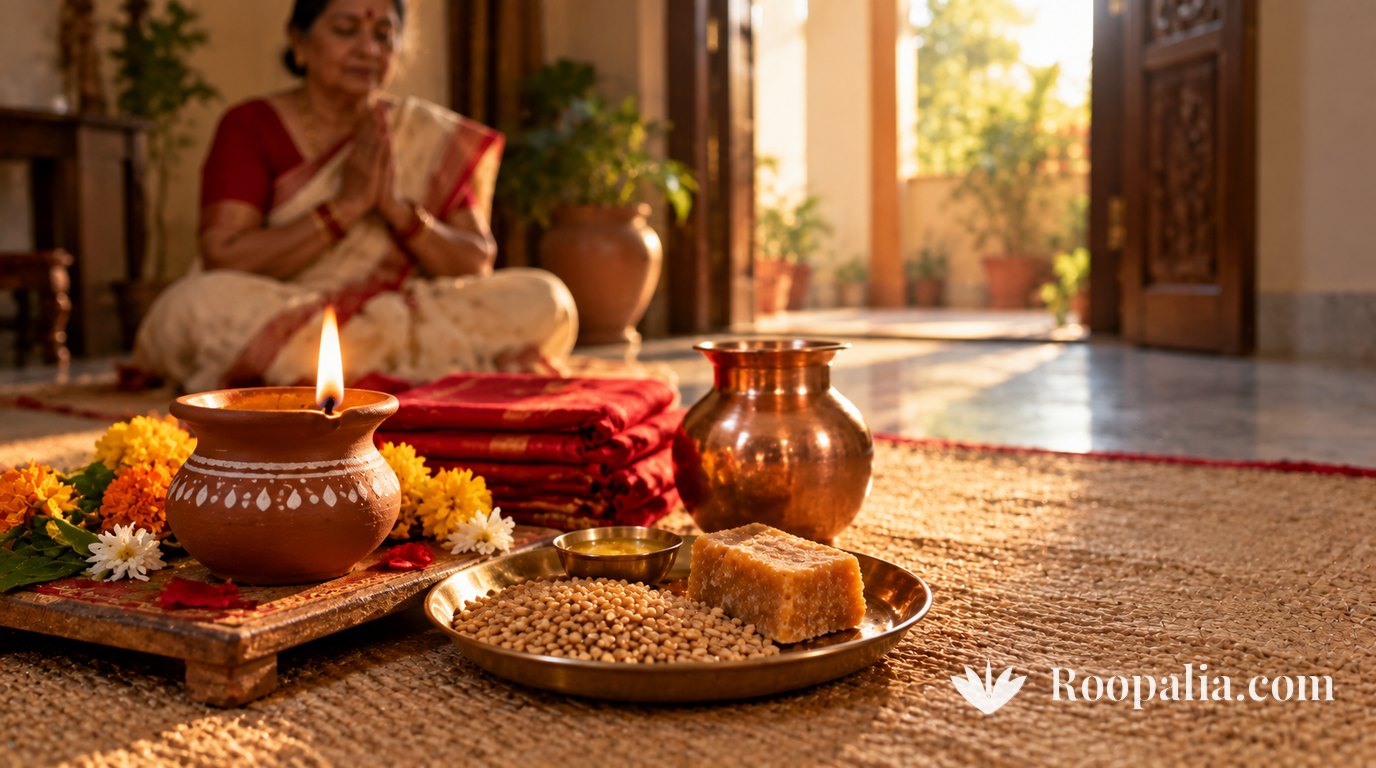
On the Sunday after your number is complete: the usual puja and arghya, a small havan for Surya if you can manage one, a meal given to someone — a brahmin by tradition, or anyone in need — and a daan of wheat, jaggery, red cloth or a copper vessel. Then a prayer for forgiveness of anything done wrong along the way.
Notice that the meal is not the decorative part. In Matsya Purana 97.5 the lotus is drawn after brahmins have been fed. Feeding people is the structure, not the garnish.
There is no rule about cost. Tradition measures capacity, not amount.
Scripture and custom, side by side
| The rule you have heard | In a text? | Where |
|---|---|---|
| Eat at night (nakta) | Yes | Matsya Purana 97.3 |
| Eat once, before sunset | Not found | The most repeated instruction online, and the text says the reverse. |
| No oil or fried food | Yes | Matsya Purana 97.13, for the concluding meal. |
| No salt | Not found | The word lavana is absent from the whole chapter. |
| Red flowers, red sandal, red cloth | Yes | Matsya Purana 97.5, and red flowers in the arghya. |
| Keep it for a year | Yes | Matsya Purana 97.17 |
| Twelve Sundays | Indirectly | Twelve named Sundays in the Bhavishya Purana. |
| Thirty Sundays | Not found | — |
| Do not wash or cut hair | Not found | Astrological and folk practice, not Puranic as far as I could check. |
A caution on that middle column: "not found" means not in the passages I was able to read. It is not the same as "does not exist". But where something was found, the chapter and verse are given, so you can check me.
Which deity belongs to which day
| Day | Deity | Planet | Guide |
|---|---|---|---|
| Sunday | Surya Dev | Sun | this article |
| Monday | Shiva | Moon | Monday fast — vidhi and rules |
| Tuesday | Hanuman | Mars | Tuesday fast — vidhi and rules |
| Wednesday | Ganesha | Mercury | — |
| Thursday | Vishnu / Brihaspati | Jupiter | Thursday fast — vidhi and katha |
| Friday | Santoshi Mata / Lakshmi | Venus | Friday fast — vidhi and rules |
| Saturday | Shani Dev | Saturn | Saturday fast — vidhi and udyapan |
Before you keep it: the medical part
Two things deserve saying clearly, because this fast is tied to the sun and that invites a claim it cannot support.
Vitamin D. You will read that standing in the morning sun for arghya gives you vitamin D. The UK's NHS is unambiguous: "between October and early March we do not make enough vitamin D from sunlight", and people with African, African-Caribbean or South Asian backgrounds "may also not make enough vitamin D from sunlight". Government advice there is that everyone should consider a daily supplement through autumn and winter. A December arghya in Britain has devotional value. It is not a source of vitamin D, and it is better not to confuse the two.
Who should be careful. Medanta's patient education material states that people with diabetes, hypertension or heart conditions "should get their doctor's approval before fasting", and that "strict fasting isn't safe for pregnant and nursing mothers". On pregnancy specifically, gynaecologist Dr Smiti Jain writes that "pregnant women should not practice complete fasting without food and water for an extended period" and that "dehydration can result in complications". For anyone managing diabetes, a paper in the Indian Journal of Endocrinology and Metabolism notes that fasting should be discouraged where there is poor glycaemic control or a history of severe hypoglycaemia.
Going without added salt for one day is unremarkable for most people. If you take medication for blood pressure, or a diuretic, ask your doctor first.
Nothing here is a recommendation to fast. The tradition itself never asked anyone to injure their body for a vow — illness, pregnancy, age and travel are recognised grounds for relaxation in every fasting tradition in India.
What is Ravivar Vrat and which god is it for?
What time should I offer arghya to the sun if I live outside India?
How do I offer arghya in a flat with no garden or balcony?
Should I eat before sunset or after sunset on Ravivar Vrat?
Is salt allowed on Ravivar Vrat?
How many Sundays should the fast be kept?
How is the udyapan of Ravivar Vrat done?
Which Hindu god is worshipped on each day of the week?
Is Ravivar Vrat easier to keep outside India?
Sources and cautions: the backbone of this article is Matsya Purana chapter 97 (Adityavara-vrata-kathanam), which was opened and checked — 97.3 (nakta, the night meal, on Sundays), 97.4 (ekabhakta on the preceding Saturday when Sunday falls with Hasta), 97.5 (the twelve-petalled lotus in red sandal, after feeding brahmins), 97.8 (the horses of Surya), 97.13 (the concluding meal free from oil) and 97.17 (the fruit of a year). Alongside these: Shiva Purana 1.14 (Sunday’s merit, the removal of sin), the twelve named Sundays of the Bhavishya Purana Brahma Parva, Agni Purana 51 (the twelve Adityas), and Valmiki Ramayana Yuddha Kanda sarga 105 for the Aditya Hridaya (numbered 107 in some translations). Three caveats worth stating plainly. First, the word lavana (salt) does not appear anywhere in chapter 97, so we could not find a scriptural basis for the no-salt rule; it is a habit shared across Indian fasting traditions. Second, the Bhadrapada, Aghan and Magha Sunday traditions are living practice, but we found no separate scriptural prescription for them. Third, “not found” means not in the passages we could read — it is a report of our search, not a ruling. This article does not ask anyone to fast; decisions about your health belong with your doctor.