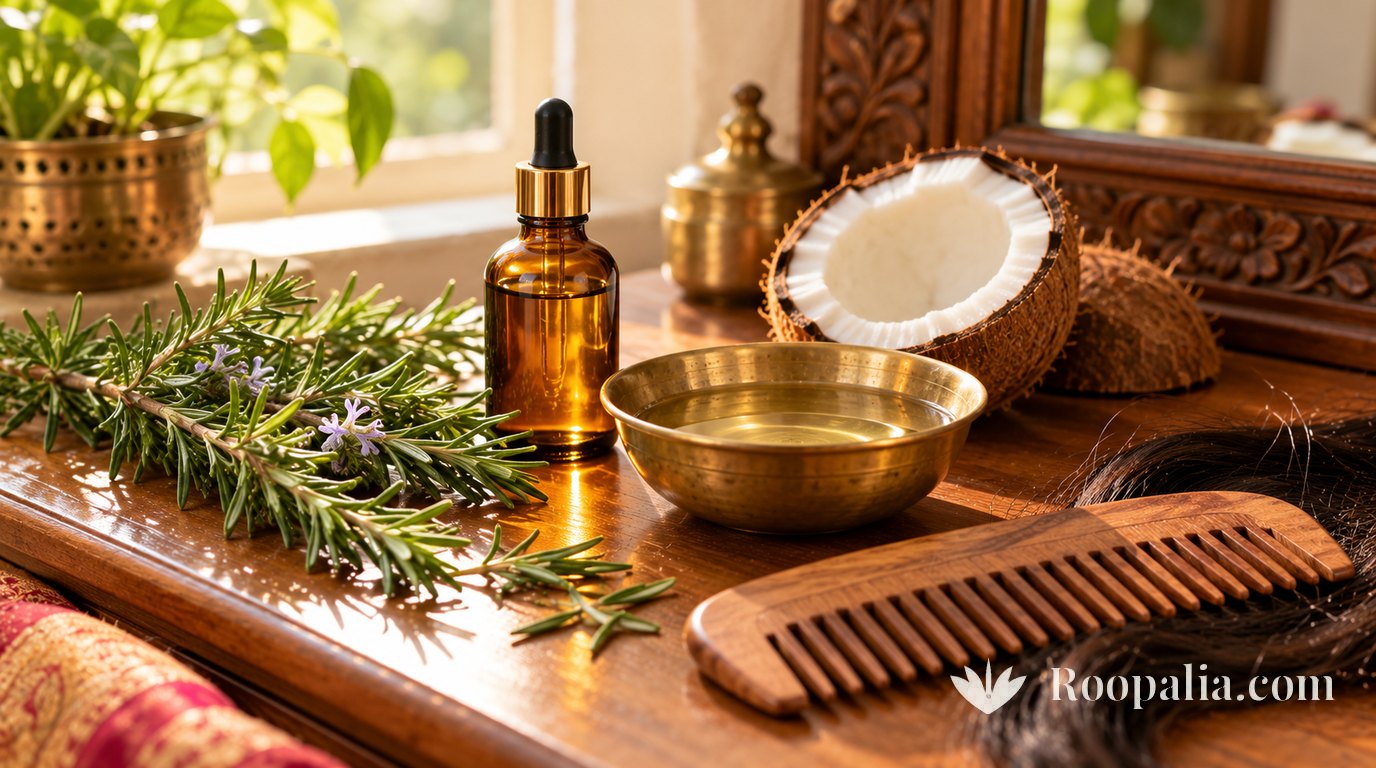
Few home remedies have had a run like this one. In the space of a couple of years rosemary oil went from a kitchen herb to the default answer to thinning hair, carried by short videos with dramatic before-and-after shots and the same confident line: it works as well as minoxidil.
That line traces back to a single paper. It is a real paper, and it found something genuinely interesting. It also found something considerably narrower than the videos suggest — and the gap between the two decides whether rosemary is worth six months of your evenings.
The whole trend rests on one paper
In 2015 the dermatology journal SKINmed published a trial by Panahi and colleagues. It enrolled 100 people with androgenetic alopecia — pattern hair loss — and split them evenly. Fifty applied a rosemary oil preparation; fifty applied minoxidil 2%, a long-established hair-loss drug.
After six months, hair counts had risen in both groups, with no significant difference between them. Scalp itching was more common in the minoxidil group.
That is the finding. It is encouraging, and it is the reason rosemary deserves to be taken seriously rather than dismissed as a fad. But it is one result, and it comes with conditions that almost never travel with it.
What the trial tested — and four things it didn’t
- Only one kind of hair loss. Everyone in the trial had pattern hair loss. It says nothing about shedding from iron deficiency, thyroid disease, PCOS, childbirth or illness.
- The weaker comparison. Minoxidil is widely used at 5%. Matching the 2% version is a narrower claim than “as good as minoxidil”.
- No untreated group. Without a placebo arm, there is no way to tell how much of the improvement in either group would have happened anyway.
- Not a drugstore bottle. The trial used a prepared formulation, which may differ from a few drops mixed at home.
A 2026 review in Dermatology Reports reaches the measured conclusion you would expect: promising, and in need of further research. There is also a 2013 study on mice. Mice are not people.
None of that makes rosemary useless. It makes it a reasonable thing to try for one specific problem, with realistic expectations — which brings us to the question the trial cannot answer for you.
Hair loss is several conditions, not one
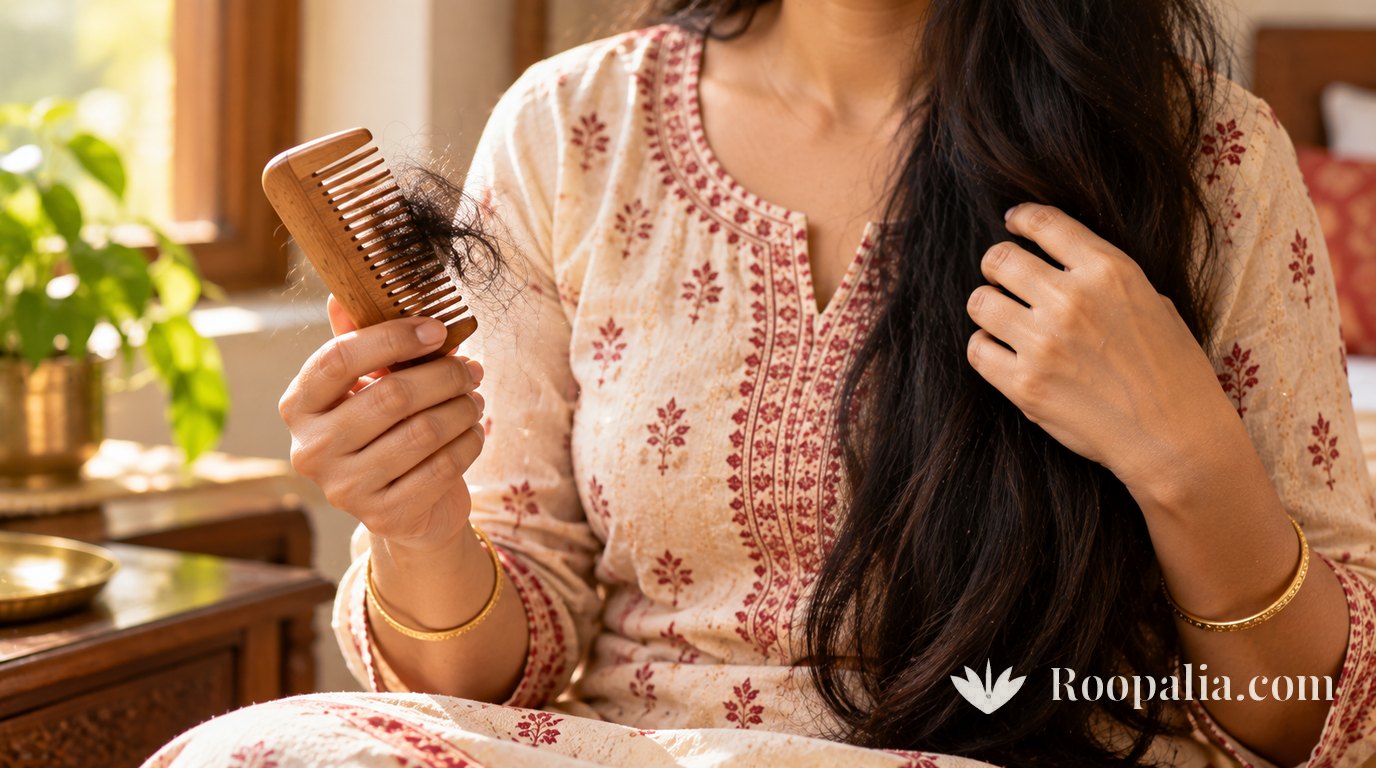
A clump of hair in a comb looks the same whatever caused it. The causes are not the same, and neither are the fixes.
In South Asian women in particular, iron deficiency and thyroid problems are common drivers of shedding, as are PCOS and the heavy shedding that follows childbirth. None of these is addressed by anything applied to the scalp. Treating them with an oil is a bit like pumping up the tyres on a car with an empty tank.
If shedding is sudden or heavy, the first step is a blood test and a doctor, not a dropper bottle. We go through the common causes, and the tests worth asking for, in hair fall in women: causes, deficiencies and what helps. Rosemary belongs in the conversation once pattern hair loss is the likely explanation.
Essential oil, infused oil, rosemary water — three different things
Much of the confusion online comes from treating these as one product. They are not.
Essential oil is a steam-distilled concentrate, sold in small dark bottles. It is potent, it must never go on skin undiluted, and it is the closest of the three to what was studied.
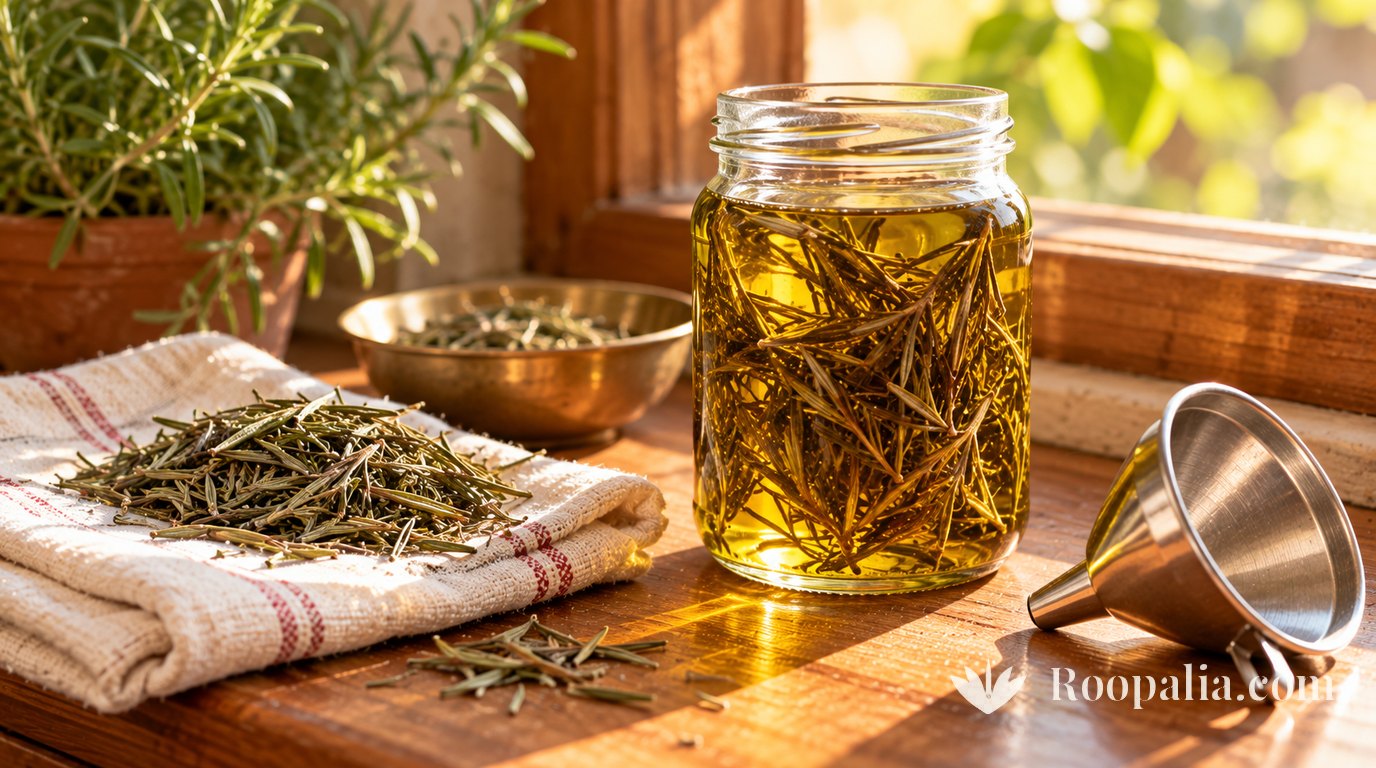
Infused oil is what you get by steeping rosemary leaves in a carrier oil at home. It smells lovely and is far weaker. If you make it, use dried leaves — fresh ones carry moisture that can spoil a sealed jar — keep the herbs fully submerged, and throw it out if it clouds, smells off or grows anything.
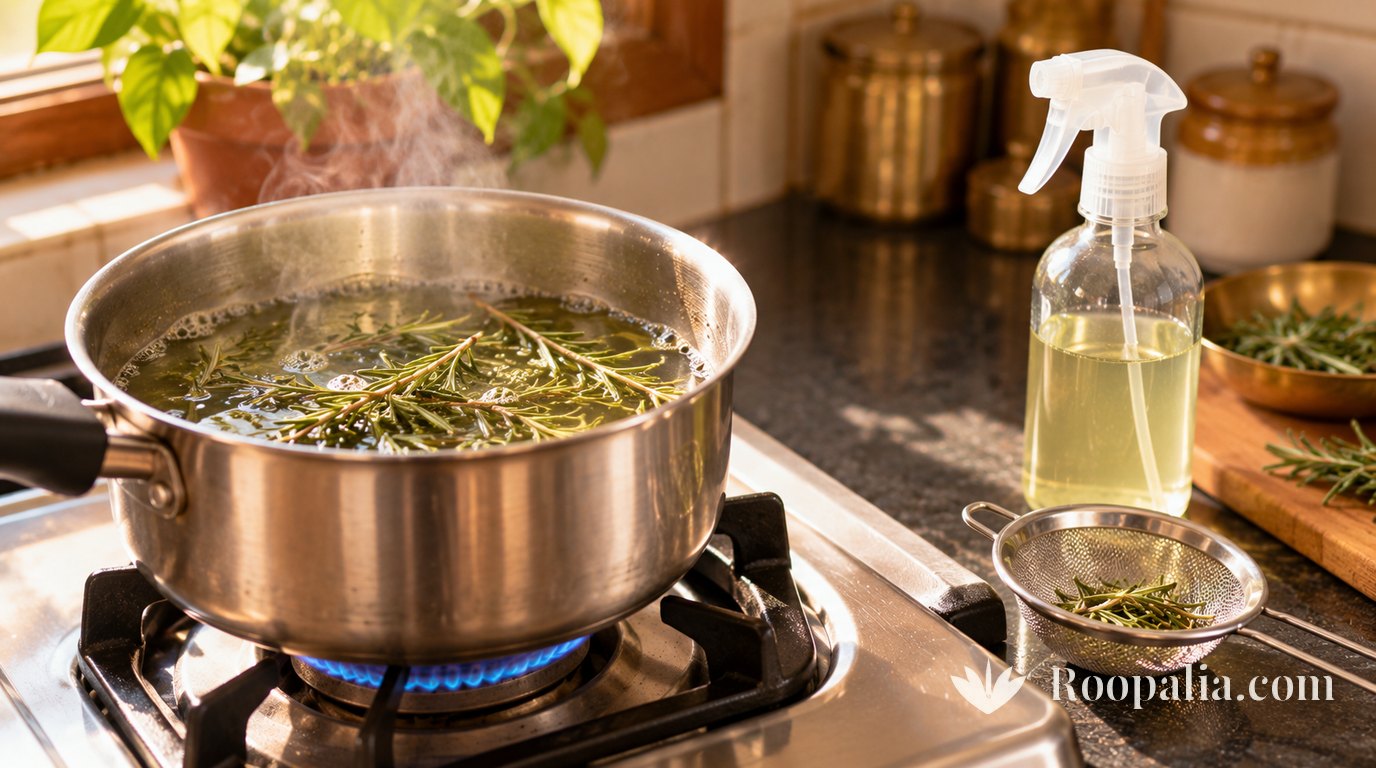
Rosemary water is sprigs simmered in water and cooled, typically used as a final rinse or spray. It is pleasant and harmless, but no human study on it for hair growth could be found, and water pulls out little of the plant’s oily compounds. It is a rinse, not a treatment. Keep it in the fridge and use it within a few days.
A sensible way to try it
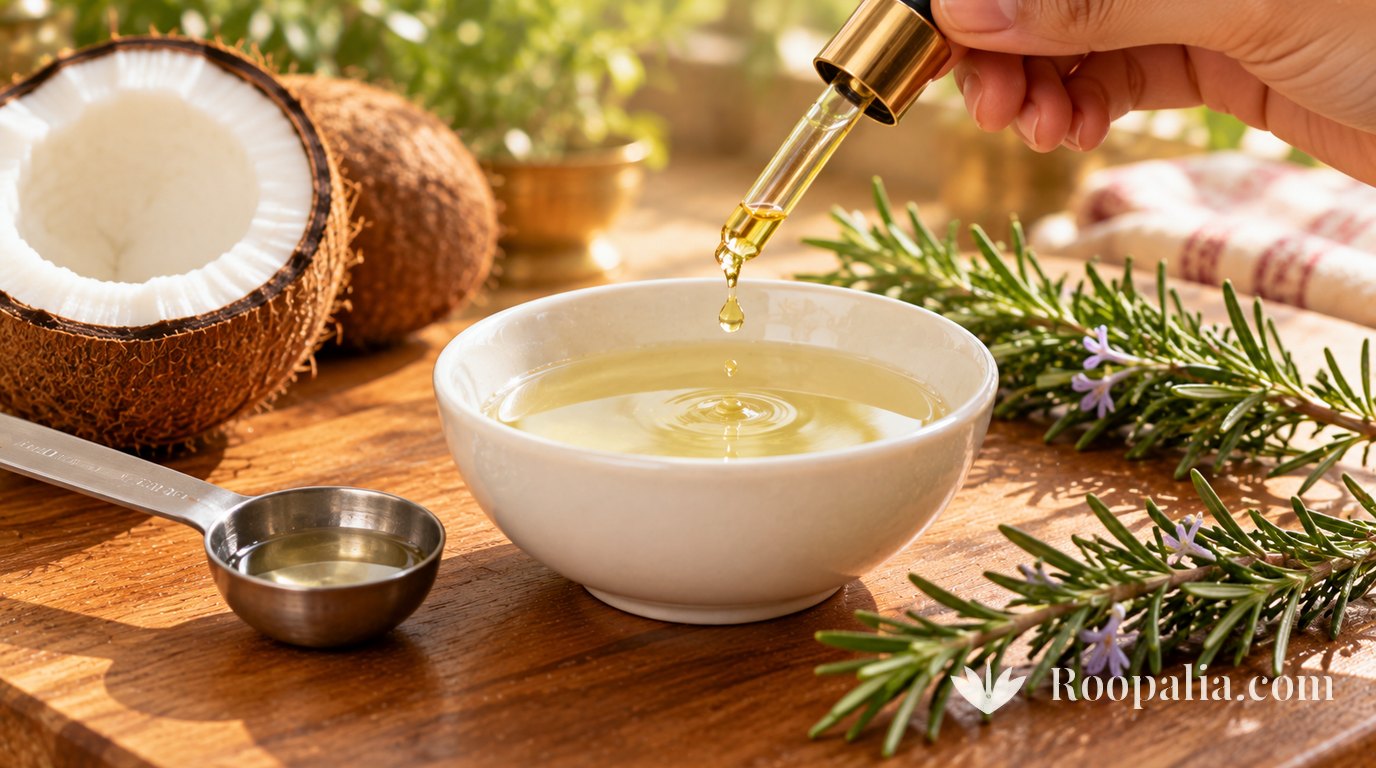
Dilute, always. Cleveland Clinic dermatologist Dr Shilpi Khetarpal advises mixing rosemary oil into a carrier such as coconut or jojoba to avoid irritation. Published guidance on strength varies — WebMD cites 5–10% — so the cautious approach is to start low: two to three drops in a teaspoon (about 5 ml) of carrier oil, which works out at roughly 2–3%.
Patch test first. A little behind the ear or on the inner wrist, left for a day. Any redness, itching or burning and it does not go on your scalp.
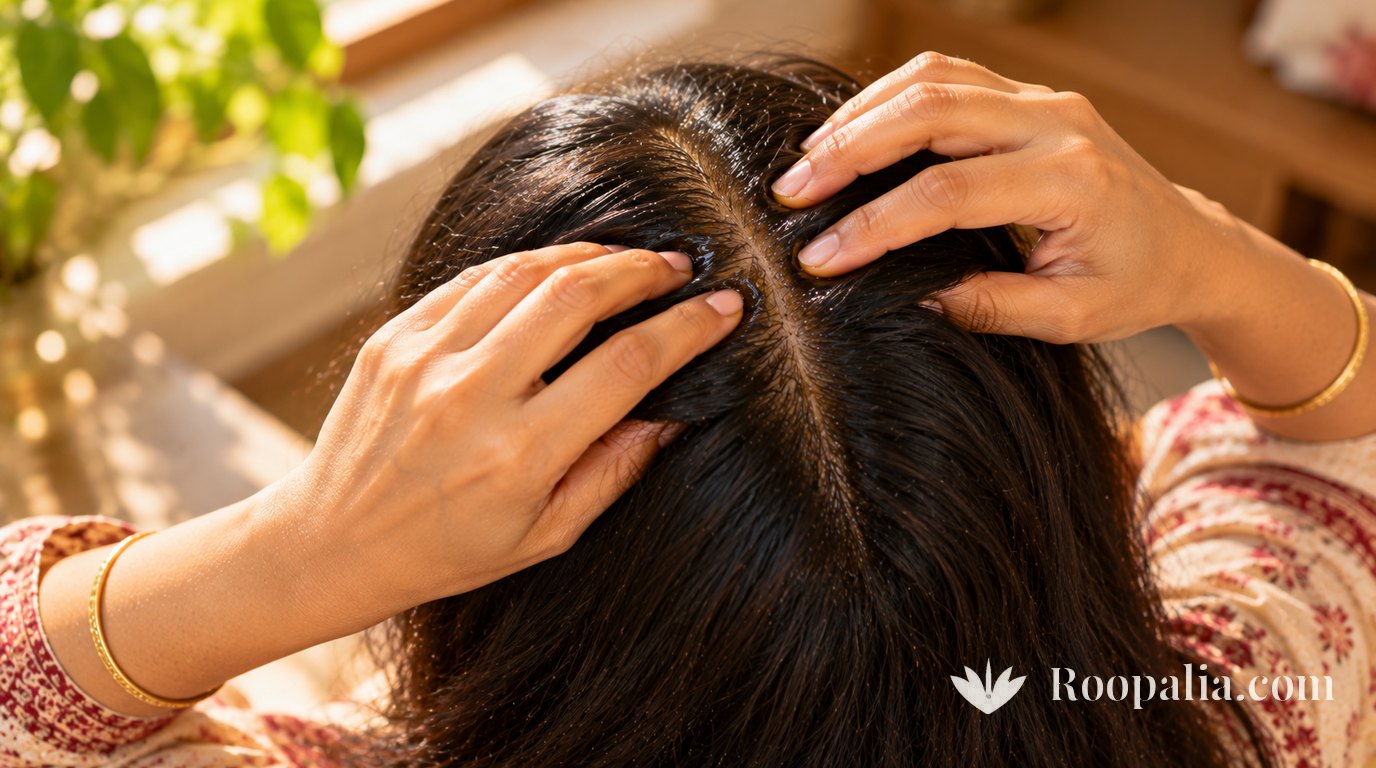
Aim for the scalp, not the hair. Part the hair, apply along the parting with fingertips, move over an inch and repeat, then massage gently for a couple of minutes. The lengths of your hair are not where anything happens.
Frequency and wear time. Cleveland Clinic suggests two to three times a week; WebMD suggests daily. Starting at two or three times a week is the gentler route. Leave it on for at least a couple of hours, or overnight and wash in the morning, as Dr Khetarpal suggests. More, and stronger, is not faster — overuse is how people end up with irritated, inflamed scalps.
What to expect, month by month
Some sources talk about early changes at two to three months. The trial that everything rests on measured its result at six, and Dr Khetarpal is blunt about it: two or three times a week, for six months, before you judge.
That timescale is set by the hair cycle, not by the oil. New growth has to emerge and lengthen before it is visible. A dramatic transformation in a fortnight is lighting, angle, or something that isn’t rosemary.
The one habit that makes this honest: photograph your parting on day one, in the same spot and the same light, and repeat monthly. Mirrors lie daily. Dated photographs don’t.
The Indian tradition it walked into
Rosemary is a Mediterranean plant — native to the hills of Portugal and north-western Spain, and now classified as Salvia rosmarinus. It does not appear in the classical Ayurvedic texts, and any claim that it does is simply wrong.
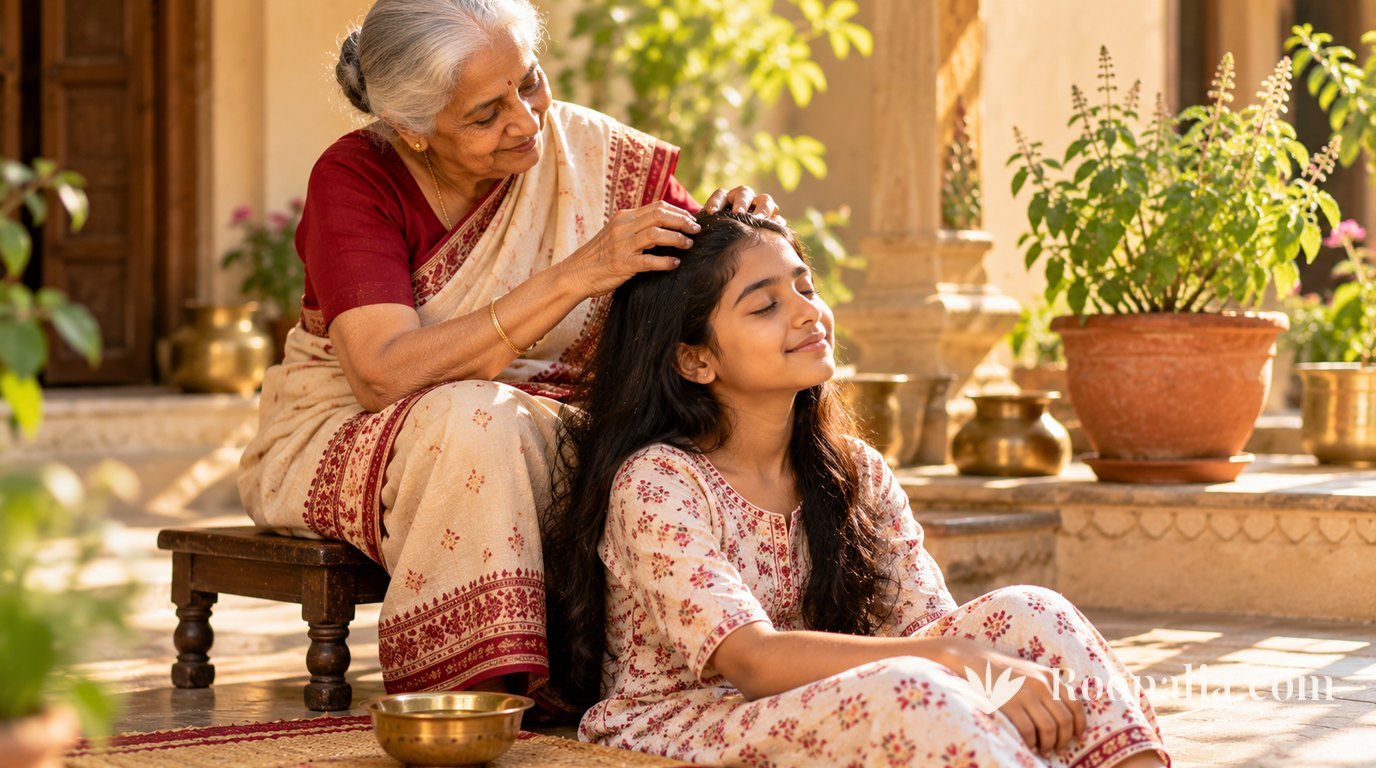
What it arrived into, though, is one of the oldest documented hair-care habits anywhere. The Charaka Samhita, in its chapter on daily routine, states it plainly:
नित्यं स्नेहार्द्रशिरसः शिरःशूलं न जायते।
न खालित्यं न पालित्यं न केशाः प्रपतन्ति च॥
Charaka Samhita · Sutrasthana 5.81–82
One whose head is oiled every day does not suffer headache, baldness or greying, and his hair does not fall.
Anyone who grew up with a grandmother’s Sunday oil massage knows the practice. Fewer know it has a verse behind it. Seen this way, the rosemary trend is less a discovery than a new ingredient dropped into a very old routine — and the carrier oil it is mixed into is doing its own quiet, traditional work.
The Sushruta Samhita adds a line that reads as if it were written this year. Explaining why hair greys early, it names krodha, shoka, shrama — anger, grief and exhaustion (Nidanasthana 13.37). The same chapter describes hair loss as a disorder rooted in the body’s internal balance rather than in the scalp alone (13.33–34). Modern dermatology would put it in different words, but it would not disagree about where to start looking.
The plants that were already here
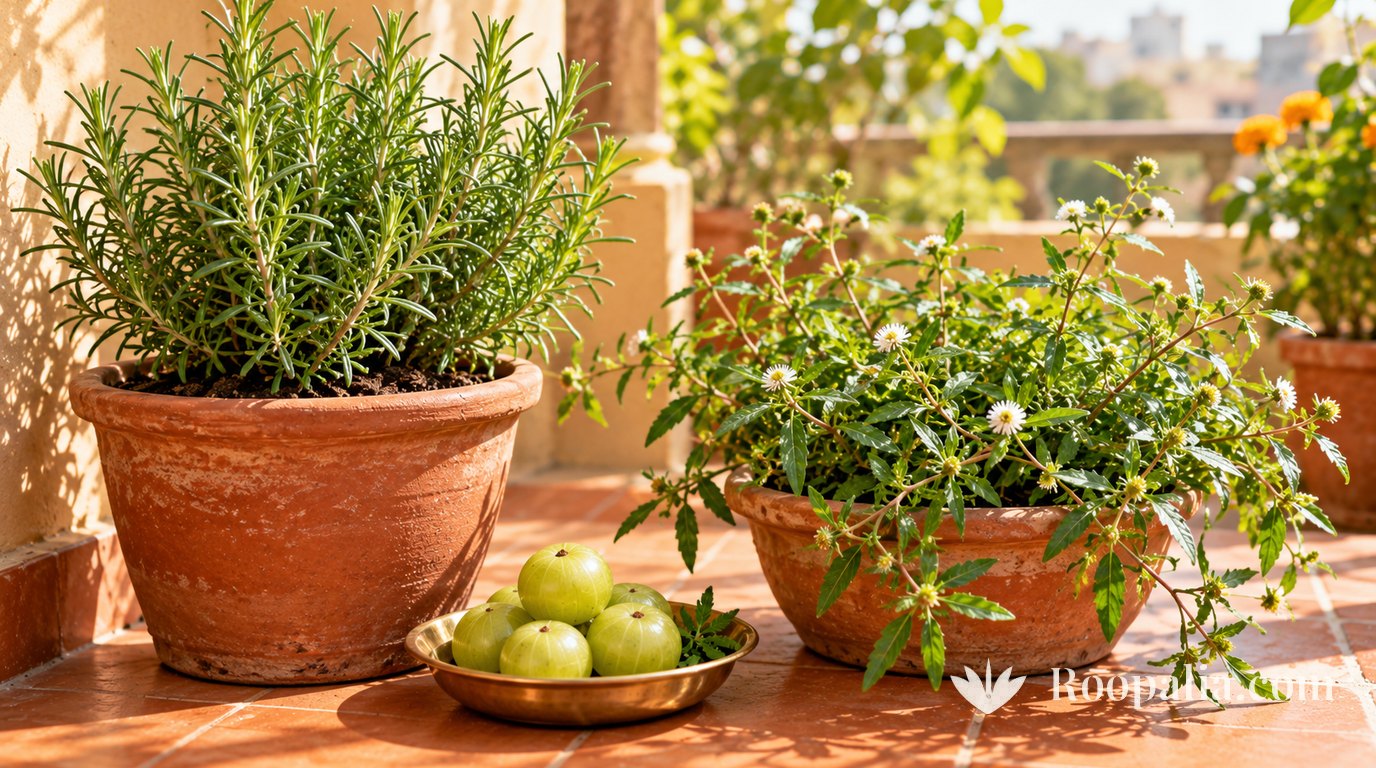
Indian households have their own hair plants, and the best known is bhringraj, traditionally called keshraj, the king of hair. Amla and brahmi belong to the same tradition, and for greying hair henna has its own long history. If you use henna on hair, the timing section of how long to leave henna on applies there too.
In fairness, the evidence for these is thin as well; being traditional is not the same as being proven. The practical difference is cost and access. Coconut oil, amla and bhringraj are cheap across India, and trying them needs no imported essential oil at all. No brand is recommended here — read ingredient lists, and treat “100% pure” as marketing rather than a standard.
Who should skip it
“Natural” is not the same as harmless — the same lesson our piece on lemon juice on skin works through in detail.
- Pregnancy and breastfeeding. Both Cleveland Clinic and WebMD advise avoiding rosemary oil during this time.
- Young children. Keep essential oils off them.
- High blood pressure, ulcers, or inflammatory bowel disease. WebMD flags these; if you take regular medication, ask your doctor.
- Never swallow it. Rosemary essential oil can be toxic when taken by mouth.
- Sensitive or eczema-prone scalps. Patch test, dilute well, and stop at the first sign of burning or redness.
If shedding worsens after starting, or the scalp breaks out, stop and see a dermatologist. And if you take one thing from all of this, let it be the order of operations the old texts and modern doctors agree on: find out why the hair is falling first, then decide what to put on it.
This article has been prepared for educational purposes. The information in it has been drawn from a range of sources — classical Ayurvedic texts, published clinical research, dermatologist guidance and health-institution articles — which were studied and compiled into this account. Every source is listed at the end. Where a claim has no evidence behind it, that is said plainly. This is not medical advice.
Frequently asked questions
Does rosemary oil actually work for hair growth?
How do I use rosemary oil on my scalp?
How often should I use rosemary oil, and how long should I leave it in?
How long before rosemary oil shows results?
Is rosemary water as good as rosemary oil?
Who should not use rosemary oil?
Is rosemary used in Ayurveda?
Sources
- Panahi Y, Taghizadeh M, Marzony ET, Sahebkar A. Rosemary oil vs minoxidil 2% for the treatment of androgenetic alopecia: a randomized comparative trial. SKINmed. 2015 — PubMed 25842469
- HairClub — what the rosemary vs minoxidil trial found
- Cleveland Clinic — Rosemary Oil for Your Hair (Dr Shilpi Khetarpal)
- WebMD — Rosemary Oil: What to Know
- Alkhalifah A et al. Review on natural remedies for hair growth promotion with a focus on rosemary. Dermatology Reports, 2026 — PagePress
- Murata K et al. Promotion of hair growth by Rosmarinus officinalis leaf extract. Phytother Res, 2013 — PubMed 22517595
- University of Wisconsin Extension — Rosemary, Salvia rosmarinus
- Charaka Samhita, Sutrasthana 5.81–82 and 5.56–58 — Matrashiteeya Adhyaya, carakasamhitaonline
- Sushruta Samhita, Nidanasthana 13.33–34 and 13.37 — Kshudra Roga Nidana, easyayurveda
This article is for information only and is not medical advice. For the cause and treatment of hair loss, see a dermatologist or doctor. No brand, shop or product is recommended anywhere in this article, and it contains no affiliate links.