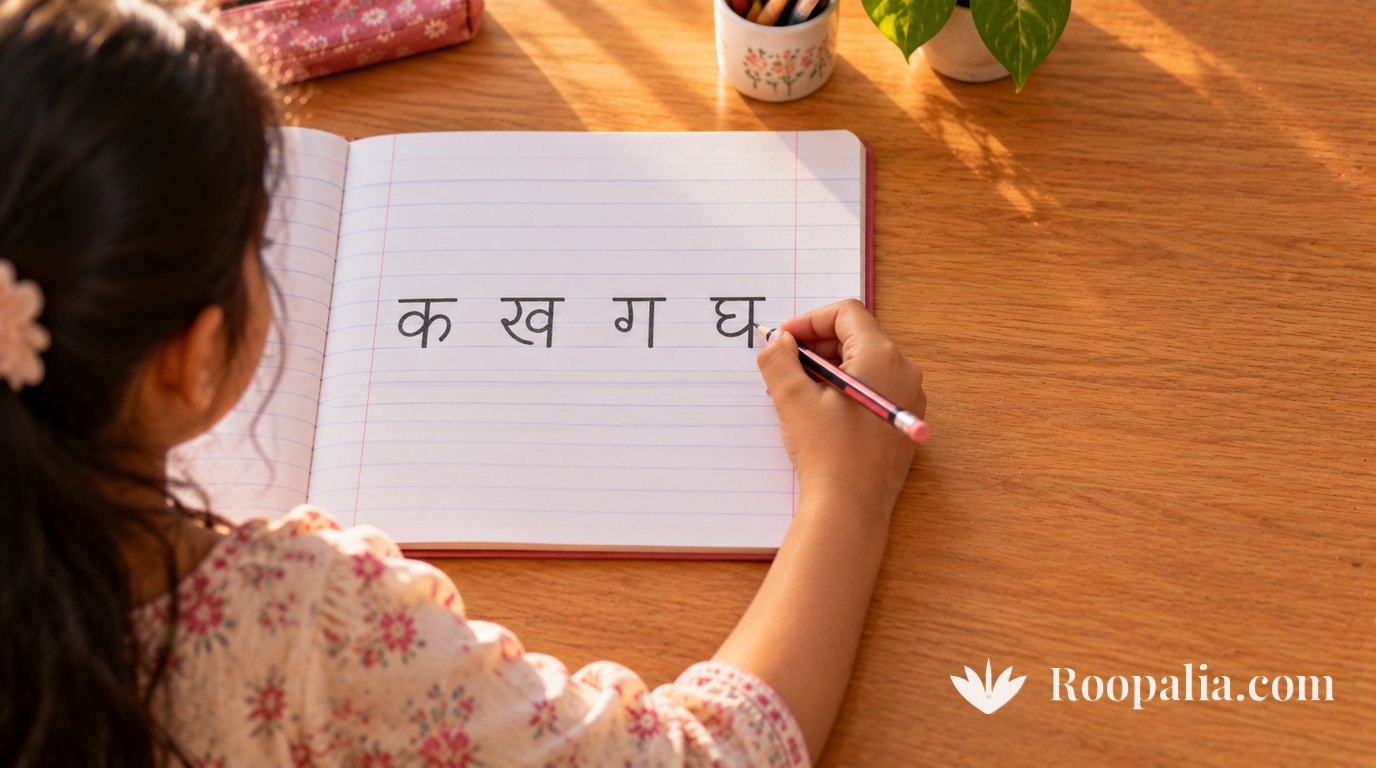
You put the notebook down. Your child folds their arms and looks away.
Maybe they say it is boring. Maybe they say they are tired. Maybe they say nothing at all, which is worse. And you are left holding a language you love and a child who does not want it.
Before anything else, here is what Google's own suggestions say. Type my child refuses to speak and the list that comes back includes "my child refuses to speak my language" and "my child doesn't want to speak spanish". Type should i teach my child and it completes to "should i teach my child my native language".
That last one is worth sitting with. Parents are not asking how any more. They are asking whether it is worth it at all.
This article is about the how. But it starts with the refusal, because until that is dealt with no method works.
🙏 Every scriptural passage below was opened and checked, with the Sanskrit and the link beside it. Where the classical texts disagree with each other, we say so. Nothing here recommends an app, a book, a class or a product — no brand name appears in this article at all.
First: the refusal is not laziness
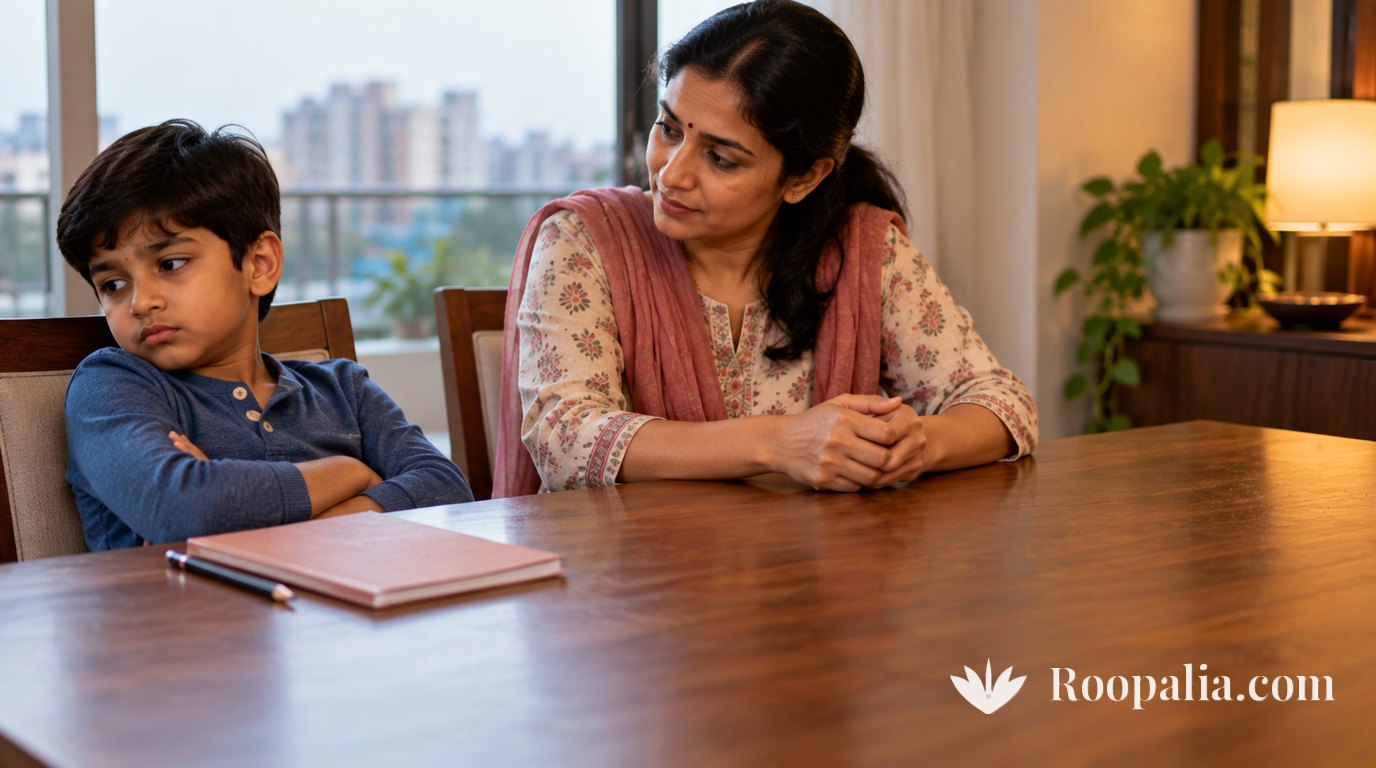
Your child spends seven hours a day being good at English. They are praised for it. It is the thing they know how to do.
Then they come home and you put in front of them something they are bad at. Nobody walks willingly towards the one task that makes them look stupid. That is not a character flaw, and it is certainly not disrespect. It is the most ordinary human reflex there is.
Which means the refusal is not really about Hindi. It is about competence. And that tells you exactly where to aim.
Give them one thing they can be good at in the first ten minutes, and the arms come down.
What nobody has told your child
Here is the fact that changes the conversation, and almost no child outside India has ever heard it.
Devanagari is far more honest than English spelling.
क is k. It is always k. It has never been anything else and it never will be.
Now look at what your child deals with every day in English. The letter c is k in cat, s in city and sh in ocean. The four letters -ough are pronounced one way in though, another in through, another in tough, another in cough and another in bough. English spelling is a museum of exceptions, and your child has memorised thousands of them without ever being thanked for it.
Hindi has almost none of that. Once a child knows what a letter sounds like, they can read it in any word, forever. There is no spelling test in Hindi in the sense that English has one, because there is almost nothing to catch you out.
Say this to your child out loud. Not as encouragement — as information. "This is going to be easier than English. English lied to you for years. This one doesn't."
Children who are told this sit up. It reframes the task from another thing I am behind on to a thing with rules that actually work.
What you will find if you search, and what it is selling
You will look this up, so it is worth knowing what is there.
We checked what currently ranks for teaching Hindi varnamala to children at home. Of the nine results, seven are businesses with something to sell — a preschool chain, an educational publisher, a printables shop, a toy company appearing twice, and a shop selling children's books. Only one looked like a parent writing from experience.
They are not bad pages. But a page whose purpose is to sell you a chart will tell you that the chart is the answer, and the chart is not the answer. Fifty-two unfamiliar shapes on one sheet of paper is the single most reliable way to lose a child in the first two minutes.
The other thing to notice: almost all of it is written for a child who will also be sitting in an Indian classroom, with an Indian syllabus and an exam at the end. Your child has none of those. Whatever does not happen inside your house will not happen anywhere else.
Start with sound, not with letters
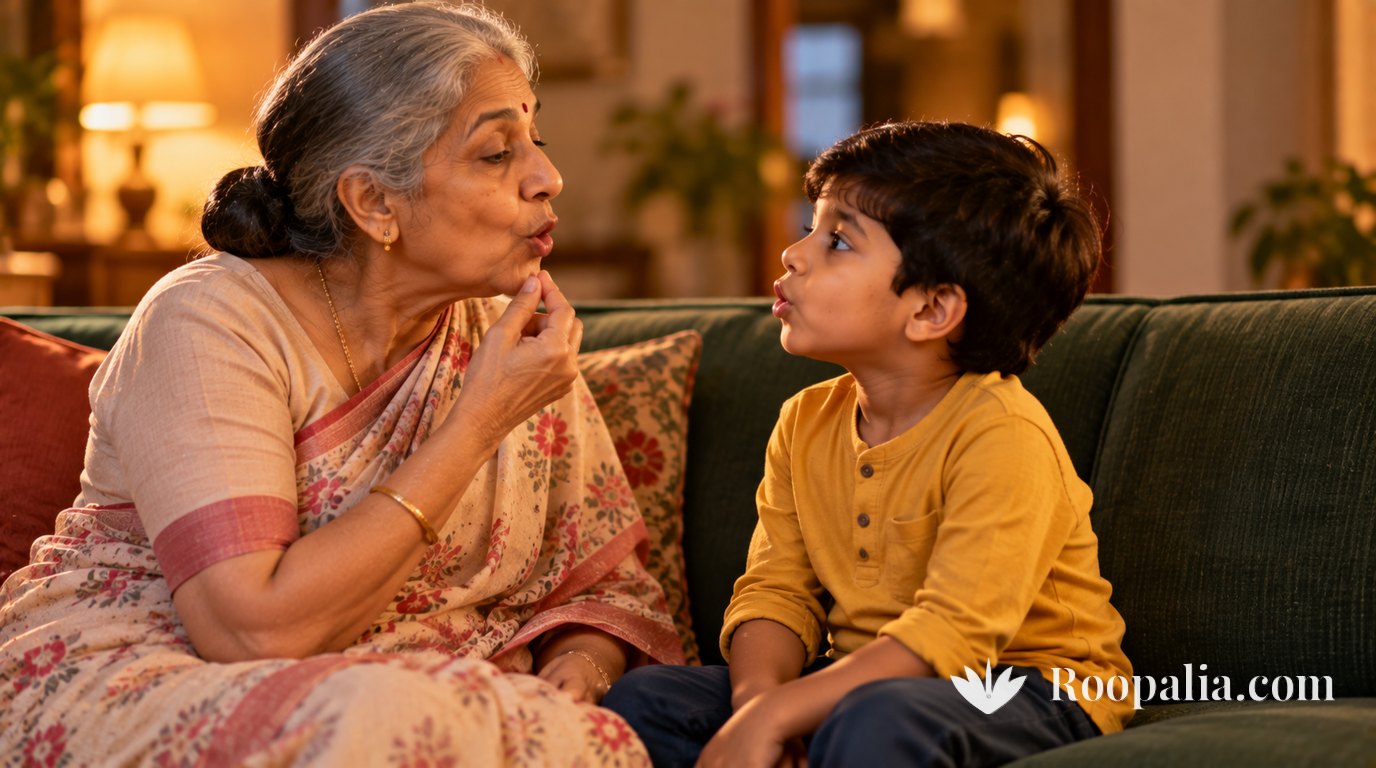
For the first week, do not show a single letter. Keep the notebook shut.
Instead, play with sounds. Say "k" — the sound, not the name of anything — and ask what words start with it. Kamra, kapda, kitab, kaan. Then another. Five minutes, no paper.
This feels like it cannot possibly count as teaching. It is in fact the oldest part of the syllabus. The first chapter of the Taittiriya Upanishad is called Shiksha Valli, and shiksha there does not mean education in general — it means phonetics, the science of sound and articulation, and it is the first of the six Vedangas.
Your child already knows the sound of क. What they have never done is hear it separately. That separation is the whole foundation.
Grandparents are better at this step than you are, and for a concrete reason: their pronunciation has not drifted. A parent raised outside India often lets English shade the edges — ड and ड़ start to sound alike. On a grandmother's tongue that difference is still alive. Put her on the call and let her do this part.
Varnamala: five at a time, and why those five
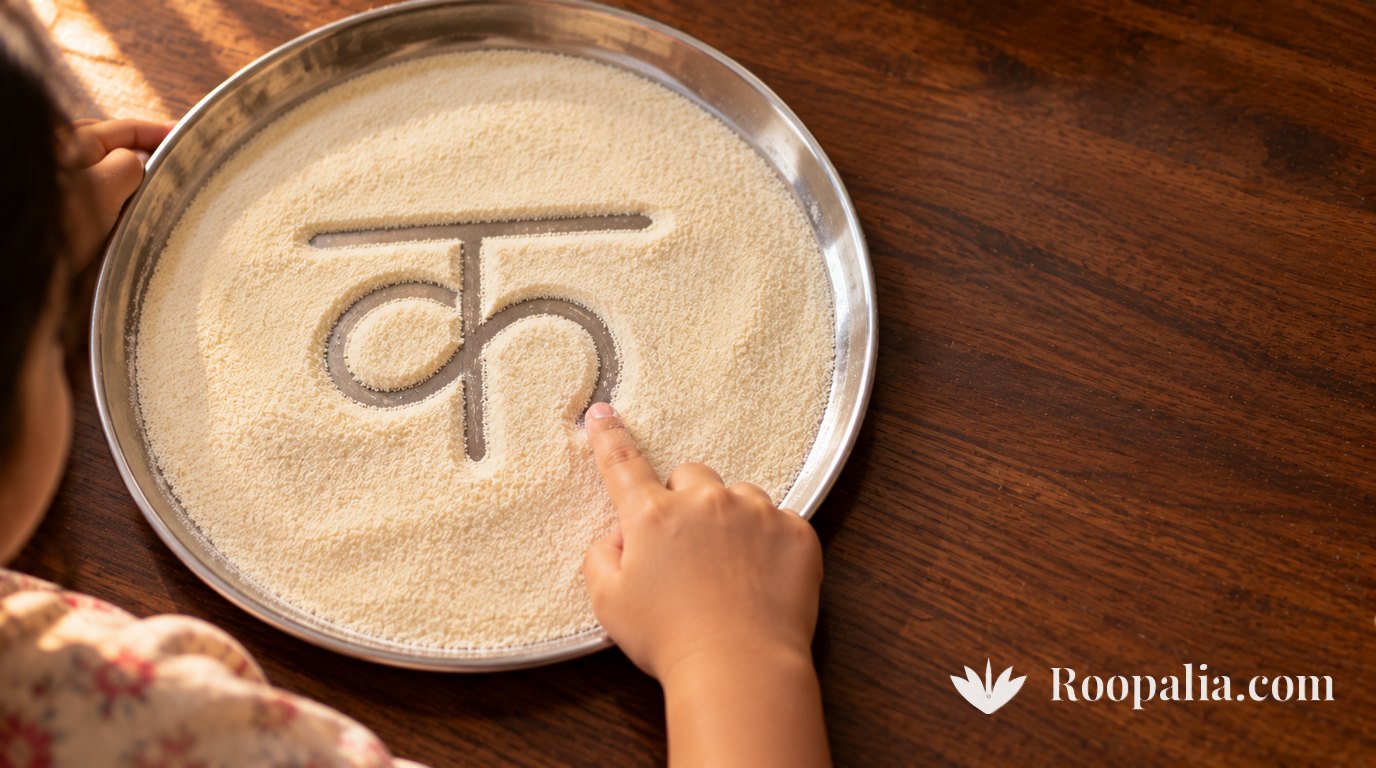
Now bring out letters — five of them. क ख ग घ ङ. Not fifty-two. Five.
Why these five together? Because the alphabet's order is not arbitrary, and this is the second thing worth telling your child. The classical phonetic texts classify every sound by its sthana — the place in the mouth where it is made. The Yajnavalkya Shiksha lists ten such places.
“According to the Yājñavalkya Śikṣā, there are ten places of articulation.”
— Shiksha Vedanga — classification by place of articulation
One honest note: the texts do not agree on every detail — this one files the क group under jihvamuliya, the root of the tongue, where the commoner classification calls it kanthya. What they all share is the principle: every sound is sorted by where in the mouth it is produced, and the alphabet's order follows that sorting.
Ask your child to say क ख ग घ ङ slowly and notice where their tongue goes each time. The same place, five times. Then ask them where the logic is in A, B, C. There isn't one — it is an accident of history that everyone simply memorises.
For writing, keep the pencil away a while longer. Spread a thin layer of semolina on a steel thali and let them draw letters with a finger. Wrong shape? Shake the thali. No eraser, no torn page, no "do it again". A small child's hand tires fast, and crooked letters teach them they are bad at Hindi when in truth their fingers are simply not ready yet.
Matra: the wall, and the one fact that explains it
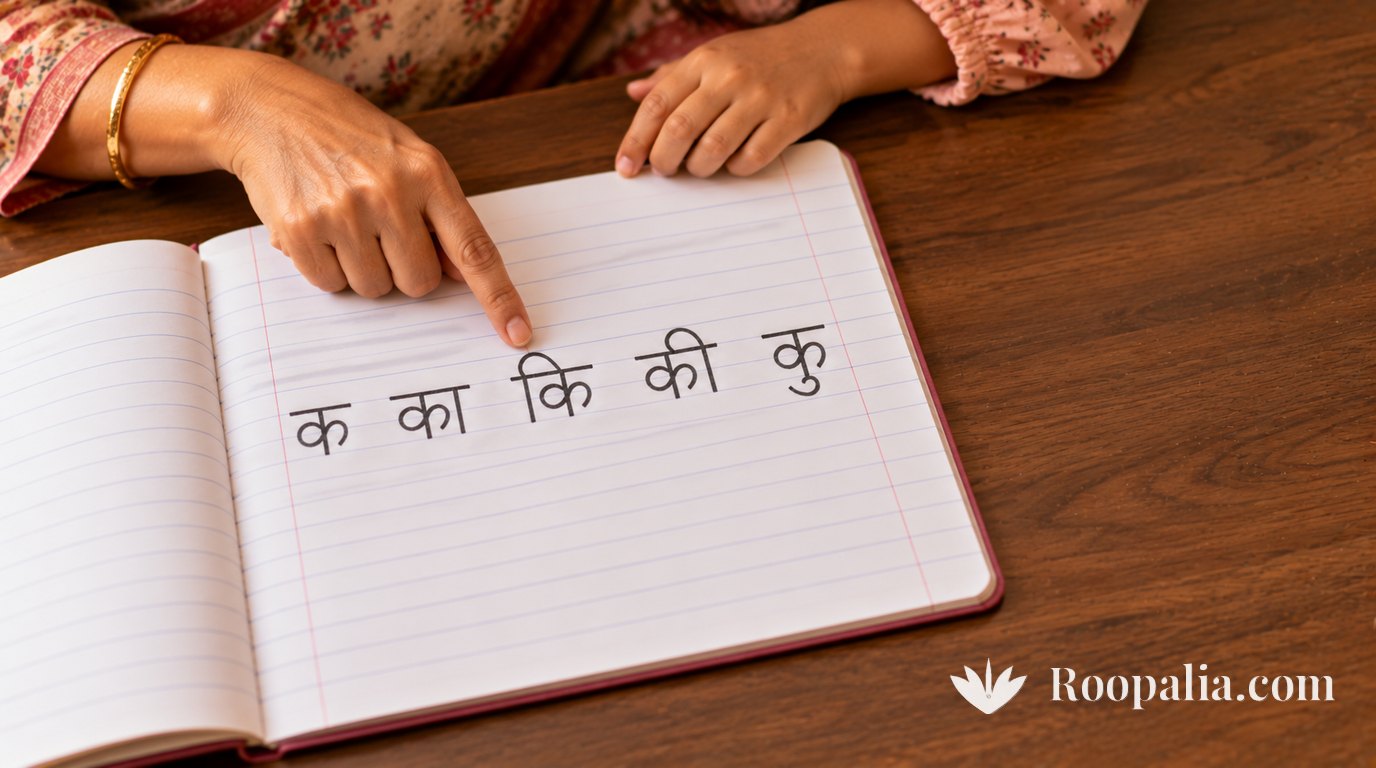
This is where nearly every child stalls, and it has one precise cause.
In कि, the vowel mark is written before the consonant but spoken after it.
Your child reads left to right, so their brain assembles "i-k" while their mouth is supposed to say "ki". That single mismatch is behind most matra errors.
So change the order you teach them in. Books present the matras as आ इ ई उ ऊ. For teaching, that is the hardest possible order, because the two that face opposite ways arrive second and third, before the child has any footing.
Use this order instead:
- ा — a single upright stroke on the right. Easiest by a distance. क becomes का
- े and ै — above the letter, easy to see
- ो and ौ — above and to the right
- ु and ू — hanging below
- ि and ी — last of all, and both on the same day
Teach that last pair together, never apart. The only difference between them is direction, and a difference of direction is invisible unless the two are side by side.
There is also something quietly satisfying here. The word matra is not a modern school term — it is in the Upanishad itself, in the passage that sets out what phonetics covers:
ॐ शीक्षां व्याख्यास्यामः । वर्णः स्वरः । मात्रा बलम् । साम सन्तानः ।
“Om! We shall treat of the phonetics: sound, rhythm, quantity, strength, modulation, union.”
— Taittiriya Upanishad 1.2
A caveat worth stating plainly. Matra there means the quantity of a vowel — how long the sound is held, short or long — not the written mark. But the two are measuring the same thing: कि is the short one and की is the long one. The mark on the page records a difference the tradition was already counting three thousand years ago.
Barakhadi: multiplication, not memorisation
Barah means twelve, and that is all barakhadi is — twelve forms of one letter. क का कि की कु कू के कै को कौ कं कः.
Children panic at this because they assume it means hundreds of separate things to learn. It does not. It is multiplication. Ten letters and twelve matras give a child a hundred and twenty syllables, and they never learned a single one of them individually.
Show them rather than tell them. Write out one letter's full barakhadi. Then write only the first three of a second letter and ask what the remaining nine will be. They will tell you. And the moment they do, Hindi stops being a mountain.
This is usually the week a child reads their first word unaided. Stop and make something of that day.
Ten minutes, and someone to read it to

An hour once a week does nothing. Ten minutes a day does everything.
The tradition has a name for exactly this daily repetition — svadhyaya. In the Taittiriya Upanishad the phrase recurs after each of the householder's duties, over and over:
स्वाध्यायप्रवचने च ।
“While engaged in all these acts, one should pay special attention to the studying and the teaching of the Veda.”
— Taittiriya Upanishad 1.9
Notice that it comes after each duty rather than instead of it. Alongside everything else, every day — which is precisely what the ten-minute rule describes.
And do not let those ten minutes be a private chore. Once a week, have your child read two sentences aloud to a grandparent on a call. Two is enough. A reader needs a listener; without one, reading is just homework with extra steps.
Roman or Devanagari?
You will face this, so here is the split that works.
For messaging — let Roman go. If your child types "nani main aa raha hoon" to their grandmother, they are thinking in Hindi and talking in Hindi. Blocking that puts up one more wall for no gain.
For learning to read — no, and the reason is practical rather than sentimental: Hindi written in Roman has no agreed spelling. One person writes bacche, another bachche, another bachhe. You cannot learn to read in a script where one word has three spellings, and a child who never learns Devanagari will never open a Hindi book as long as they live.
So: Roman for messages, Devanagari for reading. The two run happily side by side.
Weekend class or home?
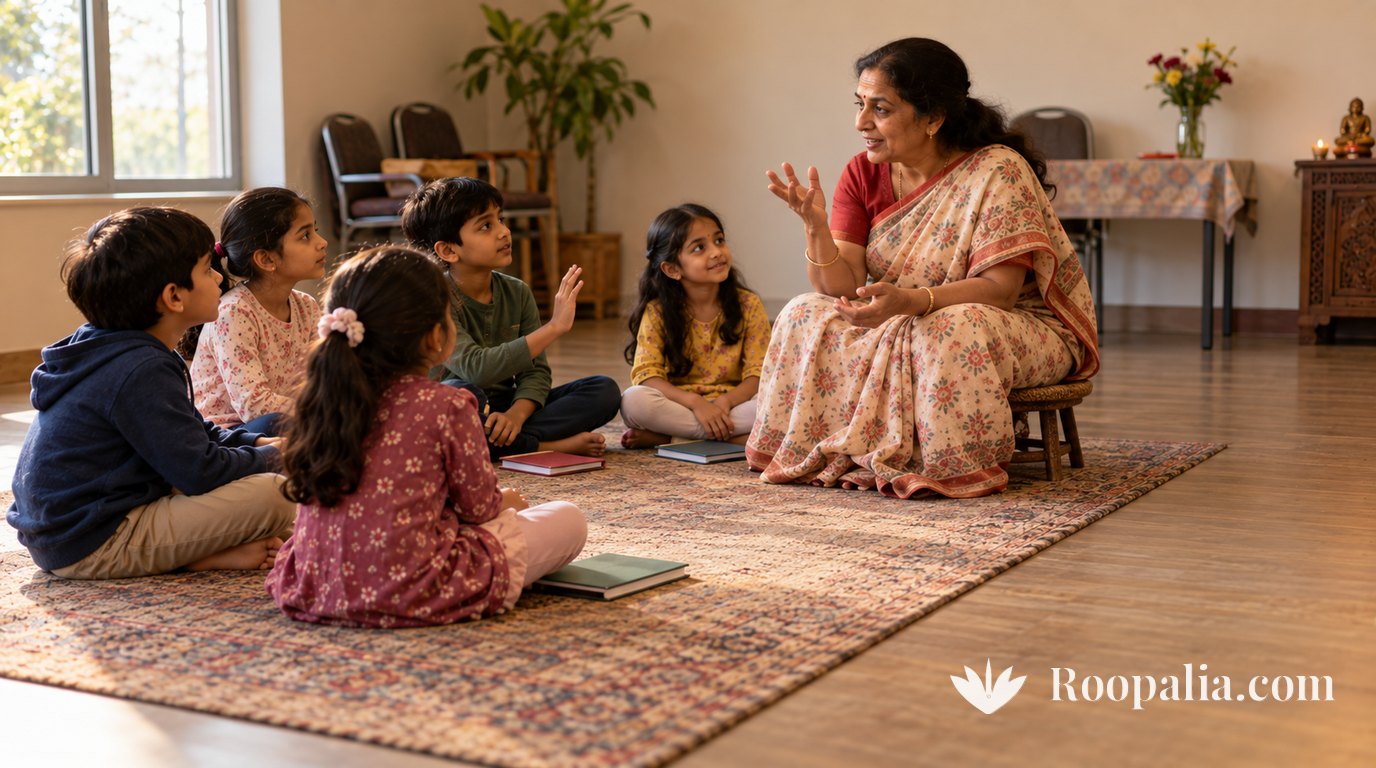
Both work, but they do different jobs, and it helps to be clear about which.
What a class gives is not teaching. It is company. Your child sits in a room and sees other children whose houses also sound like this. For an eight-year-old that recognition outweighs any lesson — the private suspicion that their family is the odd one simply dissolves.
But the script is learned at home, because ninety minutes once a week is not enough for any writing system on earth. A child who attends a class and does nothing in between finishes the year roughly where they started.
So if there is a class nearby, send them — send them for the company, and keep the ten minutes going anyway. And if there is nothing nearby, you have lost nothing. Every step in this article is a kitchen-table step.
The short version
Tell them first that this is easier than English, and mean it — क is always क.
Then sound before letters, five letters at a time, a finger in semolina before a pencil, and ि and ी last of all. Ten minutes a day, and once a week somebody on a screen who wants to hear it.
When the arms fold, make the task smaller rather than ending it — two words instead of a page. And when they read their first word without help, stop everything and tell them what they have just done.
How do I teach Hindi to my kids at home?
My child refuses to speak or learn Hindi. What do I do?
How do I teach Hindi matra to kids, and why do they mix up ि and ी?
How do I teach Hindi varnamala to kids?
Is Hindi harder than English for a child to read?
What is barakhadi and how do I teach it?
Should I teach my child my native language at all?
Should I let my child write Hindi in Roman letters?
Should I send my child to a weekend Hindi class?
At what age should a child start learning to read Hindi?
Sources and cautions: all three references here were opened on wisdomlib with the Sanskrit beside them and are linked in the article — Taittiriya Upanishad 1.2 (śikṣāṃ vyākhyāsyāmaḥ; varṇaḥ svaraḥ; mātrā balam; sāma santānaḥ), Taittiriya Upanishad 1.9 (svādhyāyapravacane ca), and the places of articulation in the Yajnavalkya Shiksha. Two caveats worth stating plainly. First, matra in the classical texts means the quantity of a vowel — how long the sound is held — not the written mark; the two record the same distinction but they are not the same thing, and this article does not claim they are. Second, the phonetic texts do not agree on every detail: the Yajnavalkya Shiksha files the क group under jihvamuliya where the commoner classification calls it kanthya; only the shared principle is used here. The search suggestions and results described are our own check and change with time, place and language. No app, book, class or product is named anywhere in this article, deliberately.