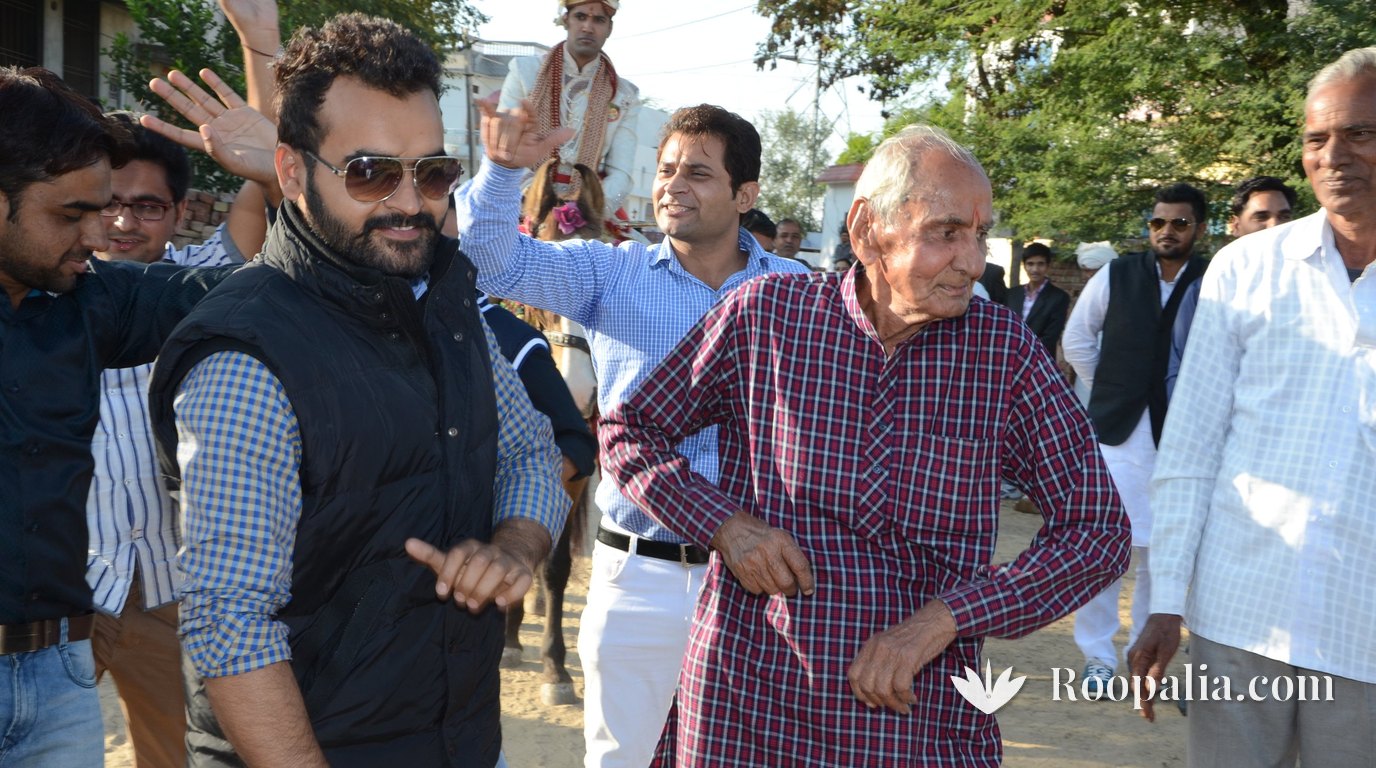
I have watched weddings in the villages of Rajasthan and Haryana my whole life, and the questions people ask today are the same ones guests have always asked, just typed into Google now: How long is an Indian wedding? What do I wear? Do I give a gift or cash? What is that bit where the father pours water? This guide answers them in the order you will actually see things happen.
First, the question on every guest’s calendar: how many days do I need to keep free?
How many days is an Indian wedding?
Most North Indian Hindu weddings today run for two to three days. Wikipedia’s article on the Hindu wedding puts it simply: they “can range from one day to multi-day events” (Hindu wedding, courtesy: Wikipedia). In the USA and Canada, families often fit everything into a long weekend.
| When | Event | What it is |
|---|---|---|
| Day 1, afternoon | Mehndi | Henna on the bride’s hands and feet; women of both families gather |
| Day 1, evening | Sangeet | Songs and dancing; often combined with the mehndi |
| Day 2, morning | Haldi | Turmeric paste applied to the bride and groom at their own homes |
| Day 2, evening | Baraat and varmala | The groom arrives in procession; bride and groom exchange garlands |
| Day 2, night | The ceremony (phere) | Kanyadaan, hathleva, pheras around the fire, sindoor |
| Next morning | Vidaai | The bride leaves her parents’ home |
The ceremony itself is timed to a muhurat, an auspicious hour chosen by the family priest, and in North India that hour often falls late at night. If your invitation says 11 pm, that is not a misprint.
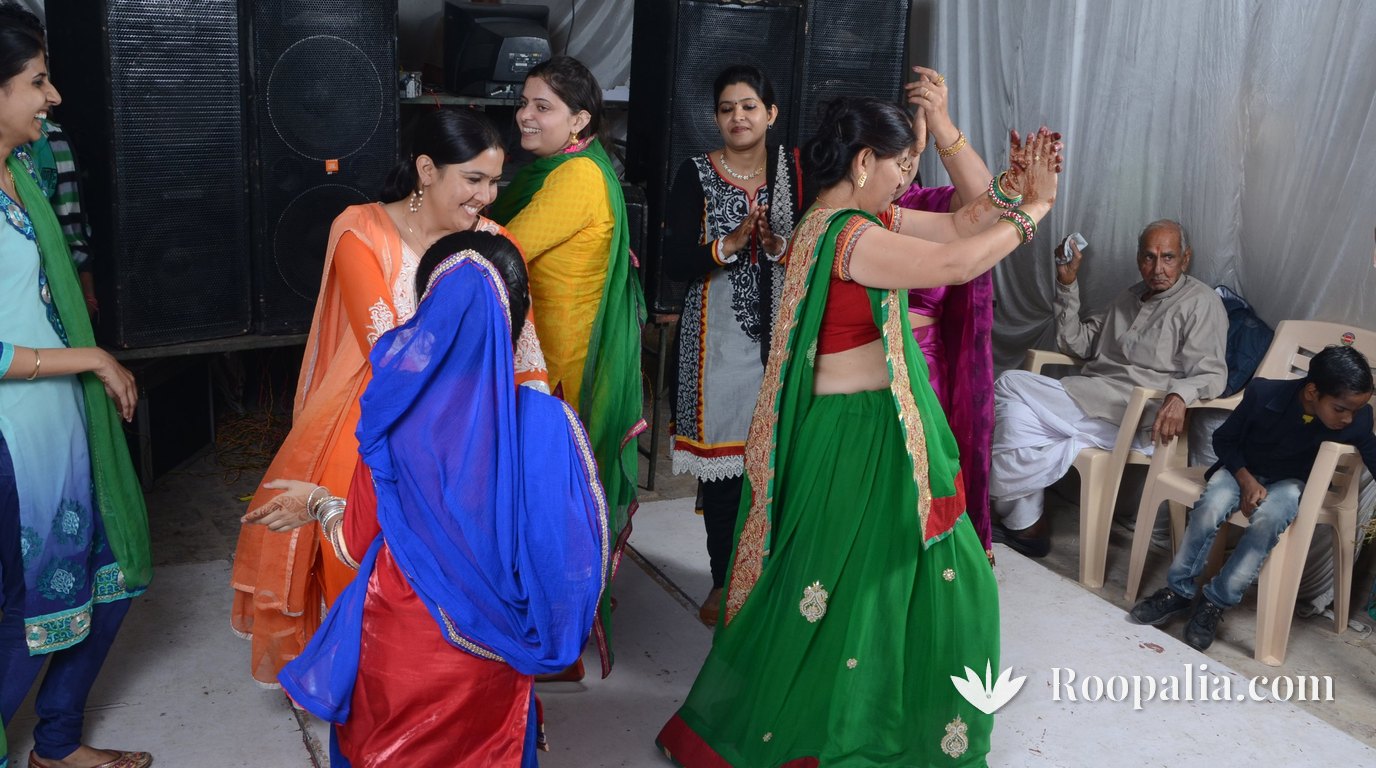
Mehndi and sangeet: the part where you are expected to dance
The mehndi is when the bride’s hands and feet are covered in henna. It takes hours, so the women around her sing, eat and talk. The sangeet is the music night. In the photo above, the women of the family have taken over the floor in front of the speakers, and only an elderly guest and a small boy are watching from the chairs.
- Can guests get mehndi? Usually yes. There is often a henna artist for guests once the bride is done. Leave it on for a few hours for a darker colour.
- Do I have to dance? No one will force you, but someone will try. One or two steps is enough to make the family happy.
- What to wear: bright colours. Yellow, green and pink are common at a mehndi.
Why henna before a wedding is such a big deal is a story of its own: why mehndi is applied before a wedding.
Then comes the loudest half-hour of the whole wedding, and it starts a long way from the venue.
What is a baraat?
A baraat is the groom’s wedding procession to the bride’s home or the wedding venue. Wikipedia defines it as “a groom’s wedding procession”, traditionally on a mare, led by drums, a band and dancing (Baraat, courtesy: Wikipedia). In Hindi you will hear the guests called baraati.
Look at the photo at the top of this page. The groom sits on a decorated mare, and in front of him his relatives dance down a sandy village lane. The oldest man in the procession, in a checked kurta, is dancing as hard as anyone. That is the spirit of a baraat: the groom’s whole family dancing him to his bride, at the speed of a slow walk.
- Can I join? If you are a guest of the groom’s side, yes. You walk with the procession and dance in front of the mare.
- How long? Anything from twenty minutes to two hours. Wear comfortable shoes.
- At the door: the bride’s family receives the groom’s family. Elders from both sides embrace in a ceremony Wikipedia calls the milni, “literally, meeting”.
Varmala: the exchange of garlands
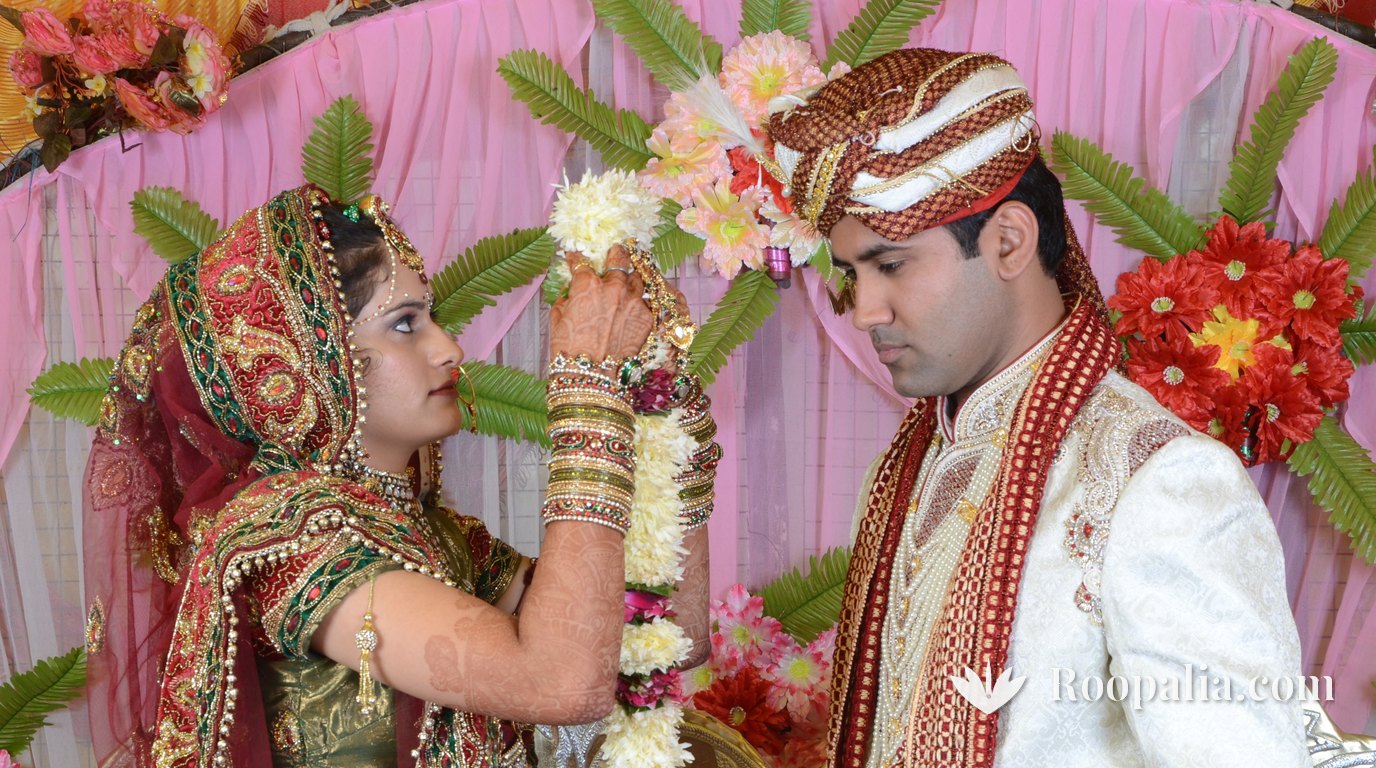
On a decorated stage, the bride and groom place flower garlands around each other’s necks. This is the varmala (also called jaimala), the first public sign that both have accepted each other. In the photo, the bride lifts a heavy garland of white flowers while the groom waits, eyes lowered.
You may see the groom’s friends lift him up so the bride cannot reach, and her friends do the same in return. It is all in fun, and the crowd loves it.
After the garlands, the mood changes. The music stops, the fire is lit, and the oldest part of the wedding begins.
Kanyadaan and hathleva: the moment the hands are joined
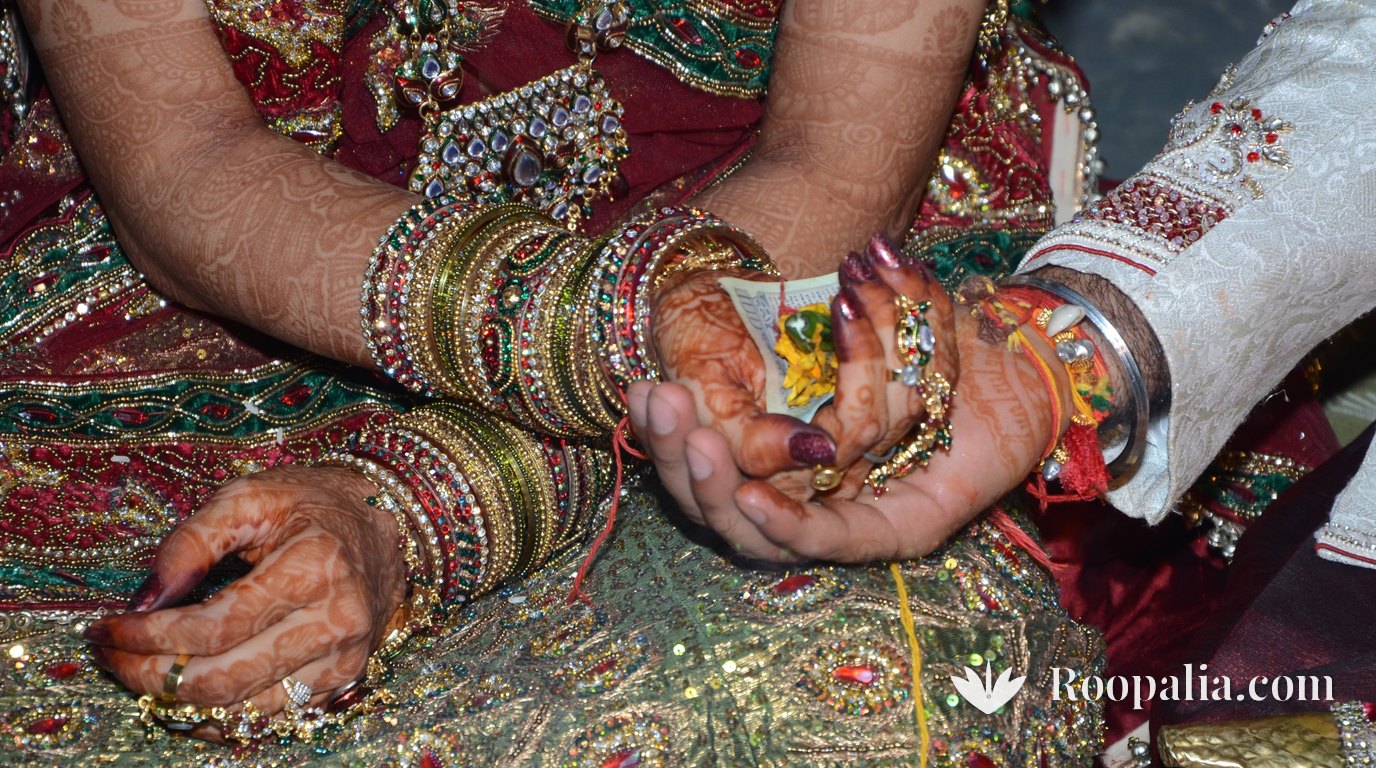
Kanyadaan, in English, means “the giving of the daughter”. The bride’s parents place her hand in the groom’s hand, and water is poured over their joined hands while the priest recites the vow. Wikipedia describes the ritual as symbolising “the transfer of responsibility and care from one family to another” (Kanyadana, courtesy: Wikipedia).
The idea is old. The Manusmriti (3.27) describes the ideal marriage as one in which the father invites a groom of learning and good character and gives his daughter to him “after having dressed and worshipped” her (tr. Ganganatha Jha, courtesy: wisdomlib.org).
In Rajasthan and Haryana, this moment is called hathleva, from “taking the hand”. The bride’s palm is coloured with henna or turmeric, and on it go a silver coin or cash, a dried turmeric root, rice, flowers and a blade of doob grass. The groom’s hand is joined to hers and the two are tied with a red cloth and sacred thread. In the photo above you can see exactly that: her hennaed hand in his palm, the flowers and the note between them. The Paraskara Grihya Sutra (1.6.3) gives the groom’s words as he takes her right hand: “I seize thy hand for the sake of happiness, that thou mayst live to old age with me, thy husband” (tr. Hermann Oldenberg, courtesy: wisdomlib.org).
Watch for the brother. In the same text (1.6.1), the bride’s brother pours fried grain into her joined hands, which she then offers to the fire. Many families still do this today. If you see a young man step up with a handful of puffed rice, that is the bride’s brother, playing a role that is written down in a text many centuries old.
If you read Hindi, our detailed Hindi article on kanyadaan, hathleva and maang bharai covers who can perform the kanyadaan when parents are not alive, and how the ritual has changed.
The pheras: seven rounds of the fire
The bride’s scarf is tied to the groom’s sash in a knot called the gathbandhan, and the couple walk around the sacred fire. In most of North India there are seven pheras, followed or accompanied by the saptapadi, seven steps taken together with a vow at each step. Under Section 7 of the Hindu Marriage Act, 1955, where the saptapadi is part of the rites, the marriage is complete and binding when the seventh step is taken.
For guests, this is the long, quiet part. The priest chants in Sanskrit, the family throws flower petals or rice at the end of each round, and it can take an hour or more. Our full explainer on the vows is here: The Seven Pheras Explained.
And then, a gesture that takes five seconds and changes how a woman is seen for the rest of her married life.
Sindoor: what the groom puts in the bride’s hair
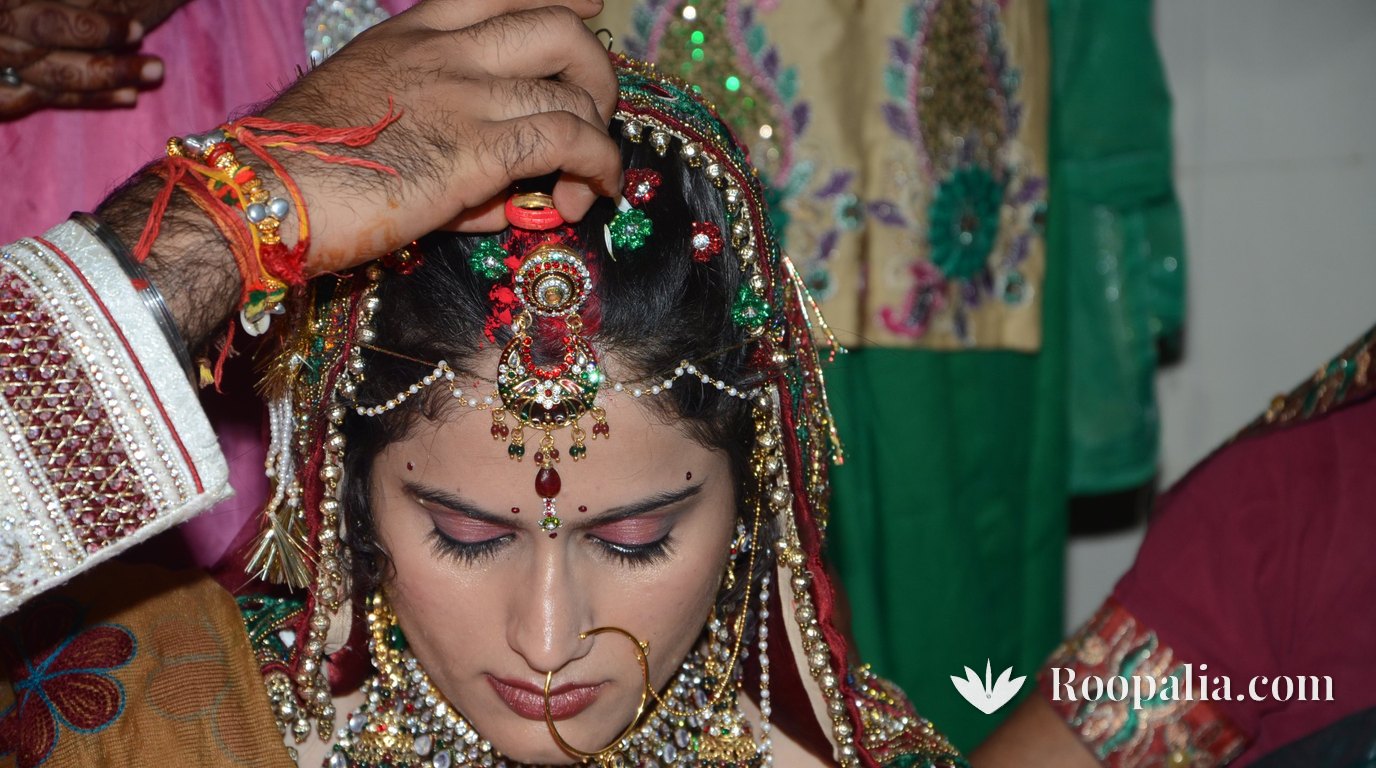
After the pheras, the groom fills the parting of the bride’s hair with red powder called sindoor. In Rajasthan and Haryana it is most often done with a gold or silver ring, sometimes with a coin, and in many families three times. This is called maang bharai or sindoor daan. In the photo you can see the ring between the groom’s fingers and the fresh red line in her parting. For many families, this is the moment a bride becomes a married woman.
Sindoor has its own history and a safety question attached to it: why sindoor is applied, and how to pick a safe one.
Vidaai: why everyone cries at the end
The vidaai is the bride’s farewell from her parents’ home, usually the next morning. She often throws a handful of rice back over her head as she leaves, and the mothers, aunts and sometimes the father break down. Guests are welcome to watch. You do not need to do anything, but this is not the moment for a selfie.
That is the wedding. Now the practical part: what to wear, what to give, and the small things a first-time guest usually learns the hard way.
What to expect at an Indian wedding as a guest: etiquette
- What to wear: bright colours. Many families avoid black and all-white, which are linked with mourning in many Hindu homes. Indian clothes are welcome on non-Indian guests; families usually take it as a compliment.
- Shoes: you will take them off near the mandap, the canopy where the fire burns. Wear shoes that are easy to slip off.
- Gift or cash: cash in an envelope, called shagun, is the most common gift. Many families give amounts ending in 1, such as 101, 251 or 501. People usually explain the extra one as a wish that the blessing never comes to an end.
- Food and drink: many weddings are fully vegetarian, and some have no alcohol. Do not ask for it at the bar if there is no bar.
- Timing: the baraat almost always starts late. The ceremony starts on time, because the muhurat does not wait.
- Phones: photos are welcome at most events, but put the phone down during the kanyadaan and the pheras unless the family has asked you to film.
Hosting an Indian wedding outside India
If it is your own family’s wedding in the USA, Canada or the UK, three things make life easier:
- Ask the venue about the fire well before the day. Many hotels and halls have smoke-alarm rules; a small havan kund and less ghee usually solves it.
- Print a one-page programme that explains each ritual in a line. Guests who understand what they are watching stay for the pheras instead of drifting to the bar.
- Turmeric root, rice and red thread for the hathleva are easy to find at Indian grocery stores. Any coin or note can stand in for the silver coin.
Every family does its wedding a little differently, and the priest and the elders will always have the last word. But if you know what a baraat is, why the father pours water and what the red line in the bride’s hair means, you will understand more of an Indian wedding than most of the guests standing next to you.
Frequently asked questions
How many days is an Indian wedding?
What happens at an Indian wedding ceremony?
What is kanyadaan meaning in English?
What is a baraat at an Indian wedding?
What should a guest wear to an Indian wedding?
How much money should I give at an Indian wedding?
Disclaimer & sources: Wikipedia (Hindu wedding, Baraat, Kanyadana); Manusmriti 3.27, tr. Ganganatha Jha; Paraskara Grihya Sutra 1.6.1 and 1.6.3, tr. Hermann Oldenberg (both courtesy: wisdomlib.org); Hindu Marriage Act, 1955, Section 7. The hathleva items, the use of a ring for sindoor and the guest customs are from the experience of families in Rajasthan and Haryana. This article is published for educational purposes only. Customs differ by region and family, so follow your hosts and their priest.
Photos credited 'Photo: Dhanpat Singh' are real photographs; the other images are AI-generated illustrations to explain the topic.