
Type “dark circles” into a search bar and the suggestions tell you everything about how people feel: kaise hataye, 2 din mein, hamesha ke liye, permanently. Most of the answers that come back are lists — potato, cucumber, almond oil, tea bags — with a confident promise attached.
This guide does something different. It starts with the cause most lists skip, then sorts every popular remedy into works, helps a little, or no evidence found.
The most useful fact I found came not from a beauty blog but from a dermatology clinic in Gujarat. Half of its patients with dark circles had something a cucumber cannot fix.
What deficiency causes dark circles?
Iron deficiency (anaemia) has the strongest link. In a study of 200 patients with dark circles at dermatology departments in Rajkot and Surendranagar, published in the Indian Journal of Dermatology, 50% were anaemic on blood testing, and several improved after their anaemia was corrected (Sheth, Shah and Dave, courtesy: PMC). Wikipedia also lists iron and vitamin B12 deficiency as believed contributors (courtesy: Wikipedia, Periorbital dark circles). I did not find reliable evidence that vitamin K or vitamin D deficiency causes dark circles.
The NHS lists the common signs of iron deficiency as tiredness, shortness of breath, palpitations, paler skin and headaches, and notes that heavy periods and pregnancy are very common causes (courtesy: NHS). If any of that sounds familiar, the first “home remedy” is a blood test.

- Iron-rich foods (NHS): dark-green leafy vegetables, pulses, dried fruit such as raisins and apricots, and fortified cereals.
- What reduces absorption (NHS): large amounts of tea, coffee, milk and dairy, and wholegrain cereals — so watch the habit of tea with meals.
- Do not self-prescribe iron tablets. Get tested, follow the doctor’s advice, and keep supplements away from children.
Which home remedies for dark circles actually work?
| Remedy | Verdict | Why |
|---|---|---|
| Cold compress (chilled spoons, cold cloth) | ✅ Works | Shrinks dilated vessels and eases swelling — Cleveland Clinic |
| Sleep, head raised on an extra pillow | ✅ Works | Less fluid pooling overnight — Cleveland Clinic |
| Sunscreen and sunglasses | ✅ Essential | Sun increases melanin around the eyes — Cleveland Clinic, Wikipedia |
| Cold tea bags | ✅ Helps a little | Cold plus caffeine, a vasoconstrictor — Cleveland Clinic, Wikipedia |
| Cucumber slices | ✅ Helps a little | Cooling and hydrating — on Cleveland Clinic’s list; no evidence of lightening pigment found |
| Potato | ❓ No evidence found | A cold slice cools; no published study found for “bleaching” |
| Almond oil | ❓ No evidence found | Moisturises dry skin; no lightening study found |
| Aloe vera gel | ❓ Moisture only | Some people react — patch-test first |
| Lemon, baking soda, toothpaste | ❌ Avoid | Irritates the thinnest skin on the face; can darken it |
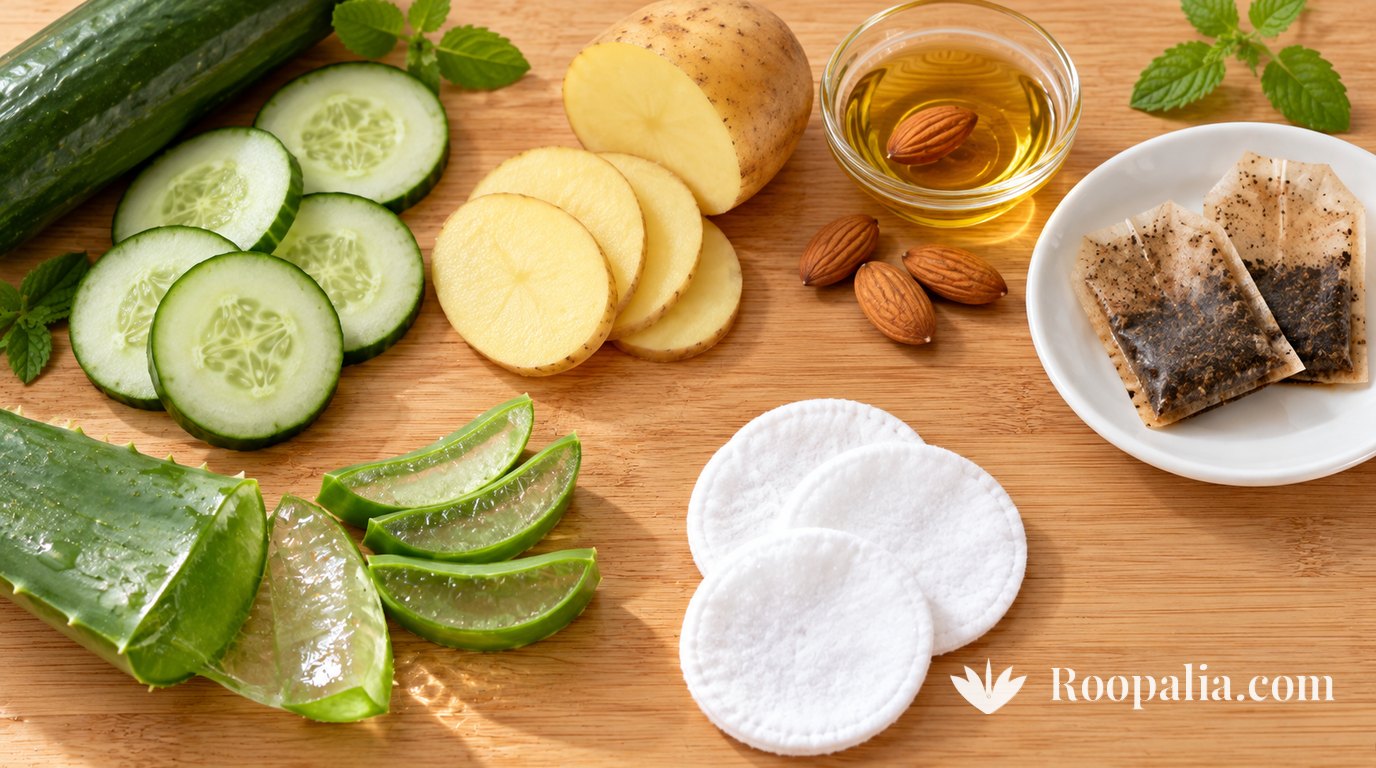
How to do a cold compress
- Chill two or three steel spoons in iced water for about ten minutes, or soak a clean cotton cloth in cold water and wring it out.
- With eyes closed, rest the back of a spoon gently under each eye; swap for a fresh spoon as it warms.
- Five to ten minutes is enough. Never rub ice directly on the skin.

Potato, cucumber and almond oil — what to expect
Potato: a cold slice or a little juice on cotton feels soothing and can make puffy circles look lighter for a while — mainly because it is cold. The popular claim that potato “bleaches” dark circles has no published study behind it that I could find. It rarely does harm; keep it out of the eyes and rinse if it stings.
Cucumber: Cleveland Clinic includes cucumber slices among simple home measures, crediting their water and vitamin C content. In practice, chilled slices work as a gentle cold compress. Expect relief from puffiness, not a change in pigment.
Almond oil overnight: it softens dry under-eye skin, which can make the area look less dull. I found no study showing that it lightens dark circles. Use a drop, pat it on with the ring finger, and keep it away from the eye itself.
Before you try anything, check which kind of dark circle you actually have — because the answer changes everything.
Dark circles vs eye bags vs puffy eyes
| Type | How it looks | What helps |
|---|---|---|
| Pigment | Brown to dark; worse with sun; often runs in families | Sun protection, no rubbing; a dermatologist for stubborn cases |
| Vascular | Bluish-purple; worse when tired | Sleep, cold compress, treating anaemia |
| Shadow (hollows) | A groove from bone structure or age that darkens under overhead light | Little effect from home remedies; specialist treatments |
| Puffy eyes / bags | Swelling, worst in the morning | Head raised, cold compress, less salt |
Most people have more than one type at once. If the swelling or darkness affects only one eye, Cleveland Clinic advises calling a healthcare provider.

Dark circles on brown and Indian skin
In darker skin tones, pigment-type circles are common and they often run in families. In the Gujarat study, 63% of patients had a family history, and the largest single type was “constitutional” — present from early life and linked to heredity (51.5%). Because sun drives melanin, daily sun protection matters more than any kitchen remedy. Rubbing makes it worse too: a third of the patients had atopy, the allergic tendency that makes eyes itch.


Can dark circles be removed permanently?
Cleveland Clinic states plainly that dark circles cannot always be prevented. When the cause is lack of sleep, allergy, sun or anaemia, fixing the cause can lighten them a great deal. Hereditary circles and age-related hollows do not disappear with home remedies; a dermatologist’s options — prescription creams, chemical peels, laser or fillers — can lighten them. For genetic circles, the realistic goal is to keep them from deepening, not to erase them. And there is no evidence for “2 days”.
Avoid: hydroquinone creams without a prescription — Wikipedia notes that its use for skin whitening is banned in European countries and that the US FDA withdrew approval for over-the-counter products in 2006 — along with lemon, baking soda and bleach near the eyes. Rub kajal and surma off gently; on lead in kohl, see our guide to bridal makeup and kajal safety. For pigmentation elsewhere on the face, see dark spots and melasma, and on why lemon is risky, lemon juice on the face.
When to see a doctor
- Dark circles with tiredness, weakness, breathlessness or pale skin — get a blood test.
- Darkness or swelling under only one eye.
- Marked or persistent swelling.
- Itchy, watery or red eyes — treat the allergy.
- No change after a few weeks of sleep, sun protection and cold compresses — see a dermatologist.

Living outside India: winter, jet lag and diet
- Dry indoor heat: radiators dry the skin; pat a plain, fragrance-free moisturiser under the eyes with the ring finger.
- Jet lag and shifts: long-haul flights and night shifts disrupt sleep — reset to the new time zone as quickly as you can.
- Vegetarian diets: keep greens, dal, rajma, chana and dried fruit on the plate, and ask your doctor for a blood test if you feel run down.
- Winter sun: sunlight on snow is strong — sunglasses are useful in winter too.

The Indian study in detail
Sheth, Shah and Dave examined 200 new skin-clinic patients aged 16 to 45 in Rajkot and Surendranagar, Gujarat. Their findings: 81% were women, housewives were the largest group (45.5%), and the 16–25 age group was the most affected. 50% were anaemic, 63% had a family history, 71% reported stress, 40% reported inadequate sleep and 33% had atopy. By type, 51.5% were constitutional, 22.5% post-inflammatory and about 8% vascular. The authors concluded that the condition is “multi-factorial”. It is one centre and 200 patients, not a national figure — but it is far closer to an Indian woman’s reality than most lists online.
What I found and what I did not
| Claim | Result |
|---|---|
| Anaemia is common in Indian patients with dark circles | Found — 50% (Indian J Dermatol) |
| Dark circles run in families | Found — 63% |
| Cold compress, cucumber, tea bags, sleep, raised head, sunscreen | Found — Cleveland Clinic |
| Iron and B12 deficiency | Found — “believed to contribute” (Wikipedia) |
| Potato lightens dark circles | No published study found |
| Almond oil lightens dark circles | No study found |
| Vitamin K or D deficiency causes them | No reliable study found |
| Gone in 2 days, or permanently, at home | No evidence found |
The bottom line: dark circles usually have more than one cause, and in Indian women iron deficiency is a frequent partner — so get a blood test before you reach for the potato. Day to day, do what genuinely works: sleep, a cold compress, a raised head, sun protection and no rubbing. Cucumber and tea bags soothe; potato and almond oil are harmless but unproven.
Disclaimer: This article is for general information, checked against published medical and research sources. Everyone’s skin and body are different — patch-test any remedy first, and see a doctor if the problem persists. All images in this article are AI-generated as examples for illustration only; they do not show real people, places or events. It is not medical, legal or astrological advice.
Frequently asked questions
What deficiency causes dark circles under the eyes?
What home remedies for dark circles actually work?
Does potato really work for dark circles?
Is cucumber good for dark circles?
Can I apply almond oil under my eyes overnight?
What is the difference between dark circles and eye bags?
Can dark circles be removed permanently?
Why are dark circles so common in Indian women?
Sources and cautions: sources consulted — Sheth PB, Shah HA, Dave JN, “Periorbital Hyperpigmentation: A Study of its Prevalence, Common Causative Factors and its Association with Personal Habits and Other Disorders”, Indian Journal of Dermatology (courtesy: PMC); causes and home measures: Cleveland Clinic (Dark Circles Under The Eyes); causes, iron and B12, hydroquinone: Wikipedia (Periorbital dark circles); iron deficiency symptoms and foods: NHS (Iron deficiency anaemia). Three things should be said plainly. First, I found no published study showing that potato or almond oil lightens dark circles, that vitamin K or D deficiency causes them, or that they clear “in 2 days”; that is the result of a search, not a final verdict. Second, the Indian study covers 200 patients at one centre, not the whole country. Third, this article is not medical advice; take iron tablets or prescription creams only on a doctor’s advice. No brand or shop is recommended.