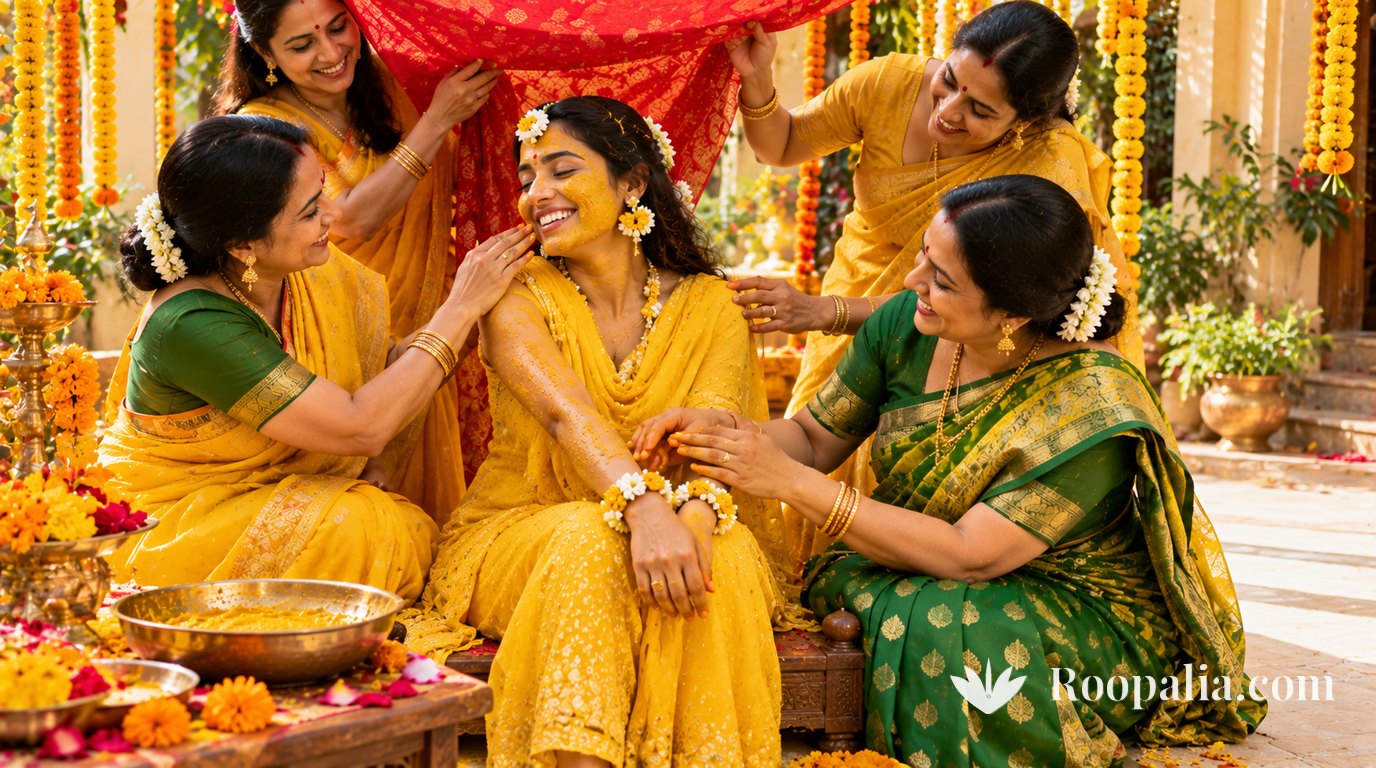
The night before an Indian wedding, the bride sits on a low wooden seat while the women of the family take turns smearing a bright yellow paste on her cheeks, arms and feet. Someone holds a red cloth above her head. Everyone ends up yellow. That paste is ubtan — and the same mixture of gram flour, turmeric and yoghurt is also the face mask grandmothers have been making in Indian kitchens for generations.
If you are planning a haldi in a rented apartment in Toronto or a semi in Leicester, or you simply want to know whether a turmeric face mask is worth it, you probably have three questions: what exactly goes into it, how is the ceremony done, and is turmeric actually good for skin?
I went looking for answers to all three. The recipe was easy. The ceremony was well documented. The third question turned up something most recipe pages leave out — and it changes how you should prepare.
The short answer: Ubtan (from the Sanskrit udvartana, “rubbing upwards”) is a thick paste of gram flour (besan), a little turmeric and yoghurt or milk, sometimes with oil, that is applied to the skin and rubbed off once it begins to dry, before a bath. At a haldi ceremony, married women of the family apply it to the bride or groom the day before the wedding. Turmeric can cause allergic contact dermatitis in some people, so patch test it first. I found no evidence that ubtan lightens skin, removes hair or removes a tan.
Ubtan meaning — what the word actually describes
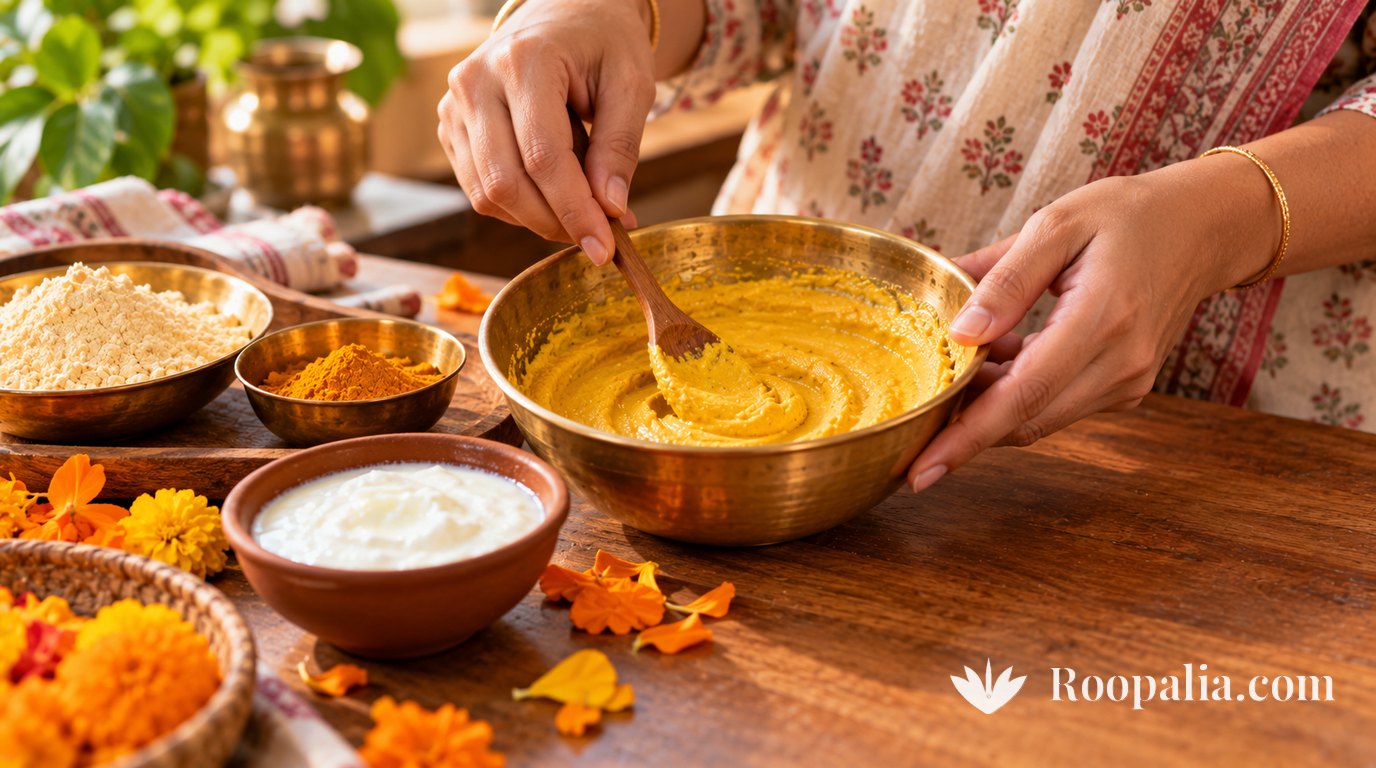
“Ubtan kya hota hai?” is one of the most common searches around the word, and the answer is simpler than the marketing suggests. Ubtan is a method as much as a recipe: a paste is spread on the skin and, as it starts to dry, rubbed off with the fingers so that it rolls away taking dirt and dead skin with it. Ayurveda calls this udvartana — massage with powders or pastes.
The ceremony that uses it goes by several names. Wikipedia’s article on Mayian (the Punjabi pre-wedding rite) lists Mayian, Vatna, Haldi and Ubtan, and notes that a similar ceremony in South India is called Pithi.
Haldi ceremony ubtan: ingredients, procedure and steps
Ingredients
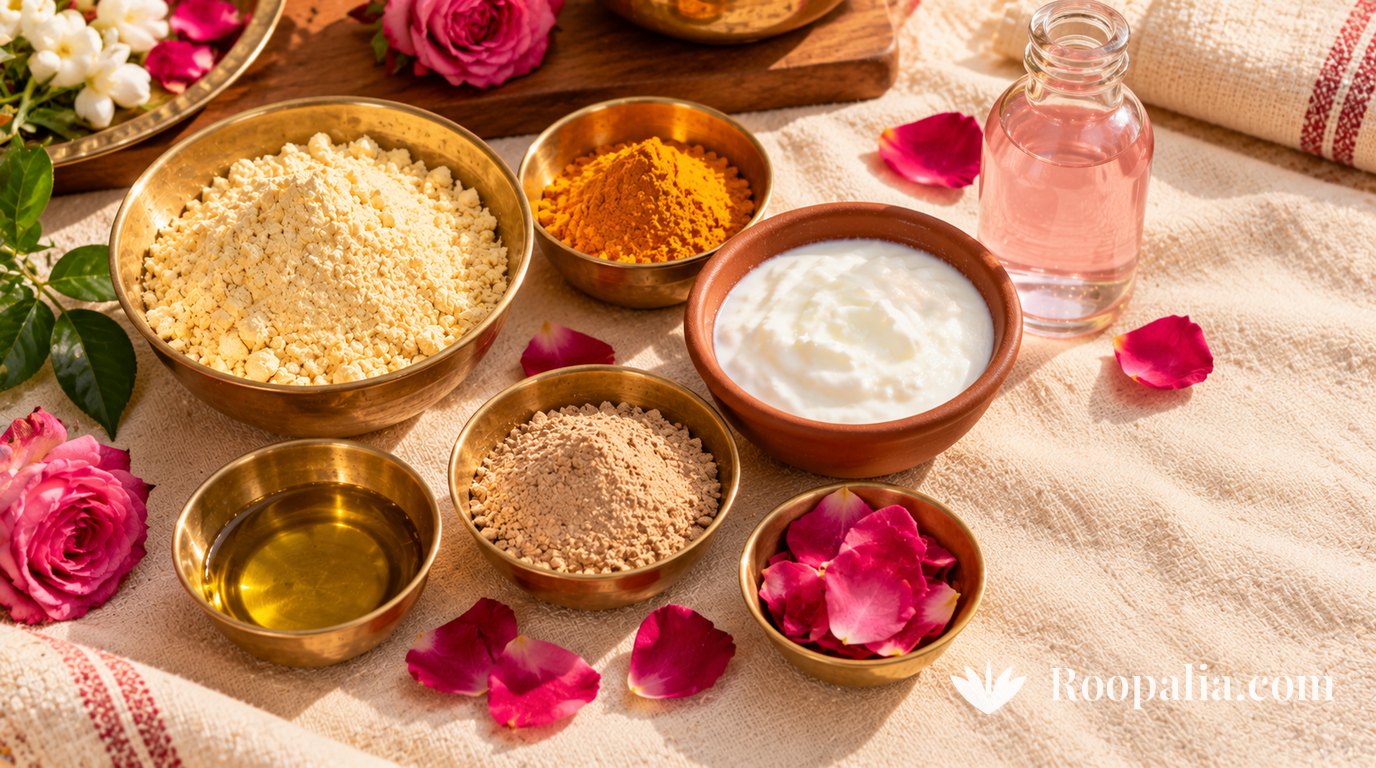
According to the Wikipedia Mayian article, the traditional ceremonial paste is turmeric, flour and mustard oil. Most families today use gram flour (besan) as the flour. A household proportion for one person — not a classical measure, just what is commonly used:
| Ingredient | Amount | Role |
|---|---|---|
| Gram flour (besan) | 2 tablespoons | The base; it rubs off as it dries |
| Turmeric | A pinch | The colour of the ceremony — more turmeric means more staining |
| Yoghurt or milk | Enough for a thick paste | Makes it smooth; many families use milk or cream for dry skin |
| Mustard oil (optional) | A few drops | Traditional in the Mayian paste; useful in cold, dry weather |
| Rose water (optional) | To thin | Fragrance and water, nothing more |
For a ceremony, multiply this and mix it in a large brass or steel bowl just before it starts. Fresh is better than made the night before.
Procedure — how the haldi ceremony is done
From Wikipedia’s description of Mayian, and what most families will recognise:
- When: traditionally the day before the wedding; many families now hold it a few days earlier.
- Who: the married women of the family, led by the mother, apply the paste.
- Where on the body: the face, arms and legs.
- The seat and the cloth: the bride sits on a low wooden seat (a patri), and a red cloth is held above her.
- Afterwards: the paste is rubbed off and the bride bathes. Mehndi usually follows — our guide to how long to leave henna on explains why mehndi is planned days before the wedding.
I also checked whether the haldi rite is prescribed in the Grihya Sutras, the ancient manuals of household rituals including marriage. In the marriage sections I looked at, I did not find it. Haldi is lokachar — family and regional custom — which is not a lesser thing. Ubtan is also counted among the sixteen adornments; the full list is in our solah shringar guide.
For why haldi and mehndi come before the wedding at all, read why mehndi is applied before a wedding; for the rite at the centre of the wedding itself, see the seven pheras explained.
A haldi ceremony abroad: carpets, sofas and cold weather
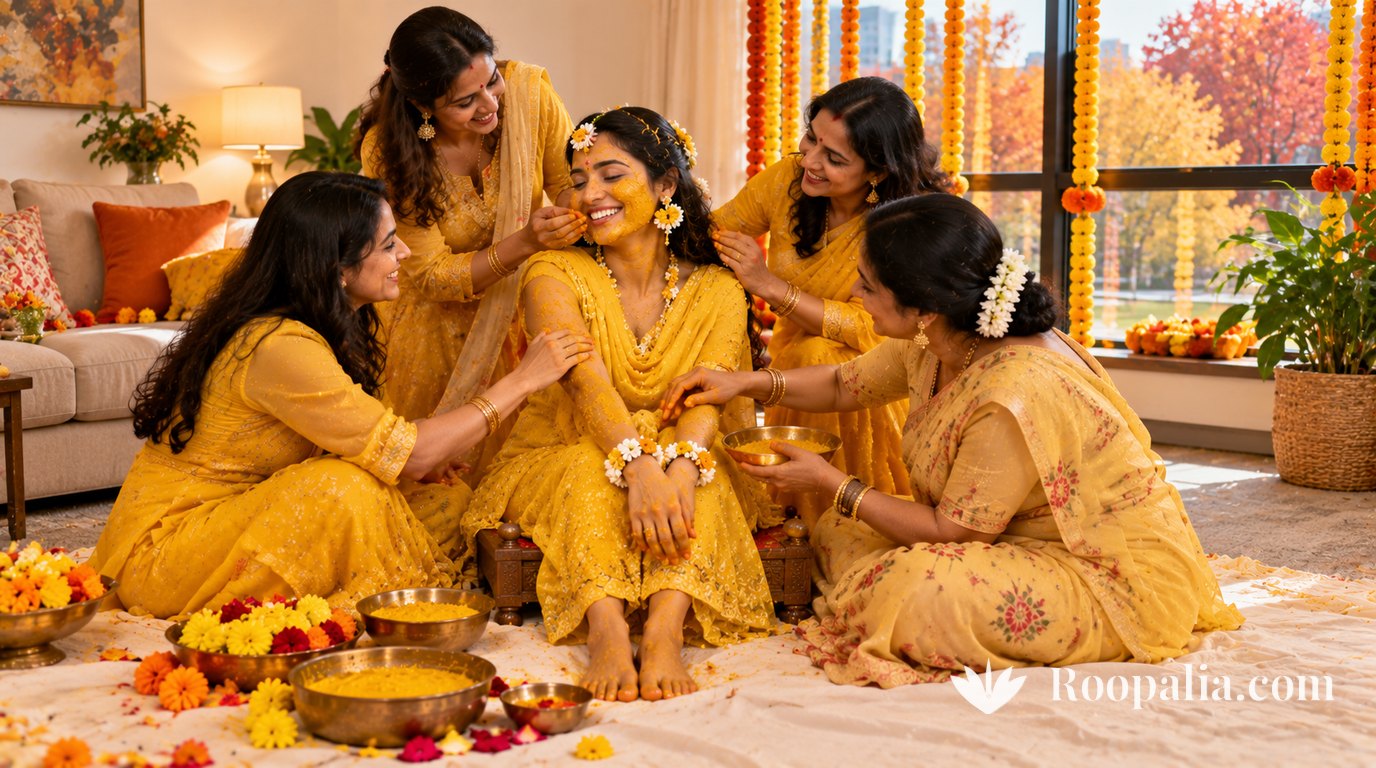
Outside India, the haldi rarely happens in a courtyard. It happens in a living room with a beige carpet, a light sofa and a white bathtub — and turmeric stains all of them. A medically reviewed Healthline article lists what turmeric can stain: skin, nails, porcelain such as sinks and bathtubs, countertops (especially marble) and dishes. A few practical steps:
- Protect the floor: a plastic sheet first, an old bedsheet on top. If you are renting, check your tenancy terms and choose a tiled kitchen or hall over a carpeted room.
- Keep the sofa out of reach. Turmeric-covered hands find it first.
- Rinse the tub immediately after the bride bathes, before the colour sets.
- Wear old clothes, or yellow ones you don’t mind staining.
- Ingredients: gram flour and turmeric are stocked by Indian grocery shops; yoghurt is in every supermarket.
- Heating dries skin. In a heated home in winter, follow the ubtan with a moisturiser. Our piece on why heels crack in winter covers dry indoor air in detail.
- Plan a patch test a few days before the ceremony — more on that below.
That patch test is not a formality. Here is what I found when I looked into turmeric on skin.
Is turmeric safe on skin? What the evidence says
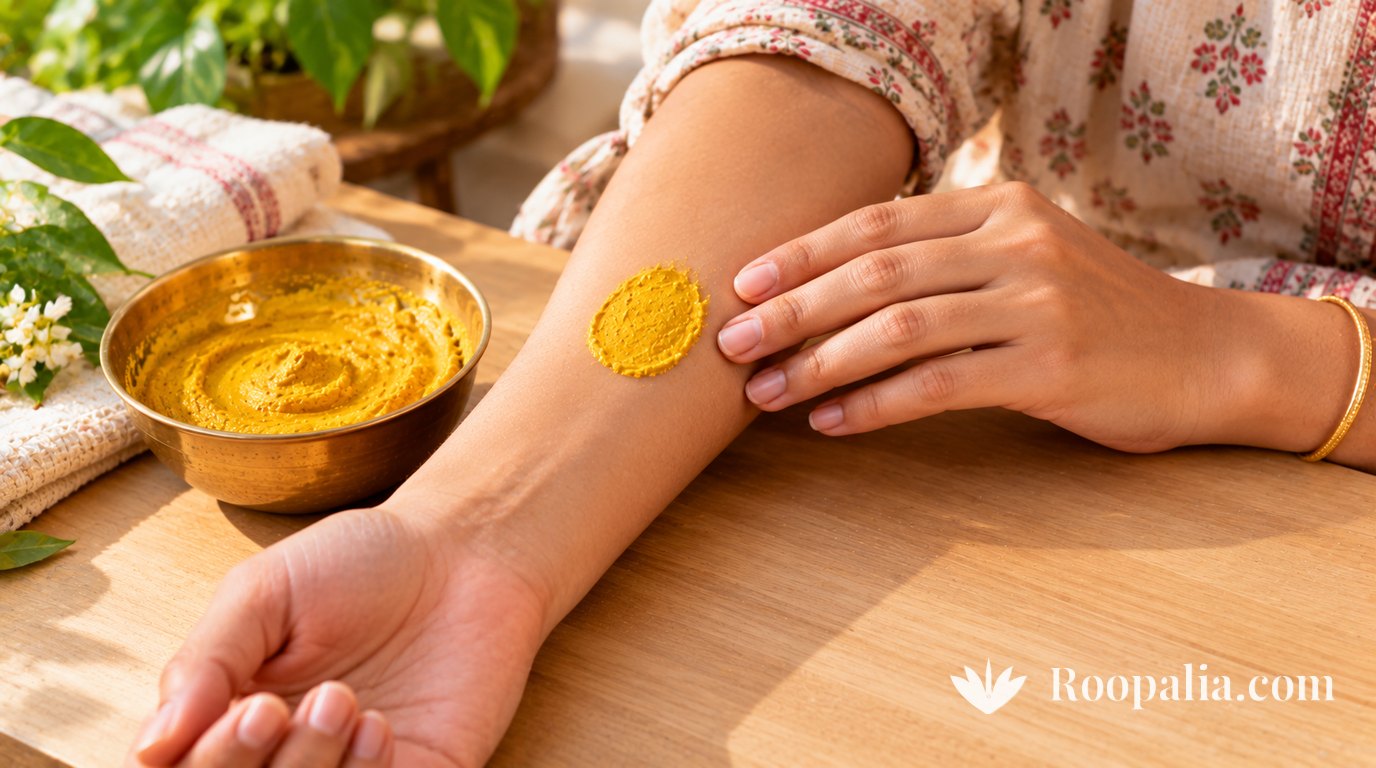
Turmeric feels like the safest thing in the kitchen. But the Healthline article on turmeric for acne, medically reviewed by Debra Rose Wilson, PhD, cites a 2015 review:
“11 separate studies demonstrate that the curcumin in turmeric is an allergen and can cause contact dermatitis.”
— Healthline, Turmeric for Acne, medically reviewed by Debra Rose Wilson, PhD (courtesy: Healthline)That review, “Curcumin: A Contact Allergen” by Chaudhari, Tam and Barr, was published in the Journal of Clinical and Aesthetic Dermatology. It does not mean turmeric harms most people. It means anyone can react, and it is easy to find out beforehand. Healthline’s method:
“Test for allergy by putting a dime size area of the product on your forearm. If you have no reaction in 24 hours, it’s unlikely you’ll have an allergic reaction.”
— Healthline (courtesy: Healthline)Use the exact mixture you plan to use — the same turmeric, the same oil. Redness, itching, burning or bumps within 24 hours mean that paste should not go on a face, least of all a bride’s on the morning of her wedding photographs.
Turmeric face mask: how to apply it and how long to leave it on
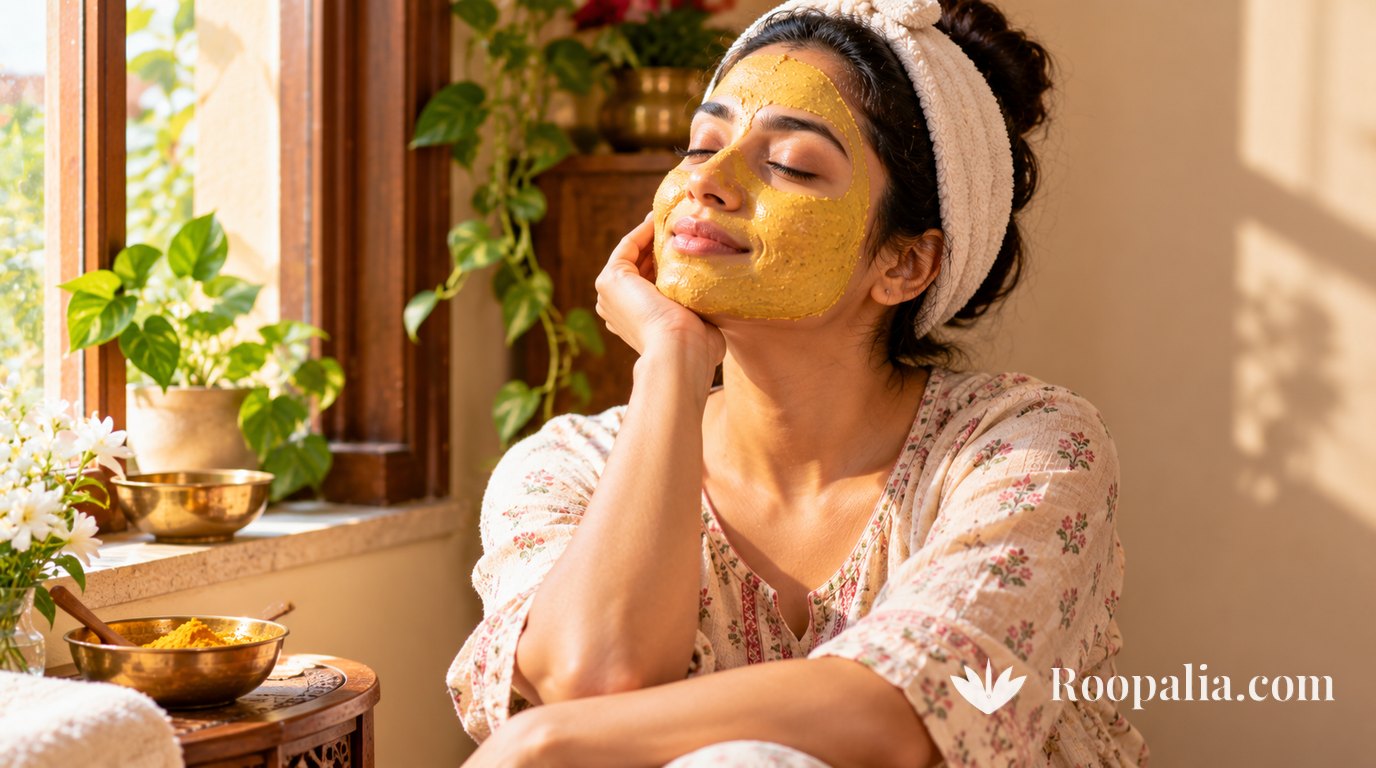
- Prepare: wash your face, tie your hair back, wear an old top.
- Apply a thin, even layer to the face and neck, avoiding the skin around the eyes and lips.
- How long to leave it on: I could not find a medical source that sets a time in minutes for an ubtan or turmeric mask. The household rule is to remove it when it starts to dry and you feel it tighten at the edges — not when it has set hard, because scrubbing off a fully dried paste roughens the skin.
- Remove it gently: with slightly damp fingers, rub in small circles so the paste rolls off. No pressure on the face.
- Rinse with lukewarm water and moisturise if your skin is dry.
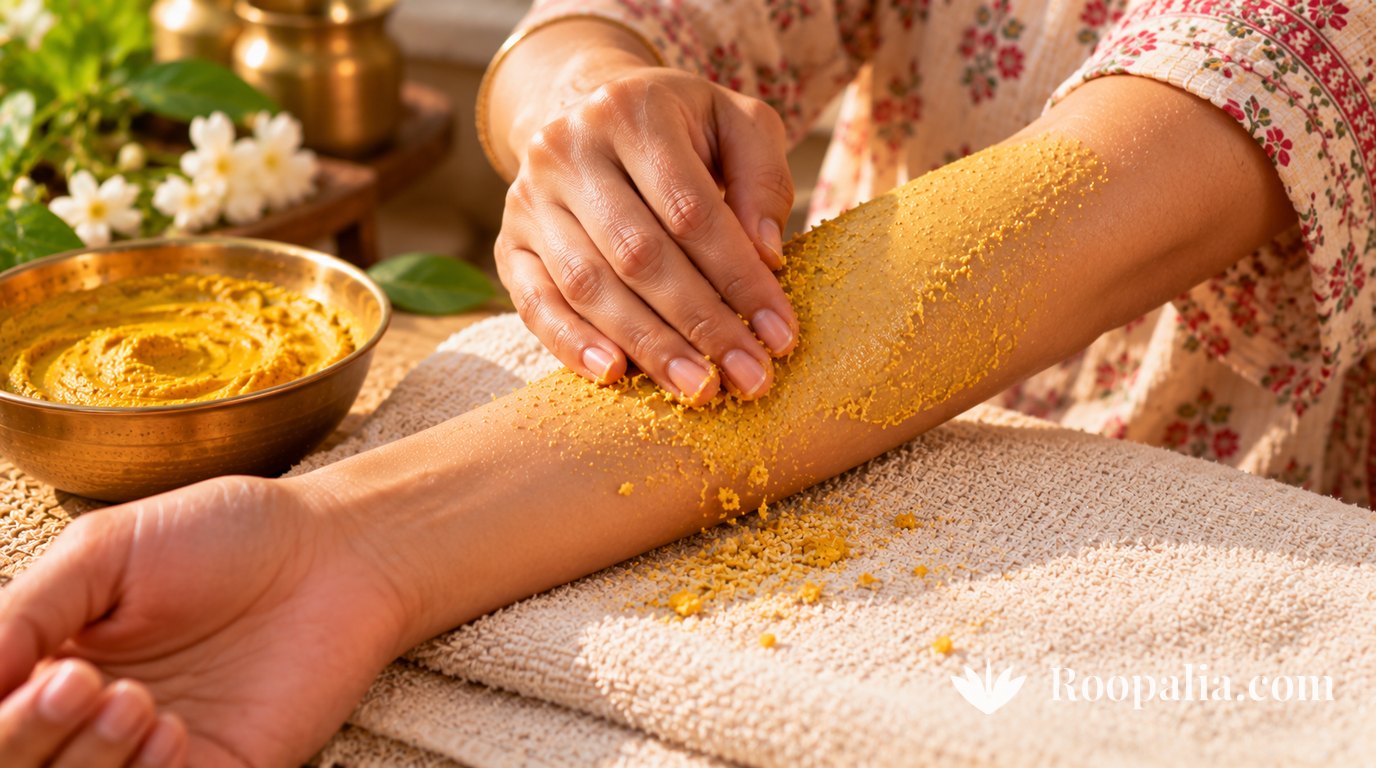
Can you use a turmeric face mask every day? I found no research on daily use. Given the contact dermatitis findings above, patch test first and watch how your skin responds before making it a habit. Even the Ayurvedic source I read lists very dry skin and eczema among the conditions where udvartana is avoided.
Turmeric for acne? Healthline says early evidence suggests turmeric and curcumin products may have benefits for skin health, which is not the same as a proven acne treatment. Rubbing a gritty paste over active, inflamed spots is not a good idea; our guide to why you get pimples covers what does help.
What the Ayurvedic texts say about ubtan
I wanted to know where the grandmother’s ubtan sits in the classical texts. I found it clearly in two places.
Ashtanga Hridaya, Sutrasthana 2.15 — Vagbhata includes udvartana in the daily routine (dinacharya). I found this verse worded the same on two separate pages:
उद्वर्तनं कफहरं मेदसः प्रविलायनम् ।
स्थिरीकरणमङ्गानां त्वक्प्रसादकरं परम् ॥
“Udvartana is a method of using medicated powders for massage. It helps to calm down aggravated Kapha, helps to dissolve fat, brings about stability to body parts and improves skin complexion.”
— Ashtanga Hridaya, Sutrasthana 2.15, tr. Dr. J. V. Hebbar (courtesy: easyayurveda.com)One word deserves care. Tvak-prasada means skin that is clear, clean and healthy-looking. The English translation uses “complexion”, but nothing in the verse is about making skin lighter.
Charaka Samhita, Sutrasthana 5.93 — Charaka lists the benefits of sharira-parimarjana, cleansing the body by rubbing:
“Applying herbal creams over the body eliminates bad smell, cures heaviness, drowsiness, itching and removes undesirable dirt and unpleasantness due to sweating.”
— Charaka Samhita, Sutrasthana 5.93, tr. Dr. J. V. Hebbar (courtesy: easyayurveda.com)The very next verse, 5.94, praises the bath — ubtan first, then the bath, the same order families still follow. I have not printed the Sanskrit of this verse, because the primary Charaka Samhita website did not load as far as verse 93 for me; the translation above is from a secondary source.
Ayurveda has its own cautions. Dr. Hebbar’s article on udvartana lists wounds, burns, eczema, excessively dry skin, the elderly, infants and pregnant women among those for whom it is avoided. Ayurveda is not modern clinical research, but the tradition itself does not claim ubtan is for everyone, always.
Ubtan for babies, facial hair and tanning — what I could not find
Searches for “ubtan for babies to remove hair”, “ubtan for facial hair removal” and “ubtan for tanning” are common. I looked for evidence for each:
- Removing body hair on babies: I found no medical source supporting this. The Ayurvedic source above itself advises against udvartana for infants. A baby’s skin is thin and easily abraded — ask your paediatrician before applying ubtan to a baby, especially one with eczema or dry skin. For scalp care after the first haircut, see our piece on the mundan ceremony.
- Facial hair removal: no expert source found.
- Tan removal and skin lightening: no evidence found. Rubbing off a paste removes dirt and dead skin, so skin can look cleaner and feel softer, but its colour does not change. Sun protection is what prevents a tan; our guide to dark spots and pigmentation goes further.
Getting turmeric stains off your skin
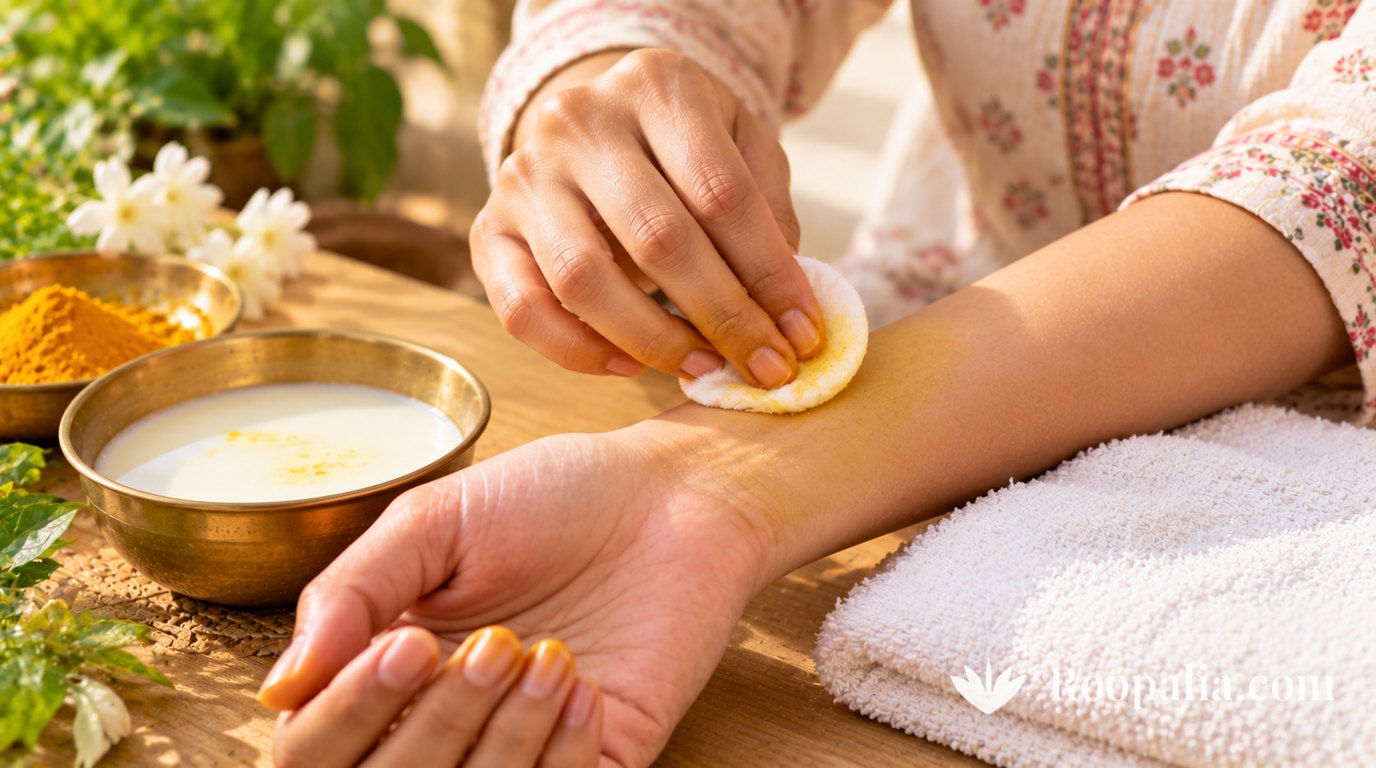
- The family method: a cotton pad soaked in milk or yoghurt, or a second gentle wash with the gram-flour paste. I have not read research on either; they are household methods.
- Don’t scrub hard. Red, raw skin is worse in photographs than a faint yellow tint, which fades with washing.
- Don’t use lemon. Lemon juice on skin can cause burns and dark marks after sun exposure — see lemon juice on the face: the evidence.
- Prevention is easiest: keep the turmeric to a pinch.
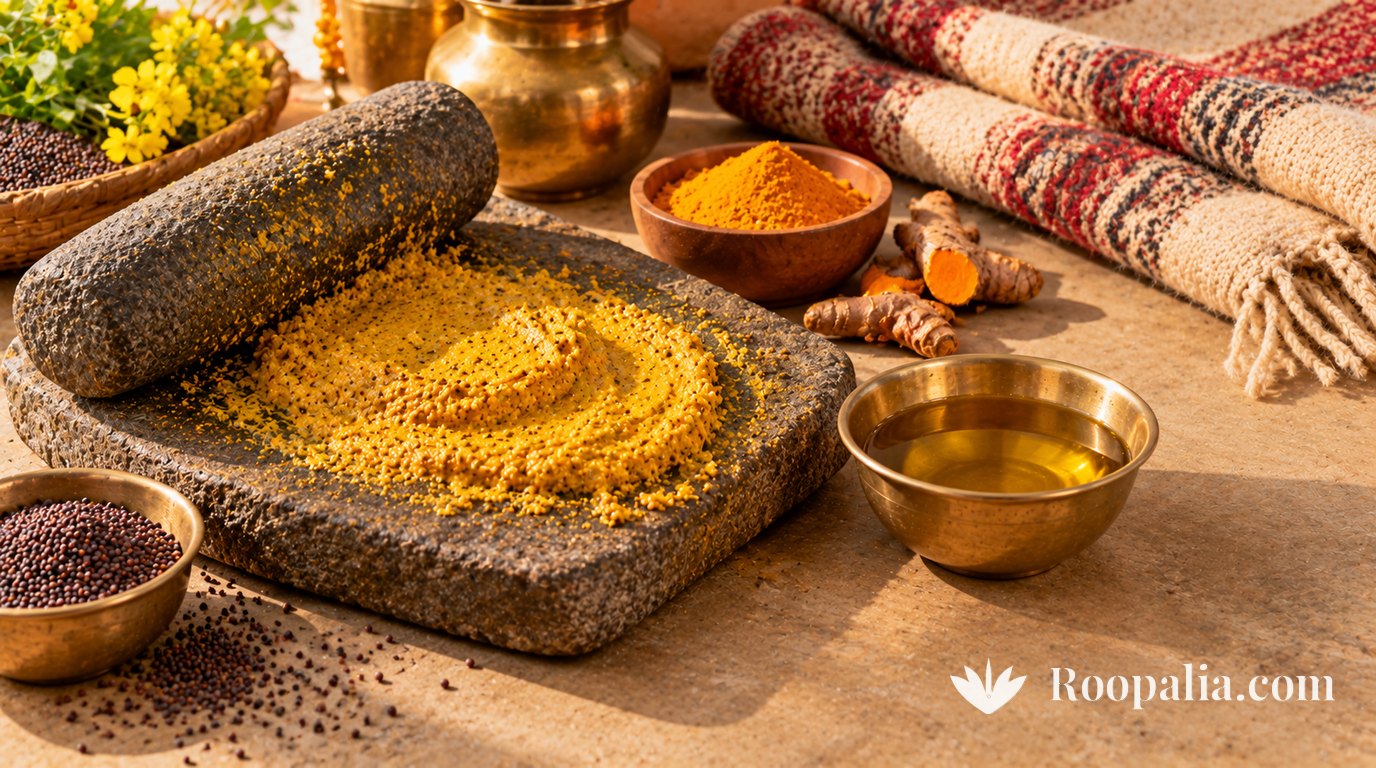
A note on mustard ubtan, the older version ground on a stone slab from yellow mustard seed and turmeric: I found no dermatology source on it. Mustard is pungent, so the patch test matters even more here.
What I found — and what I didn’t
| Question | Result |
|---|---|
| Can turmeric cause a skin allergy? | Found — 11 studies, JCAD review (via Healthline) |
| How to patch test | Found — coin-sized on the forearm, 24 hours (Healthline) |
| Ubtan in classical texts | Found — Ashtanga Hridaya 2.15; Charaka Samhita 5.93 (secondary translation) |
| How the haldi ceremony is done | Found — Wikipedia, Mayian |
| Haldi rite in a Grihya Sutra | Not found — family custom |
| How many minutes to leave it on | No fixed time found — remove as it starts to dry |
| Skin lightening / tan removal | No evidence found |
| Hair removal (face or baby) | No expert source found |
| Research on mustard ubtan | Not found |
“Not found” does not mean “does not exist”. It is the honest result of my search, not a final verdict.
The bottom line. Ubtan — gram flour, a pinch of turmeric, yoghurt — is a simple, old and lovely practice that both the Ashtanga Hridaya and the Charaka Samhita place in the daily routine. But turmeric is not safe for every skin: patch test for 24 hours, apply a thin layer, rub it off gently as it starts to dry, and moisturise afterwards.
Leave the promises of fairness, hair removal and tan removal aside. What ubtan really gives is the haldi morning itself — a mother’s hands, cousins laughing, and a ritual that has travelled from courtyards to apartment living rooms around the world. For the meaning behind another wedding custom, read what the texts say about the mangalsutra.
Frequently asked questions
What is ubtan?
What are the ingredients of haldi ceremony ubtan?
What is the procedure for a haldi ceremony?
How long should you leave a turmeric face mask on?
Can I use a turmeric face mask every day?
Is turmeric good for acne?
Does ubtan remove facial hair, baby hair or a tan?
How do you remove turmeric stains from skin?
Sources and cautions: the health information was opened and checked — a medically reviewed Healthline article (reviewer Debra Rose Wilson, PhD) on turmeric contact dermatitis, patch testing and staining, which cites the Journal of Clinical and Aesthetic Dermatology review “Curcumin: A Contact Allergen”. The ceremony is described from Wikipedia, Mayian. Texts: Ashtanga Hridaya, Sutrasthana 2.15 and Charaka Samhita, Sutrasthana 5.93, tr. Dr. J. V. Hebbar (courtesy: easyayurveda.com). Three things should be said plainly. First, the Charaka 5.93 translation is from a secondary source; the primary page did not load for me, so the Sanskrit is not printed. Second, I found no evidence that ubtan lightens skin, removes hair or removes a tan, no research on mustard ubtan or daily use, and no haldi rite in the Grihya Sutras I checked. Third, no brand is recommended, and this is not a substitute for medical advice — ask a doctor for babies, pregnancy, eczema or if you use any prescription skin treatment. “Not found” does not mean “does not exist”; it is an honest report of a search.