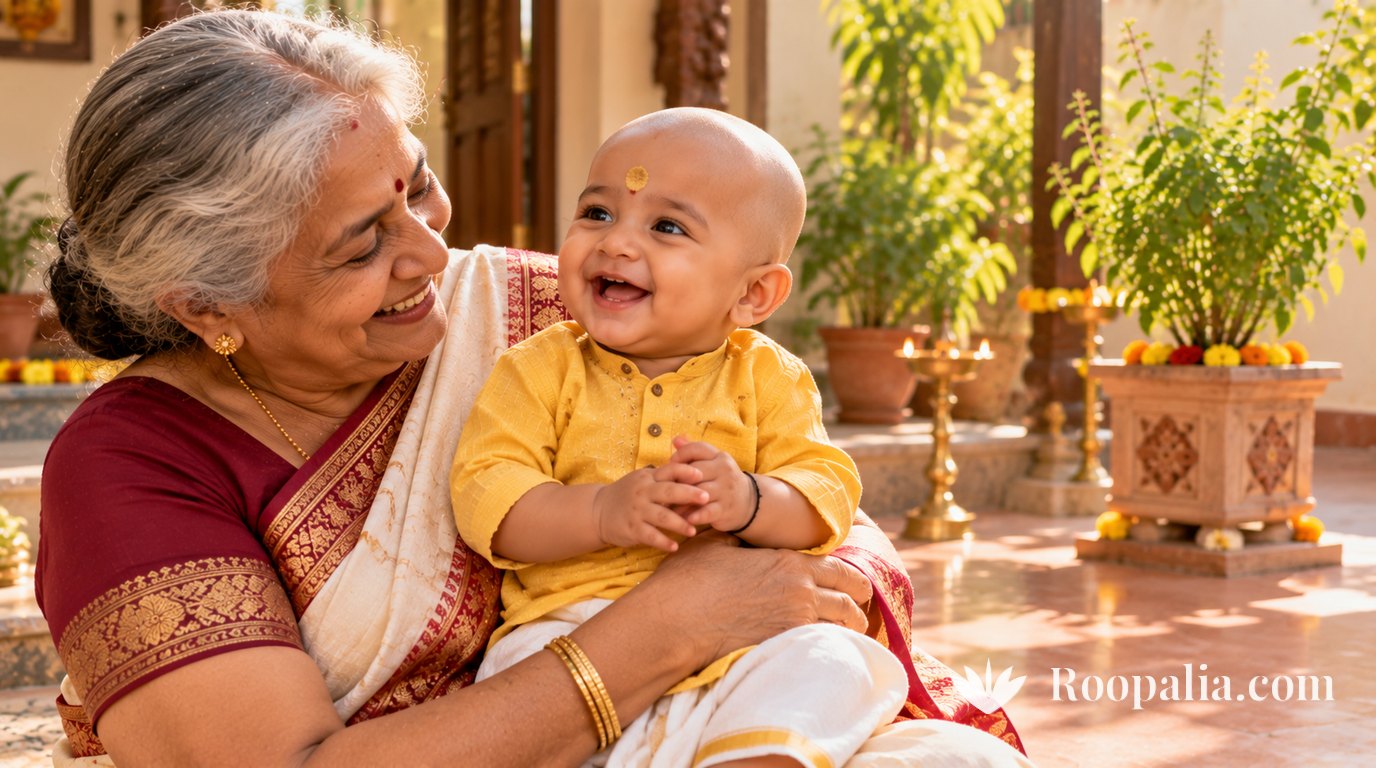
Sooner or later, usually around the first birthday, a call comes from India: "Beta, when are you doing the mundan?"
And if you are raising your child in Toronto, Birmingham, New Jersey or Frankfurt, the questions you ask back are rarely about the date. They are about why. Why shave a toddler’s head at all? Is it actually required, or just expected? What do we do with the hair here, where there is no Ganga down the road? And what will the other children at daycare say?
I took those questions to the three oldest texts that describe this ceremony. The answers turned out to be more practical, and more flexible, than most families expect. One of them even tells the barber what matters most.
Why do Hindus shave a baby’s head?
The ceremony is called mundan in everyday Hindi, but its name in the texts is chudakarana or chudakarma, sometimes chaula. It is one of the traditional sixteen samskaras, the rites that mark a Hindu life, and it follows the naming ceremony and the first-food ceremony. In it, the hair a child was born with is removed for the first time, with prayers and the family present.
So why do it? Search online and you will find a long list of reasons: it removes impurities from the womb or from a past life, it cools the head, it helps teething, it makes the hair grow back thicker. I tried to trace each of these to a text.
“In view of the injunctions of the Veda, the Tonsure-ceremony of all twice-born children should be performed, according to law, in the first year or the third.”
— Manusmriti 2.35, with Medhatithi’s commentary, tr. Ganganatha Jha (courtesy: wisdomlib.org)The reason the Manusmriti gives is short: it is done “in view of the injunctions of the Veda” and “according to law” — the Sanskrit word is dharmatah, as a matter of dharma. It is presented as a sacrament, not a health measure or a beauty treatment. In the three texts I opened, I did not find the womb-impurity, past-life, cooling or teething explanations. They may come from later writings or from family teaching, but I could not trace them, so I am not repeating them as fact.
The honest short answer: Hindus shave a baby’s head because the household rites prescribe it as one of the samskaras — a marker that the child has passed safely through infancy and is being received into the family’s way of life. Its meaning is religious and familial. It does not need a medical justification to be worth doing.
Does shaving a baby’s head make the hair grow back thicker?
This is the promise every grandmother makes, and the most searched question about mundan in English. Here the evidence is clear.
“No — shaving hair doesn’t change its thickness, color or rate of growth.”
— Mayo Clinic Staff, “Shaving hair: Does shaved hair grow back thicker?” (courtesy: Mayo Clinic)According to the Mayo Clinic, regrowing hair only seems coarser because shaving leaves each hair with a blunt tip, so it feels stubbly and can look darker for a while. The hair itself has not changed. So if your partner is sceptical because “it doesn’t actually do anything for the hair”, they are right, and it does not matter. That was never the point of the rite.
Is mundan necessary?
Many parents abroad ask this quietly, sometimes because they are unsure, sometimes because one side of the family cares a great deal and the other does not. The texts do not answer it in modern terms, but they do show how much room the tradition leaves.
“In the third year the Caula (i.e. the tonsure of the child’s head), or according to the custom of the family.”
— Ashvalayana Grihya Sutra 1.17.1, tr. Hermann Oldenberg (courtesy: wisdomlib.org)Notice the second half. The Ashvalayana Grihya Sutra, attached to the Rigveda, gives the third year and then immediately adds “or according to the custom of the family”. The text itself defers to your family’s practice. Whether a family does a full shave, leaves a small tuft (shikha), trims only a lock, or holds the rite at a particular temple has always varied from household to household.
So the practical answer is this: mundan is a prescribed samskara, and for most Hindu families it remains an important one. How and when it is done has always been a family decision, and the texts allow for that.
Which brings us to the question your parents actually asked: when?
At what age should mundan be done?
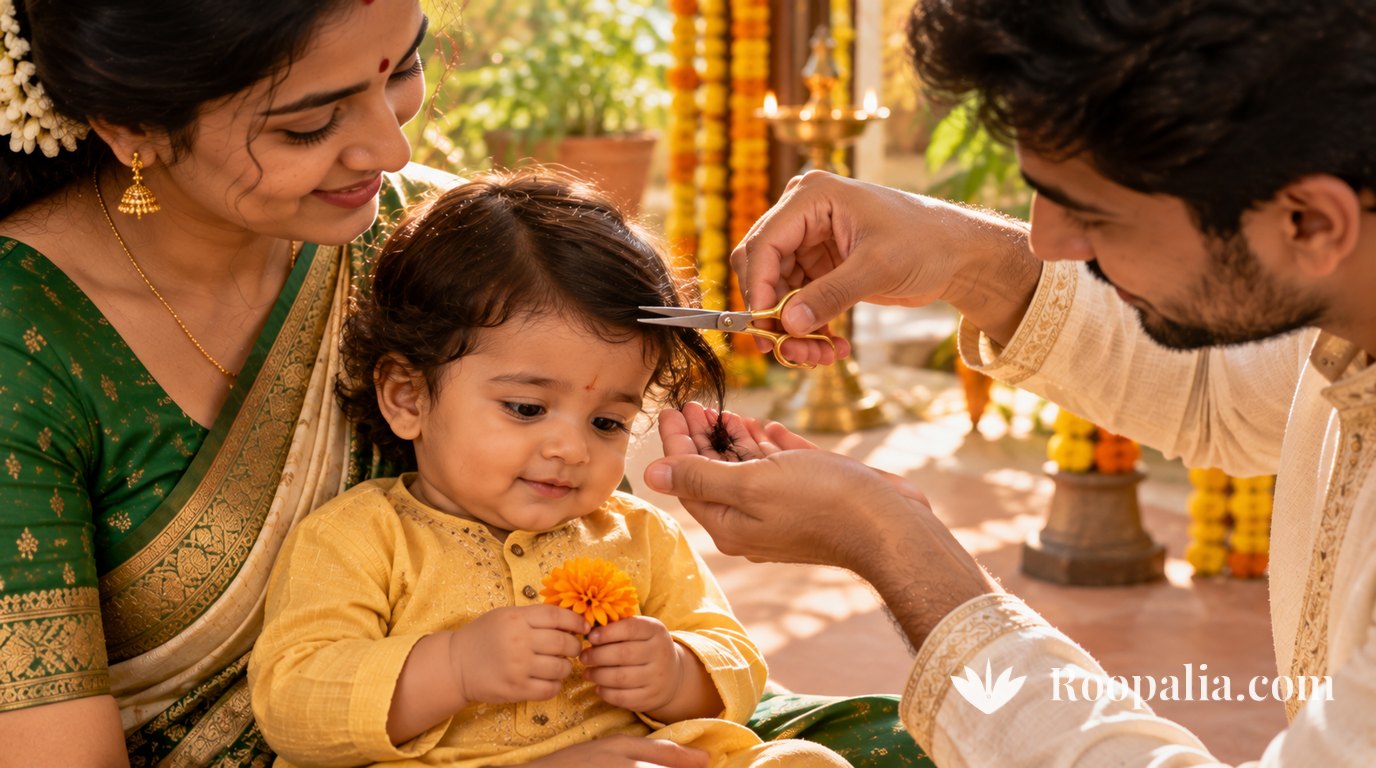
The three texts agree on a window rather than a single date:
- Paraskara Grihya Sutra 2.1.1–2 (Shukla Yajurveda, most followed in North India): when the child is one year old, or before the third year has passed.
- Manusmriti 2.35: the first year or the third. Its commentator Medhatithi says the choice between the two depends on the favourable and unfavourable positions of the planets, which is why families ask a pandit to look at the child’s chart.
- Ashvalayana Grihya Sutra 1.17.1: the third year, or by family custom.
Many families hold that the mundan must fall in an odd year — one, three, five or seven. The two years the texts name are both odd, but I did not find the fifth or seventh year in any of these three. Those probably come through the “custom of the family” route, which is a perfectly legitimate route.
A practical way to decide: start with your family’s custom, ask a pandit for an auspicious date within that year, and then look at your child. Many parents find a one-year-old sits through the shave more calmly than a two-and-a-half-year-old who has learned to be wary of strangers with blades. None of the texts says this; most parents do.
What the texts say about doing it safely
This is the line that surprised me most. In the Paraskara Grihya Sutra, when the father hands the razor to the barber, he says:
“Without wounding him, shave him.”
— Paraskara Grihya Sutra 2.1.21, tr. Hermann Oldenberg (courtesy: wisdomlib.org)The one instruction to the barber written into the ritual is about the child’s safety. In today’s terms: a new, unused blade, clean hands, and two adults gently holding the child. For a very small or wriggly child, many families choose an electric clipper to take the hair very short rather than a razor. If the child is unwell, has a fever, or has a rash, sores or crusting on the scalp, postpone and see your paediatrician first. The rite will be just as meaningful a week later.
How to do mundan at home
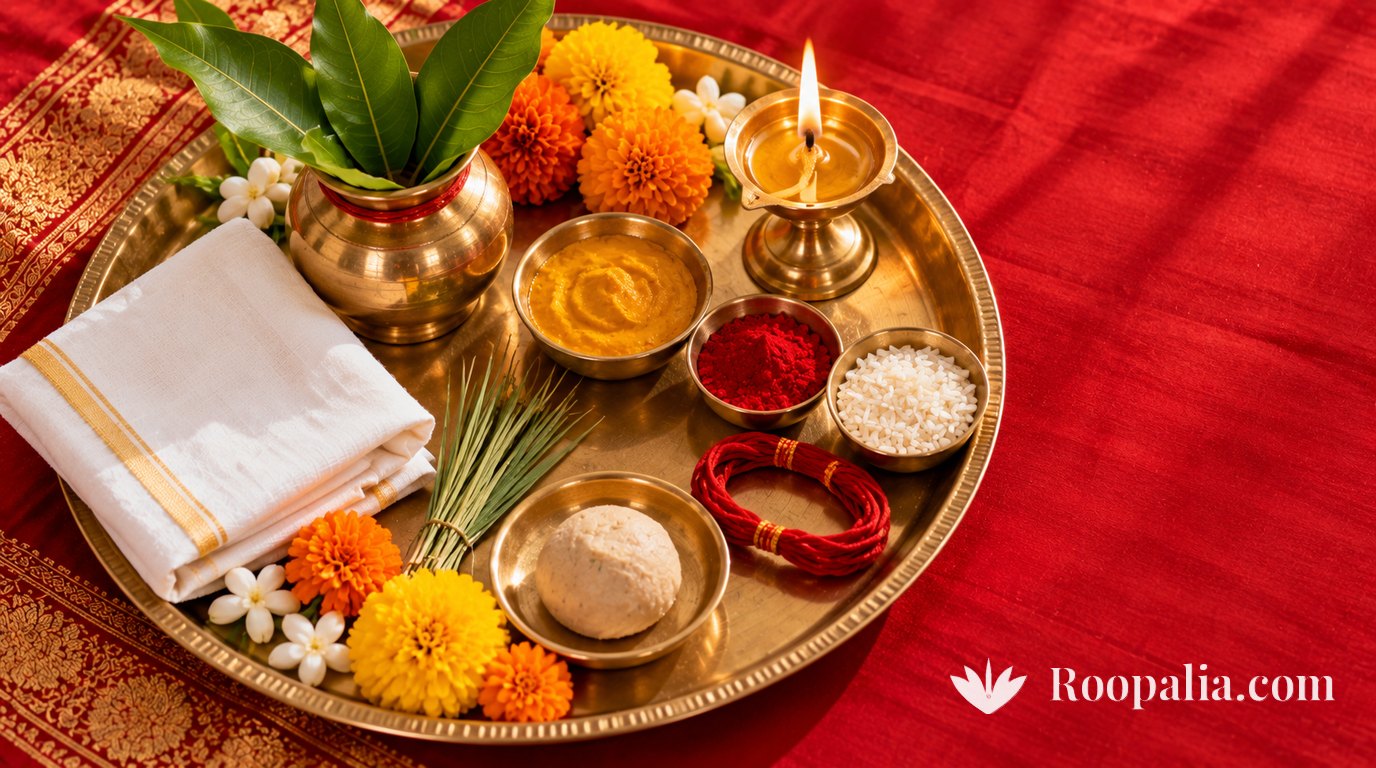
The Grihya Sutras describe it as a household rite — the word grihya itself means “of the home”. A short home version most families follow:
- Choose the day and time — family custom first, then an auspicious date. Morning works best, when the child is rested and fed.
- Set up a simple altar — a low stool with a red or yellow cloth, an image of Ganesha, a kalash, a lamp, roli, rice and flowers. See puja at home without a temple nearby.
- Sankalp and Ganesh puja — parents state their intention. A small havan is optional; here is how to do a havan at home without a pandit.
- The first lock — cut with scissors by the father, or by whoever your family custom names.
- The shave — by a barber or an experienced family member.
- Collect the hair on a white cloth, a leaf or a ball of dough, so none falls on the floor.
- Bath, new clothes, blessings — a lukewarm bath, fresh clothes, blessings from elders, a gift for the barber and a family meal.
One more detail from the Ashvalayana Grihya Sutra (1.17.11): each time hair is cut, it is handed, with shami leaves, to the mother. Her role in the ceremony is not only to hold the child, but to keep what is cut.
And that leads to the question every family abroad eventually asks: what do we actually do with the hair?
What to do with mundan hair outside India
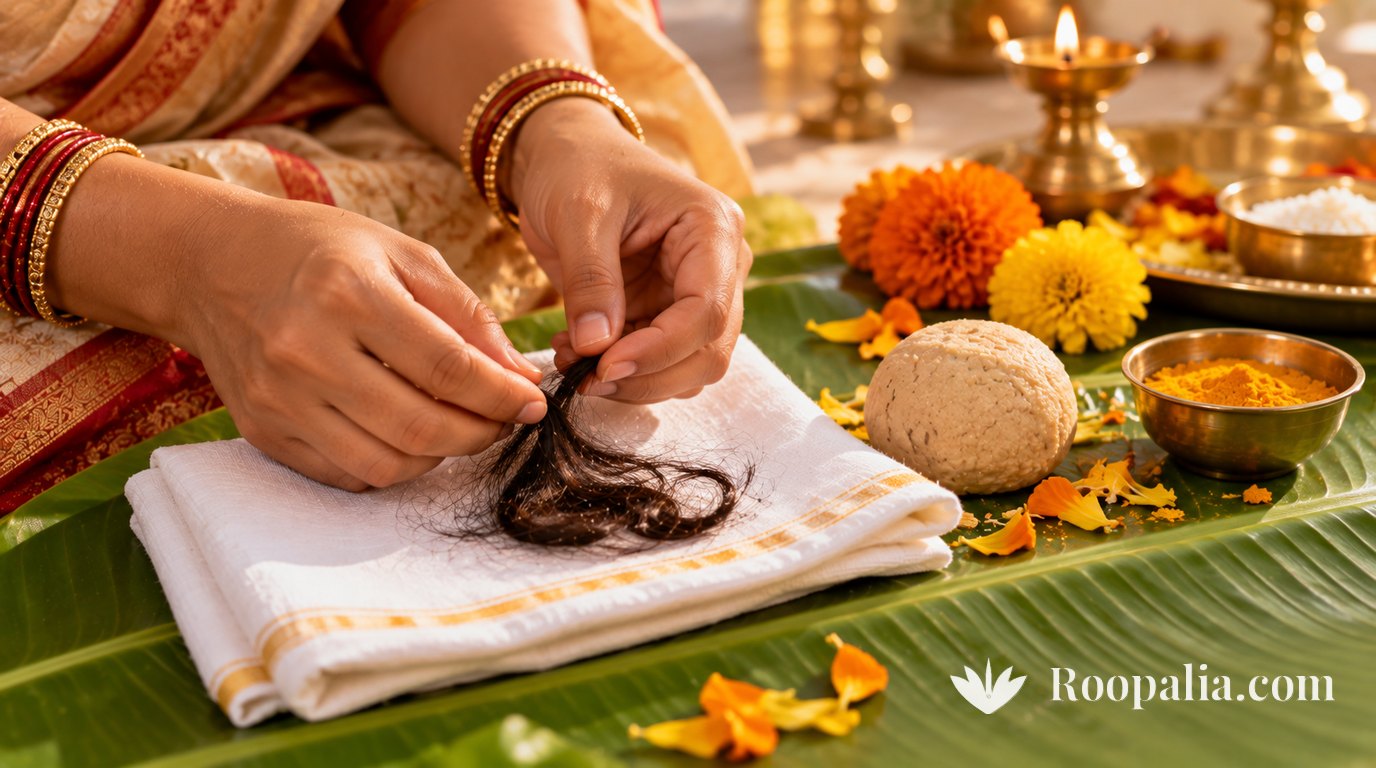
In India, most families immerse the hair in the Ganga or another sacred river, or offer it at a pilgrimage temple such as Tirupati. But the oldest instruction is different, and far easier to follow abroad.
“Having put away that lump of dung with the hair so that it is hidden in a cow-stable, or in a small pond, or in the vicinity of water.”
— Paraskara Grihya Sutra 2.1, tr. Hermann Oldenberg (courtesy: wisdomlib.org)The Paraskara Grihya Sutra says the hair is wrapped in a lump of cow dung and hidden — in a cow-stable, a small pond, or near water. The emphasis is not on a river at all. It is on putting the hair away respectfully, so that it is not scattered or trodden on. River immersion is a later and very beautiful expression of the same idea.

Three options that families abroad use, all close to that original idea:
- Bury it in the garden or a large plant pot — at the roots of a tree if you have one. Of everything here, this is closest to the text’s “hidden away”. That is my reading of the line, not its literal instruction, but the words leave room for it.
- Dry it and keep it in a small cloth bag until your next trip to India, then offer it at a river or temple there.
- A local river or lake — only after checking local rules. Councils and park authorities in many places restrict what may be put into waterways, and some Hindu temples abroad have their own arrangements for immersion. Ask your local temple first.
Home, temple or pilgrimage — and the winter problem
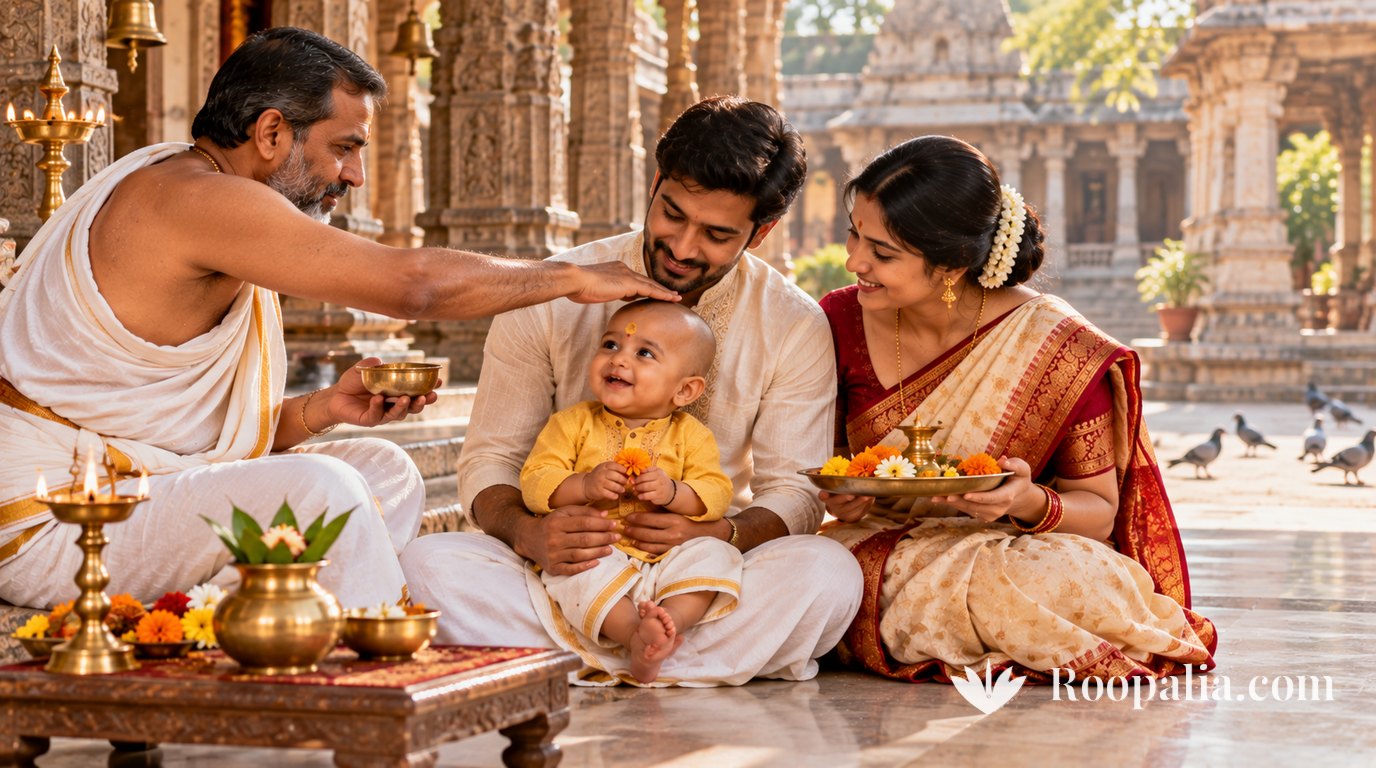
Many families hold the mundan at their kuldevi or kuldevta temple in India, and plan the rite around a trip home. Others go to a pilgrimage site. Both fall within the Ashvalayana’s “custom of the family”. But because the Grihya Sutras treat it as a household rite, a mundan done at home is not a lesser mundan.
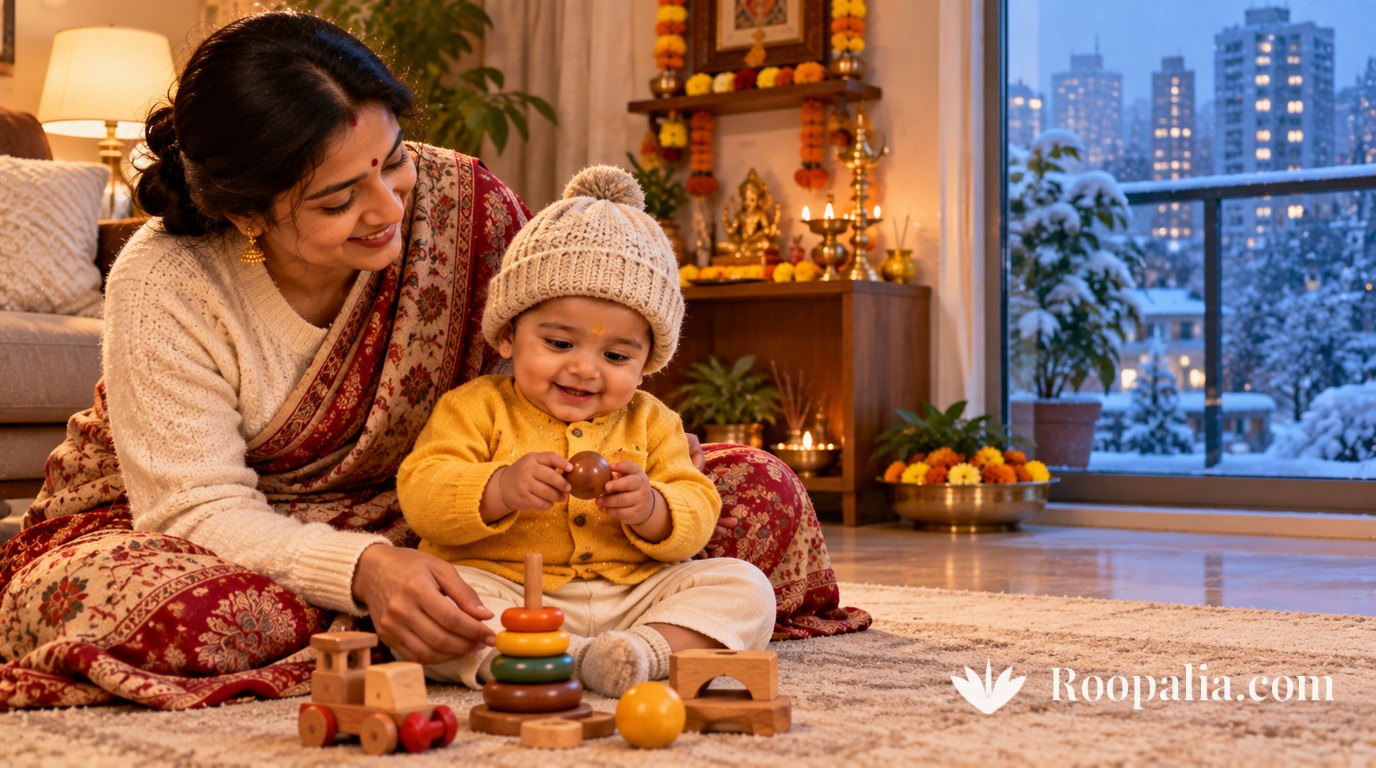
If the “right” year falls in a Canadian January, remember the window the texts give — Paraskara’s “before the third year has passed” and Ashvalayana’s family custom. Many families abroad simply wait for spring or summer. If it has to be winter, keep the room warm and the head covered with a soft cotton or wool cap.
Explaining it at daycare or school
A shaved head in a classroom gets noticed. A short note to the teacher the day before helps — “this weekend we held a family ceremony for our child’s first haircut” — so they can answer other children calmly. Give your child one simple sentence too: “It was my first haircut. It’s a special thing my family does.” For older siblings who ask harder questions, see how to explain Hinduism to a child.
Can girls have a mundan?
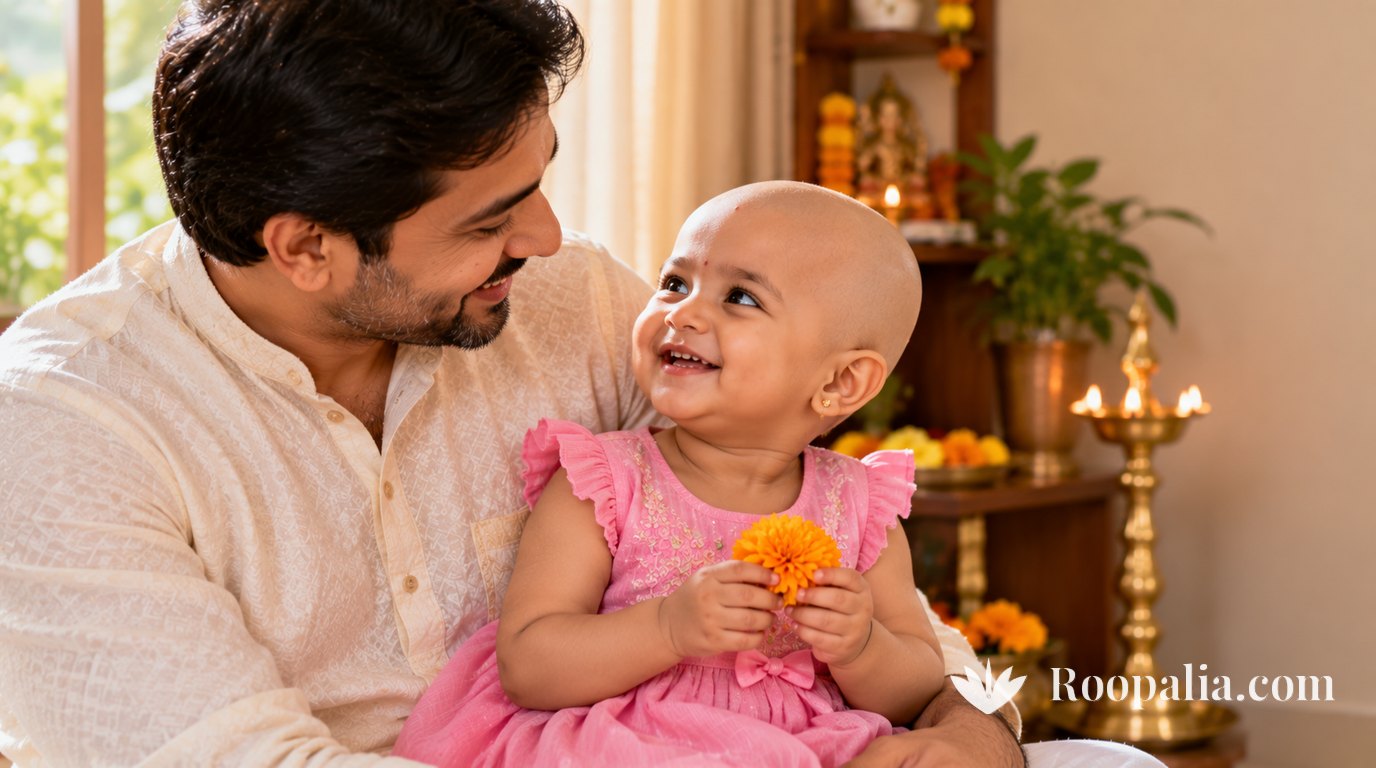
Yes. The Paraskara text is written entirely for a son, and I found no separate mention of daughters there. But the Ashvalayana closes its description with this line:
“The rite only (without the Mantras) for a girl.”
— Ashvalayana Grihya Sutra 1.17.19, tr. Hermann Oldenberg (courtesy: wisdomlib.org)So the chudakarana for a daughter is in the text itself — the same act, without the recited verses. Today many families do a full mundan for daughters; others cut only a lock or a little hair. Both are living traditions. The text does not leave daughters out.
Scalp care after mundan
None of the Grihya Sutras I read says what to put on the head afterwards. Turmeric, sandalwood paste, curd or coconut oil are family traditions. I could not open a paediatric source this time that recommends any particular oil or paste, so I am not naming one. The common-sense precautions:
- Keep the head covered from sun and cold with a soft cap.
- Lukewarm water and a gentle bath for the first few days — no scrubbing.
- Keep the child’s nails short so scratching does no harm.
- If there is a small nick, rinse it with clean water and keep it dry. Redness, swelling, pus or itching means it is time to see a doctor.
- If you want to use turmeric or sandalwood, try a small patch first. If your child has eczema or sensitive skin, ask your paediatrician before applying anything.
What I found, and what I did not
| Claim | What I found |
|---|---|
| Done as a samskara, “according to law” | Found — Manusmriti 2.35 |
| At one year, or before the third year ends | Found — Paraskara Grihya Sutra 2.1.1–2 |
| First or third year; choice by planetary positions | Found — Manusmriti 2.35 with Medhatithi |
| Third year, or by family custom | Found — Ashvalayana Grihya Sutra 1.17.1 |
| “Without wounding him, shave him” | Found — Paraskara Grihya Sutra 2.1.21 |
| Hair hidden in a cow-stable, pond or near water | Found — Paraskara Grihya Sutra 2.1 |
| Girls too, without mantras | Found — Ashvalayana Grihya Sutra 1.17.19 |
| Removes womb or past-life impurity; cools the head; helps teething | Not found in these three texts |
| Fifth or seventh year | Not found in these three texts — family custom |
| Hair grows back thicker | No — Mayo Clinic |
“Not found” does not mean “does not exist”. It is the honest result of my search, not a final verdict.
The short version. Hindus shave a baby’s head as a samskara — chudakarana — prescribed in the first or third year, and one of the oldest texts explicitly allows the custom of your own family to decide. Daughters are included. The first instruction to the barber is the child’s safety, and the hair is meant to be put away respectfully — which, outside India, can be as simple as the soil of your own garden.
It will not make the hair thicker. It was never meant to. It is a morning when the whole family puts its hands on one small head and blesses it. For the larger picture of passing these traditions on, see raising children with Indian values abroad.
Frequently asked questions
Why do Hindus shave a baby’s head?
Is mundan necessary?
At what age should mundan be done?
Does shaving a baby’s head make hair grow back thicker?
What do you do with mundan hair abroad?
Can girls have a mundan?
How do you do mundan at home?
How should you care for a baby’s scalp after mundan?
Sources and cautions: the scriptural references were opened and checked — the Paraskara Grihya Sutra 2.1 (one year or before the third year ends; “without wounding him, shave him”; hair hidden in a cow-stable, pond or near water) and the Ashvalayana Grihya Sutra 1.17 (third year or family custom; hair handed to the mother; the rite without mantras for a girl), both translated by Hermann Oldenberg, and the Manusmriti 2.35 with Medhatithi’s commentary, translated by Ganganatha Jha — all courtesy of wisdomlib.org. The point on hair thickness is courtesy of the Mayo Clinic. Three things should be said plainly. First, we did not find the womb-impurity, past-life, cooling or teething explanations, the fifth or seventh year, or any after-shave paste in these three texts; they come from family custom and later tradition. Second, no oil, cream or product is recommended here; take any decision about your child’s skin or health with your paediatrician. Third, “not found” does not mean “does not exist”; it is an honest report of a search.