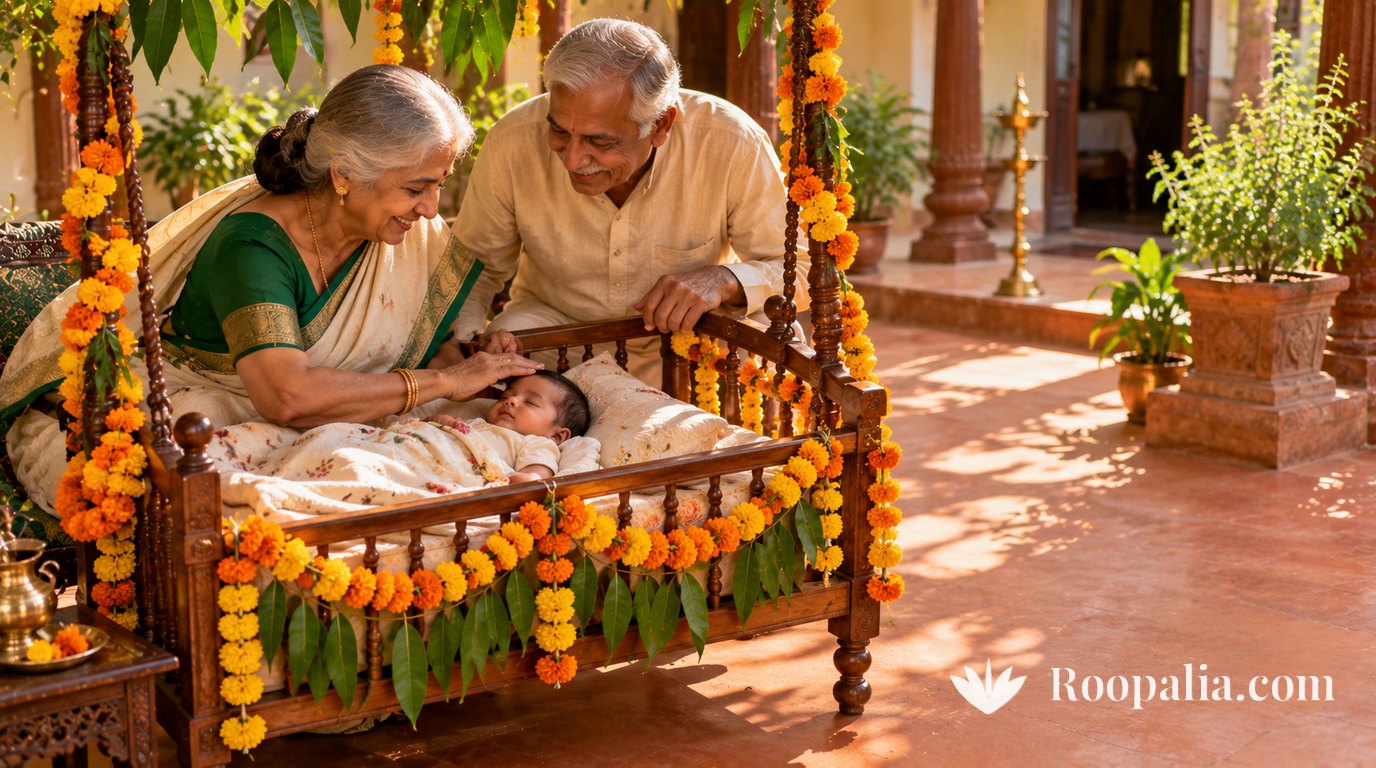
The question that arrives in the family group chat around day four is always the same: "So when is the naming?"
If you are in Toronto, Leicester, New Jersey or Melbourne, it comes with three more attached. Who will do it? Where will we do it? And how do we get Dadi and Dadaji there when they are eleven hours away?
The reassuring answer is buried in the oldest texts on the subject: the ceremony was designed to be done at home, by the father, with very little. Most of what makes it feel complicated was added later.
What a Hindu naming ceremony is
The namkaran sanskar — sometimes written namakarana — is one of the sixteen traditional Hindu rites of passage, and the first major one after birth. It is the moment a child is formally given a name in front of the family. In English it is simply called the Hindu naming ceremony.
The clearest early instructions sit in the Grihya Sutras, the manuals of household rites. The one most followed in North India is the Paraskara Grihya Sutra, attached to the Shukla Yajurveda. The Manusmriti also addresses it.
How to do a namkaran at home, step by step
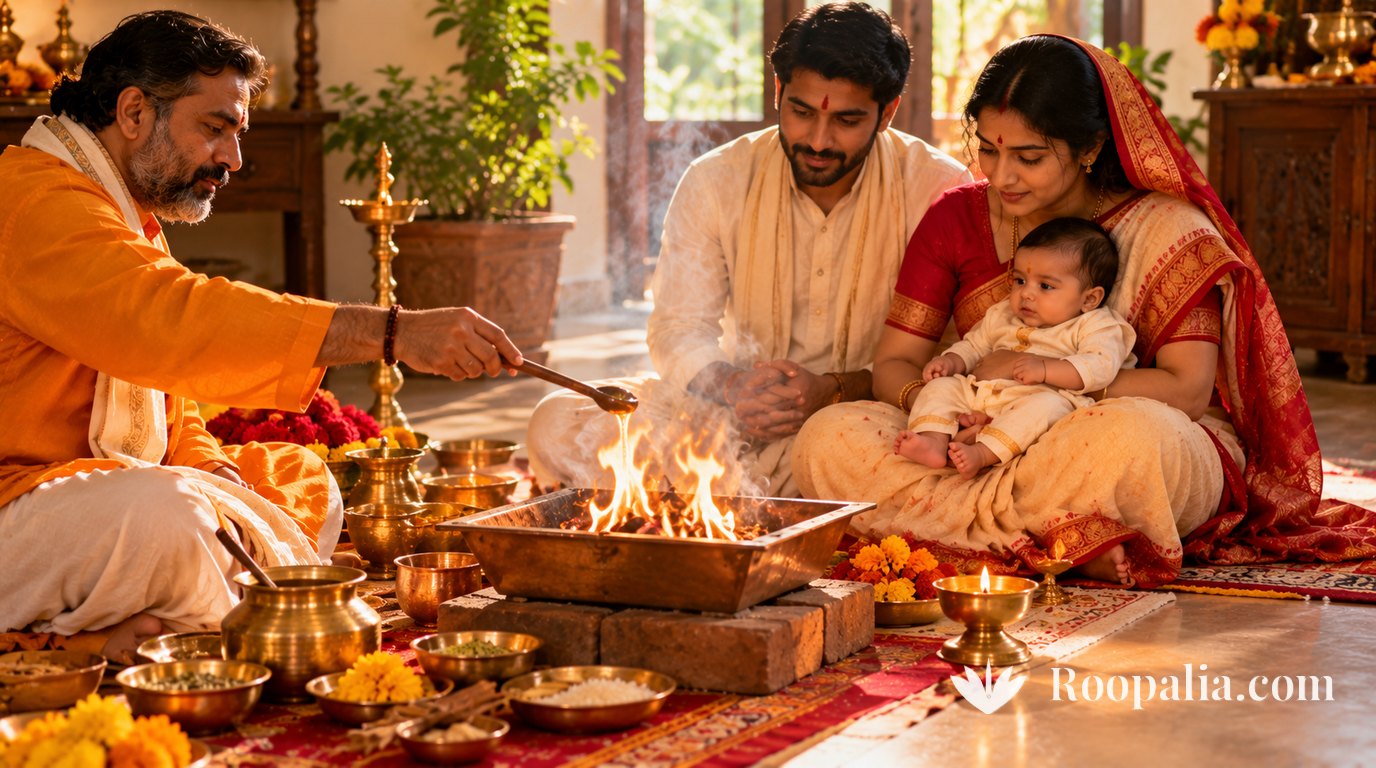
The Paraskara Grihya Sutra’s own instruction is a single line: on the tenth day the father, having fed the Brahmins, gives the name. Everything else in the modern procedure has grown up around that line. Here is the order most families follow, with what you actually need for each step.
- Bath and new clothes for mother and baby. For the baby, soft cotton in yellow or white.
- The sankalp (resolve). The father holds water, a few grains of rice and a flower and states his intention to name his child.
- Ganesh puja and a kalash — a pot of water with mango leaves and a coconut, as at the start of any auspicious rite.
- A small havan for the child’s long life and health. A small copper or steel havan kund on a tray works perfectly well indoors.
- The naming. The father leans close and speaks the name softly near the baby’s ear, then announces it to everyone present.
- Blessings from elders — grandparents, and in many families the father’s sister (the bua), who often has a special role.
- A meal. Feeding guests, and someone in need, is not hospitality added on. In the Grihya Sutra it is part of the rite itself.
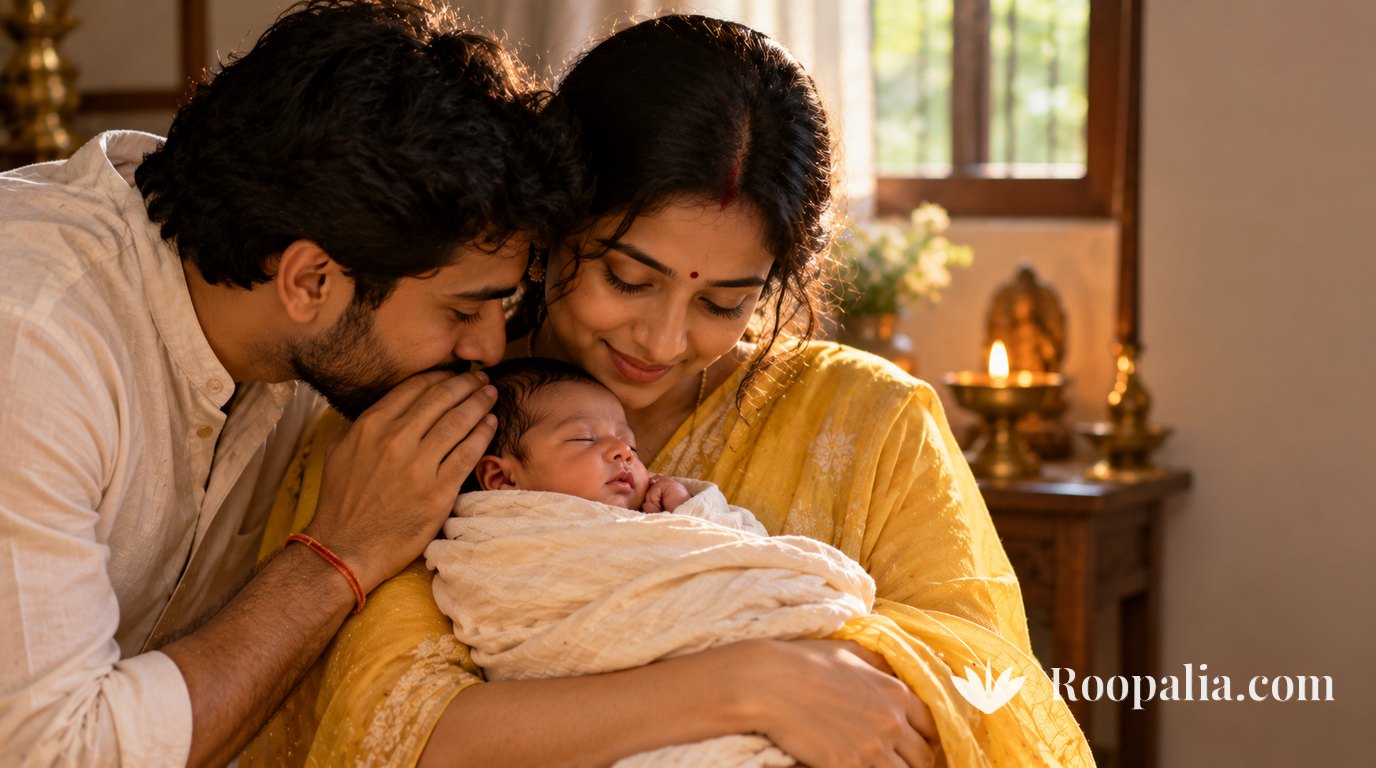
That whisper near the ear has an interesting history. The Paraskara Grihya Sutra does describe speaking near the infant’s ear — but in the earlier birth rite, the jatakarma, not the naming. Sutra 1.16.6 has the father murmur verses for long life near the navel or the right ear. Over the generations families carried that gesture forward into the naming, where it now belongs to the most emotional moment of the day.
The rice plate
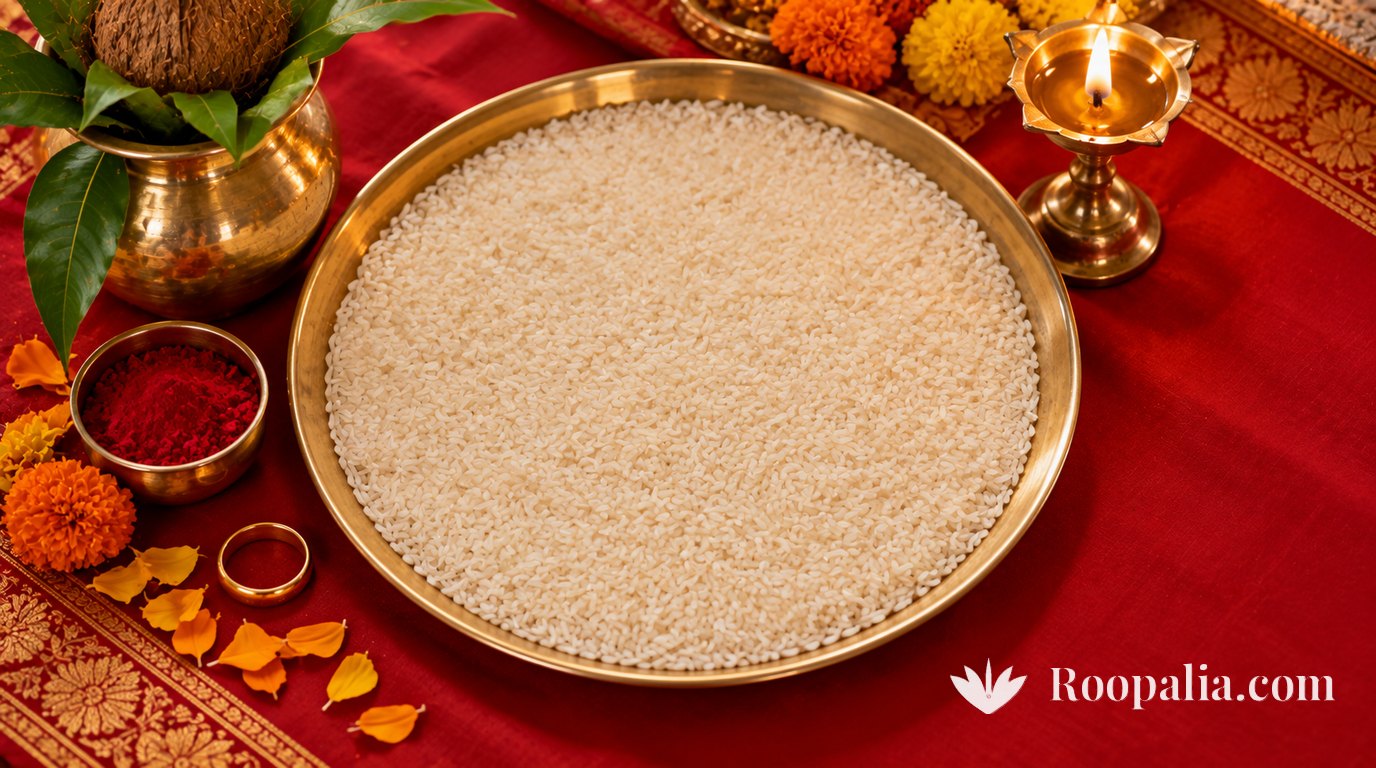
Many families have the father trace the baby’s name in a plate of raw rice using a gold ring. It is so common that people assume it is the core of the rite. I looked for its source and did not find it in the naming section of the Paraskara Grihya Sutra, which speaks of saying the name, not writing it; the pages describing the custom cite no text either. It is a lovely living tradition — rice for abundance, gold for purity. Keep it if your family does; just do not let anyone tell you the ceremony is invalid without it.
Now the question everyone in the group chat is really asking.
Why the tenth or twelfth day — and what if you cannot manage it
“One should have his ‘naming’ done on the tenth or the twelfth (day), on an auspicious lunar date and at an auspicious moment, and under a propitious lunar asterism.”
— Manusmriti 2.30, with Medhatithi’s commentaryThe Paraskara Grihya Sutra (1.17.1) says the tenth day; the Manusmriti says the tenth or twelfth. The medieval commentator Medhatithi adds two points that matter enormously to a family abroad.
First, the days are counted from the day of birth, not by the lunar calendar. A baby born on a Monday reaches the tenth day on the Wednesday of the following week.
Second, if the tenth or twelfth day is not auspicious, the ceremony is to be done on another auspicious date. The text itself builds in flexibility. Holding the naming on the first weekend everyone can gather is not cutting a corner; it is exactly the allowance the commentary makes.
Why do so many families do it on the eleventh, twelfth or even twenty-first day? Because in many households the ten days after birth are observed as sutak, a period of ritual seclusion, and the naming waits until it ends. Interestingly, Medhatithi rejects that reading — he holds that the naming can take place during that period, as the birth rites do. Lived practice took its own path anyway, and there is nothing wrong with following your family’s custom.
Choosing the name: nakshatra letters and the old rules
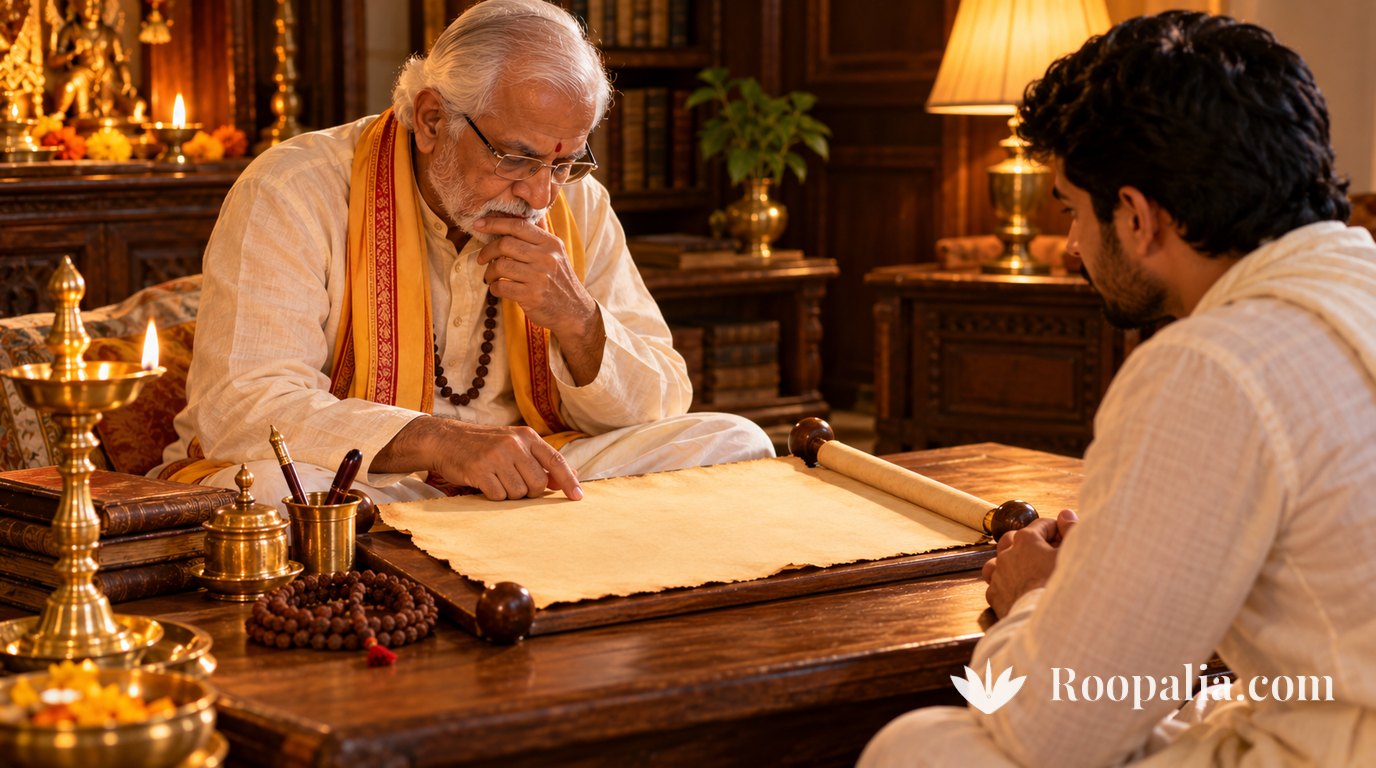
Nakshatra name letters are what most families search for first. In Indian astronomy the sky is divided into 27 nakshatras, each with 4 padas (quarters) — 108 in all, and panchang tradition attaches a syllable to each. The pada the moon occupied at the moment of birth gives the first syllable of the name.
I have deliberately not printed a letter chart here. Working out the right pada needs the exact time and place of birth — an hour’s difference can move it. For a baby born in London or Vancouver, the time must also be converted correctly, and a generic chart makes that easy to get wrong. Use a panchang calculation with the exact birth details, or ask a pandit to work it out.
The Grihya Sutra also gives rules about the shape of a name, which are less widely known than the nakshatra method:
| Paraskara Grihya Sutra | |
|---|---|
| A son’s name (1.17.2) | Two or four syllables, beginning with a soft (voiced) sound, containing one of y, r, l, v, and ending in a long vowel or visarga |
| A daughter’s name (1.17.3) | An odd number of syllables, ending in a long “aa” |
“That of women should be easily pronouncible, not harsh, of plain meaning, heart-captivating and auspicious; it should end in a long vowel and contain a benedictory term.”
— Manusmriti 2.33That last verse may be the most practical naming advice ever written, and it applies far beyond India. A child growing up in Ohio or Birmingham will hear their name said by teachers, coaches and friends who have never met a Hindi speaker. Easy to pronounce, clear in meaning, pleasant to hear — that is a test worth putting any name through before you choose it.
Gifts and decoration
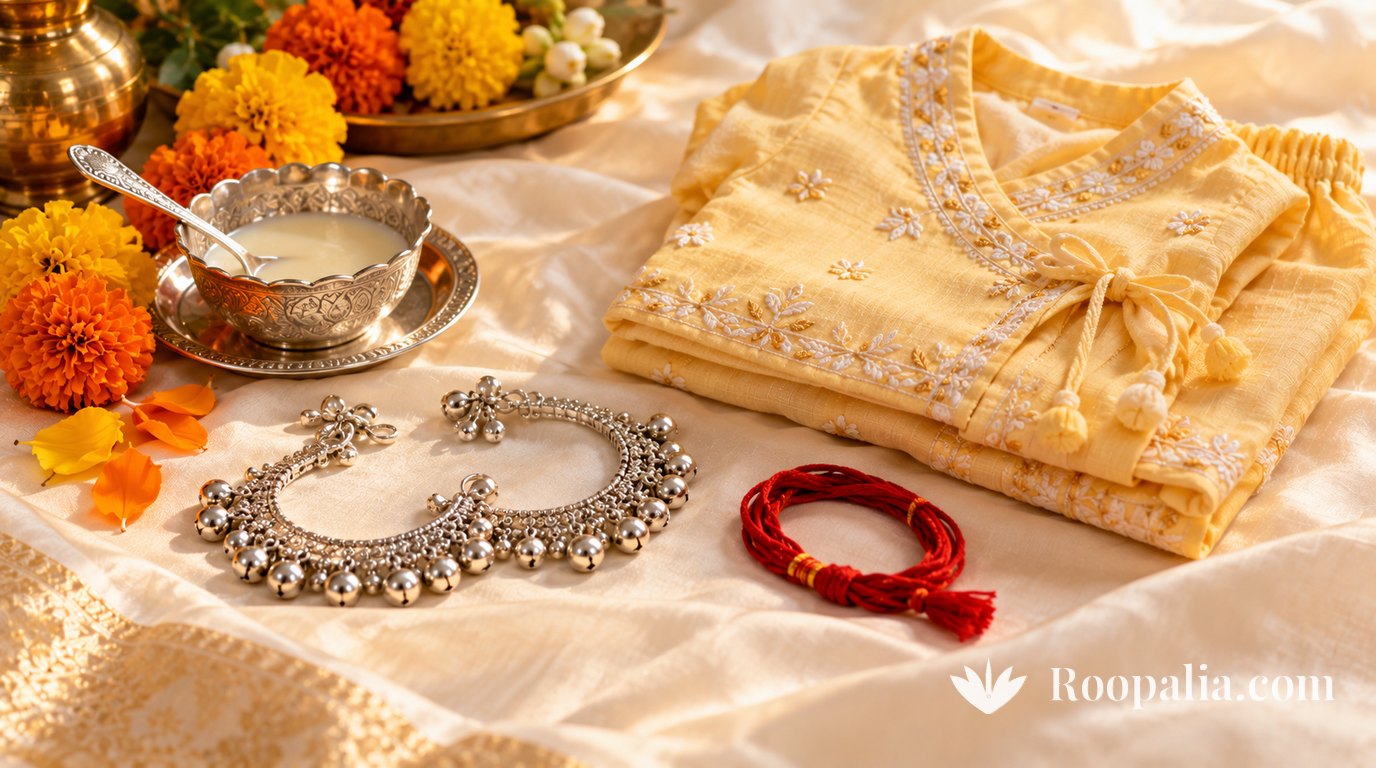
There is no scriptural list of Hindu naming ceremony gifts, but custom is consistent. A silver bowl and spoon is the classic, partly because it is used again at the first-food ceremony a few months later. Silver anklets or bangles often come from the bua or the maternal grandmother. New soft cotton clothes, a size or two up, are always useful. Cash gifts are traditionally given in odd amounts such as 11, 21, 51 or 101. A book of stories or simple verses the child can read later is a gift that outlasts all the others.
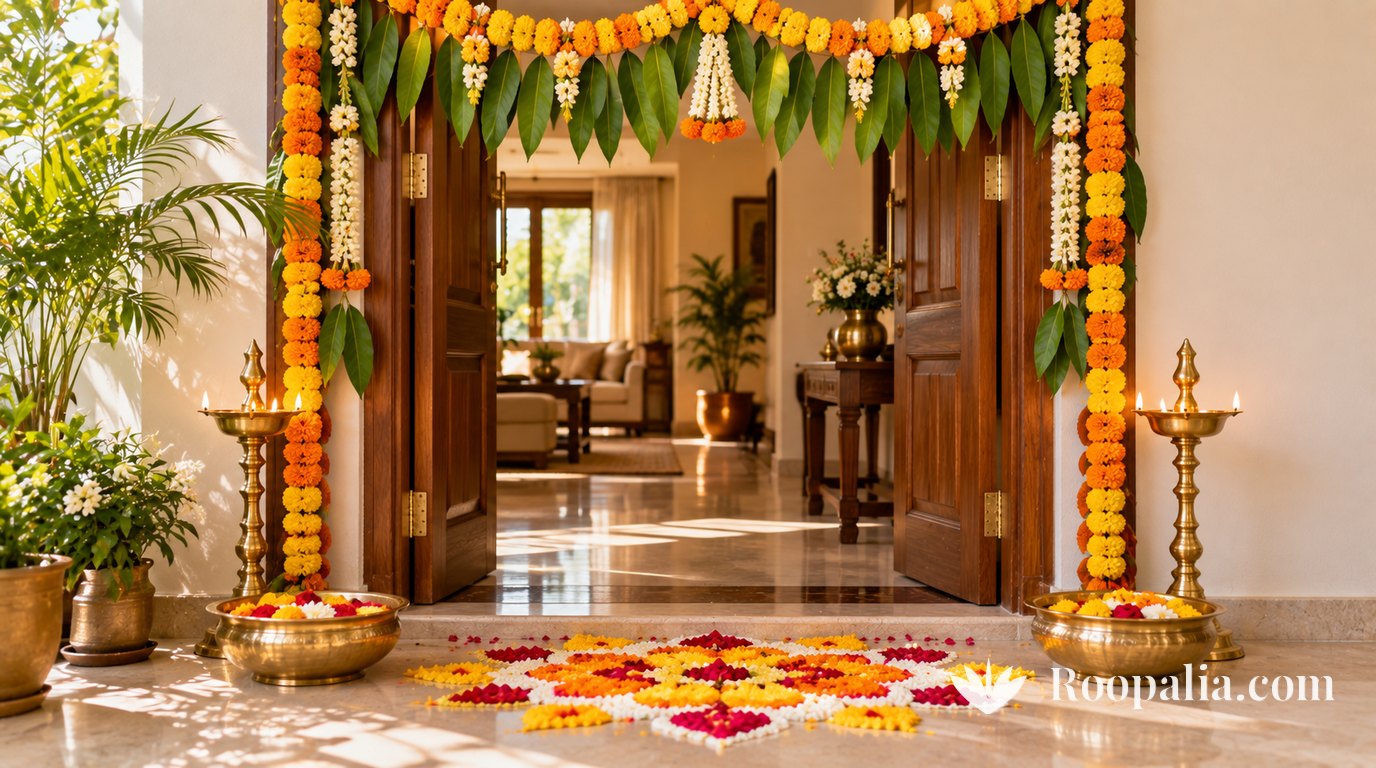
For naming ceremony decoration at home, the traditional elements are also the simplest: a toran of mango leaves and marigolds across the door, lamps on either side, and a rangoli of flower petals on the floor. In an apartment with a smoke alarm, battery-lit diyas near the door and a real one only at the puja are a sensible compromise.
When the grandparents are on a screen
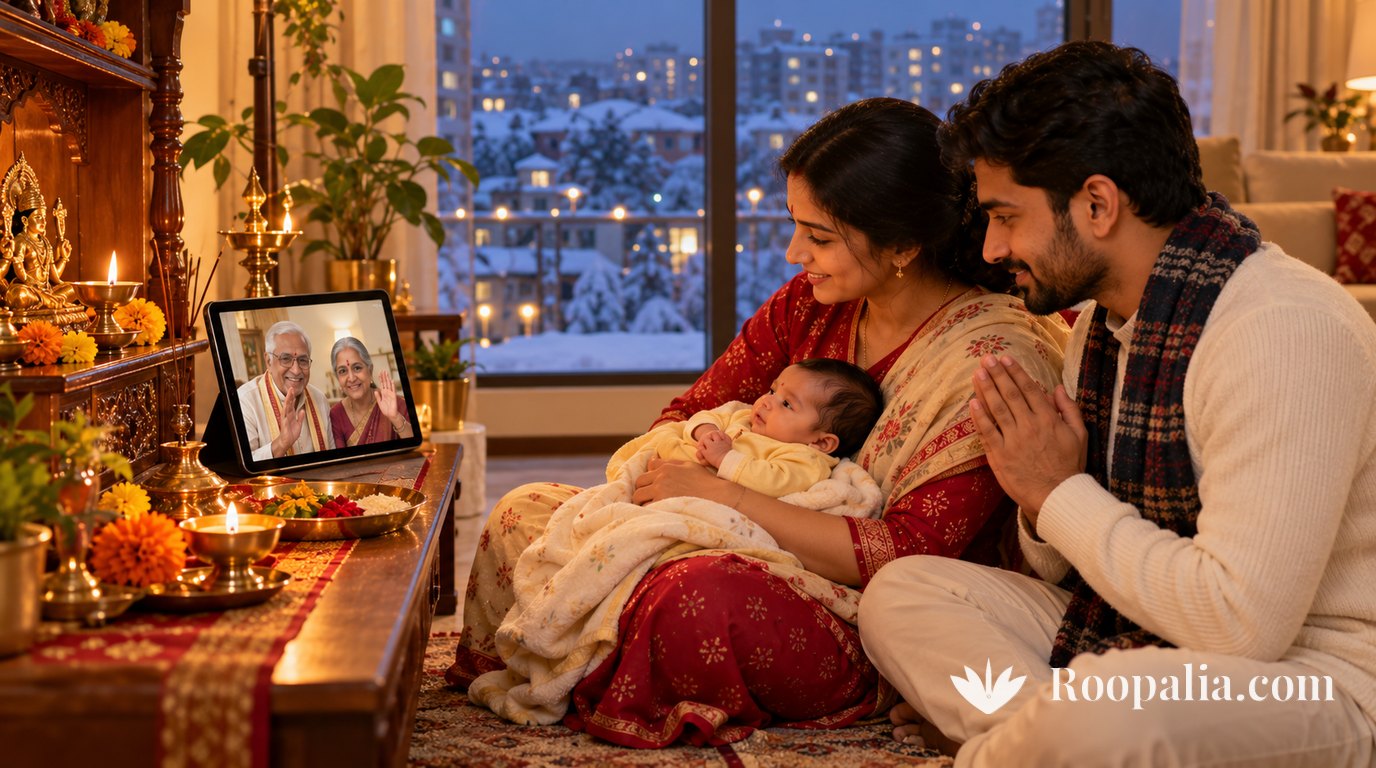
Make the video call part of the rite rather than a broadcast of it. Bring the grandparents onto the screen just before the naming, and let them be the first to say the name aloud. Many families do this, and it reliably becomes the moment people talk about afterwards.
Two practical notes for families outside India:
- The birth certificate usually comes first. Registration offices and hospitals often need a name within days or weeks — before the tenth day in some places. Register the name you intend to give; the ceremony that follows still does what it was always meant to do, which is to present the name to the family and the tradition.
- No priest available? The text names the father as the one who gives the name. A priest guides the rite but is not required for it. The full home procedure for a havan without a pandit applies here directly, and setting up a puja at home without a temple nearby covers the rest.
When your child asks about it at school
One of the more surprising things in the search data: people look up “Hindu naming ceremony KS2”. KS2 is the stage of the English primary curriculum where religious education covers rites of passage across faiths, and the Hindu naming ceremony is a common example. Which means the child whose namkaran you are planning may one day be asked to explain it to a class.
Three things a seven-year-old can say, all of them accurate:
- “It happens around the tenth or twelfth day after a baby is born.”
- “The father says the baby’s name, sometimes into the baby’s ear first, and then tells everyone.”
- “Afterwards the family shares a meal, because feeding people is part of the ceremony.”
Photos of your child’s own ceremony are the best teaching aid they will ever have. Take a few of the quiet moments, not just the posed ones. How to explain Hinduism to a child picks up the conversation from there.
The bottom line. The texts ask for very little: the tenth or twelfth day counted from birth — or another auspicious day if that one does not work — the father giving the name, and a meal shared with others. A Hindu naming ceremony at home, without a priest, with grandparents on a screen, sits squarely inside that.
Everything else — the rice plate, the gifts, the marigolds — is love that families added over centuries. Keep as much of it as you like. Just remember that the ceremony’s real moment is the first time your child is called by name.
Frequently asked questions
On which day is the Hindu naming ceremony done?
How do you do a namkaran ceremony at home?
Who names the baby in a Hindu naming ceremony?
How do you find the first letter of a baby’s name from the nakshatra?
What do the Hindu texts say a name should be like?
What gifts are given at a Hindu naming ceremony?
Is the rice and gold ring ritual part of the scriptures?
How do you hold a naming ceremony outside India?
Sources and cautions: the scriptural references were opened and checked — the Paraskara Grihya Sutra 1.17.1 (naming on the tenth day by the father, after feeding Brahmins), 1.17.2–3 (syllable rules for sons and daughters), 1.16.6 (long-life verses near the navel or right ear in the birth rite), the Manusmriti 2.30 with Medhatithi’s commentary (tenth or twelfth day, counted from birth, another auspicious date if needed) and Manusmriti 2.33 (names for daughters). Three things should be said plainly. First, we did not find the rice-plate ritual, a list of gifts or a list of things to avoid in any text; these are family customs. Second, no nakshatra letter chart is printed here, because the correct pada depends on the exact time and place of birth; use a panchang calculation or a pandit. Third, “not found” does not mean “does not exist”; it is an honest report of a search. Take any decision about the health of the newborn or the mother with your doctor.