
If you grew up in an Indian home, you know the winter routine: someone in the family is rubbing coconut oil, ghee or mustard oil into their heels at night, and someone else is insisting that lemon and petroleum jelly works better.
If you now live in Toronto, Chicago, Leicester or Stockholm, the problem often gets worse, not better — even though you wear shoes all day. Search Google and the questions pile up: why do heels crack, why do heels crack in winter, why do heels crack in summer, cracked heels is a sign of what deficiency, cracked heels home remedy.
I went to two sources first — the American Academy of Dermatology and Mayo Clinic — to understand why heels crack. Then I held the Indian remedies up against what they recommend. Most passed. Two did not. And one, it turns out, was written down in an Ayurvedic text nearly two thousand years ago.
Why do heels crack?
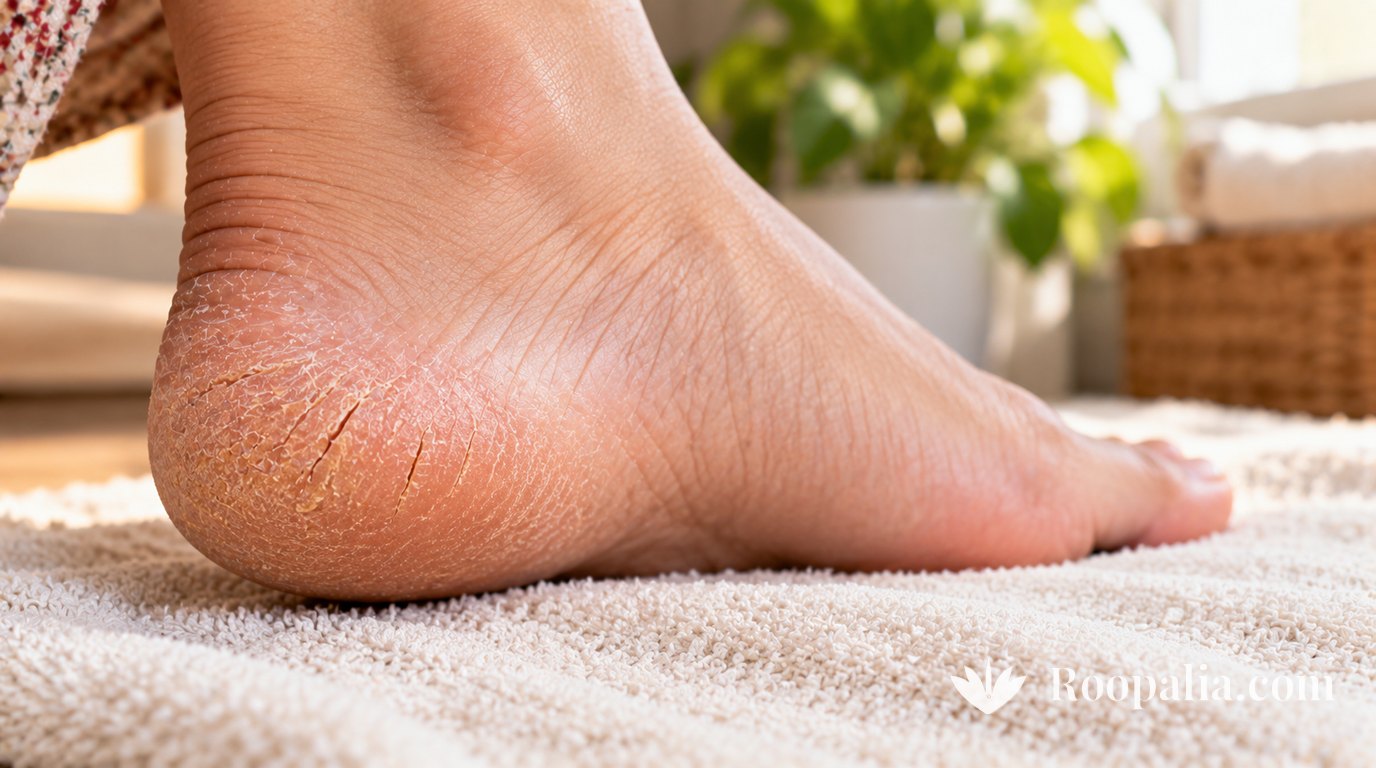
“Cracked heels usually develop when the skin around the rim of the heel is dry and thickened and increased pressure applied to the fat pad under the heel causes the skin to split.”
— Dr. Lawrence E. Gibson, Dermatology, Mayo Clinic Q&A (courtesy: Mayo Clinic)That one sentence explains almost everything. Two things happen together: the skin on the rim of the heel becomes dry and thick, and every step spreads the fat pad underneath. Thick, dry skin cannot stretch, so it splits.
Why do heels crack in winter?
Cold air holds little moisture, and indoor heating dries it further. The skin loses water faster than it can replace it, the heel rim thickens, and the pressure of walking does the rest.
Why do heels crack in summer?
Because summer is the season of open-backed footwear. The American Academy of Dermatology (AAD) specifically warns against flip-flops, slingbacks and other open-heeled shoes for people with cracked heels: without a back to hold it, the fat pad spreads sideways with every step. Walking barefoot on hard floors has the same effect.
Why do heels crack as you age?
A medically reviewed Healthline article lists aging among the more likely causes of cracked heels, alongside eczema, athlete’s foot and walking barefoot. Older skin tends to be drier, so the same routine needs to be more regular.
Cracked heels: a sign of what deficiency?
This is one of the most searched questions, and the honest answer is: usually none. The same Healthline article (medically reviewed by Cynthia Cobb, DNP) notes that deficiencies of vitamin E, vitamin B3 and vitamin C can cause dry skin — but that these deficiencies are rare in developed countries. Before reaching for supplements, try the routine below; if you suspect a deficiency, ask your doctor for a blood test.
So the problem is dryness plus pressure. The treatment follows directly from that.
What dermatologists recommend: one night, start to finish
Here is a full evening routine, combining the AAD’s six tips from dermatologist Dr. Patrick Blake with Mayo Clinic’s advice:
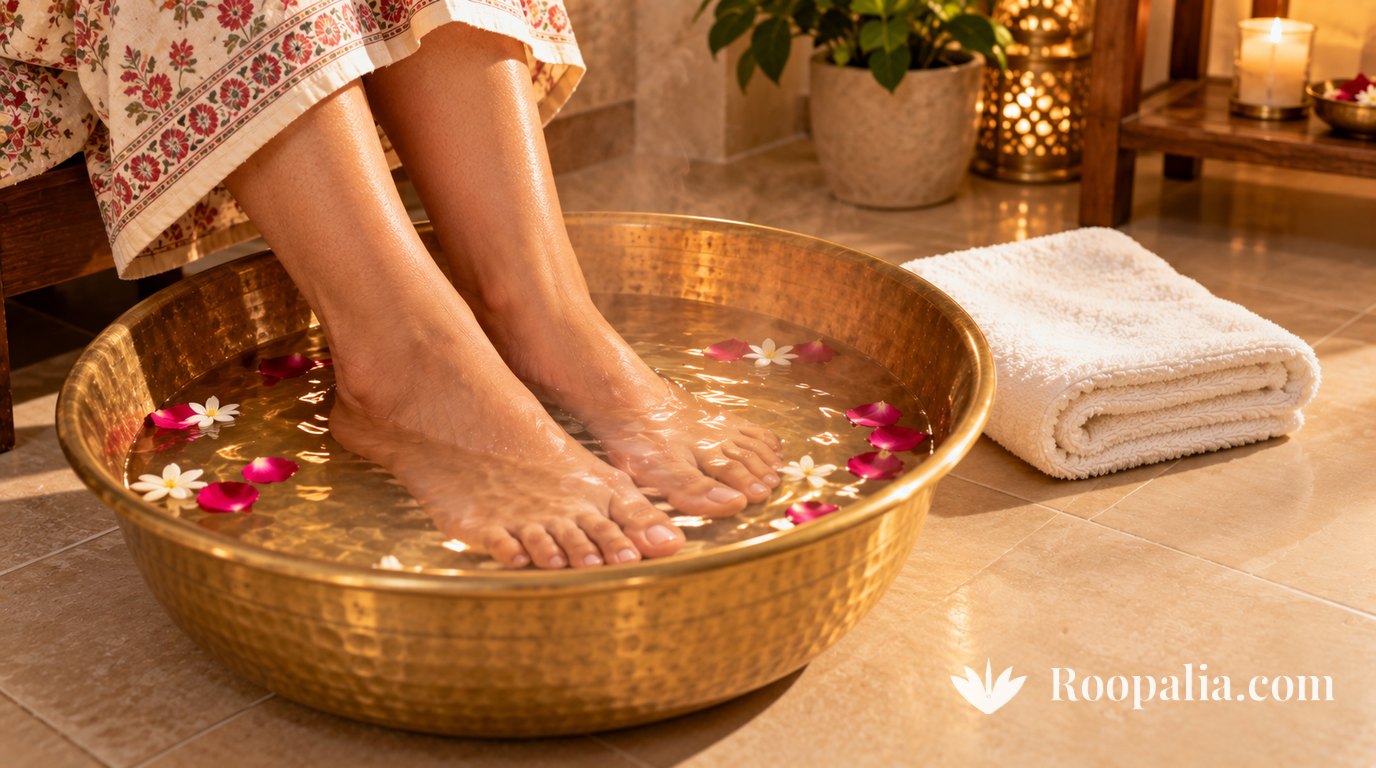
- Soak your feet in warm, plain or soapy water for about 20 minutes (Mayo Clinic).
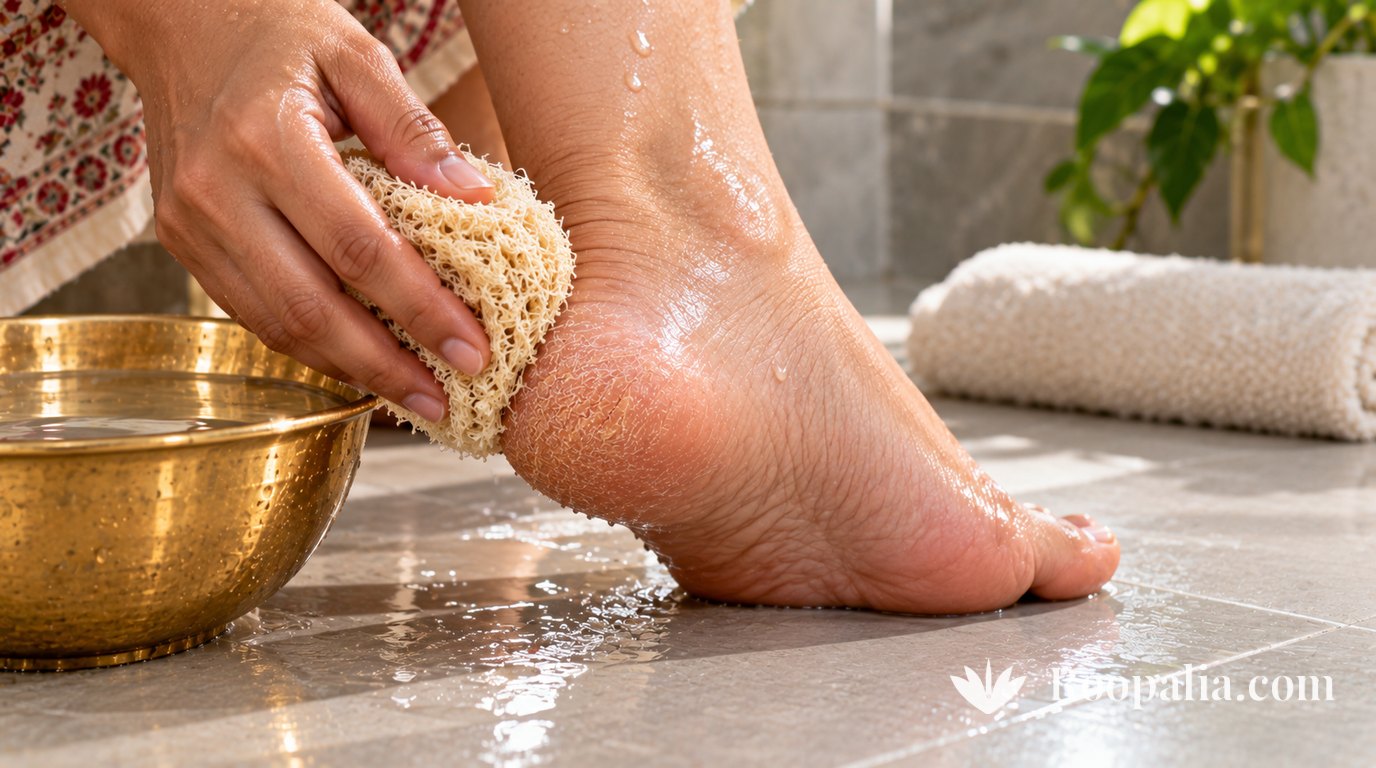
- Gently rub the thick skin with a loofah or foot scrubber (Mayo Clinic). Gently — not to the point of soreness.
- Moisturise within 5 minutes, while the skin is still damp, with a cream containing 10–25% urea, alpha hydroxy acid or salicylic acid (AAD). Mayo Clinic calls these keratolytic — they soften thickened skin.
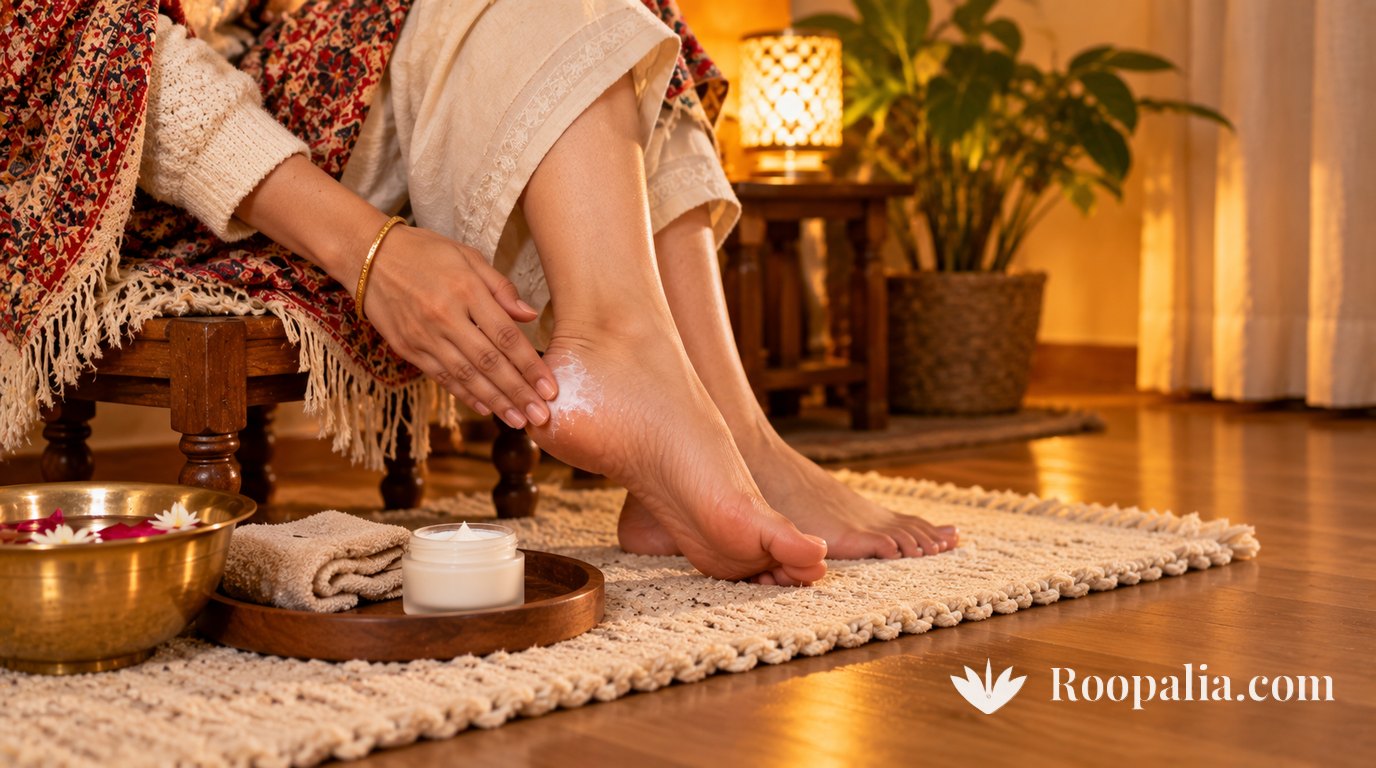
- Seal it with plain petroleum jelly or a petrolatum-based ointment (AAD, Mayo Clinic).
- Put on cotton socks for the night to lock the moisture in and keep the bedding clean.
And during the day: keep baths and showers to 5–10 minutes, use a gentle, fragrance-free cleanser, cover deep cracks with a liquid bandage to reduce pain and keep germs out, and wear closed-back shoes that fit well (AAD).
Do not cut thick skin with a blade or scissors at home. None of the sources I read recommends it — only soaking and gentle rubbing. If you have diabetes, keep anything sharp away from your feet and ask your doctor about foot care.
Now the remedies your mother and grandmother swear by. Do they hold up?
Indian home remedies, tested against the advice
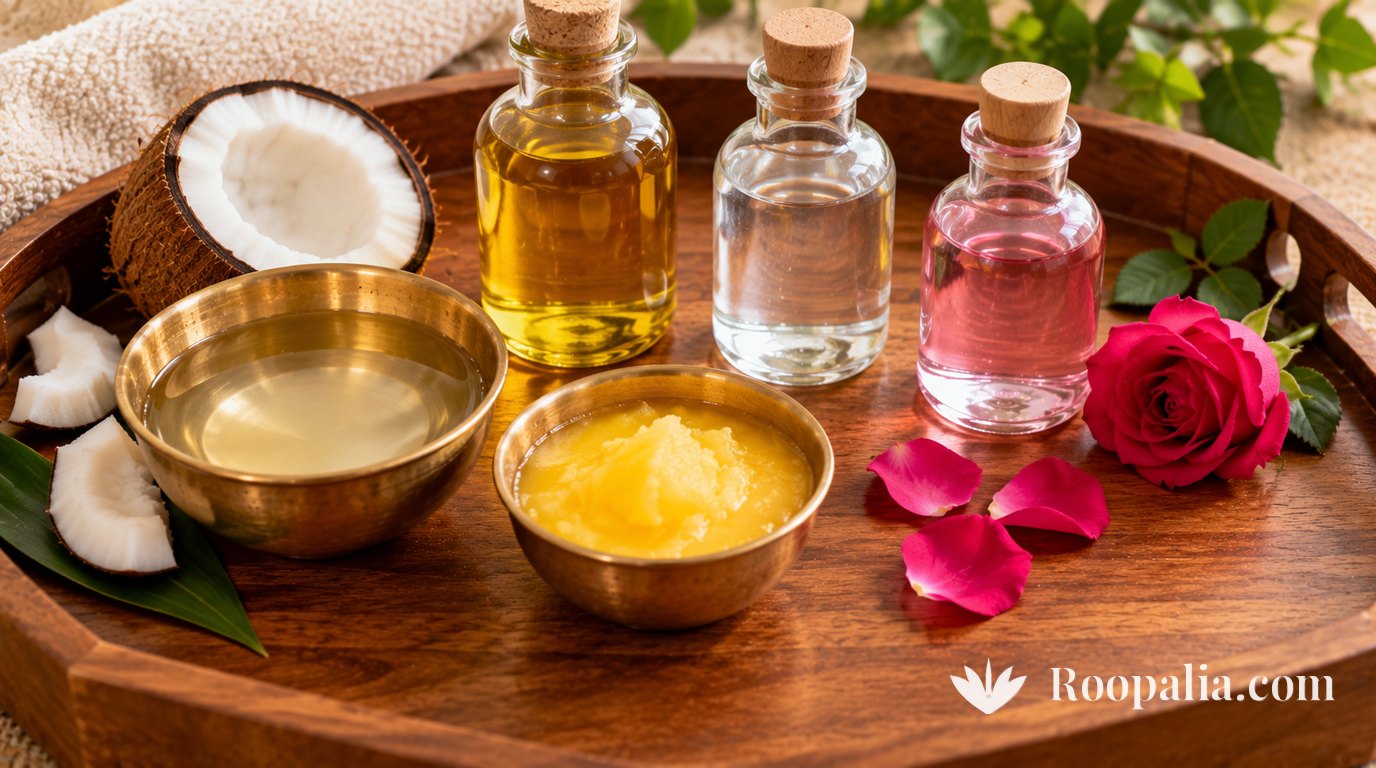
Strip the dermatologists’ advice to its core and it is two words: hydrate, then seal. Here is how the familiar remedies compare:
| Remedy | Against the advice |
|---|---|
| Coconut oil, ghee, mustard oil | Thick and occlusive — they can do the “seal” job that petroleum jelly does, especially at night under socks. I did not find heel-specific studies for any of them. |
| Glycerin with rose water | Glycerin draws water into the skin; follow it with an oil or jelly to seal it. Rose water itself is mostly scented water. |
| Warm-water soak | Matches — recommended by Mayo Clinic (about 20 minutes). |
| Petroleum jelly | Matches — recommended by both the AAD and Mayo Clinic. |
| Lemon mixed into jelly | Acid on cracked skin can sting and irritate; I found no dermatology source supporting it. See lemon juice on skin: the evidence and side effects. |
| Baking soda soak or paste | No dermatology source supporting it in what I read. |
The practical version: soak, rub gently, dry, a thin layer of coconut oil or ghee, cotton socks. If the cracks are deep, switch the oil for a urea cream — it softens thick skin in a way plain oil does not.
Dry skin in winter outside India: it is the heating

Many people who move from India to a cold country are surprised that their heels — and their whole skin — get drier, even though they now wear closed shoes. The reason is indoors: for five or six months, central heating runs constantly, and the air inside becomes very dry.
The AAD’s advice for dry skin is written exactly for this situation:
- Keep showers to 5–10 minutes, with warm rather than hot water — the long hot shower is the most tempting thing in a cold climate and the most drying.
- Moisturise right after bathing, on damp skin, and several times a day.
- Choose an ointment or cream rather than a lotion; they hold moisture longer.
- Look for “fragrance-free” rather than “unscented”.
- Run a humidifier in the rooms you use most.
- Wear gloves for washing up, and loose cotton clothes.
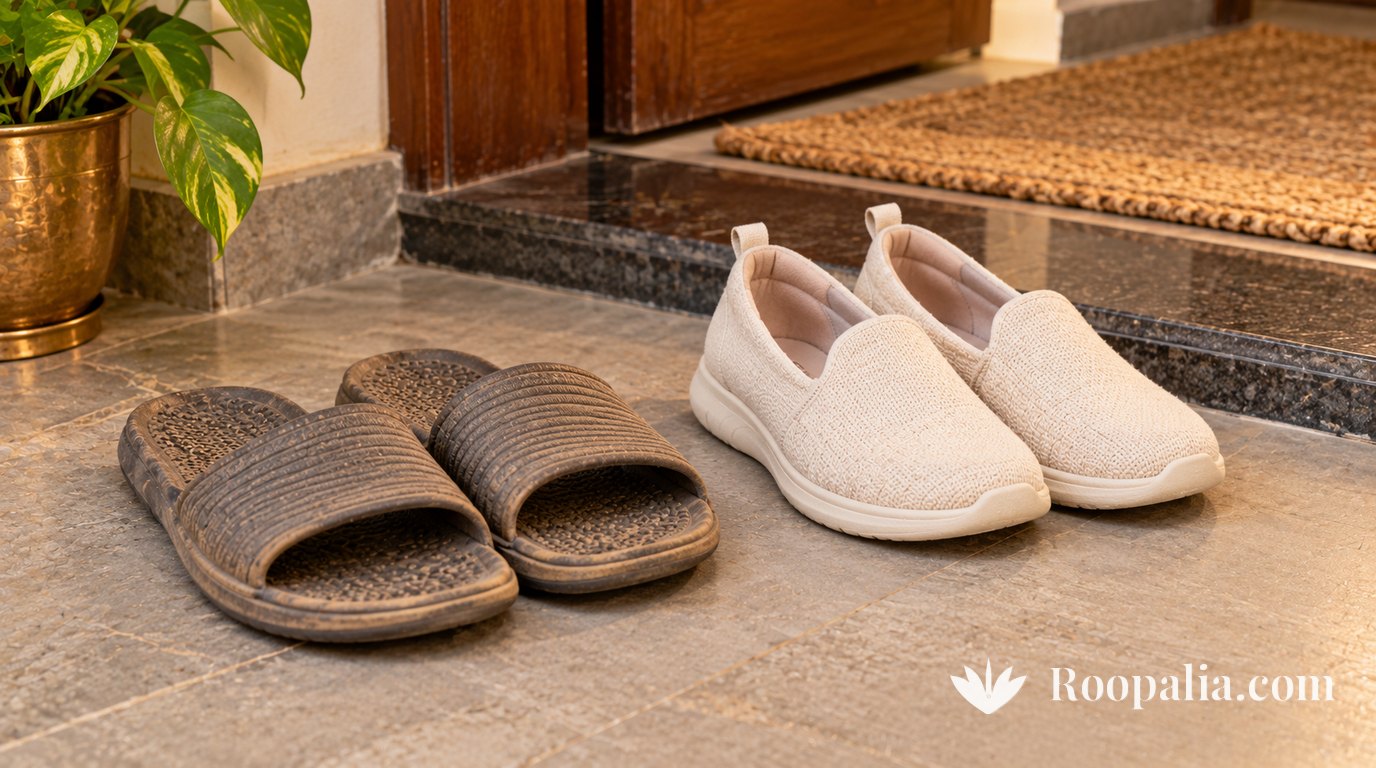
For the feet specifically: wear socks or closed-back house slippers indoors instead of walking barefoot on cold floors, and keep the oil-and-socks habit through the whole heating season. If dryness persists despite all this, the AAD advises seeing a dermatologist — conditions such as atopic dermatitis (eczema) or psoriasis may need treatment. For other winter skin problems, see dark spots and pigmentation.
The Charaka Samhita’s version: padabhyanga

“Oil your soles before you sleep” is perhaps the oldest family remedy of all. I went looking for its source and found it in the foundational text of Ayurveda:
“Foot massage also prevents grudhrasi (sciatica), fissures in the feet, contraction of the muscles, and blood vessels of legs.”
— Charaka Samhita, Sutrasthana 5.92 (courtesy: carakasamhitaonline.com)The Sanskrit word is sphuṭanam — cracking or fissuring of the feet. The verse just before it (5.90) says that oiling the feet relieves their roughness, stiffness, dryness, fatigue and numbness.
Read side by side, the Charaka Samhita’s “oil the feet to remove dryness” and the dermatologist’s “hydrate, then seal” describe the same habit. The Charaka Samhita is a classical Ayurvedic text, not modern clinical research — but on this point, tradition and dermatology point in the same direction.
When to see a doctor
According to Mayo Clinic’s Dr. Gibson, see a doctor if home care does not help, or if the heels become swollen or inflamed. He gives a particular warning for people with diabetes: untreated cracked heels may lead to infection and ulcers. The AAD likewise advises seeing a board-certified dermatologist if cracked heels are severe or do not improve. Bleeding, pus or worsening pain are reasons not to wait.
What I found, and what I did not
| Claim | What I found |
|---|---|
| Cause: dry, thick rim skin plus pressure on the fat pad | Found — Mayo Clinic, Dr. Gibson |
| Short baths, cream on damp skin, 10–25% urea, jelly and socks at night | Found — AAD, Dr. Patrick Blake |
| 20-minute soak, loofah, then ointment | Found — Mayo Clinic |
| Avoid open-heeled shoes | Found — AAD |
| Oil massage prevents cracking of the feet | Found — Charaka Samhita, Sutrasthana 5.92 |
| Vitamin deficiency as the usual cause | No — deficiencies are rare; other causes are common (Healthline) |
| Lemon or baking soda remedies | No support found |
| Cutting skin with a blade | Not recommended in any source read |
“Not found” does not mean “does not exist”. It is the honest result of my search, not a final verdict.
The short version. Heels crack because the rim skin dries and thickens, then splits under pressure. Fix both: short warm baths, cream with urea on damp skin, petroleum jelly or oil and socks at night, and closed-back shoes. Outside India, add a humidifier and take the heating seriously.
Your grandmother’s oil-before-bed habit passes the dermatology test and appears in the Charaka Samhita. Leave out the lemon and the baking soda, and see a doctor if you have diabetes or the cracks bleed. For hair that suffers in the same season, see hair fall in women: causes and treatment.
Frequently asked questions
Why do heels crack?
Cracked heels is a sign of what deficiency?
What is the best treatment for cracked heels at home?
Do Indian home remedies like coconut oil or ghee work for cracked heels?
Why do heels crack in winter?
Why do heels crack in summer?
What does the Charaka Samhita say about cracked feet?
When should I see a doctor for cracked heels?
Sources and cautions: the health information was opened and checked — the American Academy of Dermatology (dermatologist Dr. Patrick Blake’s six tips for cracked heels; dermatologists’ tips for dry skin), Mayo Clinic (dermatologist Dr. Lawrence E. Gibson on causes, soaking, ointment and the diabetes warning) and a medically reviewed Healthline article on vitamin deficiencies. The Ayurvedic reference is the Charaka Samhita, Sutrasthana 5.90–92 (courtesy: carakasamhitaonline.com). Three things should be said plainly. First, we did not read heel-specific studies on coconut oil, ghee or mustard oil, and found no dermatology source supporting lemon or baking soda remedies. Second, no brand is recommended, and this is not a substitute for medical advice — see a doctor for diabetes, bleeding, pus, swelling or severe pain. Third, “not found” does not mean “does not exist”; it is an honest report of a search.