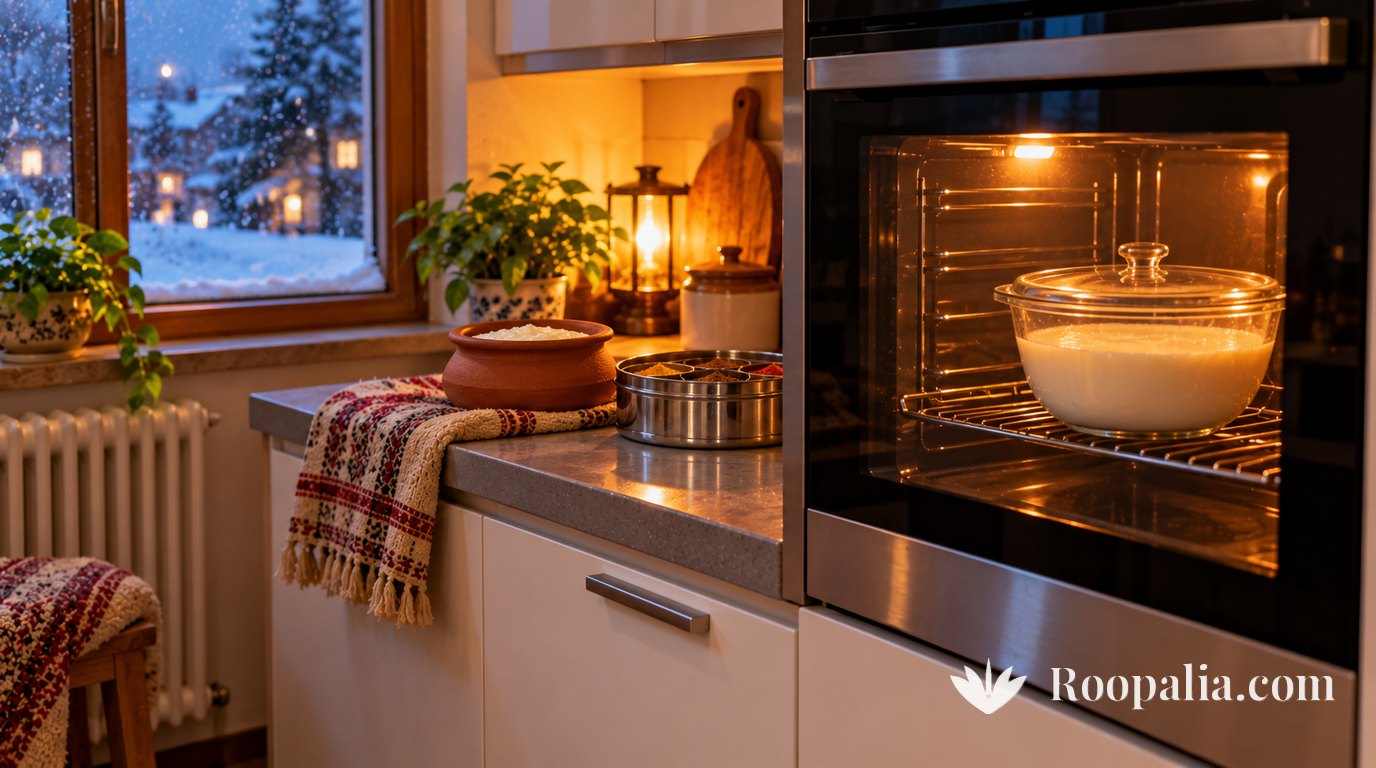
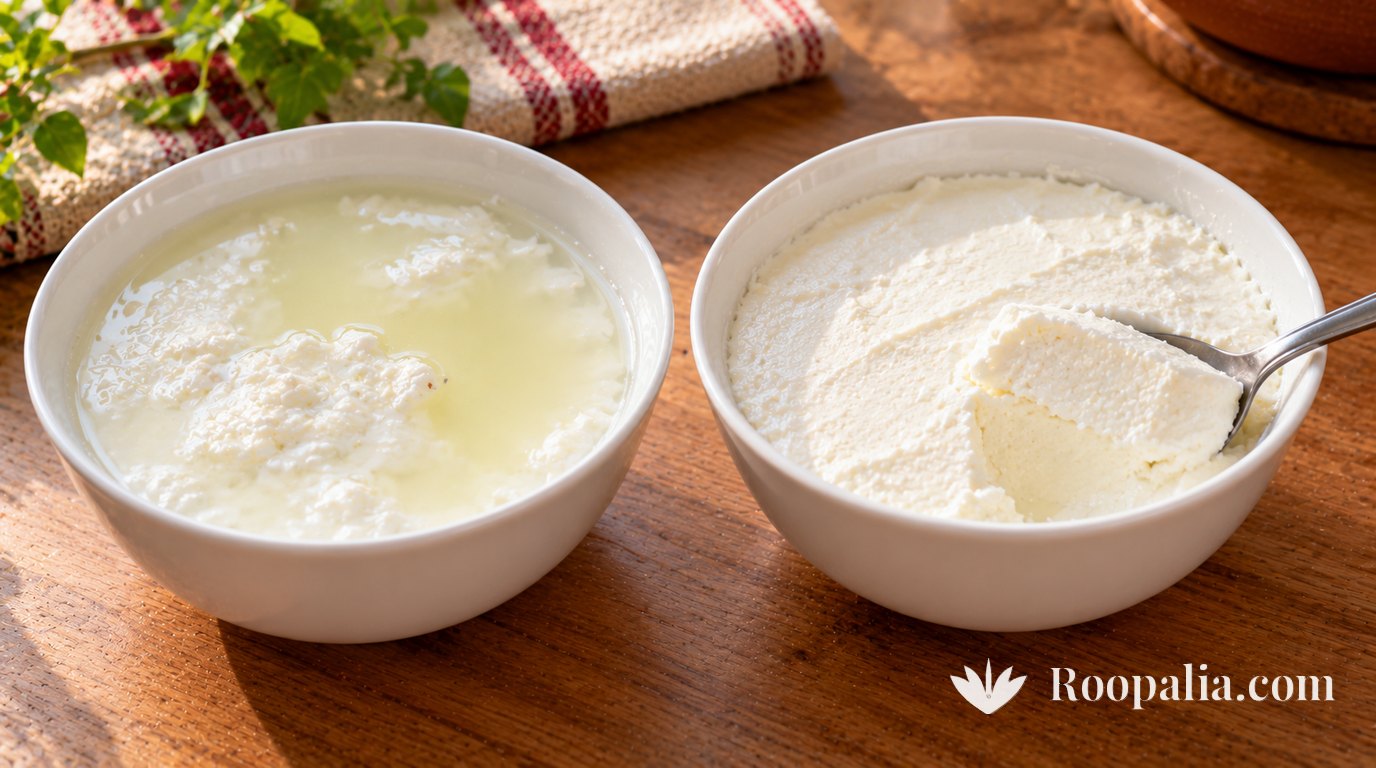
It worked perfectly all summer. Then the nights turned cold, and one morning you lift the lid on last night’s curd and find milk. Or a soft, wobbly middle with a puddle of yellowish water on top. Or something so sour it can only go into a kadhi.
If you live in Toronto, Manchester or Minneapolis, this is not a seasonal annoyance. Your kitchen may sit colder from October to March than your mother’s kitchen ever does in a Delhi December, and the milk on the shelf is not quite the milk you grew up with.
So I worked through the questions people actually search — “curd not setting in winter”, “why is my homemade yogurt runny”, “how to make curd without starter” — against two published university guides. The fix is almost always the same one thing. And the Charaka Samhita turned out to have a rule about curd for exactly this time of year.
The short answer: curd sets when its bacteria are kept warm. Food-science guides say: heat the milk to 185–200°F (85–93°C), cool it to 112–115°F (44–46°C), stir in the starter, then hold it at about 110°F (43°C) for 4–7 hours without moving it. In winter the bowl simply goes cold too fast. Put it in the oven with only the light on, wrap it in a shawl inside an insulated casserole, or use a multicooker’s yogurt mode — and refrigerate it as soon as it sets.
Why your curd is not setting — a quick diagnosis
| What you see | Most likely cause | What to do |
|---|---|---|
| Still liquid after 8+ hours | Starter added to milk that was too hot (above 115°F can kill the bacteria), or a tired starter | Re-warm to lukewarm, add fresh starter, keep it somewhere warm |
| Soft and wobbly | Kitchen too cold; the bacteria slowed down | Give it a few more hours somewhere warm |
| Whey pooled on top | Left too long, or moved while setting | Don’t touch it while it sets; refrigerate once firm. Stir the whey back in |
| Thin even when set | Milk not heated long enough | Hold the milk near boiling for longer (see below) |
| Too sour | Kept warm for hours after it had set | Check earlier; refrigerate as soon as it is firm |
Each line of that table comes from one of two guides. The first is Fermenting Yogurt at Home by food scientist Brian A. Nummer, Ph.D., written for the US National Center for Home Food Preservation. The second is Making Yogurt at Home by Julie Cascio of the University of Alaska Fairbanks Cooperative Extension — a fitting source for anyone making curd in a cold climate.
One safety line of my own: if unset milk smells off, changes colour or shows mould, don’t try to rescue it. Throw it away. Dr. Nummer’s guide is firm on using pasteurized or properly heated milk and clean equipment.
The temperature science, in one paragraph
The starter is a colony of lactic-acid bacteria. They eat the milk’s sugar, make acid, and the acid sets the milk protein into curd. Dr. Nummer puts the finish line precisely:
“Yogurt should set firm when the proper acid level is achieved (pH 4.6).”
— Brian A. Nummer, Ph.D., Fermenting Yogurt at Home, National Center for Home Food Preservation (courtesy: UC Davis Food Safety)The bacteria only reach that point if they are warm enough to work and not so hot that they die. Julie Cascio puts both edges plainly:
“Adding culture to very hot milk (over 115°F) can kill bacteria” … “An incubation temperature that is too hot or too cold can slow down culture growth.”
— Julie Cascio, Making Yogurt at Home, University of Alaska Fairbanks Cooperative Extension (courtesy: UAF Extension)- Heat the milk to 185–200°F (85–93°C), just short of a rolling boil. Dr. Nummer: this changes the proteins so they “set together rather than to form curds and whey.”
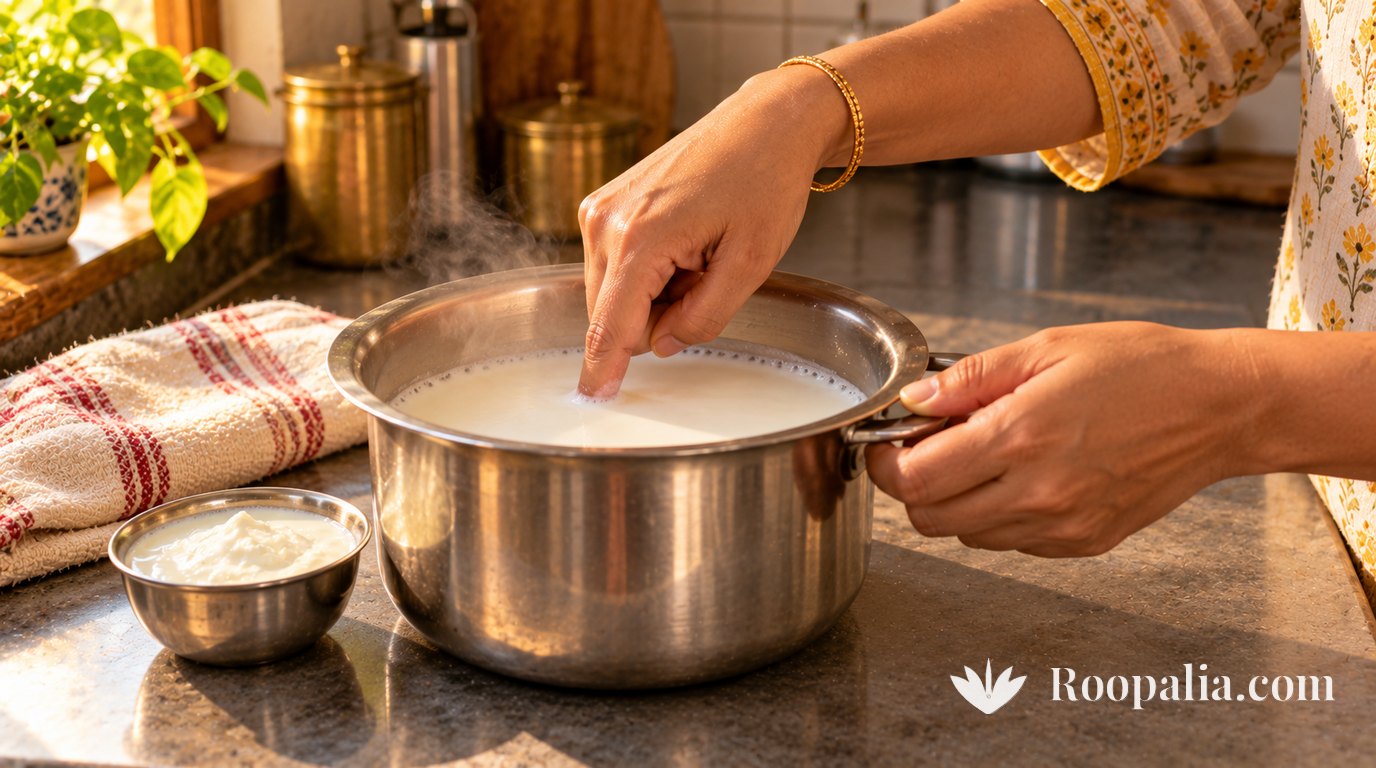
- Cool it to 112–115°F (44–46°C). Without a thermometer, the old Indian test works: a clean finger in the milk should feel distinctly warm but not hot.
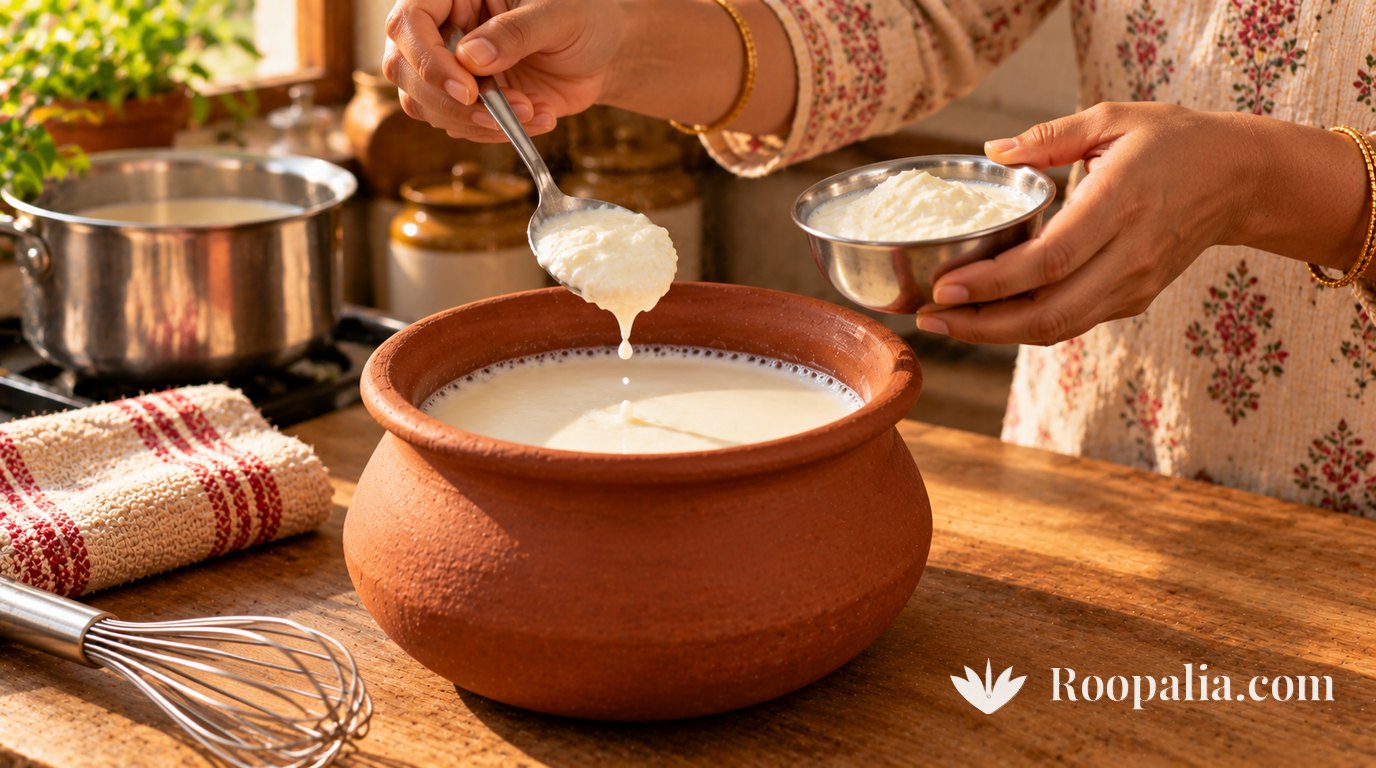
- Add starter — the UAF guide uses ¼ cup per quart of milk, more than most of us use. In winter, a little extra fresh starter helps. Loosen it in a splash of milk first.
- Incubate at 110°F ± 5°F (about 41–46°C) for 4–7 hours, covered and still.
- Refrigerate once it holds together when you tilt the bowl.
Step four is where winter wins. Here is how to hold 110°F for six hours in a cold winter kitchen.
How to set curd in cold weather
The oven with only the light on
This is the most common answer among Indian families in cold countries: put the covered bowl in the oven, leave the oven off, and switch on the interior light. In a closed box the bulb gives off gentle warmth. I found no test of this, and every oven light gives off a different amount of warmth, so check with a thermometer the first time, and leave a note on the oven door so nobody preheats it for pizza with your curd inside.
A multicooker’s yogurt setting
Many electric pressure cookers and multicookers have a yogurt mode, and the “pot-in-pot” method (setting the curd in a steel bowl inside the inner pot) is popular because the bowl comes out clean. Follow the manual’s own temperature settings.
Near the heating — not on it
A spot near a radiator or warm-air vent works, but don’t sit the bowl on top: above 115°F you start killing the very bacteria you need.
The methods from home
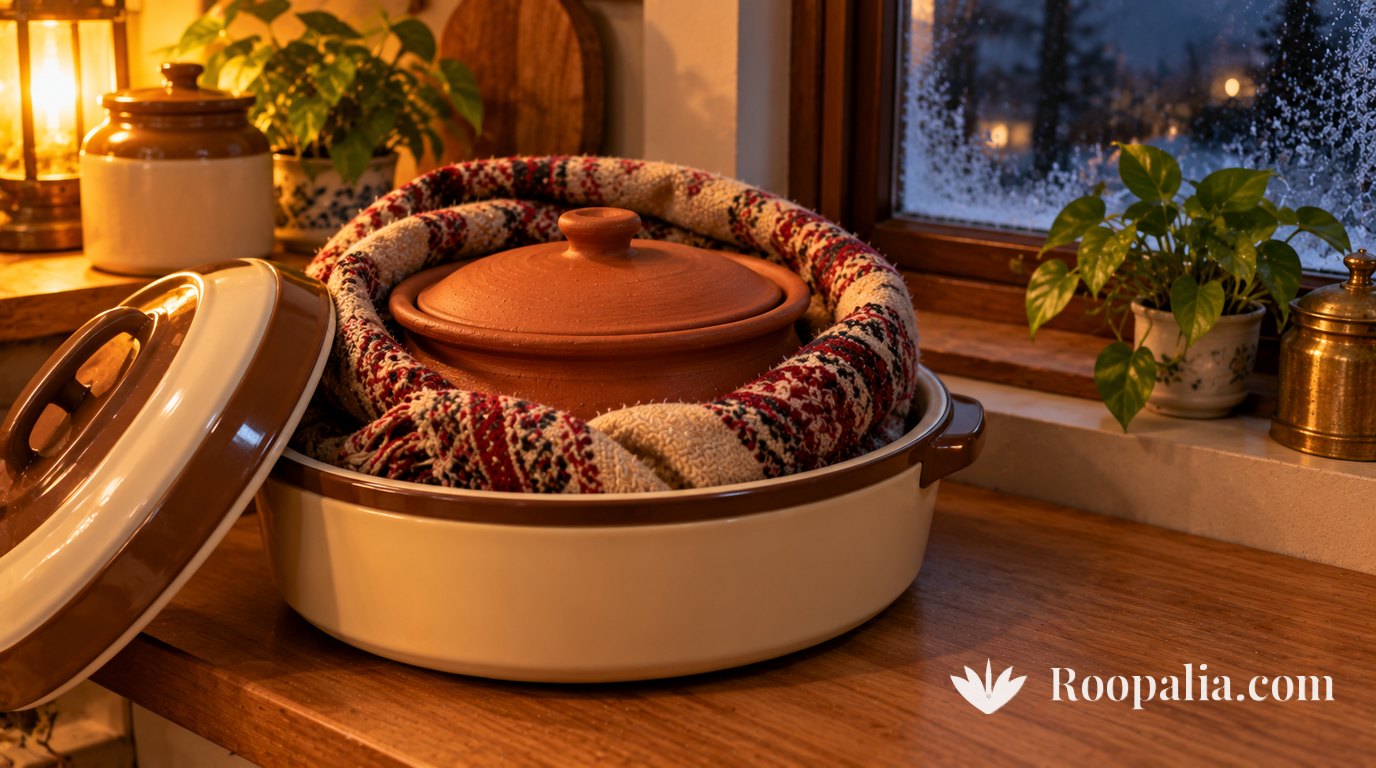
- Wrap it in a shawl or blanket — wool adds no heat but slows the milk’s own heat escaping.
- An insulated roti casserole does the same job, and better with the shawl inside it.
- Bury it in the atta tin. Grandmothers pressed a lidded bowl deep into the flour container, which holds warmth.
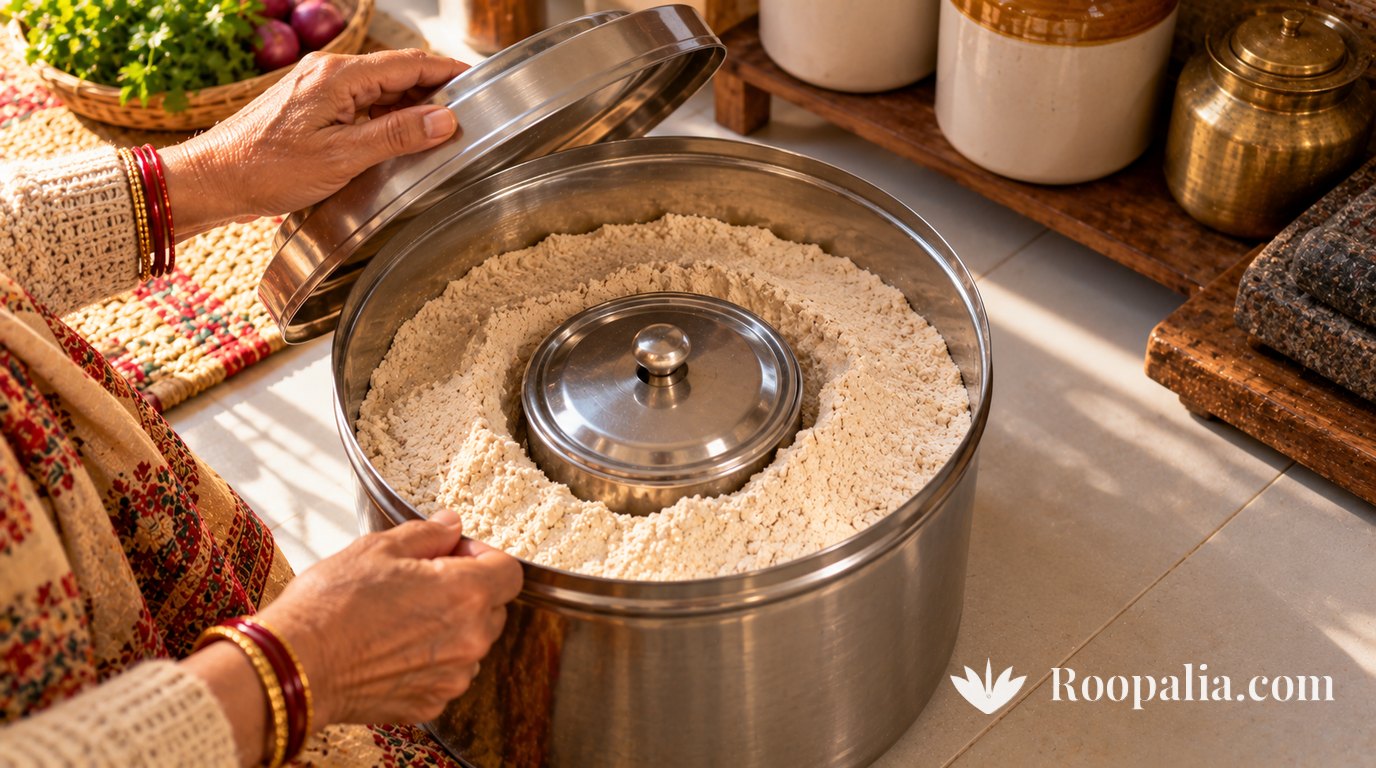
I found no lab tests of these household methods either. They all rest on the principle the guides spell out: keep the culture warm and it will do the work.
Why is my homemade yogurt runny? Making thick curd
- Heat the milk longer. Dr. Nummer: hold it at 200°F for 10 minutes for thinner yogurt, 20 minutes for thicker. In practice: bring it to the boil, then simmer gently a while.
- Add milk powder. The UAF guide suggests nonfat dry milk powder for a firmer set.
- Don’t disturb it. Dr. Nummer: whey separates when yogurt is incubated too long or “by agitating the yogurt while it is setting.”
- Don’t leave it out. Set curd left warm keeps going: thinner, then sour.
UHT and ultra-pasteurized milk. Long-life milk is common outside India, and many blogs say it sets well without heating. I looked for a university or government guide on this and did not find one, so I won’t give a rule. Ordinary pasteurized whole milk, heated as above, is the straightforward route.
Why curd turns sour
The bacteria don’t stop when the curd sets. Dr. Nummer: incubating “for several hours past the time after the yogurt has set will produce more acidity.” That is why curd left overnight in a warm Indian summer goes sour by morning. Check it at the four-hour mark, use a fresh (not already sour) starter, and refrigerate as soon as it holds.
How to make curd without a starter — the chilli stalk
“How to make curd at home without starter” and “with green chilli” are common searches. Wikipedia’s Dahi article notes that a starter is sometimes made by putting dried red chillies or their stems into hot milk. I also found a small 2019 pilot study in the Applied Food Science Journal in which chilli stalks did curdle milk — but the researchers did not identify which bacteria were responsible.
Treat it as an emergency method, not a routine one. The more reliable route abroad is a spoonful of plain, unflavoured, unsweetened supermarket yogurt as your first starter.
Keeping a starter, and how long homemade curd lasts
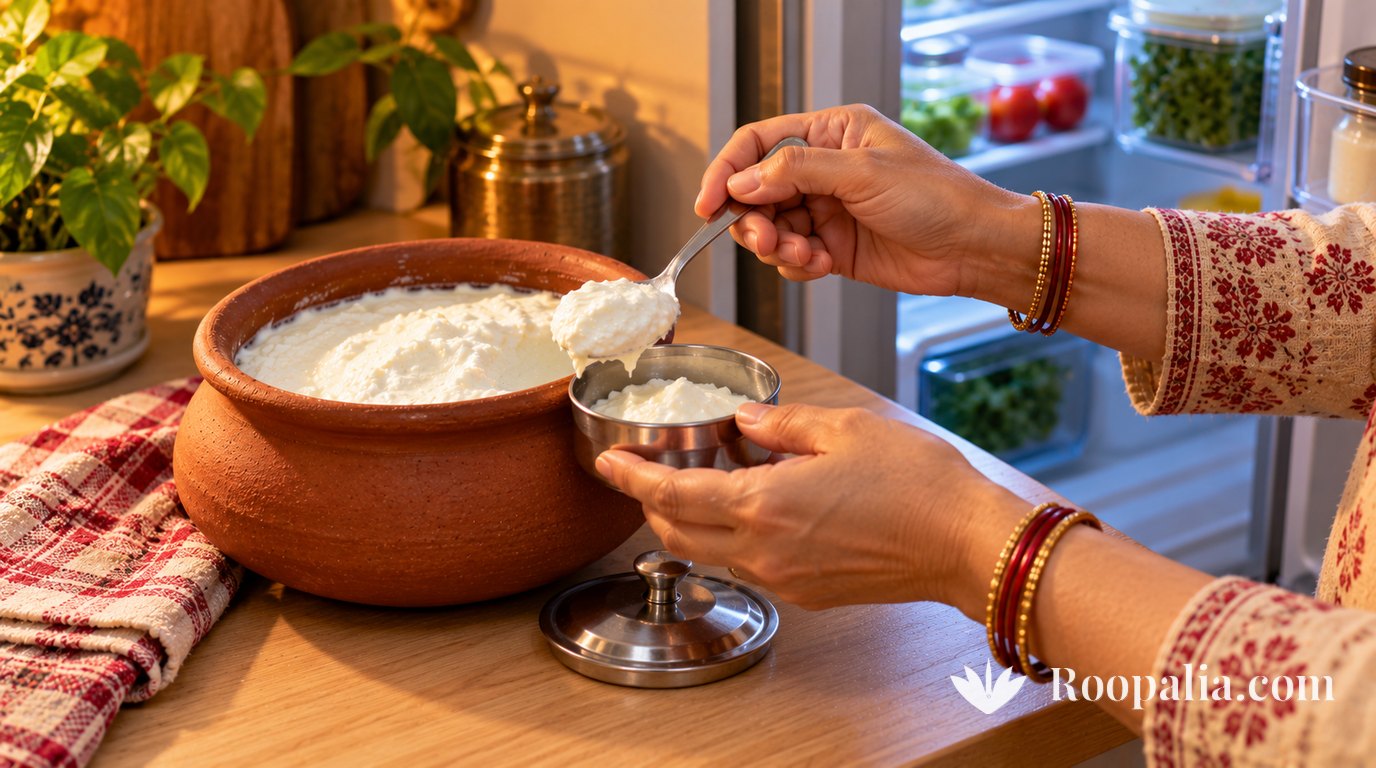
Here the two guides disagree, and both views are worth knowing. The UAF guide says to save a little of each batch as the next starter — exactly what Indian households do. Dr. Nummer recommends a fresh culture from the store each time. A practical middle path: take the starter from fresh curd with a clean spoon, and buy a new starter when batches start setting weakly or tasting odd.
Shelf life: both guides give 10–21 days in a refrigerator at 40°F (about 4°C) or below. Homemade curd grows more sour day by day, so most families finish it well before then.
Curd vs yogurt — is there a difference?
Mostly a difference of usage. Wikipedia’s Dahi article: “The word curd is used in Indian English to refer to homemade yogurt, while the term yogurt refers to the pasteurized commercial variety.” Traditional dahi is set from a previous batch, so its mix of bacteria varies from home to home; commercial yogurt uses defined cultures. That is why a supermarket tub works as a first starter: it is the same kind of fermentation.
And the question searched almost as often as how to set it: should you be eating curd at night — or in this season at all?
Can we eat curd at night? What the Charaka Samhita says
न नक्तं दधि भुञ्जीत न चाप्यघृतशर्करम् ।
नामुद्गयूषं नाक्षौद्रं नोष्णं नामलकैर्विना ॥६१॥
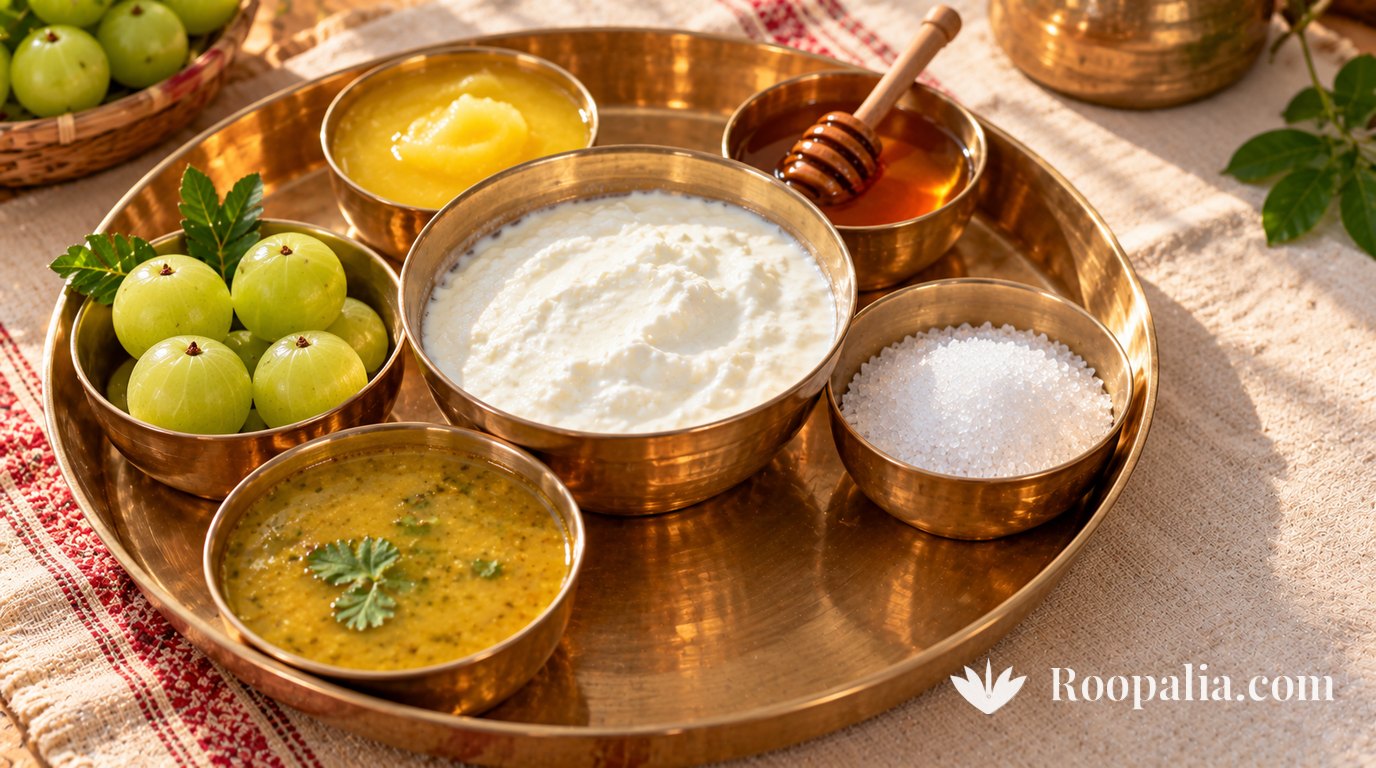
“Curd should not be consumed at night. Otherwise, if curd is to be taken, it should be mixed with ghee, sugar, green gram soup, honey or amalaka.”
— Charaka Samhita, Sutrasthana 7.61 (courtesy: carakasamhitaonline.com)The verse also says curd should not be taken heated (noshnam), and the next verse, 7.62, lists fever, bleeding disorders, skin disease, anaemia, giddiness and jaundice as the result of ignoring these rules.
And in which season? Charaka’s seasonal chapter (Sutrasthana 6) is specific:
- 6.13, Hemanta (deep winter): “gorasa” — milk products — along with cane sugar, fats, oil and new rice, are recommended. The same regimen continues into Shishira.
- 6.45, Sharad (autumn): “क्षारं दधि दिवास्वप्नं प्राग्वातं चात्र वर्जयेत्” — alkalis, curd, daytime sleep and the east wind are to be avoided.
The table on carakasamhitaonline.com places Sharad at roughly mid-September to mid-November and Hemanta at mid-November to mid-January. In other words, by Charaka’s calendar, October is a time to go easy on curd, and the deep cold is when dairy is back in favour.
Worth saying plainly: the Charaka Samhita is a classical Ayurvedic text, not modern clinical research, and its seasons follow India’s climate, not Canada’s or England’s. The verse says nothing about salt in curd either way. For pregnancy, any illness, or feeding a baby, ask your own doctor.
For whether curd is allowed on a fast, see what to eat during a Hindu fast. Dry winter air indoors affects more than curd — our piece on why heels crack in winter covers it — and curd is part of the pre-dawn meal in your first Karwa Chauth away from India.
What I found — and what I didn’t
| Question | Result |
|---|---|
| Temperatures and timing | Found — starter at 112–115°F, incubate 110°F ±5 for 4–7 hours (NCHFP, UAF) |
| Too-hot milk kills the starter | Found — above 115°F (UAF) |
| Why curd is sour or weeps whey | Found — too long warm, or disturbed (Dr. Nummer) |
| Curd at night | Found — Charaka Samhita, Sutrasthana 7.61–62 |
| Curd by season | Found — avoided in Sharad (6.45); dairy recommended in Hemanta (6.13) |
| Chilli-stalk starter | Partly — one pilot study; bacteria not identified |
| Setting curd with UHT milk | No reliable source found |
| Tests of the oven-light, shawl or atta-tin methods | Not found — household practice, consistent with the guides |
| Salt in curd | Not found — not mentioned in 7.61 |
“Not found” does not mean “does not exist”. It is the honest result of my search, not a final verdict.
The bottom line. Curd fails in winter for one reason: the starter gets cold. Heat the milk well, add fresh starter when it is warm (not hot), keep the bowl at about 110°F for 4–7 hours — oven light, multicooker, or shawl and casserole — and refrigerate it the moment it sets.
As for eating it: the Charaka Samhita says not at night, and not in Sharad, and suggests ghee, sugar, moong, honey or amla alongside. Your grandmother’s atta tin and a university food-science guide end up saying the same thing: warmth, patience and a clean spoon.
Frequently asked questions
How do you set curd in winter or in cold weather?
Why is my curd not setting?
How long does curd take to set?
Why is my homemade yogurt runny, and how do I make thick curd?
Can you make curd without a starter, for example with a green chilli?
Can we eat curd at night according to Ayurveda?
Should we eat curd in winter, and in which season should it be avoided?
What is the difference between curd and yogurt, and how long does homemade curd last?
Sources and cautions: the curd-making information was opened and checked — Brian A. Nummer, Ph.D., “Fermenting Yogurt at Home”, National Center for Home Food Preservation (courtesy: UC Davis Food Safety), and Julie Cascio, “Making Yogurt at Home”, University of Alaska Fairbanks Cooperative Extension. Celsius figures are converted from their Fahrenheit figures. The traditional method, curd/yogurt usage and chilli starter are from Wikipedia, Dahi (curd); the chilli-stalk pilot study is in the Applied Food Science Journal (2019). Texts: Charaka Samhita, Sutrasthana 7.61–62, 6.13 and 6.45 (courtesy: carakasamhitaonline.com). Three things should be said plainly. First, I found no tests of the oven-light, shawl or atta-tin methods and no university source on UHT milk. Second, the months for each season come from the table on carakasamhitaonline.com, not from the verses. Third, the Charaka Samhita is a classical Ayurvedic text; ask a doctor about pregnancy, illness or a baby’s diet. No brand is recommended. “Not found” does not mean “does not exist”.