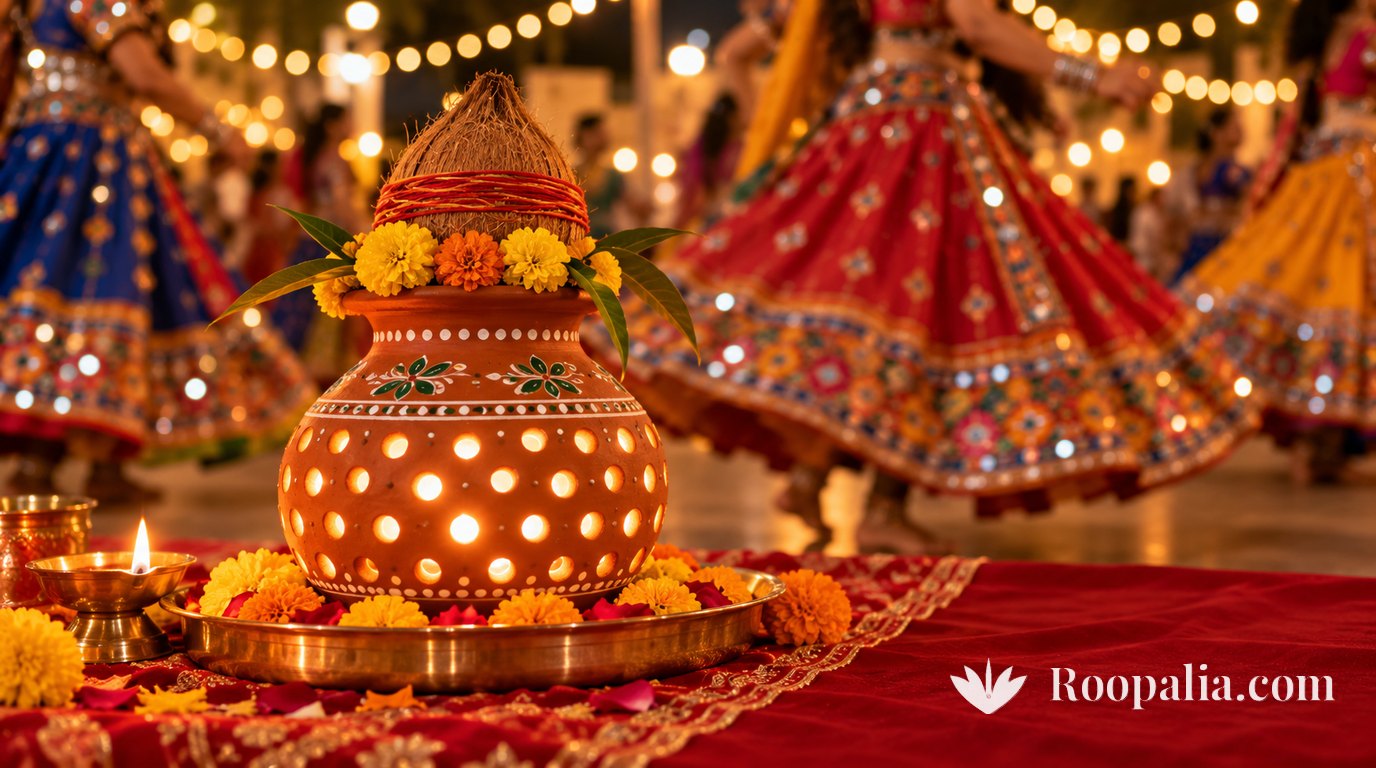
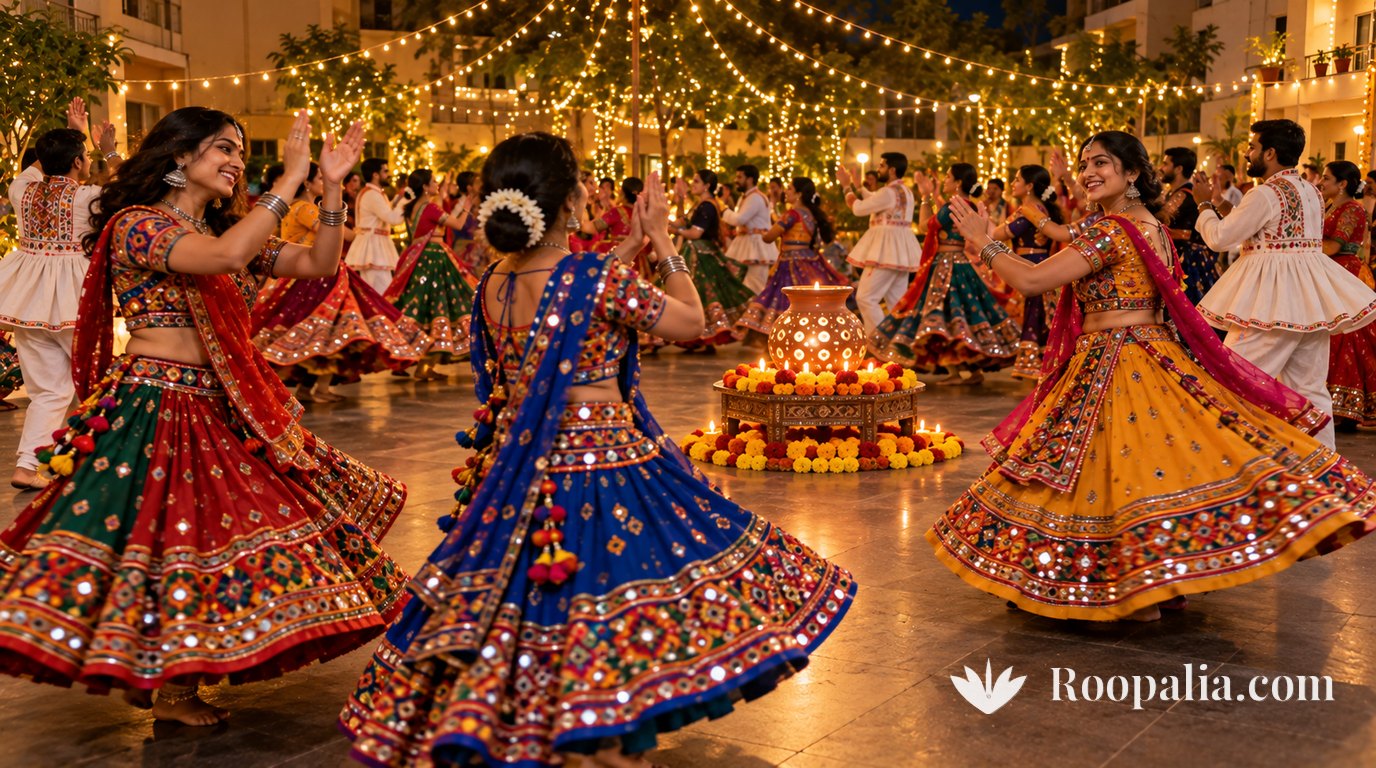
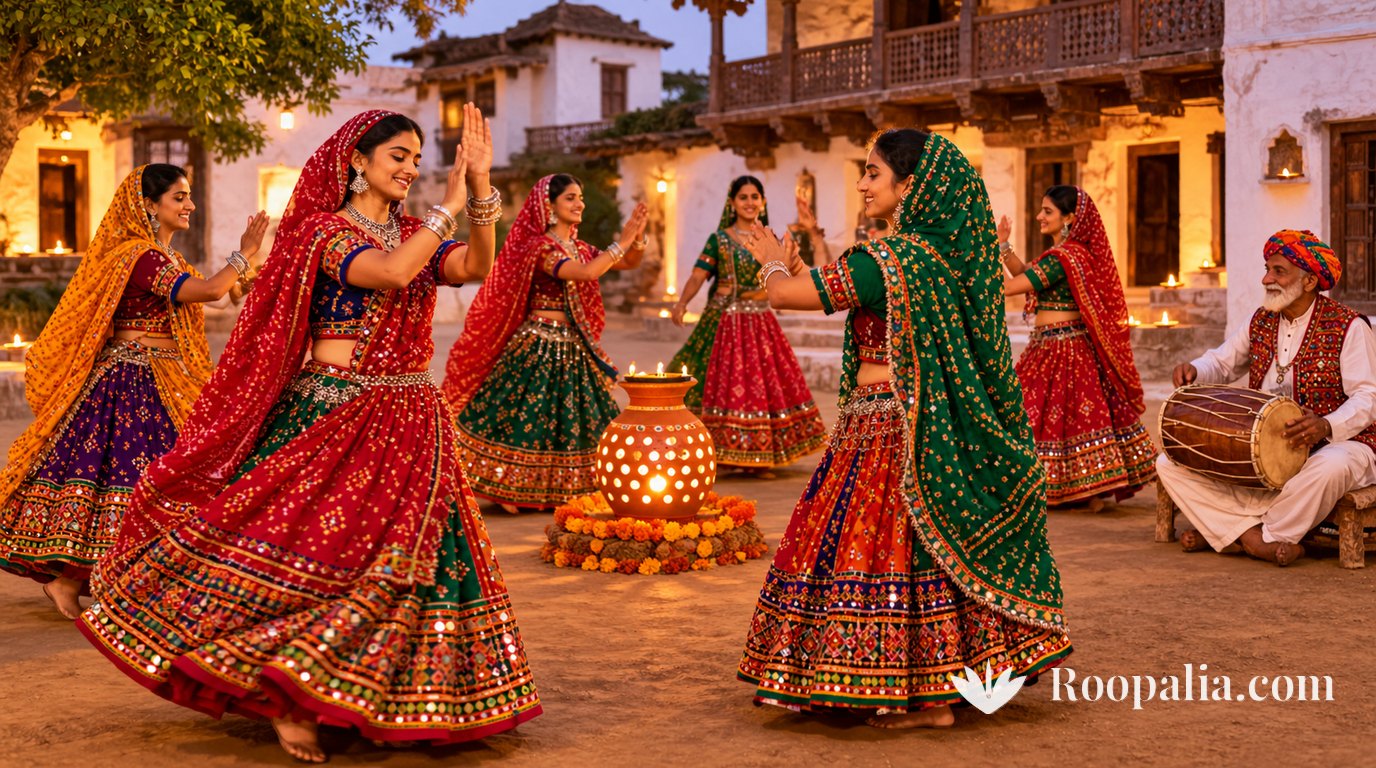
Walk into any Navratri garba night, in Ahmedabad or in Leicester, and the first thing you notice is not the music. It is a clay pot in the middle of the floor, punched with small holes, with a lamp burning inside so that dots of light spill across the ground. Hundreds of people circle it, clapping in time. That pot is the whole point.
Most guides call Garba "thousands of years old" and move on. I went looking for the oldest dated written trace of it, and found a song written by a 13-year-old boy.
What is Garba and why is it celebrated?
Garba is a devotional circle dance from Gujarat, performed during the nine nights of Navratri in worship of the Mother Goddess, Amba or Durga, around a perforated clay pot lit with a lamp. In December 2023, UNESCO added "Garba of Gujarat" to its Representative List of the Intangible Cultural Heritage of Humanity, describing it as a "ritualistic and devotional dance" celebrating feminine energy, or Shakti.
“The dance takes place around a perforated earthenware pot lit with an oil lamp, or an image of the mother goddess Amba.”
— UNESCO, Garba of Gujarat, 2023 (courtesy: UNESCO)The significance of the pot
The word garba is traced to the Sanskrit garbha, womb. The pot, called the garbo, stands for the womb, and the lamp inside for the life growing within it (courtesy: Wikipedia). Dancers circle the source of life itself: the Mother. Britannica adds a detail many guides leave out: in Gujarat, garba was traditionally also danced to mark a girl’s first menstruation and her coming marriage, as a celebration of fertility and womanhood (courtesy: Britannica). We looked at what the texts say about periods and worship in Can Hindu women pray during periods?
UNESCO also notes something social: garba "fosters social equality by diluting socio-economic, gender and religious structures". In a garba circle, nobody has a front row.
Your first garba night: what to wear
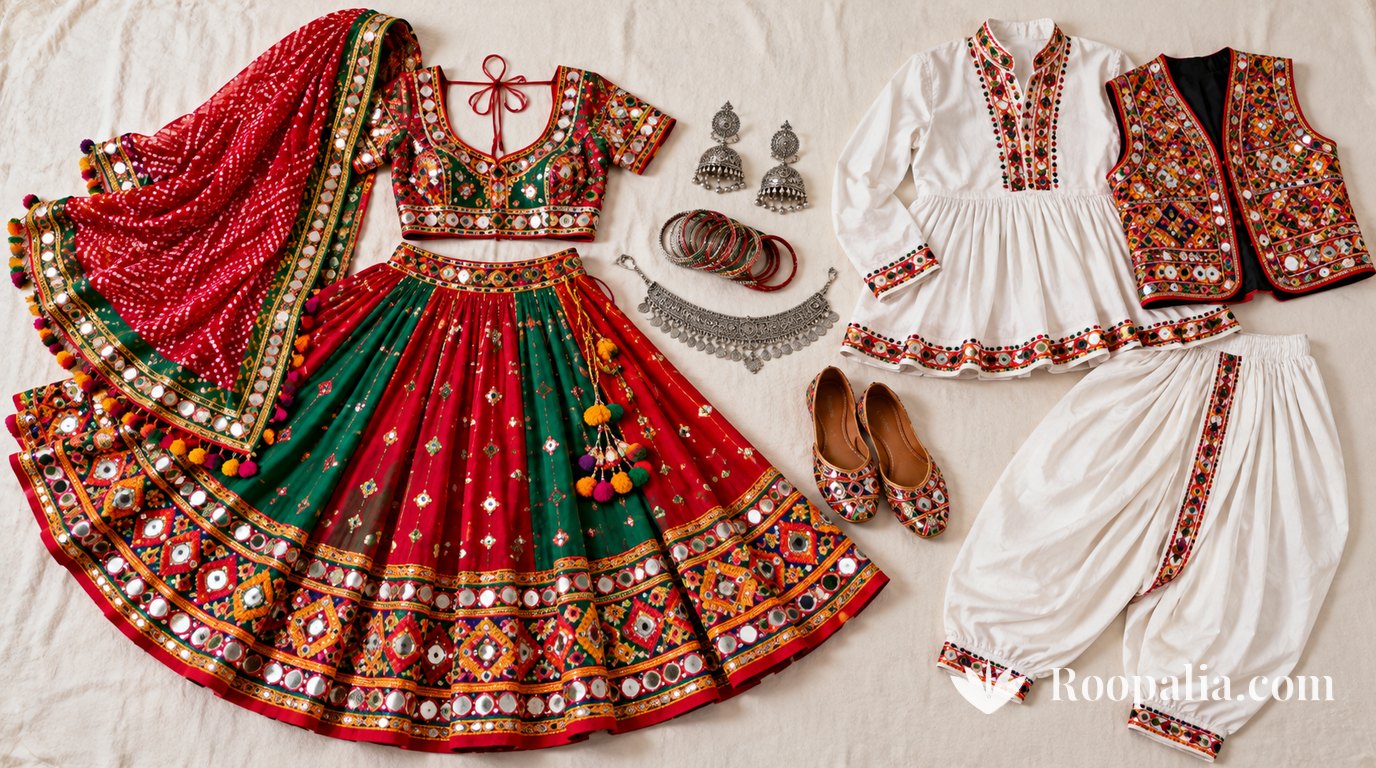
According to the Government of India’s Incredible India site, women traditionally wear the chaniya choli, and men wear the chorno, kediyu or dhoti (courtesy: Incredible India).
| Piece | What it is | Tip |
|---|---|---|
| Chaniya | A wide, flared skirt, often with mirror work and Kutchi embroidery | More flare looks better when you spin; cotton keeps you cooler |
| Choli | A fitted, embroidered blouse | Check the back ties are secure before you start |
| Odhni / dupatta | Often bandhani (tie-dye) | Pin it so it does not slip mid-twirl |
| Kediyu | Men’s top, fitted at the chest and flared below | Pairs with chorno (loose trousers) or dhoti |
| Koti | Sleeveless embroidered jacket, now worn by women and men | An easy way to dress up plain clothes |
| Footwear | Flat juttis or mojaris, or barefoot where allowed | Avoid heels; sprained ankles are common |
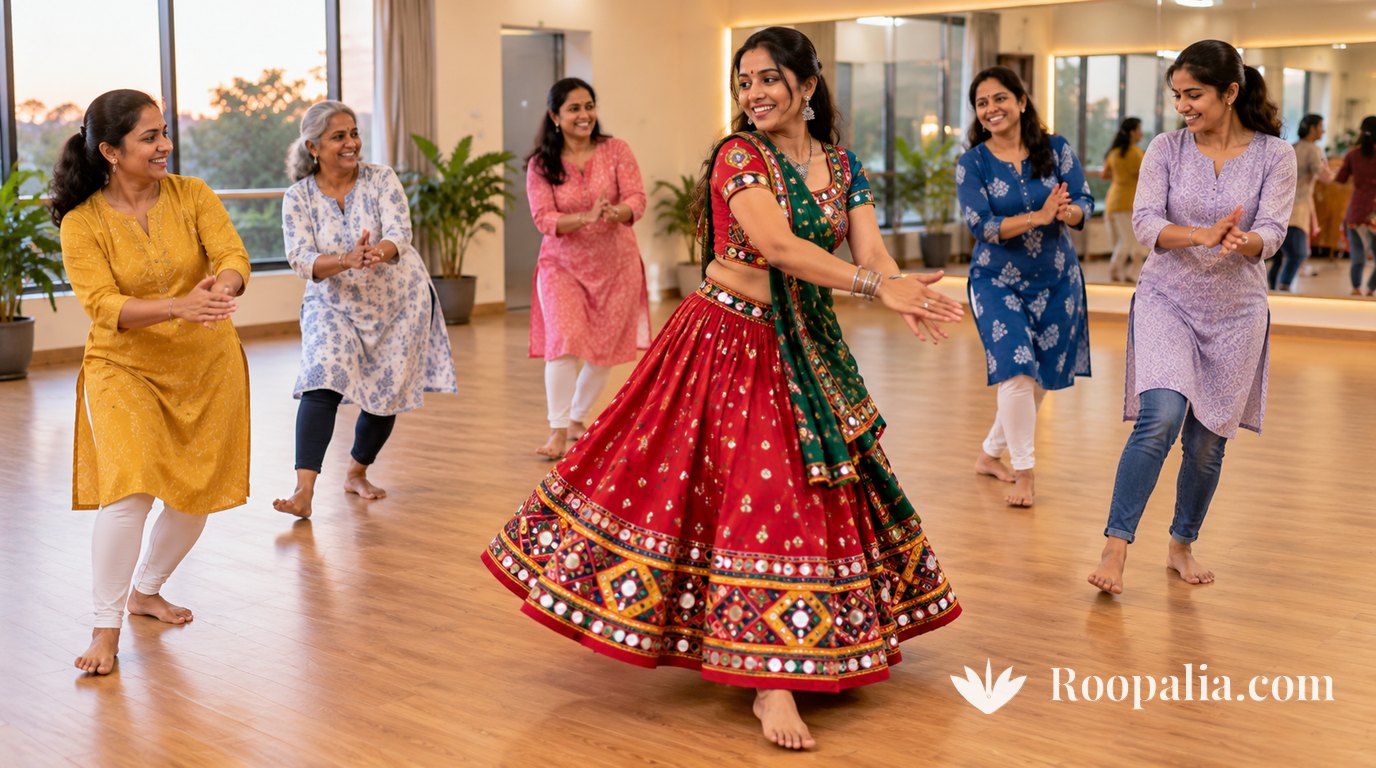
For a garba workshop, a cotton kurta with leggings or jeans is fine; save the heavy outfit for the night itself. Keep jewellery light: big jhumkas and waist chains can tangle when you spin.
How to play Garba: a beginner’s guide
Step names vary by region. A guide from the International Festival of Arts and Ideas lists three common forms: be taali (two-clap), tran taali (three-clap) and hinch (courtesy: artidea.org).
- Find the direction. UNESCO notes the circle moves counter-clockwise. Watch from the edge for a minute first.
- Two-clap: step with the right foot, bend and clap; step with the left, clap again; move forward.
- Three-clap: the same, with a third clap raised high as you turn slightly.
- Hinch: a slower, swaying rhythm with more movement in the waist and arms.
- Let it speed up. In UNESCO’s words, slow circular movements build "to a frenzied whirling". When you tire, step out. Nobody minds.
Is Garba good for health? Claims vs evidence
You will see "an hour of garba burns 400 to 600 calories" everywhere. I could not find any study behind that number; it appears only in news stories and blogs. What does exist are two small studies.
Young women, 2019
Shah Mital Bhaumik and colleagues, "The effect of Garba dance of Gujarat on fitness components of young adult females", Journal of Society of Indian Physiotherapists, August 2019, 3(2). Twenty-five students aged 19 to 25 did garba three times a week, about 30 minutes a session, for 10 weeks. Flexibility improved (sit-and-reach 46.0 to 48.5 cm) and resting heart rate fell from about 90 to 82 beats a minute. BMI, VO2max and mood did not change significantly, and there was no comparison group. (The paper is a PDF, so it is cited in words only.)
"Chair Garba", 2025
Sanjivani Kamble, Omkar Pise, Bhargavi Baria and Amisha Ghorpade of Dr. D. Y. Patil Vidyapeeth, Pune, "The Effect of Chair Garba Rhythm Therapy on Balance, Functional Mobility and Quality of Life in Neurorehabilitation: A Pilot Study", Research Square, 23 December 2025. Twenty-two patients (10 stroke, 8 Parkinson’s, 2 multiple sclerosis, 2 traumatic brain injury; aged 42 to 82) did seated garba four times a week, 45 minutes a session, for four weeks. Balance (Mini-BESTest) rose from 16.3 to 22.7, the Timed Up and Go test fell from 14.8 to 11.2 seconds, and quality-of-life scores rose from 51.8 to 64.7. (Also a PDF, cited in words.)
Read the headlines with care:
- The chair-garba paper is a preprint, not yet peer reviewed.
- Patients were not randomized, and the study lasted only four weeks; the authors say larger trials are needed.
- It did not measure the brain (no MRI or EEG), so claims that "garba activates the brain" do not come from this study.
- Three participants had near-falls. Patients should try it only under a doctor’s or physiotherapist’s supervision.
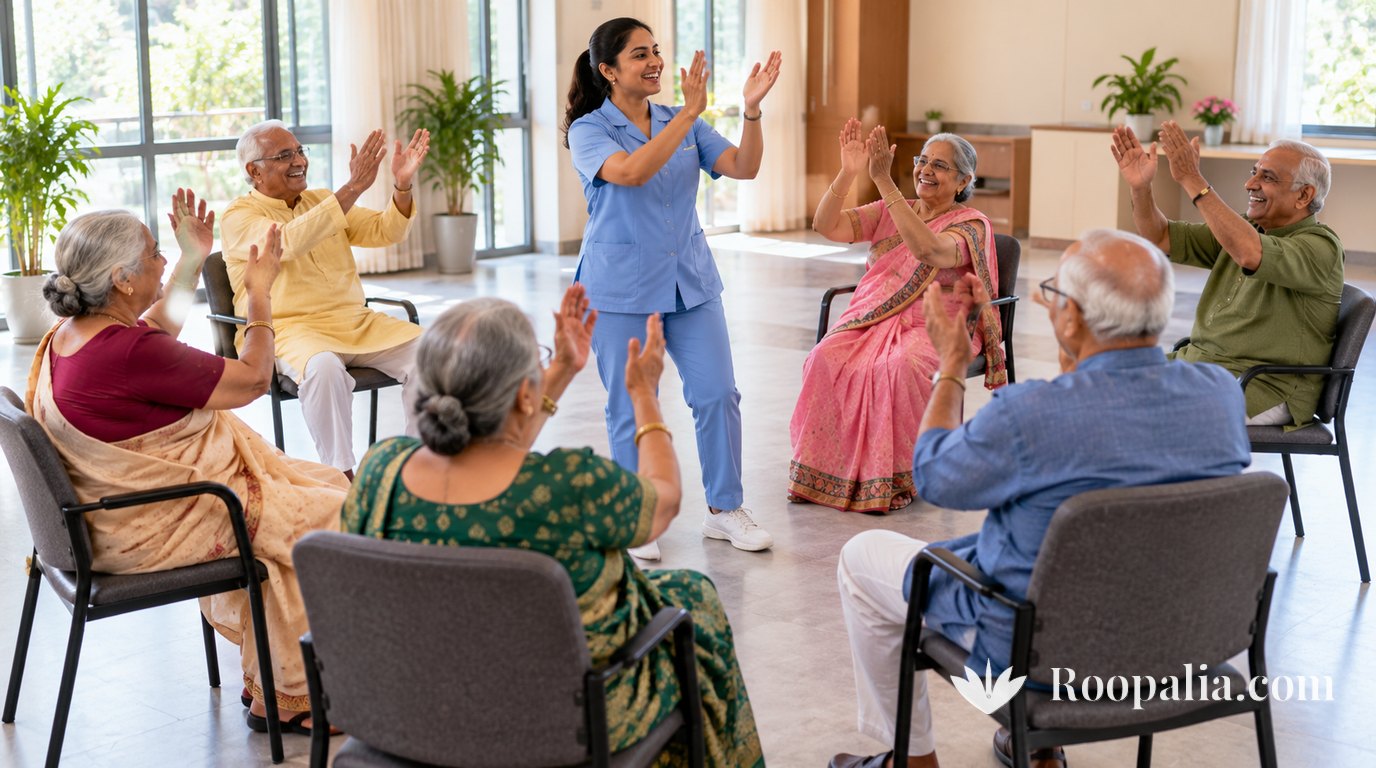
The fair summary: garba is good physical activity. The WHO recommends adults get at least 150 minutes of moderate activity a week, which lowers the risk of heart disease and high blood pressure (courtesy: WHO), and nine nights of garba easily cover that. It is not a treatment, and it is not a weight-loss trick.
Safety on garba nights
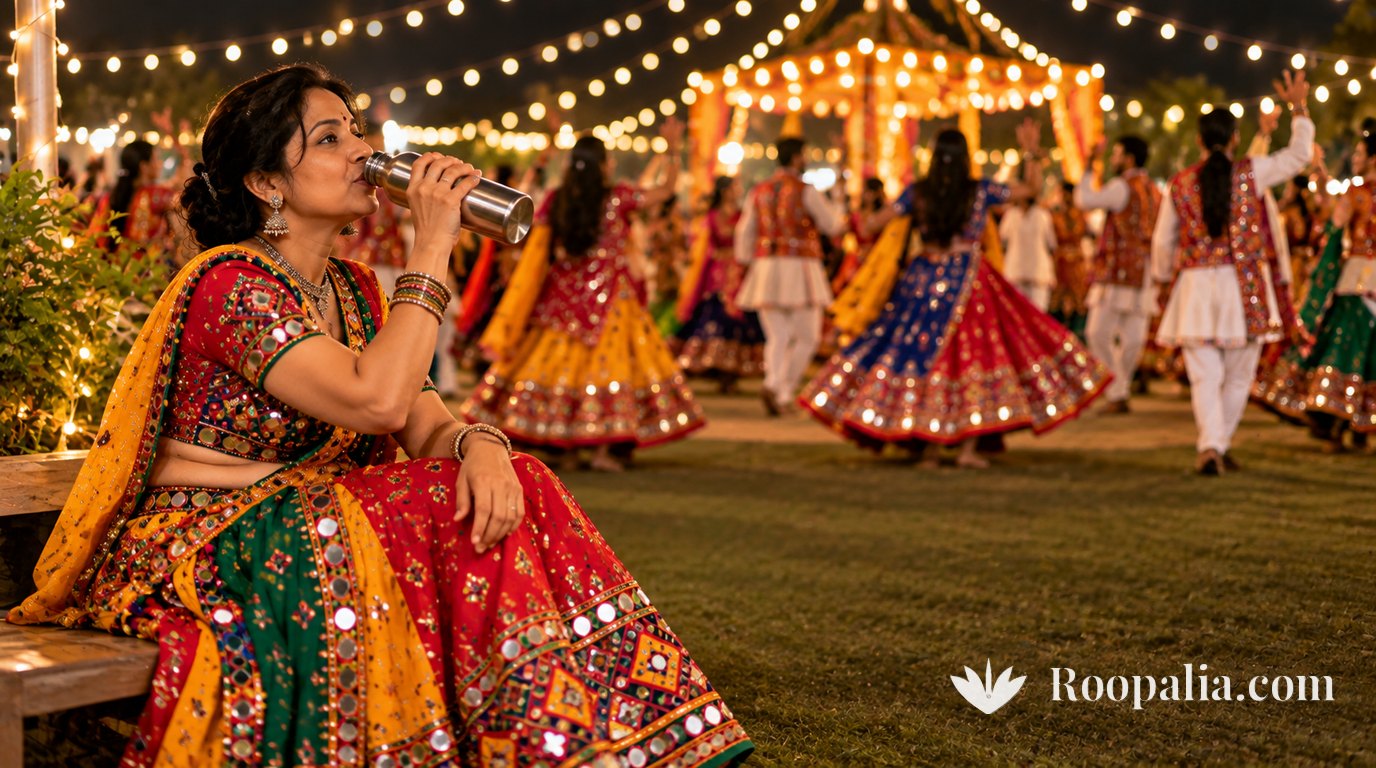
Hours of fast dancing, little sleep, too little water and fasting can add up; there have been news reports of heart attacks at garba events. The NHS lists the warning signs: chest pain that feels tight or crushing and may spread to the arm, neck or jaw, shortness of breath, nausea and sweating (courtesy: NHS). Stop and call emergency services at once. If you have heart disease, high blood pressure, diabetes, are pregnant, or have knee or back problems, check with your doctor and keep to a gentle pace. Take breaks and drink water.
Garba vs Dandiya: what is the difference?
| Garba | Dandiya Raas | |
|---|---|---|
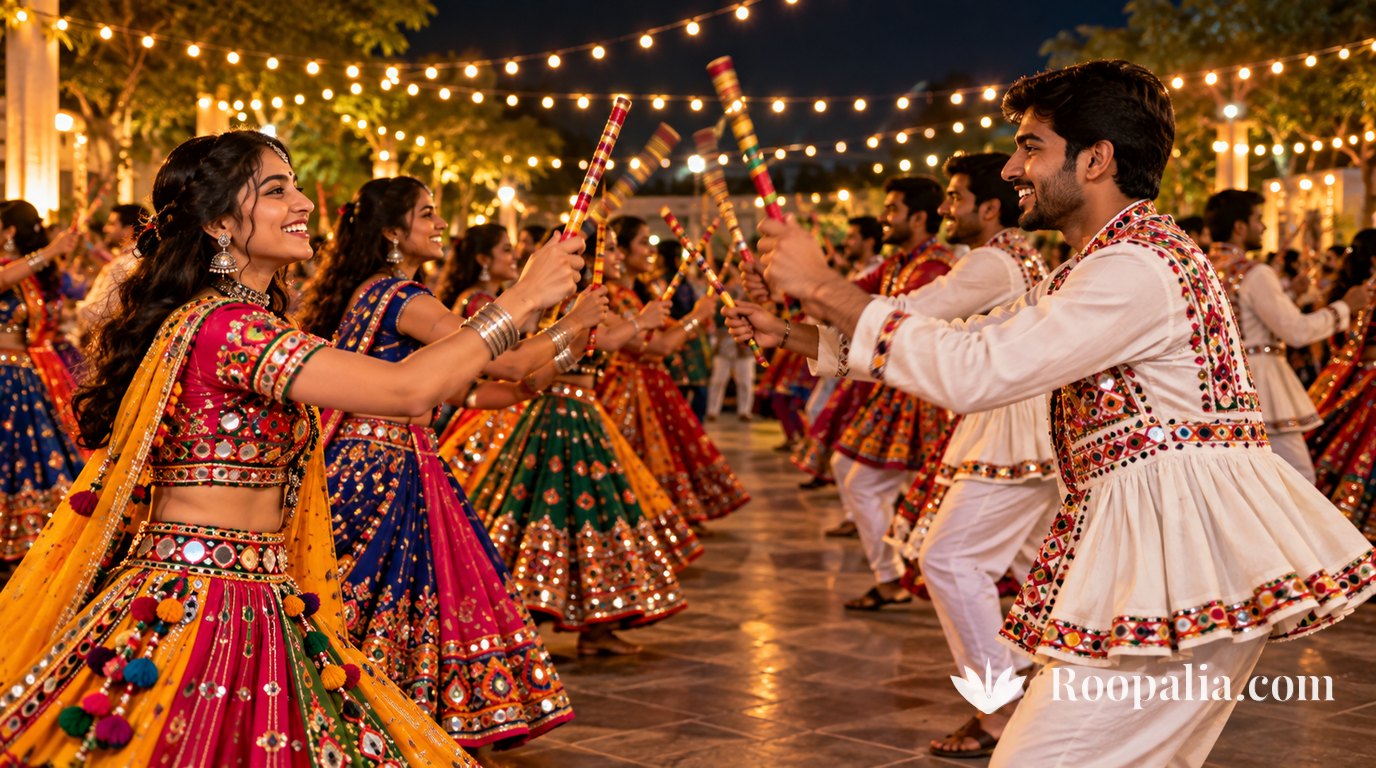
| Hands | Empty: claps and snaps | A pair of decorated sticks |
| Centre | The lit garbo or an image of the goddess | Not required |
| Formation | One circle moving together | Pairs facing each other, rotating partners |
| Meaning | Worship of the Goddess | "Raas", from Sanskrit rasa; linked to Krishna and the gopis |
Wikipedia’s Dandiya Raas article notes that men and women traditionally play it in pairs, and that in Saurashtra the women’s form is called raasda (courtesy: Wikipedia). The Arts and Ideas guide calls raas "the Sword Dance", with the sticks standing in for swords in a mock fight.
Garba outside India
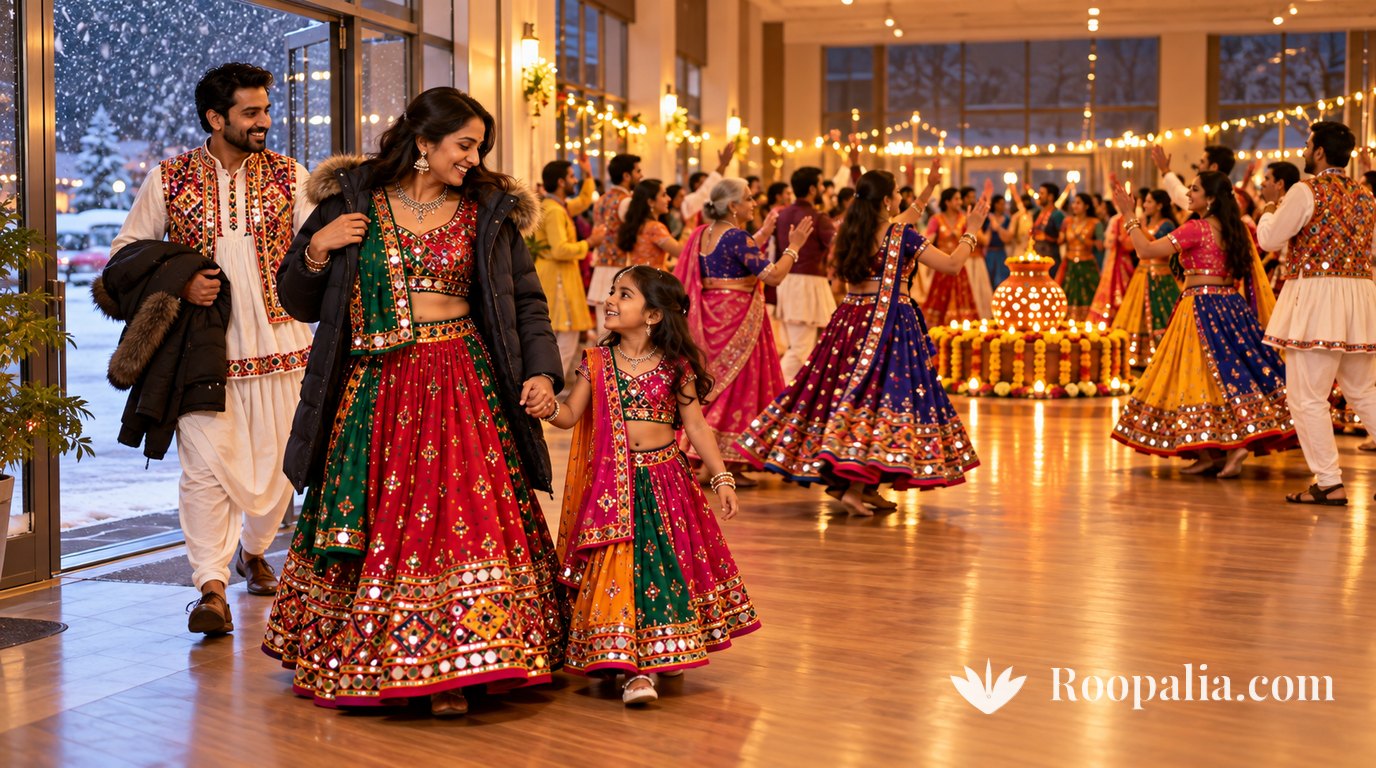
Britannica and Wikipedia both describe garba spreading far beyond Gujarat: Gujarati communities in the UK hold their own garba nights, and US universities have run garba-raas competitions since around 2000. If you are going for the first time:
- Ask your local temple, Indian cultural association or university Indian students’ group; most garba nights are listed there, often at weekends.
- In a cold climate, wear a long coat over your chaniya choli and carry your juttis in a bag.
- Bring the children and tell them what the pot and the lamp mean. Stories stay; lists do not.
- Check the dates: Navratri can begin on a different day in your city. Here is why your festival date differs from India.
Garba history: when did it begin?
No source I checked gives a date for when garba began. UNESCO, Wikipedia and Britannica all treat it as an old folk tradition of Gujarat; claims of "5,000 years" come without sources.
The oldest dated written trace I found is the Ahmedabad devotional poet Vallabh Bhatt, who, according to Wikipedia, wrote his first song, Anand no Garbo, in Vikram Samvat 1709 (about 1652–53 CE) at the age of 13, and went on to write many garbas to Bahuchar Mata and Ambaji (courtesy: Wikipedia). Wikipedia flags his dates as doubtful, so treat this as a written milestone, not the start of the dance. Later, the poet Dayaram (1777–1853) made the garbi, a Krishna-devotional song form, popular (courtesy: Wikipedia).
A legend says the goddess Parvati taught the graceful lasya dance to Usha, daughter of Banasura, who taught it to the gopis (courtesy: Wikipedia). Some pages present this as garba’s origin, but I found no source that makes that link directly.
What I found, and what I didn’t
| Claim | Result |
|---|---|
| Meaning of the pot and lamp | Found: UNESCO; Wikipedia ("garbha") |
| Link to first menstruation and marriage | Found: Britannica |
| A start date for garba | Not found |
| Oldest dated written trace | Found: Vallabh Bhatt, Samvat 1709 (dates flagged as doubtful) |
| Usha and lasya as garba’s origin | Not found as a sourced link |
| "400–600 calories an hour" | No study found |
| Health studies | Found: 2019 (25 students) and 2025 preprint (22 patients), both small |
The bottom line. Garba is worship you can dance: the pot is the womb, the lamp is life, and everyone circles the Mother. Nobody knows when it began, but songs more than 350 years old bear witness to it, and since 2023 it belongs to the world’s heritage.
The health benefits are real but modest. Dance at your own pace, keep water close, and stop at once if your chest hurts.
Frequently asked questions
Why is Garba celebrated?
What is the significance of the pot in Garba?
What should I wear for a garba night?
What is the difference between Garba and Dandiya?
What are the health benefits of Garba?
Is Garba good for weight loss?
How do you play Garba as a beginner?
When did Garba start?
Sources and cautions: sources consulted — UNESCO (Garba of Gujarat, 2023), Britannica (Garba), Wikipedia (Garba; Dandiya Raas; Vallabh Bhatt; Dayaram; Lasya), Incredible India (United Way of Baroda Garba Mahotsav), International Festival of Arts and Ideas (What is Garba?), WHO (Physical activity) and NHS (Heart attack). Two studies are PDFs and are cited in words only: Shah Mital Bhaumik et al., Journal of Society of Indian Physiotherapists, 2019; Kamble, Pise, Baria and Ghorpade, Research Square preprint, 2025. Three things should be said plainly. First, a start date for garba, a sourced link between the Usha-lasya legend and garba, and the "400–600 calories" claim were not found in this search; that is the result of a search, not a final verdict. Second, steps and customs vary by region. Third, this article is not medical advice; with heart disease, high blood pressure, diabetes, pregnancy or joint problems, check with a doctor first, and try chair garba only under a doctor’s or physiotherapist’s supervision. No brand or shop is recommended.