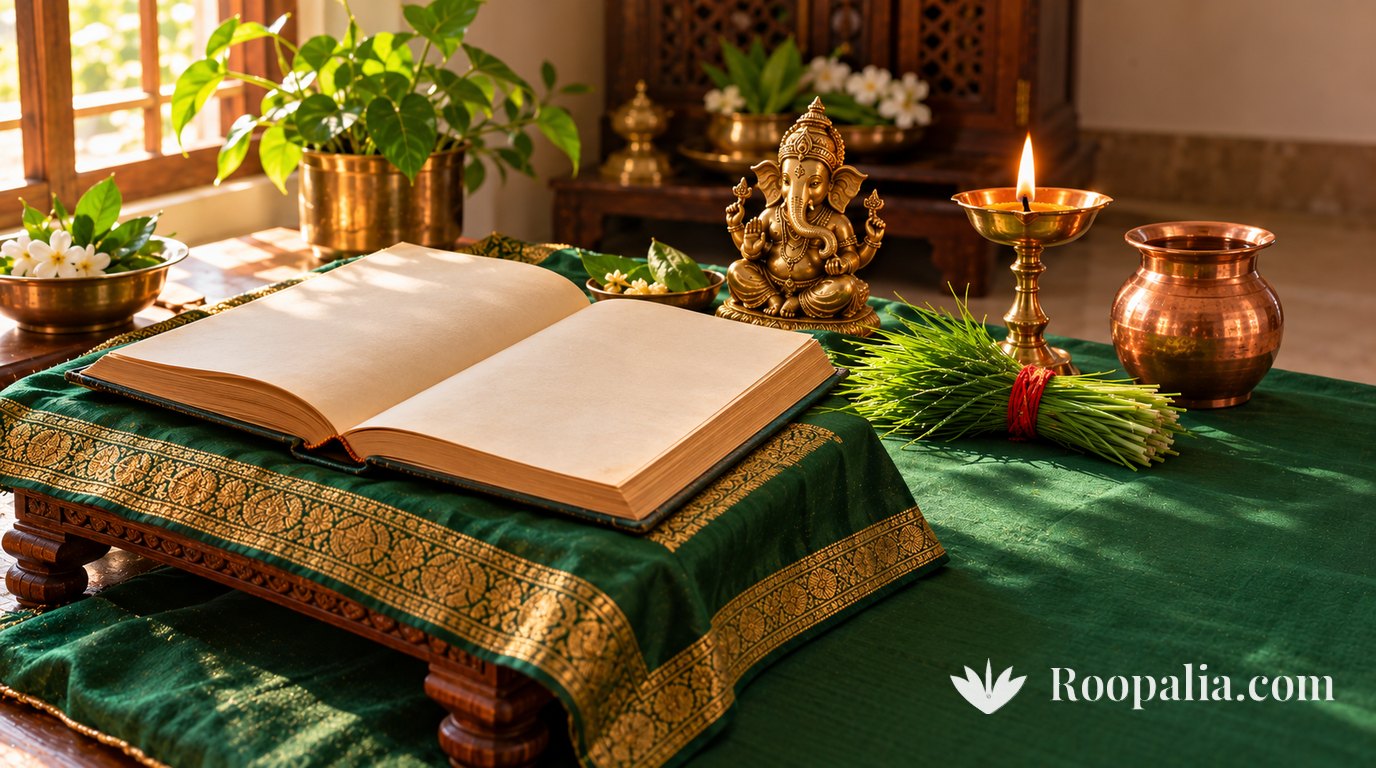
Most weekday fast stories are about lack. Someone is poor, someone is ill, someone has no children, and by the last paragraph it has been put right.
The Wednesday story is not about lack. It is about something far stranger, and far more modern: a man loses the ability to prove he is himself.
Before the story, one thing worth knowing — because it explains why this particular story exists at all, and why it is still told in families that no longer remember why.
What this story is actually answering
In a great many North Indian families there is a rule: a daughter is not sent to her marital home on a Wednesday. No journey, no vidai, not that day. Families that have moved to Toronto and Leicester and New Jersey still keep it, often without being able to say where it came from.
This story is where it came from. It is the reason, told as a story instead of as a rule — which is how traditions usually remember things, because a rule is forgotten in one generation and a story is not.
So read it as an explanation, not a warning. The difference matters, and by the end you will see why.
The Wednesday vrat katha
A man named Madhusudan lived in a town called Samatapur. His wife Sangita had gone to her parents' home in Balrampur, and when many days had passed he went to bring her back.
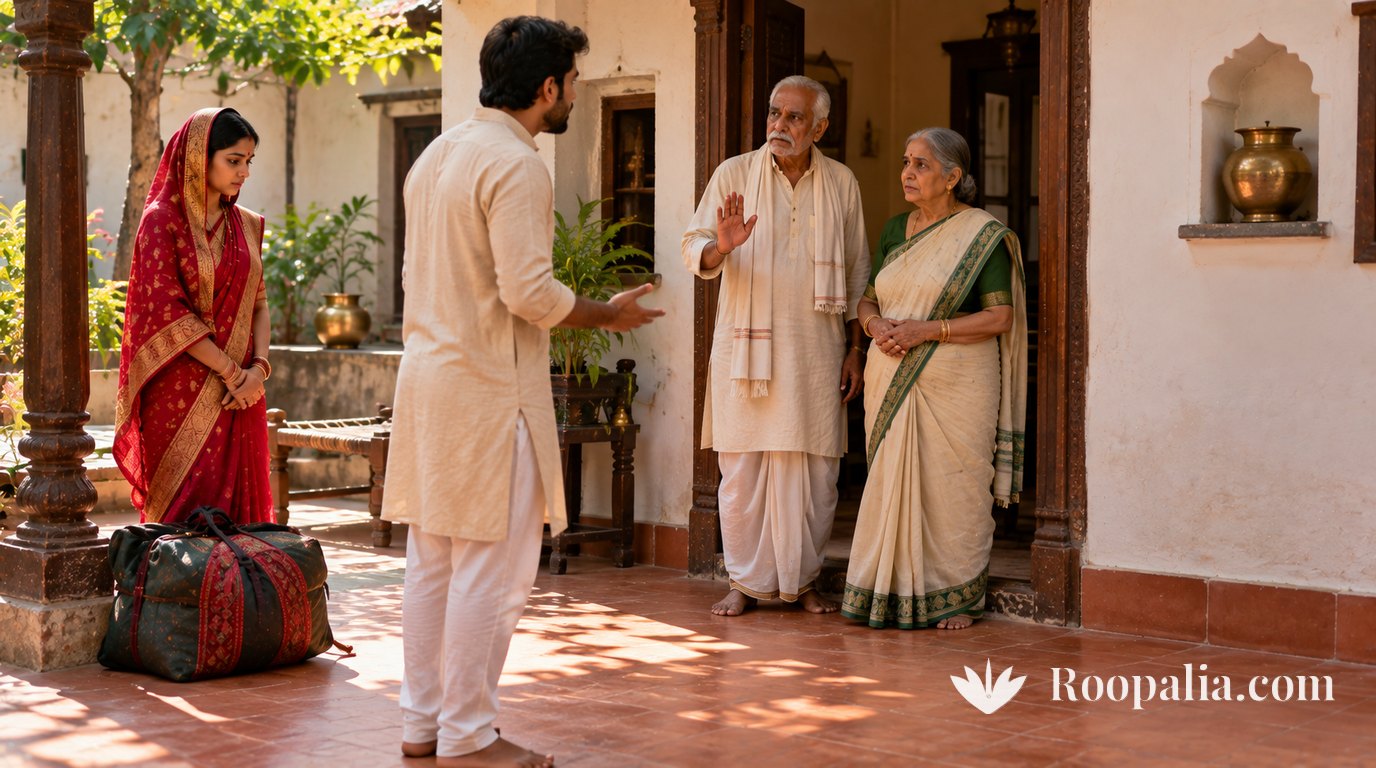
The next morning, as he made ready to leave, her family stopped him.
"Today is Wednesday. One does not travel on a Wednesday for anything auspicious. Stay one more day. Go tomorrow."
Madhusudan would not hear it. He said he had work that could not wait, seated Sangita in the bullock cart, and set out.
By midday Sangita was thirsty. There was a pond by the road, so Madhusudan took a pot and went down the steps to fill it.
When he came back he could not believe what he saw.
Sitting beside his wife in the cart was another man with his exact face. The same build, the same clothes, the same voice.
Madhusudan shouted at him. "Who are you? Why are you sitting with my wife?"
The other man answered him quite calmly. "I am her husband. I am bringing her home from her parents' house. Who are you?"
Sangita looked from one to the other. She had no answer.

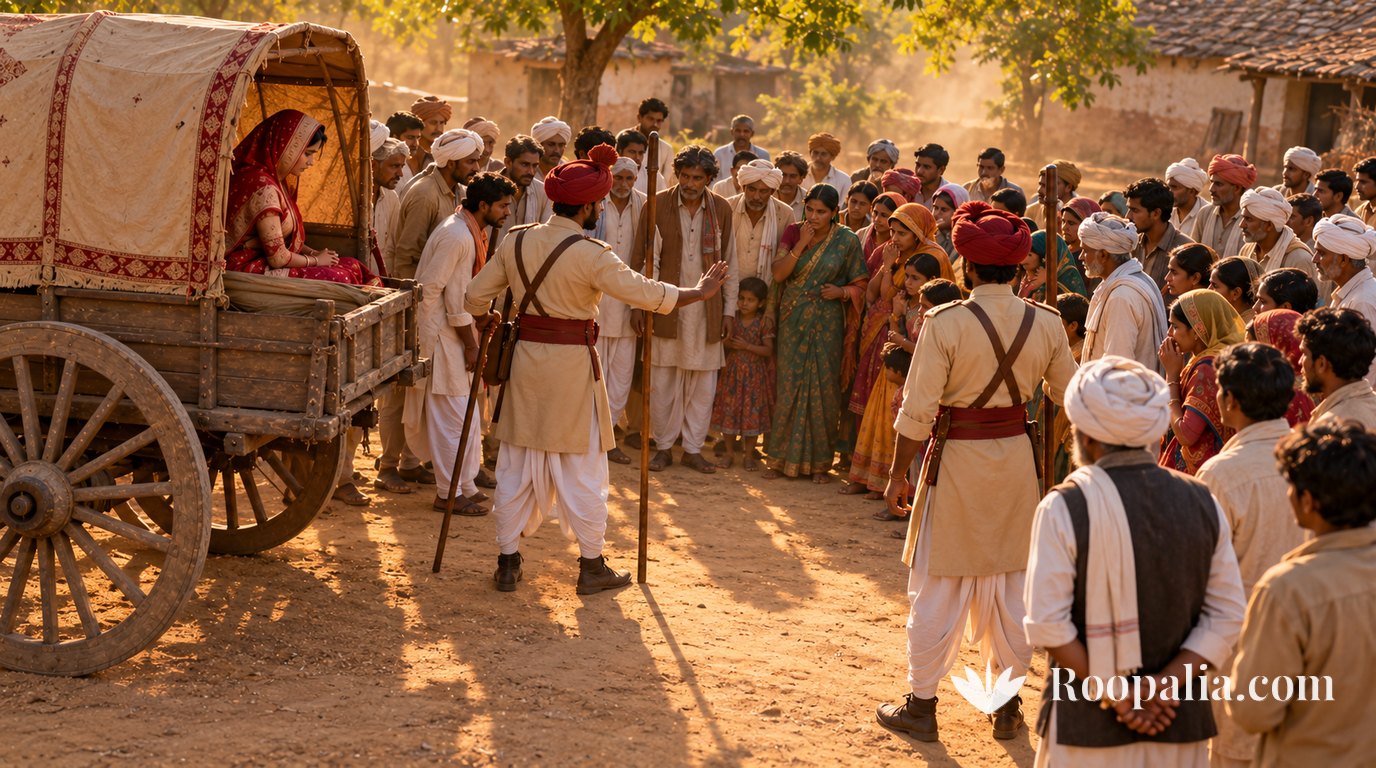
The quarrel grew loud. Travellers stopped, a crowd gathered, and word reached the king's men.
The guards took both men to the royal court. The king asked Sangita directly: "Tell us. Which of these is your husband?"
She wept, and said nothing, because she did not know.
Unable to decide, the king had them both put in prison.

Then a voice came from the sky.
"Madhusudan! You did not listen to Sangita's parents, and you left your in-laws' house on a Wednesday. All of this is happening through the wrath of Lord Budhdev."
Madhusudan folded his hands. He admitted the fault, and gave his word that he would not travel on a Wednesday again and would keep Budhdev's fast.
The moment he said it, the second man was gone. The king released them. Outside, they found the bullock cart standing exactly where it had been, unharmed.
They reached home safely, and kept the Wednesday fast from then on.

Now the part that is genuinely interesting
I went looking for this story wherever it is told, and found three distinct versions. The events barely change. What changes is who ends it.
| Version | Characters | Where it goes wrong | Who resolves it |
|---|---|---|---|
| Wednesday vrat katha | Madhusudan and Sangita, both named | Fetching water at the pond | Budhdev, through a voice from the sky |
| Budh Pradosha katha | A newly married couple, unnamed | The same — fetching water | Shiva, through the husband's silent prayer |
| The merchant version | A Ganesha devotee and his brother-in-law | The cart's wheel breaks | Ganesha, by teaching, then pardoning |
This is not confusion or corruption. Look at the pattern: whichever observance is telling the story, that observance's own deity walks in at the end. The weekday fast brings Budhdev. The Pradosha fast, which belongs to Shiva, brings Shiva. A collection compiled by Ganesha devotees brings Ganesha.
The story stays put. Only the door changes.
And what survives unchanged across all three is the actual spine of it: a refusal, an ignored refusal, a second self on the road, and a pardon. Not the names, not the towns, not even whether the trouble starts at a pond or a broken wheel.
One more detail worth noticing, because it cuts against what most people assume. The broken cart wheel appears in two of the three versions — the merchant's, and one telling of the Wednesday katha where the journey does not last two kilometres. The pond appears in only one stream. The part of a story that feels most familiar is not necessarily its oldest part.
Where the story is found, and where it is not
This question deserves a straight answer, so here it is.
I could not find this story in the text of any Purana. Everywhere I looked, it lives in vrat-katha collections, in household pothis, and in pages built from those. One page carried the heading "Pauranik Budhwar Vrat Katha" — the Puranic Wednesday fast story — and named no Purana and no chapter anywhere on it.
That is not a claim that it exists nowhere in Sanskrit literature. It is an honest report of a search.
Budha himself, though, is firmly in the texts — and what they say fits this story in a way that is hard to shrug off. According to the Bhagavata Purana, Canto 9, Chapter 14, Budha was born to Chandra and Tara — and Tara was the wife of Brihaspati, whom Chandra had taken into his own house. The same account appears in the Vishnu Purana 4.6, the Matsya Purana 23-24 and the Brahmanda Purana.
So the planet whose day this is was born out of a woman being moved from one household to another. The katha is not in scripture; its shape is. Who Budha is, and what Wednesday actually rules, is set out separately.
A smaller point, but a practical one. On the pages where the katha came with a puja procedure attached, one listed bel leaves among the offerings to Ganesha — bel belongs to Shiva. That is what mixing looks like when it happens. Read the story anywhere; take the procedure from one source you trust, and stay with it.
What the story is really saying
Read quickly, it sounds like a threat: break the rule and see what happens. Read carefully, and something is missing from it.
There is no punishment in this story. Madhusudan is not penalised. He loses nothing — not his wife, not the cart, not his home. The voice from the sky does not sentence him; it only explains. And the instant he admits the fault, everything is returned to him. Even the cart is found standing unharmed.
Which means the subject of this story is not punishment. It is recognition. A man stops listening to the people in his household, and the person closest to him can no longer tell who he is.
That is not decoration. Budha governs buddhi and vāṇī — intellect and speech. The day's own story goes wrong at exactly the point where a man stops listening.
That reading is this article's own; the katha does not state it. But all three versions are built on the same frame, which is what makes it worth saying.
Telling it to a child who has never seen a bullock cart

If you are raising children outside India, you already know the question that arrives about ninety seconds in: "But did this actually happen?" Most parents freeze there. Four things help.
Do not dodge the question. Say plainly that it is a story, not history, and that it is not in scripture but in the collections of household fast-stories. Telling a child the truth does not shrink the story. A story propped up as fact collapses the first time it is checked; a story that stands on its meaning does not.
Tell them about the three versions. Older children find this the best part — one story running in three places with a different god at the end of each. It teaches something genuinely useful: that tradition is not a fixed object but a living thing that shifts a little in every household. That understanding will serve them long after the story itself.
Build the bridge from the feeling, not the setting. Bullock carts and royal courts are not in their world. But "someone older told me not to, and I did it anyway" is in everyone's world, at every age. And the fear of not being recognised runs deeper in children than it does in adults — which is why this story lands with them at all.
Tell it in English if that is the language they think in. Tradition puts the weight on the katha being heard, not on any particular language. A child who hears it in Hindi and follows none of it has received less than a child who hears it in English and follows all of it. Keeping a home puja without a temple nearby covers the wider practicalities.
When to read it, and the aarti
The katha is read after the Wednesday puja and immediately before the aarti. Many households do it in the evening, when everyone is home. Anyone in the family may read it, man or woman. Those listening traditionally hold a few grains of whole rice, offered to Ganesha when the reading ends. It is repeated on as many Wednesdays as were resolved on — seven and twenty-one are the usual counts.
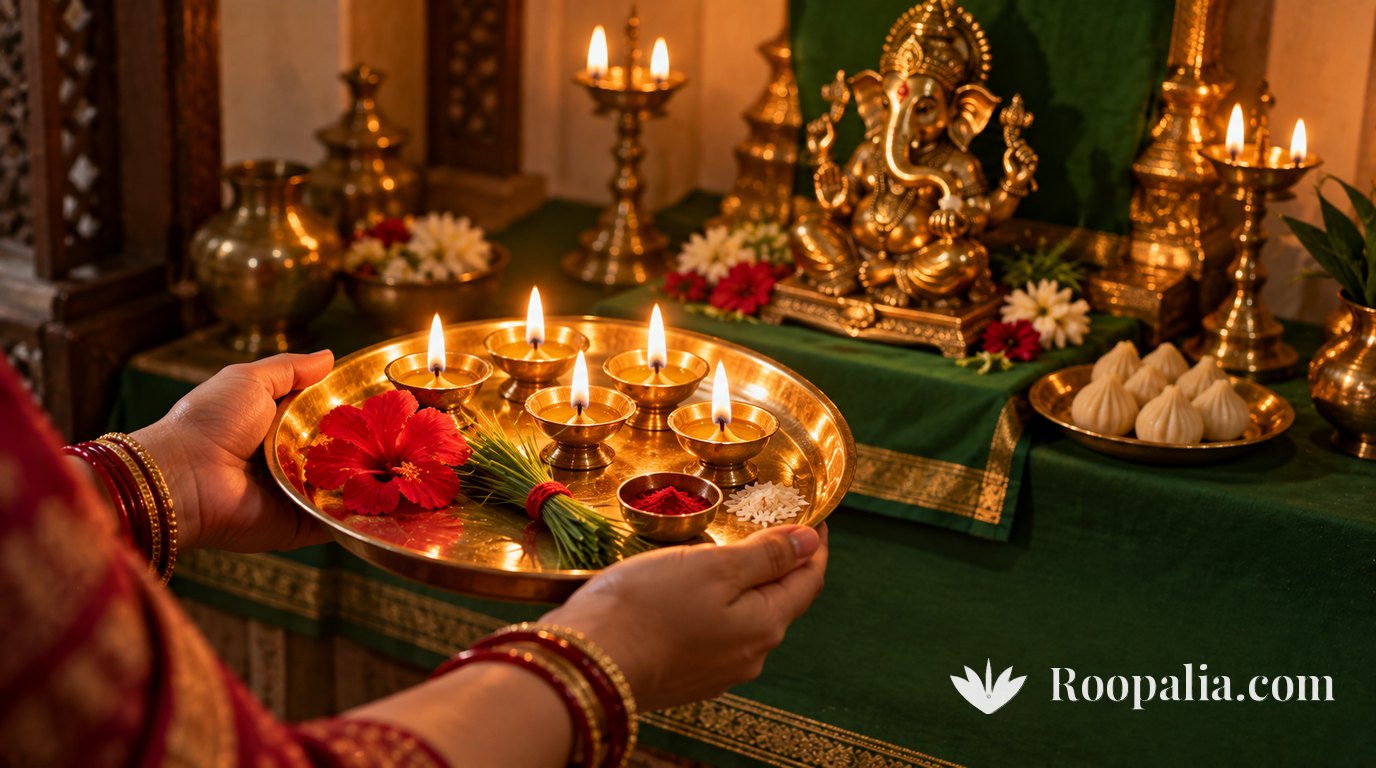
For the aarti: light five wicks in the thali, and set beside them roli, rice, a flower and durva. Hold the thali in both hands and circle it clockwise. The order tradition gives is four times at the feet, twice to the navel, once at the face, and seven times over the whole figure. Afterwards carry the thali to everyone present, then sprinkle water and distribute prasad — modak, laddu or jaggery.
The verses of the aarti are not printed here, and the reason should be said out loud. Printing them means vouching for one particular text, and that needs a reliable printed source we were able to verify — which we could not. That is our limitation, not a doubt about the aarti. So the method is here and the verses are not. Take the text from your own household pothi or a publisher you trust.
The bottom line. This is not a story that threatens anyone. Nothing is taken from Madhusudan, no sentence is passed, and the moment he admits the fault everything comes back — down to the cart.
All three versions say one thing, and they say it the same way: a man who stops listening stops being recognised by his own people. That observation is older than the weekday it is attached to, and considerably larger than it.
Frequently asked questions
What is the Budhwar vrat katha — the Wednesday fast story?
Is the Wednesday vrat katha found in any Purana?
Is the Budh Pradosha katha the same story?
Why is a daughter not sent to her in-laws’ house on a Wednesday?
When and how should the Wednesday katha be read?
How is the Ganesha aarti performed?
What does the Wednesday katha actually mean?
How do you tell this story to a child born outside India?
Sources and cautions: all three versions of the story were read separately and compared — the Wednesday vrat katha (Madhusudan and Sangita, of Samatapur and Balrampur, with Budhdev named in the voice from the sky), the Budh Pradosha katha (the same events, characters unnamed, resolved by Shiva through the husband’s silent prayer) and the merchant version (the cart’s wheel breaks, and the lesson comes from Ganesha). Four things should be said plainly. First, we could not find this story in the text of any Purana; it lives in vrat-katha collections and household pothis, and the one page headed "Pauranik Budhwar Vrat Katha" named no Purana and no chapter anywhere on it. Second, Budha himself is firmly in the texts: the Bhagavata Purana 9.14 gives his birth to Chandra and Tara, and the same account appears in the Vishnu Purana 4.6, the Matsya Purana 23-24 and the Brahmanda Purana. Third, the verses of the aarti are not printed here — printing them means vouching for one particular text, which needs a reliable printed source we were able to verify, and we could not; the method is given, the verses are not. Fourth, “not found” does not mean “does not exist”; it is an honest report of a search, not a verdict. This article does not urge anyone to fast; take any decision involving fasting with your own doctor.