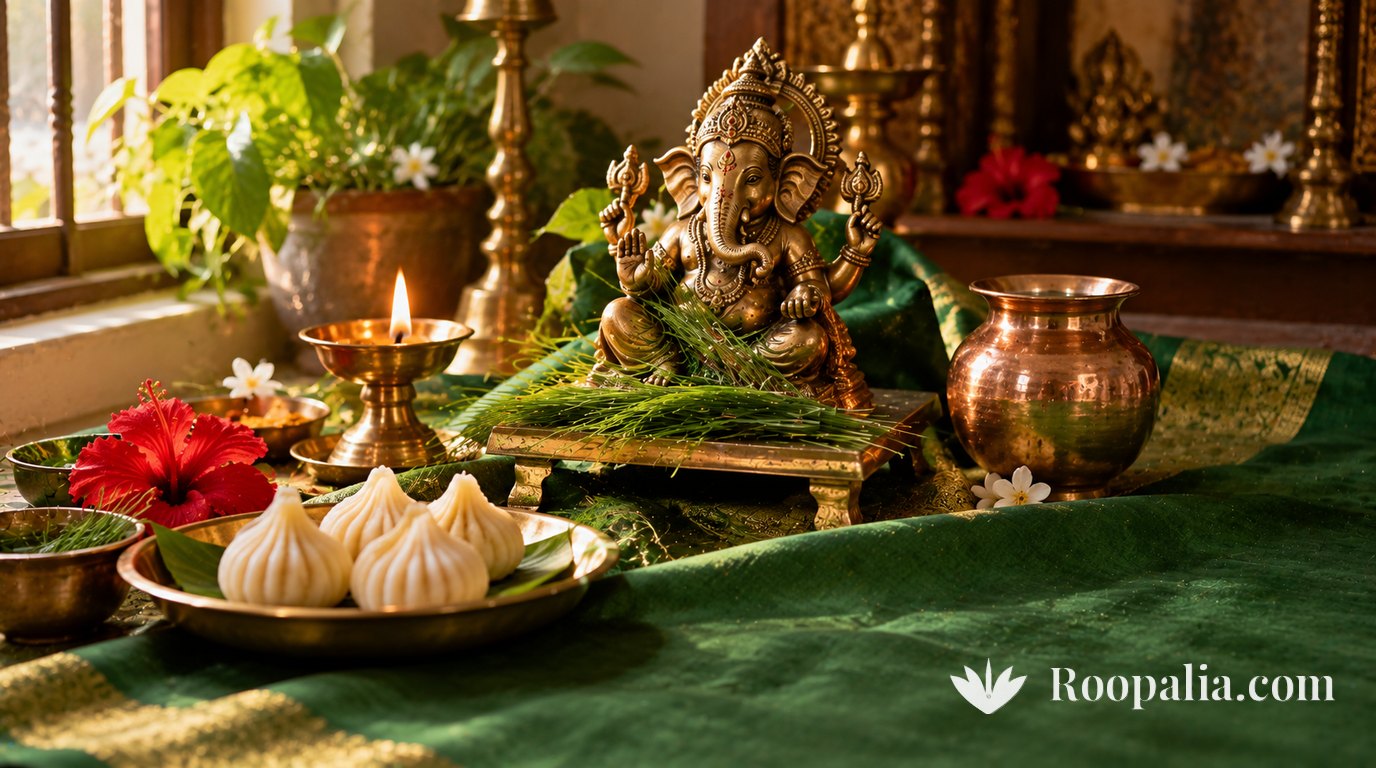
Type the question into a search box and watch what happens. One page says Wednesday belongs to Ganesha. The next says it belongs to Budha, the planet we call Mercury. A third quietly lists both and moves on.
Nobody in your family will find this confusing. They grew up with it. But if you are the one now keeping a small shelf-shrine in Toronto or Reading or Jersey City, and your ten-year-old asks "so who is it, actually?" — you need a real answer, not a list.
Here is the real answer: those are two different questions wearing the same words. One is about a deity. The other is about a planet. They arrived in the same day from opposite directions.
The short version, before the long one
| Question | Answer |
|---|---|
| Which deity is worshipped on Wednesday? | Ganesha — household practice across India and the diaspora |
| Which planet rules Wednesday? | Budha (Mercury) — the day is literally named after him |
| Is Budha the same as Ganesha? | No. Different figures, different stories, both attached to this day |
| What is the Sanskrit name for Wednesday? | Budhavāra — Budha plus vāra, "the day of Budha" |
| What does Budha govern? | Intellect, speech, mathematics, trade, learning, negotiation |
| What colour and offering belong to the day? | Green, and durva grass above every flower |
Now the part that makes the two answers hold together.
Budha is not a minor figure — he has a birth story, and it is a scandal
This is the section most English pages skip, and skipping it is why Wednesday feels arbitrary.
The story is in the Bhagavata Purana, Canto 9, Chapter 14. The same account is repeated in the Vishnu Purana 4.6, the Matsya Purana chapters 23-24, and the Brahmanda Purana. Four texts, one story — that is not a footnote, that is a load-bearing wall.
Chandra, the moon, took Tara — the wife of Brihaspati, preceptor of the gods — into his own house. Brihaspati asked for her back. Chandra refused. The quarrel pulled in the devas on one side and the asuras on the other, and the Puranas give the resulting war its own name: the Tarakamaya war. It ended when Brahma intervened and Tara returned. A son was born afterwards.
That son is Budha.
Hold on to one detail, because a custom eight hundred years younger hangs off it: Budha was born out of an episode in which a woman was moved from one household to another.
We will come back to that.

What the texts say Budha looks like
The Matsya Purana, chapter 24, describes how the images of the nine planets should be made. Budha rides a white chariot drawn by ten horses — and the detail worth noticing is that each horse is a different colour. His own complexion is given as tawny. The Agni Purana, chapter 51, puts a rudraksha rosary and a bow in his hands.
Compare that with the other planets, whose chariots are drawn by matched teams. Budha's is pulled in ten directions at once by ten different things.
Which is a startlingly good description of intelligence — the faculty that holds unrelated things together and gets somewhere with them. It is also, incidentally, a good description of a Wednesday.
So where does Ganesha come in?
Here I have to be straight with you, because this is exactly the kind of claim that gets repeated without checking.
I went looking for the scriptural source that pairs Ganesha with Wednesday — a Purana, a chapter, a verse. I did not find one. Every page that states the pairing states it as settled fact, and not one of them names a text. The planetary link needs no source at all, because it is baked into the name: Budhavāra.
That finding should not be over-read. A practice followed in millions of homes across many generations is not waiting on a citation to become real — lived tradition is its own kind of evidence, and a very durable kind. What the gap does mean is narrower and more useful: on this page, wherever a text is named, it has been opened and checked; wherever nothing was found, you will be told that too.
There is also an internal logic to the pairing that is hard to miss. Budha governs beginnings that involve the mind — study, trade, negotiation. Ganesha is invoked at beginnings generally. Two figures whose territory overlaps, meeting on the same weekday, is not a coincidence that needs a verse to justify it.

Budh graha remedies — what tradition actually prescribes
Search this phrase and the results split sharply in two. On one side, simple things anyone can do. On the other, an industry selling emerald rings, yantras and expensive remote pujas.
So it is worth saying plainly what the traditional remedies are, because the list is short and none of it costs money.
1. Give away green things

Whole green moong, green cloth, cardamom, bronze vessels, green vegetables. In a great many households the donation is school supplies — notebooks, pens, books — which fits Budha's own territory more exactly than anything else on the list.
2. Keep the fast, or a smaller version of it
One meal a day, taken after the evening puja. Offer durva. If a full fast does not fit around a working Wednesday, tradition accepts a reduced resolve; what it does not accept is a resolve you abandon halfway.
3. Watch your speech
This one gets left out of every listicle and it is the one classical astrology stresses most. Budha governs vāṇī — speech. Restraint in speech, and avoiding falsehood, are named as the strongest remedy for a weak Budha. It is free, it is unglamorous, and it is the only item on this list that changes anything about how you live.
A word of caution, because this market targets people abroad specifically. Remote-puja and gemstone operations advertise heavily to Indians outside India, where there is no family priest to ask and no way to verify what was performed. Every remedy tradition itself names — donation, fasting, worship, restraint in speech — is something you can do yourself, this Wednesday, for nothing. Treat anything with a price tag as a commercial product, and judge it as one.
The Wednesday "don'ts" — and the reasoning that goes missing
English pages list these as prohibitions and stop. Listed that way they sound superstitious. With the reasoning attached they turn into something much more ordinary: a set of cautions about movement.
Travel — and why the rule is about direction, not the day

The rule is disha shula — a direction considered inauspicious for departures on a given weekday. For Wednesday that direction is north. It was never a blanket ban on travelling; it was a caution about one heading, and even then tradition offers small mitigations, such as eating something sweet before leaving.
The practical answer, since this is what people are really asking: if your flight to India is on a Wednesday, you do not need to change it. Tradition asks you to avoid what can be avoided. Where it cannot, a moment at the shrine before you leave has always been considered sufficient.
Sending a daughter to her marital home
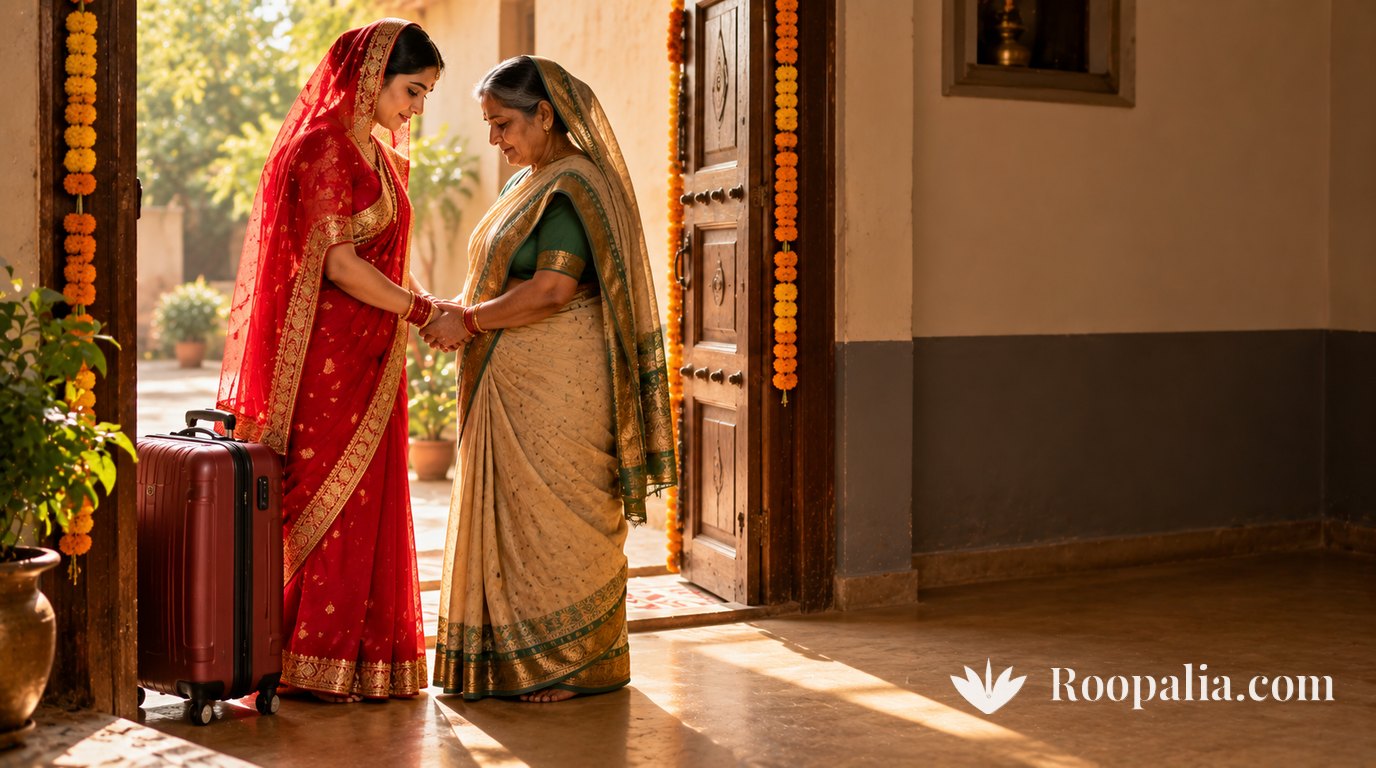
This custom — vidai is not done on a Wednesday — is alive in a great many North Indian families and travels with them. Two reasons are given, and both are on the record.
The first is the Wednesday vrat katha. A man collects his wife from her parents' house despite being told the day is wrong; on the road he returns from fetching water to find a second man identical to himself sitting beside her, and neither she nor the king's guards can tell them apart. A voice from the sky identifies the double as Budha's doing. Indian news outlets tie the custom directly to this story.
The second is astrological. The moon is held to be strongly influential for women, and a relation of enmity is described between Chandra and Budha — so a woman's move between households is kept off Budha's day.
And then there is a third connection, which the custom itself never states. Budha was born out of exactly such a move. The custom and the deity's own origin are the same story, eight hundred years apart.
There is a further detail worth knowing, because it shows how deep this particular story runs. The same narrative attaches to Budh Pradosha — the Pradosha observance falling on a Wednesday — where it is again described as a crisis arising from a wife's departure on a Wednesday, resolved by Shiva's grace.
One story, carried by two different traditions: one keyed to the weekday, one to the lunar day. There is in fact a third version as well, and a third god who ends it. Stories that survive in three systems at once are not literary inventions. They are memory.
The rest of the list
Cutting hair or shaving, starting a new loan, buying iron, wearing dark blue or black. For none of these did I find a Puranic basis; they belong to the shared stock of weekday custom and astrological practice, and several are attached to other weekdays too.
The half of Wednesday that gets forgotten

Read only the prohibitions and you would think Wednesday is a day to sit still. It is the opposite. Wednesday is considered the best day of the week to begin something — a course of study, a new skill, a business, a set of accounts, a conversation that has been put off.
Here is the pattern that reconciles the two halves, and once you see it the contradiction disappears:
Every caution concerns someone going from one place to another — a departure, a journey, money leaving the house.
Every recommendation concerns someone starting something — study, work, speech.
Wednesday is not the day of movement. It is the day of beginnings. That single distinction resolves every rule on this page.
Two observances with Puranic names
Two Wednesday-linked observances come up often enough to be worth placing properly.
Budhashtami is the eighth lunar day when it falls on a Wednesday. The name does turn up in a Purana — the Narada Purana, Purva-bhaga, chapter 13, verses 44-49, in a list of auspicious occasions for bathing Vishnu in milk, ghee, curd or honey.
“…when there is Budhāṣṭamī day or the Mercury is in conjunction with the constellation Āṣāḍhā or on other auspicious days.”
— Narada Purana, Purva-bhaga, chapter 13 (A Discourse on Dharma), verses 44-49Read that carefully, though, because it is easy to overclaim. No vrata procedure is given there — the name appears in a list, nothing more. Sanskrit dictionaries define it exactly as literally as you would expect: the ashtami that falls on a Wednesday.
Budh Pradosha is the Pradosha observance — Shiva's, at the dusk of the thirteenth lunar day — when it falls on a Wednesday. Pradosha itself rests on solid ground: the Skanda Purana, Brahmottara Khanda, chapter 6 is devoted to it, defining it in verse 5 as the dusk of the thirteenth day and giving its results in verse 75. But that chapter names no weekday at all. Splitting Pradosha by weekday comes from the later nibandha literature, where the scheme is introduced with citations from Hemadri and Vasishtha.
Keeping the day when Wednesday is a workday

Of the seven weekday observances, this is the hardest one to keep outside India, and for a boring reason. Sunday is a rest day almost everywhere. Wednesday is the middle of the working week in every country an Indian family is likely to have moved to.
On durva. Durva is Cynodon dactylon — Bermuda grass. It is a warm-season grass, so in Canada, the northern United States, Britain and northern Europe it is scarce or dormant for much of the year, and Indian grocers rarely stock it weekly. Tradition already answers this: when a prescribed material is unavailable, whole rice is offered in its place. That is a provision within the procedure, not a concession outside it.
On timing. Nothing in the Wednesday observance is tied to a solar moment the way the Sunday arghya is tied to sunrise. Ten minutes after work is a complete puja. Morning is customary, not required.
On fasting through a working day. If a full fast is not compatible with your work — and for many people it is not — take the resolve you can keep: one meal, or worship and donation only. What is eaten during a fast is covered separately.
On the vidai custom, where families abroad actually collide with it. Weddings outside India cluster on weekends, so the question rarely arises in its original form. Where it does arise — a move, a house handover, a major departure that falls on a Wednesday and cannot be shifted — tradition has a practical accommodation that long predates air travel: send a portion of the luggage a day earlier, so that the departure counts as having begun on the previous day.
The bottom line. Wednesday has two patrons because it answers two different questions. Ganesha comes from practice; Budha comes from the name of the day and from four Puranas that tell his story the same way. Neither cancels the other.
And the rules only look contradictory until you sort them. Caution attaches to leaving. Blessing attaches to beginning. Once that line is drawn, the whole day makes sense — including the parts of it your grandmother never explained, because to her they never needed explaining.
Frequently asked questions
Which Hindu god is worshipped on Wednesday?
Who is Budha in Hindu mythology, and is he the same as Buddha?
What are the remedies for a weak Budh graha?
What should you not do on a Wednesday?
Is Wednesday a good day to start something new?
Why is a daughter not sent to her in-laws’ house on a Wednesday?
What are Budhashtami and Budh Pradosha?
How do you keep the Wednesday observance while living outside India?
Sources and cautions: every scriptural reference on this page was opened and checked — the Bhagavata Purana 9.14 for Budha’s birth from Chandra and Tara (the same account appears in the Vishnu Purana 4.6, the Matsya Purana 23-24 and the Brahmanda Purana); the Matsya Purana chapter 24 for the white chariot and the ten differently coloured horses; the Agni Purana chapter 51 for the rudraksha rosary and bow; the Narada Purana, Purva-bhaga, chapter 13, verses 44-49 for the name Budhashtami; and the Skanda Purana, Brahmottara Khanda, chapter 6 for Pradosha (defined in verse 5, its results in verse 75). Four things should be said plainly. First, we found no Puranic prescription for a Wednesday vrata — the Matsya Purana’s weekday-vrata chapter (97) is Sunday’s. Second, we found no scriptural source pairing Ganesha with Wednesday; the pages asserting it name no text, so it rests on lived tradition. Third, the Wednesday vrat katha does not appear in any Puranic text we could check — it lives in vrat-katha collections, and the same narrative is attached to Budh Pradosha. Fourth, “not found” does not mean “does not exist”; it is an honest report of a search, not a verdict. This article does not urge anyone to fast; take any decision involving fasting with your own doctor, and be wary of expensive remedies sold in the name of the planets.