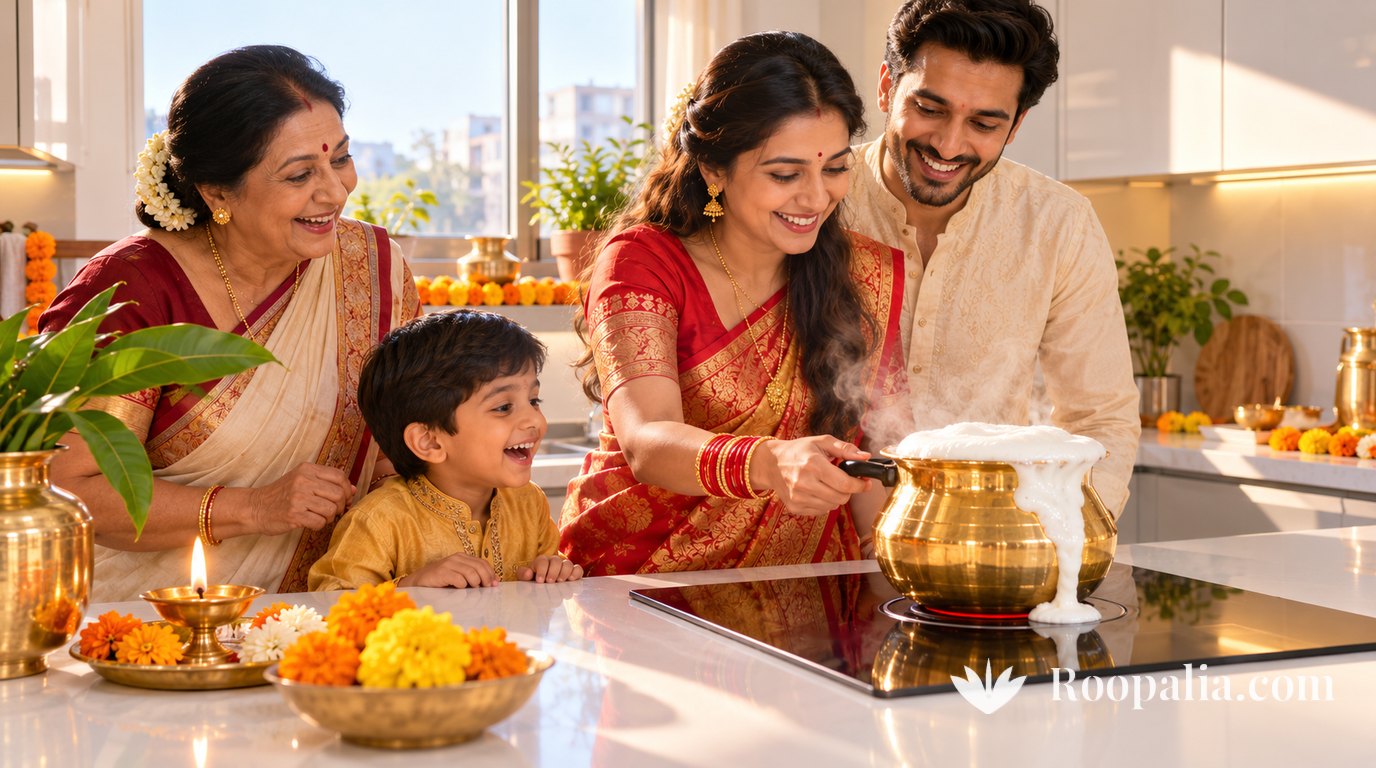
The keys are in your hand, the boxes are still taped shut, and the first thing your mother asks on the phone is not about the view or the commute. It is: “Have you boiled the milk yet?”
For millions of Indian families, a new home does not really begin until a pot of milk rises and spills over on the new stove. Then come the other questions — do we need a priest for griha pravesh, what if no pandit is free, can we do it in a rented flat, and what do we do about the smoke alarm?
While researching this, I found one of the oldest written house-entry rites in translation. In it, the words spoken at the threshold belong to the householder, not the priest — and they are worth saying in your own new home. They are further down.
Why do Indians boil milk in a new house?
Boiling milk until it overflows in the new kitchen is a sign of abundance — the wish that milk and food will always overflow in this home. It is a household custom. In the house-entry section of the Paraskara Grihya Sutra that I checked in translation, I did not find milk-boiling named as such. What the text does prescribe is offering cooked food on the new fire to the gods (3.4.8) — so cooking something first in a new home and offering it is itself an old ritual act.
The closest parallel is Pongal in South India, where the boiling over of the pot is treated as a blessing, and people call out “Pongalo Pongal” — “may it boil over” — as it rises (courtesy: Wikipedia, Pongal). The milk in a new kitchen carries the same feeling.
- Induction or electric hob? Perfectly fine. Most apartments outside India have no gas; the meaning lies in the act, not the stove.
- Which direction should it spill? Some families prefer the milk to spill towards the east. I found no text for this; it is family custom.
- What to do with it: make kheer or a sweet from the milk, offer it as bhog, and share it as prasad. Nothing needs to be thrown away.
- Why the searches mention other faiths: search suggestions pair this custom with Christian, Muslim and Sri Lankan households, which suggests it has travelled well beyond Hindu ritual. I did not find a published source documenting that, so treat it as an observation.
Do you need a priest for griha pravesh?
No — a simple griha pravesh can be done by the family. In the Paraskara Grihya Sutra (book 3, section 4), checked against Hermann Oldenberg’s translation, the householder himself makes the offerings into the fire, offers the cooked food and enters the house; the Brahman sits beside the fire and gives his consent to enter (courtesy: sacred-texts.com). A full vastu shanti is a separate, longer rite — the Agni Purana devotes a whole chapter (93) to worship of the Vastu Purusha, the presiding deity of the ground (tr. N. Gangadharan, courtesy: wisdomlib.org) — and families usually ask a priest for that. But the house entry itself is yours to do.

Wikipedia notes three kinds of griha pravesh in Vastu tradition: apurva (first entry into a newly built home), sapurva (re-entering one’s home after returning from another country) and dvandva (entering after repairs or rebuilding) (courtesy: Wikipedia, Grihapravesha). The second is exactly the situation of families returning to India after years away.
Griha pravesh in a rented apartment — leases, smoke alarms and neighbours
Whether to do griha pravesh in a rented home is a family choice; I found no text making it compulsory. Many families do a short version. Outside India, a few practical points matter more than any ritual detail:
- Read the lease and building rules. Many apartments forbid open flames, havan or fire on balconies.
- Smoke alarms. Havan or incense smoke can set them off. Open the windows and keep the smoke light — but never remove the alarm battery; it is there for your safety.
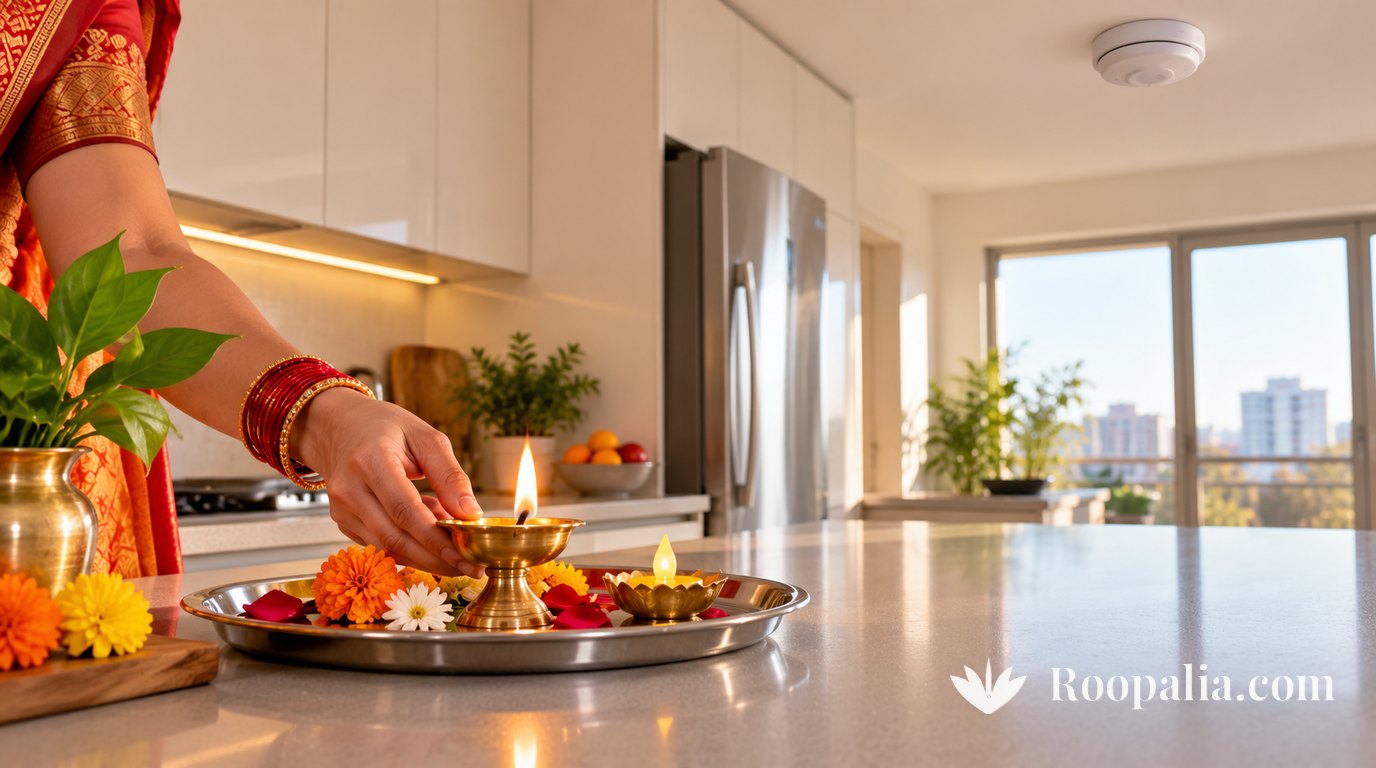
- Diya safety. The Los Angeles Fire Department advises keeping candles at least 12 inches from anything that can burn, never leaving one burning unattended, putting it out when you leave the room or go to bed, and keeping it away from children and pets (courtesy: LAFD, Candle Safety).
- Where flames are not allowed, an LED diya keeps the spirit of the puja.
- No nails. Hang the toran with removable hooks or tape so the deposit is safe.
- Neighbours. Taking a plate of prasad next door is the warmest possible start in a new building.

Now the method itself — short enough to do on a weekday morning before the movers arrive.
How to do griha pravesh puja at home without a priest
- Clean and decorate. Clean the whole home the day before. In the morning, bathe, hang a toran of mango leaves and marigolds over the door and make a rangoli at the threshold.
- Enter with the kalash. The woman of the house carries a kalash of water topped with mango leaves and a coconut; another family member carries a plate with a lit diya. Pause at the door, take God’s name and step in towards the right. Many families put the right foot first.
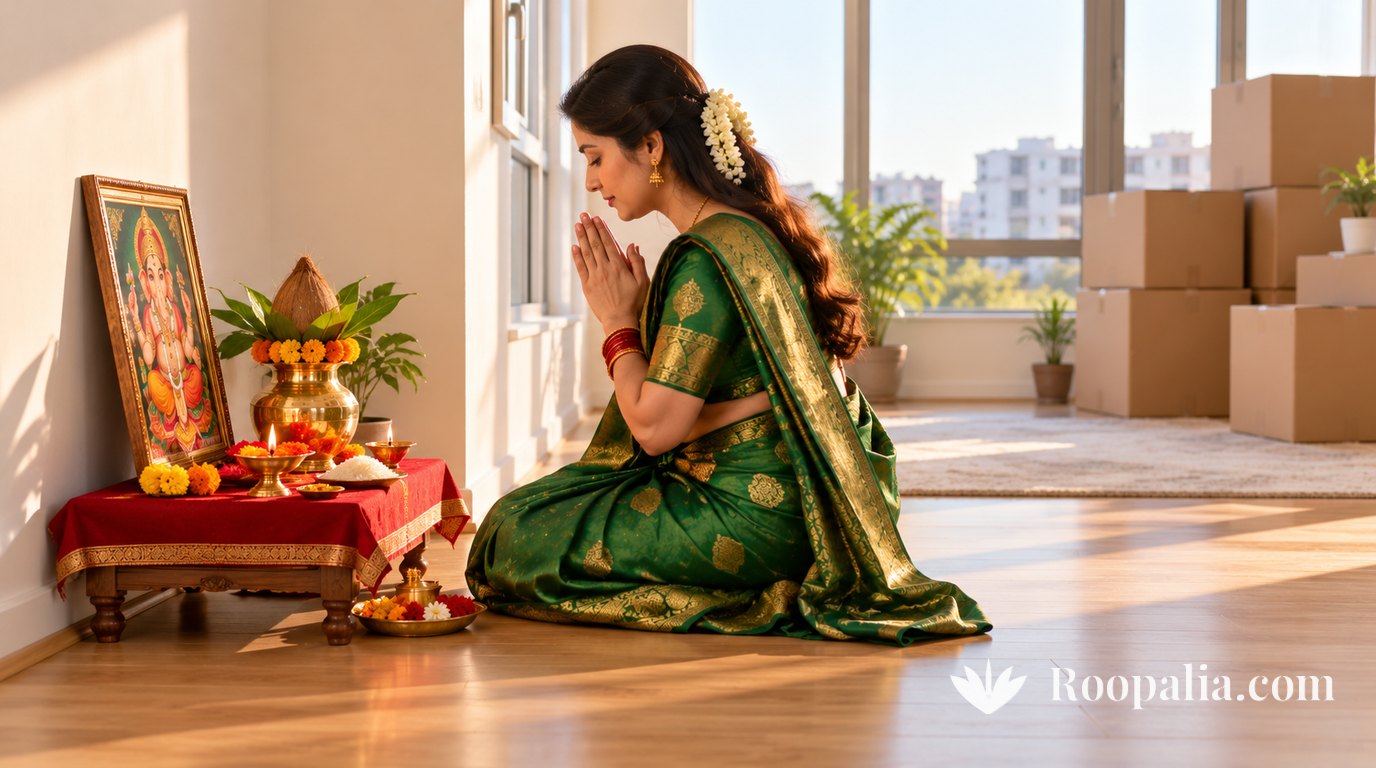
- Set up the kalash. In the north or north-east corner, place a low stool with a red cloth, the kalash, a picture of Ganesha and a ghee diya. Offer turmeric, kumkum, rice, flowers and a sweet. For more on direction, see pooja room direction as per Vastu.
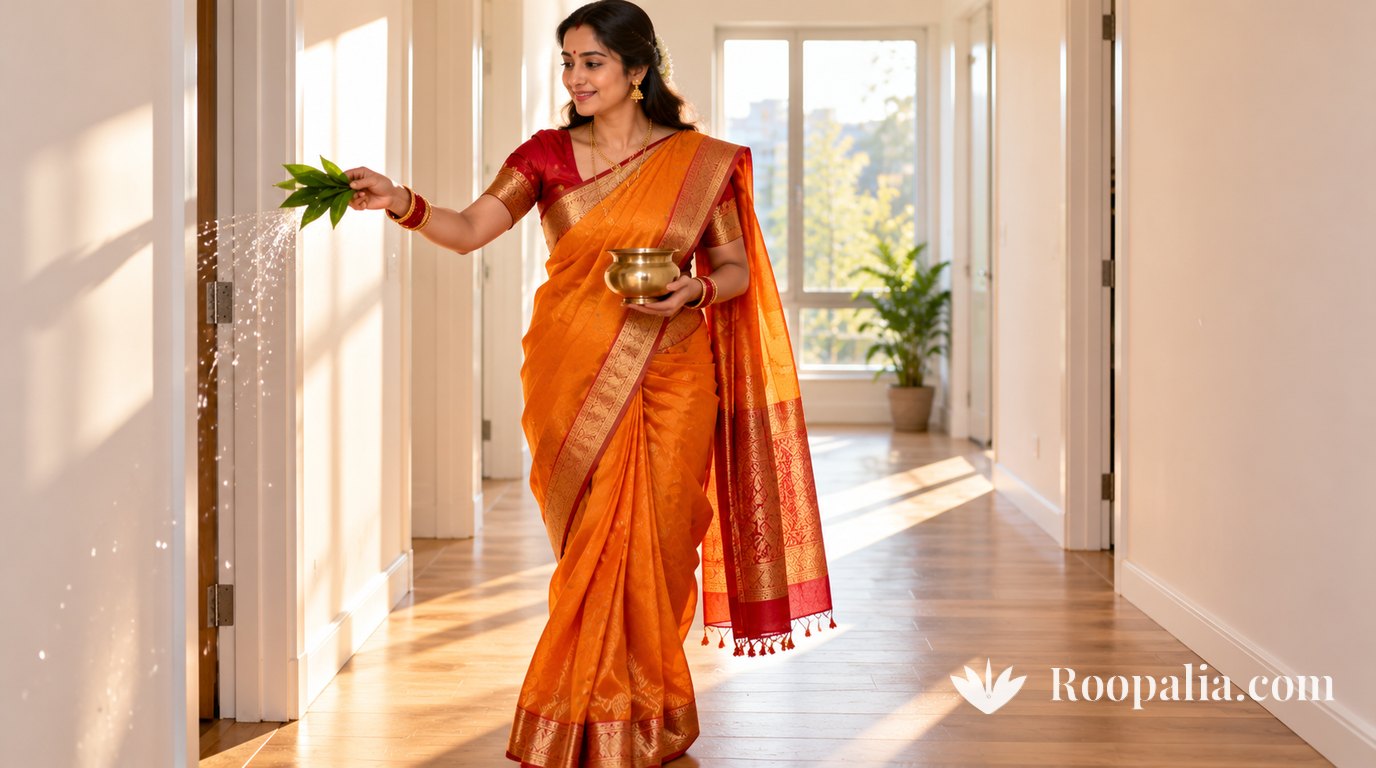
- Sprinkle water through the home. Mix a little curd, honey, ghee, durva grass and barley into water — or use plain clean water — and sprinkle it with mango leaves in every room. Paraskara (3.4.9) describes sprinkling a very similar mixture over the seats and places of the house.
- Havan or diya. If fire is allowed, offer ghee into a small havan; our guide havan at home without a pandit walks through it. If not, a single ghee or LED diya stands in for the fire.
- Boil the milk. Let it rise, make kheer and offer it as bhog.
- Feed people. Paraskara’s rite ends with feeding guests (3.4.19). Share prasad with family, friends and neighbours.
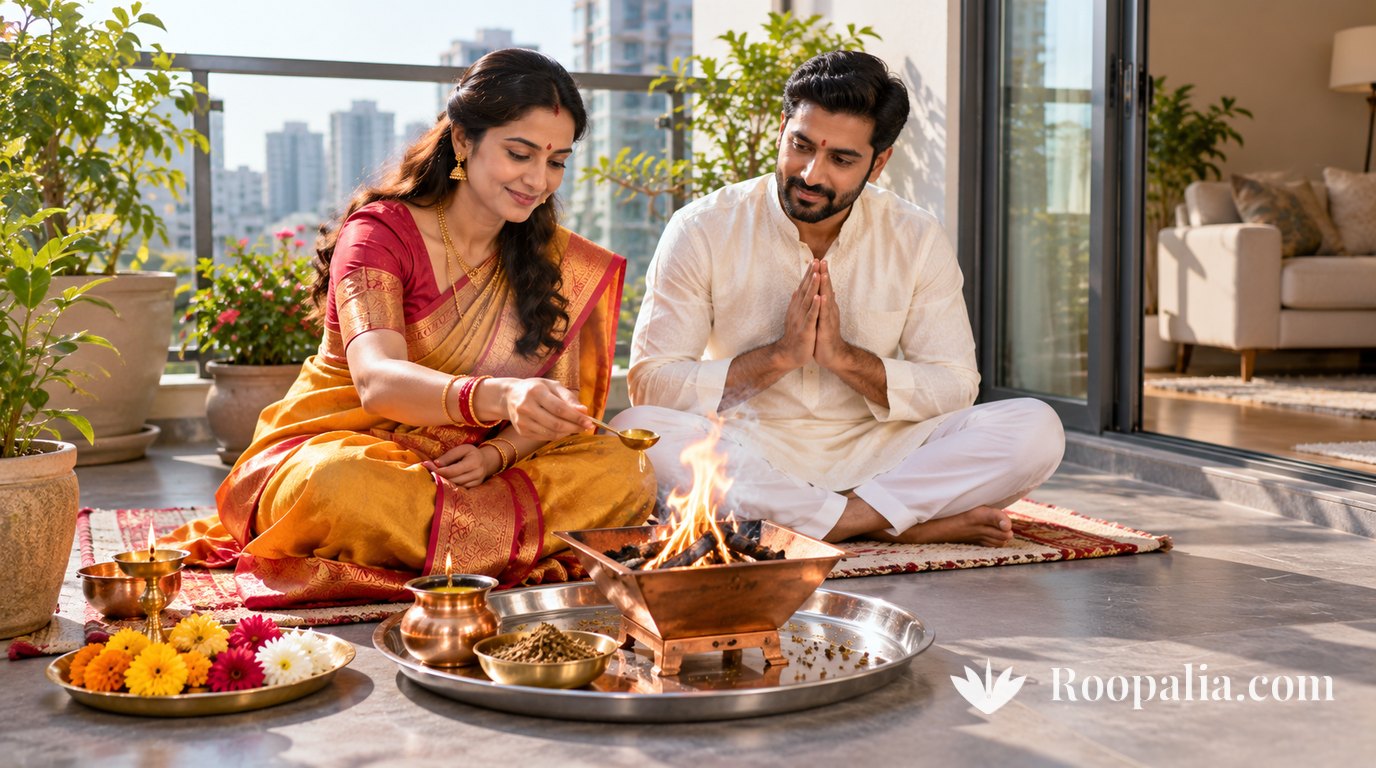
No muhurat? Traditionally the time is fixed with an astrologer or priest, and Paraskara (3.4.2) asks for building to begin on an auspicious day. But I found no text attaching a fault to a griha pravesh done without one. Many families simply choose the morning of a day they consider auspicious. If you live outside India, remember that tithis shift with location — see why your festival date differs from India.
Griha pravesh puja samagri list
| Item | Used for |
|---|---|
| Copper or brass kalash, water, 5 mango leaves, coconut, sacred thread | Carrying in and installing the kalash |
| Ganesha picture or idol, red or yellow cloth, low wooden stool | The puja spot |
| Rice (akshat), turmeric, kumkum, betel leaves, betel nuts | Worship |
| Ghee, diya, cotton wicks, incense | Lamp and aarti |
| Curd, honey, durva grass, kusha grass, barley | Sprinkling water — named in Paraskara 3.4.9 |
| Mango-leaf and marigold toran, rangoli colours or flowers | Door decoration |
| Milk, rice, sugar or jaggery | The first boil and kheer |
| Havan kund, mango wood, havan samagri (optional) | Small havan |
| Sweets and fruit | Bhog and prasad |
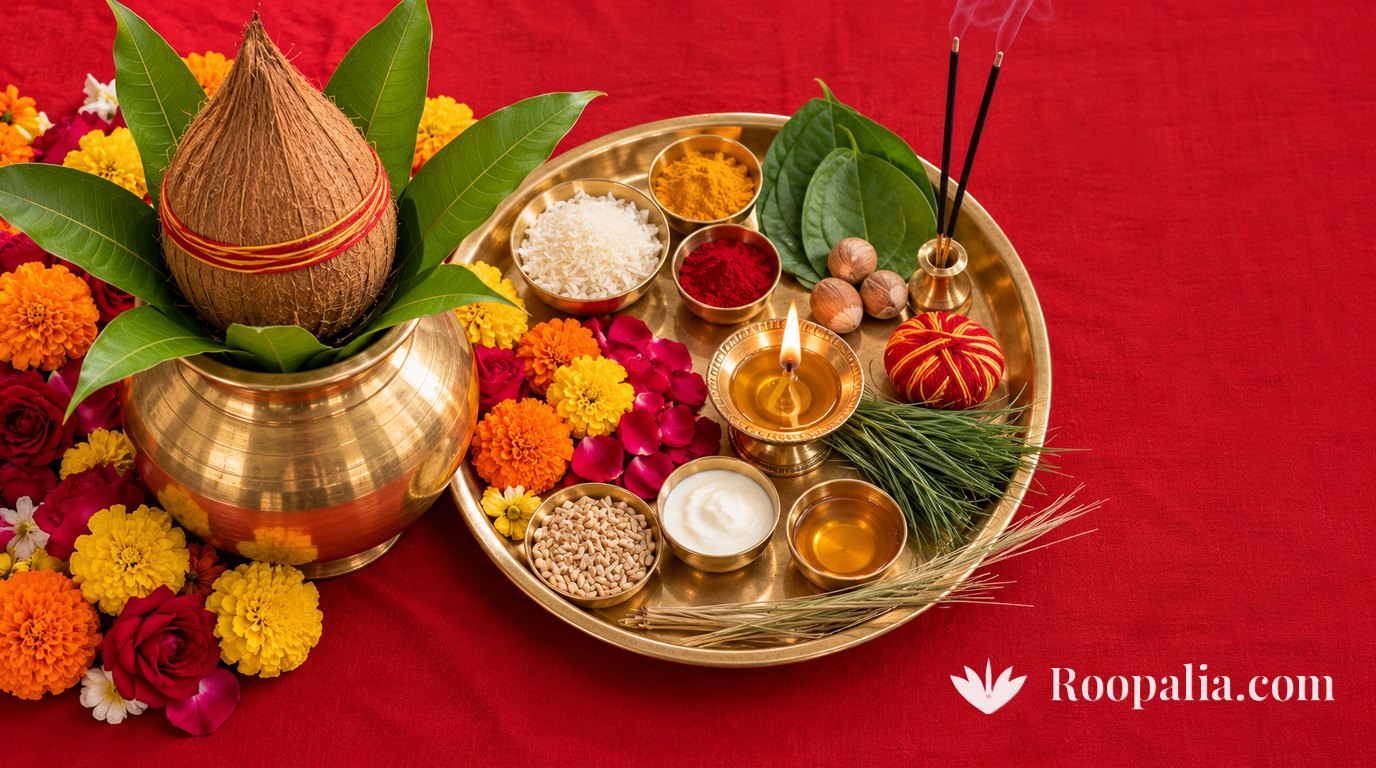
If you cannot find everything, water, a diya, a few flowers and sincerity are enough. As for what to wear: freshly washed new or traditional clothes — a saree, salwar suit or kurta — is the common household custom.
What to give at a griha pravesh
I found no fixed gift list in the texts. Common gifts share one idea — something auspicious that the new home will actually use: a tulsi plant, a pair of brass diyas or a puja thali, steel or brass kitchen vessels, sweets and dry fruit, or a small picture of a deity.
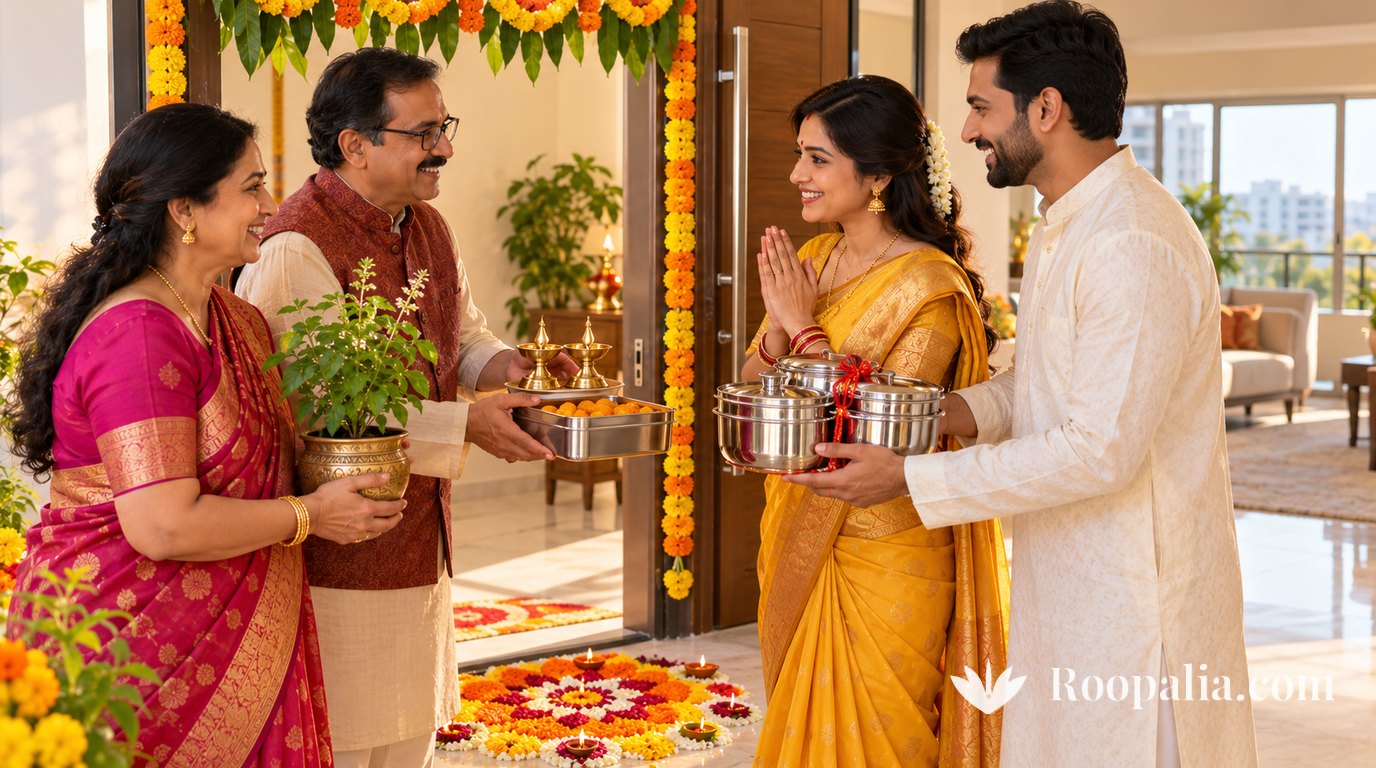
House-entry customs exist everywhere. In some places in India a cow is led in first; in Russia and Germany bread and salt were popular housewarming gifts; and in Russia a cat is let in first for luck (courtesy: Wikipedia, Housewarming party).

What the old house-entry rite actually says
The Paraskara Grihya Sutra, one of the Vedic manuals for household rites, describes entering a new house in book 3, section 4. In Oldenberg’s translation, the sequence is:
- The fire is set up inside; the Brahman sits to its south, and a water-pot is placed to the north (3.4.5).
- The householder stands at the door and says he is entering. On receiving consent, he steps in with the words below (3.4.6).
- Two ghee offerings and four prayers to Vastoshpati, the guardian of the house, for protection, a happy entry and growth in wealth (3.4.7).
- Cooked food is offered to Agni, Indra, Brihaspati, Sarasvati and others, each time asking, “Give me a dwelling-place” (3.4.8).
- Udumbara leaves, green grass, cow dung, curds, honey, ghee, kusha grass and barley are mixed in a brass vessel and sprinkled over the seats and places (3.4.9).
- The posts at the four corners are touched with blessings and the four directions worshipped (3.4.10–17); the rite ends with entry verses and feeding Brahmans (3.4.18–19).
“To right I advance, to luck I advance!”
— Paraskara Grihya Sutra 3.4.6, tr. Hermann Oldenberg (courtesy: sacred-texts.com)
“Indra’s house is wealthy, protecting; that I enter with my children, with my cattle, with everything that is mine.”
— Paraskara Grihya Sutra 3.4.18, tr. Hermann Oldenberg (courtesy: sacred-texts.com)
The first line is the closest ancient source I found for the “right foot first” custom — though the translation speaks of advancing to the right, not of the foot. The second is a lovely line to say aloud as your family crosses the threshold.
What I found and what I did not
| Claim | Result |
|---|---|
| The householder makes the offerings and enters himself | Found — Paraskara 3.4.5–8 |
| “To right I advance, to luck I advance” | Found — 3.4.6 |
| Sprinkling with curd, honey, ghee, grass and barley | Found — 3.4.9 |
| Feeding guests at the end | Found — 3.4.19 |
| Vastu Purusha worship | Found — Agni Purana 93 |
| Three types of griha pravesh | Found — Wikipedia, citing Vastu tradition |
| “Right foot first”, word for word | Not found; only “advance to the right” |
| A rule to boil milk | Not found; offering cooked food is prescribed |
| A fault for no priest or no muhurat | Not found |
| No sleeping in the home before griha pravesh | Not found — family custom |
The bottom line: boil the milk, let it rise, and share the kheer — it is a custom of abundance with deep roots in offering the first cooked food in a new home. You do not need to wait for a priest: in the Paraskara rite, the householder makes the offerings and speaks the words of entry. Enter with the kalash, worship Ganesha in the north-east, sprinkle water, light a diya the building allows, and feed the people around you. For a full vastu shanti, ask a knowledgeable priest.
Disclaimer: This article is for general information. Scriptural references have been checked against published translations, and customs vary by family and region — follow your elders or family priest. All images in this article are AI-generated for illustration only; they do not show real people, places or events. It is not medical, legal or astrological advice. Before lighting a diya or havan, check your lease and local fire-safety rules.
Frequently asked questions
Why do Indians boil milk in a new house?
Can griha pravesh be done without a priest?
Is griha pravesh necessary for a rented house?
Can we do griha pravesh puja after shifting?
What is the griha pravesh puja samagri list?
What should I give as a griha pravesh gift?
What are the three types of griha pravesh?
Why do we enter a new house with the right foot first?
Sources and cautions: sources consulted — Paraskara Grihya Sutra 3.4 (The Grihya Sutras, Part 1, SBE 29, tr. Hermann Oldenberg, courtesy: sacred-texts.com); Agni Purana, chapter 93, Vastu worship (tr. N. Gangadharan, courtesy: wisdomlib.org); types of griha pravesh and muhurat: Wikipedia (Grihapravesha); the cow entering first and Russian and German customs: Wikipedia (Housewarming party); Pongal: Wikipedia; diya safety: Los Angeles Fire Department (Candle Safety). Three things should be said plainly. First, “right foot first” word for word, a rule to boil milk, any fault for skipping a priest or a muhurat, and a ban on sleeping in the home before griha pravesh were not found in these texts; that is the result of a search, not a final verdict. Second, every family and region has its own custom; follow your elders. Third, a full vastu shanti is a separate rite; ask a knowledgeable priest for it. No brand or shop is recommended.