Is car pooja in the scriptures?
Not as "car pooja", because the texts are older than the car. But honouring a vehicle before you ride it is old. I checked translations of the household manuals (Grihya Sutras) and a Purana, and this is what I found and did not find:
None of this makes the folk customs "wrong". It just means you can do them with the right expectations: the swastika and coconut mark an auspicious start; the lemon is a belief about the evil eye; the prayer for a safe journey is the oldest part.
"Thou art the son of Tvashtri; Tvashtri is thy deity. Make me arrive safely."
— said to a camel before mounting it, Paraskara Grihya Sutra 3.15, tr. Hermann Oldenberg (courtesy: wisdomlib.org)That camel line is not just a curiosity. In the villages of Rajasthan and Haryana, the way a new camel was welcomed home is almost exactly how a new car is welcomed today. I will come back to that.
Car pooja samagri (essentials)
Most of this is already in a home mandir. If you are shopping at an Indian grocery abroad, take this list:
- Water in a kalash or any clean lota, with 5 mango leaves (or any clean leaves, or just a flower to sprinkle with)
- Roli (kumkum), haldi, chandan paste and akshat (unbroken rice)
- Mauli / kalava, the red-orange cotton thread
- A flower garland and some loose flowers
- Incense, a ghee diya, camphor
- One coconut with its husk tuft
- 2 to 4 lemons
- Something sweet for prasad: jaggery, batasha (sugar drops), laddoo, or any mithai
- A soft wet cloth to wipe the roli off the paint afterwards
A car pooja thali simply holds the diya in the centre with roli, haldi, akshat, flowers and the sweets around it. Some temples abroad publish their own list; one in Indiana, for example, asks families to bring lemons, a coconut, flowers and a bunch of bananas.
How to do a new car pooja at home: step by step
- Wash or wipe the car and park it facing out of your gate or garage. Many families prefer it facing east or north.
- Sprinkle water over the car with mango leaves dipped in the kalash: bonnet, all four wheels, doors and boot.
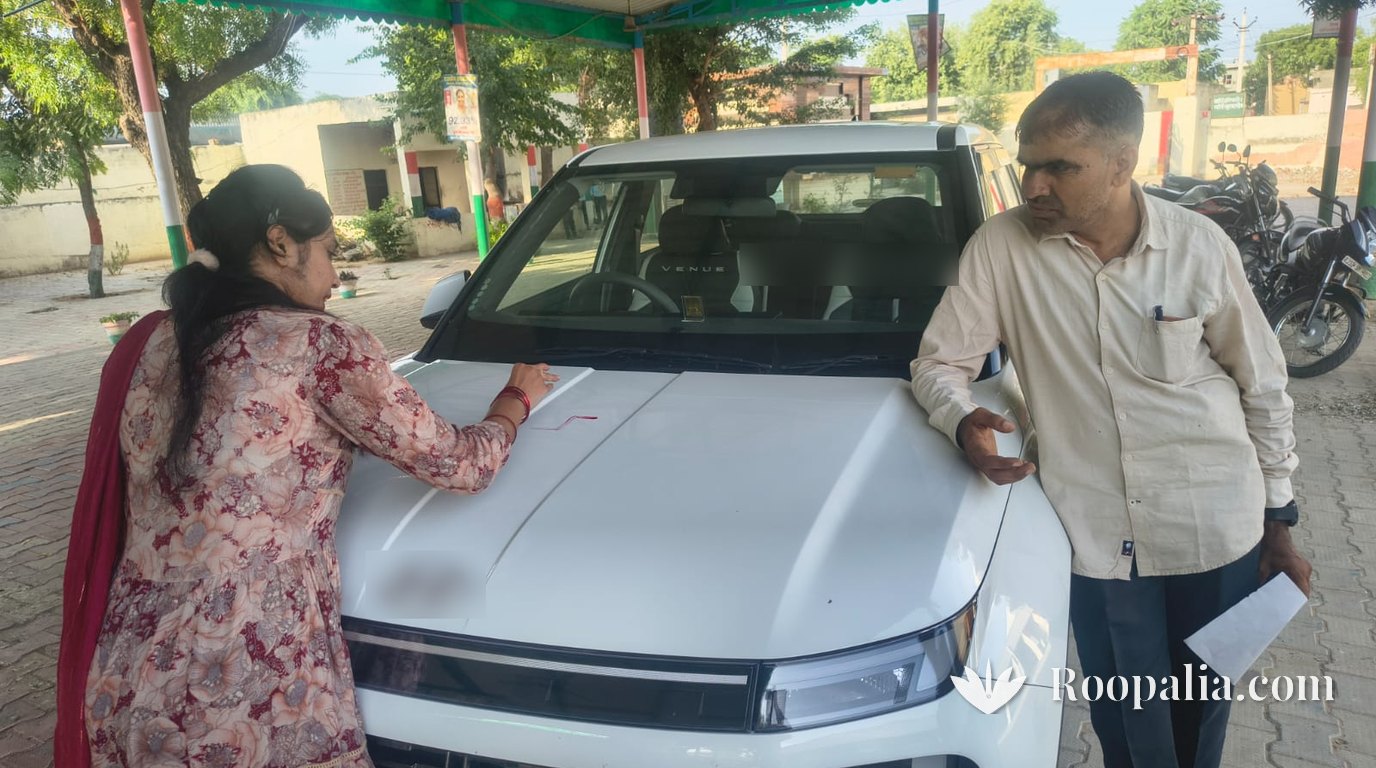
- Draw a swastika with roli on the bonnet using the ring finger, and a small one at the centre of the steering wheel. Put a few grains of akshat on it.
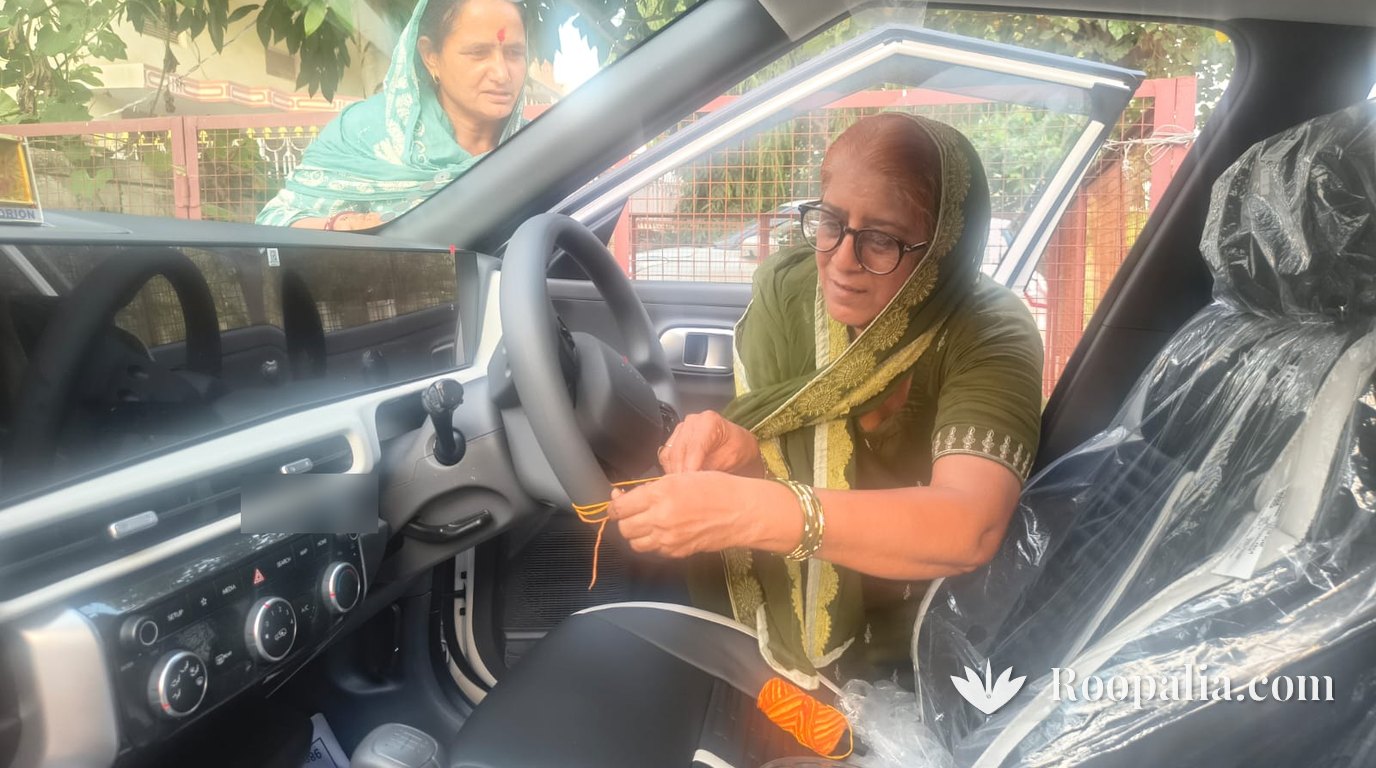
- Tie the mauli. In our families the daughter or sister of the house ties it on the steering wheel, and gets a gift (neg) in return: cash, or something she chooses.
- Garland the car, light the diya and incense, and do aarti in front of it.
- Offer the sweets and share them as prasad.
- Break the coconut on the ground a little away from the car, and sprinkle its water in front of the wheels. Some families place it before a front wheel and drive over it instead.
- Place a lemon under each front wheel and roll forward slowly so they are crushed.
- First drive: elders of the family ride first, and the car goes to the family deity's temple, or any temple nearby.
Car pooja mantra
There is no single fixed vahan puja mantra in the texts I consulted. In homes, these are the ones you will hear most:
- Om Shri Ganeshaya Namah, while drawing the swastika, as at the start of anything new.
- Om Shri Vishwakarmane Namah. Vishwakarma is regarded as the deity of tools, machines and vehicles; on Vishwakarma Puja, workshops and vehicles are worshipped for this reason.
- Om Namo Bhagavate Vasudevaya, during aarti, as a prayer for protection.
If you do not know any Sanskrit, the old line works in English too. Stand in front of the car, fold your hands and say: make me arrive safely, and bring everyone in you home safely.
Car pooja at home or at a temple?
Both are fine, and many families do both.
- At home: no priest is needed. The eldest woman of the house, or whoever does the family puja, can do every step above.
- At a temple: a report in Hinduism Today notes that temples in the US are ready for such blessings and that a new car is among the most popular (courtesy: Hinduism Today). Usually you book a slot, drive into the temple car park, and the priest does the puja there. Ask what to bring and what the fee is.
Doing car pooja outside India: the practical bits
In a driveway in the US, a shared car park in the UK, or a condo garage in Canada, a few things work differently:
- Coconut on concrete scatters shell pieces across the drive. Wrap it in an old cloth before striking it, or break it indoors and bring the water out. Pick up every piece.
- Lemons and petals: sweep up afterwards. On a shared driveway, that is what keeps neighbours happy.
- Diya and camphor: keep them on a plate on the ground, never inside the car. In a covered garage or apartment car park, check the building rules before lighting anything.
- Nothing hanging in front of the windscreen. In several places, objects that block the driver's view can bring a traffic fine. Tie the mauli small, on the centre of the steering, not on the rear-view mirror; the same goes for nimbu-mirchi. Check your own state or country's rule.
- Roli on new paint: use a light touch and wipe it off with a wet cloth the next day.
- No kalash or mango leaves? A steel lota and a flower to sprinkle with are enough. If your home has no mandir corner, see puja at home without a temple nearby.
The dealership is often part of it now. In India, the showroom hands over the key with a sweet or a coin and the family feeds the salesman some mithai. Outside India nobody expects it, but a box of sweets for the salesperson has never hurt anyone.
Car puja muhurat: when should you do it?
The simplest rule, and the one my elders followed: do the pooja on the day the car comes home, and leave the showroom in an auspicious choghadiya (one of the day's auspicious time slots) if you can. Days many families choose for taking delivery:
- Car pooja on Dussehra: on Vijayadashami, Ayudha Puja in South India includes cleaning and worshipping vehicles along with tools.
- Dhanteras, considered a day for buying new things.
- Navratri, Akshaya Tritiya, Gudi Padwa, and days with Pushya nakshatra.
Outside India, take the tithi and choghadiya from a panchang set to your own city, not to India. Sunrise sets the timings, so an Indian date can be a day off in North America. Why your festival date differs from India explains the reason.
Car pooja direction as per vastu
Families usually park the car facing east or north for the pooja, and start the first drive in one of those directions. I have seen this followed everywhere in our region, but I could not find a classical text that gives a direction for a vehicle, so treat it as family custom. If your driveway only allows one direction, do the pooja the way the car is parked.
Before cars: the camel, the horse and the rope on the forehead
I have watched this ceremony for 55 years, from the bicycle and motorcycle to today's car, and before that with camels, bullocks, cows and mares. What follows is from that experience, as the custom is practised in families of Rajasthan and Haryana.
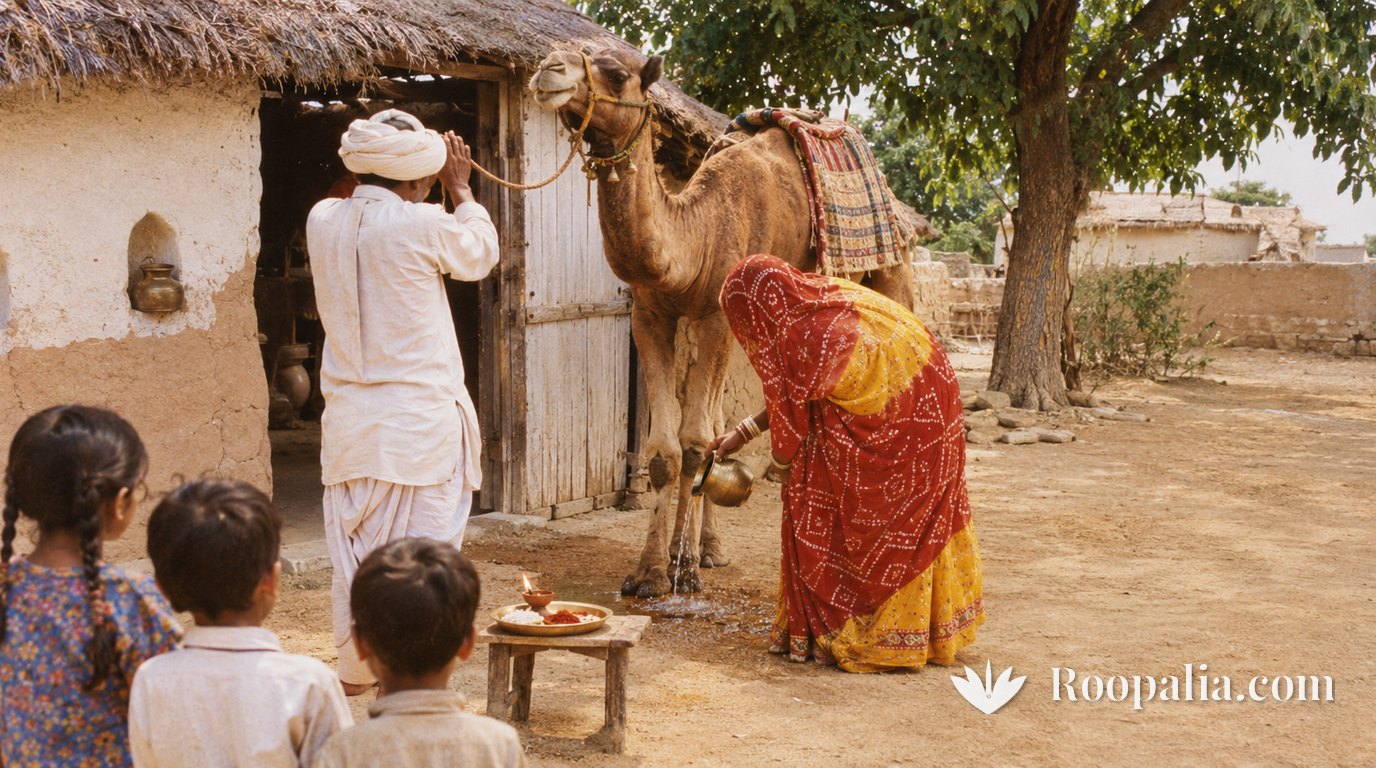
- The handover. Once the price was paid, the seller handed the animal's rope to the buyer, who first touched it to his forehead. Then the seller gave back a small part of the money as shagun, so the animal would do well in its new home. Villages had names for it: khoonta-chhudai (freeing from the old peg), rassi-chhudai, natha-chhudai, and the returned money was neg or pashu-badhai. The car key is the rope now, and the showroom sweet is the shagun.
- At the door. The eldest woman met the animal with a thali: a tilak of kumkum, haldi and rice, an aarti, and water poured on its feet. A mare was fed soaked chana dal with jaggery and ghee. A new peg was driven in for it, khoonta-ropai. Look at a car pooja and you will see the same tilak, now a swastika on the bonnet.
- The test ride. A new camel had its feet washed and got good fodder, and then the village's camel expert rode it: heels in for a full gallop, then an easy walk. He came back with a verdict: faster or slower than so-and-so's camel, calm or bad-tempered. We call it a test drive now.
One more thing every camel owner in our area knew: a camel remembers a beating. Some camels, struck with a stick, will wait for days and then try to lift that man by the neck and throw him down. I have seen it happen. Camel herders in other countries say the same, but I found no scientific study on it, so take it as what I have seen, not as a fact. It is why we were taught to be gentle with a new camel. A car does not hold grudges, but the habit of treating your vehicle with care is the same.
Elephants and kings: the older layer
The Agni Purana has a chapter on rites for the royal elephant (ch. 291, gaja-shanti). The elephant is worshipped with perfume and flowers, and the mantra tells it that the king must be protected by it "in the battle, on the way and in the house" (tr. N. Gangadharan, courtesy: wisdomlib.org). Replace "battle" with "highway" and that is still what a family asks of its new car. The Paraskara passage goes further and prays for the road itself, its crossroads, rivers and forests. A car pooja that ends with a prayer for the journey is closer to the old texts than one that ends with the lemon.
Why break a coconut, and why a lemon under the tyre?
- Coconut: broken at almost every auspicious beginning, from a new shop to a new house, as an offering and a sign of a good start.
- Lemon: it is believed to take the evil eye (nazar) on itself; crushing it with the first roll of the wheels sends the car off "clean". Nimbu-mirchi strings hang for the same reason.
You will read online that the lemon is linked to a planet, or that breaking the coconut means breaking the ego. I could not trace either to a text, so I am not repeating them as fact. And one thing worth saying plainly: a lemon is faith, a seat belt is safety. Do both.
So the new car is home, there is roli on the bonnet and mithai in everyone's hand. The real pooja happens every day after this: the seat belt, the speed you keep, the care you take on the road. Our elders touched a camel's rope to the forehead for the same reason you tie a thread on the steering wheel. Make me arrive safely.
Frequently asked questions
How do you do a car pooja at home?
What are the car pooja essentials (samagri)?
Is car pooja mentioned in Hindu scriptures?
Which is the best day for car pooja, and can I do it on Dussehra?
Why do Indians put lemons under the tyres of a new car?
Sources: Paraskara Grihya Sutra 3.15 and Hiranyakeshin Grihya Sutra 1.4.12, tr. Hermann Oldenberg (courtesy: wisdomlib.org); Agni Purana ch. 291, tr. N. Gangadharan (courtesy: wisdomlib.org); car blessings at US temples: Hinduism Today; village customs for camels, bullocks, mares and vehicles: the author's own experience of tradition as practised in families of Rajasthan and Haryana. Photos credited 'Photo: Dhanpat Singh' are real photographs; the other images are AI-generated illustrations to explain the topic.